IB DP Business Management
Resources Library
399 resources in 11 categories: notes, revision, maps, diagrams, guides, practice, cases and teaching material, from the IB course and beyond it.
- Resources
- 399
- Files to download
- 1644 PDF, 2 CSV, 158 SVG
- Not yet available
- Lesson presentations
Nothing matches.
Clear a filter, or try a shorter word.
Topic notes 37
Full notes for each subtopic, from what the guide asks to evaluation and exam practice, and the three topic briefs. Every one is a page that prints.
-
1.1 Full notes
What is a business?
Every organization you deal with, from a street food stall to a hospital to a global software firm, does the same basic thing: it brings resources together and turns them into goods or services that people want.
Contains 8
- What a business is
- Inputs, the transformation process and outputs
- Adding value
- The four sectors of economic activity
and 4 more
-
1.2 Full notes
Types of business entities
Before a business can trade, its founders must decide who will own it, who will carry the risk if it fails and what it is for.
Contains 8
- The private and public sectors
- Sole traders
- Partnerships
- Companies and privately held companies
and 4 more
-
1.3 Full notes
Business objectives
A vision says where an organization hopes to be, a mission says what it is for, and objectives turn both into targets that people can plan for and be judged against.
Contains 8
- Vision and mission statements
- Common business objectives
- Why objectives differ and change
- SWOT analysis: where the business stands
and 4 more
-
1.4 Full notes
Stakeholders
Every decision a business takes lands on people: the staff who carry it out, the customers who pay for it, the neighbours who live next to it.
Contains 9
- What a stakeholder is
- Internal and external stakeholders
- Stakeholders in different kinds of organization
- How stakeholders push back
and 5 more
-
1.5 Topic brief
Growth and evolution
Why businesses grow, why some choose not to, and how the route to growth changes the business, from economies and diseconomies of scale to five external growth methods.
Contains 8
- The situation
- Why grow, and why stay small
- Economies and diseconomies of scale
- Internal and external growth
and 4 more
-
1.6 Full notes
Multinational companies (MNCs)
Some of the largest organizations in the world operate in dozens of countries at once.
Contains 7
- What makes a company multinational
- Why companies invest abroad, and why the motive matters
- Benefits for the host country
- Costs and risks for the host country
and 3 more
-
2.1 Full notes
Introduction to human resource management
Every plan a business makes, to grow, to automate, to open a new site or to cut costs, depends in the end on people: enough of them, with the right skills, in the right place, willing to work in new ways.
Contains 8
- The role of human resource management
- Human resource planning: matching people to plans
- Internal factors in human resource planning
- External factors in human resource planning
and 4 more
-
2.2 Full notes
Organizational structure
Once a business grows beyond a handful of people, someone has to decide who does which job, who reports to whom and who is allowed to decide what.
Contains 7
- The hierarchy and the organization chart
- Centralization, decentralization and bureaucracy
- Tall and flat structures, and delayering
- Organizing by function, product or region
and 3 more
-
2.3 Topic brief
Leadership and management
What managers do, how leadership differs from management, and how to choose a leadership style that fits the people, the task and the moment.
Contains 11
- The situation
- What managers do
- Management and leadership
- Leadership styles
and 7 more
-
2.4 Full notes
Motivation and demotivation
A business can buy machines and buildings, but it cannot buy effort.
Contains 12
- Motivation and demotivation
- Taylor: scientific management
- Maslow: the hierarchy of needs
- Herzberg: motivation-hygiene theory
and 8 more
-
2.5 Full notes
Organizational (corporate) culture
Two businesses can have the same organization chart, the same pay scales and the same products and still feel completely different to work in.
Contains 7
- What organizational culture is (HL)
- Where culture comes from, and why it matters (HL)
- Handy's Gods of management (HL)
- Which culture fits? (HL)
and 3 more
-
2.6 Full notes
Communication
Every plan, instruction, warning and idea in an organization travels as a message, and every message can arrive late, garbled or not at all.
Contains 9
- Communication and the communication process
- Formal communication
- Informal communication and the grapevine
- Methods of communication: oral, written, visual and digital
and 5 more
-
2.7 Full notes
Industrial/employee relations
Every organization depends on its people, and their interests and their employer's overlap without being the same.
Contains 9
- Employee relations and the parties involved (HL)
- Three ways of seeing conflict at work (HL)
- Sources of conflict in the workplace (HL)
- Approaches to conflict by employees (HL)
and 5 more
-
3.1 Full notes
Introduction to finance
Every business has to spend money before it can earn any.
Contains 8
- The role of finance
- Capital expenditure
- Revenue expenditure
- Telling capital and revenue expenditure apart
and 4 more
-
3.2 Full notes
Sources of finance
Every business needs money that it does not yet have: to start up, to buy equipment, to carry stock, to survive a slow month or to grow.
Contains 7
- Why businesses need finance, and how sources are classified
- Internal sources of finance
- Long-term external sources: share capital and loan capital
- Short-term external sources: overdrafts and trade credit
and 3 more
-
3.3 Topic brief
Costs and revenues
What a business's costs are, how they behave as output changes, where its revenue comes from, and how contribution connects them to break-even, profit and the orders worth accepting.
Contains 11
- The situation
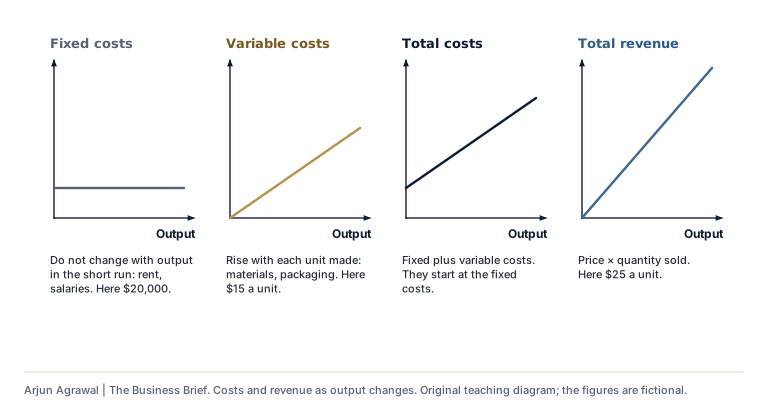
- Types of costs
- Revenue and revenue streams
- Total cost, total revenue and profit
and 7 more
-
3.4 Full notes
Final accounts
Every business keeps a record of what it sells and spends, and of what it owns and owes.
Contains 7
- Who reads the accounts, and why
- The statement of profit or loss
- The statement of financial position
- Preparing the accounts from a list of figures
and 3 more
-
3.5 Full notes
Profitability and liquidity ratio analysis
A statement of profit or loss tells you that a business made $105,000 of profit before interest and tax.
Contains 6
- What ratio analysis is for
- Profitability ratios
- Liquidity ratios
- Calculating and commenting: a worked example
and 2 more
-
3.6 Full notes
Efficiency ratio analysis
Two businesses can make the same profit and be in very different health.
Contains 7
- What efficiency ratios show (HL)
- Stock turnover (HL)
- Debtor days and creditor days (HL)
- The gearing ratio (HL)
and 3 more
-
3.7 Full notes
Cash flow
Cash is what a business pays its bills with.
Contains 7
- Profit and cash flow are different
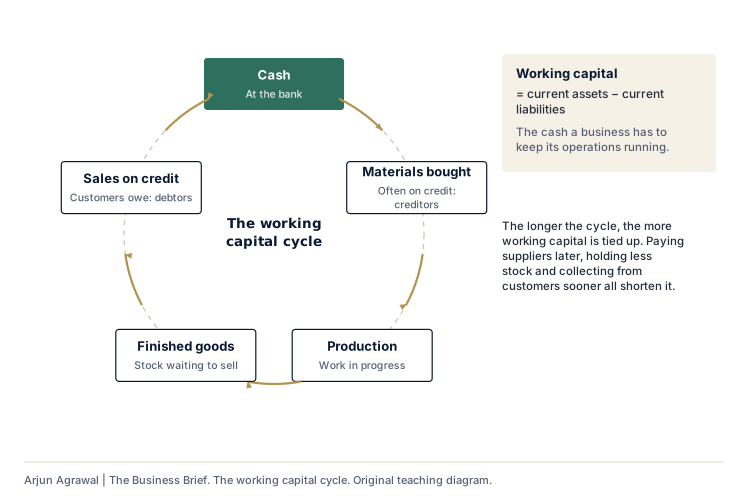
- Working capital
- Liquidity position
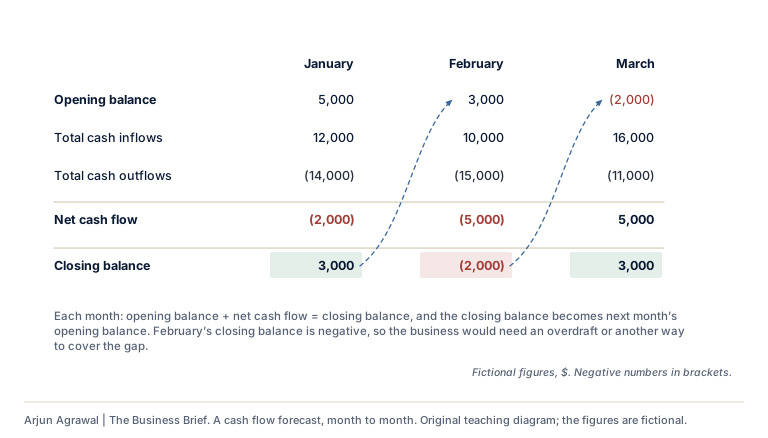
- Cash flow forecasts
and 3 more
-
3.8 Full notes
Investment appraisal
Buying a machine, opening a branch or launching a website means spending a large sum now in the hope of returns spread over several years.
Contains 6
- What investment appraisal does
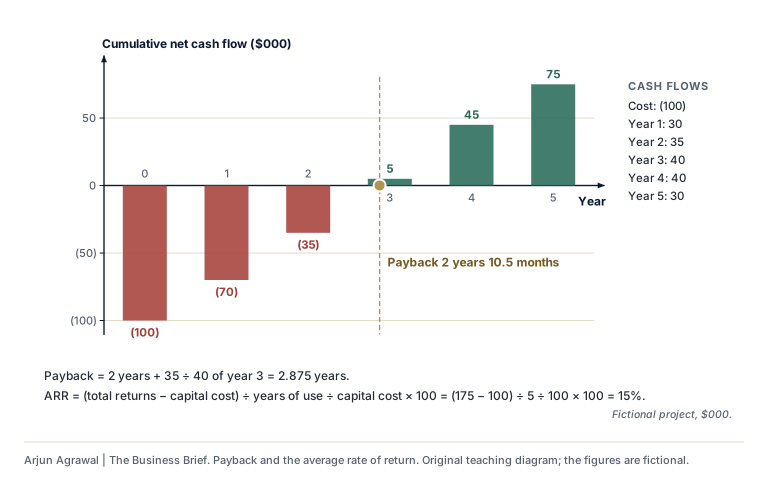
- The payback period
- The average rate of return (ARR)
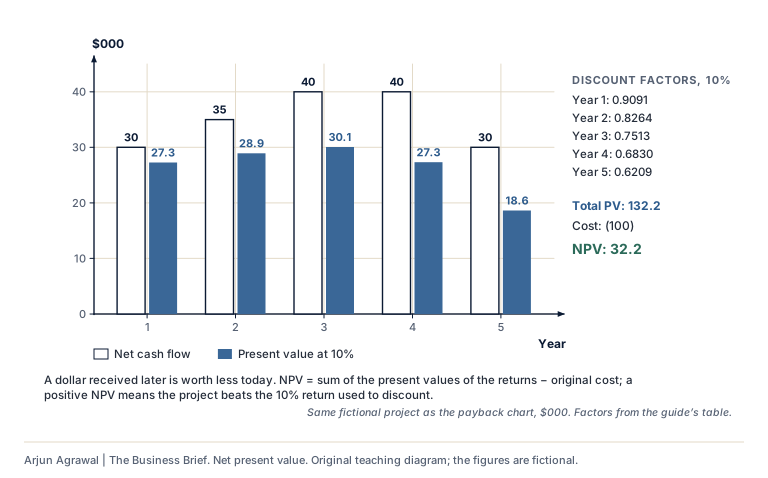
- Net present value (NPV) (HL)
and 2 more
-
3.9 Full notes
Budgets
Every organization has to decide in advance what it expects to earn, what it can afford to spend and who is responsible for each part of the money.
Contains 7
- What a budget is, and why organizations use one (HL)
- Cost centres and profit centres (HL)
- The roles of cost and profit centres (HL)
- Constructing a budget (HL)
and 3 more
-
4.1 Full notes
Introduction to marketing
A business can make an excellent product and still fail, because too few people want it at the price, or because a rival reaches them first.
Contains 6
- What marketing is, and what a market is
- Market orientation and product orientation
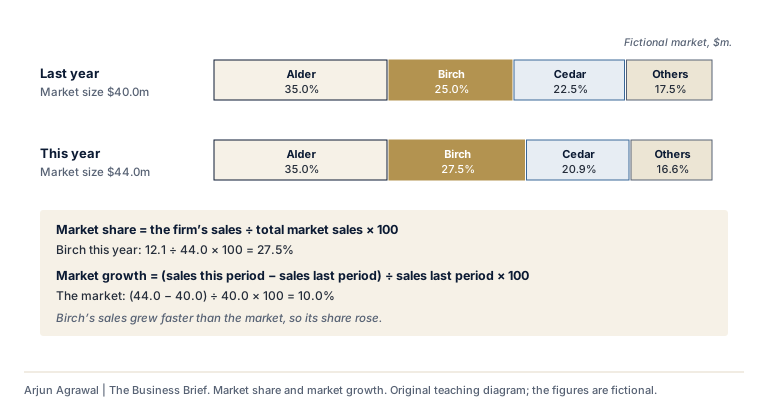
- Market share
- Market growth
and 2 more
-
4.2 Full notes
Marketing planning
No business can sell to everyone, and none can afford to try.
Contains 6
- The role of marketing planning
- Segmentation
- Targeting: niche markets and mass markets
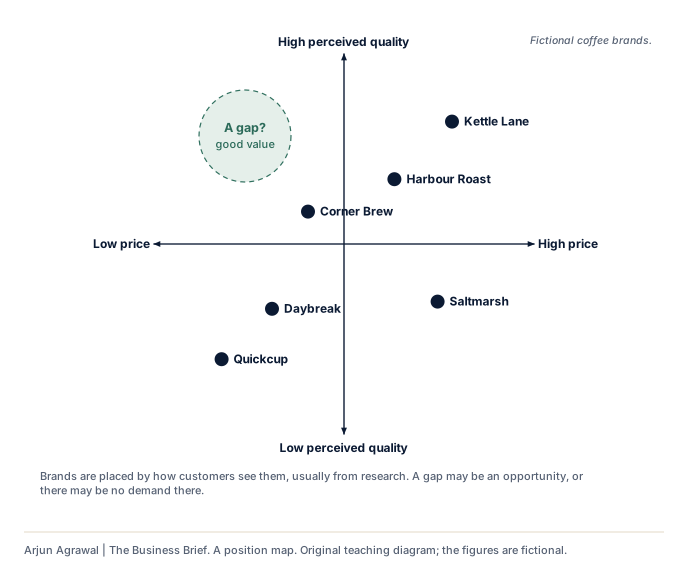
- Positioning and position maps
and 2 more
-
4.3 Full notes
Sales forecasting
Almost every plan a business makes begins with a guess at how much it will sell.
Contains 8
- What a sales forecast is, and who uses it (HL)
- Reading past sales (HL)
- Simple linear regression: scatter diagrams, lines of best fit and correlation (HL)
- Forecasting by judgement (HL)
and 4 more
-
4.4 Full notes
Market research
Every marketing decision is a bet on how customers will behave, and market research is how a business improves its odds.
Contains 7
- Why organizations carry out market research
- How organizations carry out market research
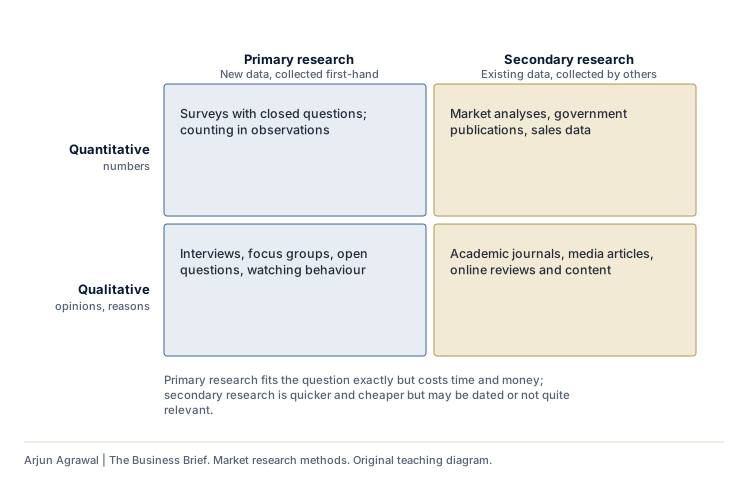
- Primary research: surveys, interviews, focus groups and observations
- Secondary research: market analyses, journals, government data, media and online content
and 3 more
-
4.5 Full notes
The seven Ps of the marketing mix
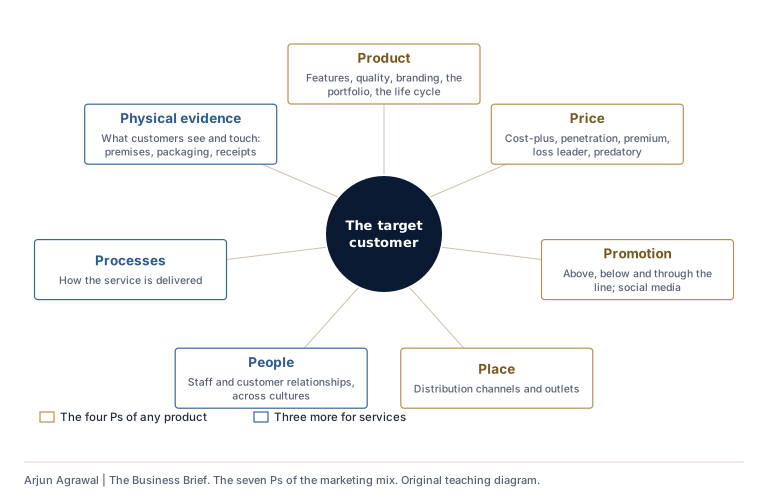
The marketing mix is the set of decisions a business makes to bring a product to its target customers: what it sells, at what price, how it tells people about it and where they can buy it.
Contains 11
- Product: the product life cycle
- Product: extension strategies
- Product: the product portfolio
- Product: branding
and 7 more
-
4.6 Full notes
International marketing
For a business whose home market has stopped growing, the rest of the world looks like an obvious answer: more customers, more sales, and more chances to spread its costs and risks.
Contains 8
- What international marketing involves (HL)
- Ways of entering an international market (HL)
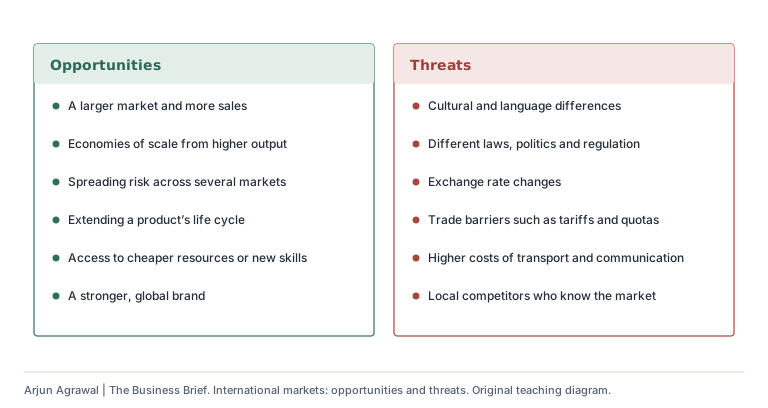
- The opportunities of entering and operating internationally (HL)
- The threats of entering and operating internationally (HL)
and 4 more
-
5.1 Full notes
Introduction to operations management
Every business makes something, whether it is a car, a haircut, a loan or a loaf of bread, and operations management is the function that makes it happen.
Contains 8
- What operations management is
- Operations for goods and for services
- What operations aims for
- Measuring how well operations performs
and 4 more
-
5.2 Full notes
Operations methods
How a business makes its products decides much of what it can offer customers: how much choice, at what price, and how quickly.
Contains 8
- Choosing how to produce: volume and variety
- Job production
- Batch production
- Mass or flow production
and 4 more
-
5.3 Full notes
Lean production and quality management
Two businesses can buy the same machines, hire people with the same skills and pay the same for materials, yet one delivers faster, wastes less and makes fewer faulty products.
Contains 8
- Lean production: less waste, greater efficiency (HL)
- Kaizen: continuous improvement (HL)
- Just-in-time production (HL)
- Cradle to cradle design and manufacturing (HL)
and 4 more
-
5.4 Full notes
Location
Where a business makes its products shapes its costs, its speed, its quality and its reputation, and the choice is hard to undo once a factory is built or a supplier contract signed.
Contains 9
- Why location matters
- Reasons for a specific location
- How the type of business shapes its location
- Comparing locations: costs and weighted scoring
and 5 more
-
5.5 Full notes
Break-even analysis
Every business needs to know how much it must sell before it stops losing money.
Contains 6
- Contribution per unit and total contribution
- The break-even chart
- The margin of safety
- Target profit, target profit output and target price
and 2 more
-
5.6 Full notes
Production planning
A business that makes things has to get the right materials to the right place at the right time, use its capacity well, keep faults to a minimum and decide what to make itself and what to buy in.
Contains 7
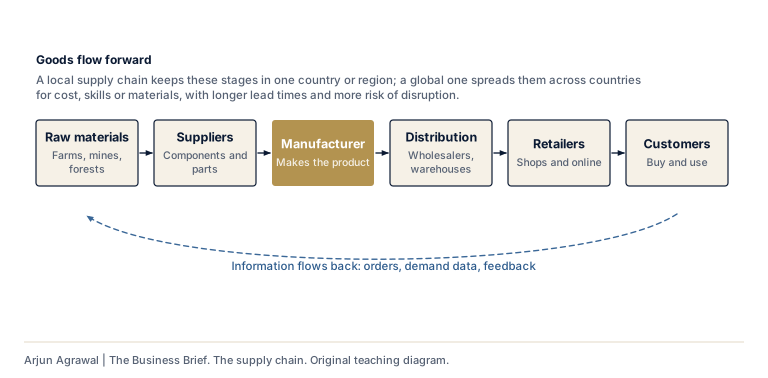
- The local and global supply chain (HL)
- Just-in-time versus just-in-case (HL)
- Stock control charts (HL)
- Capacity utilization (HL)
and 3 more
-
5.7 Full notes
Crisis management and contingency planning
Sooner or later every business meets an event it did not want: a faulty product, a fire, a cyberattack, a supplier that collapses overnight.
Contains 7
- What makes an event a crisis (HL)
- Contingency planning and crisis management (HL)
- How a contingency plan is made (HL)
- Effective crisis management: transparency, communication, speed and control (HL)
and 3 more
-
5.8 Full notes
Research and development
Every product a business sells today will one day be overtaken, by a rival, a new technology or a change in what customers want.
Contains 7
- What research and development is (HL)
- Why research and development matters (HL)
- Judging an R&D project with investment appraisal (HL)
- Products for customers' unmet needs (HL)
and 3 more
-
5.9 Full notes
Management information systems
Every sale, delivery, click and shift now leaves a trail of data.
Contains 9
- Management information systems, databases and data analytics (HL)
- Cybersecurity and cybercrime (HL)
- Critical infrastructures: data centres, cloud computing and artificial neural networks (HL)
- Artificial intelligence and big data (HL)
and 5 more
Showing 6 of 37
Revision briefs 40
A revision sheet to print for every subtopic, flashcards to revise by recall, and the glossary as a page and as a spreadsheet.
-
1.1 Revision sheet
What is a business?
The revision sheet for 1.1 What is a business?, made to be printed.
-
1.2 Revision sheet
Types of business entities
The revision sheet for 1.2 Types of business entities, made to be printed.
-
1.3 Revision sheet
Business objectives
The revision sheet for 1.3 Business objectives, made to be printed.
-
1.5 Revision sheet
Growth and evolution
The revision sheet for 1.5 Growth and evolution, made to be printed.
-
1.6 Revision sheet
Multinational companies (MNCs)
The revision sheet for 1.6 Multinational companies (MNCs), made to be printed.
-
2.1 Revision sheet
Introduction to human resource management
The revision sheet for 2.1 Introduction to human resource management, made to be printed.
-
2.2 Revision sheet
Organizational structure
The revision sheet for 2.2 Organizational structure, made to be printed.
-
2.3 Revision sheet
Leadership and management
The revision sheet for 2.3 Leadership and management, made to be printed.
-
2.4 Revision sheet
Motivation and demotivation
The revision sheet for 2.4 Motivation and demotivation, made to be printed.
-
2.5 Revision sheet
Organizational (corporate) culture
The revision sheet for 2.5 Organizational (corporate) culture, made to be printed.
-
2.7 Revision sheet
Industrial/employee relations
The revision sheet for 2.7 Industrial/employee relations, made to be printed.
-
3.1 Revision sheet
Introduction to finance
The revision sheet for 3.1 Introduction to finance, made to be printed.
-
3.2 Revision sheet
Sources of finance
The revision sheet for 3.2 Sources of finance, made to be printed.
-
3.3 Revision sheet
Costs and revenues
The revision sheet for 3.3 Costs and revenues, made to be printed.
-
3.5 Revision sheet
Profitability and liquidity ratio analysis
The revision sheet for 3.5 Profitability and liquidity ratio analysis, made to be printed.
-
3.6 Revision sheet
Efficiency ratio analysis
The revision sheet for 3.6 Efficiency ratio analysis, made to be printed.
-
3.8 Revision sheet
Investment appraisal
The revision sheet for 3.8 Investment appraisal, made to be printed.
-
4.1 Revision sheet
Introduction to marketing
The revision sheet for 4.1 Introduction to marketing, made to be printed.
-
4.2 Revision sheet
Marketing planning
The revision sheet for 4.2 Marketing planning, made to be printed.
-
4.3 Revision sheet
Sales forecasting
The revision sheet for 4.3 Sales forecasting, made to be printed.
-
4.5 Revision sheet
The seven Ps of the marketing mix
The revision sheet for 4.5 The seven Ps of the marketing mix, made to be printed.
-
4.6 Revision sheet
International marketing
The revision sheet for 4.6 International marketing, made to be printed.
-
5.1 Revision sheet
Introduction to operations management
The revision sheet for 5.1 Introduction to operations management, made to be printed.
-
5.2 Revision sheet
Operations methods
The revision sheet for 5.2 Operations methods, made to be printed.
-
5.3 Revision sheet
Lean production and quality management
The revision sheet for 5.3 Lean production and quality management, made to be printed.
-
5.5 Revision sheet
Break-even analysis
The revision sheet for 5.5 Break-even analysis, made to be printed.
-
5.6 Revision sheet
Production planning
The revision sheet for 5.6 Production planning, made to be printed.
-
5.7 Revision sheet
Crisis management and contingency planning
The revision sheet for 5.7 Crisis management and contingency planning, made to be printed.
-
5.8 Revision sheet
Research and development
The revision sheet for 5.8 Research and development, made to be printed.
-
5.9 Revision sheet
Management information systems
The revision sheet for 5.9 Management information systems, made to be printed.
-
Business terminology
The glossary
Every term of the course with its definition, a plain explanation and one in more depth, an example, the misconceptions to avoid and the related terms, with a page for each term.
-
Business terminology
The glossary as a spreadsheet
Every glossary term with its definition, subtopics, level, kind and formula, as a CSV file for a spreadsheet, a flashcard app or a class list.
Showing 6 of 40
Mindmaps 42
A map of every subtopic and of each unit. Open one to fold its branches or switch to the revision view, or take it as an SVG file.
-
Unit map
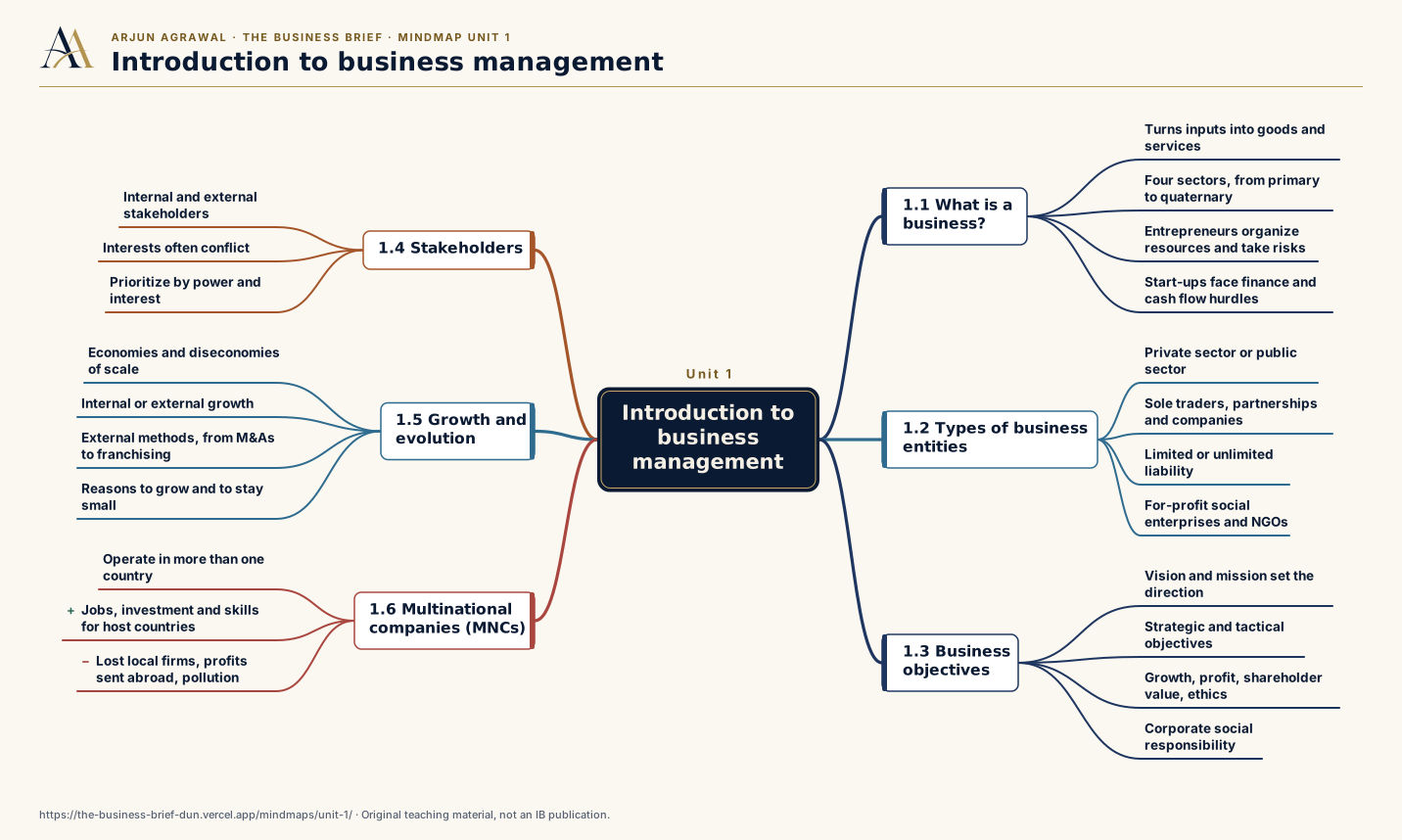
Unit 1: Introduction to business management
The whole of unit 1 on one map, from what a business is and the forms it takes to its objectives, its stakeholders, how and why it grows, and the impact of multinationals.
Download SVG, 17 KB : Unit 1: Introduction to business management
-
1.1 Subtopic map
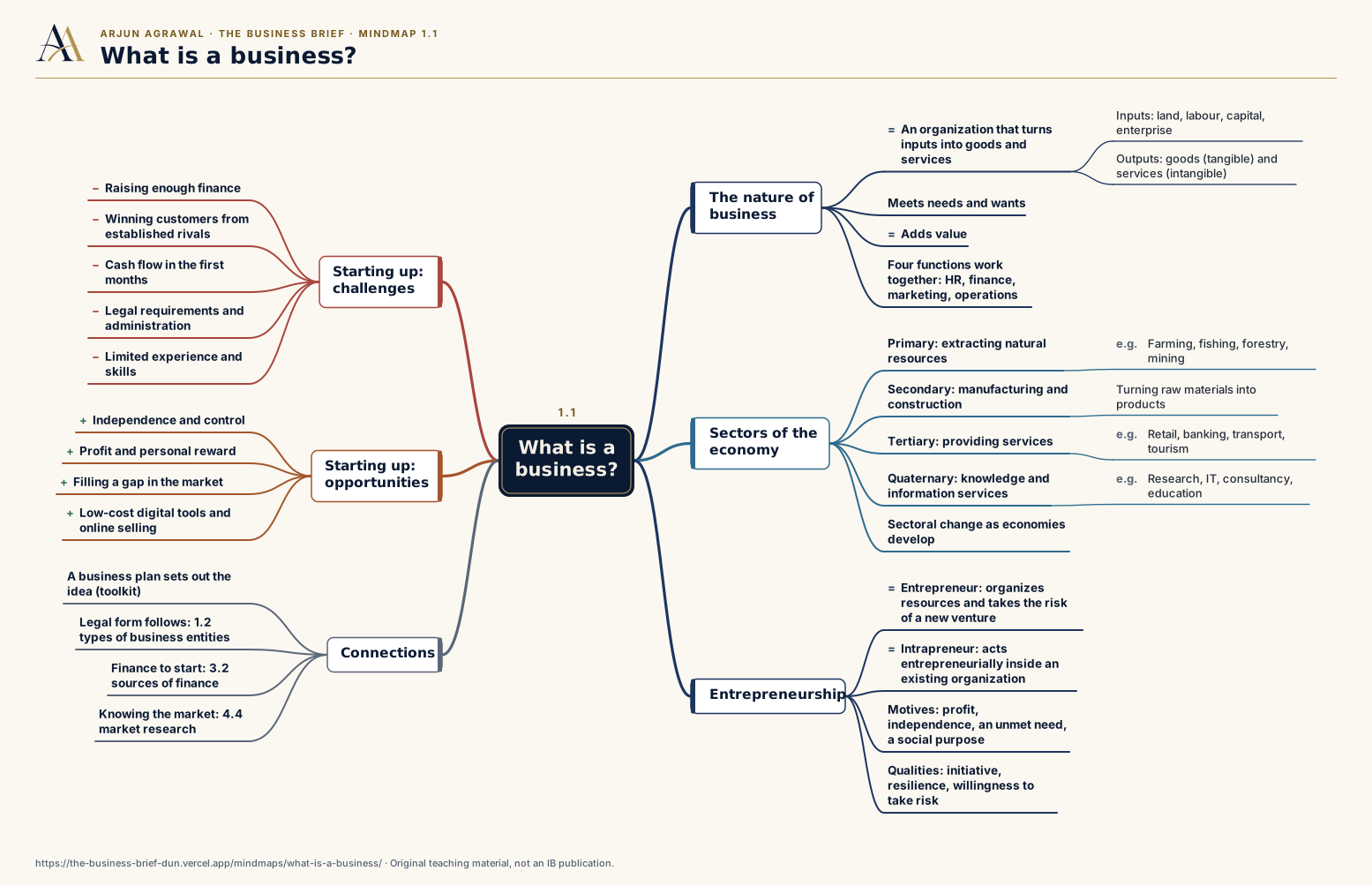
What is a business?
What a business is and does, the four sectors it can work in, the entrepreneur who starts it, and what helps or hinders a start-up.
-
1.2 Subtopic map
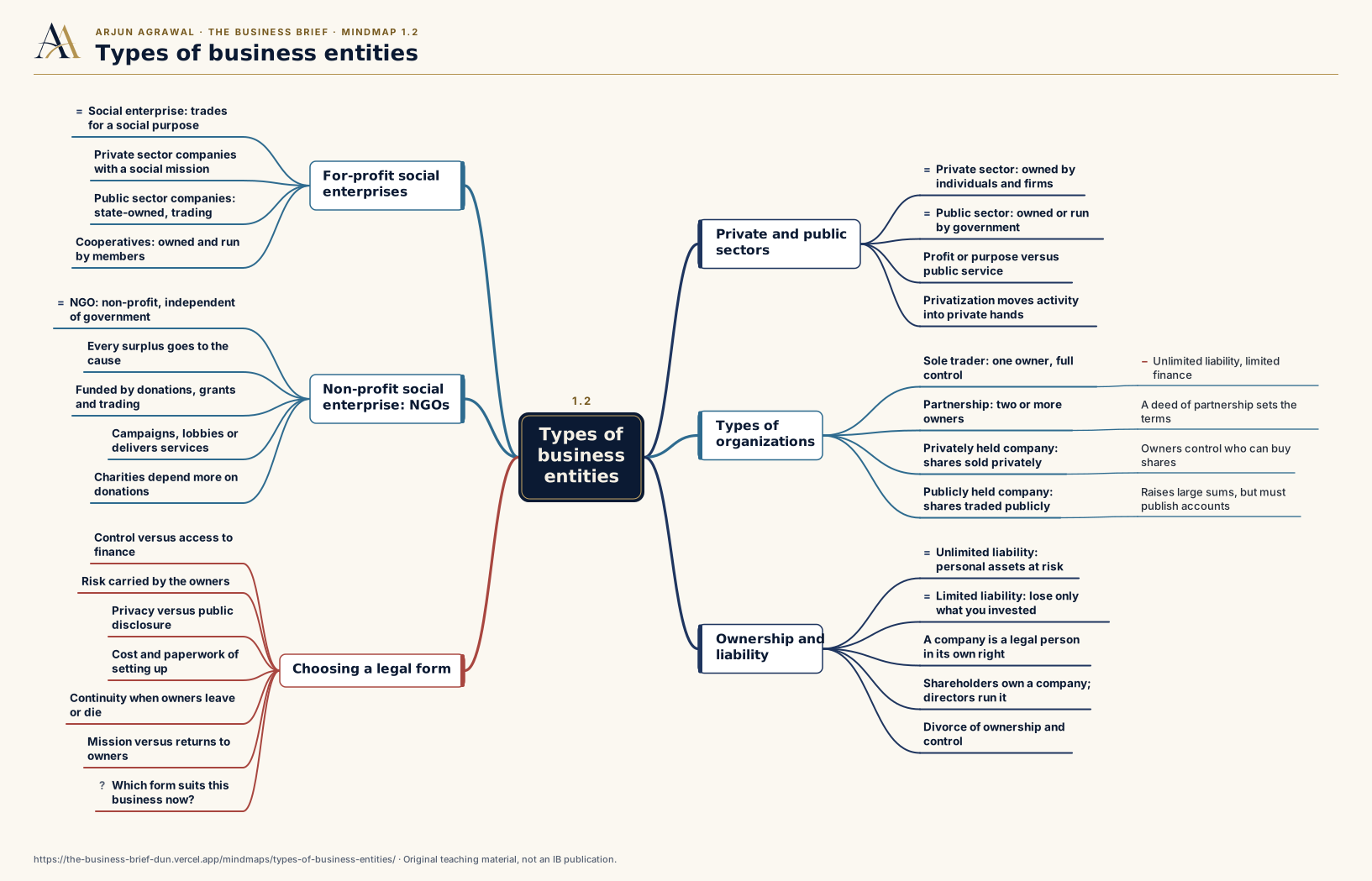
Types of business entities
How organizations differ in who owns them, who carries the risk and what they are for, from sole traders to publicly held companies, and from for-profit social enterprises to NGOs.
-
1.3 Subtopic map
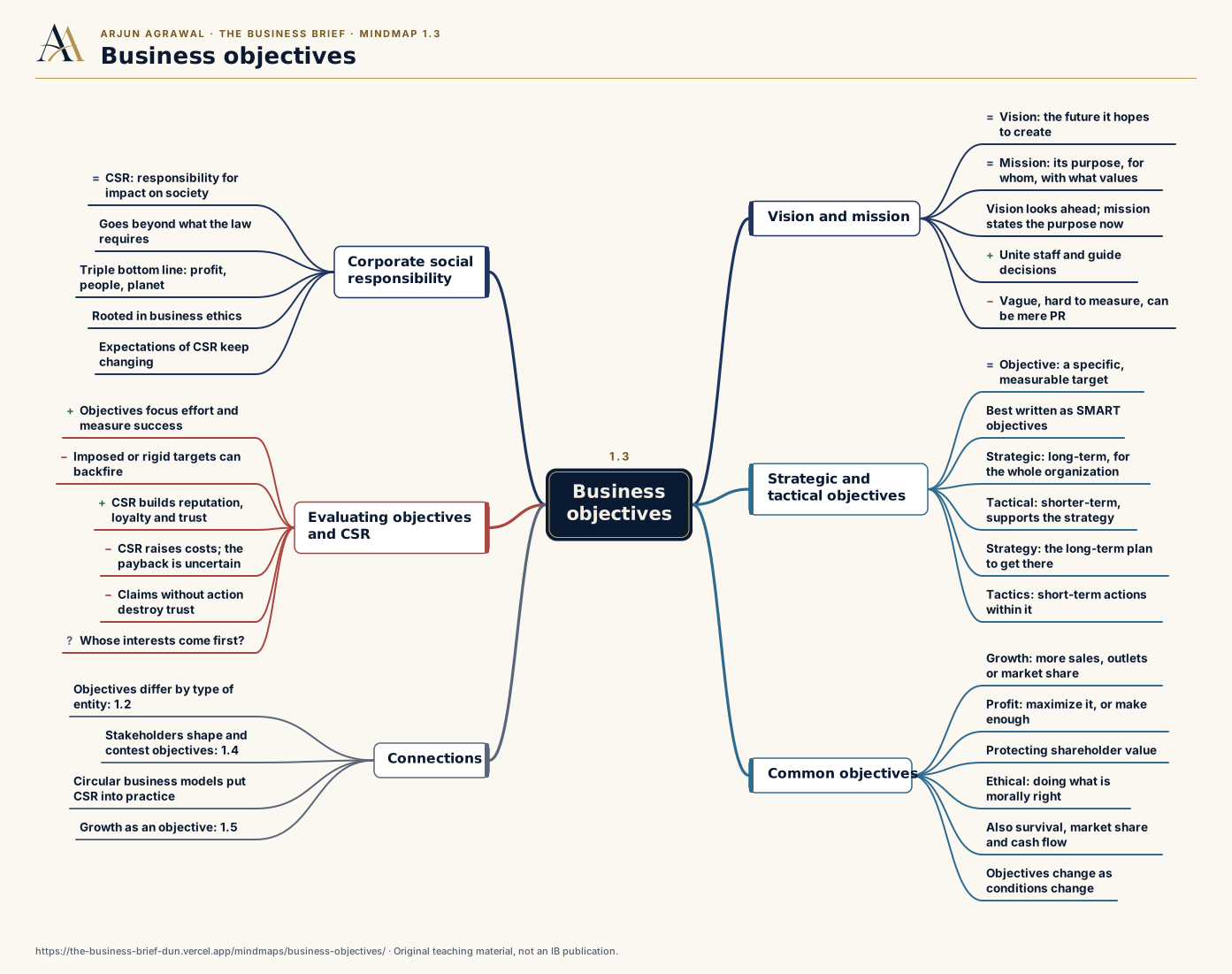
Business objectives
How a vision and a mission become strategic and tactical objectives, the objectives businesses commonly set, and what corporate social responsibility asks of them.
-
1.4 Subtopic map
Stakeholders
Who has a stake in a business, inside and outside it, why their interests clash, and how managers decide whose needs to put first.
-
1.5 Subtopic map
Growth and evolution
Why average costs fall and then rise as a business grows, the difference between internal and external growth, the external growth methods, and the reasons to grow or to stay small.
-
1.6 Subtopic map
Multinational companies (MNCs)
What makes a business multinational, why businesses expand abroad, and how to weigh the benefits and costs of MNCs for the host countries they operate in.
-
Unit map
Unit 2: Human resource management
Unit 2 at a glance, seven subtopics on the people side of business, from planning and structuring the workforce to leading and motivating it, its culture, its communication and its relations with management.
-
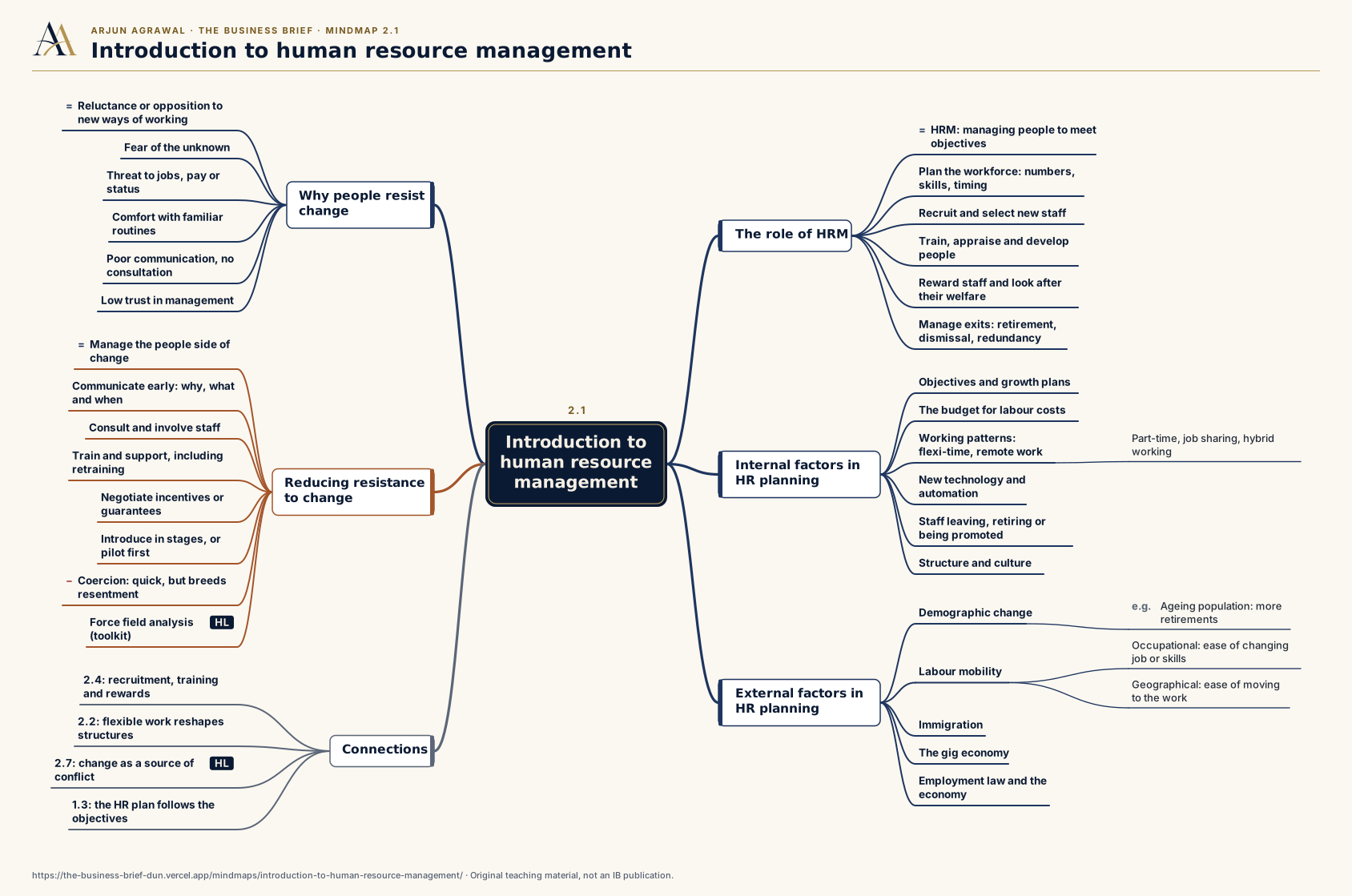
2.1 Subtopic map
Introduction to human resource management
What human resource management does, the internal and external factors that shape workforce planning, why people resist change at work and how HR strategies can reduce that resistance.
Download SVG, 24 KB : 2.1 Introduction to human resource management
-
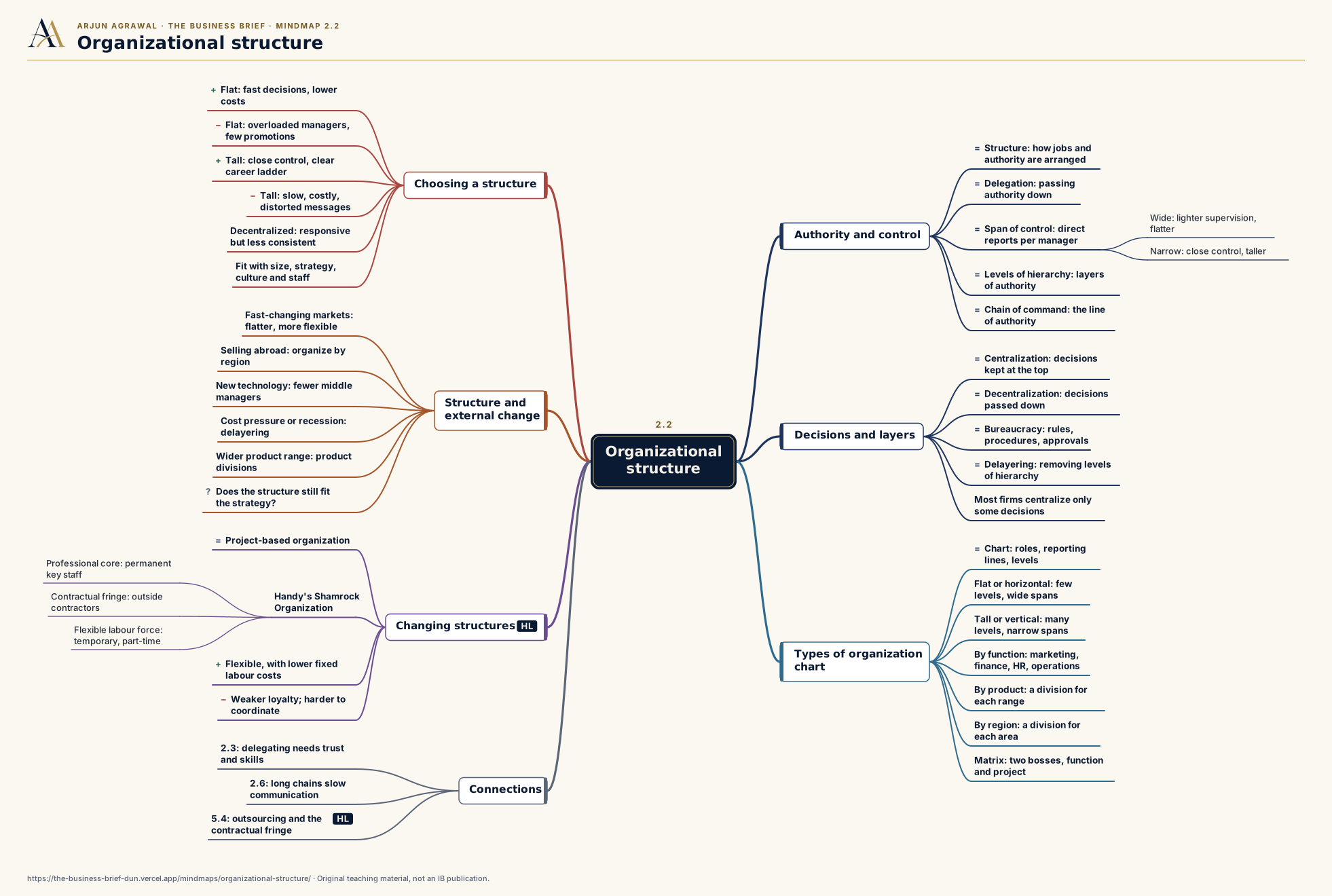
2.2 Subtopic map
Organizational structure
How organizations arrange authority, decisions and communication, the main types of organization chart, how to choose a structure when external factors change and, at HL, flexible forms such as project-based organization and Handy's Shamrock Organization.
-
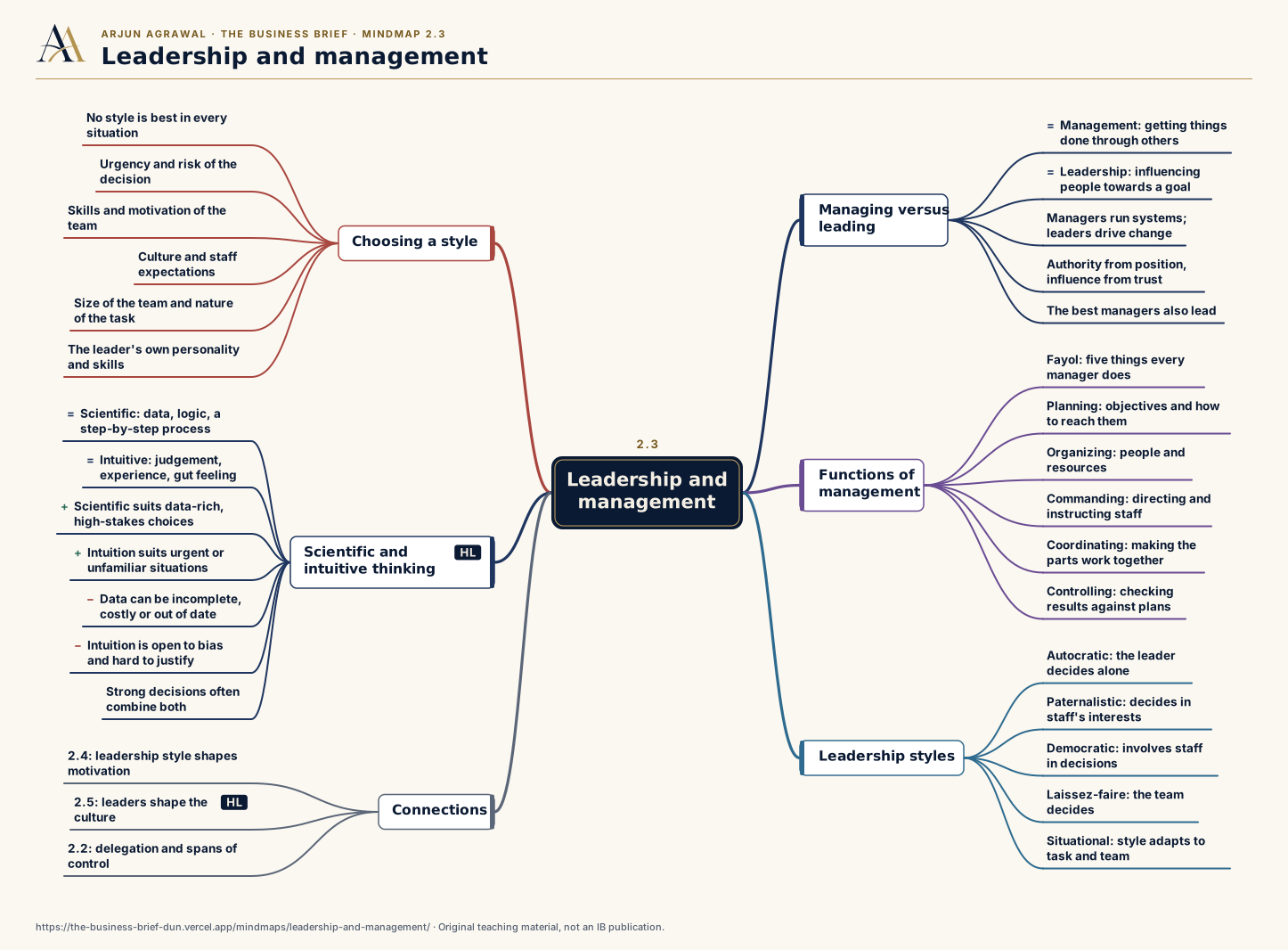
2.3 Subtopic map
Leadership and management
What managers do, how leadership differs from management, the five leadership styles and when each fits and, at HL, scientific and intuitive approaches to thinking and decision-making.
-
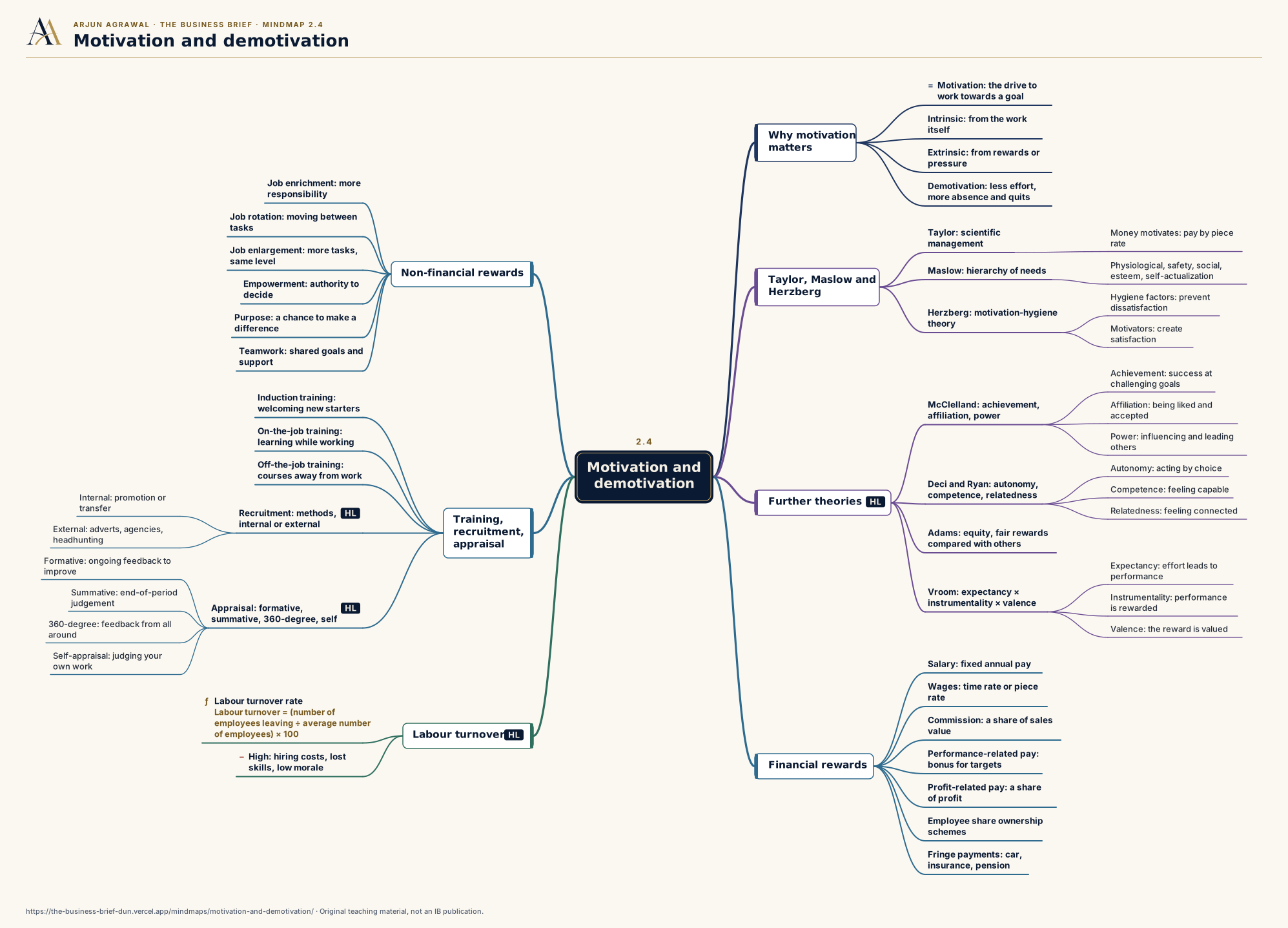
2.4 Subtopic map
Motivation and demotivation
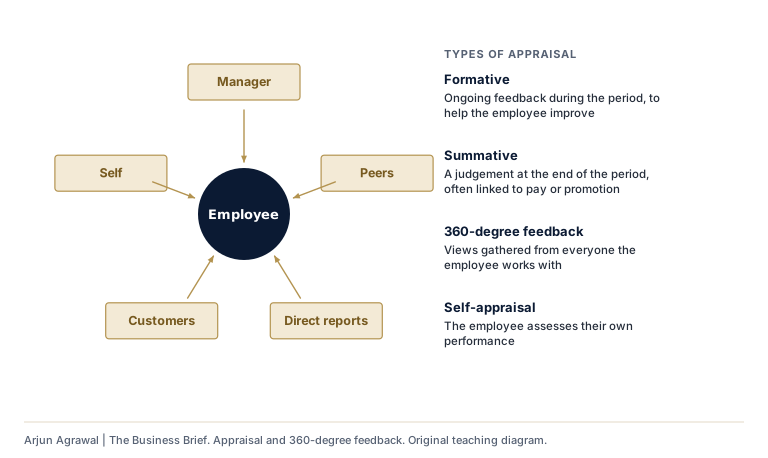
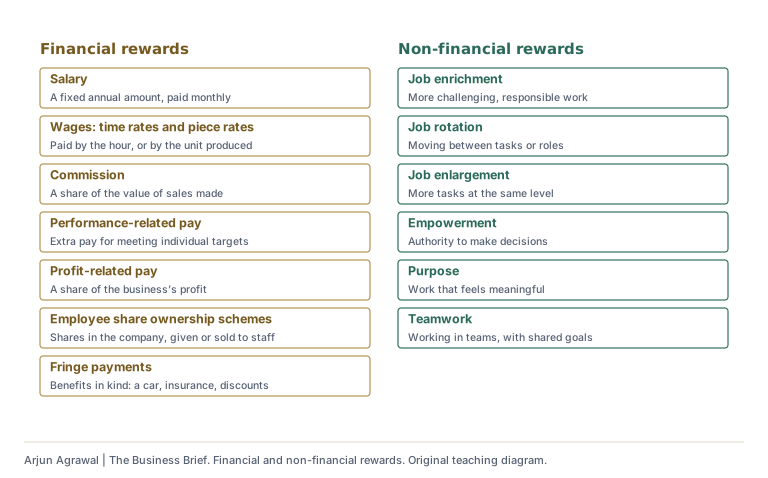
Why people work hard or stop trying, the motivation theories of Taylor, Maslow and Herzberg, financial and non-financial rewards and the types of training and, at HL, four further theories, labour turnover, appraisal and recruitment.
-
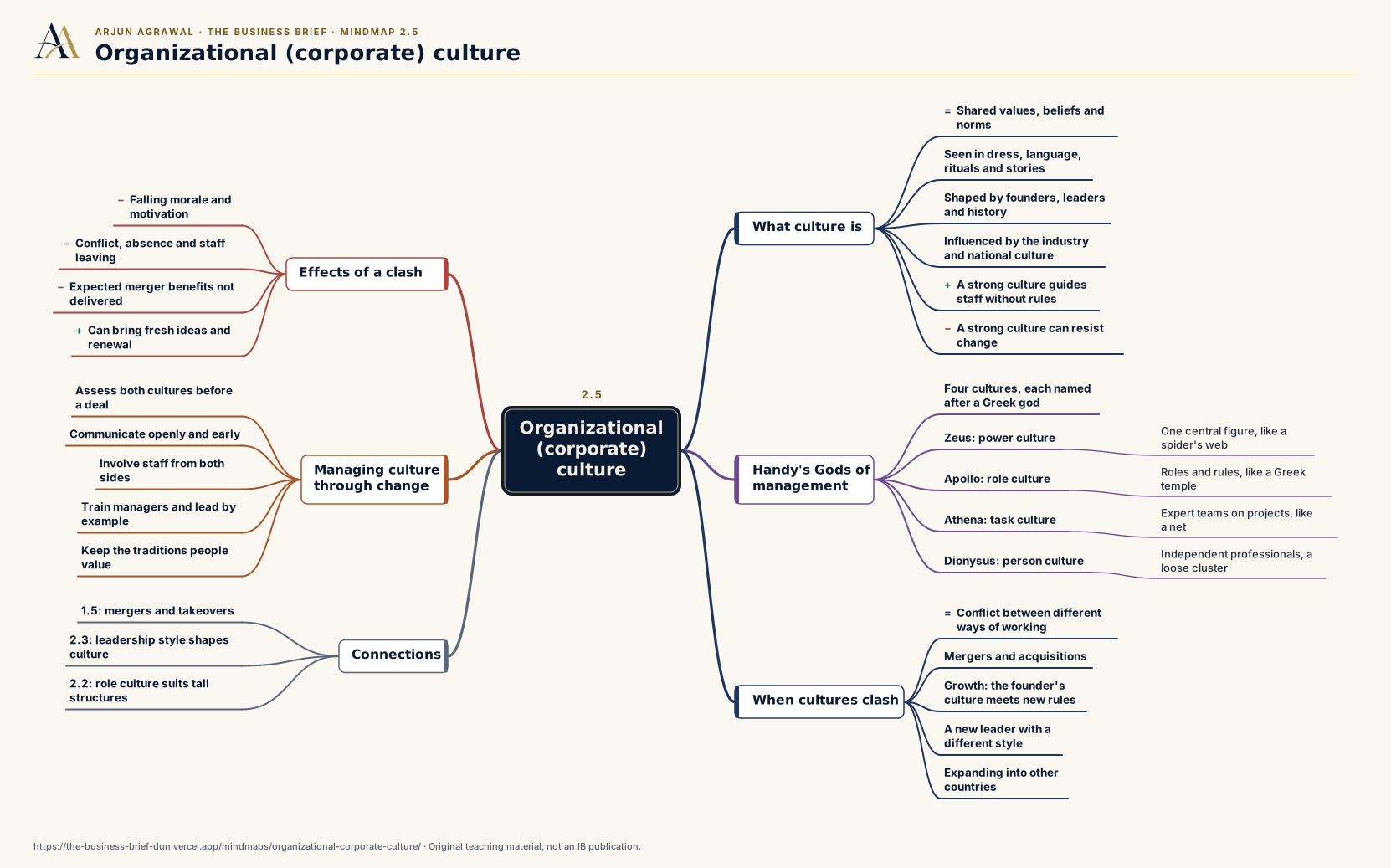
2.5 Subtopic map
Organizational (corporate) culture
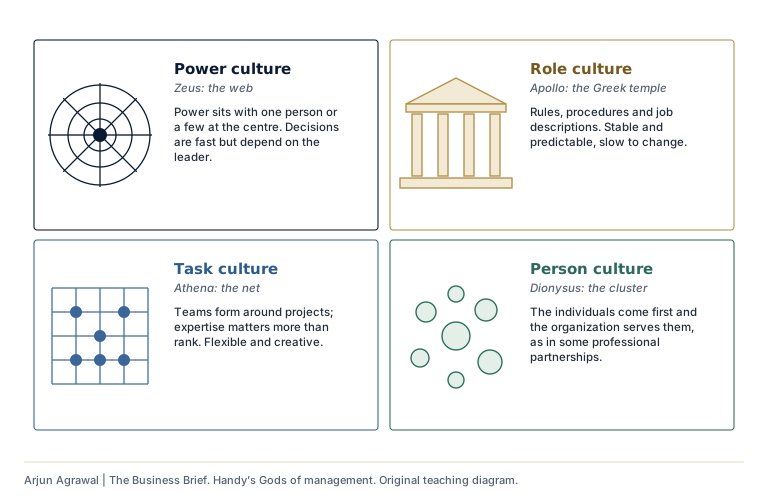
What organizational culture is and where it shows, Charles Handy's four "Gods of management" cultures, and why cultures clash when organizations grow, merge or change their style of leadership.
Download SVG, 21 KB : 2.5 Organizational (corporate) culture
-
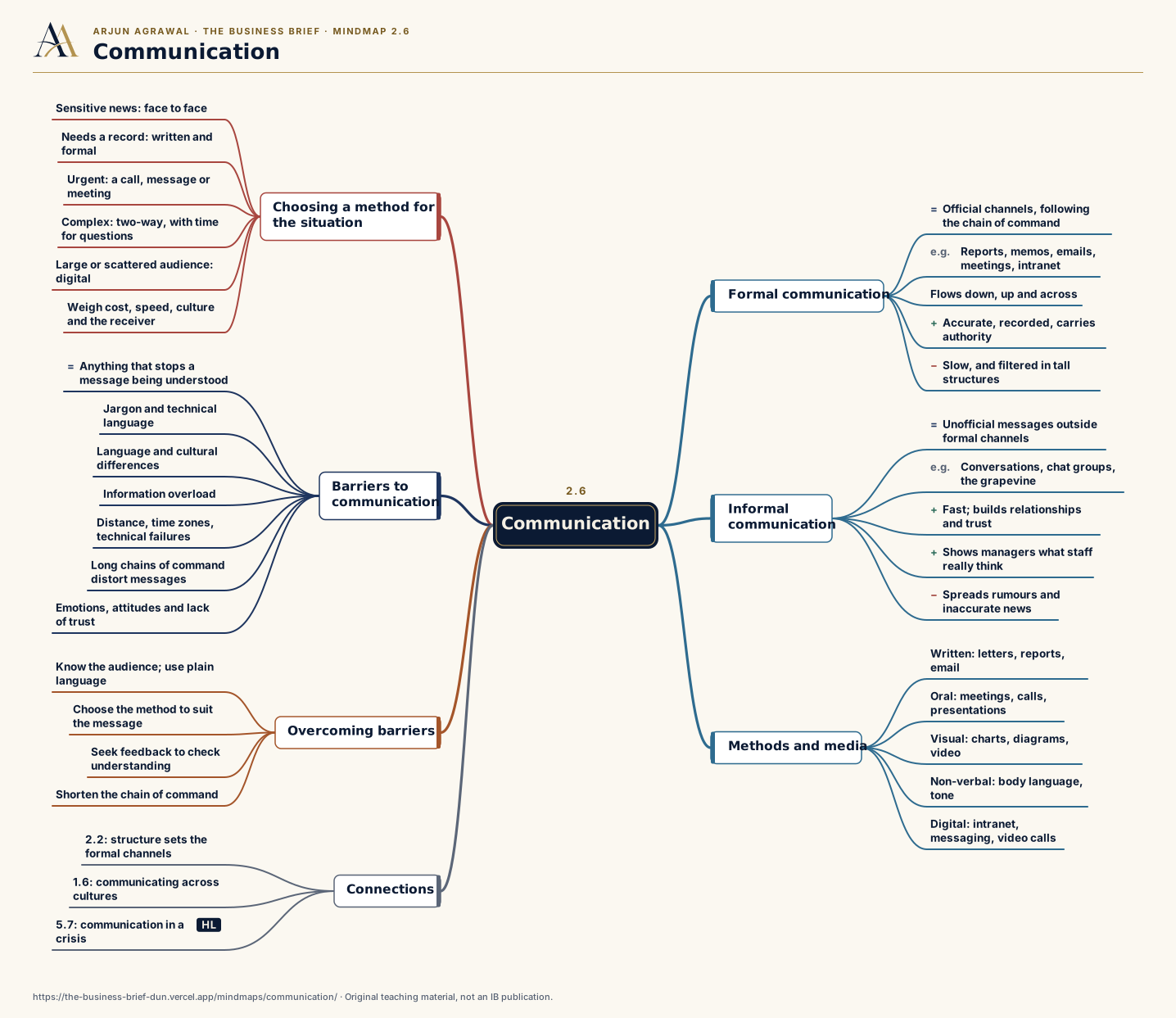
2.6 Subtopic map
Communication
How organizations communicate through formal and informal channels, how to choose the right method for a given situation, and the barriers that stop messages getting through.
-
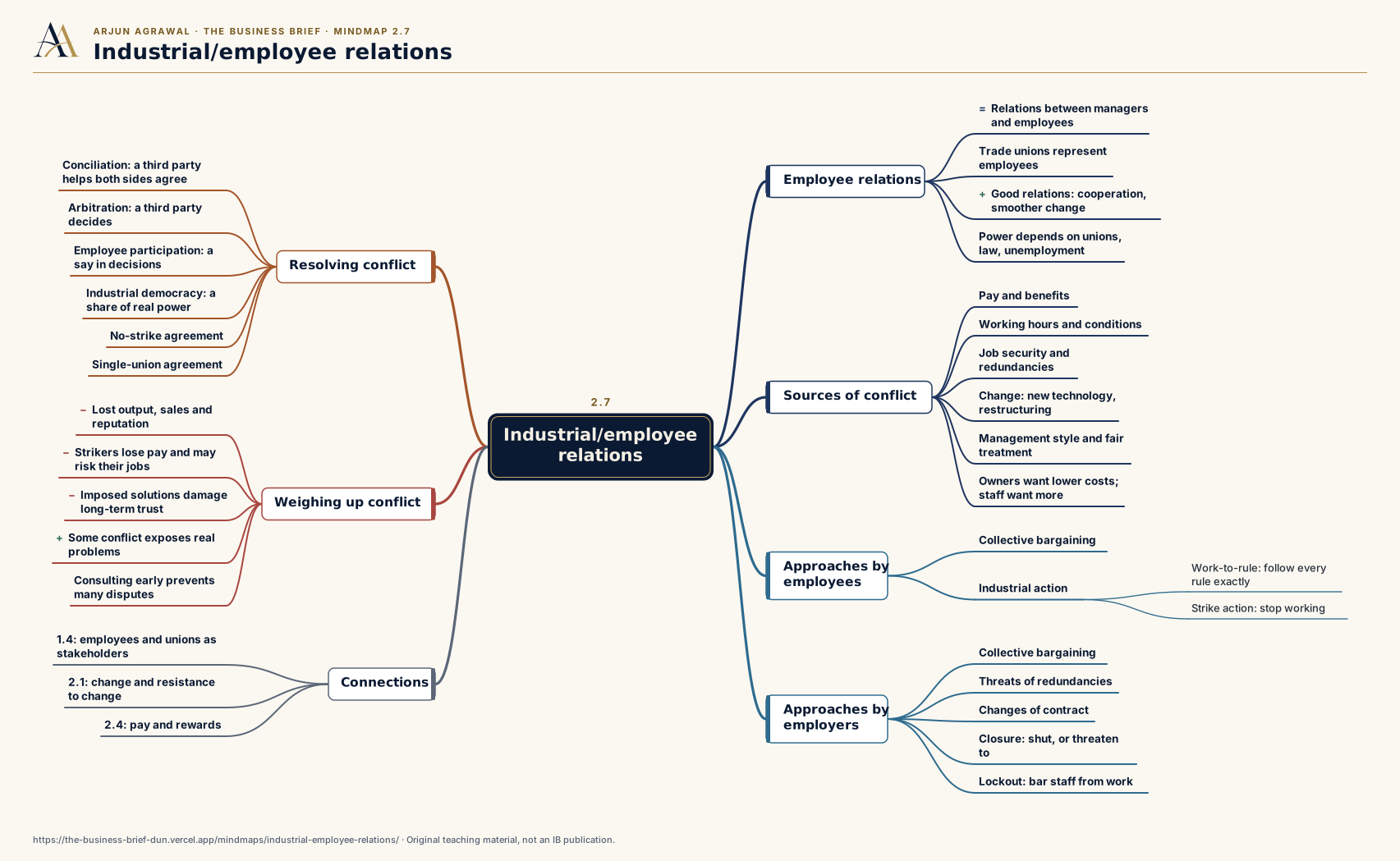
2.7 Subtopic map
Industrial/employee relations
Why conflict arises between employers and employees, the approaches each side can take in a dispute, and the ways conflict is resolved, from conciliation and arbitration to no-strike and single-union agreements.
-
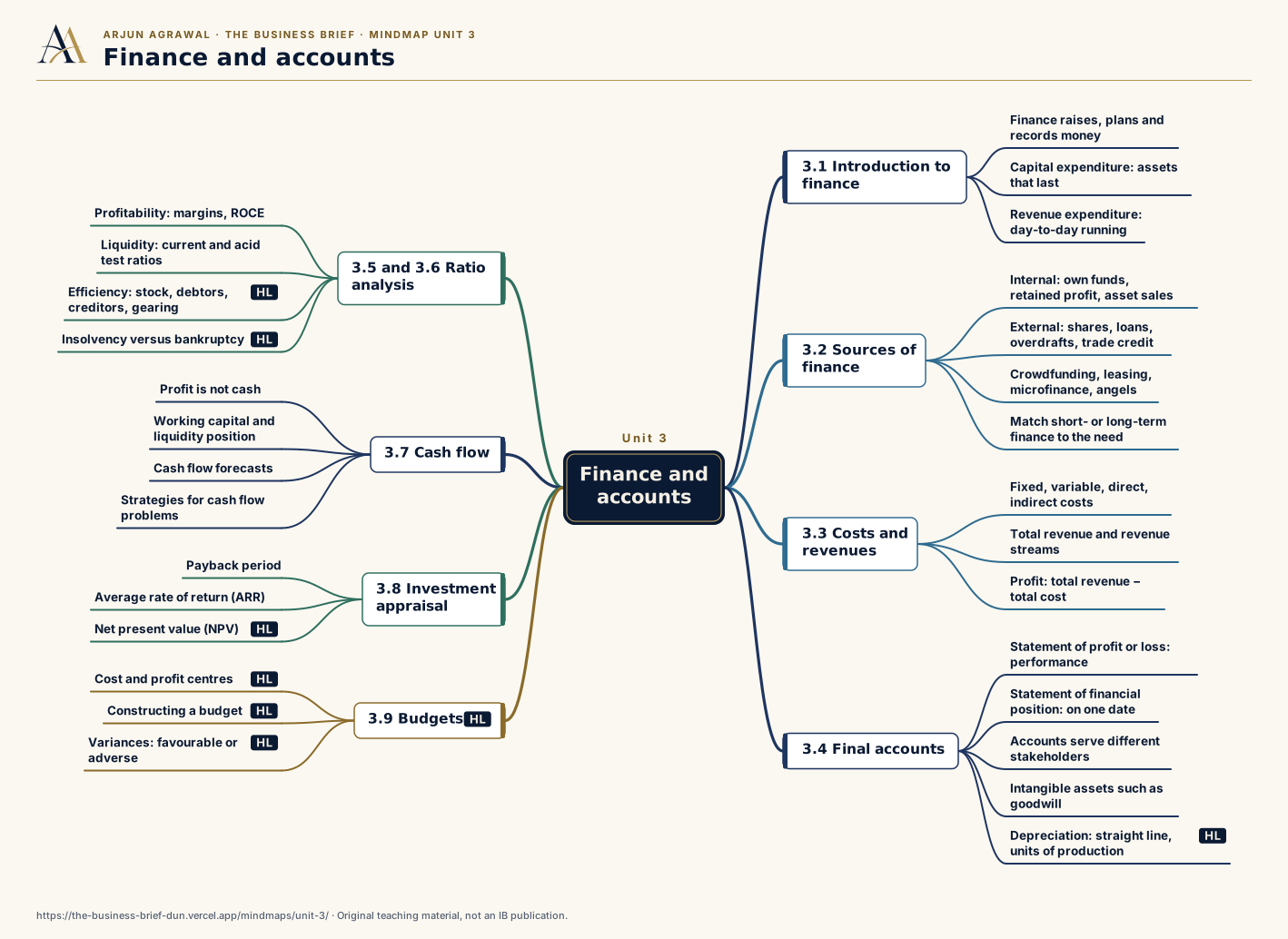
Unit map
Unit 3: Finance and accounts
How a business pays for what it does, records what it earns, owns and owes, judges its performance and its cash position, chooses investments and, for HL, plans with budgets.
-
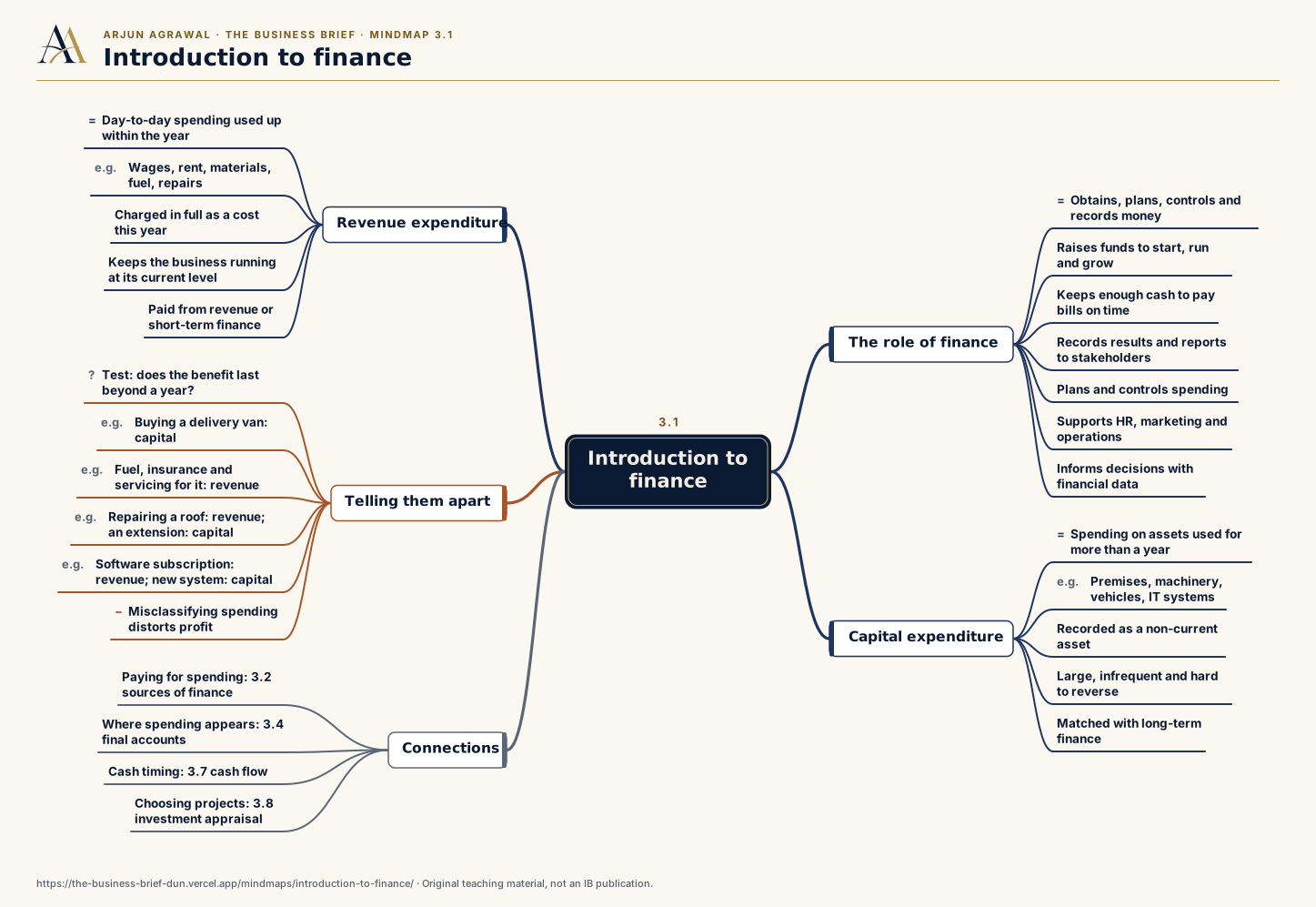
3.1 Subtopic map
Introduction to finance
Why every business needs a finance function, and the two kinds of spending it manages, capital expenditure on assets that last and revenue expenditure on day-to-day running.
-
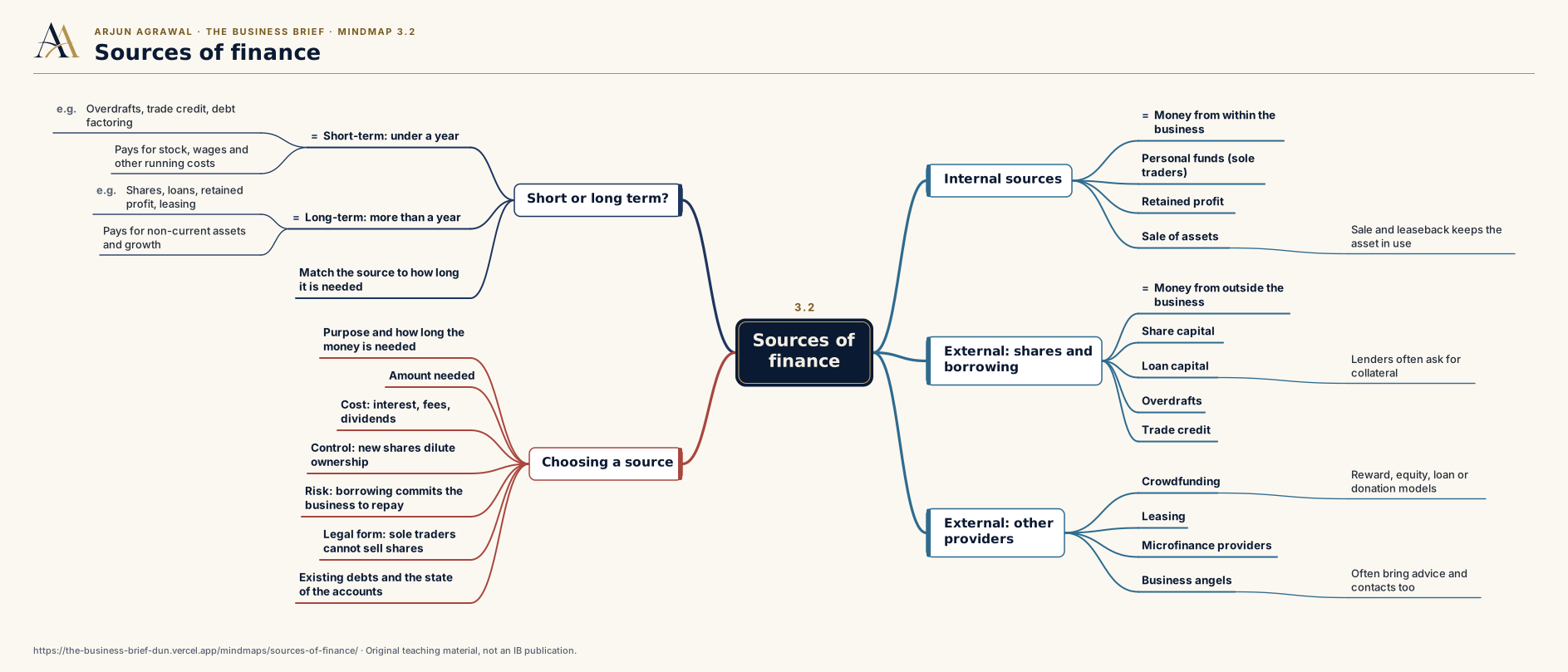
3.2 Subtopic map
Sources of finance
Where a business can find money, from its own resources or from outsiders, and how to choose a source whose cost, risk, control and time span suit the need.
-
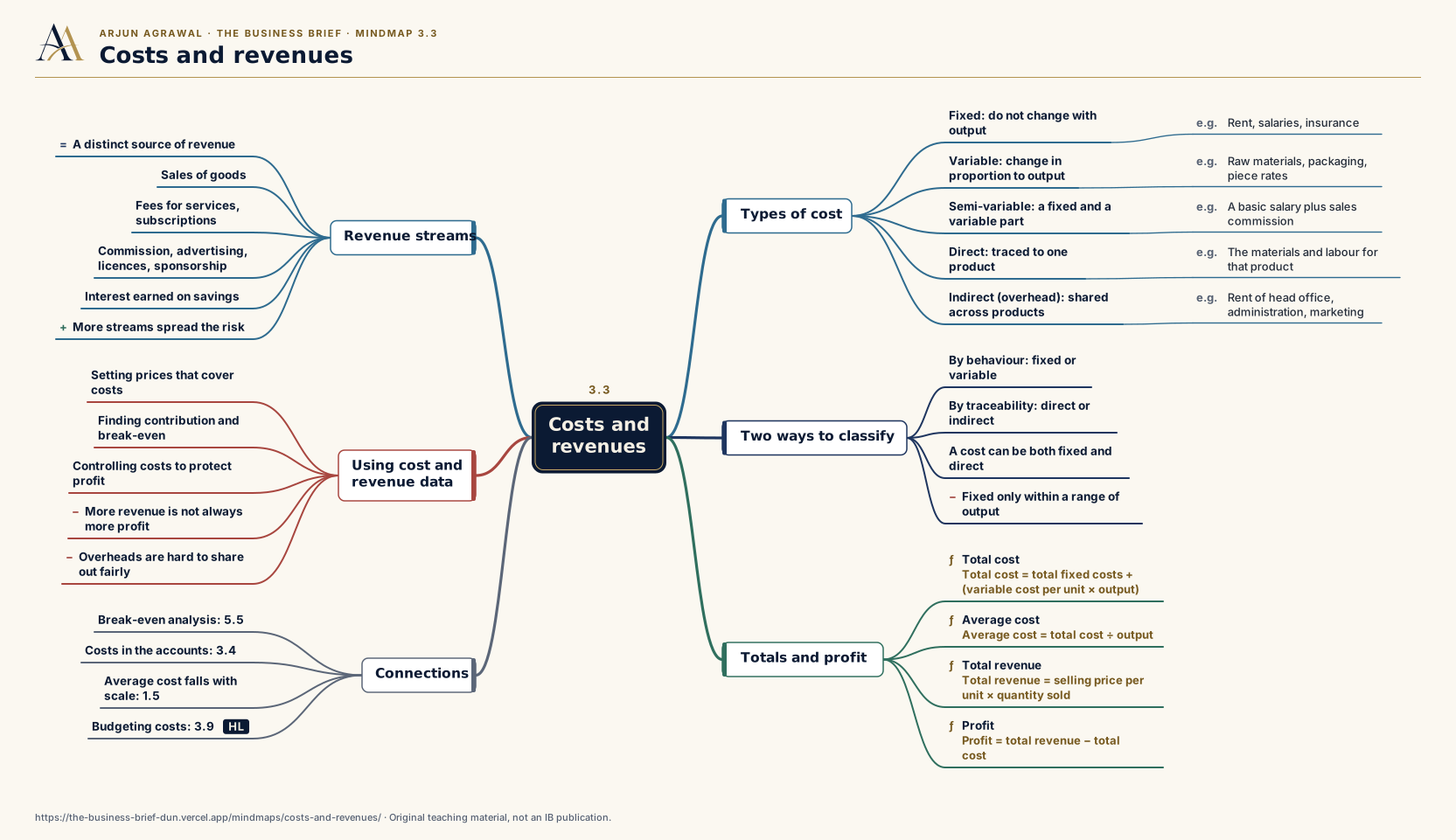
3.3 Subtopic map
Costs and revenues
How costs are classified, by how they behave as output changes and by whether they can be traced to a product, and where a business's revenue comes from.
-
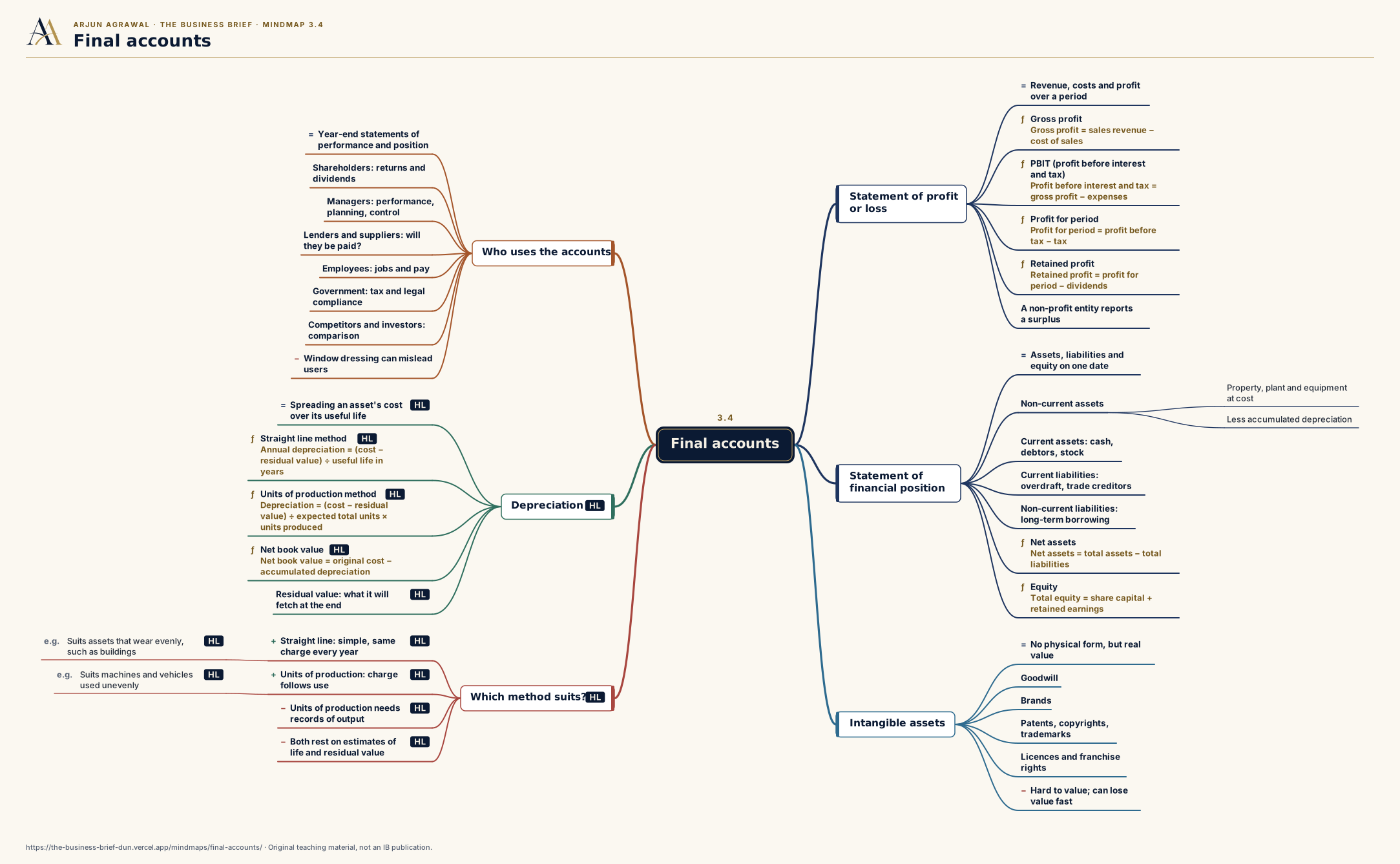
3.4 Subtopic map
Final accounts
What the statement of profit or loss and the statement of financial position show, who uses them and why, the intangible assets a business can own and, for HL, how depreciation is calculated.
-
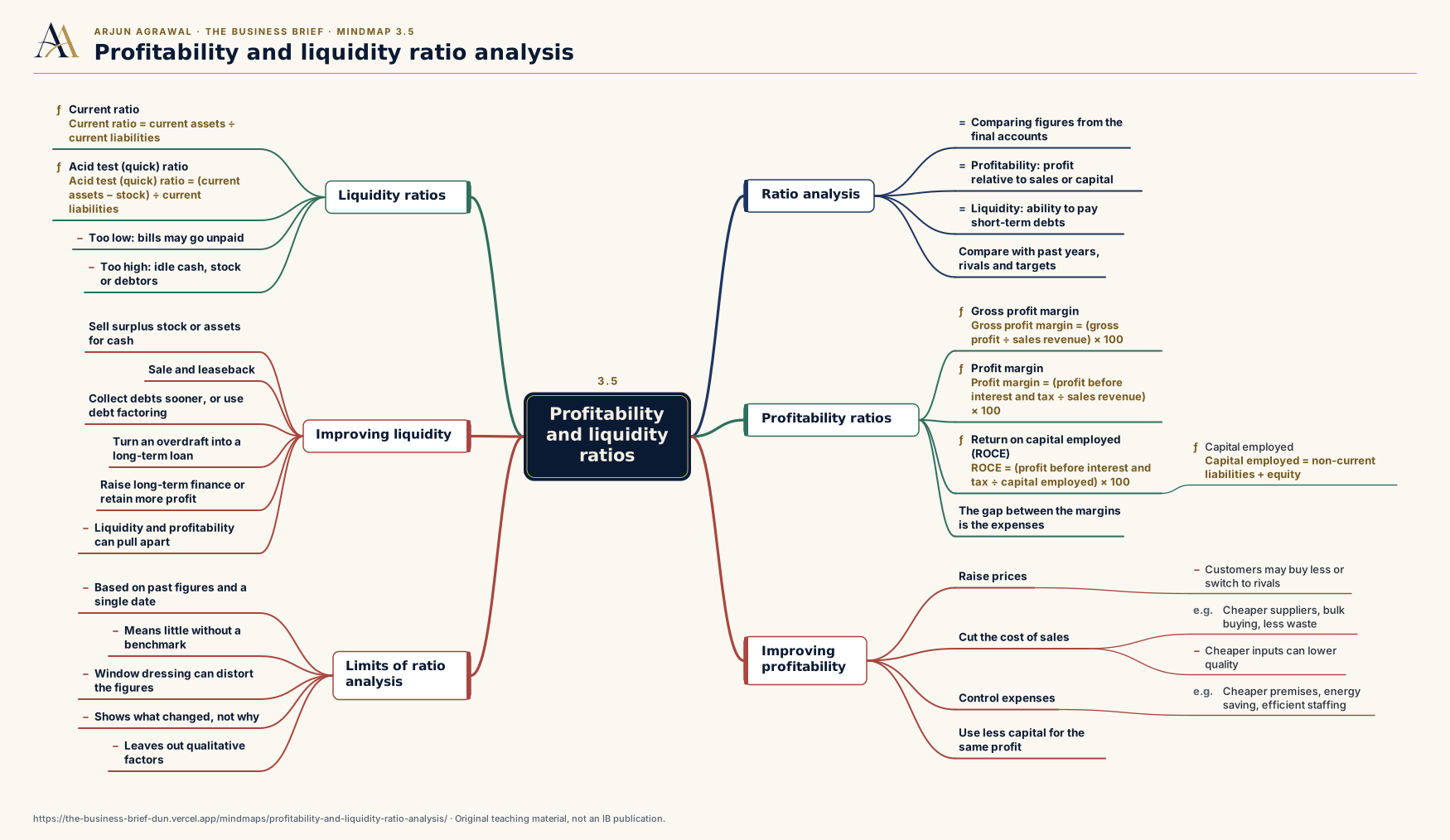
3.5 Subtopic map
Profitability and liquidity ratio analysis
The five ratios that show how profitable a business is and whether it can pay its short-term debts, how to improve each, and what ratios cannot tell you.
Download SVG, 23 KB : 3.5 Profitability and liquidity ratio analysis
-
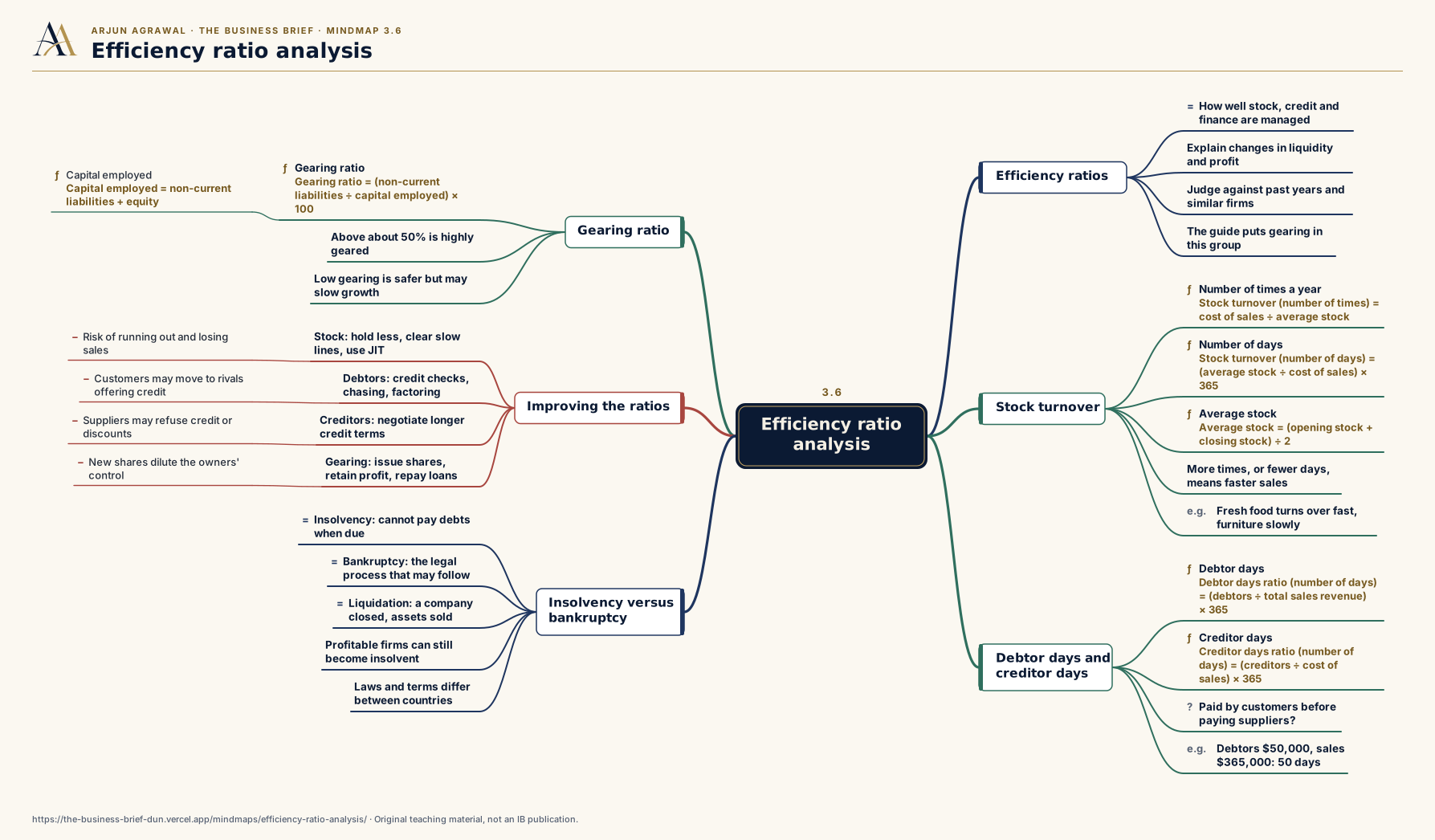
3.6 Subtopic map
Efficiency ratio analysis
The four HL efficiency ratios, stock turnover, debtor days, creditor days and gearing, how to improve each and at what cost, and the difference between insolvency and bankruptcy.
-
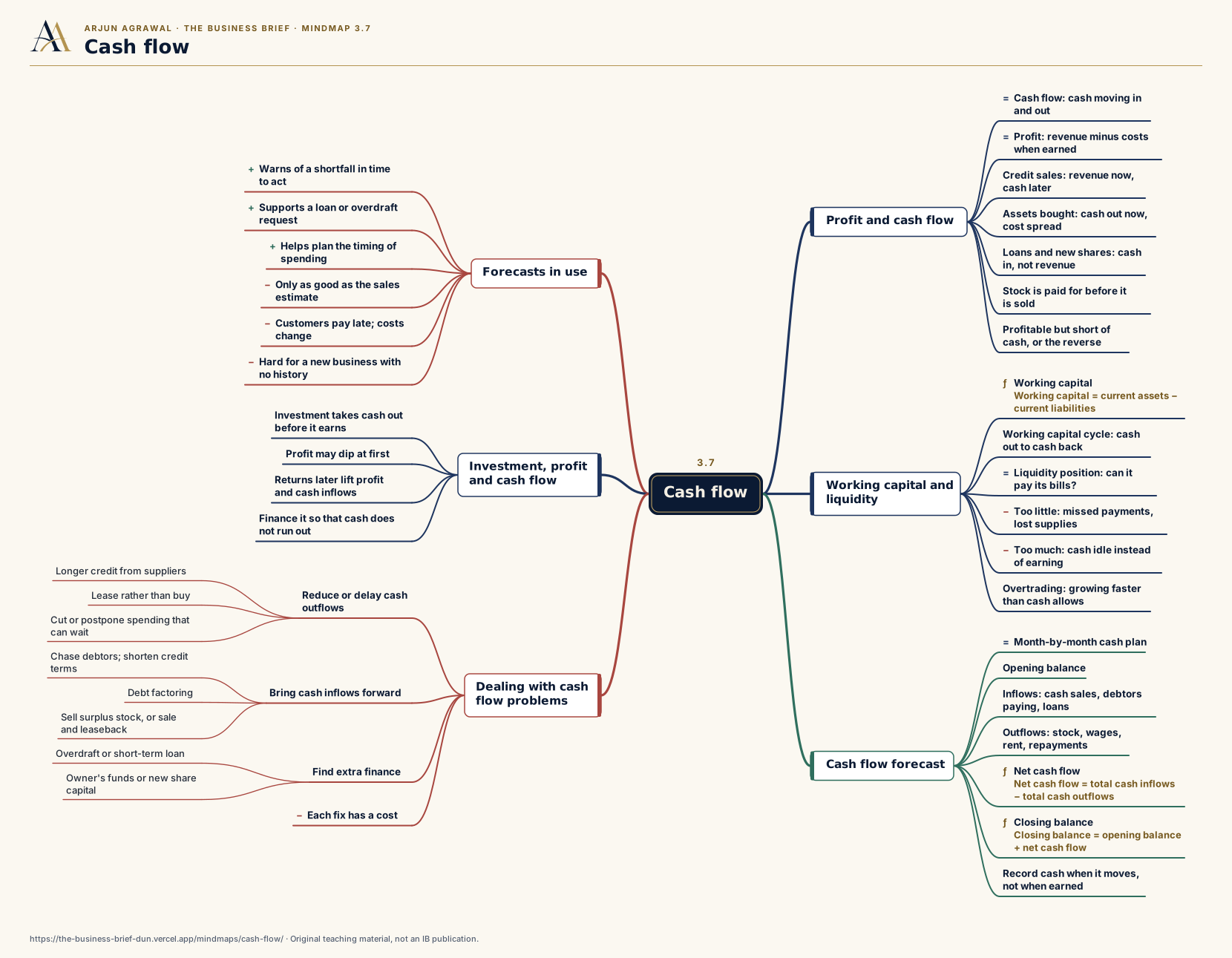
3.7 Subtopic map
Cash flow
Why profit and cash are different, how working capital and liquidity keep a business alive, how a cash flow forecast is built and used, and what a business can do when cash runs short.
-
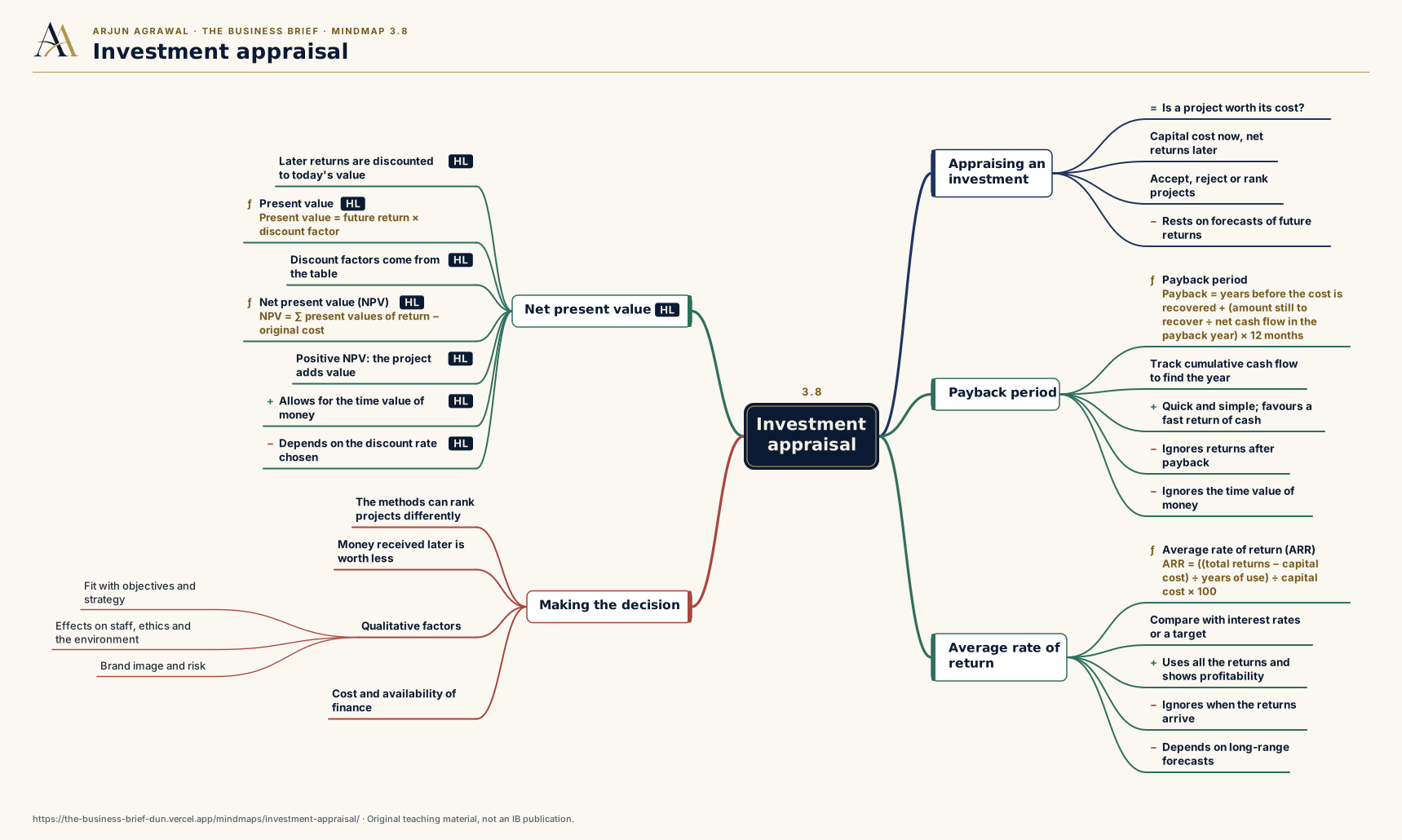
3.8 Subtopic map
Investment appraisal
How a business judges whether an investment is worth its cost, with the payback period and the average rate of return and, for HL, net present value, and what the numbers leave out.
-
3.9 Subtopic map
Budgets
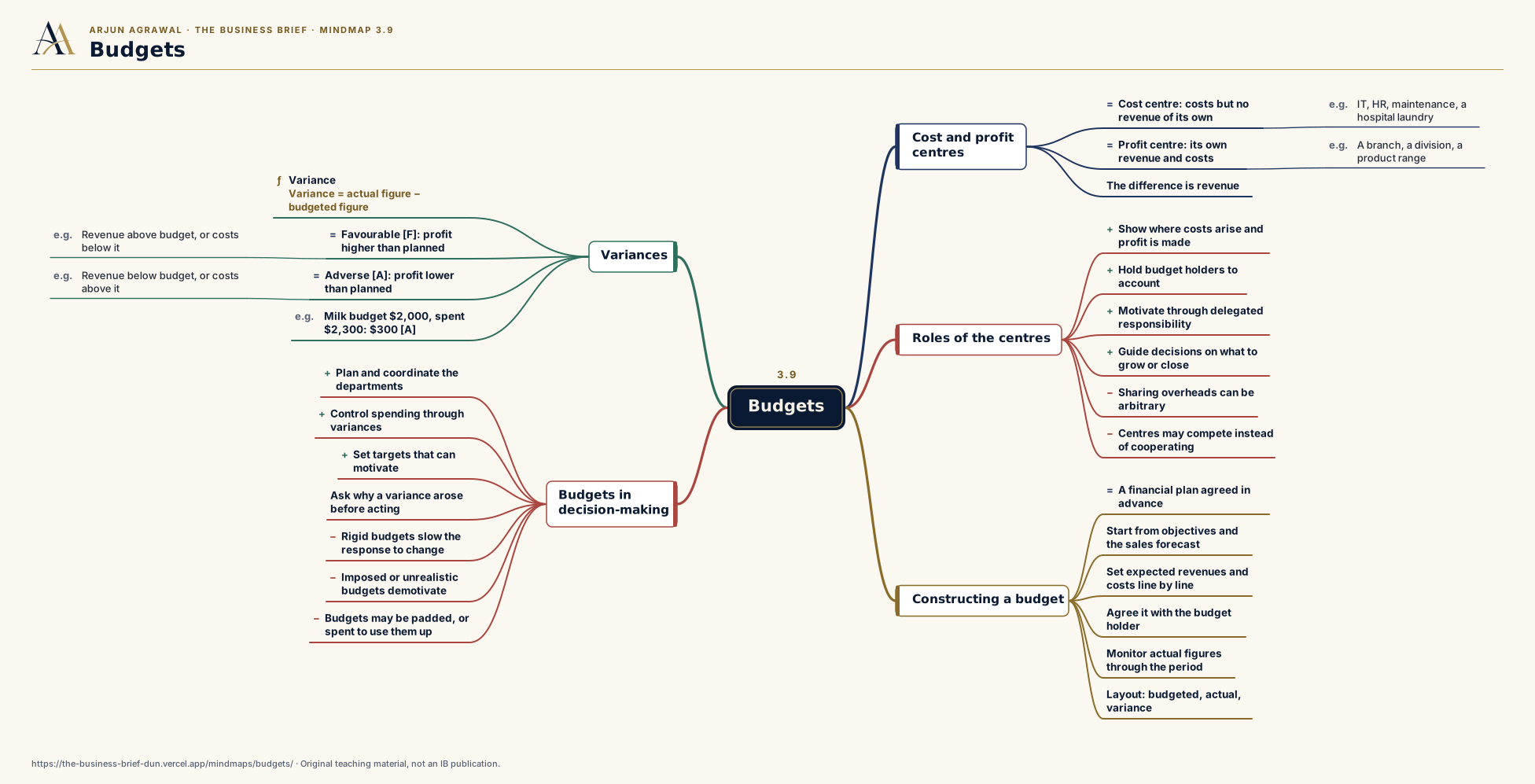
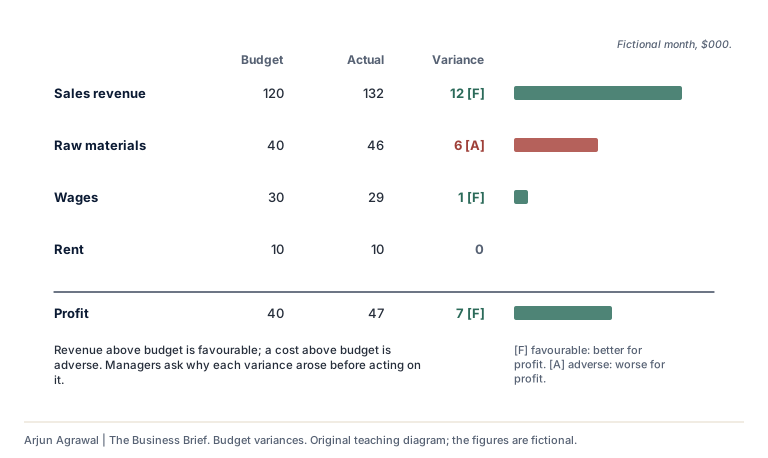
Cost and profit centres and what they are for, how a budget is built, how variances are calculated and labelled, and why budgets and variances matter for decisions.
-
Unit map
Unit 4: Marketing
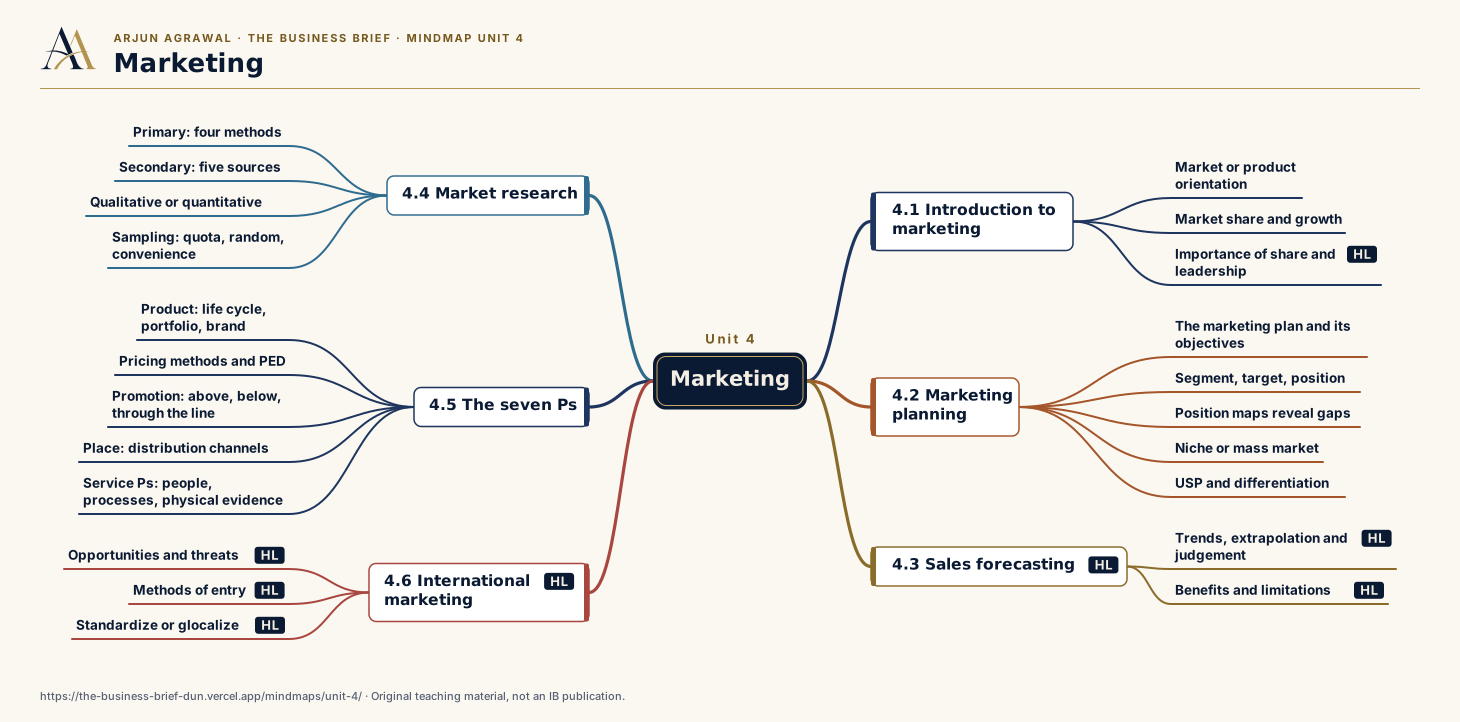
Unit 4 in one view, from what marketing is and how markets are measured, through planning a target and a position, forecasting sales (HL) and researching the market, to the seven Ps of the marketing mix and marketing across borders (HL).
-
4.1 Subtopic map
Introduction to marketing
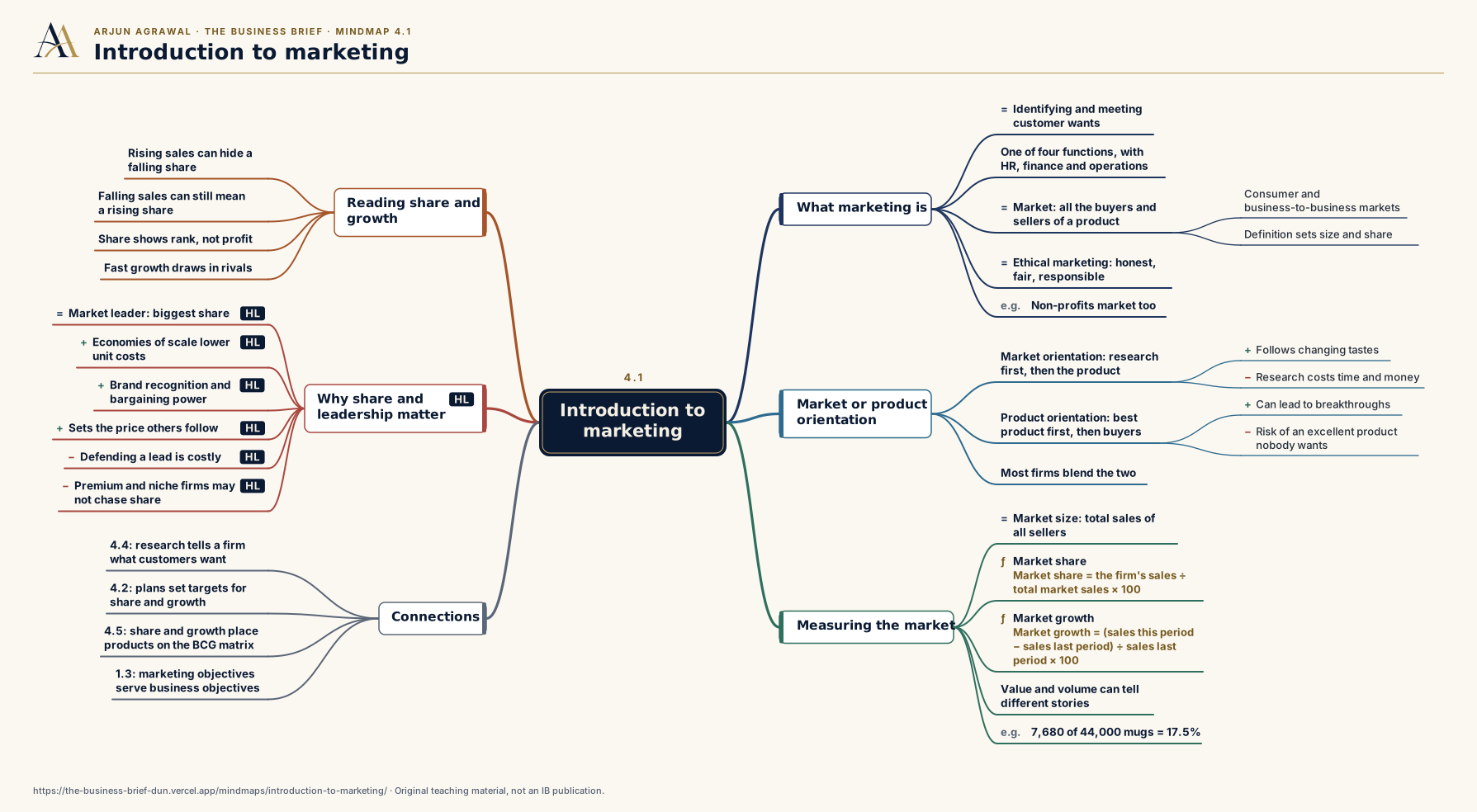
What marketing is, the choice between a market and a product orientation, how market share and market growth are measured and read, and, at HL, why market share and market leadership matter.
-
4.2 Subtopic map
Marketing planning
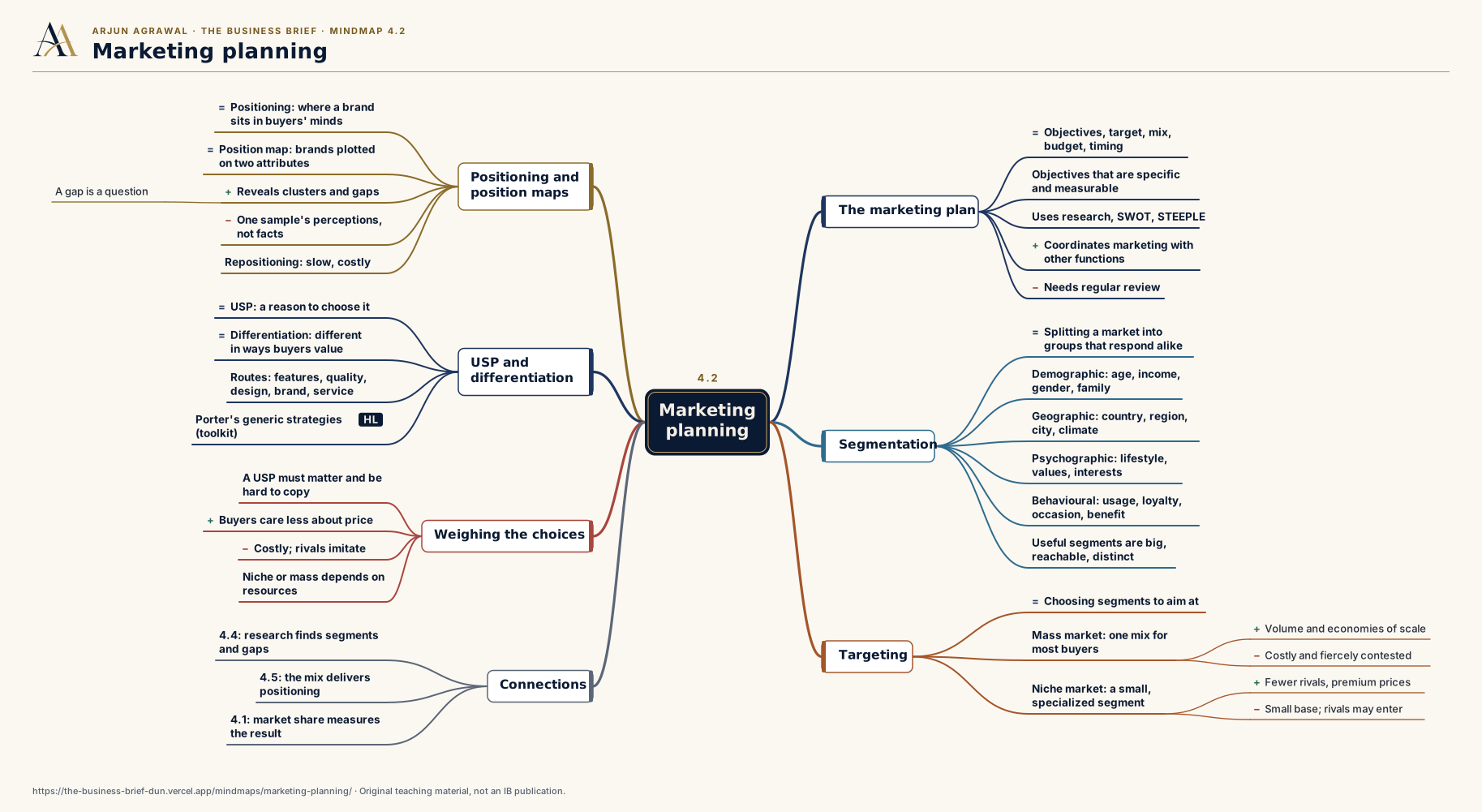
How a marketing plan turns objectives into action; segmenting a market, choosing a target and positioning a product, with position maps; niche and mass markets; and how a USP and differentiation set a business apart.
-
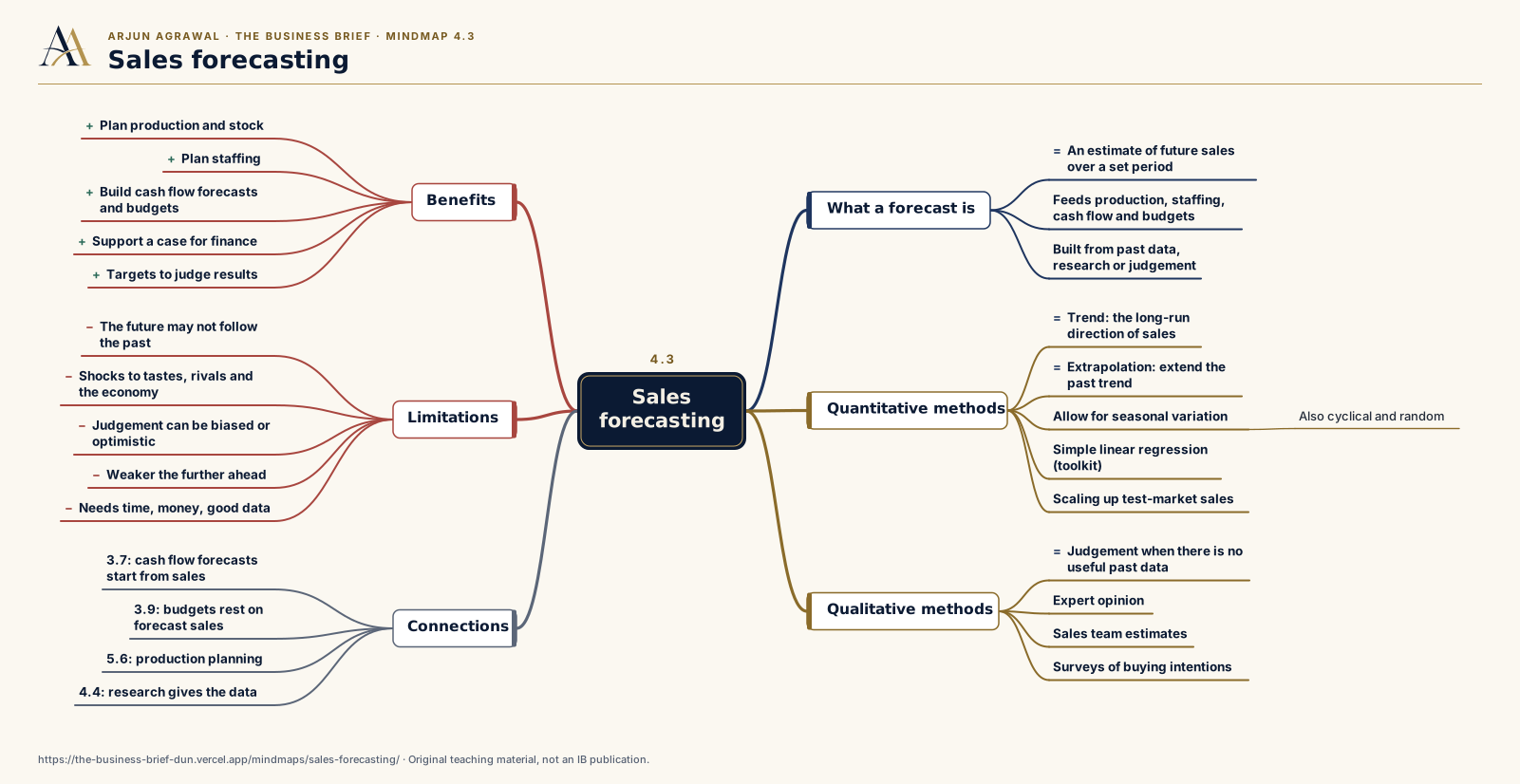
4.3 Subtopic map
Sales forecasting
An HL subtopic on why businesses forecast sales, the quantitative and qualitative ways of doing it, and the benefits and limitations of the forecasts they produce.
-
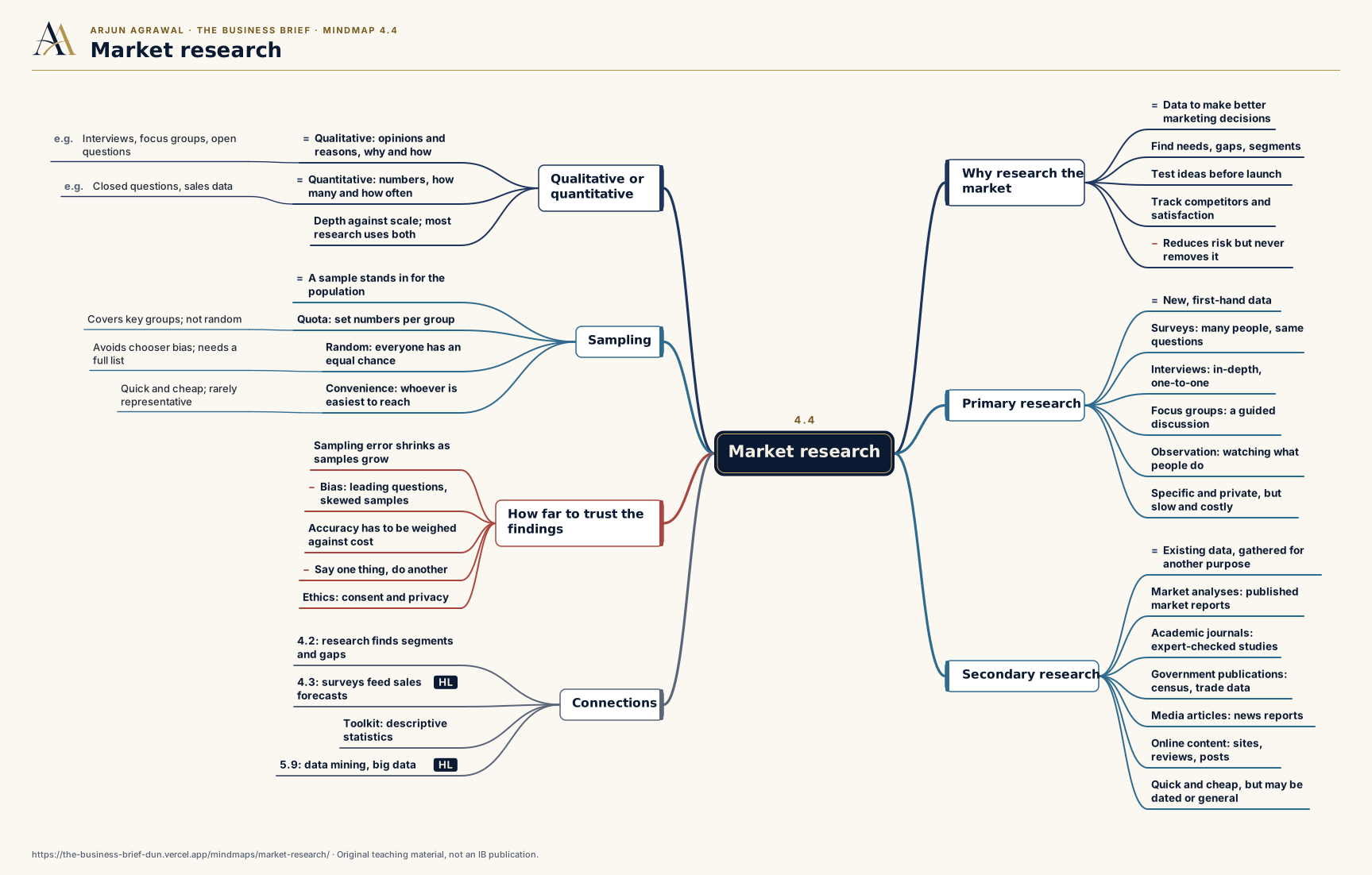
4.4 Subtopic map
Market research
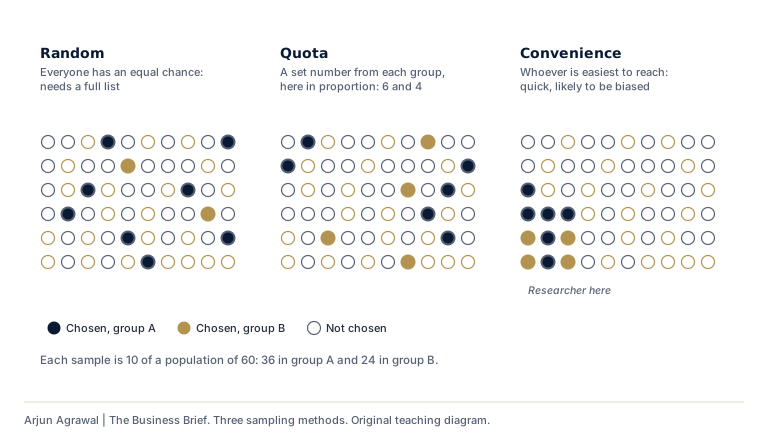
Why and how organizations research their markets, the primary and secondary methods the guide names, the difference between qualitative and quantitative research, and quota, random and convenience sampling.
-
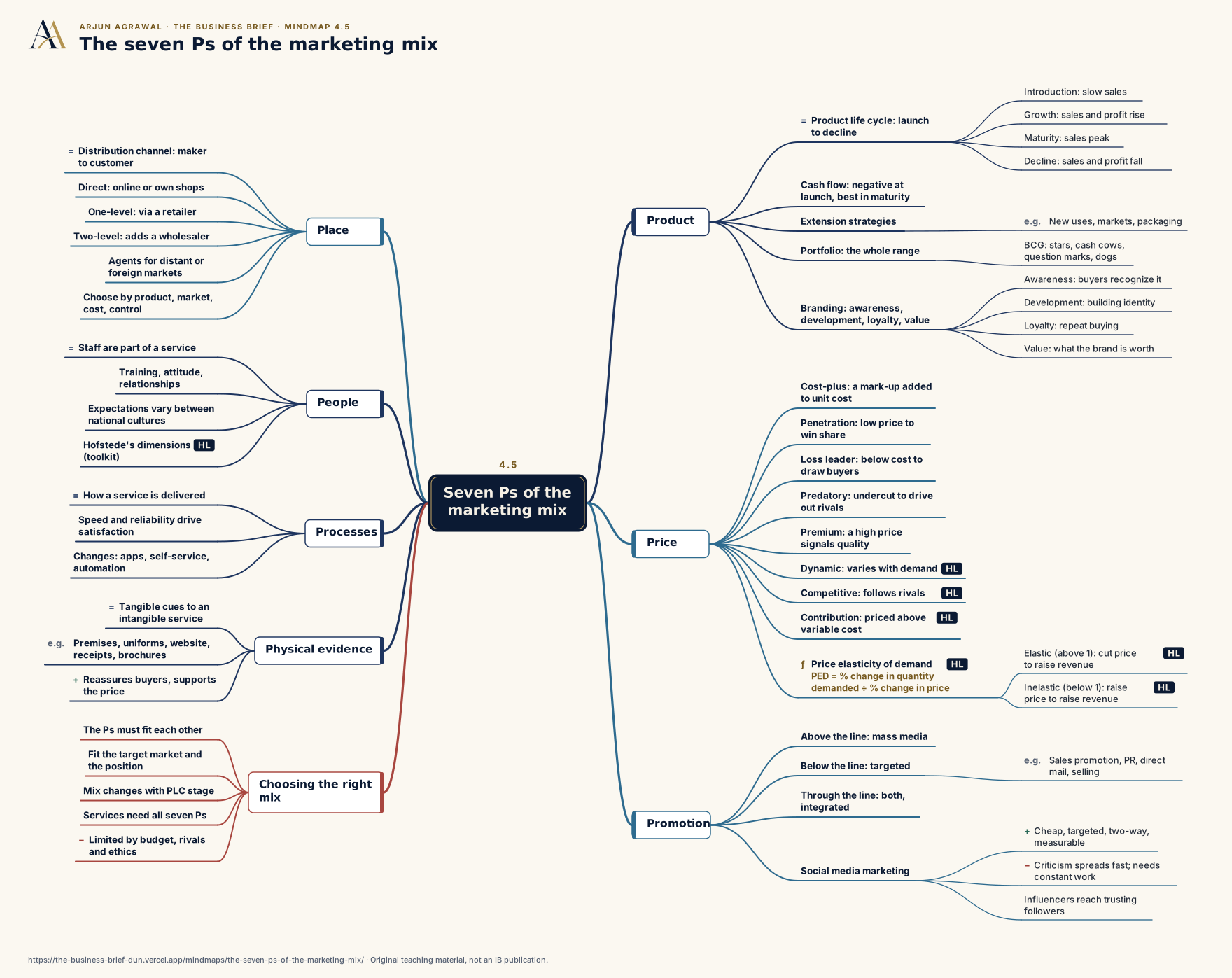
4.5 Subtopic map
The seven Ps of the marketing mix
Product (the life cycle, extension strategies, the portfolio and branding), price (five methods for all, three more and price elasticity of demand at HL), promotion above, below and through the line and on social media, place, the three service Ps, and how to choose an appropriate mix.
-
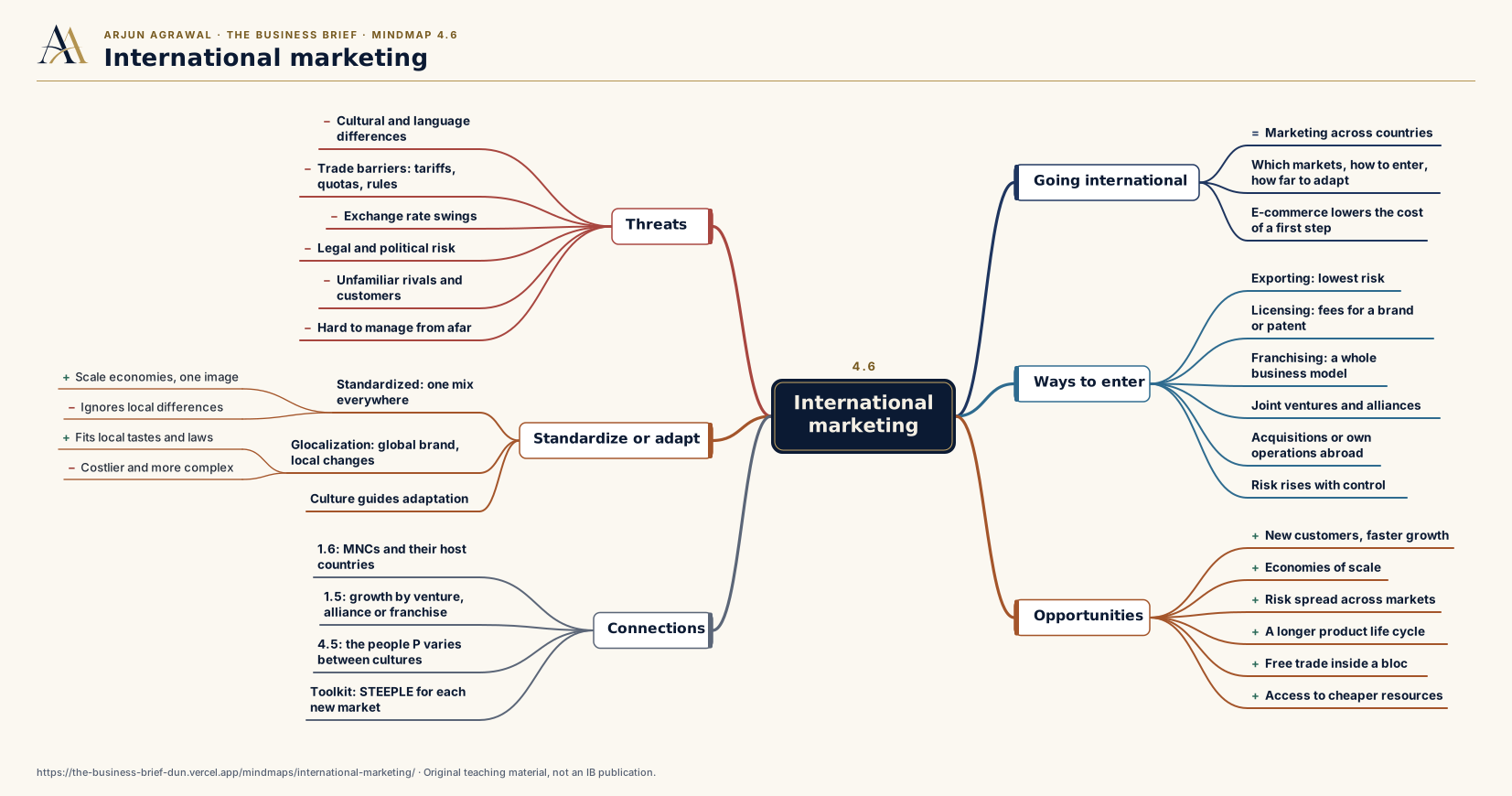
4.6 Subtopic map
International marketing
An HL subtopic on the opportunities and threats of entering and operating in international markets, the main ways in, and whether to standardize the marketing mix or adapt it for each market.
-
Unit map
Unit 5: Operations management
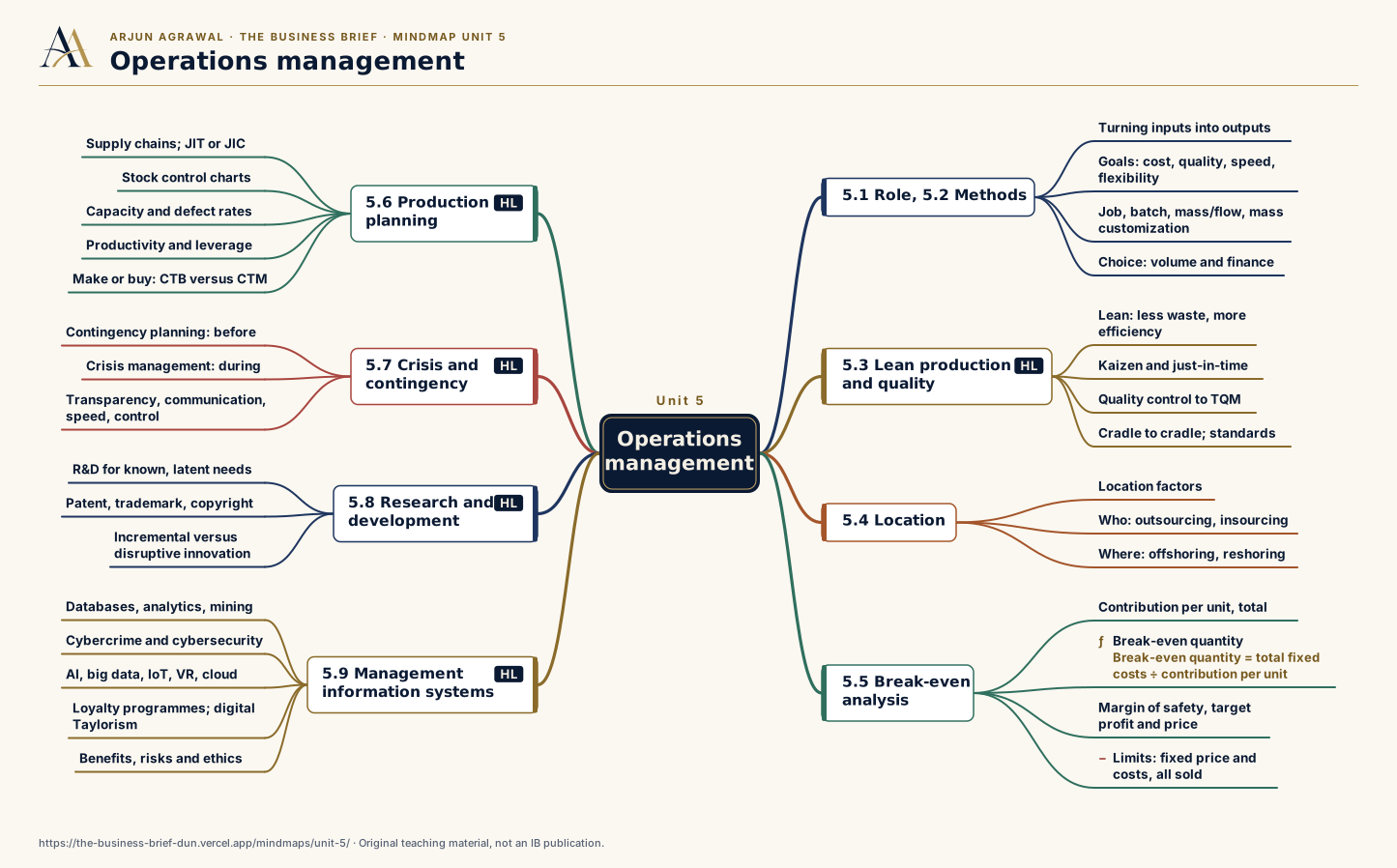
The whole unit on one map. How businesses produce, where and at what break-even point, and at HL how they manage quality, stock, capacity, crises, innovation and information.
-
5.1 Subtopic map
Introduction to operations management
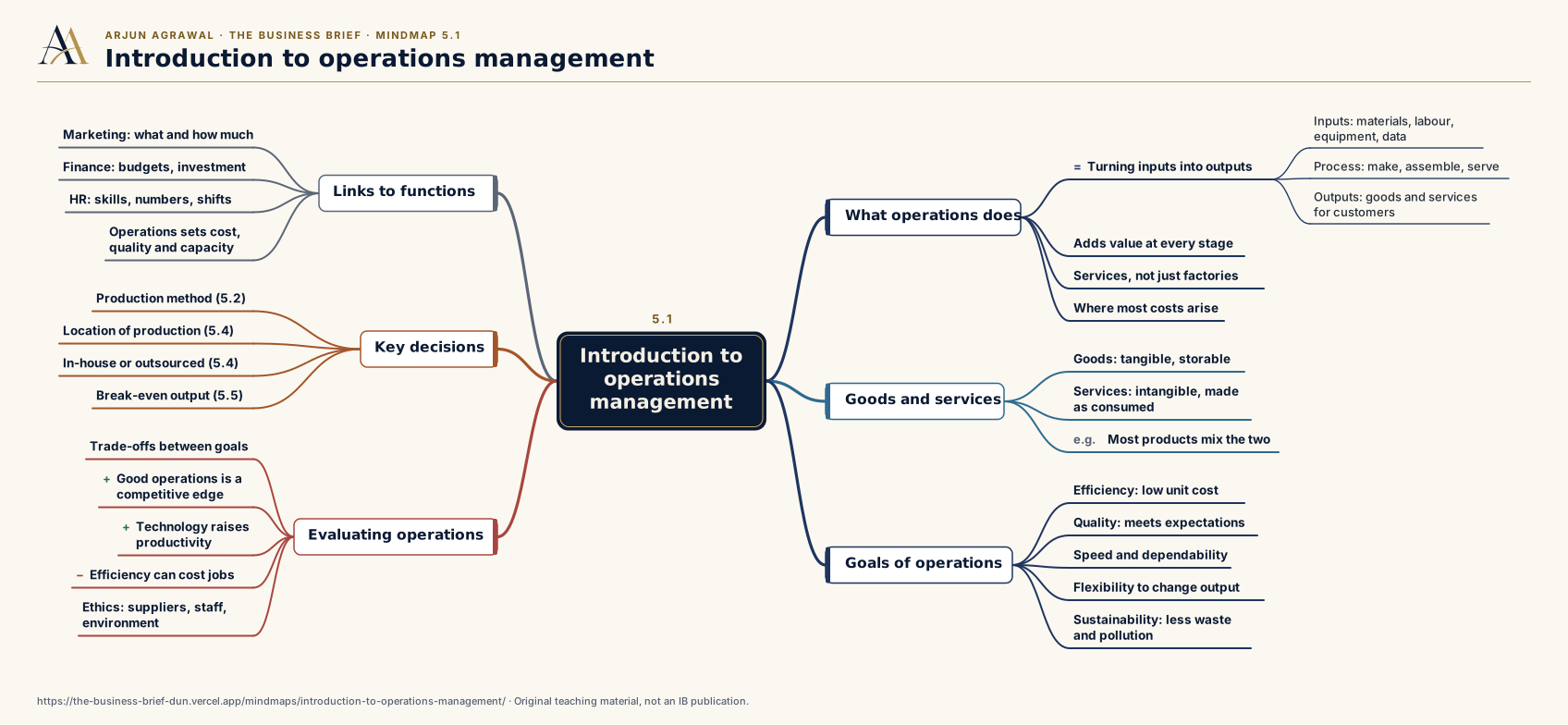
What operations management does, what it aims for, how it works with marketing, finance and HR, and the trade-offs behind its decisions.
Download SVG, 19 KB : 5.1 Introduction to operations management
-
5.2 Subtopic map
Operations methods
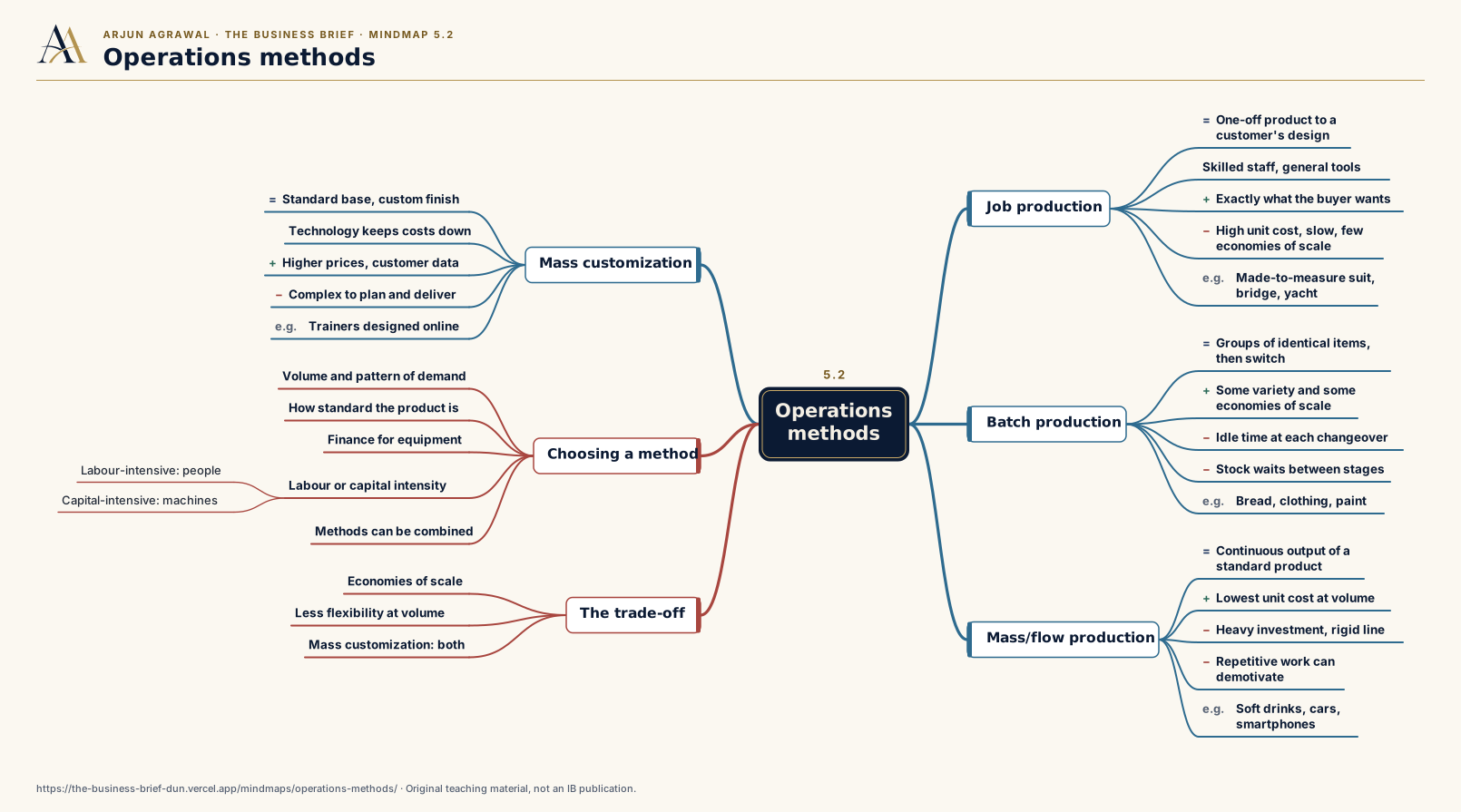
The four operations methods in the guide, what each is good and bad at, and how a business chooses between them.
-
5.3 Subtopic map
Lean production and quality management
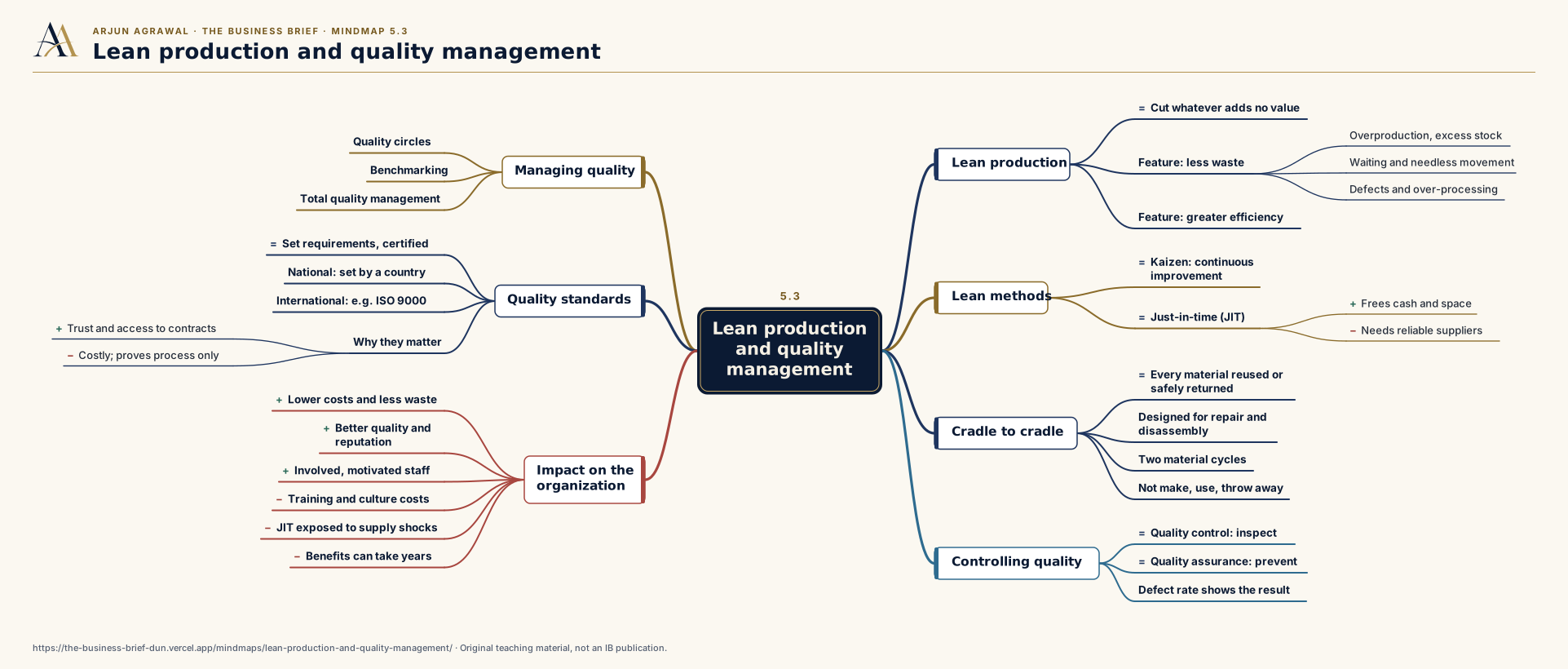
How lean production cuts waste, how kaizen, just-in-time and cradle to cradle design work, and how businesses control, assure and manage quality.
Download SVG, 21 KB : 5.3 Lean production and quality management
-
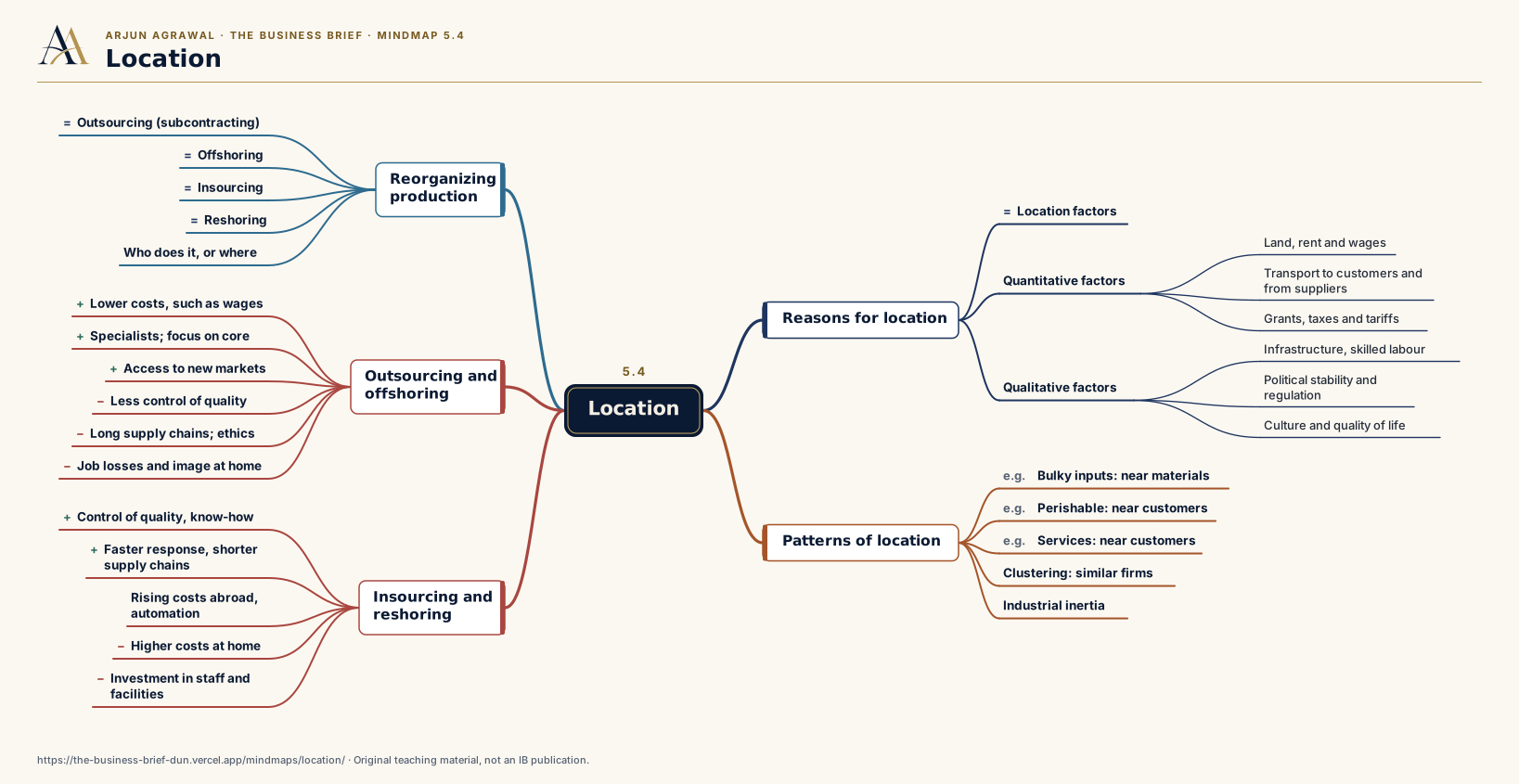
5.4 Subtopic map
Location
Why a business produces where it does, and the four ways of reorganizing production at home and abroad, with their benefits and risks.
-
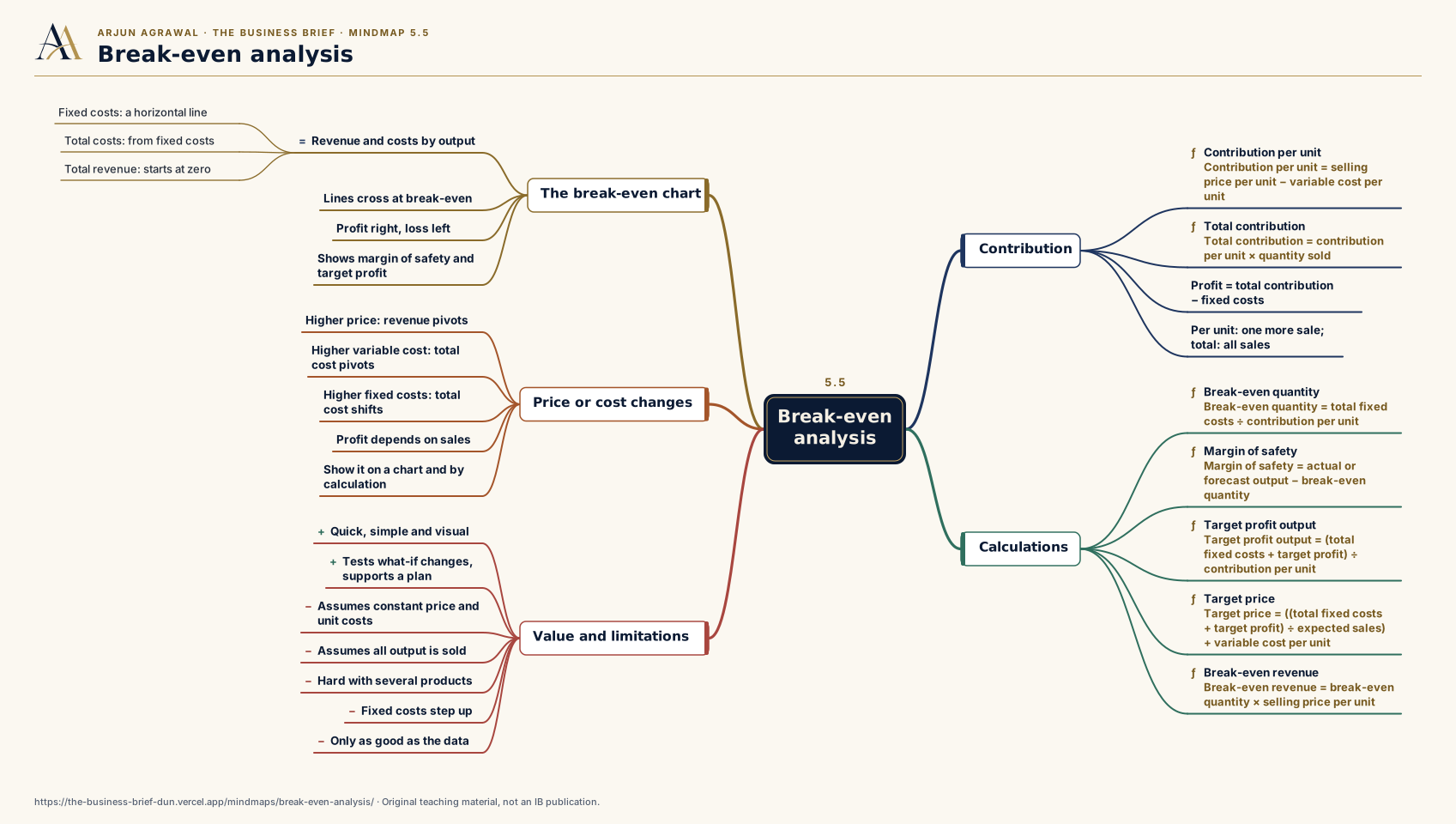
5.5 Subtopic map
Break-even analysis
Contribution, the break-even chart and its calculations, what happens when price or costs change, and why break-even is only a guide.
-
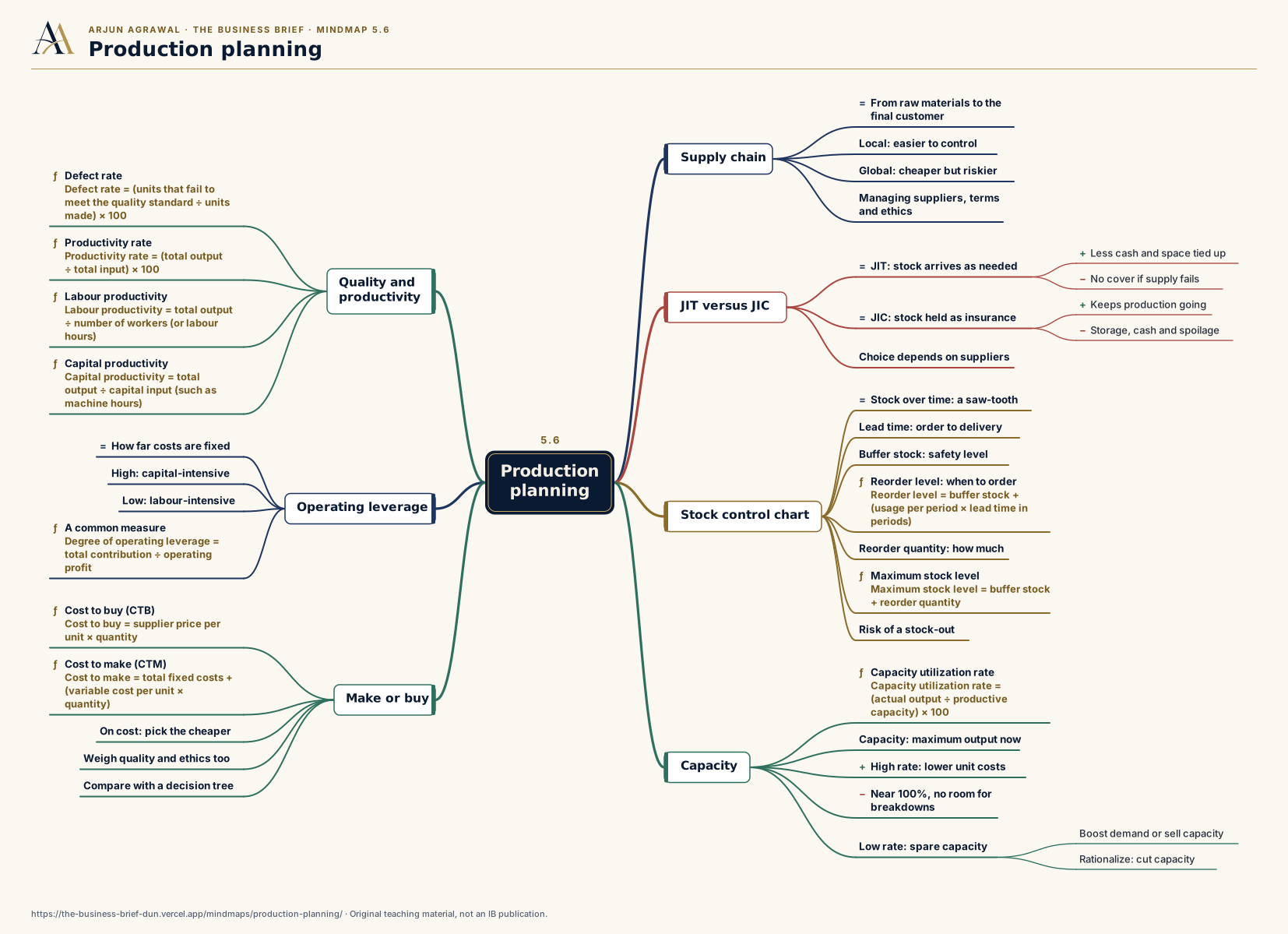
5.6 Subtopic map
Production planning
Supply chains, just-in-time against just-in-case, stock control charts, capacity, quality and productivity measures, operating leverage, and the choice between making and buying.
-
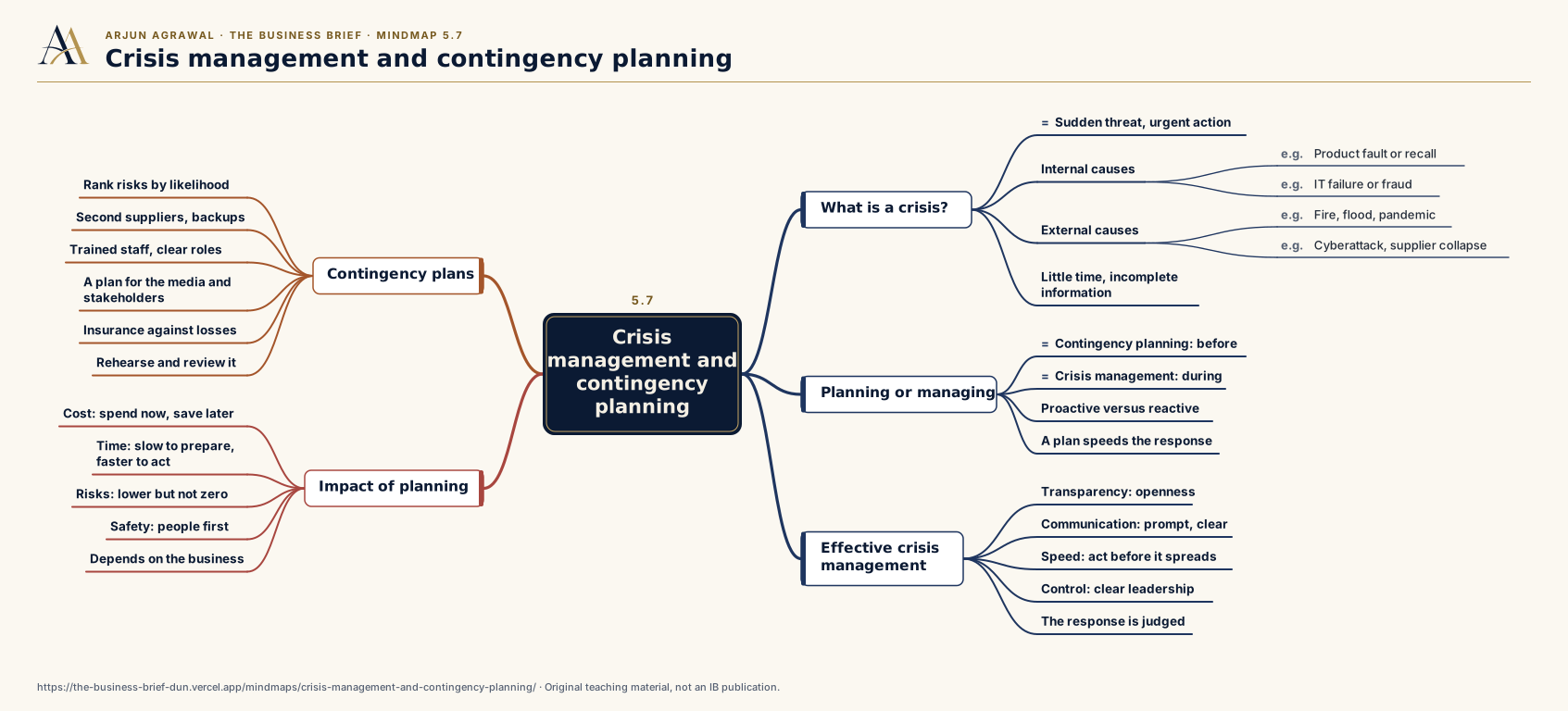
5.7 Subtopic map
Crisis management and contingency planning
What a crisis is, how preparing for one differs from managing one, the four factors in effective crisis management, and what contingency planning costs and gains.
Download SVG, 18 KB : 5.7 Crisis management and contingency planning
-
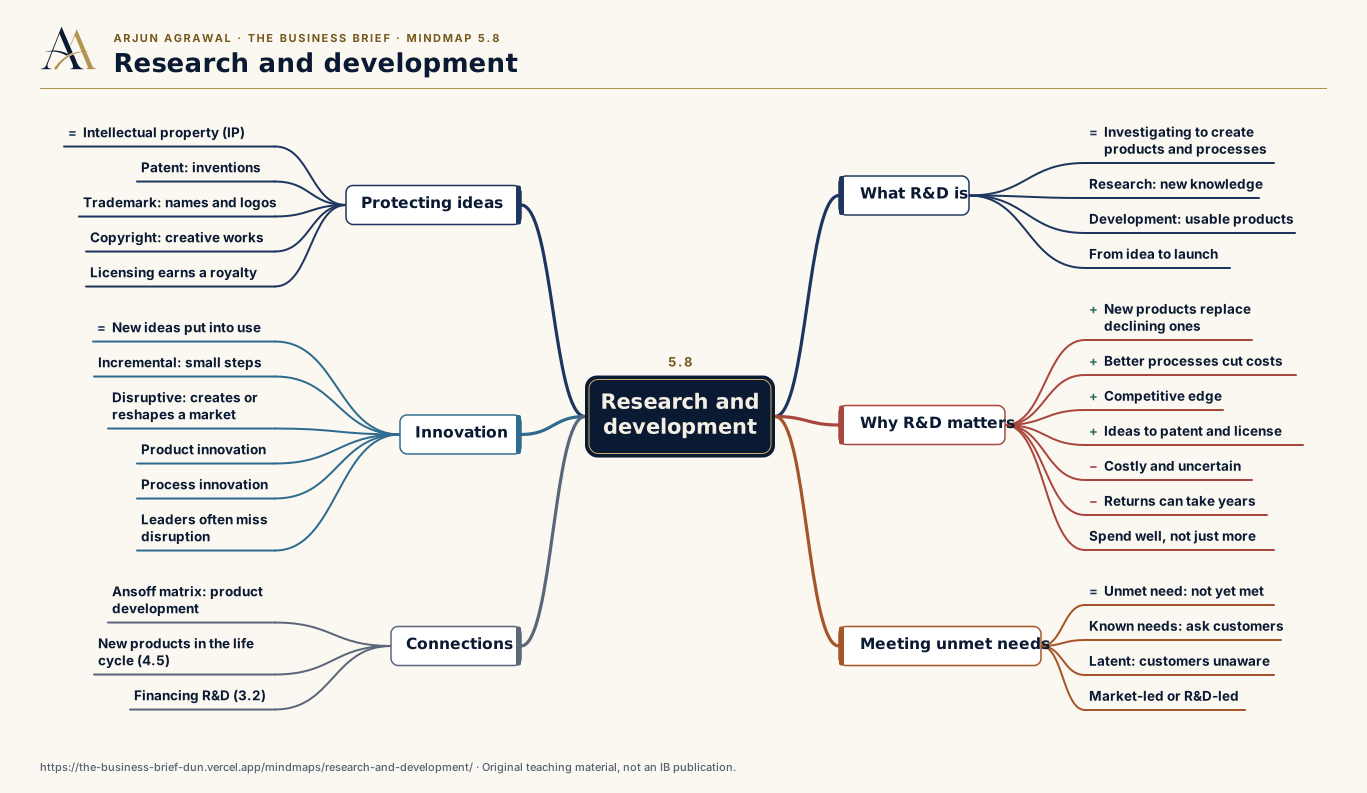
5.8 Subtopic map
Research and development
Why businesses invest in R&D, how they find needs customers know about and needs they do not, how they protect their ideas, and the difference between incremental and disruptive innovation.
-
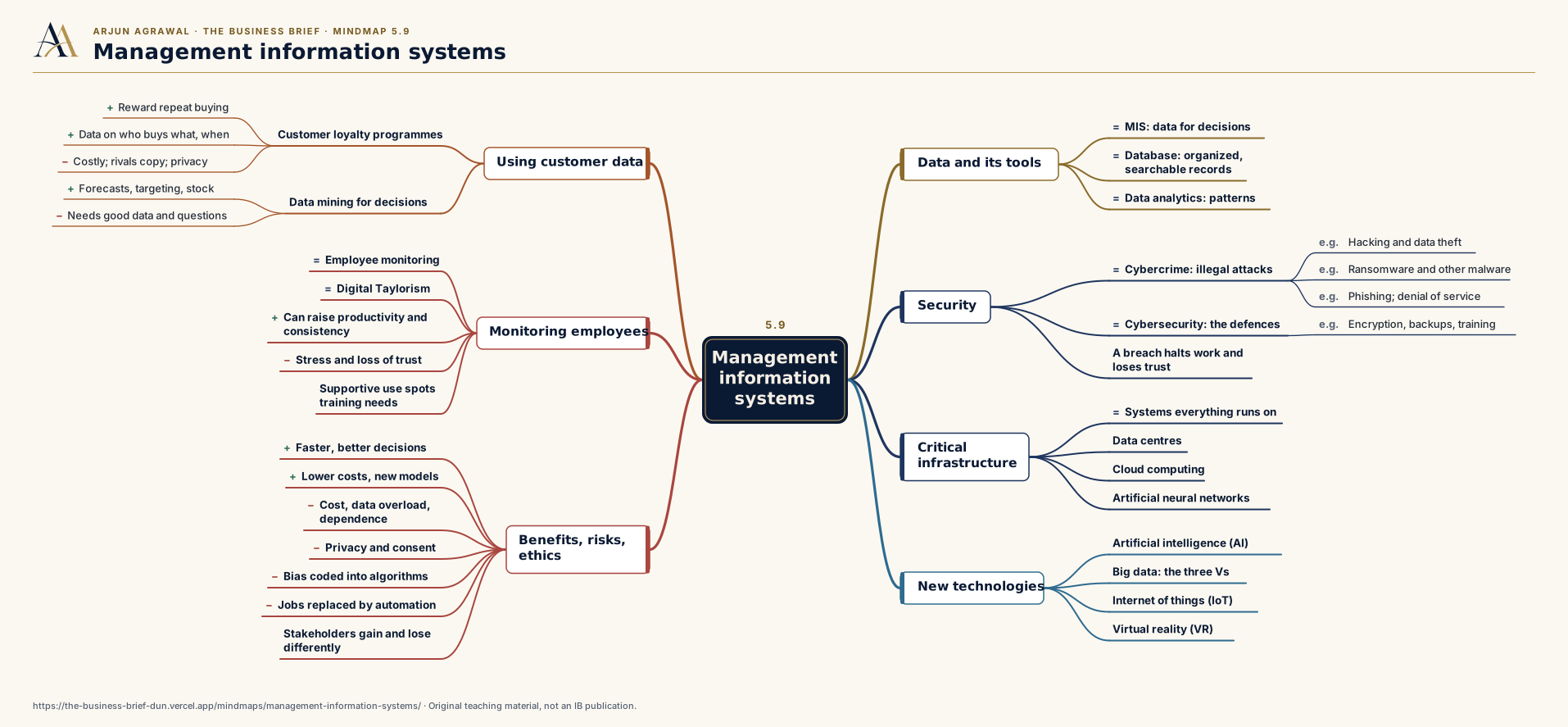
5.9 Subtopic map
Management information systems
The data tools, security threats, infrastructure and technologies the guide names, how businesses use data on customers and employees, and the benefits, risks and ethics of it all.
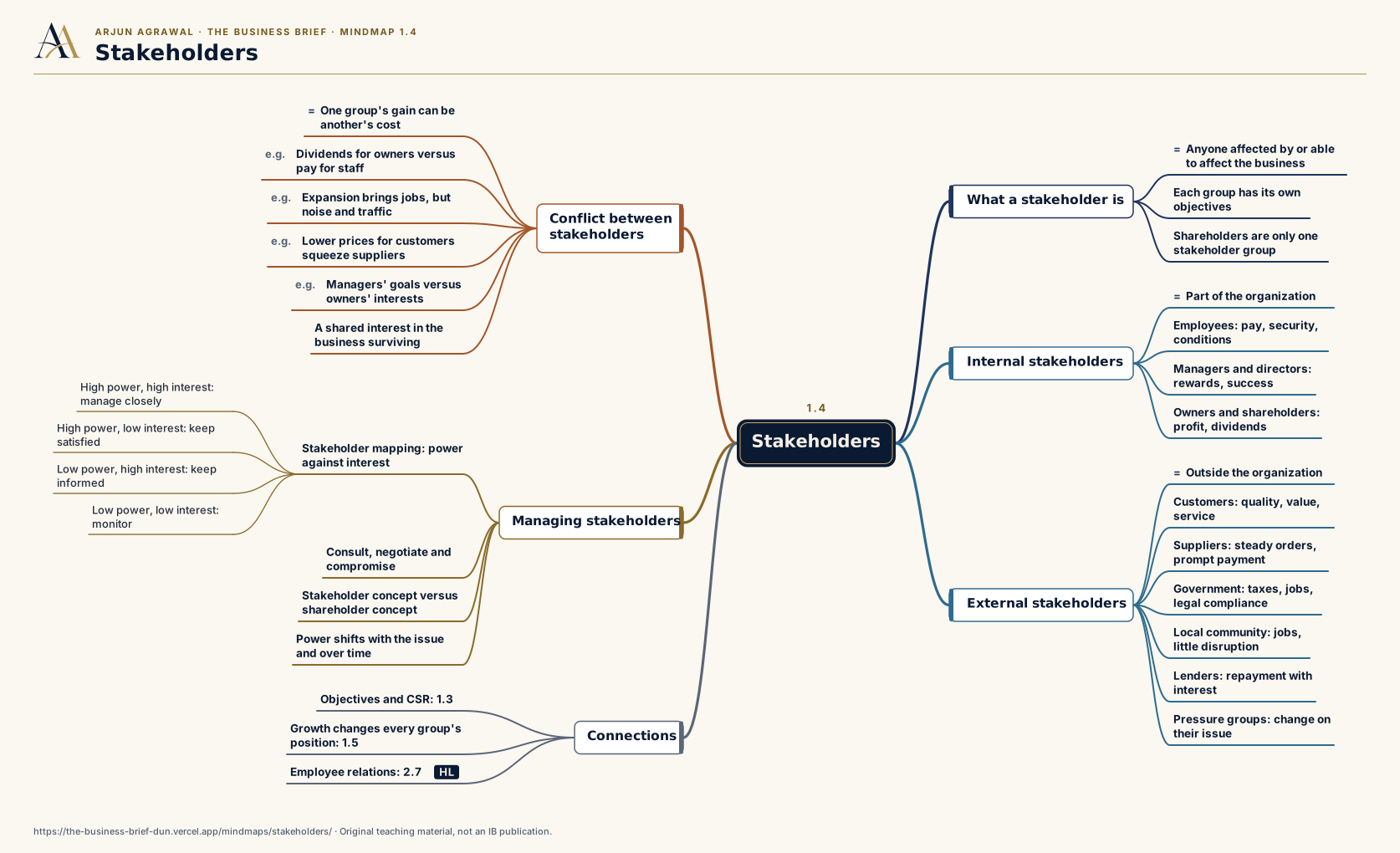
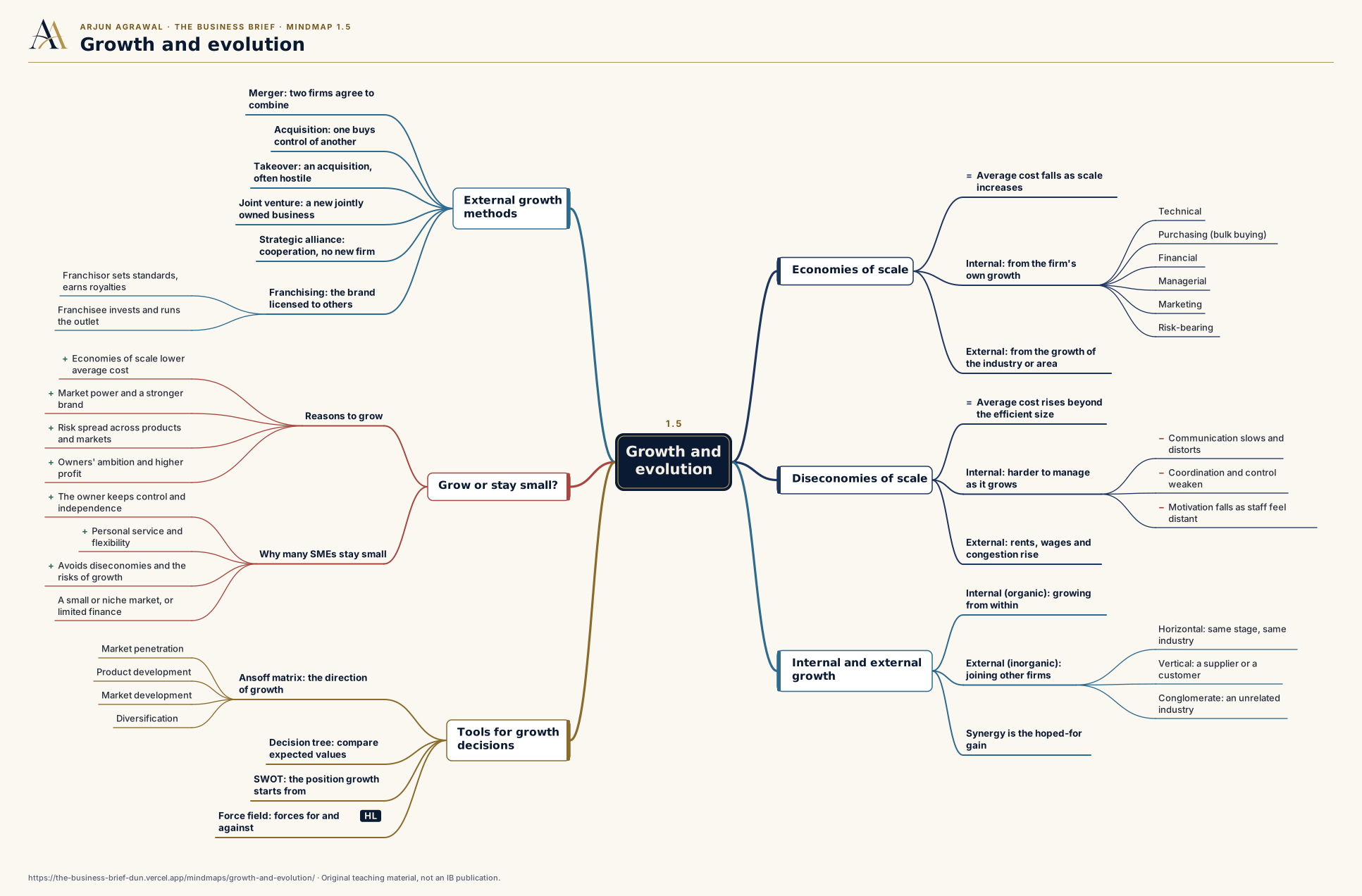
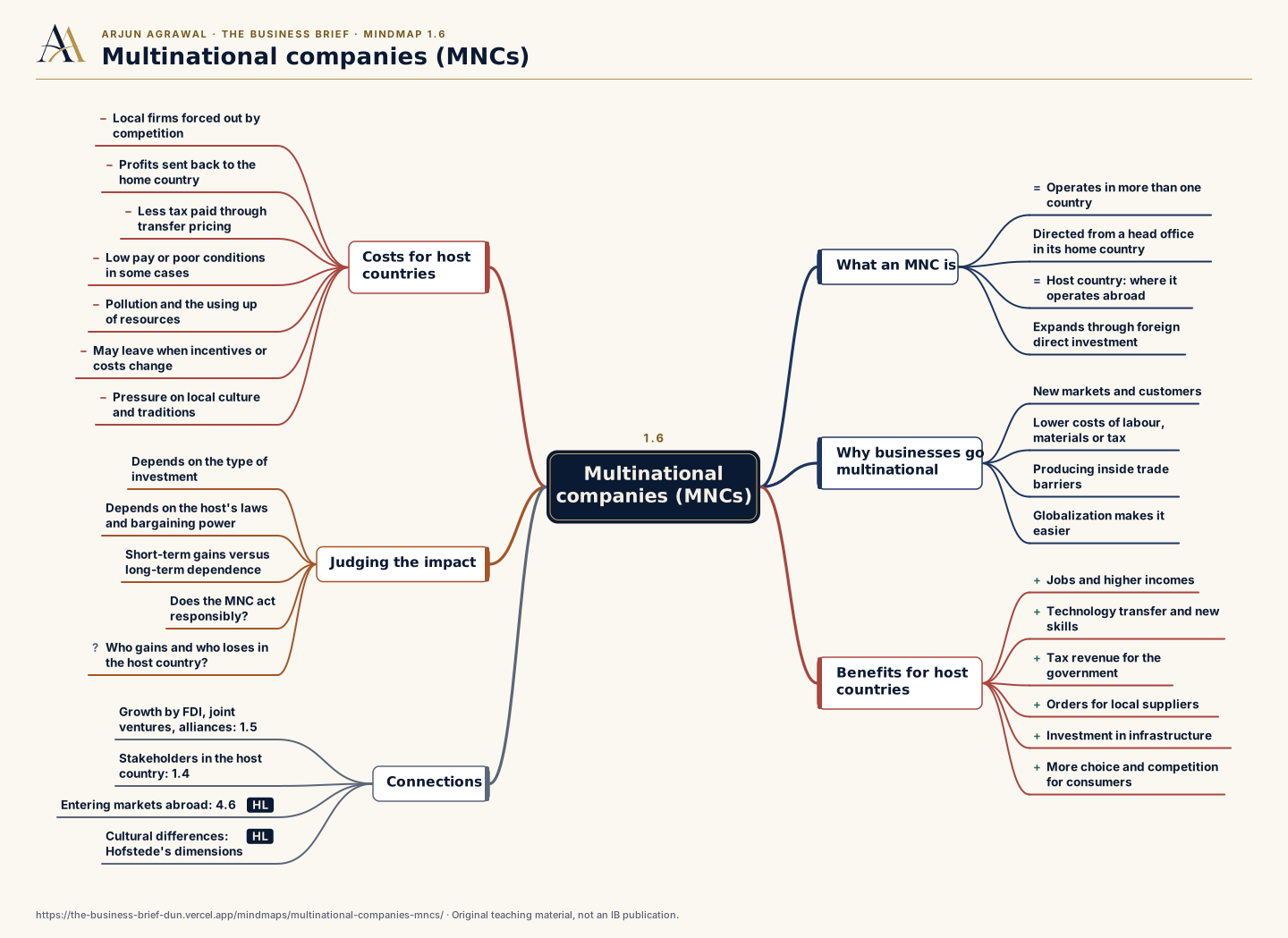
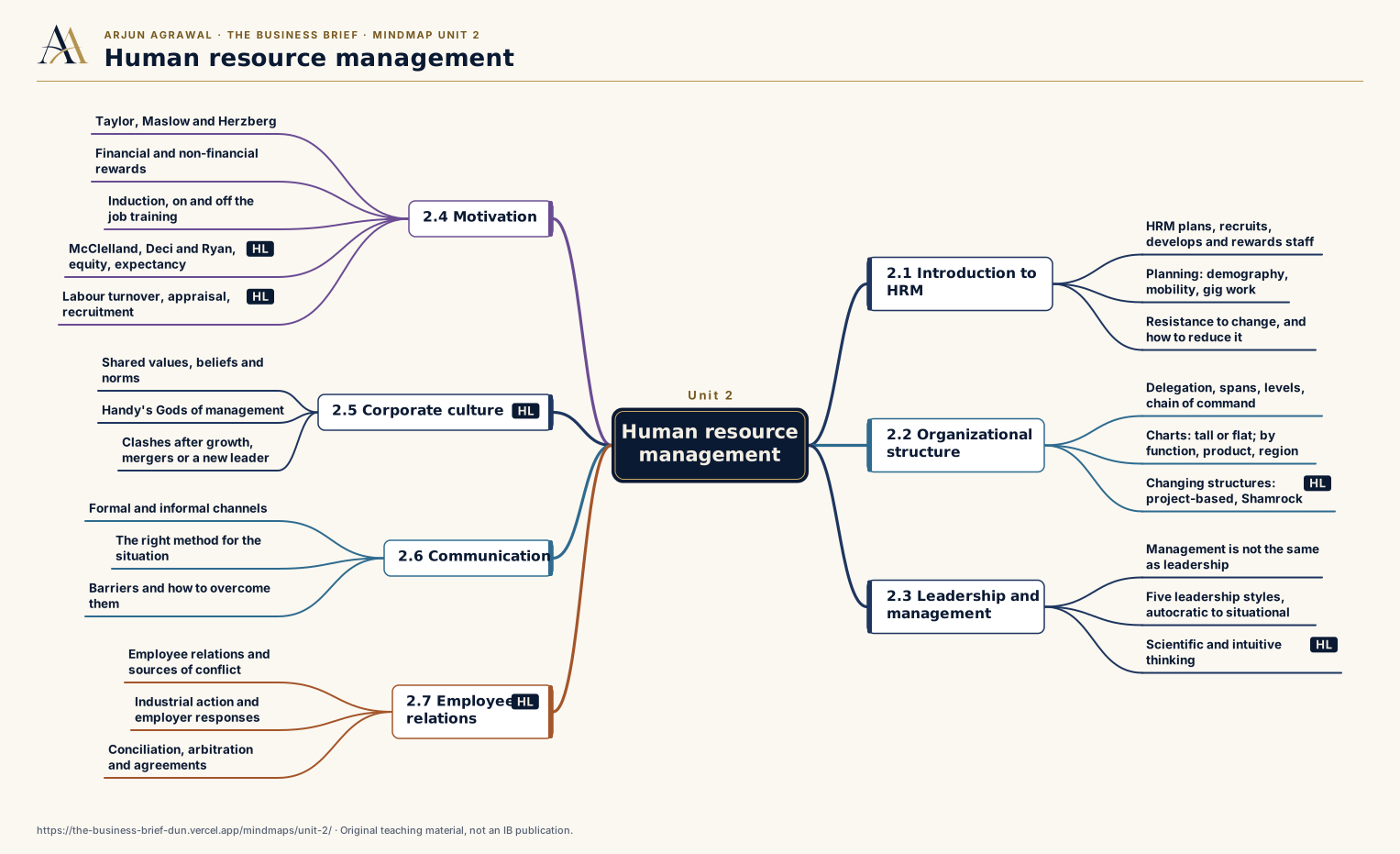
Showing 6 of 42
Infographics and diagrams 107
Original diagrams drawn from data, each with a full text description and an SVG file to download. Where a diagram has figures, they are fictional.
-
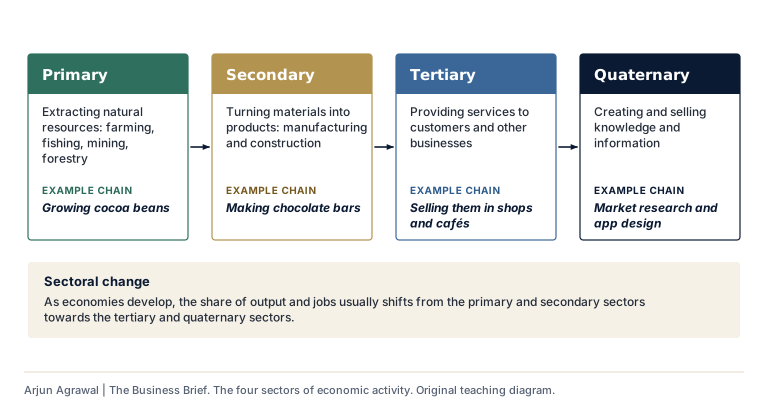
1.1 Diagram
The four sectors of economic activity
From extracting resources to selling knowledge, with one chain of production.
-
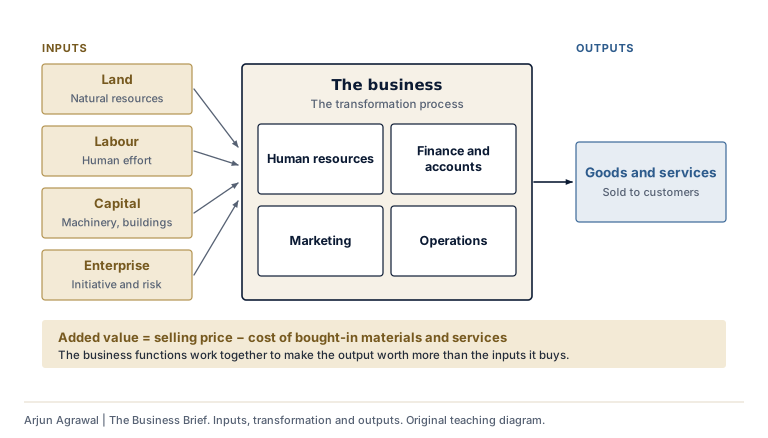
1.1 Diagram
Inputs, transformation and outputs
The factors of production, the four business functions and added value.
-
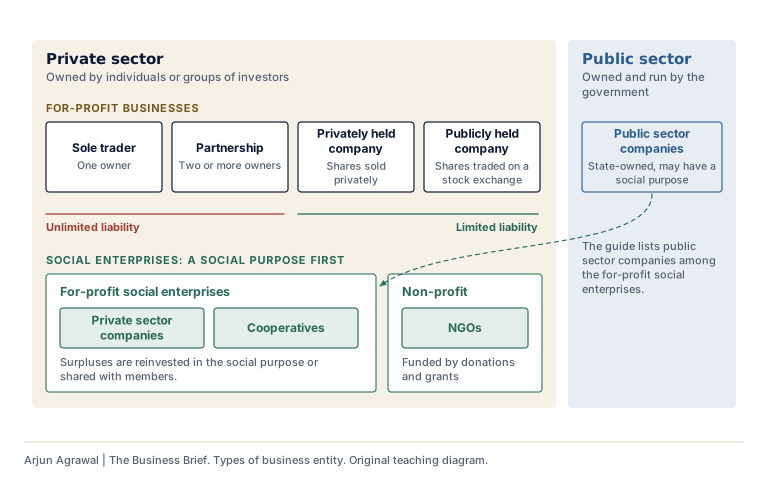
1.2 Diagram
Types of business entity
Private and public sectors, liability, and the social enterprises the guide names.
-
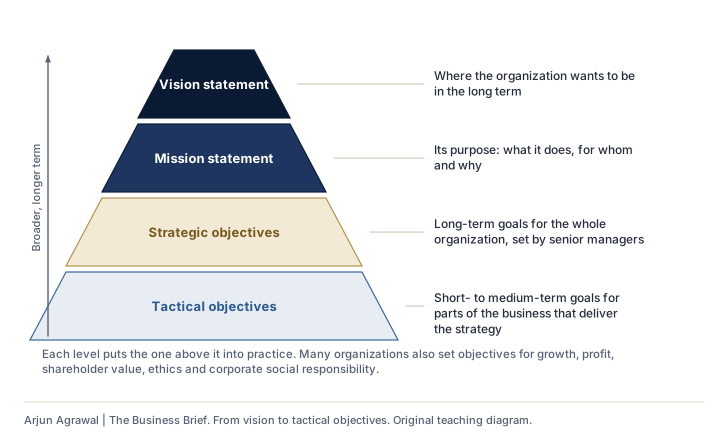
1.3 Diagram
From vision to tactical objectives
How vision, mission, strategic and tactical objectives fit together.
-
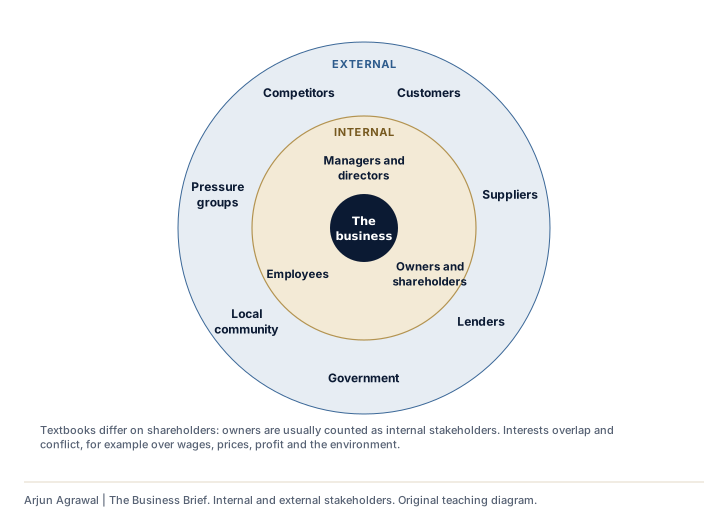
1.4 Diagram
Internal and external stakeholders
Who has a stake in the business, from the inside out.
-
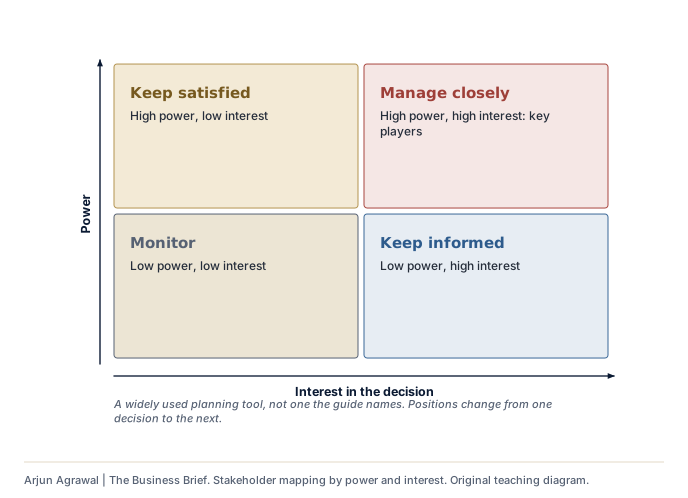
1.4 Diagram
Stakeholder mapping by power and interest
A planning tool for deciding how to treat each group in a decision.
Download SVG, 5 KB : Stakeholder mapping by power and interest
-
1.5 Diagram
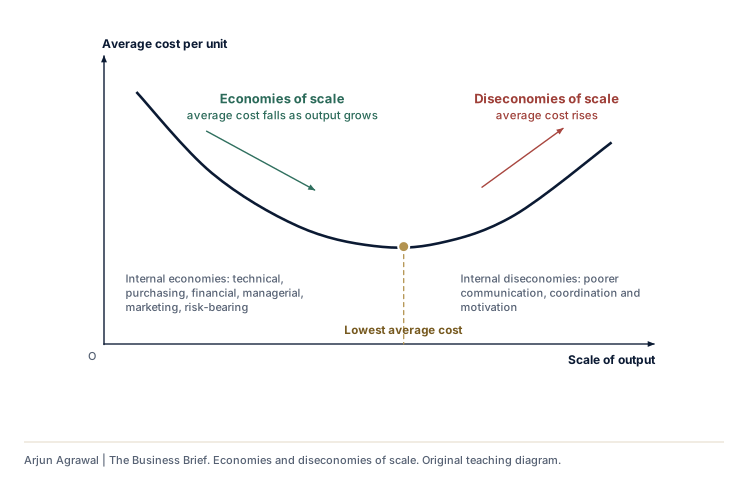
Economies and diseconomies of scale
Average cost falls, bottoms out and rises as a business grows.
-
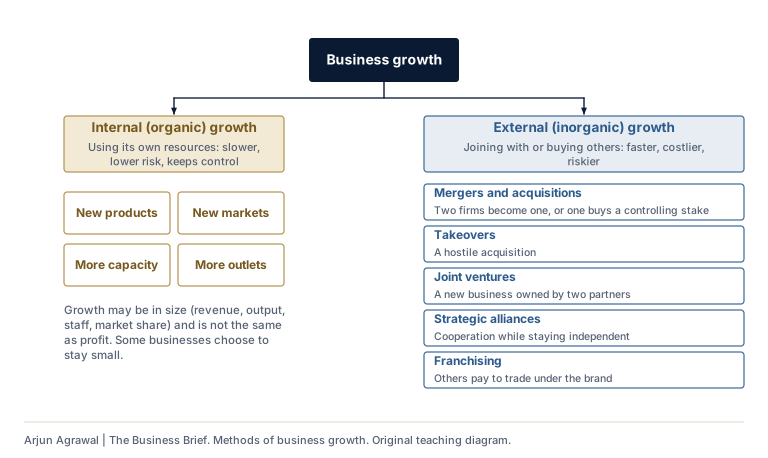
1.5 Diagram
Methods of business growth
Internal growth and the five external methods the guide names.
-
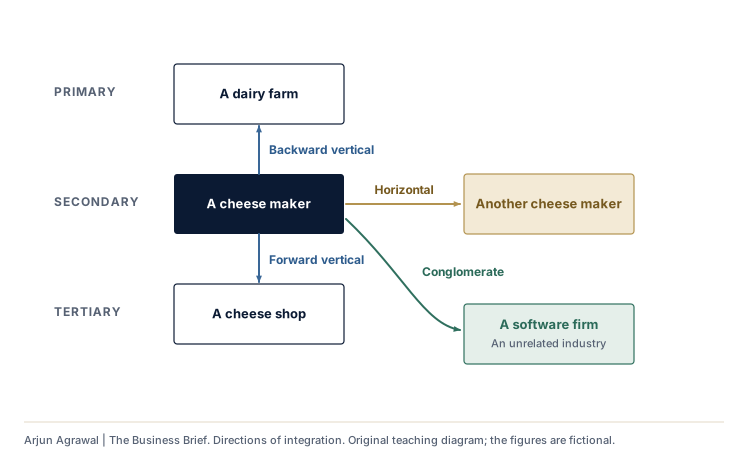
1.5 Diagram
Directions of integration
Horizontal, backward and forward vertical, and conglomerate, for one fictional business.
-
Diagram
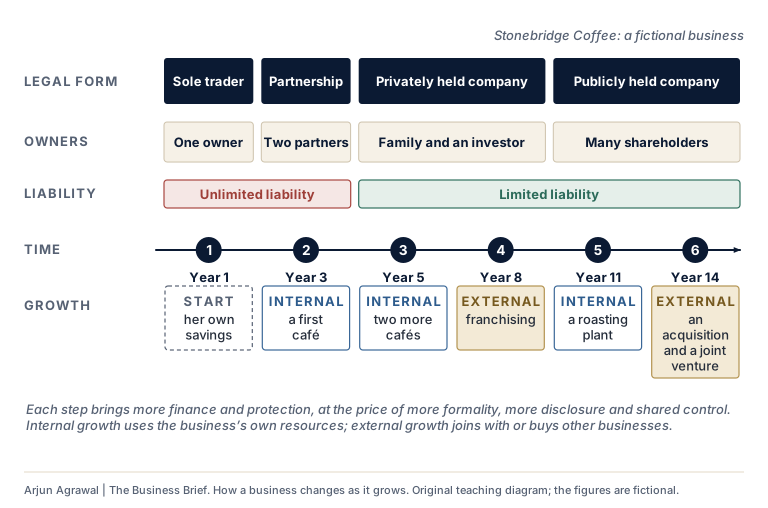
How a business changes as it grows
Legal form, owners, liability and method of growth for a fictional business over fourteen years.
-
1.2 Diagram
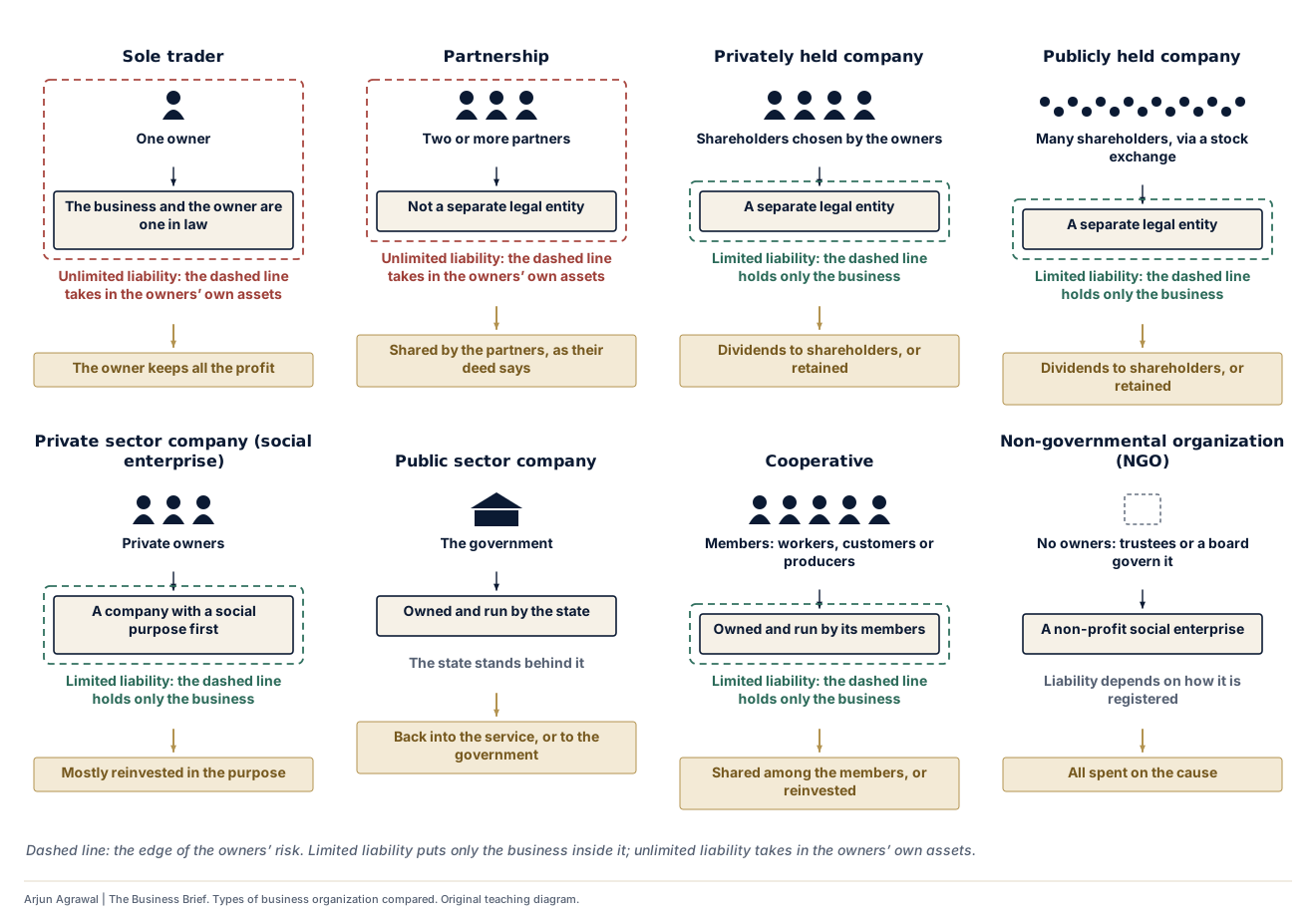
Types of business organization compared
Owners, liability and where the profit goes, for each type the guide names: choose two to set side by side.
Download SVG, 31 KB : Types of business organization compared
-
1.4 Diagram
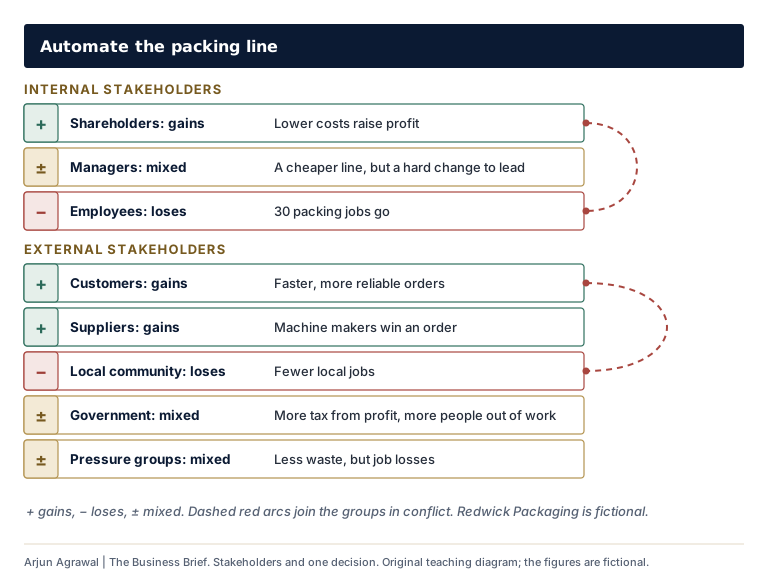
Stakeholders and one decision
Who gains and who loses from three decisions at a fictional manufacturer, and where they conflict.
-
Diagram
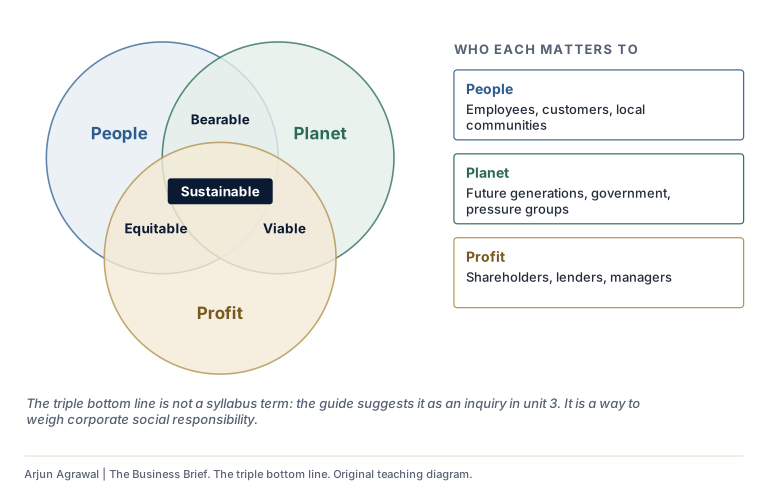
The triple bottom line
People, planet and profit, the overlaps between them, and the stakeholders each matters to most.
-
2.1 Diagram
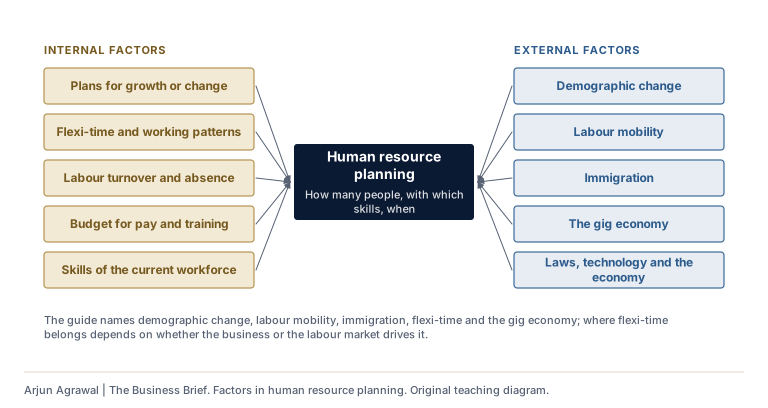
Factors in human resource planning
The internal and external factors that shape how many people a business needs.
-
2.2 Diagram
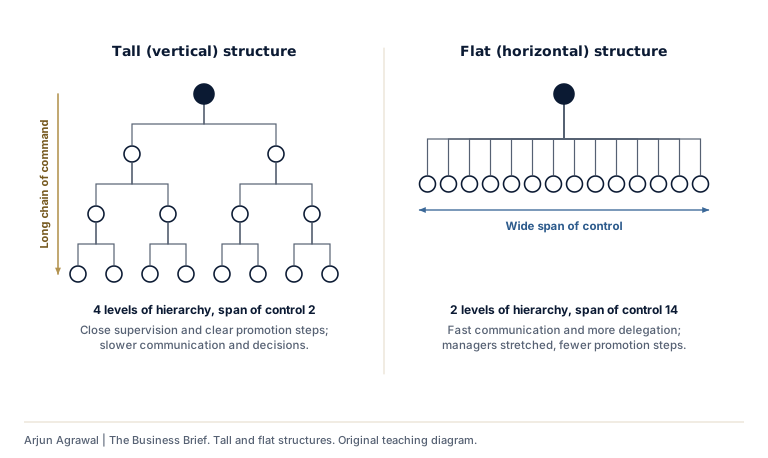
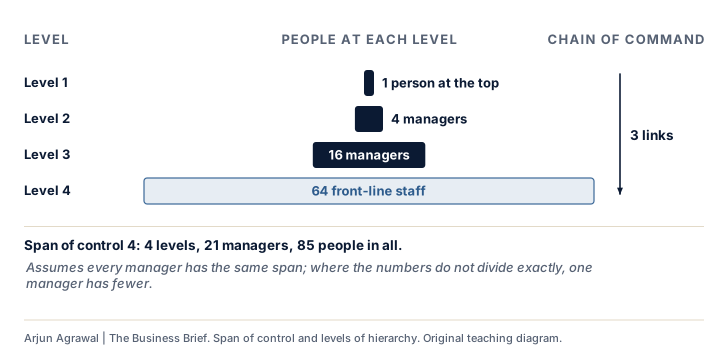
Tall and flat structures
Levels of hierarchy, span of control and chain of command compared.
-
2.2 Diagram
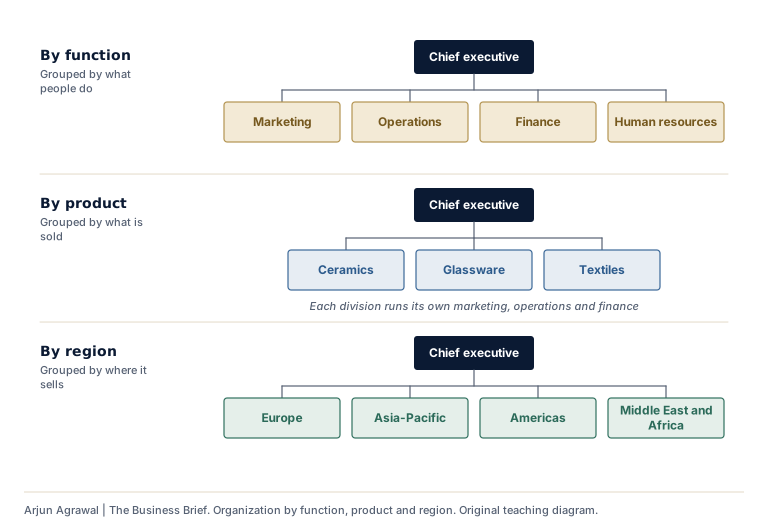
Organization by function, product and region
Three ways to group the same business.
Download SVG, 9 KB : Organization by function, product and region
-
2.2 Diagram
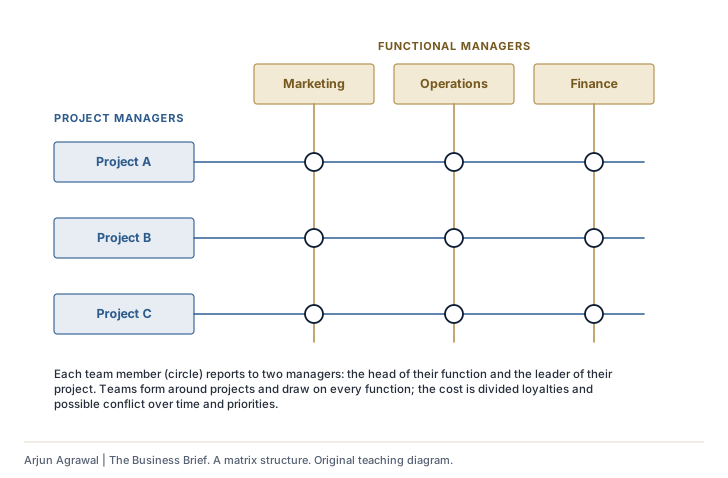
A matrix structure
Project teams that draw on every function, each member with two managers.
-
2.2 Diagram
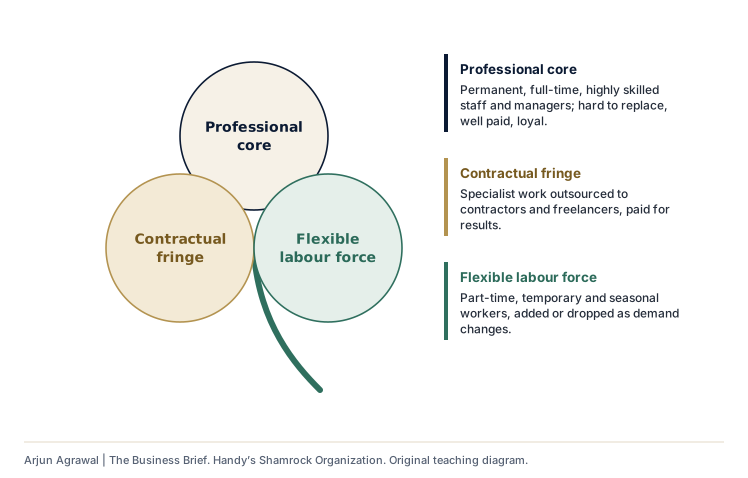
Handy’s Shamrock Organization
A professional core, a contractual fringe and a flexible labour force.
-
2.3 Diagram
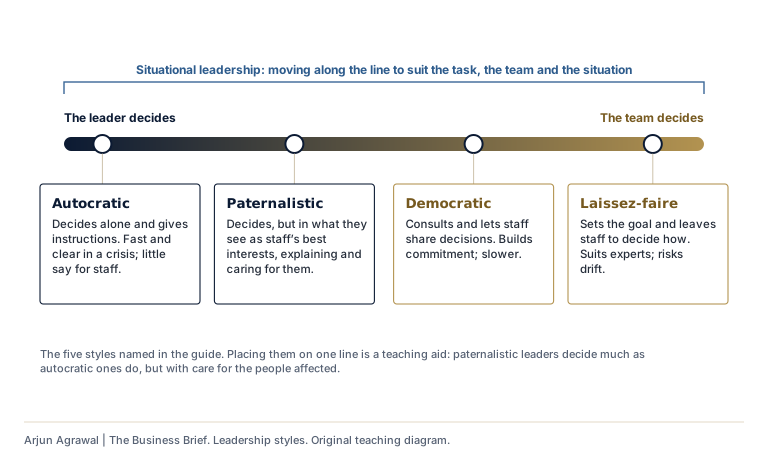
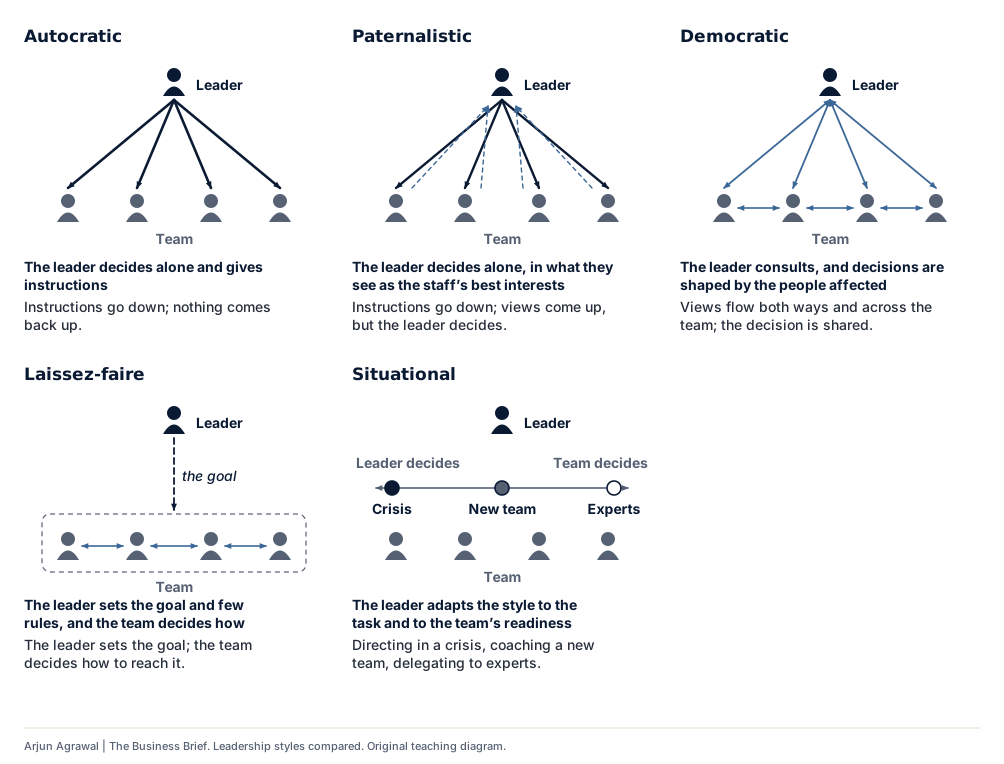
Leadership styles
The five styles in the guide, from the leader deciding to the team deciding.
-
2.4 Diagram
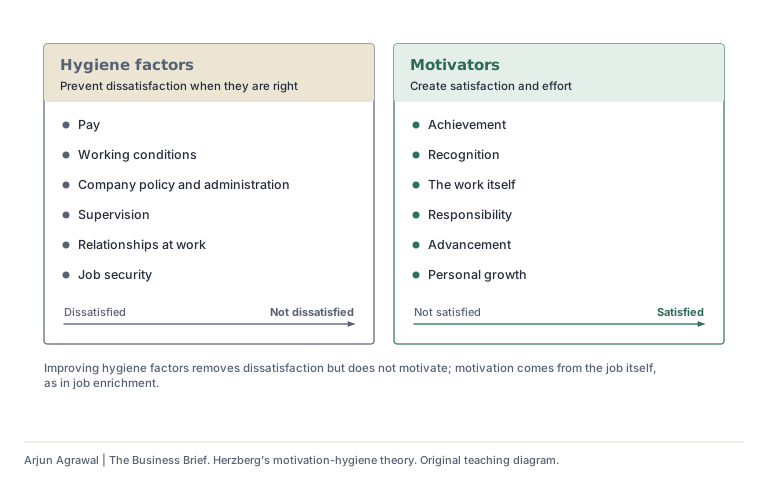
Herzberg’s motivation-hygiene theory
What prevents dissatisfaction is not what motivates.
-
2.4 Diagram
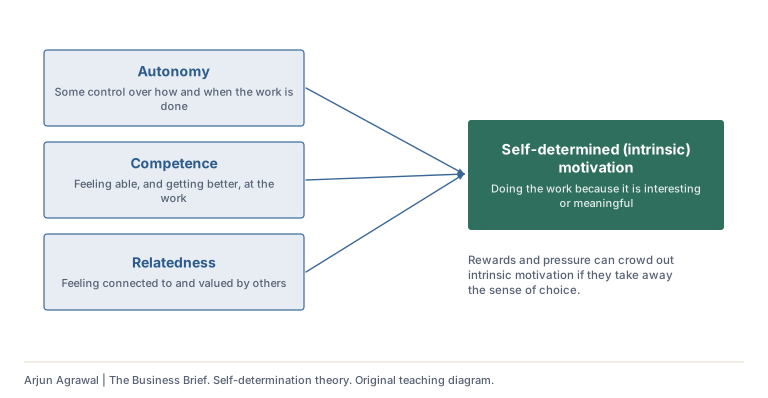
Self-determination theory
Autonomy, competence and relatedness feed intrinsic motivation.
-
2.6 Diagram
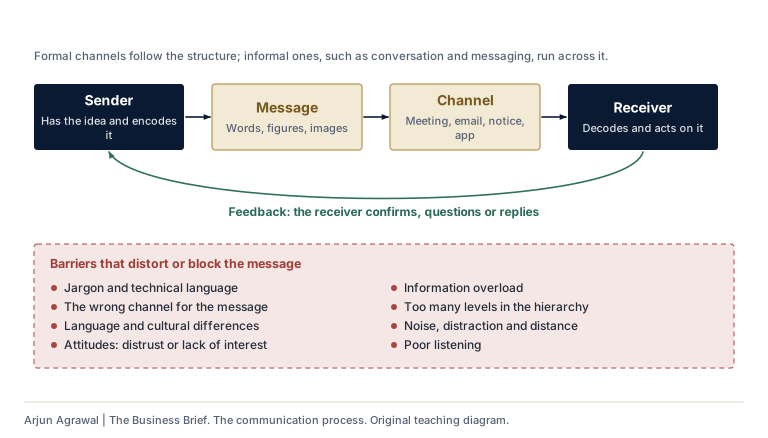
The communication process
Sender, message, channel, receiver, feedback, and the barriers in between.
-
2.7 Diagram
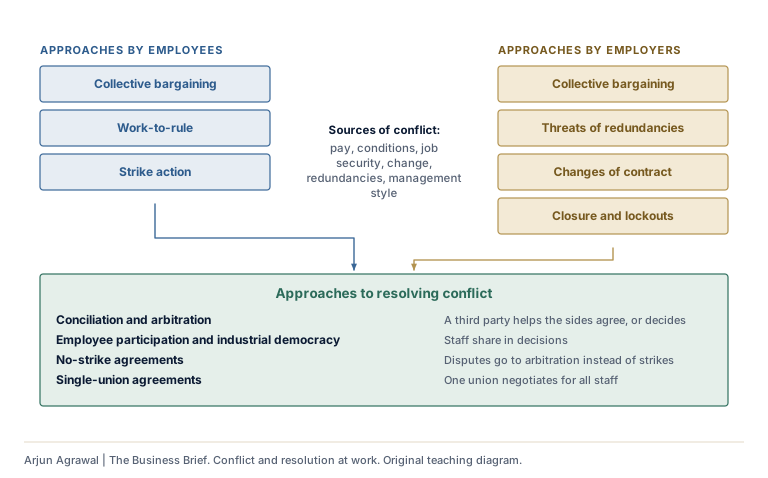
Conflict and resolution at work
Approaches by employees and employers, and the routes to agreement.
-
2.2 Diagram
Span of control and levels of hierarchy
Change the span of control and see the levels, the managers and the chain of command change with it.
Download SVG, 5 KB : Span of control and levels of hierarchy
-
2.3 Diagram
Leadership styles compared
Who decides, and which way communication runs, in each of the five styles: choose two to set side by side.
-
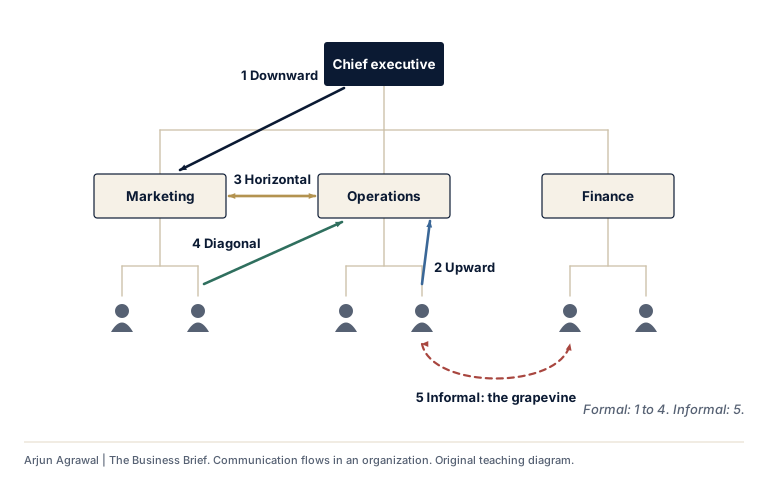
Diagram
Communication flows in an organization
Downward, upward, horizontal, diagonal and informal communication on one organization chart.
-
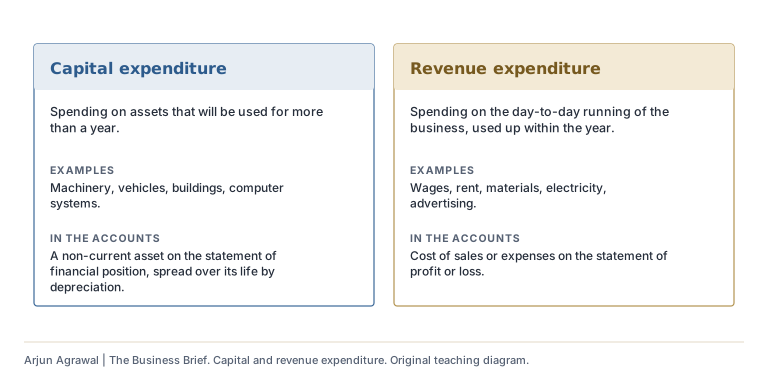
3.1 Diagram
Capital and revenue expenditure
Long-lived assets against day-to-day spending, and where each appears in the accounts.
-
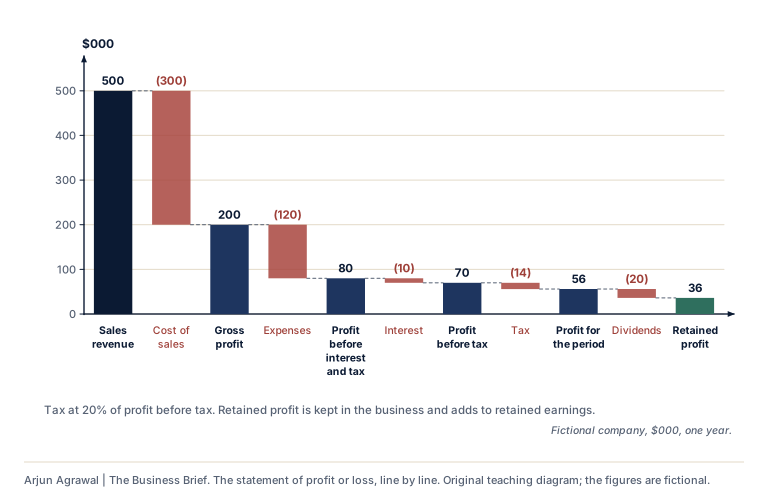
Diagram
The statement of profit or loss, line by line
From sales revenue to retained profit, in the guide’s order.
Download SVG, 10 KB : The statement of profit or loss, line by line
-
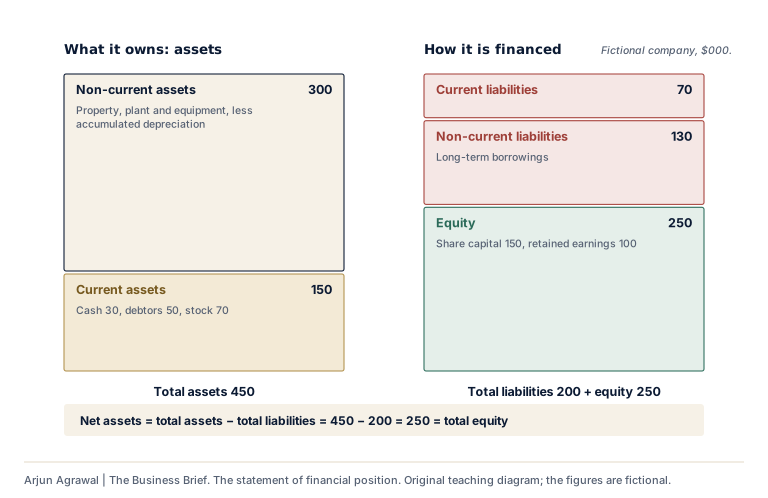
Diagram
The statement of financial position
What the business owns, and how it is financed, in balance.
-
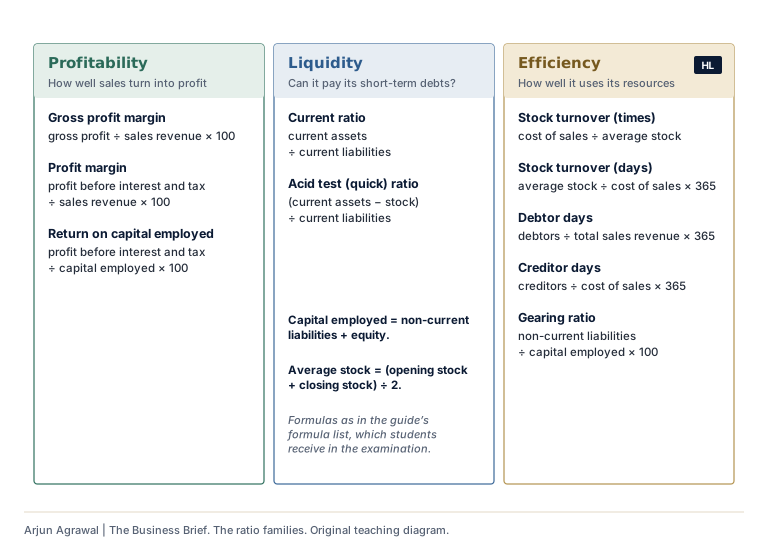
Diagram
The ratio families
Profitability, liquidity and efficiency ratios with the guide’s formulas.
-
3.7 Diagram
A cash flow forecast, month to month
How each closing balance becomes the next opening balance.
-
3.8 Diagram
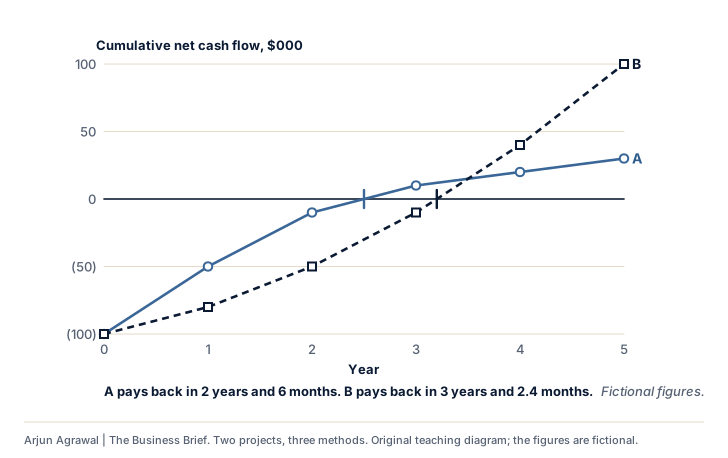
Payback and the average rate of return
Cumulative net cash flow, the payback point and the ARR.
-
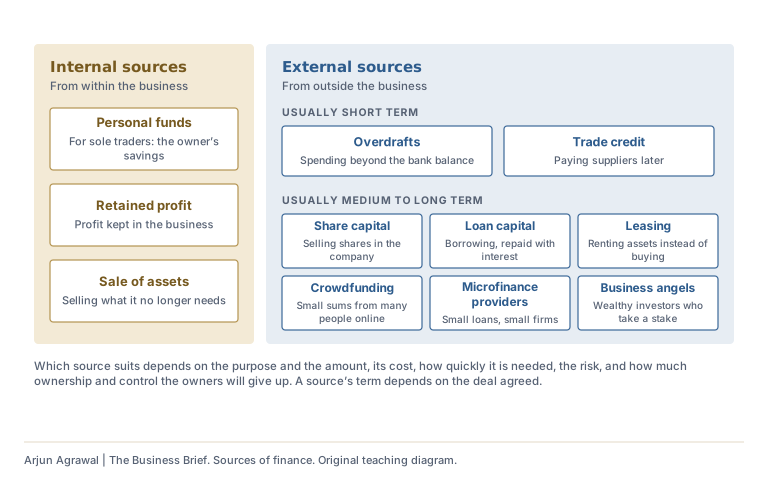
3.2 Diagram
Choosing a source of finance
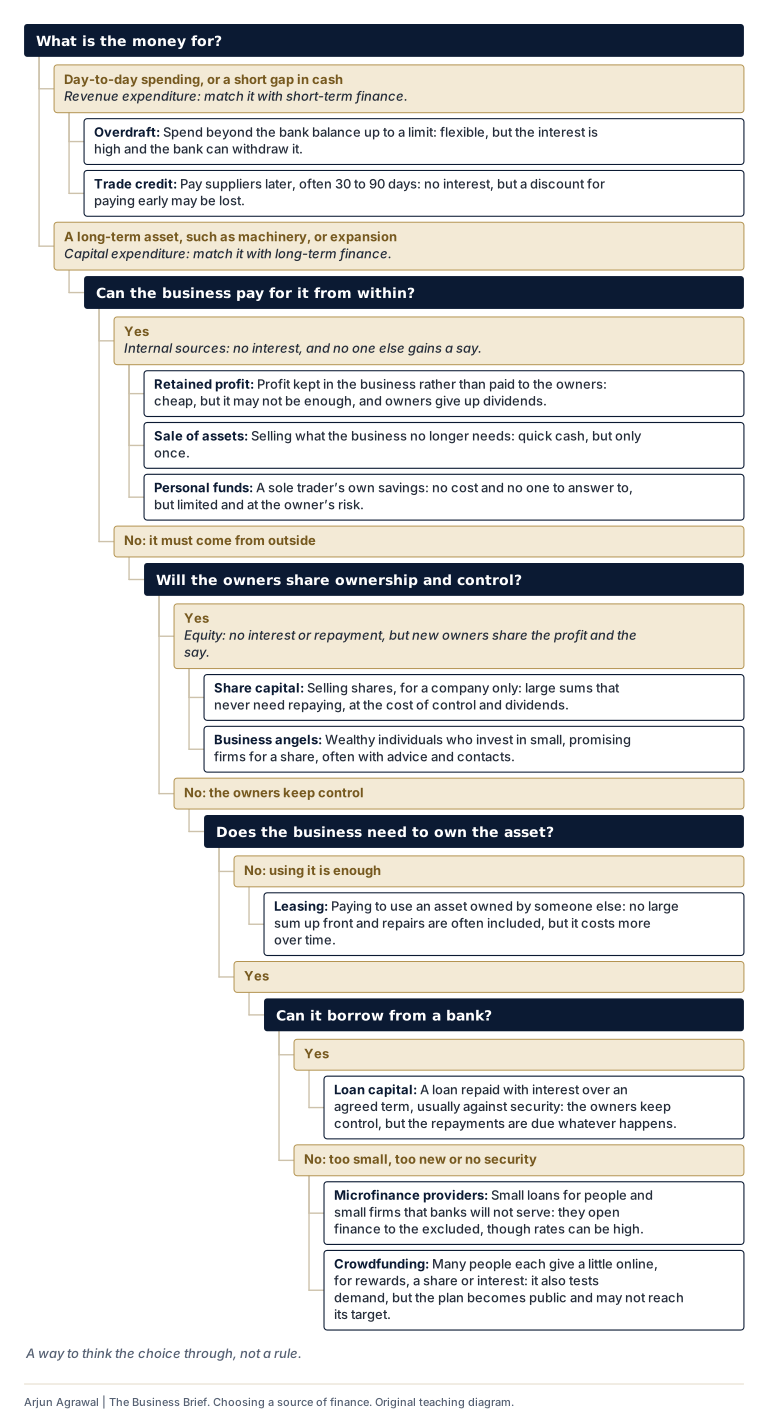
A decision tree from the purpose of the money to the sources that suit it, with the trade-off of each.
-
3.5 Diagram
Profitability and liquidity at a glance
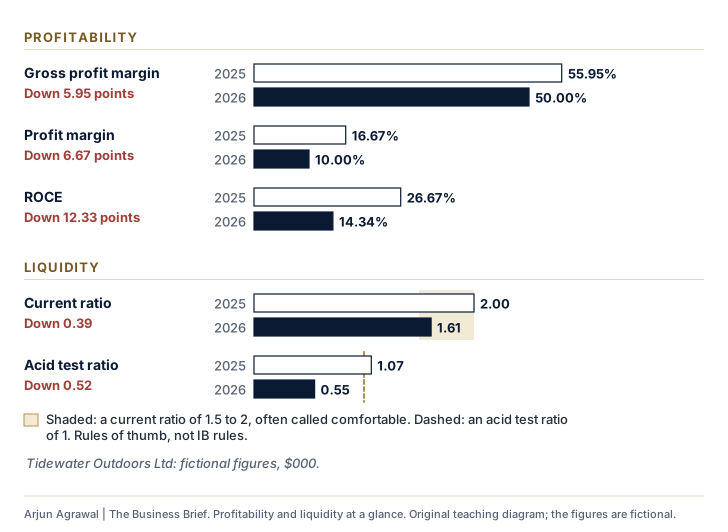
Five ratios for a fictional retailer in two years: change the second year’s figures and watch the ratios move.
Download SVG, 7 KB : Profitability and liquidity at a glance
-
3.7 Diagram
Profit and cash, month by month
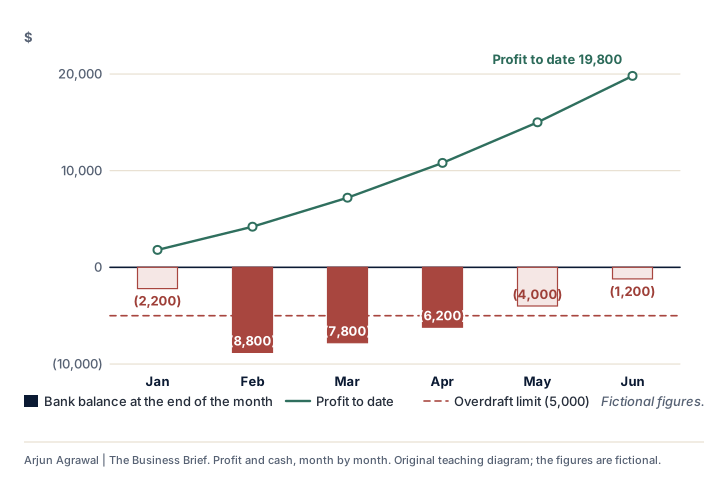
A profitable new business can still run out of cash: change the credit terms and see when the money arrives.
-
3.8 Diagram
Two projects, three methods
Payback, the average rate of return and NPV (HL) can rank the same two projects differently: change the figures and see when they agree.
-
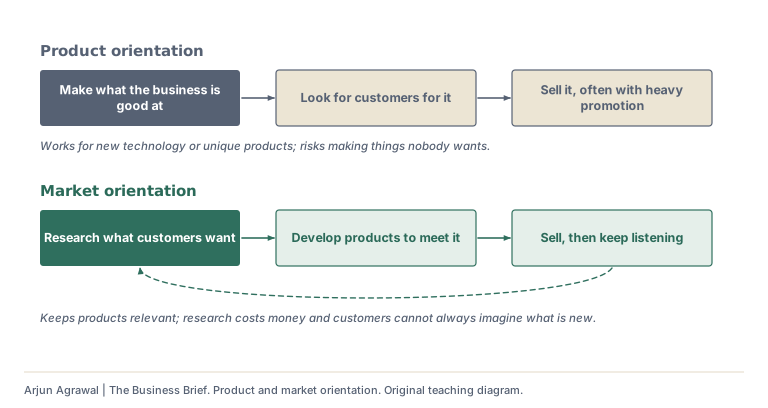
4.1 Diagram
Product and market orientation
Starting from what the business makes, or from what customers want.
-
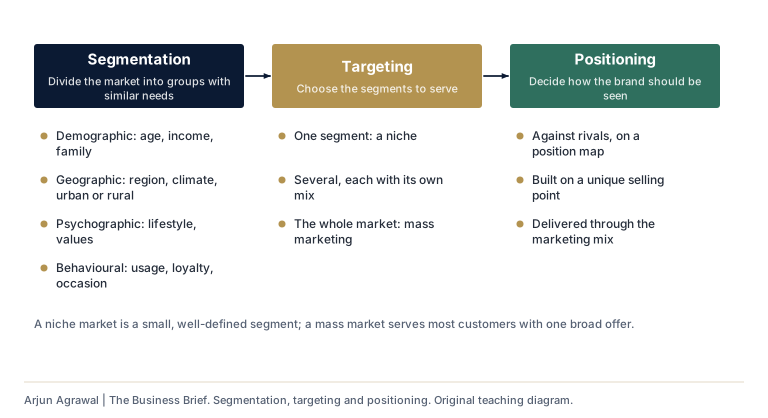
4.2 Diagram
Segmentation, targeting and positioning
The bases of segmentation and the choices that follow.
Download SVG, 6 KB : Segmentation, targeting and positioning
-
4.5 Diagram
The seven Ps of the marketing mix
The four Ps of any product and three more for services.
-
4.5 Diagram
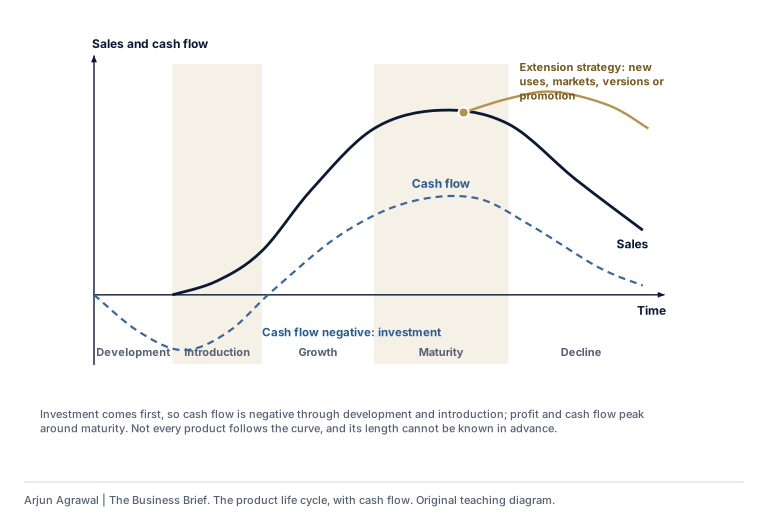
The product life cycle, with cash flow
Five stages, an extension strategy, and why cash flow lags sales.
-
4.5 Diagram
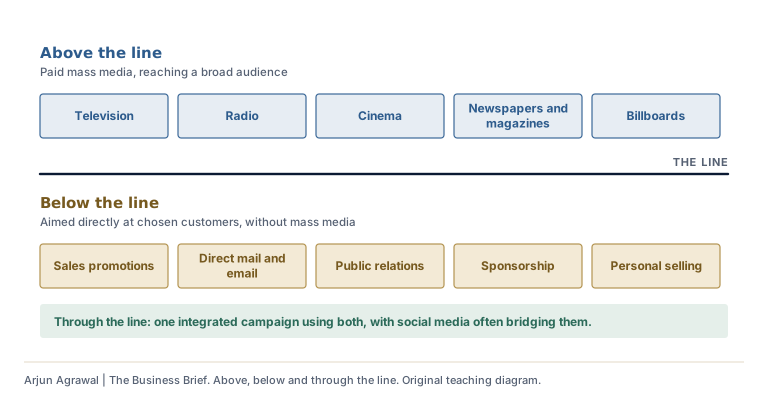
Above, below and through the line
Mass media, targeted promotion, and campaigns that combine them.
-
4.6 Diagram
International markets: opportunities and threats
What a business weighs before entering a new country.
Download SVG, 5 KB : International markets: opportunities and threats
-
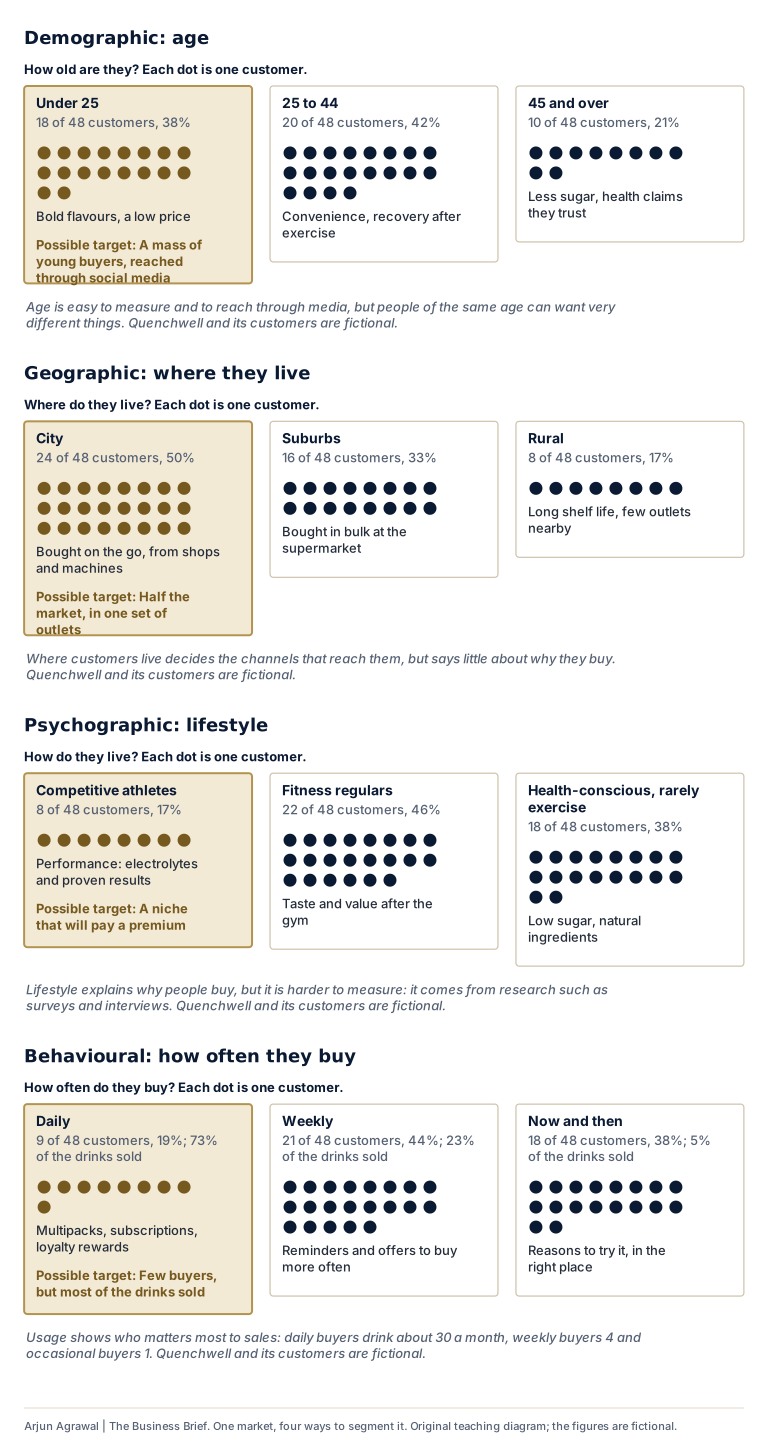
4.2 Diagram
One market, four ways to segment it
The same 48 customers grouped by age, place, lifestyle and how often they buy: each basis suggests a different target.
-
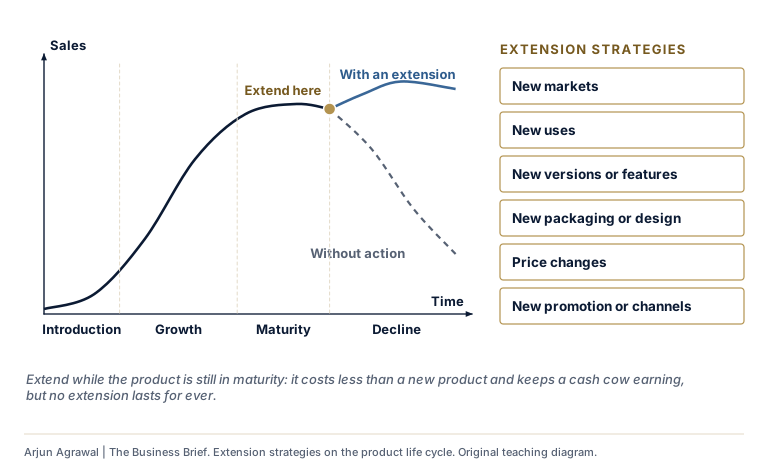
4.5 Diagram
Extension strategies on the product life cycle
Where an extension strategy changes the curve, and the six kinds to choose from.
Download SVG, 8 KB : Extension strategies on the product life cycle
-
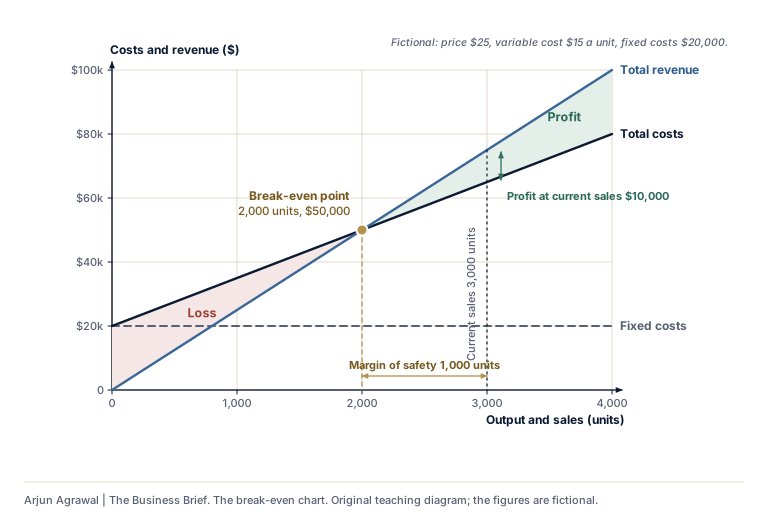
Diagram
The break-even chart
Where total revenue meets total costs; profit, loss and the margin of safety on either side.
-
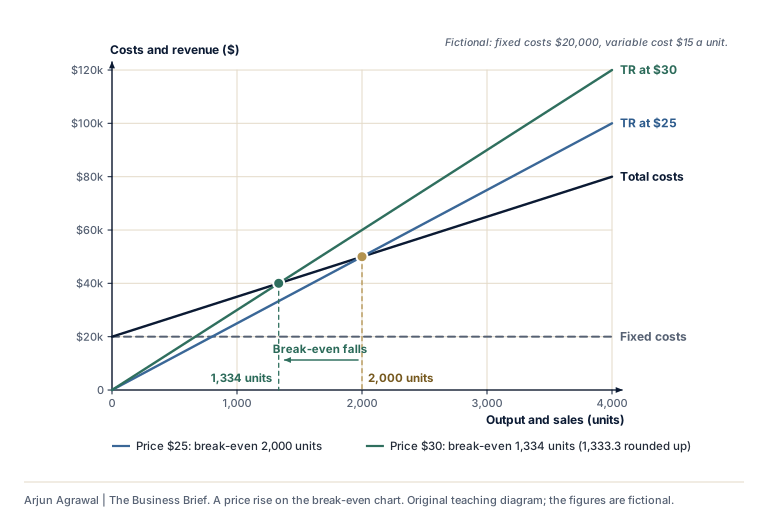
5.5 Diagram
A price rise on the break-even chart
A higher price steepens total revenue and lowers the break-even quantity.
-
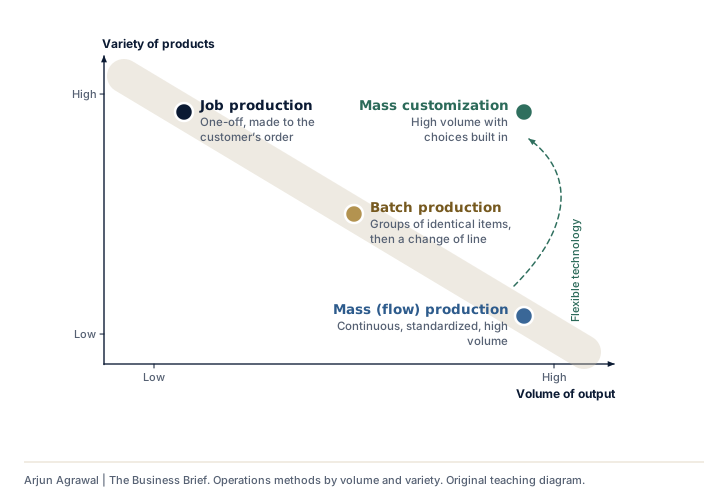
5.2 Diagram
Operations methods by volume and variety
Job, batch and mass production trade variety against volume; mass customization offers both.
Download SVG, 6 KB : Operations methods by volume and variety
-
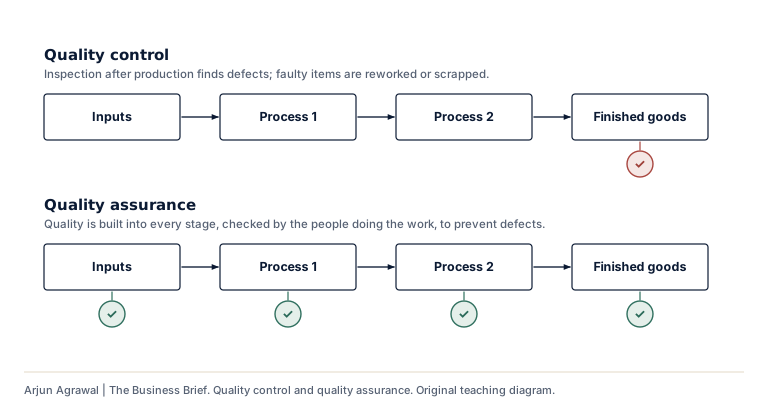
5.3 Diagram
Quality control and quality assurance
Finding defects at the end of the line, or preventing them at every stage.
-
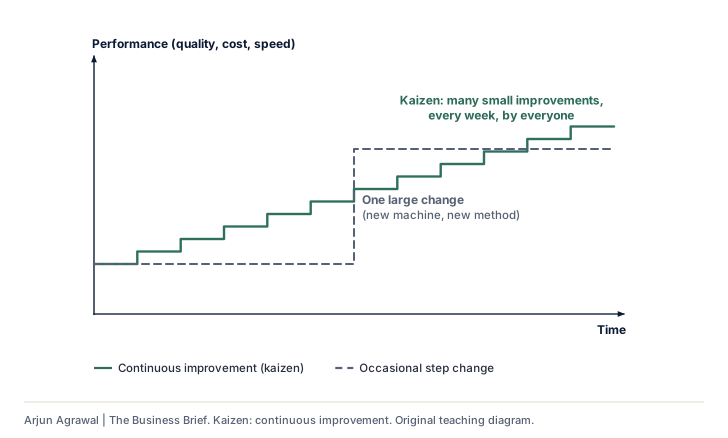
5.3 Diagram
Kaizen: continuous improvement
Many small improvements by everyone, set against one occasional large change.
-
5.3 Diagram
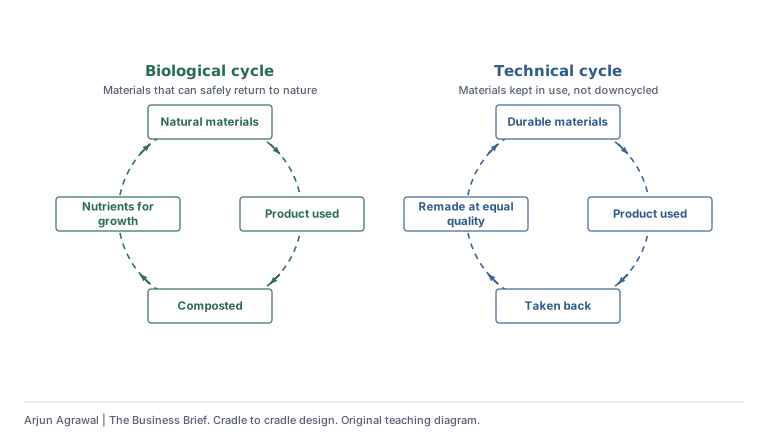
Cradle to cradle design
Every material is designed to return to nature or to be remade at equal quality.
-
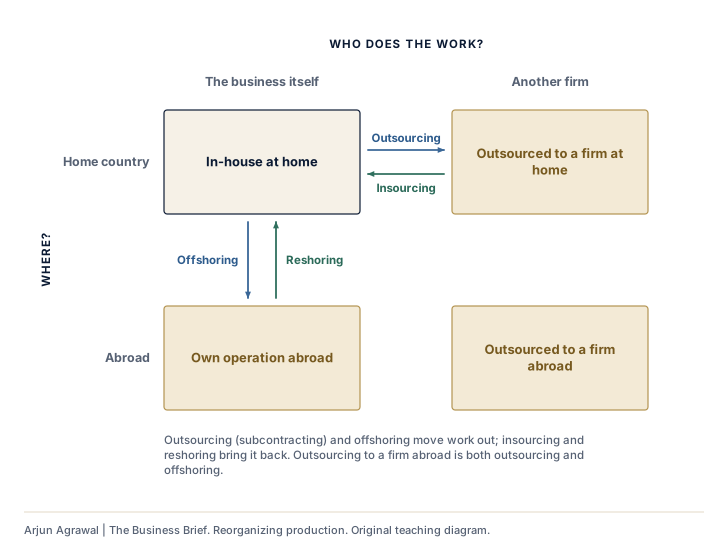
5.4 Diagram
Reorganizing production
Outsourcing, offshoring, insourcing and reshoring as moves between who does the work and where.
-
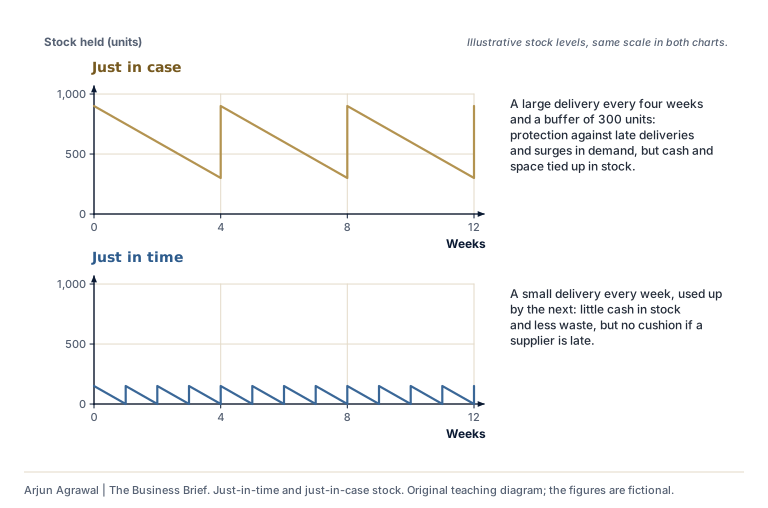
Diagram
Just-in-time and just-in-case stock
Small frequent deliveries against large deliveries with a buffer.
-
5.6 Diagram
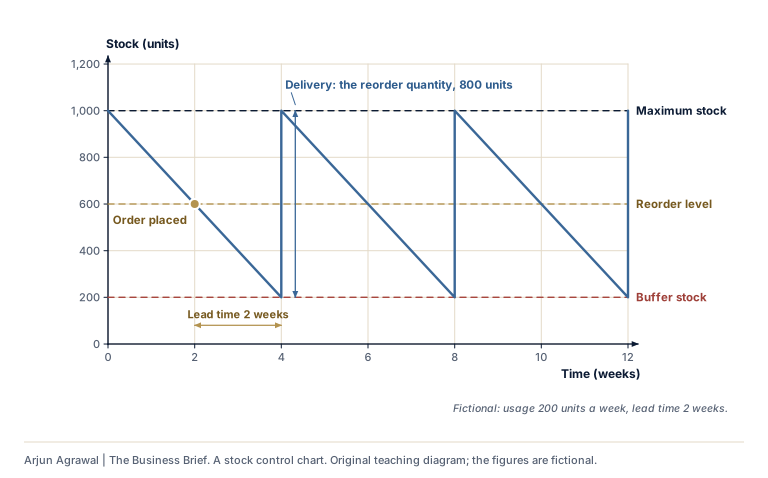
A stock control chart
Buffer stock, reorder level, reorder quantity and lead time on one chart.
-
5.7 Diagram
Contingency planning and crisis management
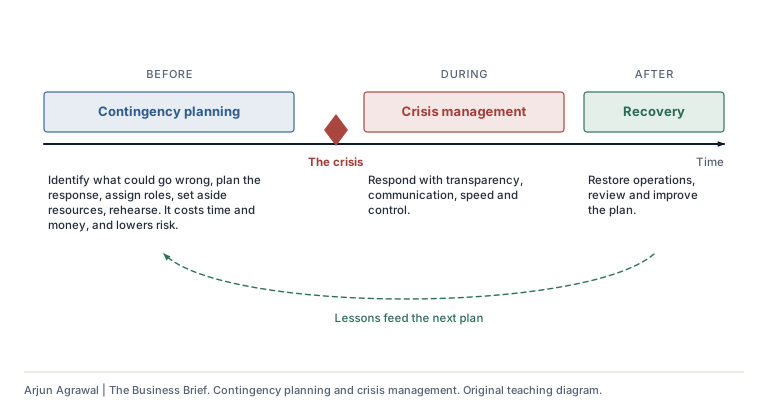
Planning before, managing during, recovering after.
Download SVG, 5 KB : Contingency planning and crisis management
-
5.8 Diagram
Incremental and disruptive innovation
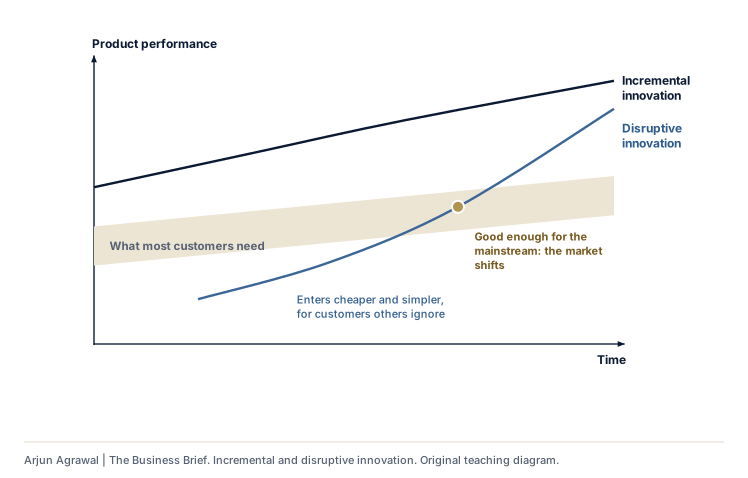
Improving what exists, or entering from below and overtaking it.
-
5.8 Diagram
Three forms of intellectual property protection
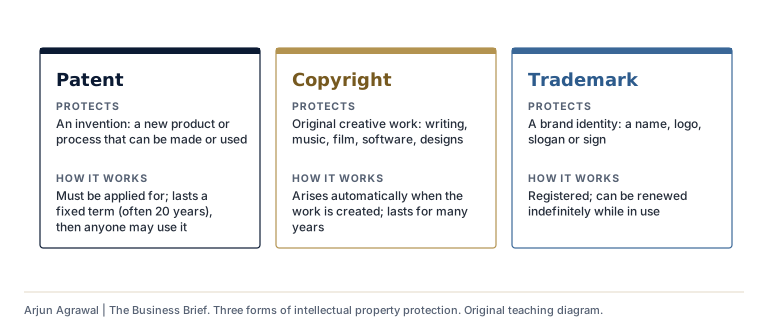
What patents, copyright and trademarks protect, and how.
Download SVG, 5 KB : Three forms of intellectual property protection
-
5.9 Diagram
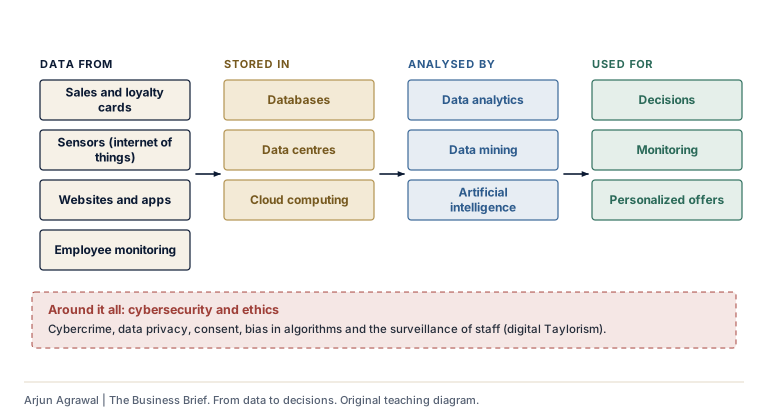
From data to decisions
How a management information system collects, stores, analyses and uses data.
-
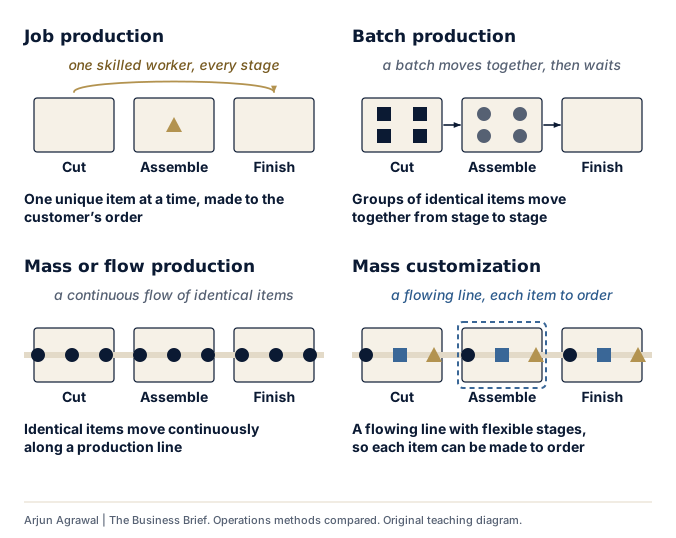
5.2 Diagram
Operations methods compared
How items move through production under each method: choose two to set side by side.
-
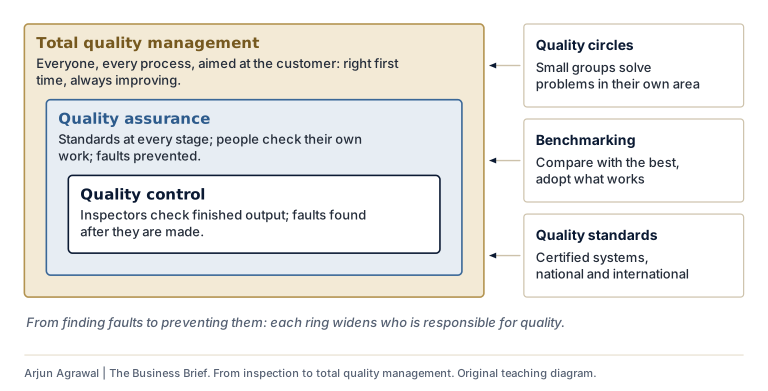
5.3 Diagram
From inspection to total quality management
Quality control, quality assurance and TQM as ever wider rings of responsibility, with the methods that support them.
Download SVG, 7 KB : From inspection to total quality management
-
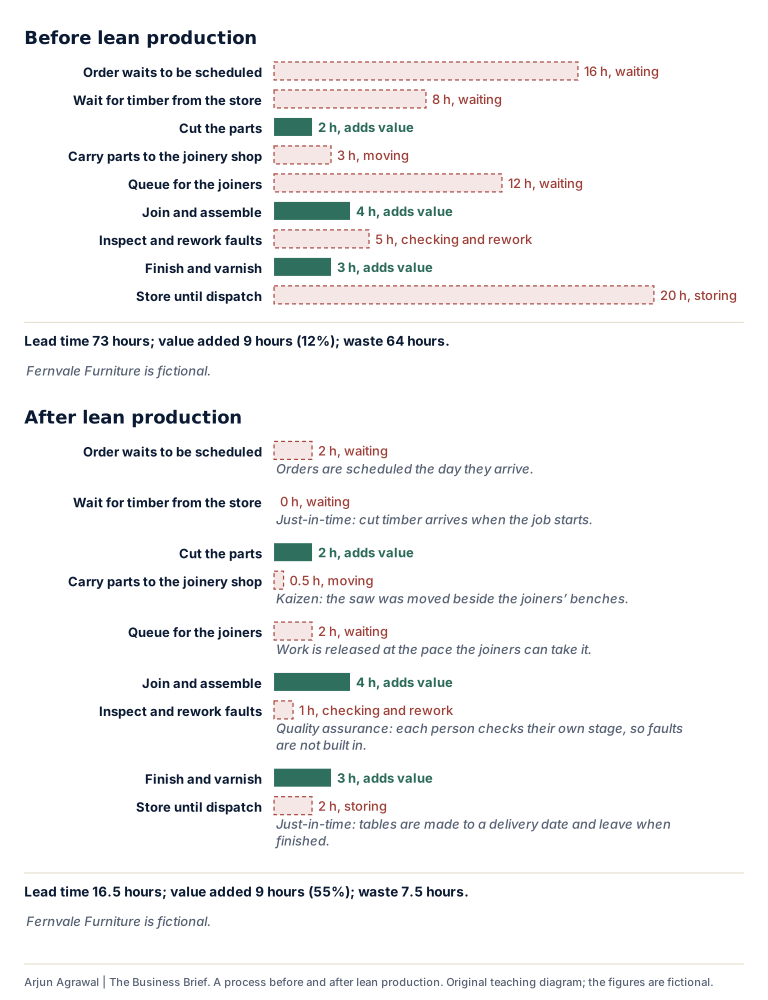
5.3 Diagram
A process before and after lean production
Making one table to order: lean production cuts the waiting, moving, checking and storing, not the work.
Download SVG, 12 KB : A process before and after lean production
-
Toolkit diagram
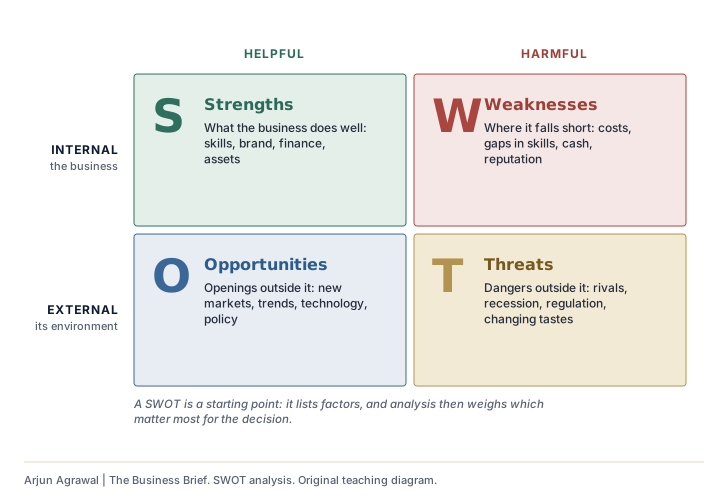
SWOT analysis
Internal strengths and weaknesses, external opportunities and threats.
-
Toolkit diagram
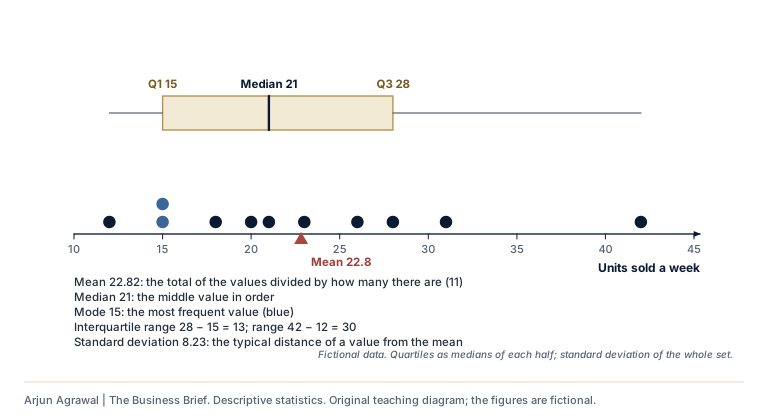
Descriptive statistics
Mean, median, mode, quartiles and standard deviation on one data set.
-
Toolkit diagram
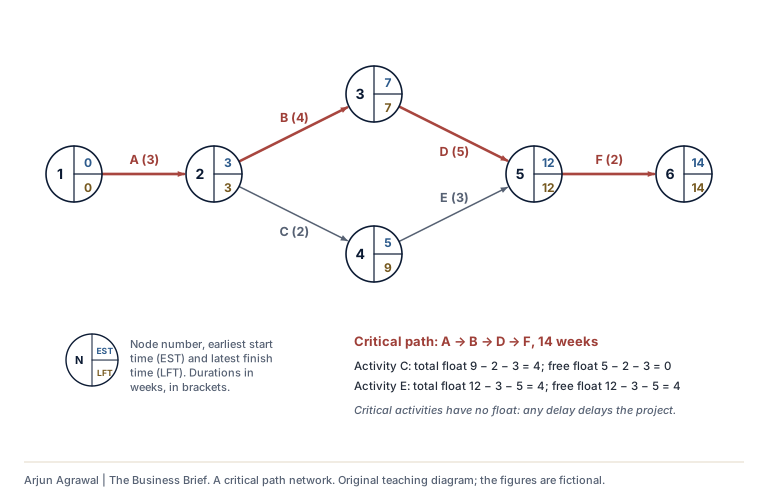
A critical path network
Earliest start and latest finish times, the critical path, total and free float.
-
4.3 Toolkit diagram
Simple linear regression
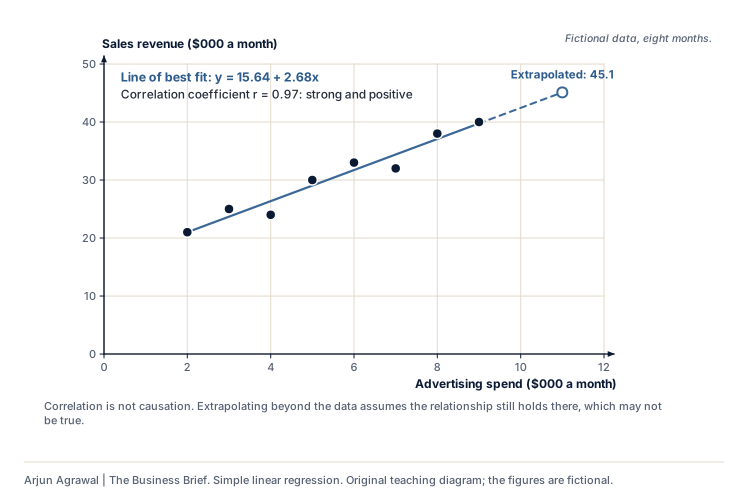
A scatter diagram, the line of best fit, correlation and extrapolation.
-
Toolkit diagram
Where each toolkit tool helps
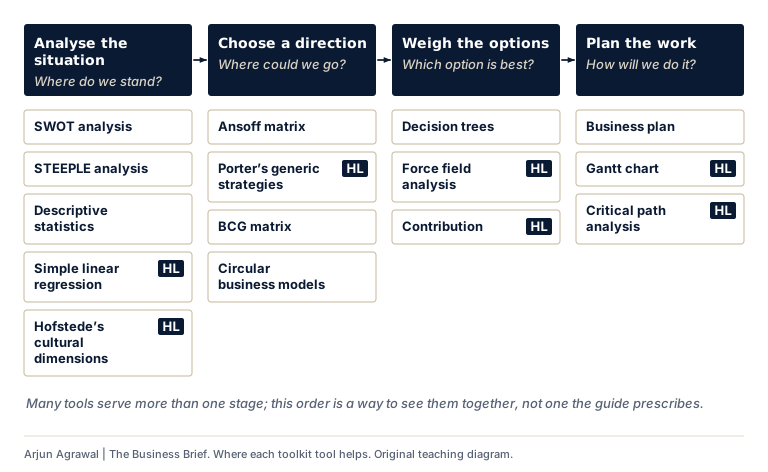
The fifteen toolkit tools placed at the stage of a strategic decision where each helps most; each opens its framework page.
-
1.1 Toolkit diagram
The anatomy of a business plan
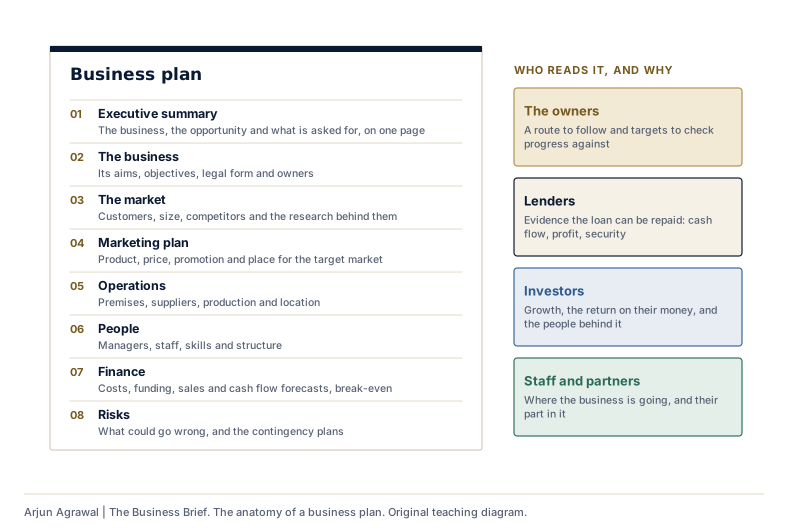
Its usual sections, and what each reader looks for.
-
Enrichment diagram
Porter’s five forces
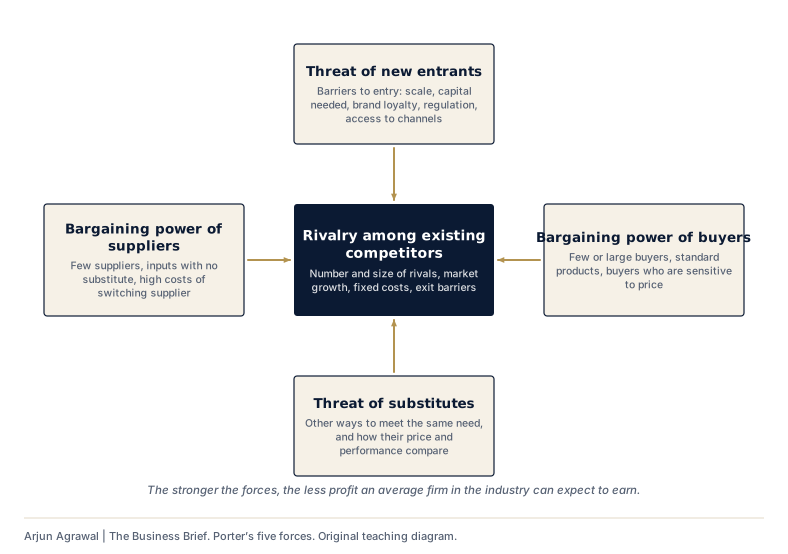
The five forces that shape how profitable an industry can be.
-
Enrichment diagram
The McKinsey 7S model
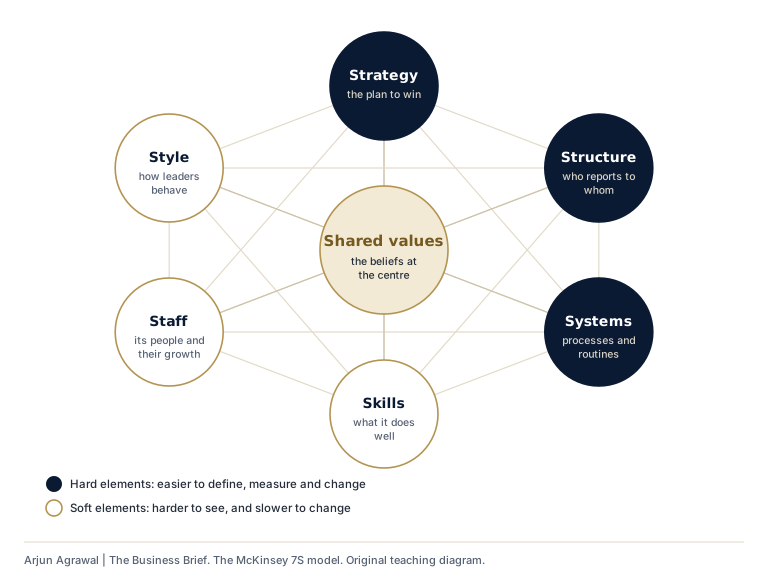
Seven elements that must fit together, with shared values at the centre.
-
Enrichment diagram
The business model canvas
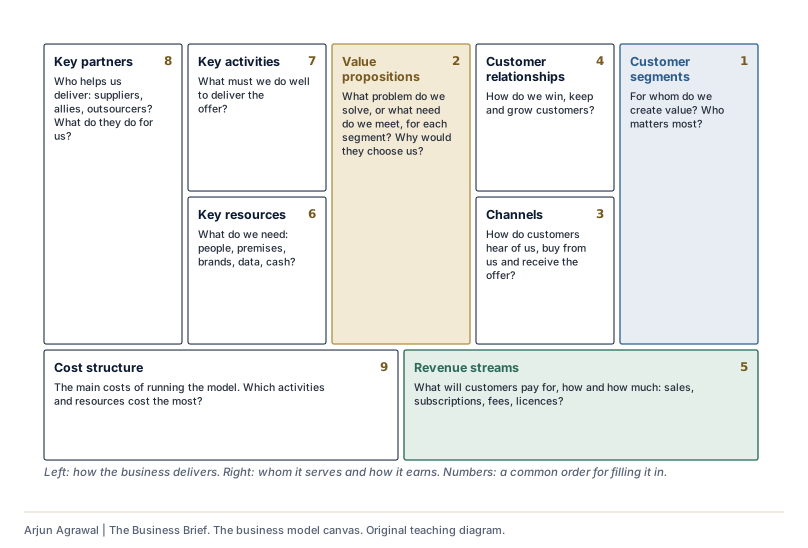
Nine blocks that describe how a business creates, delivers and captures value.
-
Enrichment diagram
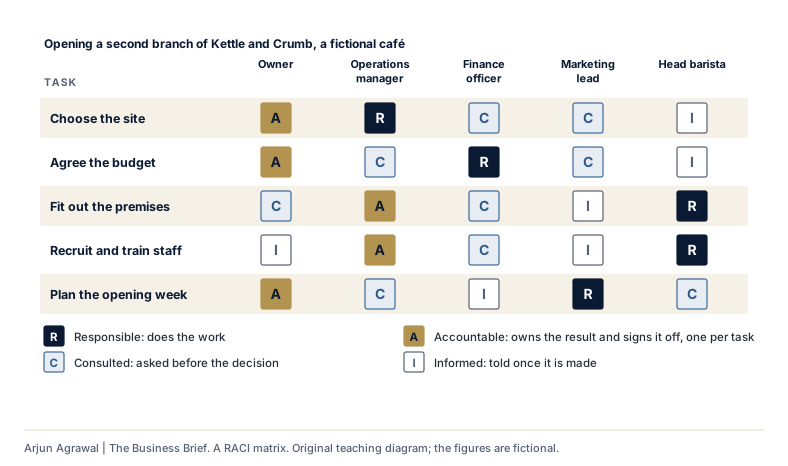
A RACI matrix
Who is responsible, accountable, consulted and informed, task by task.
Showing 6 of 107
Formula sheets 1
The IB formulae sheet exactly as the guide prints it, and apart from it every other formula the platform uses, placed in the course.
-
Formula sheet
The formula sheet
The IB formulae sheet exactly as the guide prints it, with the HL-only formulae marked, and apart from it every other formula the platform's tools use, each placed in the syllabus or marked as beyond it. A printable page; print it or save it as a PDF from your browser.
14 formulae on the IB sheet, and 45 more used on this site
- Gross profit margin
- Profit margin
- Return on capital employed (ROCE)
- Current ratio
Showing 1 of 1
Assessment guides 8
The creator’s four assessment guides as PDF files, and the pages on each component, the command terms and the internal assessment.
-
Assessment guide
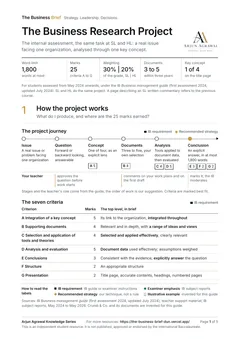
The Business Research Project: IA guide
The internal assessment in five pages, from the research question and key concept to supporting documents, criteria A to G, word count and submission, every point labelled as requirement, examiner emphasis, strategy or example.
Download PDF, 5 pages, 1.0 MB : The Business Research Project: IA guide
-
Assessment guide
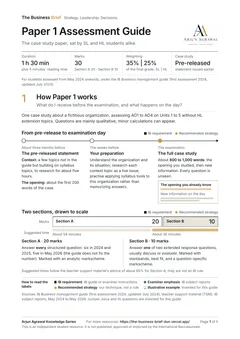
Paper 1 Assessment Guide
The case study paper in five pages, from the pre-released statement and command terms to Sections A and B, annotated answers on an invented business, and the step to the top markband.
-
Assessment guide
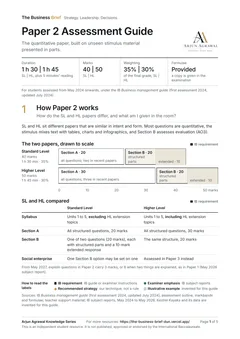
Paper 2 Assessment Guide
The quantitative paper in five pages, from reading unseen stimulus to formulas, working and rounding, evaluation of a number, and four constructions in IB format.
-
Assessment guide
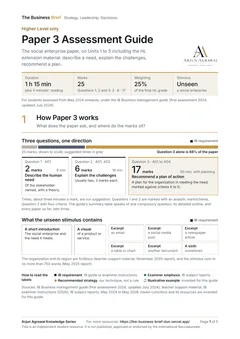
Paper 3 Assessment Guide (HL)
The social enterprise paper in five pages, from the human need and the challenges to a plan of action across the four functions, judged on criteria A to D.
Download PDF, 5 pages, 1.0 MB : Paper 3 Assessment Guide (HL)
-
Assessment guide
The Assessment Centre
How each component works, Paper 1, Paper 2, Paper 3 (HL) and the internal assessment, with what the guide requires and the preparation that pays, each point labelled by where it comes from.
-
Business terminology
Command terms, explained
What each of the course's command terms asks an answer to do, at its assessment objective, in the platform's words, with the page of the official definition.
-
IA support
IA Studio tools
A research question builder, a supporting-document checker, sorting practice on using evidence and on conclusions, and a criterion-by-criterion self-review.
-
IA support
The ten-step project planner
From a topic to a submitted project in ten steps, with checks on your supporting documents. Your plan stays on your device and prints for a meeting with your teacher.
Showing 6 of 8
Practice questions 8
Original questions in the style of each paper with mark schemes, worked constructions and calculation practice. None is an IB question.
-
Practice questions
The question bank
The platform's original practice questions, from the practice set, the notes and the case files, in one place. Filter by unit, subtopic, paper style, level, command term and marks, set yourself a timed set, and rate each answer; the ratings stay on your device.
-
Practice questions
Paper 2 calculation practice
Calculations with new fictional figures each time, from break-even and contribution to the ratios, cash flow and investment appraisal, checked within a stated tolerance, with the slip behind a wrong answer named and the full working shown.
-
Interactive tool
The Paper 2 answer builder
Twenty calculations laid out as examiners want them, formula, substitution, working and answer, with the errors that cost marks on each.
-
Worked solutions
Constructions in IB format, worked
A statement of profit or loss, a break-even chart, a cash flow forecast and a decision tree for one invented business, each laid out as the examination expects.
-
Interactive tool
The Paper 3 Strategic Planning Centre
Build a plan of action for an invented social enterprise across marketing, operations, HR and finance, tie it to the resources and tools, sequence it, and review it against criteria A to D.
-
Practice questions
Paper 1-style practice questions
11 original questions in the style of Paper 1, each with a mark scheme and the common errors to avoid. None is an IB question.
Contains 11
- Revenue streams beyond the mugs
- A battery factory in Valcora
- The Ansoff matrix and Marigold's options
and 7 more
-
Practice questions
Paper 2-style practice questions
14 original questions in the style of Paper 2, each with a mark scheme and the common errors to avoid. None is an IB question.
Contains 14
- The hotel's order (HL)
- Break-even quantity from November
- Why electricity is semi-variable
and 10 more
-
Practice questions
Paper 3-style practice questions
3 original questions in the style of Paper 3, each with a mark scheme and the common errors to avoid. None is an IB question.
Contains 3
- Paper 3 practice, question 2: the challenges
- Paper 3 practice, question 1: the human need
- Paper 3 practice, question 3: a plan of action
Showing 6 of 8
Case studies 28
Fictional businesses with exhibits to analyse and decisions to take, and one briefing on real developments, sourced and dated.
-
Case file
Atelier Barro
A ceramics studio in Porto faces an energy price rise and an order at half its usual price, in the same week.
Contains 5
- Exhibit 1: Cost ledger, before and from 1 November
- Exhibit 2: Revenue streams, last twelve months
- Exhibit 3: Customer survey and price test, estimated mugs sold a month at each price
- Exhibit 4: The hotel's request
and 1 more
-
Case file
Bellbird Home and Garden
A profitable family hardware chain in Brisbane will run out of overdraft just as its spring stock arrives.
Contains 8
- Exhibit 1: Statement of profit or loss, years to 30 June (A$000)
- Exhibit 2: Statement of financial position at 30 June (A$000)
- Exhibit 3: Cash flow forecast, July to December 2026 (A$000)
- Exhibit 4: The stores, year to 30 June 2026 (A$000)
and 4 more
-
Case file
Halden Distribution
A new site manager has four months to turn round a warehouse whose staff were led one way for fifteen years.
Contains 6
- Exhibit 1: Site performance over the last year
- Exhibit 2: People, by shift, over the last twelve months
- Exhibit 3: Staff survey, July 2026 (112 of 140 responded)
- Exhibit 4: The client's deadline
and 2 more
-
Case file
Larkspur Software
A Toronto scheduling app built to give shift workers control over their time is asked by its biggest clients to watch them instead.
Contains 9
- Exhibit 1: Summary statement of profit or loss, years to 31 December (C$000)
- Exhibit 2: Clients and revenue by segment, 2025
- Exhibit 3: What Pulse would do
- Exhibit 4: Pulse Lite and the interface, as the product team proposes them
and 5 more
-
Case file
Marigold Kitchens
A profitable four-restaurant business in Pune has five ways to grow, and a founder who will not compromise on the food.
Contains 8
- Exhibit 1: Restaurant economics, last financial year (one restaurant)
- Exhibit 2: The group today
- Exhibit 3: The five routes, as forecast by the finance manager
- Exhibit 4: Tiffin Lane, last financial year
and 4 more
-
Case file
Patchwork Digital
A Glasgow social enterprise that refurbishes laptops for pupils and trains people leaving prison is offered a contract its trainees could not work on.
Contains 8
- Exhibit 1: Income and costs, 2025 (£000)
- Exhibit 2: Devices in 2025, and the price or fee for each
- Exhibit 3: Three years of Patchwork
- Exhibit 4: Four plans, a year from 2026
and 4 more
-
Case file
Quintanilla Autopartes
A family parts maker in Monterrey must choose one investment as the engines its products are made for start to disappear.
Contains 9
- Exhibit 1: Statement of profit or loss, years to 31 December (MX$m)
- Exhibit 2: Extract from the statement of financial position at 31 December 2025 (MX$m)
- Exhibit 3: The three projects, forecast net cash flows by year (MX$m)
- Exhibit 4: Sales by product family (MX$m)
and 5 more
-
Case file
Silvertree Clinics
A Cape Town clinic network is losing nearly a third of its nurses a year, and a pay rise has already failed to stop them.
Contains 9
- Exhibit 1: Summary of the operating statement (R m)
- Exhibit 2: What a nurse's departure costs
- Exhibit 3: Nurses by clinic, 2025
- Exhibit 4: Nurses agreeing with each statement in the staff survey (%)
and 5 more
-
Case file
Tausi Beverages
A Nairobi drinks and foods maker has four products in four positions, and money to back only part of its portfolio.
Contains 7
- Exhibit 1: Contribution by product, 2025 (KSh m)
- Exhibit 2: The company, 2023 to 2025
- Exhibit 3: The retail audit, sales in the panel shops (KSh m at shelf prices)
- Exhibit 4: The four products
and 3 more
-
Decision Room
Decision Room: Atelier Barro: price, cost and a half-price order
Respond to an energy price rise, then decide whether to make 300 mugs at half the shop price.
Contains 2
- Round 1: Respond to the cost rise
- Round 2: The hotel's order
-
Decision Room
Decision Room: Halden Distribution: how to lead in the first ninety days
Choose how to lead a warehouse in trouble, then lead it through a crisis two weeks before peak season.
Contains 2
- Round 1: Choose your approach
- Round 2: The night the scanners fail
-
Decision Room
Decision Room: Marigold Kitchens: which way to grow?
Five routes, four aims, and a decision that changes what the business is.
Contains 2
- Round 1: Choose the route
- Round 2: Make it work
-
Case lab
Halden Distribution: diagnose before you decide
The learner works through the Arjun Agrawal diagnosis chain, problem, cause, strategy, implementation and evaluation, on one case. At each stage they commit to a reading of the evidence, get feedback with the exhibits behind it, and write one sentence of their own; the lab compiles the sentences into a memo beside the platform's reasoning. It diagnoses treating symptoms as the problem, choosing a cure before finding the cause, plans that ignore what must come first, and judging a plan on one number or too early.
-
Boardroom simulation
Kestle Cycles: the cash runs out first
A profitable, growing e-bike maker has a year to stop its overdraft swallowing the business.
-
Boardroom simulation
Kilbrack Bakery: machines, people and the price of bread
A family bakery must double its output for the supermarkets, and decide whether people or machines will make it.
-
Boardroom simulation
Hotel Mareluce: full rooms or a future
A family resort hotel on a small island must choose between filling every room and protecting the place its guests come for.
-
Executive simulation
Corvell Furniture: three years to restore the margin
A family furniture maker whose profit margin has slipped from ten per cent to almost nothing must decide what to fix first, what to spend and what to risk.
-
Boardroom Briefing No. 01
Should a company enter a new international market?
Hartwell & Rye weighs its first step into Japan. Japanese customers found a British skincare brand before it went looking for them. Now the board must decide whether to follow them home, and by which door.
-
Boardroom Briefing No. 02
Should a business acquire a competitor?
Quarrystone Climbing is offered its closest rival. The founders of Dublin's second-largest climbing business want to sell. Buying it would make Quarrystone the city's dominant operator, if the price, the regulator and the climbers allow.
-
Boardroom Briefing No. 03
How should a company respond to declining profitability?
Kittiwake Air's margins fall for a third year. A regional airline in Atlantic Canada is carrying more passengers than ever and making almost no money. Its board has four ways to restore its profits, and each would hurt someone.
-
Boardroom Briefing No. 04
Should a business automate its operations?
Tasman Loaf Company weighs robots for its packing hall. An Auckland bakery can automate the hardest, most repetitive work on its line. The numbers favour it; the question is how, and what happens to the 38 people who do that work now.
-
Boardroom Briefing No. 05
How should a CEO manage a major organizational crisis?
Velantra Cold Chain's systems go dark at three in the morning. Criminals have locked a cold-chain distributor out of its own warehouses, with hospitals, pharmacies and supermarkets waiting for deliveries. The chief executive has hours, not weeks, to decide how to lead.
-
Boardroom Briefing No. 06
Should a start-up prioritize growth or profitability?
Mãozinha's founders choose between more cities and a profit. A São Paulo marketplace for home repairs has nearly doubled its bookings every year and lost money every year. Investors will pay for more growth; the numbers ask whether more of the same is worth buying.
-
Boardroom Briefing No. 07
How should a company respond to a disruptive competitor?
Scholarline's tutors meet a tutor that never sleeps. A Singapore tuition chain is losing secondary students to an AI tutoring app at less than a tenth of its price. The most profitable response in the short run may be the one that loses the market in the long run.
-
Boardroom Briefing No. 08
Should a business vertically integrate its supply chain?
Tallowood Cafés is offered the roaster behind its coffee. A Melbourne café chain can buy the roastery that supplies it, build one of its own, or stay a customer on better terms. Owning the supply chain looks like control; the evidence asks what control is worth.
-
Boardroom Briefing No. 09
How should a company balance shareholder returns with long-term investment?
Velmar Components weighs a buyback against a factory for electric cars. A German maker of car parts has €480m of net cash and an investor demanding it back. Its future depends on electric vehicles; its profits still depend on petrol and diesel.
-
Boardroom Briefing No. 10
How should a company respond to reputational damage?
Rowan & Rill's recycled range turns out to be partly recycled. A Bristol clothing brand built on sustainability has been found to have overstated its green claims. Sales and trust have fallen; the board must decide what kind of company it will be when they recover.
-
Real-world briefing
The Business Intelligence Briefing
Real developments in business, each fact dated and tied to its sources, with the management concepts that explain them, the choices the organizations faced and what a student or manager can learn.
Showing 6 of 28
Framework guides 37
Every framework and toolkit tool: the question it answers, how to use it and its limits, with its diagram and its standing in the course.
-
Business framework
The business management toolkit
The tools of the course, from SWOT and the Ansoff matrix to decision trees and critical path analysis, each with what it decides and how to use it well.
-
Business framework
The Framework Application Lab
Choose a framework by the decision you face, by its purpose and by its standing in the course, and open its application mode, a worksheet that applies it to your own case.
-
Syllabus framework
Equity theory
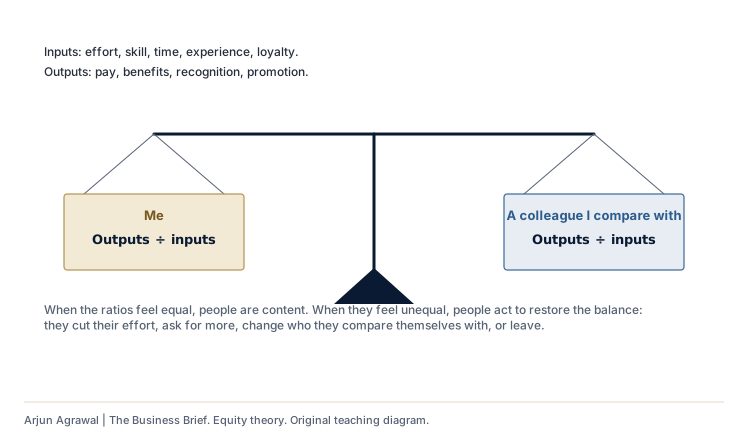
The theory that people compare what they put into their work and get out of it with what others put in and get out, and lose motivation when the comparison feels unfair. Do our people believe they are treated fairly compared with others?
-
Syllabus framework
Expectancy theory
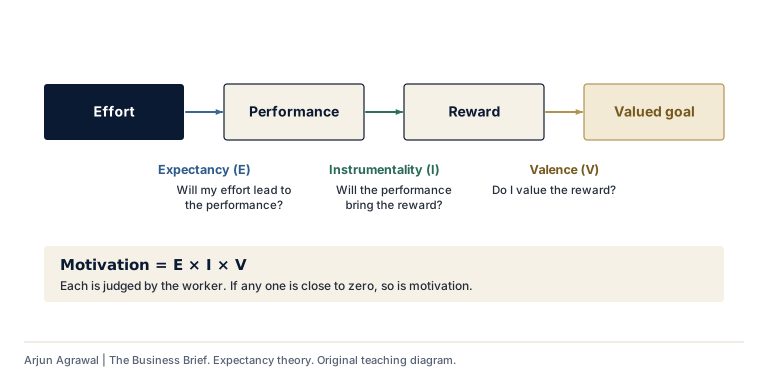
Vroom's theory that people put in effort only when they expect it to lead to performance, expect performance to be rewarded, and value the reward. Will this incentive actually change effort, given what people believe about it?
-
Syllabus framework
Herzberg's motivation-hygiene theory
Herzberg's theory that hygiene factors, such as pay and conditions, only prevent dissatisfaction, while motivators, such as responsibility and recognition, create real motivation. Are we only stopping people being dissatisfied, or are we actually motivating them?
Download its diagram, SVG, 6 KB : Herzberg's motivation-hygiene theory
-
Syllabus framework
Leadership styles
The guide's five leadership styles, autocratic, paternalistic, democratic, laissez-faire and situational, from the leader deciding alone to the team deciding. Which way of leading suits this team, this task and this moment?
-
Syllabus framework
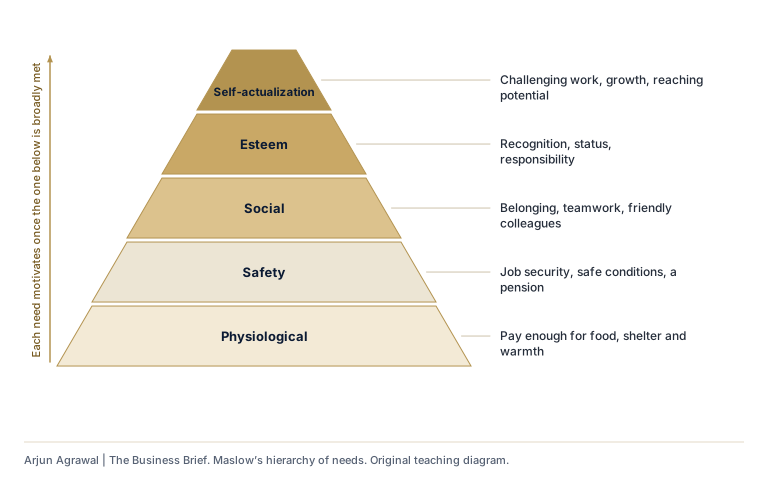
Maslow's hierarchy of needs
Maslow's theory that people are motivated by five levels of need, from physiological needs up to self-actualization, each becoming important as the one below is met. Which of an employee's needs does this job meet, and which is left unmet?
Download its diagram, SVG, 5 KB : Maslow's hierarchy of needs
-
Syllabus framework
McClelland's acquired needs theory
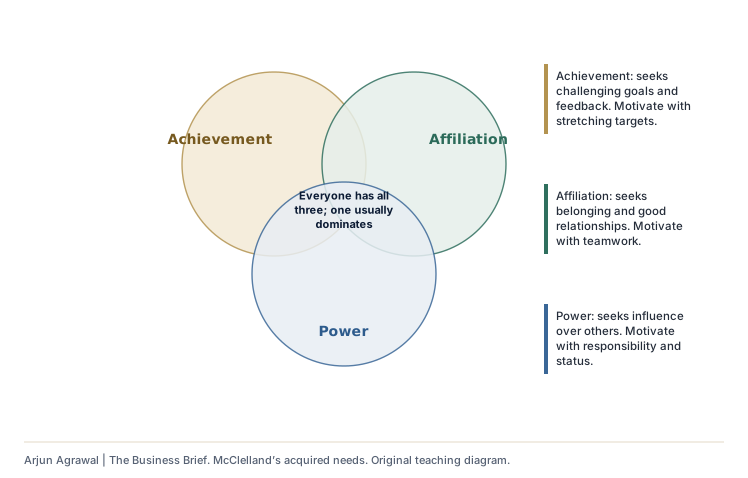
McClelland's theory that people are driven by three needs learned through experience, achievement, affiliation and power, in different strengths. Which need drives this person most, and what work and rewards suit it?
Download its diagram, SVG, 5 KB : McClelland's acquired needs theory
-
Syllabus framework
Self-determination theory
Deci and Ryan's theory that people are most motivated, and do their best work, when their needs for autonomy, competence and relatedness are met. Does this work let people choose how they work, grow their skills and feel connected?
-
Syllabus framework
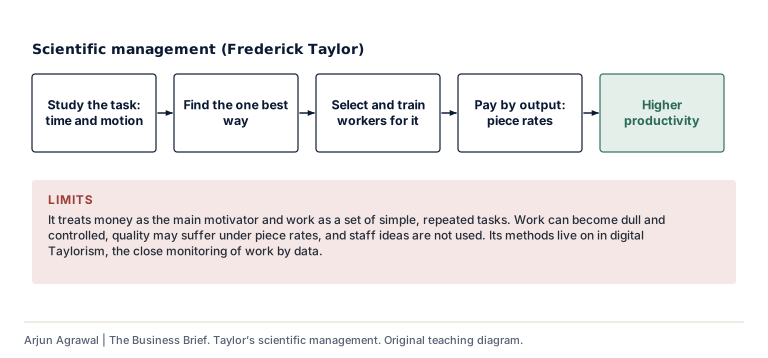
Taylor's scientific management
Taylor's theory that work should be studied, broken into simple tasks done the one best way, and paid by results, because money is what motivates workers. Can we raise output by redesigning the work and paying people for what they produce?
Download its diagram, SVG, 5 KB : Taylor's scientific management
-
Syllabus framework
The product life cycle
The stages a product goes through, development, introduction, growth, maturity and decline, and how sales, profit, investment and cash flow change across them. Where is this product in its life, and what should the marketing mix do now?
-
Toolkit tool
Circular business models
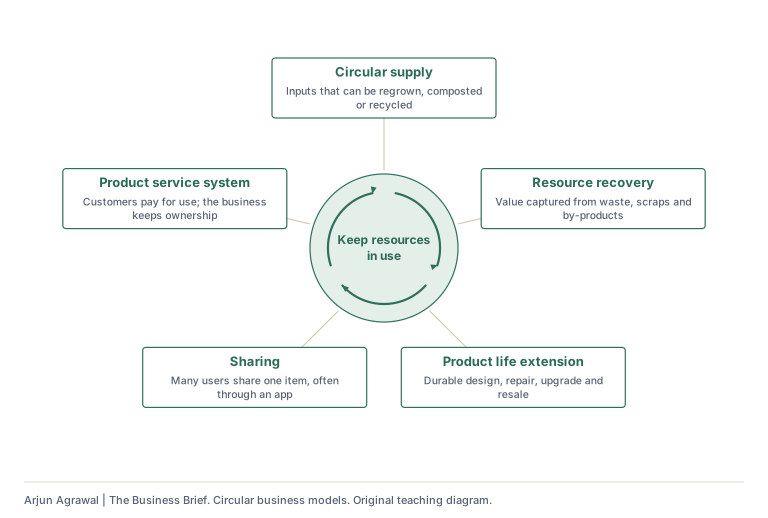
Five ways for a business to earn money while keeping products and materials in use: circular supply, resource recovery, product life extension, sharing and product service systems. How can the business earn more while using fewer new resources?
-
Toolkit tool
Contribution
Judging a decision by what it adds towards fixed costs and profit, as in accepting a special order, making or buying a component, or comparing contribution and absorption costing. Does this decision add to profit once only the costs it changes are counted?
-
Toolkit tool
Critical path analysis
A method of planning a project as a network of linked activities, to find the shortest time it can take, the activities that cannot slip, and the float on the rest. How long will the project take, and which activities can we not afford to delay?
-
Toolkit tool
Decision trees
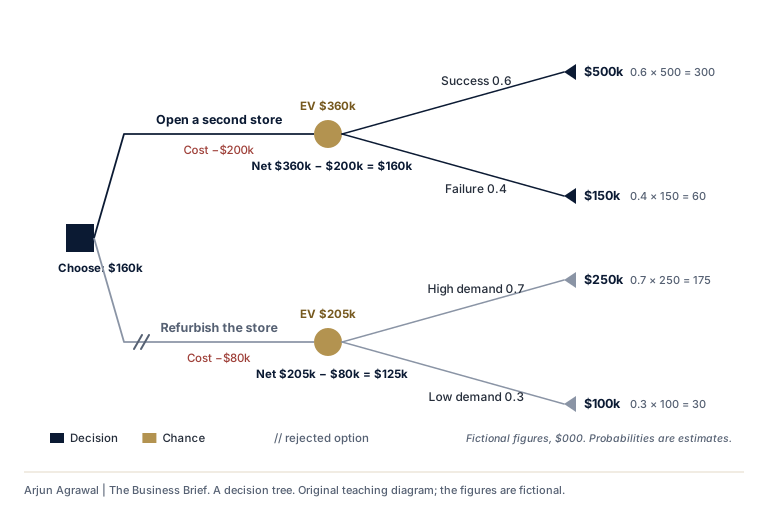
A diagram of the options in a decision and their possible outcomes, with probabilities and payoffs, used to compare options by their expected value. Taking the risks into account, which option is likely to pay off best?
-
Toolkit tool
Descriptive statistics
Measures and charts that summarize a set of data: the mean, median and mode, quartiles and standard deviation, and bar charts, pie charts and infographics. What does this data actually show, and how much does it vary?
-
Toolkit tool
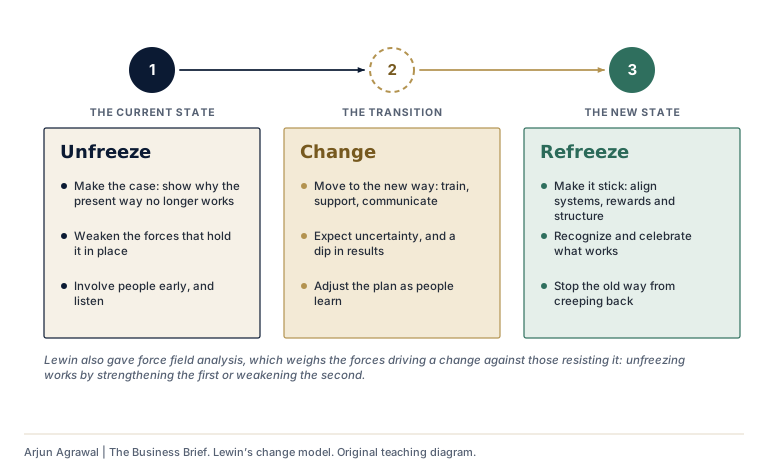
Force field analysis
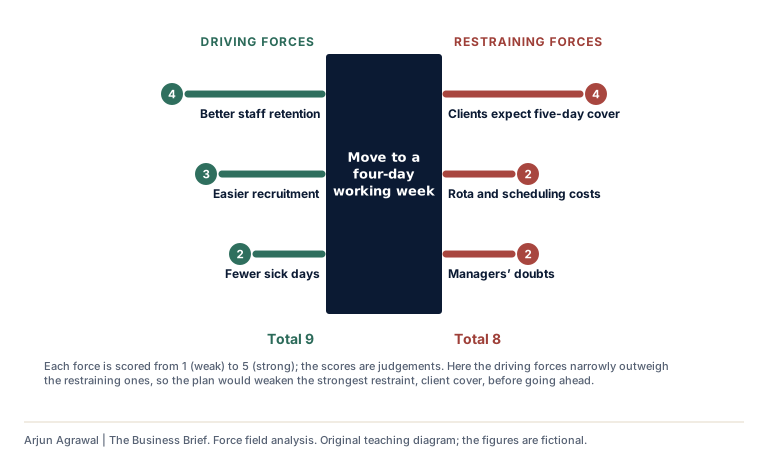
A way of weighing the forces driving a change against the forces resisting it, to judge whether it will succeed and how to help it. What is pushing for this change, what is holding it back, and which force should we work on?
-
Toolkit tool
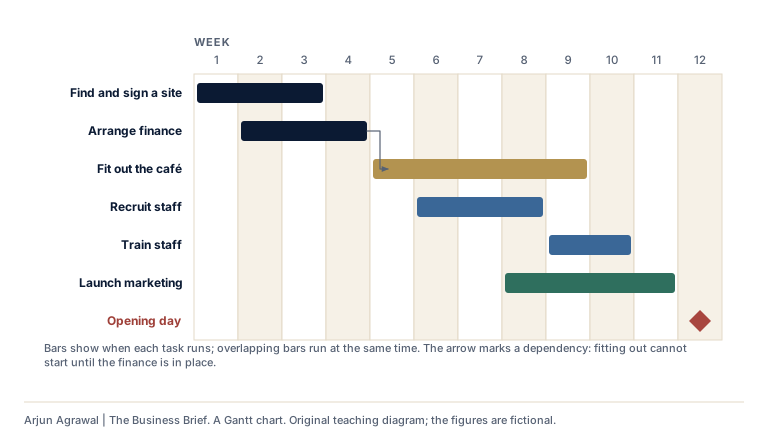
Gantt charts
A chart of a project's tasks as bars against a timeline, showing when each starts and ends, which overlap, and the milestones along the way. When does each task happen, and is the project on schedule?
-
Toolkit tool
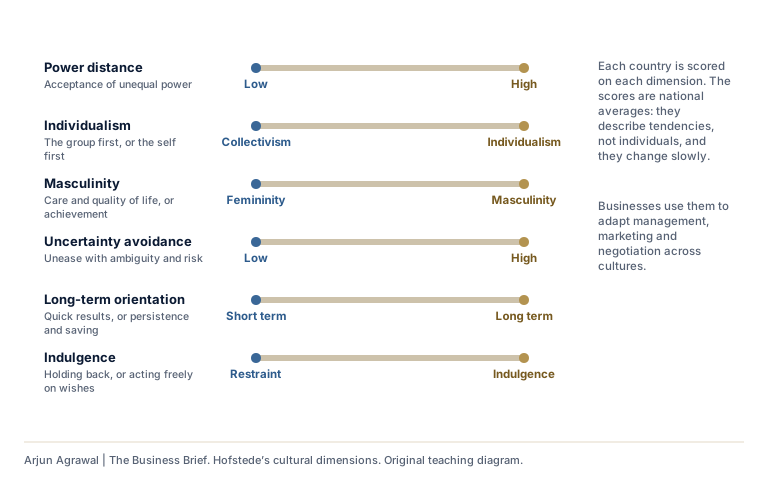
Hofstede's cultural dimensions
Six scales for comparing national cultures, from power distance to indulgence, used to adapt management, marketing and negotiation across countries. How might this country's culture change the way we manage, sell or negotiate here?
Download its diagram, SVG, 7 KB : Hofstede's cultural dimensions
-
Toolkit tool
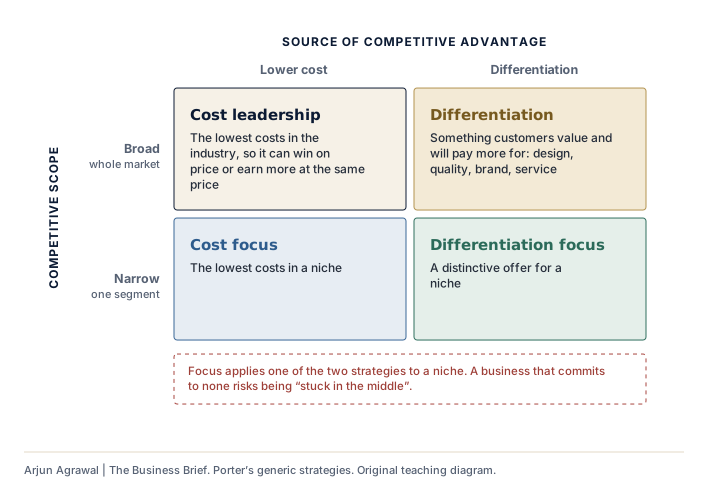
Porter's generic strategies
Three ways a business can build a competitive advantage: the lowest costs, a differentiated offer, or either of those aimed at a narrow segment. On what basis will we beat our competitors, and across how much of the market?
Download its diagram, SVG, 6 KB : Porter's generic strategies
-
Toolkit tool
Simple linear regression
Fitting the straight line that best describes how one variable changes with another, with a scatter diagram, the correlation and, with care, extrapolation. How closely are these two things linked, and what might happen next?
-
Toolkit tool
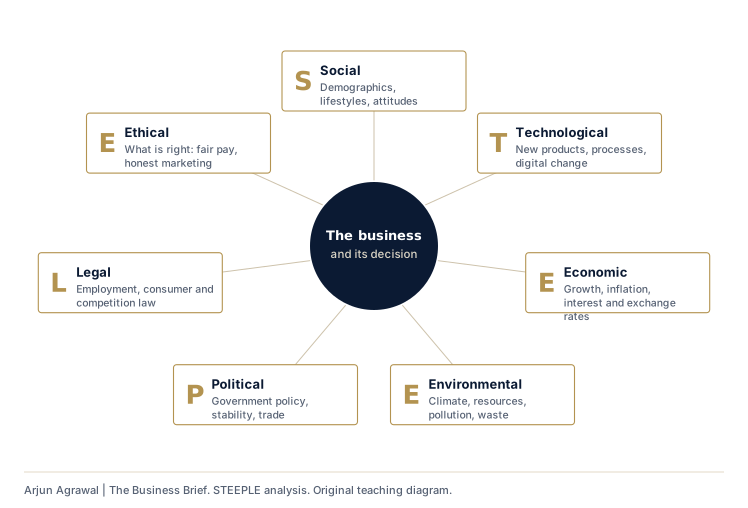
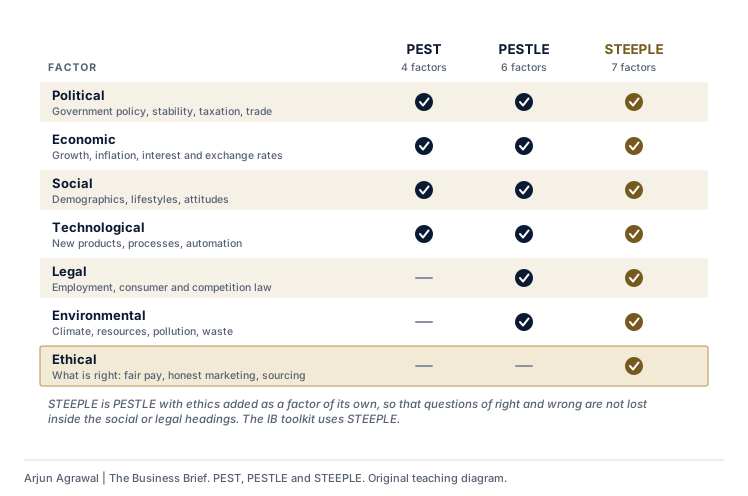
STEEPLE analysis
A scan of seven kinds of external factor, social, technological, economic, environmental, political, legal and ethical, that bear on a business decision. What is changing outside the business that could affect this decision?
-
Toolkit tool
SWOT analysis
A summary of a business's internal strengths and weaknesses and the external opportunities and threats it faces, as the starting point for a decision. Where does the business stand before it decides, inside and out?
-
Toolkit tool
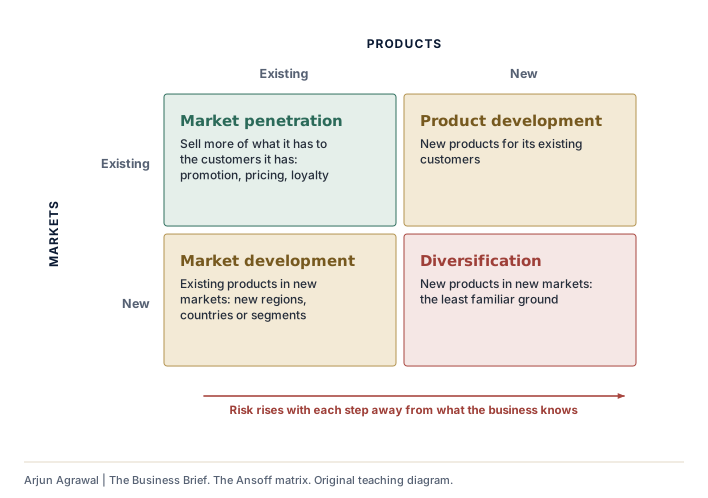
The Ansoff matrix
Four routes to growth, by whether a business sells existing or new products in existing or new markets, with risk rising as it moves away from what it knows. Which route to growth suits this business, and how much risk does it carry?
-
Toolkit tool
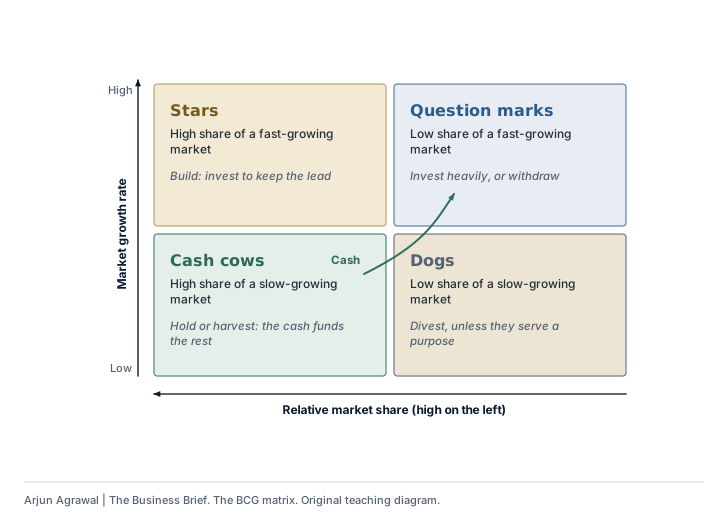
The Boston Consulting Group matrix
A grid that classifies a business's products by market growth and relative market share, to decide where to invest the cash they generate. Which of our products should we invest in, keep, rethink or let go?
Download its diagram, SVG, 6 KB : The Boston Consulting Group matrix
-
Toolkit tool
The business plan
A document that sets out what a new business or project will do, for whom, how it will operate and what it will cost and earn, to test an idea and win support for it. Is this business idea viable, and can we convince others to back it?
-
Enrichment framework
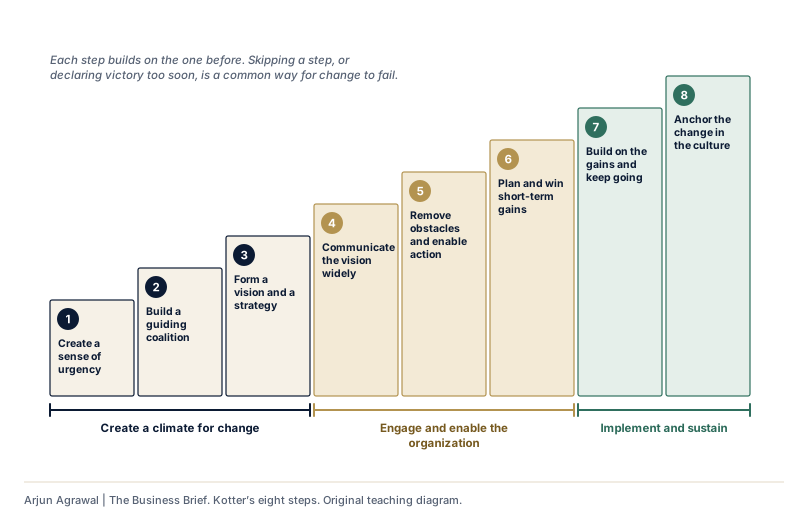
Kotter's eight steps
A sequence of eight steps for leading a major change, from creating urgency to anchoring the change in the organization's culture. How do we lead a big change so that people commit to it and it lasts?
-
Enrichment framework
Lewin's change model
A three-stage model of change: unfreeze the current state, move to the new one, then refreeze so that the new way becomes stable. How do we move people from the way things are done now to a new way, and make it stick?
-
Enrichment framework
Mendelow's matrix
A grid that places each stakeholder group by its power over a decision and its interest in it, to decide how closely to involve each one. Which stakeholders must we manage closely on this decision, and which can we simply keep informed?
-
Enrichment framework
PESTLE against STEEPLE
The family of checklists for scanning a business's external environment, and how the IB toolkit's STEEPLE extends the common PESTLE by giving ethics a heading of its own. Which forces outside the business could change its decision, and have we missed any?
-
Enrichment framework
Porter's five forces
A way to judge how attractive an industry is, by examining the five competitive forces that decide how much profit the firms in it can earn. How much profit can a business in this industry expect to make, and what holds it down?
-
Enrichment framework
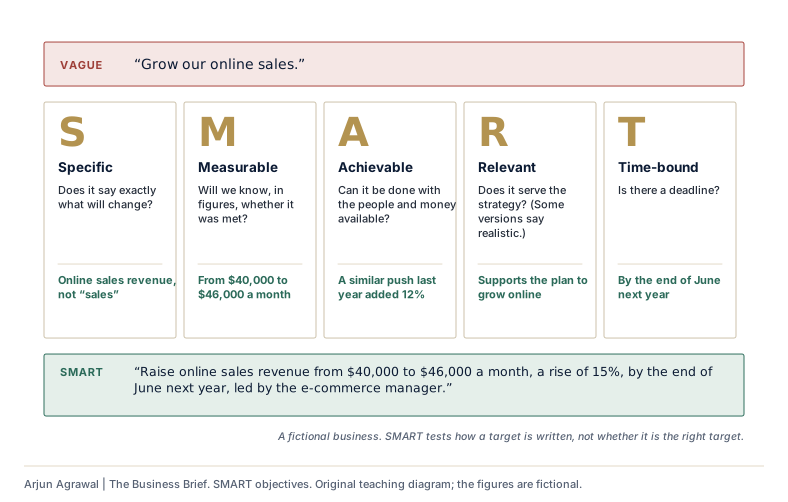
SMART objectives
A test for writing objectives that can be checked: specific, measurable, achievable, relevant (or realistic) and time-bound. Is this objective written so that everyone knows what success looks like and when it is due?
-
Enrichment framework
The balanced scorecard
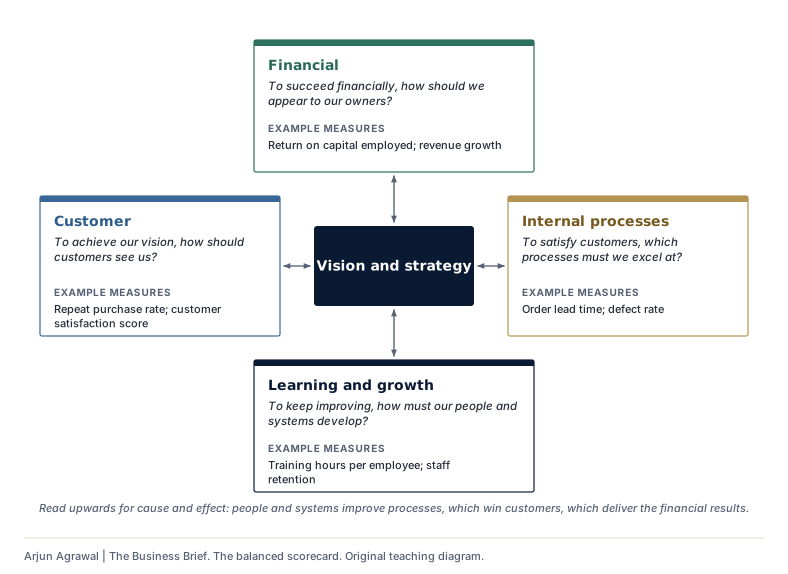
A way to measure performance against a strategy from four perspectives, financial, customer, internal processes, and learning and growth, rather than by profit alone. Are we on track with our strategy, and will our results last?
-
Enrichment framework
The business model canvas
A one-page template of nine blocks that describes how a business creates value for customers, delivers it and earns money from it. How exactly will this business create value, reach customers and make money?
-
Enrichment framework
The McKinsey 7S model
Seven elements of an organization, three hard and four soft, that must fit together for a strategy or a change to work. If we change one part of the organization, what else has to change for it to work?
-
Enrichment framework
The RACI matrix
A grid of tasks against people that shows, for each task, who is responsible, who is accountable, who is consulted and who is informed. For each part of this project, who does the work, who decides, who is asked and who is told?
-
Enrichment framework
The value chain
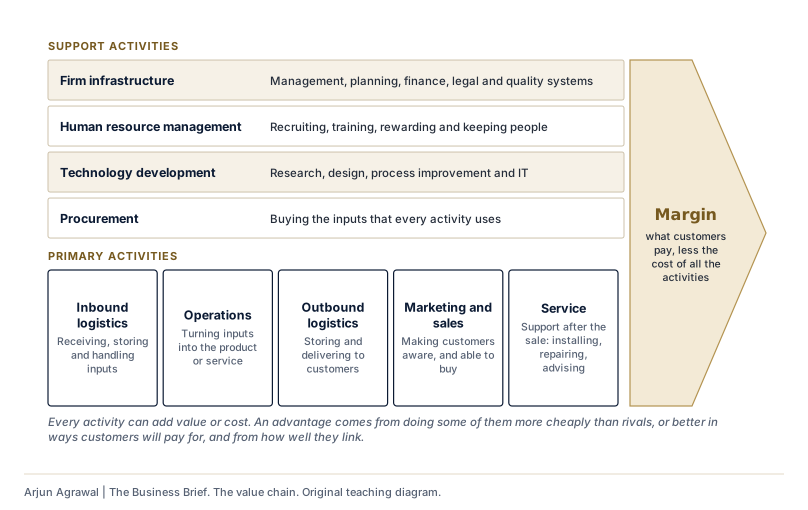
A way of breaking a business down into the activities that create value for its customers, to see where its costs and its advantages really come from. Which of our activities create value customers will pay for, and which only add cost?
Showing 6 of 37
Teacher resources 48
For teachers: a checklist of syllabus statements for each subtopic, classroom activities, lesson sequences and the course map.
-
For teachers
The Teacher resource area
Everything for teaching the course in one place: lesson sequences, discussion prompts, classroom activities, topic checklists and the files to download.
-
Discussion prompts
Discussion prompts by subtopic
116 prompts for class discussion across 37 subtopics, by unit, written to open a lesson or test a judgement.
-
Spreadsheet
Every topic checklist as a spreadsheet
All 143 syllabus statements, one row each, with their depth of teaching, their level and the guide’s page, and empty columns to record when each was taught and checked.
-
Teaching resource
The course map and coverage tracker
The whole course on one page, and what the platform has for every subtopic, for planning a term or a revision schedule.
-
Teaching resource
The teachers' pathway
How the platform fits a teaching cycle, from planning the course to revision, with a timed lesson sequence for every subtopic built from its notes or brief.
-
Classroom activity, 50 minutes
Price, cost and a half-price order
Teams of three run the Atelier Barro Decision Room as the studio's owner, manager and throwers. They work the numbers before each commitment, defend their choices to another team, and finish on the question the case is built to test: is an order below average cost a loss?
Contains 6
- 5 min: Set up
- 12 min: Round one, the cost rise
- 10 min: Round two, the hotel's order
- 8 min: Defend it to another team
and 2 more
-
Classroom activity, 47 minutes
Leading Halden through ninety days and one bad night
Groups of four become Halden's leadership in miniature: the new site manager, a team leader, a night-shift picker and an owner. They read the evidence shift by shift, choose an approach to leadership, then lead through a crisis against the clock.
Contains 6
- 6 min: The deadline
- 10 min: Evidence, shift by shift
- 8 min: Round one, the approach
- 6 min: Round two, the night the scanners fail
and 2 more
-
Classroom activity, 45 minutes
Five routes, one founder: pitching a way to grow
Five teams each make the case for one of Marigold's routes to growth, and a panel playing the founder and the people with money at stake chooses one. The class then commits the panel's choice in the Decision Room and decides together how to make it work.
Contains 5
- 5 min: What does Meera want?
- 12 min: Build the case
- 12 min: Pitches and questions
- 6 min: The decision
and 1 more
-
Classroom activity, 50 minutes
Bellbird: the board meeting before the bank
A profitable retailer is about to break its overdraft limit. Groups of six hold Bellbird's board meeting, with the family, the finance manager, the bank and the largest supplier each pressing their own interest, and leave with one plan and a memo the bank would accept.
Contains 5
- 8 min: Read the forecast
- 8 min: Prepare the roles
- 14 min: The board meeting
- 8 min: Write the memo
and 1 more
-
Classroom activity, 48 minutes
Silvertree: why do the nurses leave?
A pay rise has not stopped nurses leaving a chain of clinics. Pairs first sort the evidence on why they leave, then groups of five hold the board meeting where the head of people must win support for a plan that deals with the cause, not the cost.
Contains 5
- 10 min: Why do nurses leave?
- 8 min: Match the options
- 12 min: The board meeting
- 8 min: Write the recommendation
and 1 more
-
Classroom activity, 45 minutes
Tausi: four plans for one marketing reserve
A drinks maker has one reserve and four plans that each spend all of it. Groups place the portfolio with the figures, argue the plans in a board meeting where each director pushes a different product, and set a milestone that would show the chosen plan is working.
Contains 5
- 10 min: Place the portfolio
- 8 min: Read the evidence critically
- 12 min: The board meeting
- 5 min: Set the milestone
and 1 more
-
1.1 Topic checklist
What is a business?
4 syllabus statements with the depth of teaching, to tick off as they are taught and checked.
-
1.2 Topic checklist
Types of business entities
4 syllabus statements with the depth of teaching, to tick off as they are taught and checked.
-
1.3 Topic checklist
Business objectives
4 syllabus statements with the depth of teaching, to tick off as they are taught and checked.
-
1.4 Topic checklist
Stakeholders
2 syllabus statements with the depth of teaching, to tick off as they are taught and checked.
-
1.5 Topic checklist
Growth and evolution
5 syllabus statements with the depth of teaching, to tick off as they are taught and checked.
-
1.6 Topic checklist
Multinational companies (MNCs)
1 syllabus statement with the depth of teaching, to tick off as they are taught and checked.
-
2.1 Topic checklist
Introduction to human resource management
4 syllabus statements with the depth of teaching, to tick off as they are taught and checked.
-
2.2 Topic checklist
Organizational structure
4 syllabus statements with the depth of teaching, 1 of them HL only, to tick off as they are taught and checked.
-
2.3 Topic checklist
Leadership and management
3 syllabus statements with the depth of teaching, 1 of them HL only, to tick off as they are taught and checked.
-
2.4 Topic checklist
Motivation and demotivation
9 syllabus statements with the depth of teaching, 5 of them HL only, to tick off as they are taught and checked.
-
2.5 Topic checklist
Organizational (corporate) culture
3 syllabus statements with the depth of teaching, 3 of them HL only, to tick off as they are taught and checked.
-
2.6 Topic checklist
Communication
2 syllabus statements with the depth of teaching, to tick off as they are taught and checked.
-
2.7 Topic checklist
Industrial/employee relations
3 syllabus statements with the depth of teaching, 3 of them HL only, to tick off as they are taught and checked.
-
3.1 Topic checklist
Introduction to finance
1 syllabus statement with the depth of teaching, to tick off as they are taught and checked.
-
3.2 Topic checklist
Sources of finance
3 syllabus statements with the depth of teaching, to tick off as they are taught and checked.
-
3.3 Topic checklist
Costs and revenues
2 syllabus statements with the depth of teaching, to tick off as they are taught and checked.
-
3.4 Topic checklist
Final accounts
5 syllabus statements with the depth of teaching, 2 of them HL only, to tick off as they are taught and checked.
-
3.5 Topic checklist
Profitability and liquidity ratio analysis
4 syllabus statements with the depth of teaching, to tick off as they are taught and checked.
-
3.6 Topic checklist
Efficiency ratio analysis
3 syllabus statements with the depth of teaching, 3 of them HL only, to tick off as they are taught and checked.
-
3.7 Topic checklist
Cash flow
6 syllabus statements with the depth of teaching, to tick off as they are taught and checked.
-
3.8 Topic checklist
Investment appraisal
2 syllabus statements with the depth of teaching, 1 of them HL only, to tick off as they are taught and checked.
-
3.9 Topic checklist
Budgets
5 syllabus statements with the depth of teaching, 5 of them HL only, to tick off as they are taught and checked.
-
4.1 Topic checklist
Introduction to marketing
4 syllabus statements with the depth of teaching, 1 of them HL only, to tick off as they are taught and checked.
-
4.2 Topic checklist
Marketing planning
5 syllabus statements with the depth of teaching, to tick off as they are taught and checked.
-
4.3 Topic checklist
Sales forecasting
1 syllabus statement with the depth of teaching, 1 of them HL only, to tick off as they are taught and checked.
-
4.4 Topic checklist
Market research
5 syllabus statements with the depth of teaching, to tick off as they are taught and checked.
-
4.5 Topic checklist
The seven Ps of the marketing mix
13 syllabus statements with the depth of teaching, 1 of them HL only, to tick off as they are taught and checked.
-
4.6 Topic checklist
International marketing
1 syllabus statement with the depth of teaching, 1 of them HL only, to tick off as they are taught and checked.
-
5.1 Topic checklist
Introduction to operations management
1 syllabus statement with the depth of teaching, to tick off as they are taught and checked.
-
5.2 Topic checklist
Operations methods
1 syllabus statement with the depth of teaching, to tick off as they are taught and checked.
-
5.3 Topic checklist
Lean production and quality management
7 syllabus statements with the depth of teaching, 7 of them HL only, to tick off as they are taught and checked.
-
5.4 Topic checklist
Location
2 syllabus statements with the depth of teaching, to tick off as they are taught and checked.
-
5.5 Topic checklist
Break-even analysis
4 syllabus statements with the depth of teaching, to tick off as they are taught and checked.
-
5.6 Topic checklist
Production planning
7 syllabus statements with the depth of teaching, 7 of them HL only, to tick off as they are taught and checked.
-
5.7 Topic checklist
Crisis management and contingency planning
3 syllabus statements with the depth of teaching, 3 of them HL only, to tick off as they are taught and checked.
-
5.8 Topic checklist
Research and development
4 syllabus statements with the depth of teaching, 4 of them HL only, to tick off as they are taught and checked.
-
5.9 Topic checklist
Management information systems
6 syllabus statements with the depth of teaching, 6 of them HL only, to tick off as they are taught and checked.
Showing 6 of 48
Lesson presentations
Slide decks for teaching each subtopic.
Not yet available
No slide decks have been made. In the meantime, the lesson library gives every subtopic a presentation outline as text, to build your own slides from.
Enrichment 43
Beyond the IB course, for curious students and for university and MBA learners: enrichment maps, Advanced Management modules and advanced financial analysis. None of it is required or assessed by the IB.
-
Enrichment map: Finance
Corporate finance
How a business decides which investments to make, how to pay for them and what to return to its owners, with the time value of money and risk at the centre of each decision.
-
Enrichment map: Governance
Corporate governance
How companies are directed and controlled, from the agency problem and the board's duties to whose interests come first, executive pay, audit and disclosure, and the checks that keep power accountable.
-
Enrichment map: Enterprise
Entrepreneurship and new ventures
How a new venture turns an opportunity into a business, from finding and testing ideas and designing the business model to financing under uncertainty and growing without running out of cash.
-
Enrichment map: Leadership
Leading change
How leaders take an organization through change, from the kinds of change and the models that guide it to leading people, resistance and culture, and how a transformation is sequenced and made to last.
-
Enrichment map: Marketing
Marketing strategy
How an organization decides whom to serve, what value to promise and how to capture it, through customer insight, segmentation and positioning, brands and loyalty, pricing and measurement.
-
Enrichment map: Operations
Operations strategy
How operations help an organization compete, from the performance it must deliver and the trade-offs between objectives to process, capacity, supply networks and continuous improvement.
-
Enrichment map: People
Organizational behaviour
How individuals, groups and the organization itself shape behaviour at work, from motivation and judgement to teams, power and culture, and what the evidence says a manager can change.
-
Enrichment map: Strategy
Strategy formulation
How an organization chooses where to compete and how to win, from reading its environment and its own resources to testing a strategy before committing to it.
-
Enrichment map: Sustainability
Sustainable business strategy
How organizations treat environmental and social impact as a strategic question, from framing and measuring it to choosing a response, redesigning the business model and telling real progress from greenwashing.
-
Advanced financial analysis
Integrated forecast
A three to five year forecast built from drivers: a statement of profit or loss, a statement of cash flows and a balance sheet that balances every year, with base, upside and downside scenarios and two strategic alternatives side by side.
-
Advanced financial analysis
Capital budgeting comparator
Two or three projects compared by net present value at any discount rate, internal rate of return, payback, discounted payback and the profitability index, with a tornado chart of what moves NPV and a WACC helper that sets the discount rate.
-
Advanced financial analysis
Break-even scenarios
Two cost structures side by side, higher fixed and lower variable costs against the reverse: break-even, margin of safety, degree of operating leverage and the indifference volume at which one becomes better.
-
Advanced financial analysis
Financial performance dashboard
Several years of accounts read through the DuPont analysis of return on equity, the cash conversion cycle, interest cover and gearing, beside the IB’s own ratios, with a reading of each movement and the limits of each measure.
-
Advanced Management: Advanced strategy
Competitive advantage and industry analysis
Why do some industries earn far more than others, why do some firms beat their rivals in the same industry, and how long can either advantage last?
-
Advanced Management: Advanced strategy
Corporate strategy and restructuring
When does owning several businesses create more value than the businesses could create apart, and what should a company do when it does not?
-
Advanced Management: Advanced strategy
Mergers, acquisitions and strategic alliances
When should a firm buy another, ally with it or build the capability itself, and why do so many acquisitions disappoint the buyer?
-
Advanced Management: Advanced strategy
Disruption, digital transformation and business model innovation
Why do well-run incumbents lose to entrants whose products are worse at first, and what can they do about it?
-
Advanced Management: Advanced strategy
International expansion
Where should a firm go abroad, how should it enter, and why does distance cost more than managers expect?
-
Advanced Management: Advanced strategy
Strategy execution, change and crisis
Why do sound strategies fail in execution, how can organizations change without breaking, and what separates a crisis handled well from one that becomes a catastrophe?
-
Advanced Management: Advanced financial management
Financial statement analysis
How does an analyst read the three financial statements as one system, to judge how good a company's profits are, what return it earns on the capital it uses and how much risk its balance sheet carries?
-
Advanced Management: Advanced financial management
Capital budgeting and investment decisions
Which investments should a business make, how should it measure whether they create value, and why do the methods managers find most intuitive so often point the wrong way?
-
Advanced Management: Advanced financial management
Risk, return, the cost of capital and capital structure
What return must an investment earn to compensate its owners for its risk, and does the mix of debt and equity a company chooses change what the company is worth?
-
Advanced Management: Advanced financial management
Working capital, forecasting and cash flow modelling
How much cash does a business tie up in running itself, how can it forecast the cash it will need, and why can a profitable, growing company still run out of money?
-
Advanced Management: Advanced financial management
Valuation fundamentals
What is a business worth, how do the main valuation methods reach an answer, and why do careful valuations of the same company still disagree?
-
Advanced Management: Advanced financial management
Sensitivity analysis and scenario planning
How should a manager test a forecast that is certain to be wrong, and what can sensitivity analysis, simulation and scenarios each tell a decision-maker that the others cannot?
-
Advanced Management: Leadership and organizational behaviour
Leadership under uncertainty and executive decision-making
How should executives decide when the odds cannot be known, the stakes are high and their own judgement is part of the problem?
-
Advanced Management: Leadership and organizational behaviour
Organizational design and corporate culture
How should an organization divide and coordinate its work, and what is culture, beyond the slogans, that it could be designed or changed at all?
-
Advanced Management: Leadership and organizational behaviour
Motivation, incentives and talent
What do incentives really do to effort, honesty and who stays, and how should an organization find, grow and keep the people it most needs?
-
Advanced Management: Leadership and organizational behaviour
Change, organizational politics and conflict
Why do so many change efforts stall, who has the power to stop them, and how can conflict be resolved without destroying what it was about?
-
Advanced Management: Leadership and organizational behaviour
Governance and accountability
Who holds the people who run a company to account, by what means, and why do the arrangements so often fail when they are most needed?
-
Advanced Management: Advanced marketing
Brand strategy and competitive positioning
What is a brand worth, how does it create value in customers' minds and in the accounts, and how should a firm choose where to stand against its rivals?
-
Advanced Management: Advanced marketing
Customer economics: segmentation, acquisition and lifetime value
Which customers are worth acquiring, what is a customer worth over the whole relationship, and how should segments be drawn so that they predict what people will do?
-
Advanced Management: Advanced marketing
Pricing strategy
How should a firm set prices when customers value the product differently, rivals respond, and every price also sends a signal?
-
Advanced Management: Advanced marketing
Marketing analytics, performance measurement and digital transformation
How can a business tell which of its marketing actually caused sales, which measures deserve a manager's attention, and what changes when marketing runs on data?
-
Advanced Management: Advanced marketing
International marketing
When a firm takes its brand abroad, what should it keep the same, what must it adapt, and how does distance, cultural, administrative, geographic and economic, change the answer?
-
Advanced Management: Operations and supply chain strategy
Operations strategy, process optimization and lean systems
How operations choices create or destroy competitive advantage, and what the laws of flow and the logic of lean say about improving any process.
-
Advanced Management: Operations and supply chain strategy
Capacity planning, quality management and technology adoption
How much capacity to build and when, how to make quality predictable rather than inspected, and why new technology so often disappoints before it pays.
-
Advanced Management: Operations and supply chain strategy
Supply chain resilience, global sourcing and risk
Why supply chains amplify shocks, how a business should decide where and from whom to buy, and how much efficiency it should trade for resilience.
-
Advanced Management: Operations and supply chain strategy
Sustainable operations
How operations can cut environmental and social harm across a whole value chain, when doing so pays, and how to judge the claims businesses make about it.
-
Advanced Management: Entrepreneurship and innovation
Startup strategy, business model validation and product-market fit
How a new venture chooses a strategy when almost everything is uncertain, tests the assumptions that could sink it, and recognizes product-market fit when it arrives.
-
Advanced Management: Entrepreneurship and innovation
Unit economics and entrepreneurial finance
When each additional customer makes a young business richer rather than poorer, and how founders should model the cash it takes to reach that point.
-
Advanced Management: Entrepreneurship and innovation
Funding strategy and venture capital
Which money fits which venture, how venture capital terms divide the value a start-up creates, and what fund economics demand of the companies they back.
-
Advanced Management: Entrepreneurship and innovation
Scaling, innovation management, failure and recovery
What breaks when a venture grows, how established firms manage innovation that threatens their own business, and what the evidence says about failure and recovery.
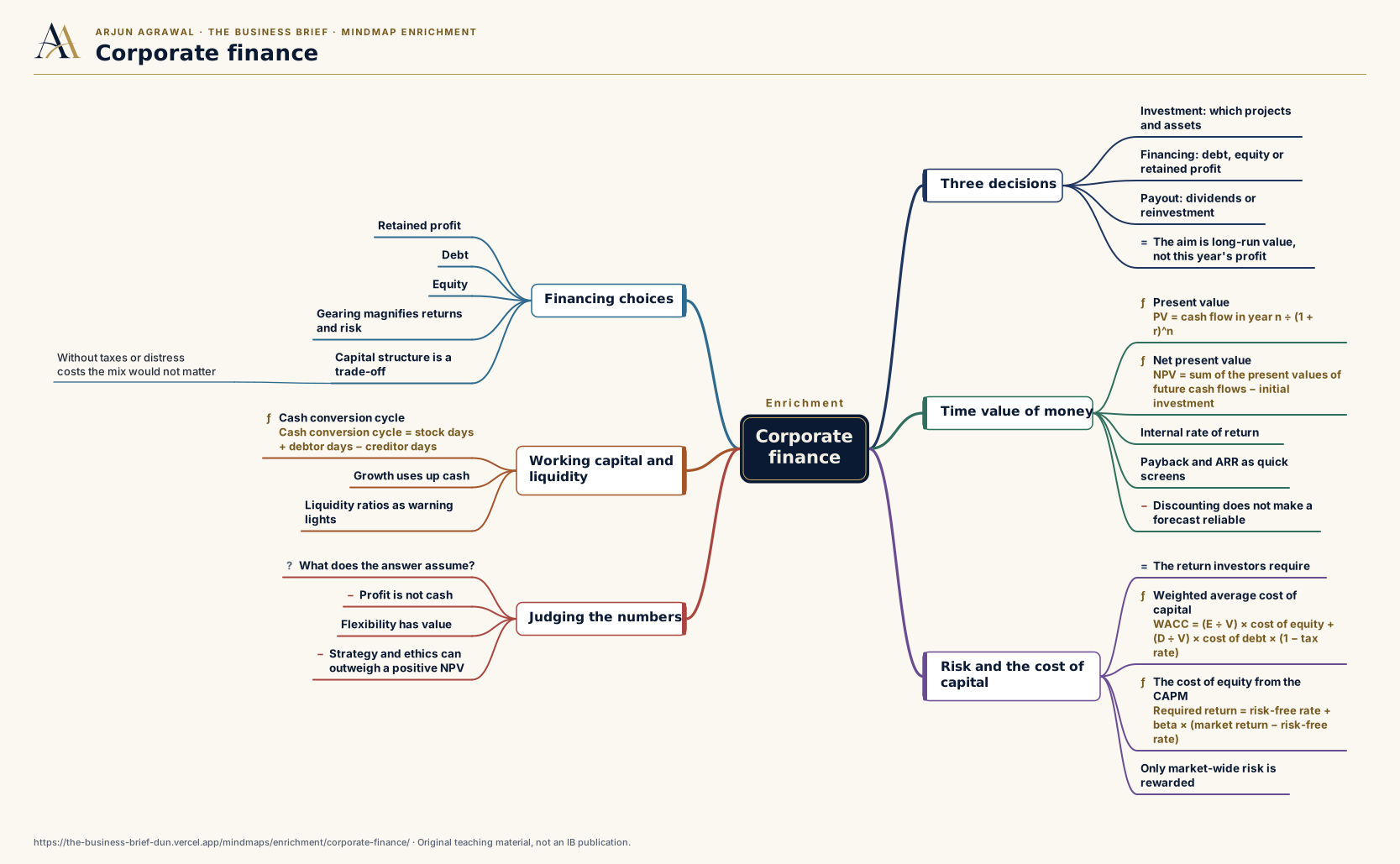
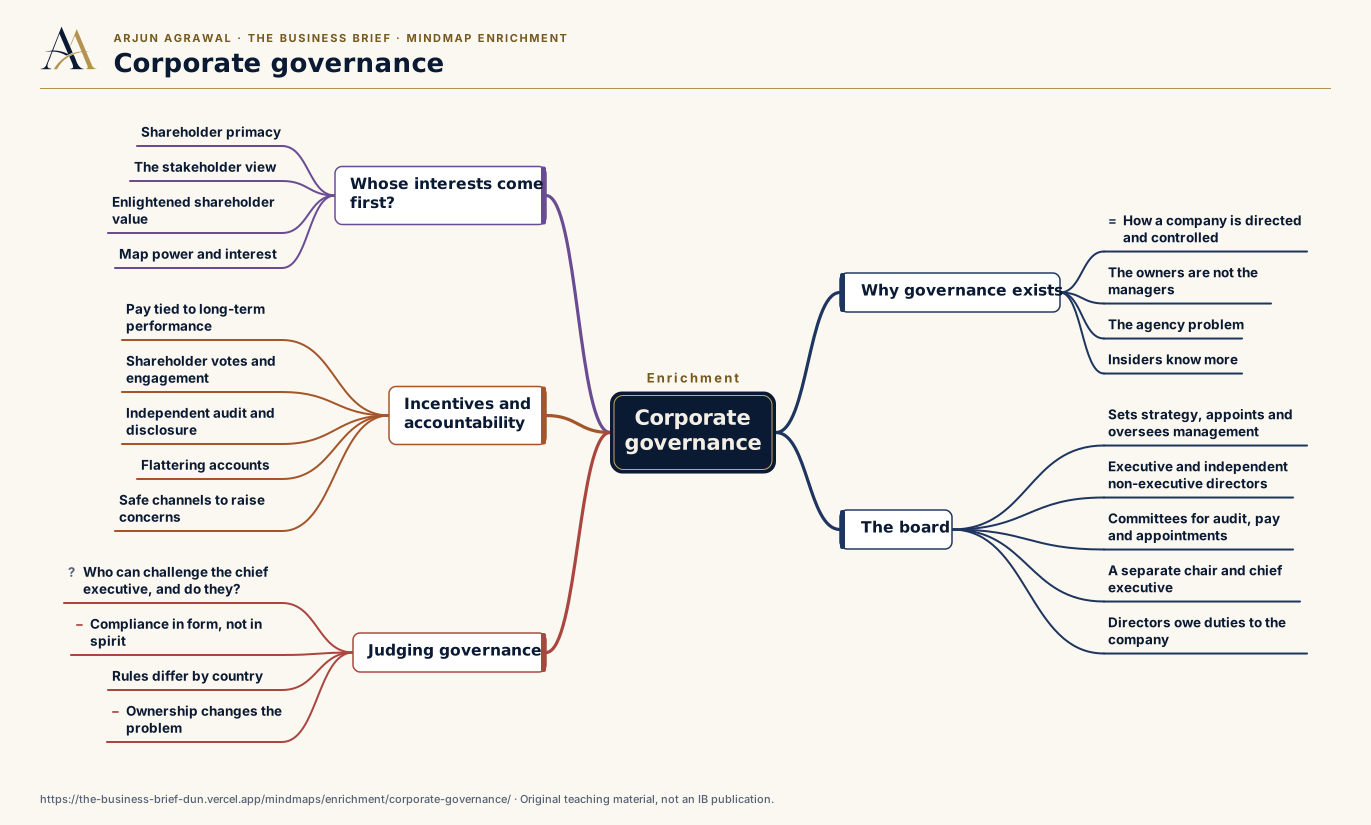
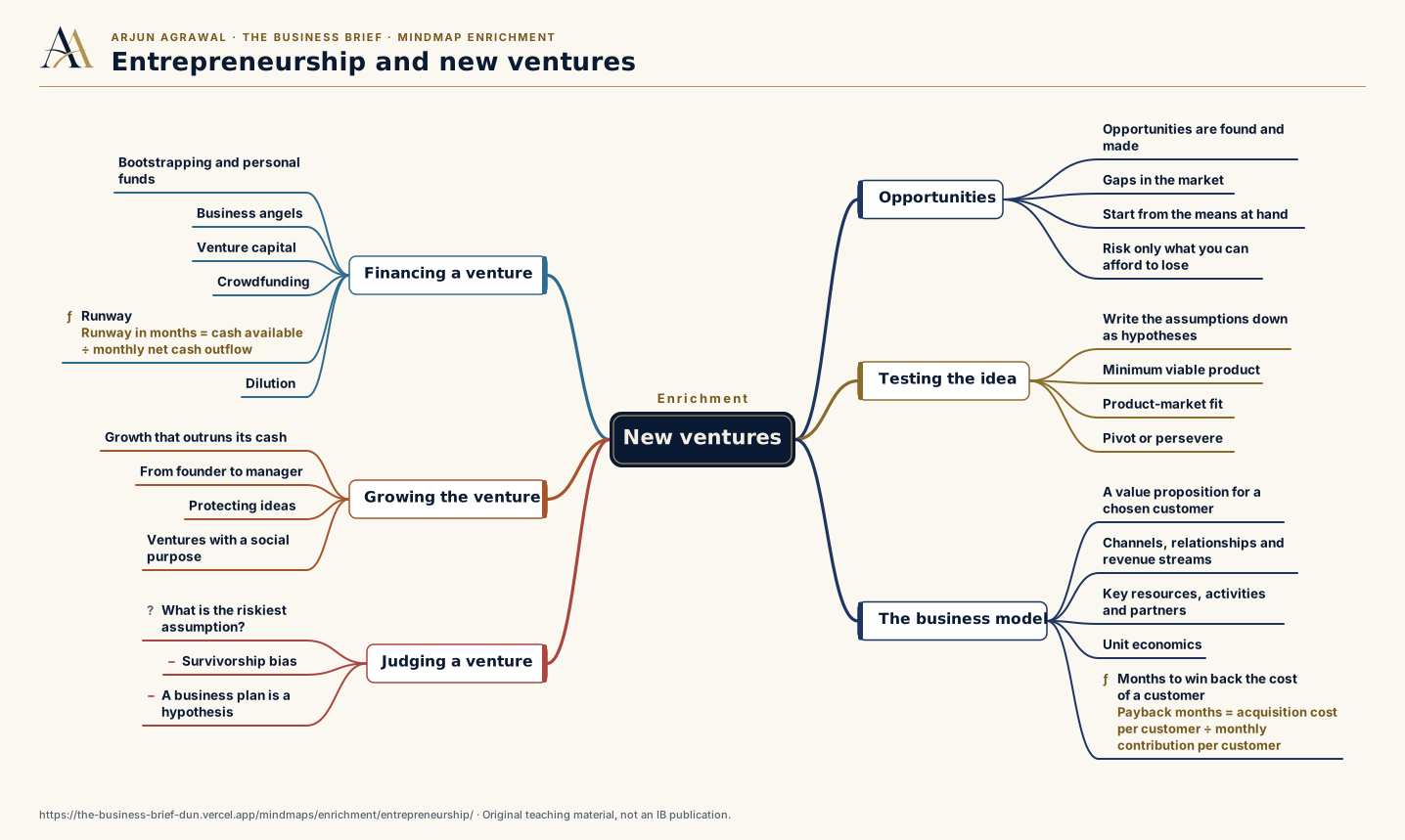
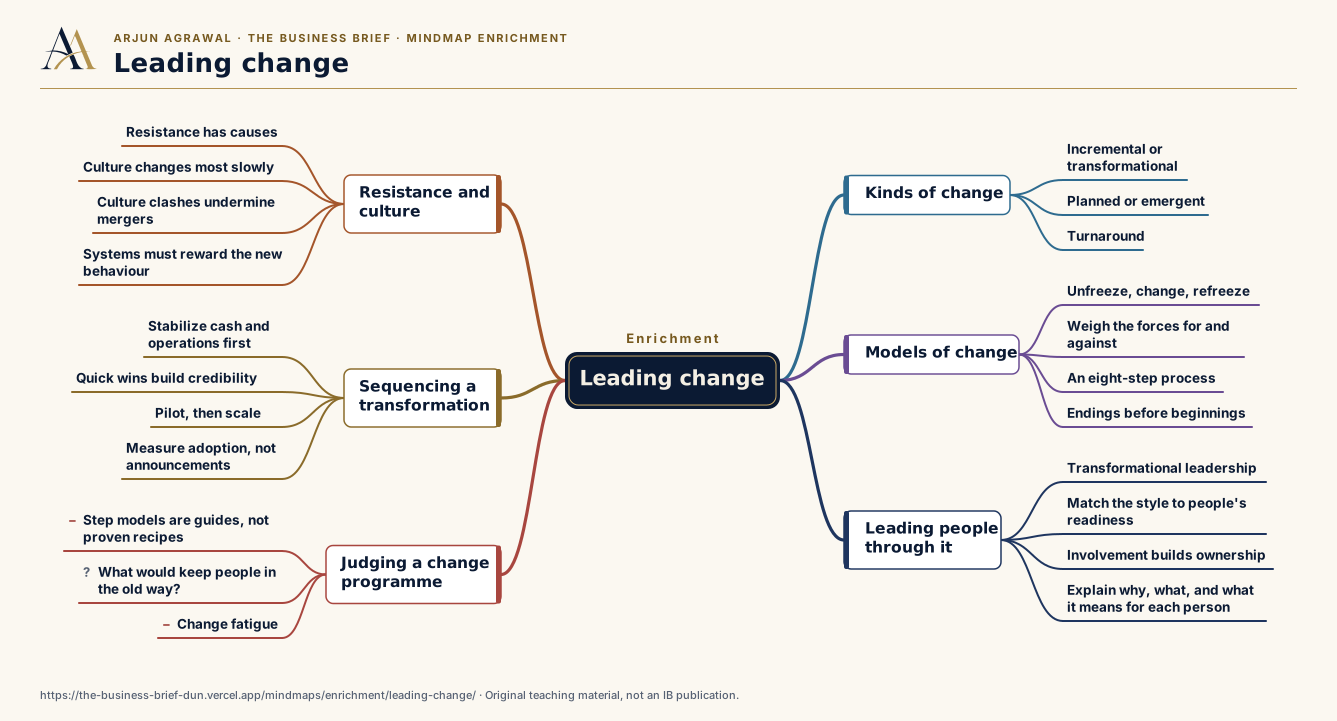
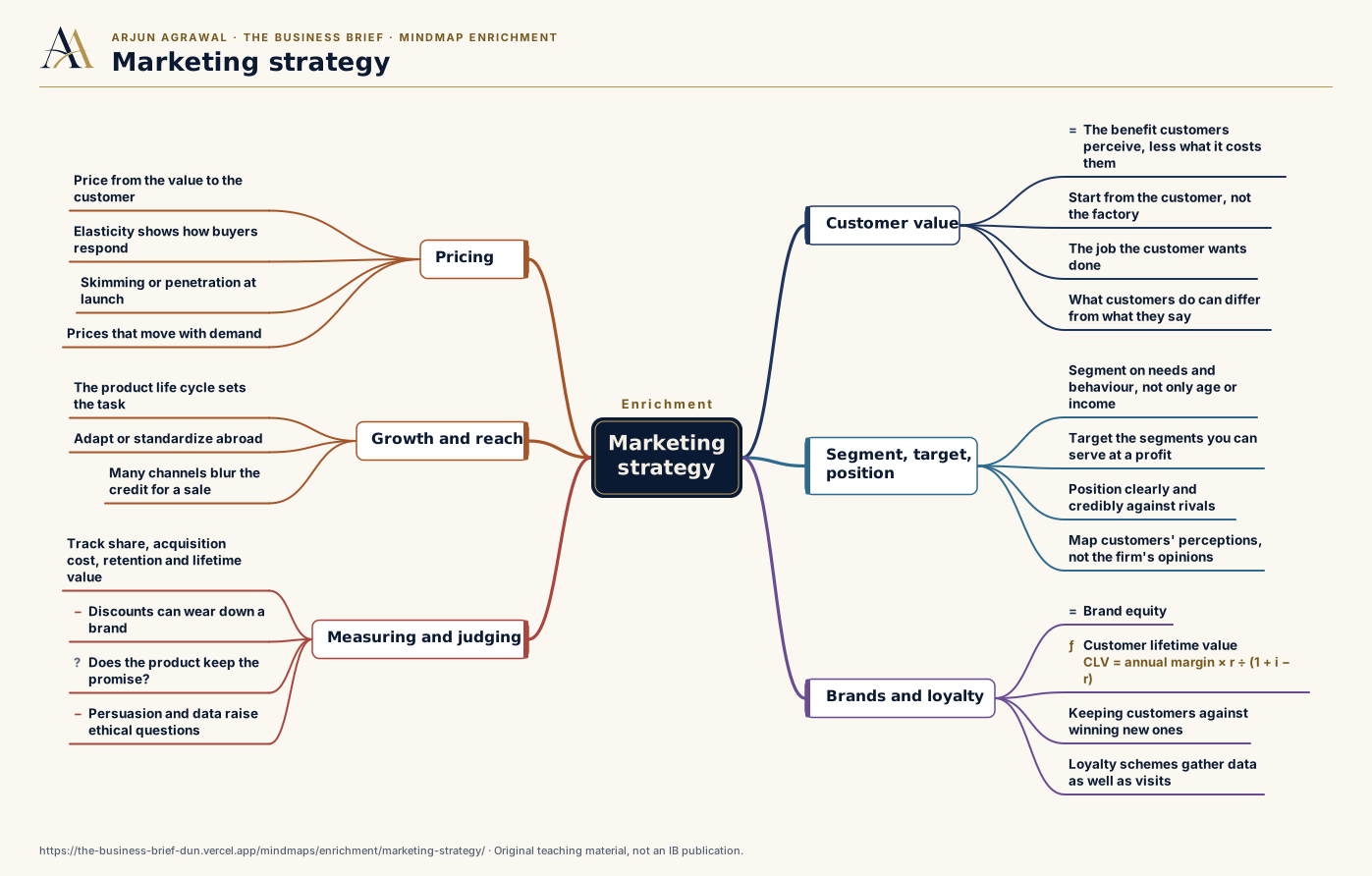
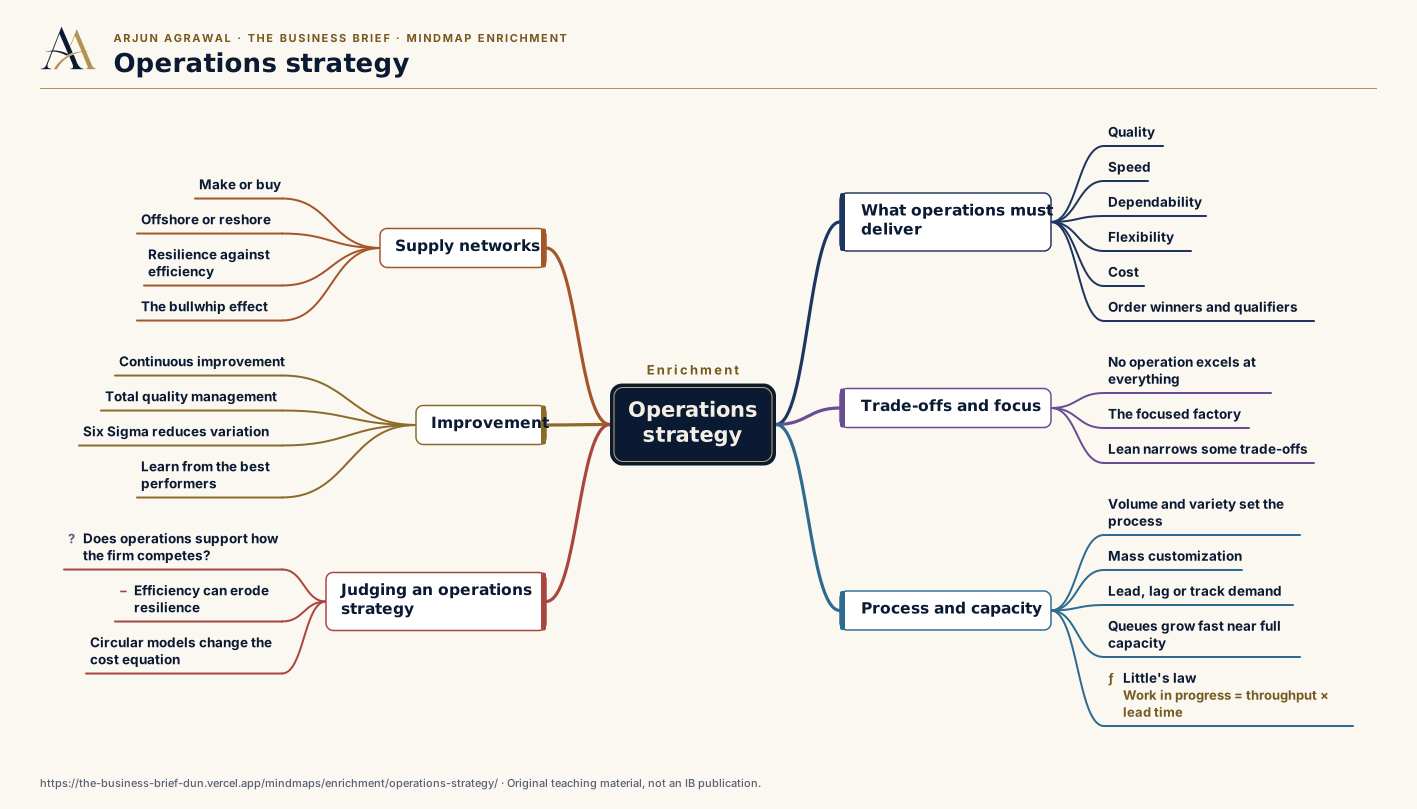
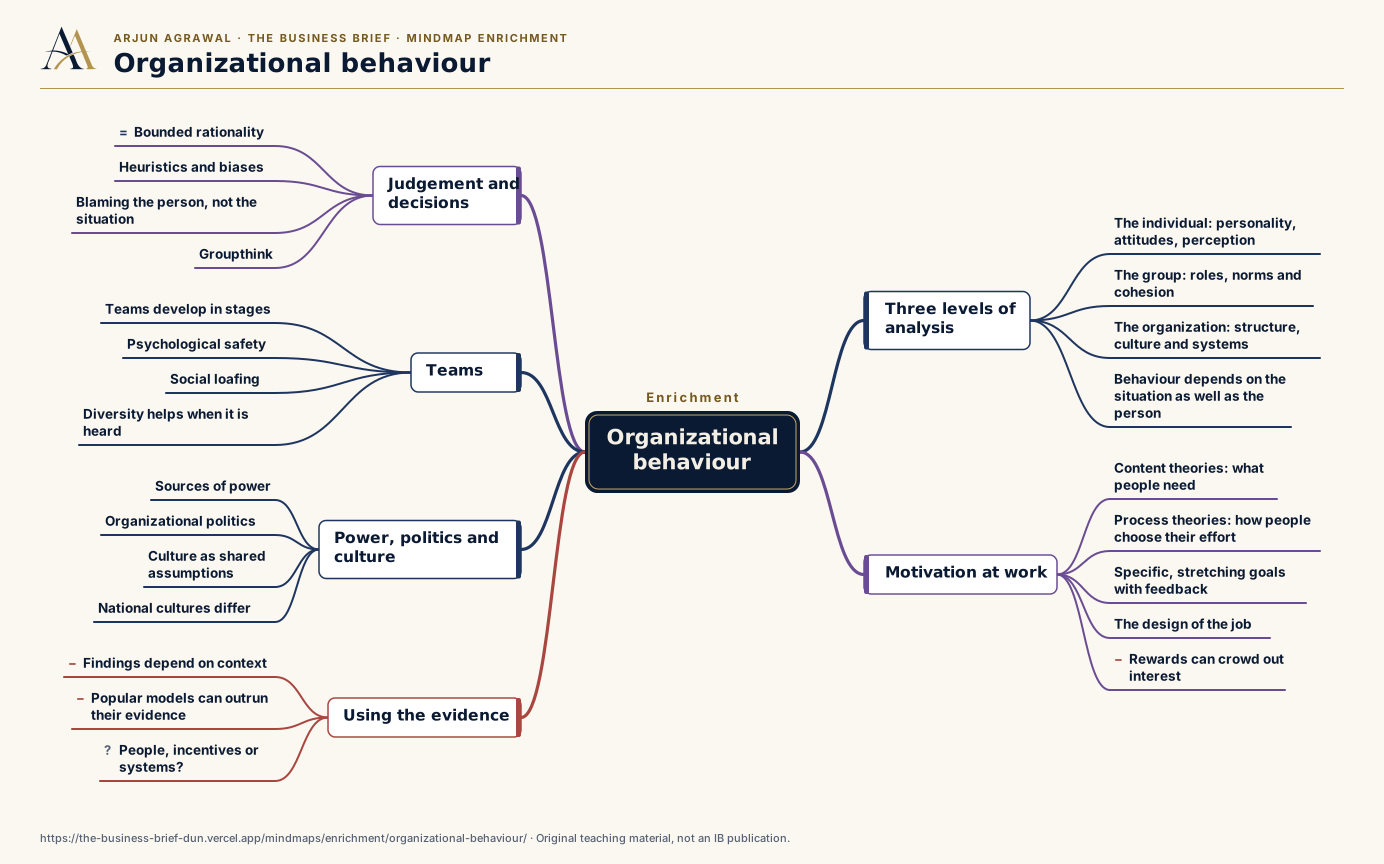
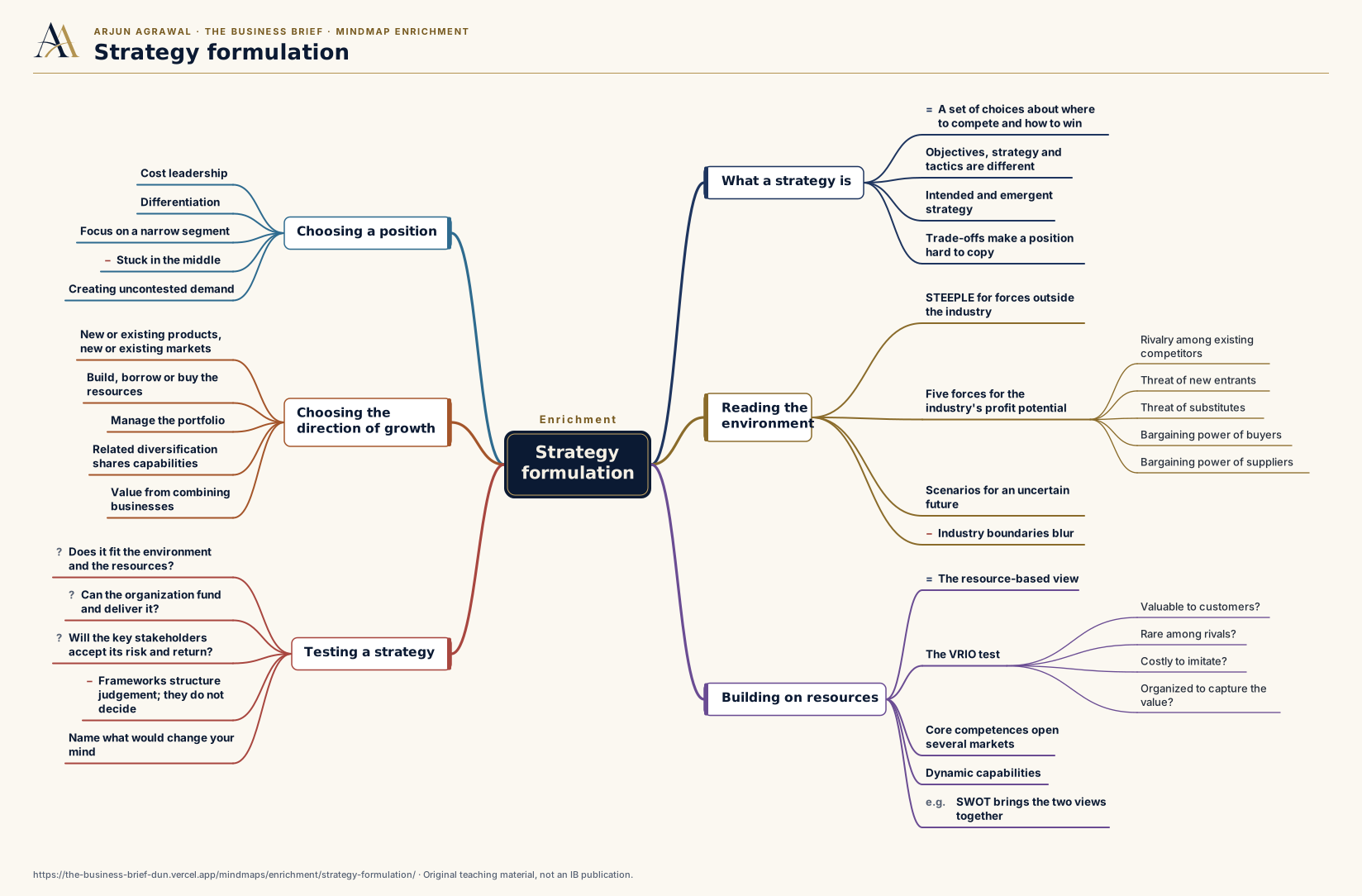
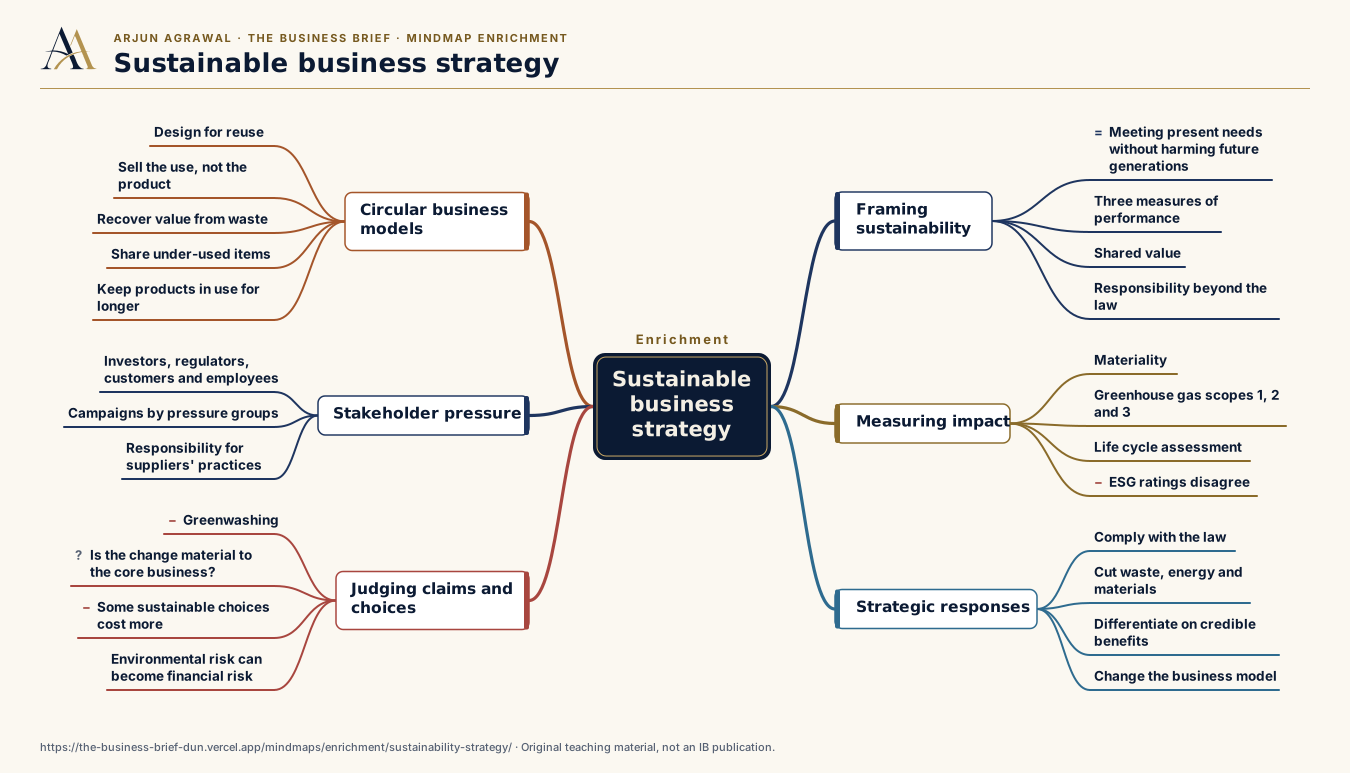
Showing 6 of 43
The assessment guides are the creator's own work. Every business in the case studies is fictional unless it is marked real-world. Nothing here is published, approved or endorsed by the International Baccalaureate.
Arjun Agrawal | The Business Brief, https://the-business-brief-dun.vercel.app/resources/. Original teaching material, not an IB publication. The organizations in the teaching cases are fictional unless a case says otherwise.