Enrichment map · Sustainability · Beyond the IB course
Sustainable business strategy
How organizations treat environmental and social impact as a strategic question, from framing and measuring it to choosing a response, redesigning the business model and telling real progress from greenwashing.
Drag to move the map, or use the arrow keys. Click a branch to fold it away. Whole map shows all of it; zoom with the buttons, or with Ctrl and the scroll wheel.
- Core ideas
- Tools
- Types and forms
- Applications
- Evaluation
- Advantage
- Limitation
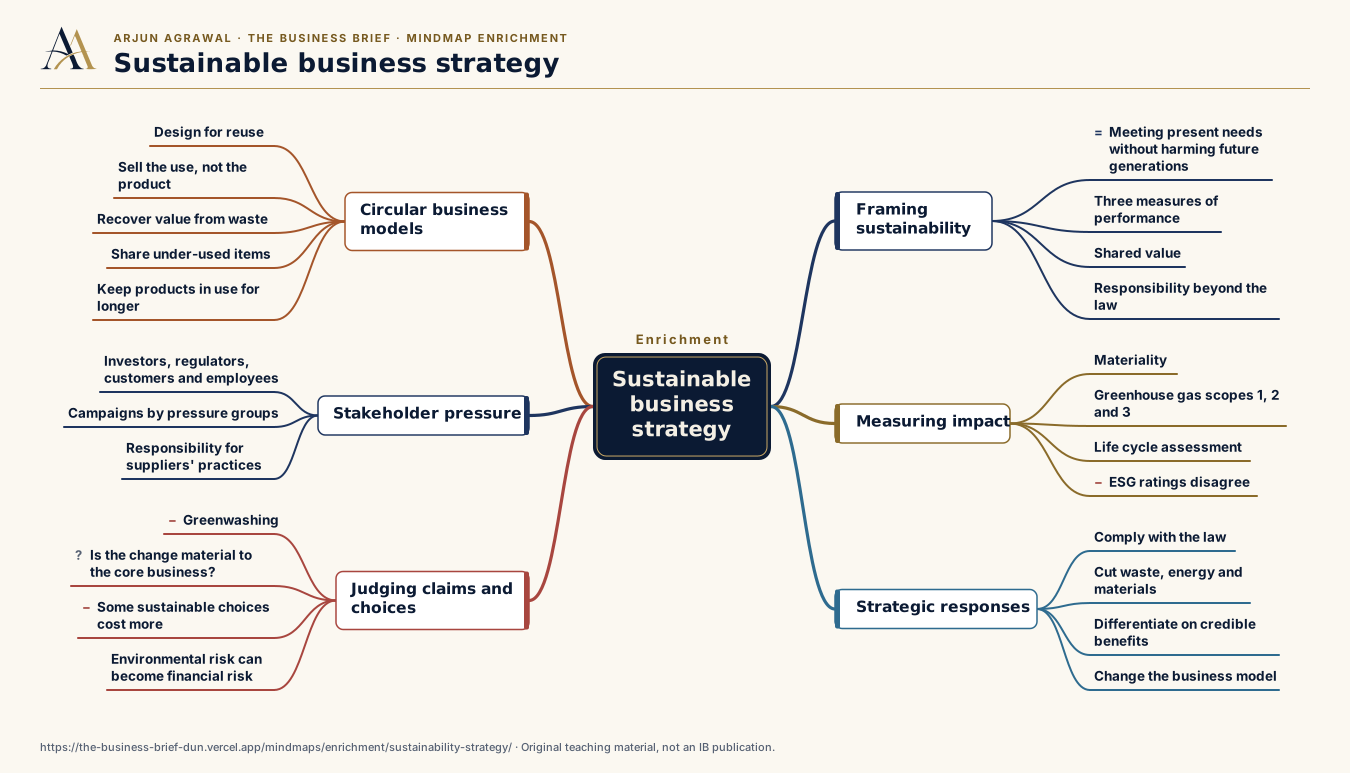
The map as an outline
Framing sustainability
Core ideas
- Definition Meeting present needs without harming future generations The United Nations definition of 1987, which the IB guide also quotes.
- Three measures of performance People, planet and profit.
- Shared value Profitable ways of meeting social needs (Porter and Kramer).
- Responsibility beyond the law
Measuring impact
Tools
- Materiality Which issues matter most to the business and to its stakeholders.
- Greenhouse gas scopes 1, 2 and 3 Direct emissions, purchased energy, and the rest of the value chain.
- Life cycle assessment Impacts from raw materials to disposal.
- Limitation ESG ratings disagree Rating agencies use different methods, so one firm can receive very different scores.
Strategic responses
Types and forms
- Comply with the law
- Cut waste, energy and materials Often saves money as well.
- Differentiate on credible benefits Customers pay more only for claims they trust.
- Change the business model
Circular business models
Applications
Stakeholder pressure
Core ideas
- Investors, regulators, customers and employees
- Campaigns by pressure groups
- Responsibility for suppliers' practices Labour and environmental standards at suppliers' sites.
Judging claims and choices
Evaluation
- Limitation Greenwashing Claims that overstate environmental benefits.
- Question Is the change material to the core business?
- Limitation Some sustainable choices cost more The trade-off is real, at least in the short run.
- Environmental risk can become financial risk Through regulation, physical damage and changing demand.
Download the full map as an SVG file Works without JavaScript; the buttons above also save the view you have open.
Section 01: Where it starts from the IB course
For readers who know the IB course: the subtopics this map builds on. The map goes further than any of them.
- 1.1 What is a business? Circular business models
- 1.3 Business objectives Ethical objectives and corporate social responsibility
- 1.4 Stakeholders Stakeholders and pressure groups
- 5.3 Lean production and quality management HL: cradle to cradle design and lean production
Section 02: Related enrichment maps
- Corporate governance How boards oversee environmental and social risk
- Operations strategy Supply chains and circular operations
- Marketing strategy Claims customers can trust
Section 03: Terms on the map
Where an idea on the map is the same as a term in the platform's glossary, the node links to it. The glossary defines each term as the IB course uses it.
- Circular business models
- Corporate social responsibility (CSR)
- Cradle-to-cradle design
- Environmental, social and governance (ESG)
- Greenwashing
- Pressure group
- Product life extension model
- Product service system model
- Resource recovery model
- Sharing model
- Supply chain
- Triple bottom line
- Waste (in lean production)
How this map was written
The platform's own summary of established ideas about sustainable business, written for the undergraduate and MBA pathways. It goes beyond the IB course and is aligned to no university course or textbook, because none was supplied. Ideas are named with the people usually credited with them; their works were not opened for this map.
- Business management guide, first assessment 2024 (published February 2022, updated May 2022), (2022) p. 13: The definition of sustainability the guide quotes from the United Nations (1987). Supplied to the platform and read.
Arjun Agrawal | The Business Brief, https://the-business-brief-dun.vercel.app/mindmaps/enrichment/sustainability-strategy/. Original teaching material, not an IB publication. The organizations in the teaching cases are fictional unless a case says otherwise.