Unit 3: Finance and accounts
3.7 Cash flow
Study mode could not start. The page reads as usual.
Study mode
On this page
Section 01: What the IB course asks
The content statements for 3.7, in the platform's words, with the depth of teaching the guide sets (guide, from p. 29).
- The difference between profit and cash flow AO2
- Working capital AO2, AO4
- Liquidity position AO2
- Cash flow forecasts AO2, AO4
- The relationship between investment, profit and cash flow AO2
- Strategies for dealing with cash flow problems AO3
AO1 knowledge and understanding · AO2 application and analysis · AO3 synthesis and evaluation · AO4 a range of skills. A question can use a command term at its statement's level or below. The whole course.
Section 02: Why it matters
Cash is what a business pays its bills with. Staff, suppliers, landlords and banks want cash on the day it is due, and the promise of a profit next month will not do instead. A business that runs out of cash can be forced to close even while it is making a profit.
This subtopic explains why profit and cash flow differ, and how working capital and a business's liquidity position show whether it can keep going. It shows how to construct and read a cash flow forecast in the layout the IB uses, why investing can drain cash before it adds to profit, and what a business can do when its cash runs short.
By the end you can
- Distinguish between profit and cash flow, and explain why a profitable business can run short of cash.
- Calculate working capital, and explain how the working capital cycle ties up cash.
- Analyse a business's liquidity position from its cash, its working capital and its liquidity ratios.
- Construct a cash flow forecast in the guide's layout, and comment on what it shows.
- Explain the relationship between investment, profit and cash flow.
- Evaluate strategies for dealing with cash flow problems.
Section 03: Profit and cash flow are different
Profit is revenue minus costs for a period, counted when the revenue is earned and the costs are incurred. Cash flow is the money that actually moves into and out of the business in that period: cash inflows coming in and cash outflows going out. The two measure different things, and the gap between them is mostly a matter of timing.
A sale made on credit in March is March's revenue and adds to March's profit, but if the customer pays in May, the cash arrives in May. Going the other way, the cash for a new van leaves on the day the van is paid for, while its cost reaches the statement of profit or loss a little at a time, as depreciation. Some cash flows are never revenue or costs at all: a bank loan brings cash in but is not revenue, and repaying it takes cash out but is not a cost.
So a business can be profitable and short of cash at the same time, or make a loss and still have money in the bank, for a while. Over a long enough period profit and cash come together; in any one month they can be far apart.
- Credit sales
Count as revenue, and so towards profit, when the sale is made. The cash arrives later, when the customer pays.
- Credit purchases
Supplies bought on trade credit can be used, and even sold, before they are paid for, which helps cash flow.
- Stock
Cash goes out when stock is paid for, but its cost reaches profit only when the stock is sold, which may be months later.
- Assets and depreciation
Buying an asset takes cash out at once, but its cost reaches profit only gradually, as depreciation. Depreciation itself is never a cash outflow.
- Loans and owners' money
Loans and new share capital bring cash in but are not revenue. Repaying a loan takes cash out but is not a cost.
Section 04: Working capital
Working capital is current assets minus current liabilities: the money a business has for its day-to-day running once its short-term debts are allowed for. It pays for the stock, wages and bills that keep the business trading until its customers pay.
Working capital does not sit still. It moves round the working capital cycle: cash buys materials and labour, these become stock, the stock is sold, often on credit, and when customers pay, the debtors turn back into cash. The longer the cycle takes, the more working capital the business needs. Holding stock for less time, collecting from customers sooner and paying suppliers later all shorten it.
What working capital is made of matters as much as its size. Cash can pay a bill today; debtors depend on customers paying; stock has first to be sold.
- Too little working capital
The business may be unable to pay its suppliers and staff on time, may lose its credit terms and discounts, and has no buffer against a slow month.
- Too much working capital
Cash, stock or debtors are tied up instead of earning a return elsewhere, and stock may go out of date.
- Overtrading
Growing faster than working capital allows. More orders mean more stock and wages paid for before customers pay, so the cash gap widens with every sale, and a business whose sales are booming can run out of cash.
Text description
A loop of five stages: cash is used to buy materials, often on credit from suppliers, the creditors; materials go into production as work in progress; they become finished goods held as stock; the goods are sold, often on credit, so customers owe money as debtors; and when debtors pay, the cash returns. Working capital is current assets minus current liabilities, the cash a business needs to keep running. The longer the cycle, the more working capital is tied up; paying suppliers later, holding less stock and collecting from customers sooner all shorten it.
Working capital
Working capital = current assets − current liabilities
The guide's formula list does not include it; this is the standard definition, from two lines of the statement of financial position.
Section 05: Liquidity position
A business's liquidity position is how well it can pay its debts as they fall due. It is strong when the business has enough cash, or assets that will soon become cash, to meet what it owes over the coming months with room to spare. It is weak when one late payment or one slow month would leave it unable to pay.
No single number settles it. Judge it from several pieces of evidence together:
- the cash balance now, and the closing balances in the cash flow forecast;
- the working capital, and what it is made of;
- the current ratio and the acid test ratio (3.5);
- how much of the agreed overdraft is still unused, and how all of these have changed over recent months.
A weak liquidity position is dangerous even for a profitable business. Suppliers stop giving credit, the bank may cut the overdraft, and a business that cannot pay its debts as they fall due is insolvent, which can end in its closure. HL students compare insolvency with bankruptcy in 3.6.
Section 06: Cash flow forecasts
A cash flow forecast estimates the cash a business expects to receive and to pay out in each month of a coming period, often six or twelve months, and so the cash it will hold at the end of each month. It is a plan built on estimates: of sales, of when customers will pay, and of the costs the business expects to meet.
The guide's layout runs down each month's column in this order: the opening balance; the cash inflows, item by item, then total cash inflows; the cash outflows, item by item, then total cash outflows; the net cash flow; and the closing balance, which becomes the next month's opening balance. Negative figures, such as a negative net cash flow or an overdrawn balance, are shown in brackets.
The rule that matters most is to enter each item in the month the cash moves, not the month the sale or purchase is made. A sale on 30 days' credit in March is a cash inflow in April. Depreciation never appears, because no cash moves; the purchase of the asset does, in the month it is paid for.
In the diagram, February's net cash flow of ($5,000) takes the balance from $3,000 to ($2,000), so the business would need an overdraft of at least $2,000 to get through the month.
Text description
A three-month cash flow forecast in the guide’s layout. January: opening balance 5,000, total cash inflows 12,000, total cash outflows 14,000, net cash flow (2,000), closing balance 3,000. February: opening balance 3,000, total cash inflows 10,000, total cash outflows 15,000, net cash flow (5,000), closing balance (2,000). March: opening balance (2,000), total cash inflows 16,000, total cash outflows 11,000, net cash flow 5,000, closing balance 3,000. Each closing balance becomes the next month’s opening balance. February’s closing balance is negative, so the business would need an overdraft or another way to cover the gap.
Net cash flow
Net cash flow = total cash inflows − total cash outflows
Closing balance
Closing balance = opening balance + net cash flow
Opening balance
Opening balance = the previous month's closing balance
The guide's formula list does not include these; they follow from its cash flow forecast layout (p. 63).
Advantages
- Warns of a cash shortfall early enough to act, for example by arranging an overdraft before it is needed.
- Supports an application for a loan or an overdraft, since lenders often ask to see one.
- Helps to time spending, such as buying equipment in a month when cash is high.
- Gives a benchmark, so that actual cash flows can be compared with the forecast each month and problems show up early.
Limitations
- It is only as good as its estimates, and sales forecasts can be wrong, especially for a new business with no history.
- Customers may pay late, and costs such as energy, materials and wages can change.
- Events outside the business, such as a new competitor or a recession, are hard to foresee.
- It takes time to prepare, and it has to be updated as conditions change.
Section 07: Investment, profit and cash flow
Investment means spending now on assets or projects, such as machinery, a new store or research, in order to earn more in the future. It links profit and cash flow in a pattern that repeats over time.
- At the start, the investment takes a large sum of cash out, and set-up costs, training and launch marketing come before any extra revenue. Cash flow is strongly negative, and profit may fall.
- As it begins to earn, extra revenue arrives, but profit also carries the depreciation of the new assets, and the interest on any loan that paid for them.
- When it succeeds, the returns lift both profit and cash inflows, and over its life the investment repays the cash it used.
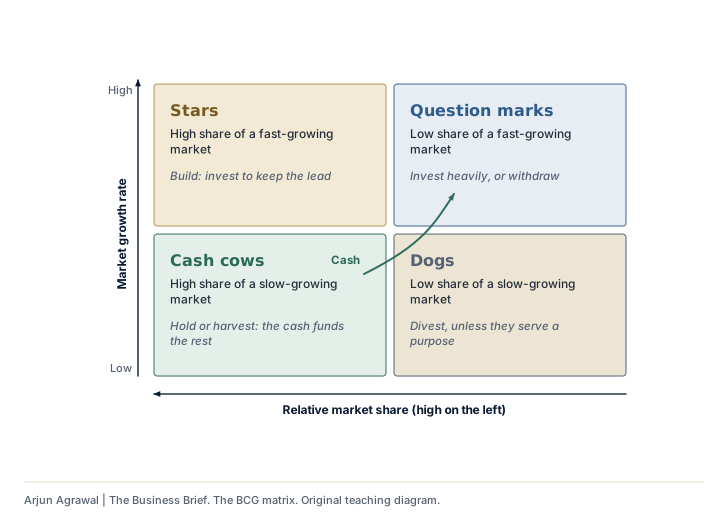
The danger lies in the gap between the cash going out and the returns coming in. A business can make an investment that will be very profitable and still run out of cash before the returns arrive. That is why long-term investment should be paid for with long-term finance (3.2) rather than from working capital or an overdraft, and why its timing is checked with investment appraisal (3.8). The same pattern runs through a product's life cycle: cash flow is usually negative around the launch and strongest in maturity (4.5). The BCG matrix, a toolkit tool the guide suggests for this unit, rests on the same idea: question marks usually need more cash than they earn, stars use most of what they earn to keep growing, and cash cows produce the surplus that pays for the others.
Section 08: Why cash runs short
A cash flow problem has a cause, and a strategy works only if it fits the cause. Most shortfalls come from one or more of these.
- Overtrading
Growing faster than working capital allows, so that stock and wages are paid for long before customers pay.
- Poor credit control
Customers are given too long to pay, late payers are not chased, or some never pay at all.
- Too much stock
Cash is tied up in stock that sells slowly, or that goes out of date before it sells.
- Seasonal demand
Sales come in a few months of the year while rent, wages and loan repayments continue in every month, as for a ski school or a garden centre.
- Unexpected costs or falling sales
A breakdown, a supplier's price rise, a new competitor or a recession can open a gap that the forecast did not show.
- Investment and borrowing
Buying assets out of working capital, or repaying debt faster than the business can afford, takes cash it needs for its everyday running.
- Poor planning
Without a forecast, or with one that is never updated, the business sees the shortfall only when a payment fails.
Section 09: Strategies for dealing with cash flow problems
There are three ways to close a cash gap: reduce or delay cash outflows, increase or bring forward cash inflows, or find extra finance to cover it. Each has a cost. The best choice depends on the cause of the problem, how long it will last and what the business can afford to give up. A seasonal dip calls for a short-term fix, but a business that loses money every month needs more than a bigger overdraft. These are the usual options, not a list the IB prescribes.
- Ask suppliers for longer credit
Delays outflows and keeps cash in the business for longer, at no direct cost. Suppliers may refuse, raise their prices or withdraw credit if payments become late, and any discount for prompt payment is lost.
- Lease or rent instead of buying
Replaces one large outflow with smaller regular payments. Over the life of the asset, leasing usually costs more than buying, and the business never owns the asset unless the agreement lets it buy.
- Delay or cut spending that can wait
Postponing a replacement machine, ordering less stock or trimming costs such as some marketing reduces outflows quickly. Delays can store up problems, since old machines break down and low stock risks lost sales.
- Chase debtors and tighten credit terms
Invoicing promptly, following up late payers, shortening the time allowed to pay or asking for deposits brings cash in sooner. Customers may move to rivals that offer better terms.
- Offer a discount for prompt payment
Brings cash in sooner, but the discount cuts the revenue, and the profit, on every sale where it is taken.
- Debt factoring
A factor pays most of the value of the business's invoices at once and then collects them itself. Its fee reduces profit, and some customers may read the use of a factor as a sign of trouble.
- Sell surplus stock or assets
Clearing slow-selling stock or selling equipment the business no longer needs brings cash in. Stock may have to be discounted, and with sale and leaseback the business keeps using an asset but pays to lease it for years.
- Overdraft or short-term loan
Quick to arrange, and suited to a short gap such as a seasonal dip. Interest is usually higher than on a long-term loan, the bank can withdraw an overdraft at short notice, and borrowing does not fix the cause.
- Owners' funds or new share capital
Adds cash with no interest to pay. A sole trader puts personal savings at risk, new shareholders dilute the owners' control, and raising share capital takes time.
Section 10: In practice: industries and stakeholders
The same ideas look different from one industry to the next, and land differently on each group with a stake in the business.
Across industries
- Seasonal tourism and leisure
A ski school, a beach hotel or a garden centre earns most of its cash in a few months but pays rent, loan repayments and permanent staff all year. Its forecast shows the low months in advance, so it can arrange an overdraft before the off season instead of asking for one in the middle of it.
- Construction
Builders buy materials and pay workers for months before a stage of the project is signed off and paid for, and clients may hold back part of the final payment until defects are fixed. A builder that takes on several large projects at once can overtrade, running out of cash while its order book looks healthier than ever.
- Supermarkets
Customers pay at the till, stock sells within days, and suppliers are paid weeks later, so the working capital cycle runs in the supermarket's favour. Growth brings in cash before the bills for it fall due, the opposite of a manufacturer's position, although a supermarket that stops growing loses some of that advantage.
- Manufacturing and exporting
Cash is tied up at every stage of a long cycle, in raw materials, work in progress, finished goods and customers abroad who may take 60 or 90 days to pay. Exchange rates can change the value of a foreign payment between the sale and its arrival, so exporters forecast cautiously and often use trade credit insurance or factoring.
- Technology start-ups
A start-up may spend heavily on developers for a year or more before it has much revenue, so it plans by how many months its cash will last at the current rate of spending. Customers who pay a year's subscription in advance bring cash in before the service is delivered, which can fund growth without borrowing.
- Charities and social enterprises
Grants often arrive in large sums, sometimes only after the work has been done and reported on, while staff and rent are paid every month. Many charities keep reserves for this reason, and money given for one purpose may not be used to cover a shortfall elsewhere, which makes their forecasts more complicated than a business's.
For each stakeholder
- Suppliers
Trade credit is finance that suppliers provide, and a business short of cash is tempted to pay them later. A small supplier can be pushed into cash problems of its own, so late payment shifts the strain down the supply chain, and a supplier that notices may demand payment on delivery.
- Banks and other lenders
Base overdraft and loan decisions on the forecast and on the evidence behind it, and can withdraw an overdraft at short notice. A bank wants to see the cause of a cash problem dealt with, not just funded, which can clash with owners who want to borrow their way through it.
- Employees
Wages are the payment a business can least afford to miss, and cash shortages bring recruitment freezes, cancelled overtime and, in the worst case, redundancies. Employees can end up bearing part of the cost of a cash gap they did nothing to cause.
- Owners and shareholders
May be asked to put in more money or to accept smaller dividends, since every dividend paid is cash leaving the business. A lender may restrict dividends until liquidity improves, which puts the owners' wish for income against the bank's wish for safety.
- Customers
Feel the effect when a business chases its own cash flow, through deposits, shorter credit terms or discounts for paying promptly. They also need their supplier to survive, since a business that runs out of cash cannot honour guarantees or finish orders.
- Managers
Choose the stock levels, credit terms and timing of investment that shape the working capital cycle. Pressure to grow sales can conflict with the need to keep cash, and the forecast is the tool that shows how far growth can go before it becomes overtrading.
Section 11: Evaluation and limits
What to weigh before reaching a judgement.
- Profit and cash answer different questions. Profit shows whether the business is worth running; cash shows whether it can keep running. Over the life of an investment the two come together, as Millstone's oven shows, but in any one month they can be far apart, and a business has to survive every month to reach the long run.
- A forecast is a set of estimates. Its closing balances are only as reliable as the sales figures and payment dates behind them, and a new business has the least history to estimate from. Treat the lowest balance as a warning, plan for a worse case, and update the forecast as actual figures arrive.
- Fit the fix to the cause. An overdraft suits a short, seasonal or one-off gap; it does not cure overtrading, poor credit control or a product that loses money. If the cash problem comes from losses, the business needs to improve its profitability, not just its cash.
- Every strategy moves the cost to someone else, whether suppliers paid later, customers pushed to pay sooner, owners asked for money or lenders charging interest. Squeezing stakeholders too hard damages relationships the business will need later, and paying small suppliers late raises ethical questions.
- More cash is not always better. Cash that sits idle earns little and lowers the return on capital employed (3.5). The aim is enough liquidity to meet debts with a margin of safety, not as much cash as possible.
- Investment often drains cash before it adds to profit. The answer is rarely to avoid investing; it is to match long-term spending with long-term finance, and to check when the returns will arrive before committing.
Section 12: Make the decision
Use the ideas on a business choice: weigh the options, decide, and say what would change your mind.
Decision brief · a fictional business
Funding the hotel order
Hollow Oak Furniture, the fictional table maker in the working capital section, has been offered the order for 40 tables at $1,500 each, $60,000 in all, by a hotel group that pays 60 days after delivery. The tables need $700 each of timber and wages, $28,000, paid while they are being made, so the order would contribute $32,000 towards Hollow Oak's fixed costs and profit.
Hollow Oak has $12,000 in the bank, current liabilities of $60,000 falling due over the coming year, and $36,000 owed by its own customers. It wants the order, but it must find the cash first.
How to weigh the options
The order is clearly worth having: no way of funding it costs more than about $1,200, against a contribution of $32,000. The real question is how to bridge the two months between paying for the tables and being paid for them, without leaving Hollow Oak unable to pay its other bills.
The deposit shrinks the gap at its source and keeps the bank out of it, and deposits are normal for large made-to-order work. Its risk is commercial: a hotel group with other suppliers may refuse, or agree only in return for a discount, and a discount of just 2% would cost $1,200, more than the factor's fee. The overdraft keeps the customer's terms and costs least in interest if the bank agrees, but an overdraft can be withdrawn at short notice, and $16,000 is the minimum, since wages and suppliers for Hollow Oak's other work fall due in the same weeks. Factoring brings forward cash that Hollow Oak would receive anyway, so it fits a timing problem, but it costs $1,080, puts a third party between Hollow Oak and its customers, and leaves less cash coming in over the next two months.
If the hotel will pay a deposit without a discount, that fits the cause best. If it will not, an overdraft agreed in advance is the cheapest bridge, and factoring is the fallback if the bank is unwilling to lend. The decision would change if more large orders are coming, because a gap that recurs needs a permanent answer, such as deposits as standard terms, rather than a one-off loan.
Section 13: Exam-style practice
Original questions written by the platform in the style of the papers, with what a strong response does. They are not IB questions and the guidance is not an official markscheme.
-
Distinguish between profit and cash flow.
What a strong response does
A strong response defines both and explains at least two ways in which they differ, with examples.
- Profit is revenue minus costs for a period, counted when sales are made and costs are incurred; cash flow is the money that actually comes into and goes out of the business in the period.
- Timing: a credit sale counts towards profit when it is made but brings in cash only when the customer pays, and supplies bought on credit are paid for later.
- Items in one but not the other: depreciation reduces profit but is not a cash flow, while a loan, new share capital or the purchase of an asset moves cash without being revenue or a cost of the period.
- A strong answer draws the consequence: a business can be profitable and short of cash at the same time.
-
At 30 June, Copperpot Catering, a fictional event caterer, had cash of $3,000, debtors of $1,500, stock of $900, trade creditors of $2,800 and other current liabilities of $1,000. Calculate Copperpot's working capital.
What a strong response does
A strong response shows both totals before the answer.
- Current assets = 3,000 + 1,500 + 900 = $5,400.
- Current liabilities = 2,800 + 1,000 = $3,800.
- Working capital = current assets − current liabilities = 5,400 − 3,800 = $1,600.
The formula is not on the guide's formula list, so write it before substituting.
-
Copperpot Catering expects the following for July to September.
- Cash at the start of July: $3,000.
- Private events, paid for in full in the month they take place: $9,000 in July, $11,000 in August and $8,000 in September.
- A conference for a corporate client in August, worth $12,000, which the client will pay 60 days after the event.
- Food and drink cost 35% of the value of each month's events and are paid for one month later. June's events were worth $8,000.
- Wages of $4,000 a month, plus $2,500 for extra staff at the conference in August.
- Kitchen rent of $1,200 a month.
Construct a cash flow forecast for Copperpot Catering for July to September.
What a strong response does
A strong response uses the guide's layout, enters each item in the month the cash moves, and carries each closing balance forward as the next month's opening balance.
Figures in $, for July, August and September:
- Opening balance: 3,000 · 4,000 · 4,150
- Private events: 9,000 · 11,000 · 8,000
- Total cash inflows: 9,000 · 11,000 · 8,000
- Food and drink (paid a month later): 2,800 · 3,150 · 8,050
- Wages: 4,000 · 6,500 · 4,000
- Rent: 1,200 · 1,200 · 1,200
- Total cash outflows: 8,000 · 10,850 · 13,250
- Net cash flow: 1,000 · 150 · (5,250)
- Closing balance: 4,000 · 4,150 · (1,100)
The conference's $12,000 does not appear, because the client pays in October. Its food, 35% of $12,000, is $4,200 of September's $8,050, alongside $3,850 for August's private events.
-
Copperpot expects to make a profit of $7,900 over these three months. Using your forecast from question 3, comment on why its cash position worsens over the same period.
What a strong response does
A strong response uses the figures to show that the gap is one of timing, and says what follows.
- The bank balance falls by $4,100, from $3,000 to an overdraft of $1,100, while the business makes a profit of $7,900: a difference of $12,000.
- The difference is the conference. Its $12,000 counts as August's revenue, and so towards profit, but the cash arrives only in October, while its food ($4,200, paid in September) and its extra staff ($2,500, paid in August) are paid for first.
- So the most profitable event of the quarter causes its cash shortfall. The problem is temporary if the client pays on time, but September needs an overdraft of at least $1,100, and more if the client pays late.
- A strong comment adds that one customer's payment now decides whether Copperpot can pay its bills, a risk the profit figure hides.
-
Copperpot is considering buying a refrigerated van for $18,000 in cash in September. It would use the van for six years and depreciate it by $3,000 a year. Explain how buying the van would affect Copperpot's profit and its cash flow this year.
What a strong response does
A strong response separates the effect on profit from the effect on cash, and applies both to Copperpot.
- Cash flow: the full $18,000 leaves in September, when the forecast already shows an overdraft of $1,100, so September's closing balance would become an overdraft of $19,100 unless the van is financed in another way.
- Profit: the van is capital expenditure, so only the year's depreciation of $3,000 reduces profit, and depreciation involves no cash.
- Over time: if the van lets Copperpot take on more events, the extra revenue adds to profit and cash in later years, but the cash spent comes back only gradually.
- A strong answer concludes that a long-lived asset should be paid for with long-term finance, such as a loan or a lease, not from working capital in the month when cash is weakest.
-
Recommend how Copperpot Catering should deal with the cash flow problem shown in its forecast.
What a strong response does
A strong response identifies the cause, weighs at least two strategies against it, and makes a justified recommendation.
- The cause: a timing gap. The business is profitable over the quarter, and the shortfall comes from a 60-day credit term on one large event whose costs fall due first. It is short and should clear in October.
- An overdraft for September: quick to arrange and the right size for a short gap, and the interest on about $1,100 for a month is small. But it depends on the bank, and it does nothing to stop the same thing happening at the next conference.
- Deposits from corporate clients: a 50% deposit of $6,000 in August would turn September's closing balance into $4,900. It treats the cause and could become standard terms, but clients may resist, and large clients have bargaining power.
- Factoring the conference invoice: a factor advancing 80% of it, $9,600, in August, for a fee of, say, 3% ($360), would leave September at $8,500, at a cost to profit, and the client would learn that Copperpot uses a factor.
- Paying for food later: asking the supplier for longer credit on September's bill would close the gap at no direct cost, but it strains a relationship Copperpot needs for every event.
- Recommendation: for example, agree an overdraft now as a safety net for September, and make deposits standard for corporate events so that the problem does not recur. A strong answer says what would change this: a client known to pay late, more conferences booked, or a bank unwilling to lend.
Section 14: Revision summary
The subtopic on one page: what to remember.
- Profit is revenue minus costs, counted when they are earned and incurred; cash flow is the money that actually moves in and out. The gap between them is mostly timing.
- A profitable business can run short of cash through credit sales, stock bought before it sells, assets paid for at once and loan repayments. Depreciation is never a cash flow.
- Working capital = current assets − current liabilities. It circulates through the working capital cycle, and the longer the cycle, the more working capital a business needs.
- Overtrading is growing faster than working capital allows, so that cash runs out while sales are booming.
- The liquidity position is judged from the cash balance and forecast balances, working capital and what it is made of, the liquidity ratios and the unused overdraft.
- A cash flow forecast runs: opening balance + total cash inflows − total cash outflows = closing balance, which becomes the next month's opening balance. Enter each item in the month the cash moves.
- Investment drains cash at the start, adds depreciation and interest to costs, and repays its cash only over time, so long-term spending needs long-term finance.
- Three ways to close a cash gap: reduce or delay outflows, increase or bring forward inflows, or find extra finance. Each has a cost, and the right one fits the cause and how long the problem will last.
Section 15: The mindmap
Why profit and cash are different, how working capital and liquidity keep a business alive, how a cash flow forecast is built and used, and what a business can do when cash runs short.
Drag to move the map, or use the arrow keys. Click a branch to fold it away. Whole map shows all of it; zoom with the buttons, or with Ctrl and the scroll wheel.
- Core ideas
- Calculations
- Evaluation
- Advantage
- Limitation
- HL HL only
The map as an outline
Profit and cash flow
Core ideas
- Definition Cash flow: cash moving in and out
- Definition Profit: revenue minus costs when earned
- Credit sales: revenue now, cash later
- Assets bought: cash out now, cost spread Depreciation is a cost but never a cash outflow.
- Loans and new shares: cash in, not revenue
- Stock is paid for before it is sold
- Profitable but short of cash, or the reverse
Working capital and liquidity
Core ideas
- Formula Working capital Working capital = current assets − current liabilities
- Working capital cycle: cash out to cash back
- Definition Liquidity position: can it pay its bills? Judged from cash, working capital and the liquidity ratios (3.5).
- Limitation Too little: missed payments, lost supplies
- Limitation Too much: cash idle instead of earning
- Overtrading: growing faster than cash allows
Cash flow forecast
Calculations
- Definition Month-by-month cash plan
- Opening balance The previous month's closing balance.
- Inflows: cash sales, debtors paying, loans
- Outflows: stock, wages, rent, repayments
- Formula Net cash flow Net cash flow = total cash inflows − total cash outflows
- Formula Closing balance Closing balance = opening balance + net cash flow
- Record cash when it moves, not when earned
Forecasts in use
Evaluation
- Advantage Warns of a shortfall in time to act
- Advantage Supports a loan or overdraft request
- Advantage Helps plan the timing of spending
- Limitation Only as good as the sales estimate
- Limitation Customers pay late; costs change
- Limitation Hard for a new business with no history
Investment, profit and cash flow
Core ideas
- Investment takes cash out before it earns
- Profit may dip at first Set-up costs and depreciation come before the returns.
- Returns later lift profit and cash inflows
- Finance it so that cash does not run out Long-term sources for long-term assets (3.2).
Dealing with cash flow problems
Evaluation
- Reduce or delay cash outflows
- Longer credit from suppliers
- Lease rather than buy
- Cut or postpone spending that can wait
- Bring cash inflows forward
- Chase debtors; shorten credit terms
- Debt factoring
- Sell surplus stock, or sale and leaseback
- Find extra finance
- Overdraft or short-term loan
- Owner's funds or new share capital
- Limitation Each fix has a cost Lower profit from fees and discounts, strained relationships or less control.
Open the mindmap on its own page, with its terms and connections.
Section 16: More diagrams
Original diagrams from the platform's library, each with a text description and an SVG download.
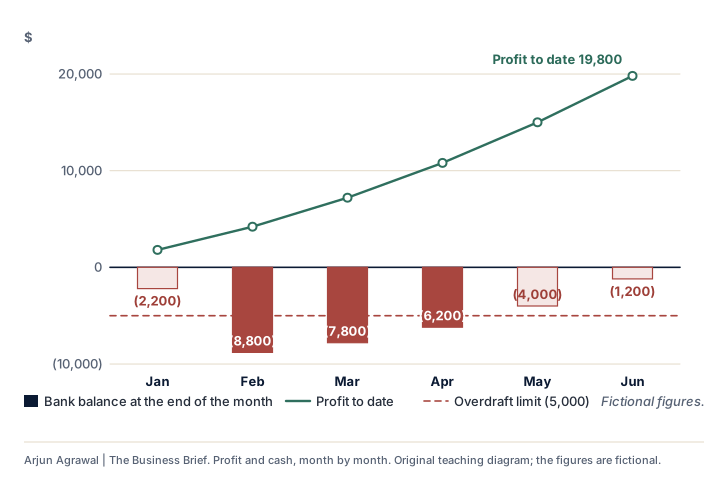
Change when customers pay and when suppliers are paid; the balances, the chart and the reading follow.
- Profit over the six months
- $19,800
- Bank balance at the end of June
- −$1,200
- Lowest balance
- −$8,800 (February)
- Customers still owe (debtors)
- $25,000
- Owed to suppliers (creditors)
- $0
| Month | Cash in | Cash out | Closing balance |
|---|---|---|---|
| January | 0 | 6,200 | (2,200) |
| February | 0 | 6,600 | (8,800) |
| March | 8,000 | 7,000 | (7,800) |
| April | 9,000 | 7,400 | (6,200) |
| May | 10,000 | 7,800 | (4,000) |
| June | 11,000 | 8,200 | (1,200) |
Larkfield Cycles makes a profit every month, $19,800 in all. Its balance goes beyond the $5,000 overdraft limit in February, March and April, so it would need more finance or would have to change its credit terms. Profit counts a sale when it is made; cash arrives only when the customer pays. Closing balance = opening $4,000 + profit $19,800 − debtors $25,000 + creditors $0 = −$1,200.
The figures above are the example’s. With JavaScript on, they can be changed here.
Text description
Larkfield Cycles, a fictional new business, sells on 2 months' credit and pays its suppliers after 0 months, starting with $4,000 in the bank and an overdraft limit of $5,000. Closing bank balances: January (2,200), overdrawn, within the limit; February (8,800), beyond the overdraft limit; March (7,800), beyond the overdraft limit; April (6,200), beyond the overdraft limit; May (4,000), overdrawn, within the limit; June (1,200), overdrawn, within the limit. Profit to date climbs every month to $19,800 by June. At the end customers still owe $25,000 and the business owes suppliers $0.
Text description
A two by two grid of a product portfolio, with market growth rate on the vertical axis and relative market share on the horizontal axis, high share on the left. Stars have a high share of a fast-growing market; build them by investing to keep the lead. Question marks have a low share of a fast-growing market; invest heavily or withdraw. Cash cows have a high share of a slow-growing market; hold or harvest them, as their cash funds the rest. Dogs have a low share of a slow-growing market; divest unless they serve a purpose. An arrow shows cash flowing from the cash cows to the question marks.
Section 17: Key terms
Defined in the platform's own words. Each opens its full entry.
- Cash flow
- The movement of cash into a business (cash inflows) and out of it (cash outflows) over a period of time.
- Cash flow forecast
- A plan that estimates a business's cash inflows and outflows month by month for a future period, to show the cash it expects to hold at the end of each month.
- Cash inflow
- Cash coming into a business, such as from cash sales, customers paying for earlier credit sales, loans received, new share capital or the sale of an asset.
- Cash outflow
- Cash leaving a business, such as payments for stock and materials, wages, rent, utilities, interest, tax, loan repayments, dividends and new assets.
- Closing balance
- The cash a business holds at the end of a period, found by adding the period's net cash flow to its opening balance.
- Credit sales
- Sales in which the customer receives the goods or service now and pays by an agreed later date; until then, the amount is owed to the business as debtors.
- Debt factoring
- Selling the money owed by customers to a specialist firm, the factor, which pays most of it to the business straight away and then collects the debts itself, keeping a fee.
- Debtors
- Customers who have bought goods or services on credit and not yet paid, and the total they owe the business, which is a current asset.
- Investment
- Spending money now on capital assets or projects, such as machinery, buildings, technology or research, in order to earn returns in the future.
- Leasing
- Paying regular amounts to use an asset, such as a vehicle, machine or building, that is owned by another firm, instead of buying it.
- Liquidity
- A business's ability to pay its short-term debts as they fall due from its cash and the assets it can quickly turn into cash; for a single asset, how quickly it can become cash at close to its full value.
- Net cash flow
- Total cash inflows minus total cash outflows for a period, which is negative when more cash leaves than comes in.
- Opening balance
- The cash a business holds at the start of a period, such as a month, which is the same as the closing balance of the period before.
- Overdraft
- An arrangement with a bank that lets a business take more money out of its current account than it has in it, up to an agreed limit.
- Overtrading
- Expanding sales or output faster than the business's working capital can support, so that it runs short of cash to pay for stock, wages and suppliers even though demand is strong.
- Sale and leaseback
- Selling an asset the business still needs, usually property, to another firm and then leasing it back so that the business can go on using it.
- Trade credit
- An arrangement in which a supplier lets a business receive goods or services now and pay for them later, often 30 to 90 days after delivery.
- Working capital
- Current assets minus current liabilities, the resources a business has for its day-to-day running once its short-term debts are allowed for.
- Working capital cycle
- The time between a business paying out cash for materials, stock and labour and receiving cash back from customers for the goods or services they produce.
Section 18: Tools and practice
6 tools on the platform for 3.7, by room, with exercises, worked calculations and practice questions.
Entrepreneurship and Innovation Lab
- Start-up cost calculator IB and enrichment
Advanced financial analysis
- Integrated forecast Enrichment
Worked calculations
Section 19: Check your recall
Answer from memory, then reveal and rate yourself. Your ratings stay on this device.
Answer each question from memory, out loud or on paper, before you reveal the answer. Your ratings also schedule these questions in your flashcards.
-
Give two reasons why a profitable business can be short of cash.
For example, sales made on credit (revenue now, cash later), cash paid for stock before it is sold, an asset bought with cash while its cost reaches profit only gradually as depreciation, or loan repayments, which take cash out but are not costs.
How well did you recall it? -
Define working capital, and give its formula.
The money a business has for its day-to-day running once its short-term debts are allowed for. Working capital = current assets − current liabilities.
How well did you recall it? -
In a cash flow forecast, how is the closing balance found, and where does it go next?
Closing balance = opening balance + net cash flow, where net cash flow = total cash inflows − total cash outflows. It becomes the next month's opening balance.
How well did you recall it? -
A business sells $8,000 of goods in March on 60 days' credit. In which month is the cash inflow entered in its forecast?
In May, when the customer pays, not in March, when the sale is made.
How well did you recall it? -
Why does depreciation never appear in a cash flow forecast?
No cash moves when depreciation is charged. The cash left the business when the asset was paid for, and that payment is what the forecast shows.
How well did you recall it? -
What is overtrading, and why can it sink a business whose sales are growing?
Expanding faster than working capital allows. Each new order means stock and wages paid for before customers pay, so the cash gap widens as sales grow, until the business cannot pay its bills.
How well did you recall it? -
Give two pieces of evidence you would use to judge a business's liquidity position.
For example, its cash balance and forecast closing balances, its working capital and what it is made of, its current and acid test ratios, and how much of its overdraft is unused.
How well did you recall it? -
Why can a new investment reduce cash flow, and perhaps profit, at first?
The cash is paid out at the start, with set-up costs, while the returns arrive later. Depreciation of the new assets and interest on any loan also reduce profit in the early years.
How well did you recall it? -
Give one way to bring cash inflows forward, and its drawback.
For example, debt factoring (the fee cuts profit, and customers may see it as a sign of trouble), a discount for prompt payment (it cuts revenue), or shorter credit terms (customers may go to rivals).
How well did you recall it?
Section 20: How it connects
Where 3.7 meets the rest of the course: worked connections with an exam-style question on each, then the further links the notes name.
-
With 3.4 Final accounts
Profit is not cash
The statement of profit or loss records revenue when a sale is made and costs when they are incurred, but cash moves only when customers and suppliers actually pay. A business that sells on credit, holds a lot of stock or buys a large asset can report a profit and still run short of cash: the asset's cost leaves the bank at once but does not appear as a single cost in that year's profit. That is why the guide treats profit and cash flow as different measures, and why a profitable business can still become insolvent.
Exam-style question Source: Original practice question Command term: Explain (AO2)
Explain why a profitable business can run out of cash. [4 marks]
-
With 3.5 Profitability and liquidity ratio analysis
Liquidity ratios and cash flow
The current ratio and the acid test ratio measure liquidity on one date, while a cash flow forecast shows how the cash position will change month by month. A business with cash flow problems often shows them in its ratios: cash falls, short-term debts such as an overdraft and trade creditors rise, and the acid test ratio drops below a comfortable level. Strategies that improve one usually improve the other, such as collecting debts sooner, reducing stock or replacing an overdraft with a long-term loan, though each has a cost.
Exam-style question Source: Original practice question Command term: Explain (AO2)
Explain how a cash flow problem might show up in a business's current ratio and acid test ratio. [4 marks]
-
With 4.5 The seven Ps of the marketing mix
The product life cycle and cash flow
The guide asks for the relationship between the product life cycle, investment, profit and cash flow. In development and at launch, cash flows out on research, production and promotion while sales are low, so cash flow and profit are usually negative. In growth, sales rise and the product moves towards profit, though it may still need investment to keep up with demand. In maturity it usually generates the most cash, which can fund new products, and in decline its cash inflows fall unless an extension strategy revives sales. A business whose products are all at the same stage can face serious cash flow problems.
Exam-style question Source: Original practice question Command term: Explain (AO2)
Explain the relationship between the product life cycle and cash flow. [4 marks]
-
With 5.7 Crisis management and contingency planning
Cash as a contingency plan HL
A crisis usually brings costs at once, such as recalls, repairs or lost sales, and a business without cash or credit may fail before it can recover. A cash reserve or an agreed overdraft is therefore one of the commonest contingency measures. It has a cost: cash held in reserve earns little and is not invested in growth, and an overdraft facility may carry fees. Weighing that cost against the risk it covers is the judgement the guide asks for when it sets the impact of contingency planning on cost, time, risks and safety.
Exam-style question Source: Original practice question Command term: Explain (AO2)
Explain how holding a cash reserve can form part of a business's contingency plan. [4 marks]
Also linked in the notes
- 3.1 Introduction to finance Capital expenditure drains cash at once but reduces profit gradually, one reason why profit and cash flow differ.
- 3.2 Sources of finance The short-term and long-term sources of finance that can close a cash gap.
- 3.6 Efficiency ratio analysis At HL, stock turnover, debtor days and creditor days measure the stages of the working capital cycle, and insolvency is compared with bankruptcy.
- 3.8 Investment appraisal Investment appraisal judges a project by its cash flows and when they arrive.
- 3.9 Budgets A cash flow forecast is a budget for cash, built from the same sales and cost plans.
- 4.3 Sales forecasting A cash flow forecast begins with forecast sales and when customers will pay for them.
- 5.5 Break-even analysis Break-even is about profit; cash flow is about timing, and a business needs both.
- 5.6 Production planning Stock ties up working capital, so stock control decisions affect cash flow.
See 3.7 on the course connections map, with every link drawn across the five units.
Section 21: Connected learning
Everything else on the platform that teaches, applies or tests 3.7, each labelled by its standing.
- Revise
-
- The 3.7 mindmap Full and revision views, to print or download
- Revision sheet The subtopic on one printable page
- Flashcards The 3.7 cards, to rate as you go
- Practise
-
- 10 questions on 3.7 in the question bank From the practice sets, the notes and the case files, filtered to this subtopic
- Cases
-
- Bellbird Home and Garden Fictional Case Vault
- Decisions and simulations
-
- Kestle Cycles: the cash runs out first Fictional Boardroom simulation
- Corvell Furniture: three years to restore the margin Fictional Boardroom simulation
- Frameworks
-
- The Boston Consulting Group matrix IB toolkit
- Tools
-
- 6 tools for 3.7 In Tools and practice on this page: Finance Desk, Financial Laboratory, Operations Floor, Entrepreneurship and Innovation Lab, Advanced financial analysis
- Boardroom Briefings
-
- Velantra Cold Chain's systems go dark at three in the morning Fictional Briefing 5
- Mãozinha's founders choose between more cities and a profit Fictional Briefing 6
- Business Intelligence
-
- Oracle's record year leaves free cash flow at minus $23.7 billion Real-world A real development, 10 June 2026, with its sources
- Two fires at Novelis's Oswego plant cost it $925 million and cut a year's profit by 98% Real-world A real development, 19 May 2026, with its sources
- Advanced Management
-
- Working capital, forecasting and cash flow modelling Enrichment Advanced financial management: beyond the IB course
- Unit economics and entrepreneurial finance Enrichment Entrepreneurship and innovation: beyond the IB course
- Scaling, innovation management, failure and recovery Enrichment Entrepreneurship and innovation: beyond the IB course
- Course connections
-
- 4 worked connections on the connections map With 3.4, 3.5, 4.5, 5.7
Notes checked against: Business management guide, first assessment 2024 (published February 2022, updated May 2022), pp. 28 to 30, 63 to 65 (The six content statements and their assessment objectives (pp. 29 to 30), the tools suggested for unit 3 (p. 28), the layout of the cash flow forecast (p. 63), and the formula list, which has no cash flow formulas (pp. 64 to 65)); Business management teacher support material, pp. 82, 84 to 85 (The glossary entries for current assets, current liabilities, insolvency and liquidity, read to check terms; nothing reproduced). Updated 2026-11-03. The IB guide is the authority on the course.
Arjun Agrawal | The Business Brief, https://the-business-brief-dun.vercel.app/topics/cash-flow/. Original teaching material, not an IB publication. The organizations in the teaching cases are fictional unless a case says otherwise.