Enrichment map · Enterprise · Beyond the IB course
Entrepreneurship and new ventures
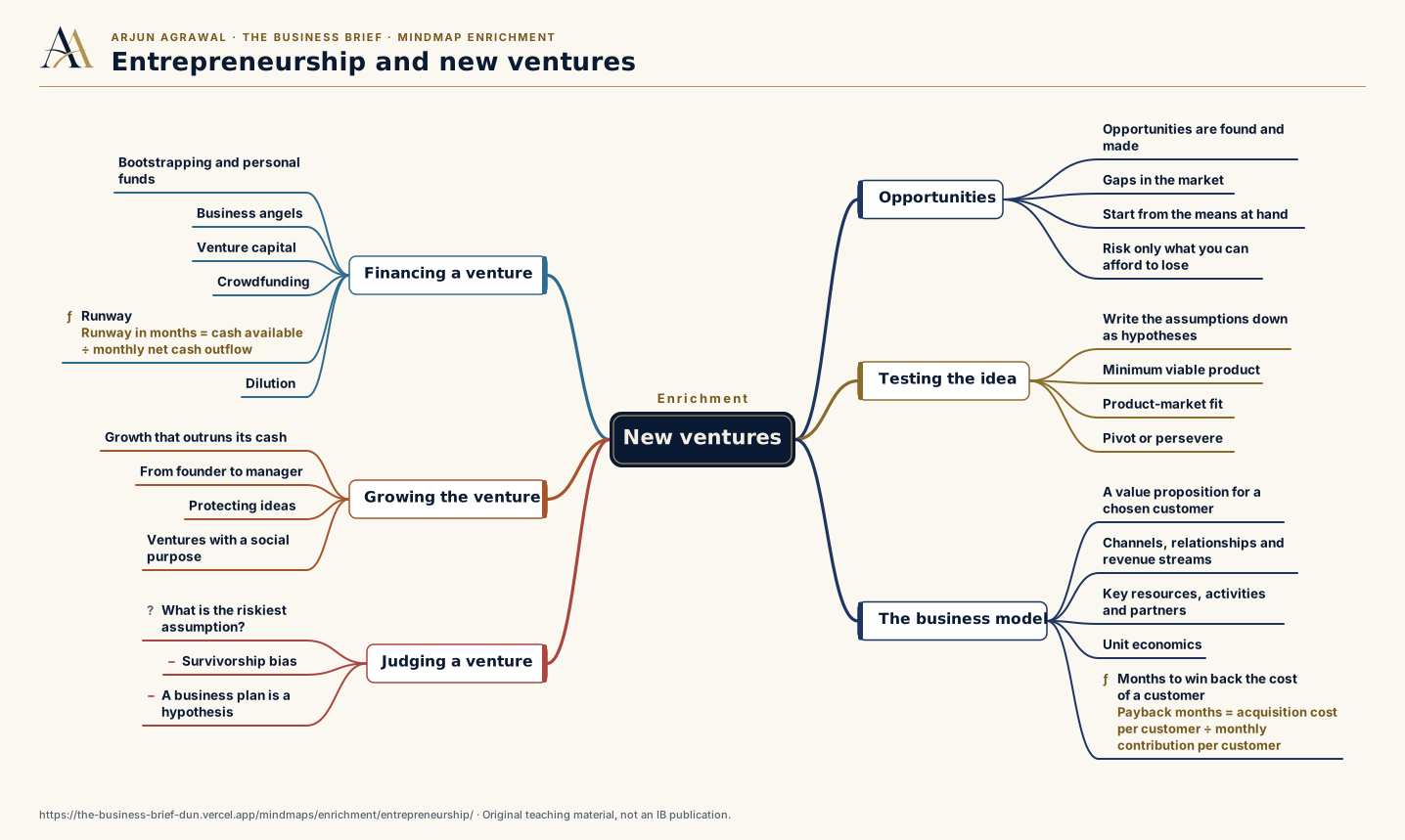
How a new venture turns an opportunity into a business, from finding and testing ideas and designing the business model to financing under uncertainty and growing without running out of cash.
Drag to move the map, or use the arrow keys. Click a branch to fold it away. Whole map shows all of it; zoom with the buttons, or with Ctrl and the scroll wheel.
- Core ideas
- Tools
- Types and forms
- Applications
- Evaluation
- Advantage
- Limitation
The map as an outline
Opportunities
Core ideas
- Opportunities are found and made Some are discovered in unmet needs; others are created by acting and learning.
- Gaps in the market
- Start from the means at hand Who you are, what you know and whom you know (Sarasvathy's effectuation).
- Risk only what you can afford to lose Affordable loss, rather than a forecast of expected return.
Testing the idea
Tools
- Write the assumptions down as hypotheses Then test the riskiest one first.
- Minimum viable product The smallest offer that shows whether customers will pay.
- Product-market fit Customers keep buying and recommending without being pushed.
- Pivot or persevere Change one part of the model when the evidence says so.
The business model
Core ideas
- A value proposition for a chosen customer
- Channels, relationships and revenue streams
- Key resources, activities and partners
- Unit economics Contribution per customer must repay the cost of winning them, then the fixed costs.
- Formula Months to win back the cost of a customer Payback months = acquisition cost per customer ÷ monthly contribution per customer
Financing a venture
Types and forms
- Bootstrapping and personal funds
- Business angels
- Venture capital Equity in stages for fast-growing firms, in return for a large share of the upside.
- Crowdfunding
- Formula Runway Runway in months = cash available ÷ monthly net cash outflow The monthly net outflow is often called the burn rate.
- Dilution Each equity round shrinks the founders' share, though the stake can still grow in value.
Growing the venture
Applications
- Growth that outruns its cash
- From founder to manager Delegation and structure become unavoidable as the team grows.
- Protecting ideas
- Ventures with a social purpose
Judging a venture
Evaluation
- Question What is the riskiest assumption?
- Limitation Survivorship bias Famous successes hide the many that did the same things and failed.
- Limitation A business plan is a hypothesis
Download the full map as an SVG file Works without JavaScript; the buttons above also save the view you have open.
Section 01: Where it starts from the IB course
For readers who know the IB course: the subtopics this map builds on. The map goes further than any of them.
- 1.1 What is a business? Entrepreneurship and the opportunities and challenges of starting up
- 1.2 Types of business entities Choosing a legal form
- 3.2 Sources of finance Personal funds, business angels and crowdfunding
- 3.7 Cash flow Cash flow forecasts
- 5.5 Break-even analysis Contribution and break-even
Section 02: Related enrichment maps
- Corporate finance Financing and valuing growth
- Strategy formulation From one product to a strategy
Section 03: Terms on the map
Where an idea on the map is the same as a term in the platform's glossary, the node links to it. The glossary defines each term as the IB course uses it.
How this map was written
The platform's own summary of established ideas about new ventures, written for the undergraduate and MBA pathways. It goes beyond the IB course and is aligned to no university course or textbook, because none was supplied. Ideas are named with the people usually credited with them; their works were not opened for this map.
Arjun Agrawal | The Business Brief, https://the-business-brief-dun.vercel.app/mindmaps/enrichment/entrepreneurship/. Original teaching material, not an IB publication. The organizations in the teaching cases are fictional unless a case says otherwise.