Unit 2: Human resource management
2.2 Organizational structure
Study mode could not start. The page reads as usual.
Study mode
On this page
Section 01: What the IB course asks
The content statements for 2.2, in the platform's words, with the depth of teaching the guide sets (guide, from p. 25).
- Terms for organizational structures: delegation, span of control, levels of the hierarchy, chain of command, bureaucracy, centralization, decentralization, delayering and matrix structure AO2
- Organization charts: flat or horizontal, tall or vertical, and by product, function or region AO2, AO4
- Which organizational structure suits a change in external factors AO3
- Changes in organizational structures, such as project-based organization and Charles Handy's Shamrock Organization AO3 HL
AO1 knowledge and understanding · AO2 application and analysis · AO3 synthesis and evaluation · AO4 a range of skills. A question can use a command term at its statement's level or below. The whole course.
Section 02: Why it matters
Once a business grows beyond a handful of people, someone has to decide who does which job, who reports to whom and who is allowed to decide what. The answers make up its organizational structure: the way it arranges its jobs, departments and lines of authority. A structure is more than a diagram on a wall. It decides how quickly the business can act, how much it spends on managers, how well information travels and how much freedom its people have.
This subtopic gives you the vocabulary to describe any structure, the main shapes an organization chart can take, and the judgement the examination rewards most: which structure suits a business when the world around it changes. At HL you also weigh newer, more flexible forms, such as project-based organization and Charles Handy's Shamrock Organization.
By the end you can
- Explain the terms used to describe a structure: delegation, span of control, levels of the hierarchy, chain of command, bureaucracy, centralization, decentralization, delayering and matrix structure.
- Construct an organization chart from a description of a business, and read its levels, spans of control and chains of command.
- Distinguish between tall and flat structures, and between structures organized by function, by product and by region.
- Evaluate which structure suits an organization when external factors change.
- Discuss changes in structure such as project-based organization and Handy's Shamrock Organization (HL only).
Section 03: The hierarchy and the organization chart
Most organizations are arranged as a hierarchy: layers of authority, with a few senior managers at the top and more people at each level below. Authority, the right to make decisions and give instructions, passes down the hierarchy. Accountability, the duty to answer for results, passes up.
An organization chart is a diagram of this formal structure. Each box is a post or a department, each line a reporting relationship and each row a level. A chart shows formal relationships only. Informal networks, such as the colleague everyone asks for advice, and the way work really gets done can look quite different.
The guide sets organization charts at AO4 as well as AO2, so you may be asked to draw one from a case, not only to read one. To construct a chart:
- Put the most senior post (the owner, the chief executive or the board) at the top.
- Place each post or department one row below the person it reports to, so that posts of equal rank share a row. Each row is then a level of the hierarchy.
- Join each post to its manager with a line, and label each box with a job title or a department.
- Check the result: count the levels, count each manager's direct reports and trace a chain of command from the bottom to the top.
- Levels of the hierarchy
The number of layers of authority, from the most senior managers down to the employees with no one reporting to them. More levels make a taller structure, with more steps for promotion but longer lines of communication.
- Span of control
The number of subordinates who report directly to one manager. A wide span means lighter supervision and more freedom; a narrow span allows close control and support. For the same number of staff, wider spans mean fewer levels.
- Chain of command
The formal line of authority through which instructions pass down and accountability passes up, from the top of the hierarchy to the bottom. Long chains slow decisions and distort messages as they pass through many people.
- Delegation
Passing the authority to carry out a task or make a decision to someone lower in the hierarchy. The manager who delegates stays accountable for the result, so delegation needs trust, clear instructions and staff with the right skills. It frees managers' time and can motivate the people trusted with the work, but delegating without support can overload them.
Section 04: Centralization, decentralization and bureaucracy
Two organizations can have the same chart and still work very differently, because a chart does not show where decisions are actually made. That depends on how much authority stays at the top.
In practice it is a matter of degree. Most organizations centralize some decisions, such as finance, brand and major investment, and decentralize others, such as staff rotas, local promotions and dealing with complaints. The question for an answer is which decisions should sit where, for this business, now.
Delegation and decentralization are easily confused. Delegation passes a particular task from one manager to one subordinate. Decentralization is a feature of the whole structure: it passes decision-making power down to lower levels, regions or branches.
- Centralization
Keeping decision-making authority with a small group of senior managers, usually at head office. It brings consistent decisions and a uniform brand, tight control of costs and quick action in a crisis, since few people decide. Its drawbacks are slow responses to local conditions, overloaded senior managers and less motivated staff lower down.
- Decentralization
Passing decision-making authority from the centre to lower levels, or to regional and branch managers. Decisions are made close to customers and problems, responses are faster and managers develop their skills. The risks are inconsistent decisions, duplicated effort and weaker central control.
- Bureaucracy
A way of organizing based on formal rules, written procedures, clearly defined roles and set approval processes. The German sociologist Max Weber saw it as the most efficient way to run a large organization, because rules replace personal favour. It brings consistency, fairness, clear accountability and control, which suits large organizations and work where mistakes are costly, but decisions are slow and staff have little room for initiative. In the course the word is a neutral description, not the everyday insult for red tape.
Section 05: Tall and flat structures, and delayering
Levels of hierarchy and spans of control together give a structure its shape. The same number of people can be arranged as a tall structure, with many levels and narrow spans, or as a flat one, with few levels and wide spans. The diagram arranges fifteen people both ways.
Delayering means removing one or more levels of the hierarchy, usually layers of middle management, to make a structure flatter. Businesses delayer to cut costs, to speed up decisions, or because technology lets fewer managers coordinate more people. The managers who remain take on wider spans of control.
- Tall or vertical structure
Many levels and narrow spans of control. It allows close supervision, clear roles and a ladder of promotion, but communication is slow, messages are distorted along the long chain of command, management costs are high and staff at the bottom may feel far from decisions. It is common in large, traditional organizations such as armed forces, banks and government departments.
- Flat or horizontal structure
Few levels and wide spans of control. Communication is fast, management costs are lower and employees have more responsibility, which can motivate. Managers may be overloaded, supervision is lighter and there are fewer chances of promotion. It suits smaller organizations and work that needs speed and initiative.
Text description
Two organization charts of fifteen people each. The tall, or vertical, structure has four levels of hierarchy with a span of control of two: one manager, two below, four below them and eight at the bottom, a long chain of command that gives close supervision and clear promotion steps but slows communication and decisions. The flat, or horizontal, structure has two levels: one manager with fourteen people reporting directly, a span of control of fourteen, which speeds communication and encourages delegation but stretches the manager and offers fewer promotion steps.
Advantages
- Delayering cuts salary costs and shortens the chain of command, so decisions and messages travel faster.
- After delayering, the staff who remain often gain responsibility and authority, which can motivate them.
- Senior managers end up closer to customers and to frontline staff.
Limitations
- The managers left behind take on wider spans of control and may be overloaded.
- Fewer levels mean fewer steps on the promotion ladder.
- Delayering often brings redundancies, which can damage the morale and trust of the staff who stay.
- Experience and knowledge leave with the managers who go.
Section 06: Organizing by function, product or region
A chart also shows how the work is grouped below the top. The guide names three ways, and the diagram shows one business arranged each way. Large organizations often combine them: a multinational may have a division for each region, each organized by function inside.
The right grouping follows the strategy. A business with one main product in one market groups by function. A business with distinct product ranges, each facing different customers and rivals, groups by product. A business that sells in many countries, with different tastes, laws and cultures, groups by region.
- By function
Departments based on the work people do, such as marketing, operations, finance and human resources. Specialists work together, which builds expertise, avoids duplication and gives clear career paths. Departments can become inward-looking, communicate poorly with each other and put their own goals first.
- By product
A division for each product or product range, each usually with its own marketing, production and finance staff. Each division can focus on its own customers and competitors, and it is easy to see which products perform well. Functions are duplicated across divisions, which adds cost, and divisions may compete for resources.
- By region
A division for each geographical area, such as a country or a continent, each responsible for its own market. Local managers can adapt products, prices and promotion to local conditions and respond quickly. Functions are duplicated in each region, and head office may lose control and consistency.
Text description
Three organization charts for a fictional business, each headed by a chief executive. By function: departments for marketing, operations, finance and human resources, grouped by what people do. By product: divisions for ceramics, glassware and textiles, grouped by what is sold, each running its own marketing, operations and finance. By region: divisions for Europe, Asia-Pacific, the Americas, and the Middle East and Africa, grouped by where the business sells.
Section 07: Matrix structure
In a matrix structure employees report to two managers at once: the head of their function, such as engineering or marketing, and the manager of the project or product they are working on. Project teams are laid across a functional structure, so people keep their specialist home while working with colleagues from other departments.
A matrix suits organizations whose work comes as complex projects that need several kinds of expertise at once, such as engineering, consultancy, software and product development. Its cost is the break with a single chain of command: when the two managers want different things, the employee is caught between them.
Text description
A grid with functional managers for marketing, operations and finance across the top and project managers for projects A, B and C down the side. Lines from each run across the grid, and a team member sits at each crossing, reporting to two managers: the head of their function and the leader of their project. Teams form around projects and draw on every function, at the cost of divided loyalties and possible conflict over time and priorities.
Advantages
- Brings people with different skills together around a project, which helps creativity and problem-solving.
- Uses staff flexibly, moving expertise to wherever it is needed.
- Keeps functional expertise and standards while focusing teams on results.
- Improves communication between departments.
Limitations
- Two managers can mean conflicting priorities, confusion and divided loyalty.
- Decisions slow down when the two managers disagree.
- It is costly and complex to coordinate, with more meetings and more managers.
- Answering to two people adds to employees' stress.
Section 08: Choosing a structure when external factors change
No structure is best in every situation. A structure suits a business when it fits its size, strategy, culture and people, and the environment it works in. When external factors change, a structure that served the business well can become a handicap. A STEEPLE analysis is a useful way to identify the change; the next step is to ask what the change demands of the structure: speed, control, local knowledge, flexibility or lower cost.
Changing a structure is itself costly and disruptive. Staff may resist new reporting lines, managers may lose status, and a new structure takes time to settle. A good answer weighs the gain from a better fit against the cost of the change, and says which matters more for this business.
- Fast-changing markets or technology
Speed and new ideas matter most, so a flatter, more decentralized structure, or project teams in a matrix, can respond faster than a tall bureaucracy.
- Expansion into new countries
Tastes, laws and cultures differ, so organizing by region, with authority passed to local managers, helps the business adapt.
- Recession or low-cost competition
Cost matters most, so delayering and centralizing purchasing can cut overheads, though cuts can damage morale when staff are already worried about their jobs.
- New regulation or a crisis
Control and consistency matter most, so some decisions may be centralized and procedures tightened, for example on safety, data or finance.
- Remote work and digital communication
Online tools let one manager coordinate more people, wherever they are, so wider spans of control and fewer layers become possible.
- Growth into new product markets
Each range faces different customers and rivals, so product divisions keep each one focused on its own market.
HL Section 09, Changing structures: project-based organization and the Shamrock, is HL only and is hidden while you are viewing SL content. Switch to HL at the top of the page to see it.
Section 09: Changing structures: project-based organization and the Shamrock
HL onlyMany organizations have moved away from fixed hierarchies towards structures that can change shape as their work changes. The guide gives two examples to evaluate.
Project-based organization builds the work around projects. Each project has a temporary team drawn from different functions, with its own goal, budget and deadline. When the project ends the team disbands and its members move to the next project. It goes further than a matrix: in a matrix, people keep a permanent functional home and report to two managers, while here the project is the main unit of the organization. It is common in consultancy, construction, film, advertising and software.
The Shamrock Organization was described by Charles Handy, an Irish management writer, in The Age of Unreason (1989). He argued that organizations would keep only a small core of essential people on permanent contracts and buy in the rest of their work as it was needed, so that the workforce would have three parts, like the three leaves of a shamrock. Each leaf has a different relationship with the organization, so each has to be managed, rewarded and motivated differently. Handy also pointed to a possible fourth leaf: customers who do part of the work themselves, as in self-service.
- Professional core
Permanent, highly skilled managers, professionals and technicians whose knowledge is essential and hard to replace. They are kept few, paid well and expected to be highly committed, and keeping them is a priority.
- Contractual fringe
Outside firms and self-employed specialists who do work that is not central, such as cleaning, catering, IT support or payroll, and who are paid for results rather than for their time. This turns fixed costs into variable ones but gives the organization less control over quality.
- Flexible labour force
Part-time, temporary and seasonal workers taken on when demand rises and released when it falls. Labour costs follow demand, but these workers usually have less pay, security and training than the core, so their commitment may be lower.
Text description
A shamrock with three leaves, each a group of workers. The professional core: permanent, full-time, highly skilled staff and managers who are hard to replace, well paid and loyal. The contractual fringe: specialist work outsourced to contractors and freelancers, paid for results. The flexible labour force: part-time, temporary and seasonal workers, added or dropped as demand changes.
Advantages
- Both forms are flexible, so the organization can respond quickly as projects, demand or technology change.
- The Shamrock lowers fixed labour costs and lets the business concentrate on what it does best, buying in specialist skills when it needs them.
- Project teams bring different skills together around a clear goal, which can encourage creativity and develop staff.
Limitations
- Loyalty and commitment are weaker outside the core, and frequent changes of people add recruitment and training costs.
- Quality, communication and coordination are harder to manage across contractors, temporary staff and changing teams.
- People on projects or short contracts may lack security and a clear career path, which can demotivate them and raises ethical questions.
- The core may be overloaded, and knowledge can be lost when project teams disband or contractors leave.
Section 10: In practice: industries and stakeholders
The same ideas look different from one industry to the next, and land differently on each group with a stake in the business.
Across industries
- Armed forces and government departments
Tall, bureaucratic structures with long chains of command give clear authority, accountability and consistent rules, which matter when mistakes are costly and every decision must be defensible. The price is slow decisions and little room for initiative lower down, which is why many such organizations give frontline teams more freedom within clear rules.
- Technology and software
Small, highly skilled teams, fast-changing products and cheap digital communication favour flat structures, wide spans of control and project teams, often in a matrix with engineering and design. As these firms grow, many add layers and rules to keep control, and some delayer again when decisions slow down.
- Retail chains
Head office usually centralizes buying, pricing, the brand and store design, to keep every store consistent and to buy at scale, while store managers decide rotas and local service. Area or regional managers sit between the two, and they are the layer that chains most often remove when they delayer, as Brannock Hardware did.
- Multinational manufacturers
Large manufacturers often combine product divisions with regional ones, sometimes in a matrix, so that expertise in each product meets knowledge of each market's customers and laws. Coordinating two lines of authority is costly, and the balance between them shifts as markets and strategies change.
- Hospitals
The clinical professions bring their own hierarchies of doctors and nurses alongside the management hierarchy, and staff in teams that combine several professions answer to both, much as in a matrix. Strict procedures, a bureaucratic feature, protect patients, while decisions taken on the ward let staff respond to patients quickly.
- Events, film and construction
Work arrives as one-off projects, so these industries rely on project-based organization, with temporary teams assembled for each job and disbanded at the end. A small permanent core hires contractors and temporary staff around it, the pattern Handy described as the Shamrock Organization (HL).
For each stakeholder
- Employees
Flat structures and decentralization give them more responsibility and a shorter route to the people who decide, but wider spans mean less support and fewer steps for promotion. Delayering can cost jobs, and in a matrix they answer to two managers whose demands may conflict.
- Middle managers
They are the layer that delayering removes, so restructuring threatens their jobs and status even when decentralization gives those who remain more authority. Their resistance can slow a change of structure that senior managers want.
- Owners and senior managers
Centralization keeps control and consistency in their hands but can overload them, as Hana Marrick's approvals show, while delegation frees their time at the cost of some control. Owners gain from lower management costs after delayering, but they also bear the cost of disruption and lost experience.
- Customers
Decentralized structures put decisions close to customers, so problems are solved faster and services fit local needs, while centralized ones give the same product and price everywhere. Customers rarely see the structure, but they notice its effects, such as a month's wait for a price cut or a complaint passed up a long chain of command.
- Contractors and temporary workers
At HL, in a Shamrock Organization the contractual fringe and the flexible labour force do much of the work without the pay, security or training of the core, so the organization's flexibility is partly their insecurity. Contractors gain business but depend on contracts that can be cut as soon as demand falls.
- Trade unions and staff representatives
Restructuring changes jobs, reporting lines and sometimes contracts, so unions and staff representatives press for consultation, fair selection for any redundancies and retraining. A structure imposed without them invites resistance and conflict, which at HL is the subject of industrial relations (2.7).
Section 11: Evaluation and limits
What to weigh before reaching a judgement.
- No structure is right in itself. The best structure fits the organization's size, strategy, culture, people and environment, and a structure that fits today may not fit in five years. Judge a structure against the case, not against an ideal.
- Flat structures are often praised for speed and empowerment, but they work only when staff are skilled and willing to take responsibility and managers can cope with wide spans. Without those conditions, flattening brings overload and confusion rather than freedom.
- Charts show the formal structure only. Much real coordination happens through informal networks, so a chart can make an organization look tidier, or more rigid, than it really is.
- Changing a structure has costs of its own: redundancies, lost knowledge, resistance and a period of confusion. Delayering can cut costs on paper while raising them in practice if the managers who remain are overstretched or the best people leave.
- Structure and culture work together. The same matrix can succeed where people trust each other and fail where they fear blame; at HL, link this to Handy's role and task cultures in 2.5.
- At HL, flexible structures such as the Shamrock shift risk from the organization to its workers. Weigh the savings and flexibility against weaker loyalty, harder quality control and the ethics of insecure work.
- In an examination answer, use the case's evidence. Count the levels and spans if a chart is given, name the external change, explain what it demands of the structure, and only then recommend a structure and say what the change would cost.
Section 12: Make the decision
Use the ideas on a business choice: weigh the options, decide, and say what would change your mind.
Decision brief · a fictional business
Who should set the prices at Larkspur Cafés?
Larkspur Cafés, the fictional chain of forty cafés, decides its prices, menus and promotions at head office, and all forty café managers report directly to its operations director. When a rival opened beside three of its cafés, approval to cut prices took a month, and the three cafés lost $14,000 of sales. The board plans to open 20 more cafés in a new region next year, which would leave 60 café managers reporting to the operations director.
The question is where decisions about prices and promotions should sit as the chain grows.
How to weigh the options
Start from what the change in the environment demands: faster responses to local rivals, and control over a chain about to grow by half, from 40 cafés to 60.
- Central but faster: it keeps the consistency the brand depends on, for $90,000 a year, but 48 hours is still slow against a rival that changes prices every day, and it leaves the operations director with a span of 60, far too wide to support each manager.
- Decentralize: it is the cheapest option, $72,000 once, and the fastest, using what managers know about their own streets. But prices could drift apart, managers need judgement as well as training, and with a span of 60 nobody is really supervising their decisions.
- Regional layer: spans of five at the top and twelve below are manageable, and regional managers can respond within days with local knowledge while head office keeps the brand. But at $325,000 a year it is the most expensive, it adds a level to the chain of command, and it rebuilds the kind of layer Brannock Hardware removed to save money.
For scale, the $14,000 lost at three cafés in one month shows what slowness can cost, but it is a single episode, so a strong answer asks how often rivals appear. Many chains combine the options, for example decentralizing prices within limits now and adding regional managers when the new region opens. The answer would change with how far the brand depends on identical prices everywhere, how skilled the café managers are, and how fast competition moves in the new region.
Section 13: Exam-style practice
Original questions written by the platform in the style of the papers, with what a strong response does. They are not IB questions and the guidance is not an official markscheme.
-
Define the term span of control.
What a strong response does
A strong response gives a precise definition: the number of subordinates who report directly to one manager.
- The word "directly" matters: people further down the chain of command do not count.
- It may add that a wide span means lighter supervision and a narrow span closer control.
-
A fictional insurance company has 64 claims handlers and is choosing between two structures. In the first, every manager has a span of control of 4; in the second, every manager has a span of 8. In both, a single head of claims sits at the top.
For each structure, calculate the number of levels of hierarchy, counting the claims handlers as one level, and the number of managers needed above the claims handlers.
What a strong response does
- Spans of 4: 64 ÷ 4 = 16 team leaders, 16 ÷ 4 = 4 managers and 4 ÷ 4 = 1 head of claims, so 4 levels and 16 + 4 + 1 = 21 managers.
- Spans of 8: 64 ÷ 8 = 8 team leaders and 8 ÷ 8 = 1 head of claims, so 3 levels and 8 + 1 = 9 managers.
- Comparison: the flatter structure needs 12 fewer managers and one fewer level.
A strong response shows the working level by level and draws the point it illustrates: for the same workforce, wider spans of control mean fewer levels and lower management costs, but less support for each handler.
-
After the expansion, Hana Marrick manages four managers: production, electronics, sales and finance. The production manager runs three supervisors, each in charge of ten assemblers. The electronics manager runs two team leaders, each with five technicians. The sales manager has four sales staff, and the finance manager has three clerks.
Construct an organization chart for Marrick Cycles, and state its number of levels and the production manager's span of control.
What a strong response does
A strong response draws a clear chart, with every post one row below the person it reports to, and labels each box. It has four rows:
- Hana Marrick, the owner.
- The production, electronics, sales and finance managers.
- Three production supervisors, two electronics team leaders, four sales staff and three clerks.
- Thirty assemblers, ten under each supervisor, and ten technicians, five under each team leader.
- Levels: four. The production manager's span of control: three, the supervisors who report to him directly, not the 30 assemblers below them.
- The chart covers 1 + 4 + 12 + 40 = 57 people, the 27 before the expansion and 30 more. The sales staff and clerks sit on the third row because they report to second-row managers, even though nobody reports to them.
-
Explain two disadvantages for Marrick Cycles of keeping its decision-making centralized as it grows.
What a strong response does
A strong response explains two disadvantages, each applied to Marrick with the case's evidence.
- Slow decisions: assemblers already wait two days for approval to reorder parts; with 30 more staff and a second workshop, delays will grow, and a contract for 3,000 bikes over two years leaves little room for them.
- An overloaded owner: Hana approves every purchase over $200, every hire and every design change. As the business doubles, she will have less time for strategy and for the city, its most important customer, and mistakes become more likely.
- Other valid disadvantages include managers who are never trusted to decide losing motivation, and the city's engineers not getting the single contact with authority that they want.
-
Evaluate whether Marrick Cycles should reorganize into two product divisions, for conventional bicycles and for electric bikes, rather than keep its structure by function as it grows.
What a strong response does
A strong response weighs the change against the external change that prompts it, using the case, and reaches a supported judgement.
- For: the electric bike contract has its own customer, technology and deadlines, so a division with its own production, electronics and customer contact would give the city the single contact its engineers want; it would make one manager accountable for the contract; and it would let the conventional business carry on without being disrupted.
- Against: in a business of 57 people, two divisions duplicate functions such as production management and finance, adding cost; scarce skills would be split; the divisions may compete for resources; and the contract runs for only two years, so a permanent division may outlast its purpose.
- Alternatives: a project team or a matrix for the contract could bring production, electronics and sales together without splitting the whole business, though staff would then answer to two managers.
- Judgement: for example, Marrick should create an electric bike division only if electric bikes look likely to become a lasting market beyond this contract; otherwise a project team led by one manager with real authority meets the city's needs at lower cost. Either way, Hana must delegate more. A strong answer notes what is missing, such as Marrick's plans after the contract.
When weighing one option, the teacher support material advises at least two arguments for and two against (pp. 56 and 60).
-
Discuss whether Lumenfield Events' use of the Shamrock Organization benefits both the business and the people who work for it.
What a strong response does
A strong response weighs the effects on the business and on each leaf of the Shamrock, using the case, and reaches a balanced judgement.
- For the business: with twelve permanent staff, its fixed labour costs stay low for most of the year, and it hires around 400 temporary staff only for its three summer weekends; specialist firms bring skills in staging, security and catering that it could not keep busy all year.
- Against, for the business: it must train hundreds of newcomers every summer; loyalty and quality are harder to secure outside the core; and one poor security contractor can damage its reputation overnight.
- For the people: the core is well paid and secure; seasonal work can suit students and others who want a few weekends of paid work; and contractors gain business.
- Against, for the people: the flexible labour force has little security, training or prospect of promotion, which raises ethical questions; contractors depend on a contract that can be lost after one bad season.
- Judgement: for example, the Shamrock clearly suits a business whose demand comes in three weekends a year, but it benefits workers only if the flexible staff want flexibility and are treated fairly; inviting the best stewards back each year, with training and fair pay, would strengthen both sides. A strong answer notes what the case does not say, such as how many stewards return.
HL Question 6 is HL only and hidden while you are viewing SL content. Switch to HL at the top of the page to see it.
Section 14: Revision summary
The subtopic on one page: what to remember.
- An organizational structure sets out who does which job, who reports to whom and who decides what; an organization chart shows the formal structure only, not the informal networks.
- The guide's terms: levels of the hierarchy, span of control (direct reports to one manager), chain of command, delegation (passing authority for a task while staying accountable), centralization and decentralization (where decisions are made), bureaucracy (rules, procedures and defined roles) and delayering (removing levels).
- For the same number of people, wider spans mean fewer levels. Tall structures have many levels and narrow spans; flat structures have few levels and wide spans.
- Charts group work by function, by product or by region; large organizations often combine them, and the grouping should follow the strategy.
- In a matrix structure employees answer to a functional manager and a project manager at once, which brings skills together but divides authority.
- The guide sets organization charts at AO4 as well as AO2: be ready to construct one from a description and to count its levels and spans.
- No structure is best in general. Choose the one that fits what a change in external factors demands, whether speed, control, local knowledge, flexibility or lower cost, and weigh it against the cost of changing.
- (HL) Project-based organization builds temporary teams from several functions around each project; Handy's Shamrock Organization has a professional core, a contractual fringe and a flexible labour force, gaining flexibility at the cost of loyalty and security.
Section 15: The mindmap
How organizations arrange authority, decisions and communication, the main types of organization chart, how to choose a structure when external factors change and, at HL, flexible forms such as project-based organization and Handy's Shamrock Organization.
Drag to move the map, or use the arrow keys. Click a branch to fold it away. Whole map shows all of it; zoom with the buttons, or with Ctrl and the scroll wheel.
- Core ideas
- Types and forms
- Evaluation
- Applications
- Theories and models
- Connections
- Advantage
- Limitation
- HL HL only
The map as an outline
Authority and control
Core ideas
- Definition Structure: how jobs and authority are arranged It sets who reports to whom, who decides what and how information flows.
- Definition Delegation: passing authority down The manager who delegates stays accountable for the result.
- Definition Span of control: direct reports per manager
- Wide: lighter supervision, flatter
- Narrow: close control, taller
- Definition Levels of hierarchy: layers of authority
- Definition Chain of command: the line of authority Instructions pass down it; accountability passes up.
Decisions and layers
Core ideas
- Definition Centralization: decisions kept at the top
- Definition Decentralization: decisions passed down
- Definition Bureaucracy: rules, procedures, approvals Consistent and controlled, but slow and rigid.
- Definition Delayering: removing levels of hierarchy Usually cuts middle managers to flatten the structure and save costs.
- Most firms centralize only some decisions Finance and brand are often decided centrally; local service decisions are passed down.
Types of organization chart
Types and forms
Choosing a structure
Evaluation
- Advantage Flat: fast decisions, lower costs
- Limitation Flat: overloaded managers, few promotions
- Advantage Tall: close control, clear career ladder
- Limitation Tall: slow, costly, distorted messages
- Decentralized: responsive but less consistent
- Fit with size, strategy, culture and staff
Structure and external change
Applications
- Fast-changing markets: flatter, more flexible Fewer layers and more decentralization let the business respond faster.
- Selling abroad: organize by region Local managers can adapt to local tastes, laws and cultures.
- New technology: fewer middle managers Digital tools let one manager coordinate more people, often working remotely.
- Cost pressure or recession: delayering
- Wider product range: product divisions
- Question Does the structure still fit the strategy?
Changing structures HL
Theories and models
- Definition Project-based organization Temporary teams from different functions form around each project, then disband.
- Handy's Shamrock Organization Three groups of workers, like the three leaves of a shamrock.
- Advantage Flexible, with lower fixed labour costs
- Limitation Weaker loyalty; harder to coordinate
Connections
Connections
- 2.3: delegating needs trust and skills
- 2.6: long chains slow communication
- 5.4: outsourcing and the contractual fringe HL
Open the mindmap on its own page, with its terms and connections.
Section 16: More diagrams
Original diagrams from the platform's library, each with a text description and an SVG download.
Change the number of staff or the span of control; the structure redraws.
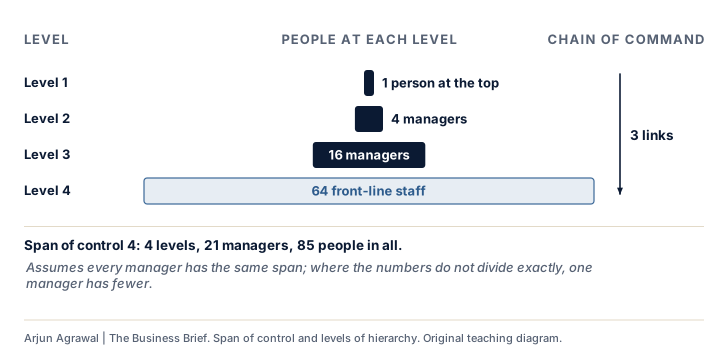
- Levels of hierarchy
- 4
- Managers above the front line
- 21
- People in all
- 85
- Links in the chain of command
- 3
With a span of control of 4, 64 front-line staff need 21 managers in 3 levels above them, so an instruction from the top passes through 3 links to reach the front line. Doubling the span to 8 would leave 3 levels and 9 managers: 1 level fewer and 12 fewer managers, which is what delayering does, at the cost of more people for each manager to supervise.
The figures above are the example’s. With JavaScript on, they can be changed here.
Text description
A structure with 64 front-line staff and a span of control of 4. Level 1: 1 person at the top. Level 2: 4 managers. Level 3: 16 managers. Level 4: 64 front-line staff. That is 4 levels of hierarchy, 21 managers and 85 people in all, with 3 links in the chain of command from the top to the front line. It assumes every manager has the same span.
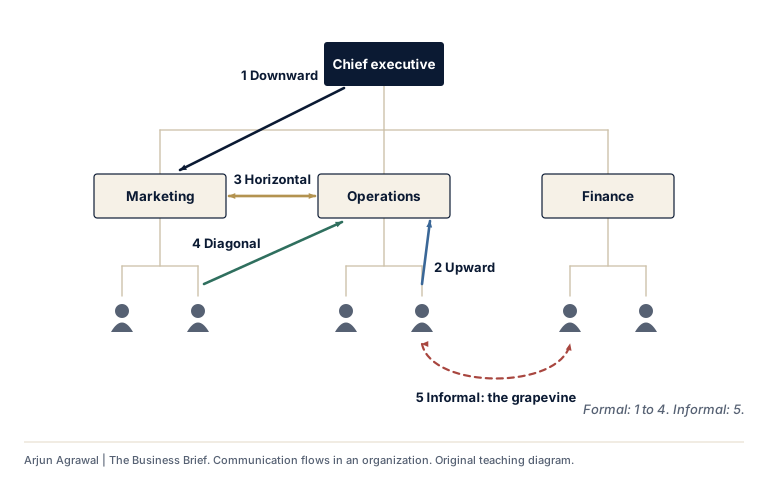
Point to a flow, or tab to it, to read what it carries; select it to open its subtopic. On a touch screen, the first tap explains and the second opens.
Every part, explained
- Downward communication Down the chain of command: instructions, targets and policies, through briefings, emails, memos and notices. It is formal, and every extra level it passes through is a chance for the message to be delayed or distorted. 2.6 Communication
- Upward communication From staff to managers: feedback, reports, suggestions and complaints, through meetings, appraisals, surveys and suggestion schemes. Without it managers decide without the knowledge of the people who do the work. 2.6 Communication
- Horizontal communication Between people at the same level in different departments, to coordinate: meetings, shared documents and project teams. Marketing and operations must agree what can be made and when. 2.6 Communication
- Diagonal communication Across departments and levels at once, such as a marketing assistant asking the operations manager directly. It is fast, but it bypasses the chain of command, so line managers can be left out. 2.2 Organizational structure
- Informal communication: the grapevine Conversation outside the formal structure: chats, social media groups and gossip. It is quick and builds relationships, but rumours spread on it and it cannot be controlled. Managers can listen to it, and keep formal channels open so it does not fill a silence. 2.6 Communication
Text description
An organization chart of a fictional business: a chief executive at the top, three department heads below (marketing, operations and finance) and two staff in each department. Five kinds of communication are marked. Downward: from the chief executive to a department head, carrying instructions, targets and policies. Upward: from a member of staff to their head, carrying feedback, reports and suggestions. Horizontal: between the heads of marketing and operations, to coordinate. Diagonal: from a marketing assistant directly to the head of operations, across departments and levels, which is fast but bypasses the chain of command. Informal: a dashed line between staff in operations and finance, the grapevine, quick but prone to rumour. The first four are formal methods, following or crossing the structure; the last is informal.
Section 17: Key terms
Defined in the platform's own words. Each opens its full entry.
- Bureaucracy
- A way of organizing based on formal rules, written procedures, clearly defined roles and a hierarchy of authority, in which decisions follow set approval processes.
- Centralization
- Keeping decision-making authority with a small group of senior managers, usually at head office, rather than passing it down to lower levels or local units.
- Chain of command
- The formal line of authority through which instructions pass down an organization and accountability passes up, from the top of the hierarchy to the bottom.
- Contractual fringe HL
- In Handy's Shamrock Organization, the outside individuals and firms contracted to do work that is not central to the organization, paid for results rather than for the time they spend.
- Decentralization
- Passing decision-making authority from the centre to lower levels of the hierarchy, or to regional and branch managers.
- Delayering
- Removing one or more levels of hierarchy, usually layers of middle management, to make a structure flatter.
- Delegation
- Passing the authority to carry out a task or make a decision to someone lower in the hierarchy, while the manager who delegates remains accountable for the result.
- Flat structure
- An organizational structure with few levels of hierarchy and wide spans of control.
- Flexible labour force HL
- In Handy's Shamrock Organization, the part-time, temporary and seasonal workers that an organization takes on when demand requires and lets go when it falls.
- Functional structure
- A structure that groups employees into departments by the work they do, such as marketing, finance, operations and human resources.
- Levels of hierarchy
- The number of layers of authority in an organization, from the most senior managers down to the employees with no one reporting to them.
- Matrix structure
- A structure in which employees report to two managers at once, usually the manager of their function, such as marketing or engineering, and the manager of the project or product they are working on.
- Organization chart
- A diagram of an organization's formal structure, showing its positions or departments, the lines of authority between them and the levels of the hierarchy.
- Organizational structure
- The way an organization arranges its jobs, departments and lines of authority, which sets who reports to whom, who makes which decisions and how information flows.
- Product-based structure
- A structure that divides an organization into units by product or product range, each usually with its own functional staff.
- Professional core HL
- In Handy's Shamrock Organization, the permanent, highly skilled staff, such as managers, professionals and technicians, whose knowledge and skills are essential to the organization.
- Project-based organization HL
- A way of organizing in which work is built around projects, each carried out by a temporary team drawn from different functions that disbands when the project is finished.
- Regional structure
- A structure that divides an organization into units by geographical area, such as countries or regions, each responsible for its own market.
- Shamrock Organization HL
- Charles Handy's model of an organization made of three groups of workers, like the three leaves of a shamrock: a professional core of permanent key staff, a contractual fringe of outside contractors and a flexible labour force of temporary and part-time workers.
- Span of control
- The number of subordinates who report directly to one manager.
- Tall structure
- An organizational structure with many levels of hierarchy and narrow spans of control.
Section 18: Tools and practice
3 tools on the platform for 2.2, by room, with exercises, worked calculations and practice questions.
Strategy Studio
- Strategic fit check Enrichment
Practice questions with mark schemes
Section 19: Check your recall
Answer from memory, then reveal and rate yourself. Your ratings stay on this device.
Answer each question from memory, out loud or on paper, before you reveal the answer. Your ratings also schedule these questions in your flashcards.
-
What is the difference between span of control and levels of the hierarchy?
Span of control is the number of people who report directly to one manager. Levels of the hierarchy are the number of layers of authority. For the same workforce, wider spans mean fewer levels.
How well did you recall it? -
How does delegation differ from decentralization?
Delegation passes a particular task or decision from one manager to a subordinate, while the manager stays accountable. Decentralization passes decision-making power down the whole structure, to lower levels, regions or branches.
How well did you recall it? -
Give two advantages and two disadvantages of a flat structure.
Advantages: for example faster communication, lower management costs, and more responsibility for staff, which can motivate. Disadvantages: for example overloaded managers, lighter supervision and fewer chances of promotion.
How well did you recall it? -
What is delayering, and what is one risk of it?
Removing one or more levels of the hierarchy, usually middle managers, to make a structure flatter. Risks include overloaded managers, fewer promotion steps, low morale after redundancies and lost experience.
How well did you recall it? -
Which grouping suits a business selling in many countries with different tastes and laws, and why?
Grouping by region, because regional managers can adapt products, prices and promotion to local conditions and respond quickly.
How well did you recall it? -
What is a matrix structure, and what is its main drawback?
Employees report to two managers at once, the head of their function and the manager of their project. The main drawback is conflict between the two managers' priorities, which causes confusion and divided loyalty.
How well did you recall it? -
Why might a business facing fast technological change flatten and decentralize its structure?
So that decisions are taken quickly and close to customers and problems, without waiting for approval to pass up and down a long chain of command.
How well did you recall it? -
(HL) Name the three parts of Handy's Shamrock Organization.
The professional core of permanent key staff, the contractual fringe of outside contractors paid for results, and the flexible labour force of part-time, temporary and seasonal workers.
How well did you recall it?
Section 20: How it connects
Where 2.2 meets the rest of the course: worked connections with an exam-style question on each, then the further links the notes name.
-
With 2.6 Communication
The structure sets the channels
An organization chart is also a map of formal communication. In a tall structure with a long chain of command, messages pass through many levels, so they travel slowly and can be distorted or filtered on the way. A wide span of control gives a manager many people to keep informed, which can mean less contact with each. Delayering shortens the chain and can speed communication, though it may overload the managers who remain. A matrix structure adds a second line of reporting, which helps information cross departments but can send mixed messages.
Exam-style question Source: Original practice question Command term: Explain (AO2)
Explain how a tall organizational structure can create barriers to communication. [4 marks]
-
With 3.9 Budgets
Cost and profit centres follow the structure HL
A business divides itself into cost and profit centres along the lines of its organizational structure: a department, a branch, a product or a region. Making a manager responsible for a centre's budget is a form of delegation, and a decentralized business usually has more centres with more freedom over them. The arrangement can motivate managers and make performance easier to compare, but it can also set centres against each other, and some costs, such as those of head office, are hard to divide fairly between them.
Exam-style question Source: Original practice question Command term: Explain (AO2)
Explain how organizing a business into profit centres is a form of delegation. [4 marks]
Also linked in the notes
- 1.5 Growth and evolution Growth adds levels, rules and managers, and poor communication and coordination are diseconomies of scale.
- 2.1 Introduction to human resource management A change of structure is a change people may resist, and the gig economy and flexible working supply the Shamrock's flexible labour force (HL).
- 2.3 Leadership and management How far leaders are willing to delegate shapes spans of control and how decentralized a structure can be.
- 2.4 Motivation and demotivation Delegation, empowerment and job enrichment can motivate, while delayering can remove promotion steps and damage morale.
- 2.5 Organizational (corporate) culture At HL, Handy's role culture fits tall bureaucracies and his task culture fits matrix and project structures.
- 5.4 Location Outsourcing work to other firms creates the Shamrock's contractual fringe (HL).
See 2.2 on the course connections map, with every link drawn across the five units.
Section 21: Connected learning
Everything else on the platform that teaches, applies or tests 2.2, each labelled by its standing.
- Revise
-
- The 2.2 mindmap Full and revision views, to print or download
- Revision sheet The subtopic on one printable page
- Flashcards The 2.2 cards, to rate as you go
- Practise
-
- 8 questions on 2.2 in the question bank From the practice sets, the notes and the case files, filtered to this subtopic
- Cases
-
- Silvertree Clinics Fictional Case Vault
- Frameworks
-
- The McKinsey 7S model Enrichment
- The RACI matrix Enrichment
- Tools
-
- 3 tools for 2.2 In Tools and practice on this page: Strategy Studio, People and Culture
- Business Intelligence
-
- Microsoft's research on AI agents at work: workers move faster than their organizations Real-world A real development, 5 May 2026, with its sources
- Nestlé replaces its chief executive and its chair, then plans to cut about 16,000 jobs Real-world A real development, 16 October 2025, with its sources
- Oracle replaces one chief executive with two Real-world A real development, 22 September 2025, with its sources
- Cracker Barrel restores its old logo weeks after a rebrand, pauses remodels and plans for fewer guests Real-world A real development, 19 August 2025, with its sources
- Advanced Management
-
- Organizational design and corporate culture Enrichment Leadership and organizational behaviour: beyond the IB course
- Course connections
-
- 2 worked connections on the connections map With 2.6, 3.9
Notes checked against: Business management guide, first assessment 2024 (published February 2022, updated May 2022), pp. 25, 41 to 46 (The four content statements and their assessment objectives; the papers and the rule on command terms, pp. 41 to 46, for the exam-style practice); Business management teacher support material, pp. 56, 60, 80 to 90 (The glossary of subject-specific terms, read to check definitions; nothing reproduced; the advice on answering papers 1 and 2, pp. 56 and 60). Updated 2026-11-03. The IB guide is the authority on the course.
Arjun Agrawal | The Business Brief, https://the-business-brief-dun.vercel.app/topics/organizational-structure/. Original teaching material, not an IB publication. The organizations in the teaching cases are fictional unless a case says otherwise.