Unit 1: Introduction to business management
1.1 What is a business?
Study mode could not start. The page reads as usual.
Study mode
On this page
Section 01: What the IB course asks
The content statements for 1.1, in the platform's words, with the depth of teaching the guide sets (guide, from p. 23).
- The nature of business AO1
- Primary, secondary, tertiary and quaternary sectors AO2
- Entrepreneurship AO2
- Challenges and opportunities for starting up a business AO2
AO1 knowledge and understanding · AO2 application and analysis · AO3 synthesis and evaluation · AO4 a range of skills. A question can use a command term at its statement's level or below. The whole course.
Section 02: Why it matters
Every organization you deal with, from a street food stall to a hospital to a global software firm, does the same basic thing: it brings resources together and turns them into goods or services that people want. This subtopic gives you the language for that process: inputs, outputs and added value; the four sectors that classify what a business does; the entrepreneurs who start new businesses; and what helps or holds back a new venture.
It is the foundation for the rest of the course. Units 2 to 5 study the four functions that run the transformation process, and examination cases are built around organizations that you will need to describe in exactly these terms: what they produce, for whom, in which sector, and how they add value.
By the end you can
- Describe the nature of business: how a business turns the factors of production into goods and services and adds value.
- Distinguish between the primary, secondary, tertiary and quaternary sectors, and classify the activities of a business by sector.
- Explain why the balance between the sectors changes as an economy develops, and what that means for businesses.
- Explain the role of entrepreneurs and intrapreneurs, what drives them and why they matter to the economy.
- Analyse the opportunities and challenges that a particular start-up faces.
- Apply the five circular business models from the toolkit to the inputs and outputs of a business.
Section 03: What a business is
A business is an organization that brings resources together and uses them to provide goods or services for others. The resources might be a field, a team of nurses, a set of ovens or a piece of software; the customers might be households, other businesses or the government.
Two features make an activity a business rather than a hobby. It is organized: people and resources are coordinated towards a purpose. And it is directed at other people's needs and wants: it exists to supply something that someone values enough to pay for, or that a government or donor pays for on their behalf.
Many businesses exist mainly to make a profit for their owners, but not all do. A state hospital exists to provide a public service and a social enterprise to pursue a social purpose; both are businesses in this sense too, because each organizes resources to provide something people value.
Businesses matter beyond their customers. They create jobs and incomes, pay taxes, buy from other businesses and develop new products and methods. And because the resources they use are limited, every choice about what to produce, and how, has an opportunity cost.
- Needs and wants
Needs are the essentials of a safe life, such as food, clean water and somewhere to live; wants are everything people would like beyond them, such as concert tickets or a designer jacket. Businesses supply both, and the line between them moves with income and culture.
- Goods
Physical things a customer buys and keeps, such as a pair of trainers or a laptop. Because they can be stored, they can be made in advance and held in stock until someone buys them.
- Services
Work done for a customer rather than an object they take away, such as a haircut, a bus journey or a lesson. Services cannot be stored, so capacity that goes unused is lost: an empty seat on today's train cannot be sold tomorrow. Many businesses sell a mix of the two, such as a phone shop that also repairs phones.
- Opportunity cost
The value of the best alternative that a choice rules out. A bakery that spends its last $3,000 on a second oven cannot also spend it on a month of advertising, so if advertising was its next-best use, that is what the oven really cost.
Section 04: Inputs, the transformation process and outputs
Every business, whatever it sells, can be described in the same way. It gathers inputs, changes them through a transformation process and produces outputs that it sells or provides to customers. The same model fits a gold mine, a car factory and a bank, which is what makes it useful: it lets you compare organizations that look nothing alike.
The inputs are the four factors of production. Inside the business, the four functions share the work of transformation. Human resources finds, trains and keeps the people; finance and accounts raises the money and keeps track of it; marketing finds out what customers want and persuades them to buy; operations turns the inputs into the finished good or service. In a very small business the owner may do all four.
The outputs are goods and services, but most processes also create by-products and waste, such as offcuts, packaging, waste water or emissions. Some by-products can become another business's inputs; the rest are a cost to the business, to the environment or to both.
One common slip: profit is not an input. It is what the owner hopes to earn once the inputs have been turned into something customers will pay for, and in that sense it is the reward for enterprise.
- Land
Natural resources of every kind, including the site itself and the soil, water, minerals, timber, fish or sunlight that a business draws on. For a farm, a mine or a hotel by the sea, the quality and location of the land can decide success.
- Labour
Human effort, physical and mental. The number of workers matters, and so do their skills, attitudes and experience; the same café with better-trained staff is selling a different product.
- Capital
Equipment and buildings made to help production, such as machinery, vehicles, tools, premises and software. In finance, capital also means money invested in a business; here it means the things that money buys.
- Enterprise
The initiative and willingness to take risks that spots an opportunity and combines the other three factors. It is supplied by the entrepreneur, and its reward is profit.
Text description
Four inputs, the factors of production, flow into the business: land, meaning natural resources; labour, human effort; capital, such as machinery and buildings; and enterprise, the initiative and risk-taking that combines them. Inside the business, the four functions, human resources, finance and accounts, marketing and operations, carry out the transformation process. The output is goods and services sold to customers. Added value is the selling price minus the cost of bought-in materials and services.
Section 05: Adding value
A business survives only if customers value what it produces more than it costs to make. Added value measures that gap in its simplest form: what customers pay for the output, minus what the business paid other businesses for the materials and services that went into it.
Added value is not profit. Out of it the business must still pay wages, rent, interest and its other costs; only what is left after those is profit. A business that adds a great deal of value can still make a loss if its other costs are higher still.
There are two broad ways to add more value: persuade customers to pay more for the output, or spend less on bought-in inputs without making the output worth less to customers.
- Raising what customers will pay
Through design, quality, convenience, speed, reliability, service or a strong brand, or through a unique selling point (USP) that rivals lack.
- Cutting the cost of bought-in inputs
By finding cheaper suppliers, buying in bulk, wasting less material or redesigning the product, as long as customers do not end up valuing it less.
Added value
Added value = selling price − cost of bought-in materials and services
Per unit, as here, or in total, using sales revenue in place of the selling price. Wages, rent and other costs are paid out of added value; what remains is profit.
Section 06: The four sectors of economic activity
Economic activity is classified into four sectors according to what is being done at each stage of production. Read them as a chain: raw materials are extracted in the primary sector, turned into products in the secondary sector and delivered to customers, along with other services, in the tertiary sector, while the quaternary sector supplies knowledge and information along the way.
The classification describes activities, not whole businesses. A single business can work in several sectors at once, so the useful question is not only "which sector is it in?" but "which of its activities are in which sector, and where does its added value come from?"
The sector matters for analysis because it shapes what a business depends on. Primary businesses depend on land and the weather and are exposed to swings in world prices; secondary businesses depend on machinery and gain from producing on a large scale; tertiary businesses depend on people and on the customer's experience; quaternary businesses depend on highly skilled people and on ideas, which they often protect as intellectual property.
- Primary sector
Extracting or harvesting natural resources, as in farming, fishing, forestry, mining, quarrying and drilling for oil and gas. Its output is usually sold on as raw material to other businesses.
- Secondary sector
Making things: turning raw materials and parts into finished products and buildings, as in manufacturing, food processing, energy generation and construction.
- Tertiary sector
Selling services rather than physical products, to households and to other businesses: retail, transport, banking, insurance, tourism, hairdressing and health care. It is the biggest employer in most developed economies.
- Quaternary sector
Work based on knowledge and information: research and development, software, data analysis and consultancy. Many writers count it as a branch of the tertiary sector; it is listed separately because so much modern work is of this kind.
Text description
Four linked boxes show the sectors of economic activity in order. Primary: extracting natural resources, as in farming, fishing, mining and forestry; the example is growing cocoa beans. Secondary: turning materials into products through manufacturing and construction; making chocolate bars. Tertiary: providing services; selling the bars in shops and cafés. Quaternary: creating and selling knowledge and information; market research and app design. Below, a note on sectoral change: as economies develop, output and jobs usually shift from the primary and secondary sectors towards the tertiary and quaternary sectors.
Section 07: Sectoral change
The share of output and jobs in each sector changes over time. As an economy develops, work usually moves first off the land and into factories, and later out of factories into services and knowledge-based work: primary, then secondary, then tertiary and quaternary. When manufacturing's share of jobs falls, the process is called deindustrialization.
Several forces drive the shift.
- Rising incomes. Richer households spend a smaller share of their income on food and basic goods and a larger share on services such as travel, health care, education and entertainment.
- Technology. Machines raise output per worker on farms and in factories, so fewer workers are needed there, while digital technology creates new knowledge-based work.
- Globalization. Manufacturing often moves to countries with lower costs, while richer economies specialize in design, finance and research.
- Education. A more educated workforce makes knowledge-based activity possible.
Sectoral change is a tendency, not a law. Economies follow different paths: some developed economies keep large manufacturing industries, and some developing economies grow their service sectors quickly without a long industrial stage.
- Opportunities for businesses
New and growing markets in services and knowledge, such as health and fitness, online learning and tourism, and a growing supply of skilled workers.
- Threats to businesses
Falling demand or tougher foreign competition in declining sectors. Businesses there must cut costs, move into higher-value products or change what they sell.
- Jobs and skills
Employers need different skills, so businesses invest in training and compete for scarce specialists, while workers from declining industries may need to retrain or move.
Section 08: Entrepreneurship
Entrepreneurship is finding an opportunity and taking the risk of building a business around it: raising the money, gathering the people and other resources, and organizing them to sell something people want. Someone who does it is an entrepreneur. As a factor of production, enterprise is what sets the other three to work; without it, land, labour and capital sit idle.
People become entrepreneurs for many reasons, usually more than one: to earn a profit, to be independent, to turn a skill or a passion into a living, to solve a problem they have met themselves, or to make a social or environmental difference. A push can matter as much as a pull, such as losing a job or finding no work that fits around family life.
Qualities often linked with successful entrepreneurs include initiative, creativity, resilience after setbacks, a willingness to take calculated risks and the ability to persuade customers, lenders and staff. None of them guarantees success: the idea, the timing, the market and access to finance matter at least as much.
Entrepreneurship matters to the whole economy. New businesses create jobs, compete with established firms, which pushes prices down and quality up, and bring new products and methods to market. That is why many governments support start-ups with advice, grants or cheaper loans.
- Entrepreneur
Starts and runs a new venture, puts in time and usually money, carries the risk of failure and keeps the reward of success.
- Intrapreneur
An employee who acts like an entrepreneur inside an existing organization, for example by proposing and leading a new product. The organization provides the money and carries most of the financial risk. Organizations encourage it to keep new ideas coming and to hold on to restless, creative people.
- Social entrepreneur
An entrepreneur who sets out mainly to tackle a social or environmental problem, and pays for the work by trading rather than relying only on donations. The organizations they build are social enterprises (1.2), and the HL Paper 3 is built around the challenges one faces.
Section 09: Starting up: opportunities and challenges
New businesses start when someone sees an opportunity that seems worth the risk. Many opportunities come from change: in what customers want, in technology, in the economy, in laws or in attitudes. The challenges come from inside the new business, such as too little money or experience, and from outside it, such as established rivals or a weak economy.
How much each challenge matters depends on the business. A tutoring service run from home needs very little finance but must win the trust of parents; a restaurant needs a large investment before it serves its first meal and faces strict hygiene rules. And a change that sinks one start-up can be the making of another.
A business plan, one of the planning tools in the toolkit, is the usual way to test an idea before committing to it. It sets out the product, the target customers, how the business will reach them, what it will cost and when cash will come in. Writing it forces the founder to think the idea through, and banks and investors usually ask to see one. Its forecasts are still guesses, though, and forecasts written by someone in love with their idea are rarely cautious.
- Opportunity: a gap in the market
A need that no business meets, or meets badly, such as late-night food near a university or repairs for an unusual product.
- Opportunity: a change in the environment
Social, technological, economic, environmental, political, legal or ethical change creates new demand, such as more people working from home, a new law that requires safety inspections, or shoppers who want refillable packaging.
- Opportunity: low-cost ways to start
Online shops, social media, shared workspaces and renting rather than buying equipment let many businesses start small and test demand before investing heavily.
- Opportunity: independence and reward
Being your own boss, deciding how to work and keeping the profit are powerful reasons to start.
- Challenge: raising finance
A new business has no track record, so lenders see it as risky and may charge high interest or refuse. Founders often rely on savings, family and small loans, which limits what they can do.
- Challenge: winning customers
Customers stick with brands they know, and retailers are reluctant to stock an unknown product. Building awareness takes time and money that a start-up may not have.
- Challenge: cash flow
Money goes out before it comes in: equipment, stock and rent must be paid for before the first sale, new suppliers often want cash up front, and big customers may take months to pay. Many start-ups that could have become profitable fail because they run out of cash first.
- Challenge: lack of experience
Running a business takes many skills at once. A brilliant baker may know nothing about pricing, contracts, employment law or bookkeeping, and has nobody to hand them to.
- Challenge: rules and paperwork
Registration, licences, tax, insurance and health and safety rules take time and money, and differ between countries and industries.
- Challenge: pressure on the founder
Long hours, personal financial risk and little time off strain health and family life.
Section 10: Circular business models
Most production still runs in a line: extract or grow materials, make a product, use it, discard it. A circular business model bends that line into a loop, so that products, parts and materials are used again and again and waste is avoided at the design stage.
Circular business models are part of the business management toolkit rather than one of the four content statements for 1.1. The guide names five, suggests using them in units 1 and 5, and includes among the unit's inquiry statements how businesses could benefit from adopting them. They belong here because each one changes what a business takes in, how it transforms it or what happens to its outputs.
Businesses adopt them for several reasons: raw materials are becoming scarcer and dearer, customers and staff increasingly care about environmental impact, investors weigh environmental risk, and laws on waste and emissions keep tightening.
- Circular supply
Replacing scarce or newly extracted inputs with renewable, recycled or biodegradable ones, such as packaging made from crop waste instead of plastic.
- Resource recovery
Capturing value from waste, scraps and by-products by turning them into new inputs, for the business itself or for another, such as a brewery selling its spent grain as animal feed.
- Product life extension
Designing products to last and to be repaired, upgraded or resold, such as a phone with replaceable parts, or a retailer that buys back and refurbishes the furniture it sold.
- Sharing
Letting many users share one item instead of each owning one, often through an app, such as a car club or a tool library.
- Product service system
The customer pays to use a product while the business keeps ownership, maintains it and takes it back, such as washing machines rented by the wash or lighting paid for by the month. The business then earns more from products that last than from selling replacements.
Text description
The five circular business models the guide names, around a loop that keeps resources in use. Circular supply: inputs that can be regrown, composted or recycled. Resource recovery: value captured from waste, scraps and by-products. Product life extension: durable design, repair, upgrade and resale. Sharing: many users share one item, often through an app. Product service system: customers pay for use while the business keeps ownership.
Advantages
- Lower costs over time, as less is spent on new materials and on getting rid of waste.
- Can win customers, recruits and investors who care about the environment.
- Puts the business ahead of tightening environmental rules.
- Creates new income from repairs, rentals, refills or the sale of by-products.
Limitations
- Redesigning products, processes and supply chains takes investment and time.
- Many customers still choose on price, and some do not want refurbished goods or products they cannot own.
- Recovered materials can be harder to source reliably and can vary in quality.
- Renting products out instead of selling them means paying for the stock up front and waiting longer for the money to come back.
- Claims can run ahead of reality, and a business that calls itself circular but changes little risks being accused of greenwashing.
Section 11: In practice: industries and stakeholders
The same ideas look different from one industry to the next, and land differently on each group with a stake in the business.
Across industries
- Farming and fishing
Land and the weather dominate the inputs, and produce sold raw to a processor carries little added value because the buyer, not the farm, sets the price. Many farms add value by moving into processing, farm shops or visits, as Highfield did, and most lend themselves to resource recovery, since manure, crop waste and damaged produce can go back into the soil or into another product.
- Manufacturing
The transformation process is long and capital-intensive, so a new manufacturer must invest heavily before its first sale, which makes starting up harder than in most services. Added value comes from design, scale and reliability, while offcuts, packaging and emissions are a cost unless they can be recovered or designed out; repair and remanufacturing are product life extension in practice.
- Hospitality and tourism
The output is a service, so it cannot be stored. An empty hotel room or restaurant table tonight is revenue lost for good, and demand rises and falls with the seasons. Labour is the critical input and much of the added value is the experience staff create, which is why a new restaurant's challenges are as much about people and hygiene rules as about money.
- Software and digital services
The main inputs are skilled people and ideas, and once a product is written an extra copy costs almost nothing to supply, so the added value of each sale can be very high. Starting is cheap but winning customers from established names is hard, and many large technology firms encourage intrapreneurs so that new ideas are developed inside the business rather than leaving with the people who had them.
- Healthcare
Many providers are public sector bodies or non-profit organizations, so success is measured in patients treated rather than profit, yet each still organizes scarce labour and expensive capital to provide a service. Highly skilled staff are the scarcest input, regulation makes starting up slow, and much innovation comes from intrapreneurs, such as clinicians who design better ways of working inside their own hospital.
- Social enterprises
They trade like any business but count part of the value they add in social terms, such as jobs for people far from work or breakfasts for schoolchildren, and spend most of any surplus on that purpose. Their founders face the usual start-up challenges and one more, convincing lenders and customers that a business can serve a purpose and still pay its way, the kind of challenge the HL Paper 3 asks about.
For each stakeholder
- Entrepreneurs and owners
They supply the enterprise and carry the risk, often with their savings, their homes or their family's money, and keep the profit if the venture works. Their wish for control and independence can clash with lenders and investors, who want security, a say in decisions or a share of the reward in return for their money.
- Employees
New businesses create jobs, and sectoral change moves work from farms and factories into services and knowledge work, rewarding new skills while leaving others stranded. Start-up jobs can be insecure and stretched, and when owners add value by automating or cutting costs, the gain to owners and customers can come at the expense of the workforce.
- Customers
Added value exists only because customers believe a product is worth more than its inputs, so in the end they decide which businesses survive. They gain from the choice, competition and new products that entrepreneurs bring, but circular models can ask them to change their habits, such as renting instead of owning, which not all of them will accept.
- Lenders and investors
Banks, relatives, business angels and governments finance start-ups that have no track record to judge, so they ask for business plans, security or high interest. Their caution protects their money but is one of the biggest challenges founders face, and it causes conflict when founders want patient, flexible money and lenders want repayment on schedule.
- Government
Governments want the jobs, taxes, competition and new ideas that new businesses bring, and many offer start-up advice, grants or cheap loans. They also set the licences, taxes and safety rules that founders find burdensome, and they must manage the effects of sectoral change, such as retraining workers from declining industries.
- Local communities and the environment
Businesses bring jobs and spending to an area, but also traffic, noise, waste and emissions, and the closure of a large employer, like the mills in Stanmoor, can change a town for a generation. Circular business models reduce the waste a business pushes onto its neighbours, but only where its claims match what it actually does.
Section 12: Evaluation and limits
What to weigh before reaching a judgement.
- The four sectors classify activities, not businesses. Many businesses work in several sectors, and the line between the tertiary and quaternary sectors is blurred, so in an answer say which activity you are classifying and why.
- Added value shows what a business contributes, but it is not profit, and it rests on what customers believe a product is worth. Value created mainly by branding can vanish quickly if tastes change or a rival offers more.
- Sectoral change describes what has usually happened, not what must happen. One of the guide's theory of knowledge questions for this unit asks whether business can discover laws in the way the natural sciences do; patterns like this one are tendencies that particular countries and industries can break.
- Entrepreneurial qualities help, but they are neither necessary nor sufficient. Many start-ups with talented founders fail because the market, the timing, the finance or the execution was wrong, and luck plays a larger part than success stories admit.
- The challenges of starting up are not equal. A service run from home needs little capital but must build trust; a manufacturer needs heavy investment before its first sale. Weigh the challenges for the particular business, not in general.
- Circular business models can cut costs and win customers, but they take time and money, and not every customer will pay for them. Whether one suits a business depends on its product, its customers and whether its actions match its claims.
- In an examination answer, describe the business in the case precisely, with its own inputs, outputs and sectors, and use its figures. Two or three challenges explained with the case's evidence and weighed for that business earn more than a long general list.
Section 13: Make the decision
Use the ideas on a business choice: weigh the options, decide, and say what would change your mind.
Decision brief · a fictional business
What should Highfield do with its extra fruit?
Highfield Berries' two new polytunnels will produce about 6,000 kg more strawberries a year from next summer, and Ruth Okafor must decide what to do with them. The farm already sells 2,000 jars of jam a month at $6.50 a jar, with $2.00 of bought-in materials and services in each jar, and it runs a farm shop and pick-your-own visits. Fruit picked by staff costs $0.80 a kg in wages. Ruth has $15,000 to invest and does not want to borrow.
Each option sends the extra fruit into a different sector of the business.
How to weigh the options
Start with added value, then remember that it is not profit: wages and the farm's other costs are paid out of it.
- Supermarket: ($3.20 − $0.40) × 6,000 = $16,800 of added value. After picking wages of 6,000 × $0.80 = $4,800, $12,000 is left towards the farm's other costs and profit. Nothing needs to be invested and the risk is low, but the buyer sets the price, can cut it next season and keeps most of the value the fruit will eventually earn.
- Jam: ($6.50 − $2.00) × 15,000 = $67,500 of added value. After the picking wages of $4,800 and the cook's $30,000, $32,700 is left, and the $12,000 kettle fits Ruth's budget. But the shops would have to sell 62.5% more jam than the 24,000 jars a year they sell now. If they sell only 7,500 more jars, added value falls to $33,750, and after the cook and the picking of the 3,000 kg used ($2,400) only $1,350 is left. The cook's wage is a commitment; the demand is a hope.
- Pick-your-own: ($7.00 − $0.30) × 6,000 = $40,200 of added value if visitors pick every kilogram, with no picking wages to pay. After weekend staff of $9,000, $31,200 is left, and the $8,000 car park fits the budget. A wet summer cuts takings sharply: if visitors pick only 4,000 kg, $17,800 is left, although fruit left in the field could go to the jam kitchen if it has room, the resource recovery the farm already practises.
A strong judgement looks past the biggest number. Jam offers the highest return but has the most uncertain demand and a fixed wage to pay; pick-your-own builds on what the farm already does well but depends on the weather; the supermarket is safe but captures the least value. Ruth could also combine them, opening the field to visitors and sending whatever they leave to the jam kitchen or the supermarket. The answer would change with a firm order from the shops, a price the supermarket will hold for several seasons, or the number of visitors that last summer's pick-your-own drew.
Section 14: Exam-style practice
Original questions written by the platform in the style of the papers, with what a strong response does. They are not IB questions and the guidance is not an official markscheme.
-
Define the term added value.
What a strong response does
A strong response gives a precise definition: the difference between the price a business receives for its output and the cost of the materials and services it bought in from other businesses to make it.
- Both parts are needed: the selling price, or sales revenue, and the cost of bought-in inputs.
- It may add that added value is not profit, because wages, rent and other costs are paid out of it. A vague phrase such as "making a product worth more" is not a definition.
-
Greywell Joinery, a fictional workshop, makes oak dining tables and sells them for $900 each. For each table it buys timber for $210, fittings for $45 and finishing oil for $25, and pays a courier $70 to deliver it. Its two joiners are paid $60,000 a year in total, and it sells 160 tables a year.
Calculate the added value per table and the total added value for the year. Show your working.
What a strong response does
- Bought-in materials and services per table: $210 + $45 + $25 + $70 = $350.
- Added value per table: $900 − $350 = $550.
- Total added value for the year: $550 × 160 = $88,000.
A strong response leaves the joiners' wages out of the calculation: wages are paid out of added value, not bought in from another business. The $60,000 of wages leaves $28,000 of the added value for the workshop's other costs, such as rent, and its profit.
-
Gannet Bay Seafoods, a fictional family business, catches fish with two boats, smokes part of the catch in its own smokehouse, sells fresh and smoked fish in a harbour shop and restaurant, and sells the records it keeps of fish numbers to a university research team.
Analyse how Gannet Bay's activities in different sectors contribute to its added value.
What a strong response does
A strong response classifies each activity correctly, then analyses where value is added and what each activity depends on, using the case.
- Primary, catching fish: sold raw, the catch fetches a price set largely by the market, so it adds relatively little value, and it depends on the weather and on fish stocks.
- Secondary, smoking: processing turns raw fish into a product that keeps longer and sells for more per kilogram, at the cost of equipment and skills.
- Tertiary, the shop and restaurant: selling directly keeps the margin a retailer would otherwise take, and the restaurant adds value through the experience it offers, though it needs staff and its demand is seasonal.
- Quaternary, selling data: records the business keeps anyway earn extra income at very little extra cost.
- Analysis: working across the sectors lets Gannet Bay keep more of the value of each fish it catches and spreads its risk, since the restaurant and the data still earn when catches fall, but it needs a wider range of skills and capital. The case gives no figures, so any view of which activity adds most value is tentative.
-
Explain two challenges that Pedal Post faces as a start-up.
What a strong response does
A strong response explains two challenges, each applied to Pedal Post with its evidence and consequence.
- Raising finance: the founders need $18,000 for bikes, insurance and a depot but have $7,000, a gap of $11,000. As a new business with no track record, they will find lenders cautious, which may force them to start smaller or pay more to borrow.
- Cash flow: their first two customers want to pay 60 days after each delivery, while the bikes, insurance and depot must be paid for before the first delivery. Their plan shows the cash running out in the fourth month, even if the business is winning work.
- Other valid challenges include the founders' lack of experience in managing staff, or winning customers from established delivery firms. Listing challenges without applying them to Pedal Post earns little.
-
Leon Varga's hospital funded his idea for an app and put him in charge of a small team to build it. Explain two reasons why a large organization might encourage intrapreneurship in this way.
What a strong response does
A strong response gives two distinct reasons, each explained and linked to the hospital.
- New ideas from the front line: staff such as Leon see problems every day that senior managers do not, so backing their ideas brings improvements, here better care for patients after they leave the clinic, that the organization might never have thought of.
- Keeping creative people: a physiotherapist with an idea could leave to develop it alone, as Amara Osei did. Giving Leon resources and responsibility keeps his skills, and the idea, inside the hospital.
- Other valid reasons include the chance to develop future leaders and the motivation that responsibility can bring. The hospital carries the financial risk, which is what makes the idea possible for Leon.
-
A year after starting, Pedal Post's two founders run it as a partnership and want to open in a second city, which needs $40,000. They are considering two options.
- Take on a third partner, who would invest $40,000, run the new city full time and share profits equally with the two founders.
- Form a privately held company and sell 40% of its shares to a business angel for $40,000. The angel would join the board but would not work in the business.
Recommend which option Pedal Post should choose.
What a strong response does
This question draws on the features of partnerships and privately held companies (1.2) and on sources of finance (3.2), because 1.1 on its own is set at AO2. A strong response weighs both options with the case's evidence and reaches a justified recommendation.
- Third partner, for: it brings both money and a manager for the new city, answering the founders' lack of experience and the fact that they cannot be in two cities at once, and it keeps the business simple and its accounts private.
- Third partner, against: each founder's share of profit falls from a half to a third; partners usually have unlimited liability, so the founders could be liable for debts the new partner runs up in the second city; and three partners can disagree and slow decisions.
- Company with an angel, for: limited liability protects the founders' homes and savings as the business takes on more bikes, staff and contracts; the angel may bring experience and contacts as well as money; and the founders keep 60% of the shares between them, enough to control ordinary decisions as long as they agree.
- Company with an angel, against: a company costs more to set up and run and must usually file its accounts publicly; the angel will expect a return and a voice on the board; and nobody has yet been found to run the second city.
- Judgement: for example, the company is the stronger choice because expansion multiplies the risks that limited liability protects against, provided the founders also hire a manager for the new city; the partnership would be better if a trusted person on the ground matters more than protection. A strong answer says what would change the recommendation, such as the angel's terms, and notes what the case leaves out, including the profits of the first city and the founders' attitudes to risk.
When asked to choose between two options, the teacher support material advises at least one argument for and one against each (pp. 56 and 60).
Section 15: Revision summary
The subtopic on one page: what to remember.
- A business organizes resources to provide goods or services that others value; most aim for profit, but public sector bodies and social enterprises are businesses too.
- The transformation process turns inputs, the four factors of production (land, labour, capital and enterprise), into outputs of goods and services, with by-products and waste along the way.
- Added value = selling price − cost of bought-in materials and services. It is not profit: wages, rent and other costs are paid out of it.
- The primary, secondary, tertiary and quaternary sectors classify activities, not whole businesses; one business can work in several, so say which activity you are classifying.
- Sectoral change usually moves output and jobs from the primary to the secondary and then the tertiary and quaternary sectors as incomes rise, technology improves, trade grows and education spreads. It is a tendency, not a law.
- An entrepreneur spots an opportunity, organizes the resources and carries the risk; an intrapreneur shows the same initiative inside an organization that funds the work and carries most of the risk.
- Start-ups grow from gaps in the market, change in the environment and cheap ways to start, and are held back by finance, winning customers, cash flow, inexperience, rules and the pressure on the founder; a business plan tests the idea before money is committed.
- The toolkit's five circular business models (circular supply, resource recovery, product life extension, sharing and product service systems) keep materials in use, cutting costs and waste, but they need investment and claims that match reality.
- The guide sets 1.1 at AO1 and AO2, so questions on it alone ask you to describe, explain or analyse; evaluation questions bring in another subtopic, such as 1.2, 1.5 or 3.2.
Section 16: The mindmap
What a business is and does, the four sectors it can work in, the entrepreneur who starts it, and what helps or hinders a start-up.
Drag to move the map, or use the arrow keys. Click a branch to fold it away. Whole map shows all of it; zoom with the buttons, or with Ctrl and the scroll wheel.
- Core ideas
- Types and forms
- Evaluation
- Applications
- Connections
- Advantage
- Limitation
- HL HL only
The map as an outline
The nature of business
Core ideas
- Definition An organization that turns inputs into goods and services Inputs are the factors of production; outputs are sold to customers to meet their needs and wants.
- Meets needs and wants A need is essential to survival; a want is a desire beyond it.
- Definition Adds value The difference between the selling price and the cost of bought-in materials.
- Four functions work together: HR, finance, marketing, operations Each function is a unit of this course.
Sectors of the economy
Types and forms
- Primary: extracting natural resources
- Example Farming, fishing, forestry, mining
- Secondary: manufacturing and construction
- Turning raw materials into products
- Tertiary: providing services
- Example Retail, banking, transport, tourism
- Quaternary: knowledge and information services
- Example Research, IT, consultancy, education
- Sectoral change as economies develop Employment and output shift from the primary sector towards the tertiary and quaternary sectors.
Entrepreneurship
Core ideas
- Definition Entrepreneur: organizes resources and takes the risk of a new venture
- Definition Intrapreneur: acts entrepreneurially inside an existing organization
- Motives: profit, independence, an unmet need, a social purpose
- Qualities: initiative, resilience, willingness to take risk
Starting up: challenges
Evaluation
- Limitation Raising enough finance
- Limitation Winning customers from established rivals
- Limitation Cash flow in the first months
- Limitation Legal requirements and administration
- Limitation Limited experience and skills
Starting up: opportunities
Applications
- Advantage Independence and control
- Advantage Profit and personal reward
- Advantage Filling a gap in the market
- Advantage Low-cost digital tools and online selling
Connections
Connections
- A business plan sets out the idea (toolkit)
- Legal form follows: 1.2 types of business entities
- Finance to start: 3.2 sources of finance
- Knowing the market: 4.4 market research
Open the mindmap on its own page, with its terms and connections.
Section 17: More diagrams
Original diagrams from the platform's library, each with a text description and an SVG download.
Text description
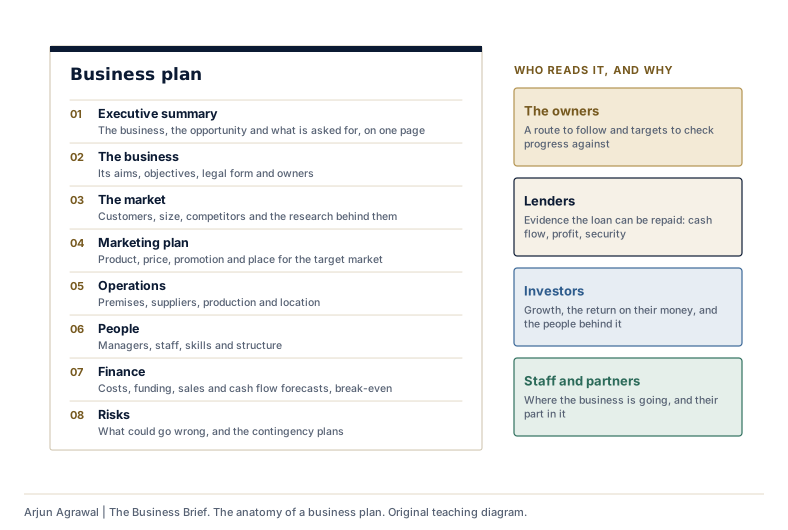
A business plan drawn as a document with eight sections: 1, an executive summary of the business, the opportunity and what is asked for, on one page; 2, the business, its aims, objectives, legal form and owners; 3, the market, its customers, size and competitors and the research behind them; 4, the marketing plan, product, price, promotion and place for the target market; 5, operations, premises, suppliers, production and location; 6, people, managers, staff, skills and structure; 7, finance, the costs, how they will be funded, forecasts of sales and cash flow, and break-even; 8, risks and the contingency plans. Beside it, its readers: the owners, who want a route and targets; lenders, who want evidence the loan can be repaid; investors, who want growth and a return; and staff and partners, who want to know where the business is going.
Section 18: Key terms
Defined in the platform's own words. Each opens its full entry.
- Added value
- The difference between the price a business receives for its output and the cost of the materials and services it bought in to make it.
- Business
- An organization that brings together resources such as people, materials and equipment to provide goods or services for customers, usually in return for payment.
- Business functions
- The four main areas of activity inside a business: human resource management, finance and accounts, marketing, and operations management.
- Business plan
- A document in which an entrepreneur or manager explains what a new business or project will do, who its customers will be, how it will operate and what it is expected to cost and earn.
- Entrepreneurship
- Spotting a business opportunity and organizing the resources to pursue it, while accepting the risk that it may fail; the person who does this is an entrepreneur.
- Factors of production
- The resources a business uses to produce goods and services: land (natural resources), labour (human effort), capital (man-made aids to production such as machinery and buildings) and enterprise (the initiative and risk-taking that combines the other three).
- Goods and services
- The two kinds of output a business provides. Goods are physical products that can be stored and owned, such as shoes; services are intangible activities carried out for a customer, such as a haircut.
- Intrapreneurship
- Entrepreneurial behaviour by an employee inside an existing organization, such as developing a new product or process with the organization's resources and backing.
- Needs and wants
- Needs are what people must have to survive and live safely, such as food, water, shelter and health care; wants are what people would like to have beyond those, such as a holiday or the latest phone.
- Opportunity cost
- What is given up when a choice is made, measured by the value of the best alternative that was not chosen.
- Primary sector
- The part of the economy that takes raw materials directly from nature, through activities such as farming, fishing, forestry, mining and drilling for oil and gas.
- Quaternary sector
- The part of the economy in which businesses create, process and sell knowledge and information, for example in research, software, data analysis and consultancy.
- Secondary sector
- The part of the economy that manufactures, processes or builds, turning raw materials and components into finished goods and structures.
- Sectoral change
- A shift over time in the share of an economy's output and employment that each sector accounts for.
- Social entrepreneur
- An entrepreneur whose main aim is to solve a social or environmental problem, using business methods and trading income rather than relying only on donations.
- Start-up
- A newly established business in its early stage, usually small, built on a new idea or a new way of serving a market, with an uncertain future.
- Tertiary sector
- The part of the economy that provides services to consumers and to other businesses, such as shops, transport, insurance, tourism and hairdressing.
- Transformation process
- The sequence of activities through which a business changes its inputs, the factors of production, into outputs of goods and services that customers value more highly than the inputs themselves.
Section 19: Tools and practice
4 tools on the platform for 1.1, by room, with exercises, worked calculations and practice questions.
Entrepreneurship and Innovation Lab
- Business Model Canvas builder Enrichment
- Business plan outline builder IB toolkit
- Start-up cost calculator IB and enrichment
- Start-up feasibility assessment Enrichment
Practice questions with mark schemes
Section 20: Check your recall
Answer from memory, then reveal and rate yourself. Your ratings stay on this device.
Answer each question from memory, out loud or on paper, before you reveal the answer. Your ratings also schedule these questions in your flashcards.
-
What makes an organization a business, even if it does not aim to make a profit?
It organizes resources to provide goods or services that others value. Public sector bodies and social enterprises are businesses in this sense, even though profit for owners is not their purpose.
How well did you recall it? -
Name the four factors of production, with an example of each for a café.
Land: the site and natural resources such as water. Labour: the baristas and kitchen staff. Capital: the building, coffee machines, ovens and furniture. Enterprise: the owner's initiative and risk in opening it.
How well did you recall it? -
A bookshop sells a book for $20. It paid the publisher $12 for it and pays $1 a book for delivery. What is the added value per book, and is it the same as profit?
$20 − ($12 + $1) = $7 a book. It is not profit, because wages, rent and other costs must still be paid out of it.
How well did you recall it? -
Classify by sector catching fish, canning it, selling it in a supermarket, and writing software that tracks fish stocks.
Primary, secondary, tertiary and quaternary, in that order.
How well did you recall it? -
What is sectoral change, and why does it happen?
A shift over time in each sector's share of output and jobs, usually from primary to secondary to tertiary and quaternary. Its causes include rising incomes, technology raising output per worker, globalization and education.
How well did you recall it? -
Distinguish between an entrepreneur and an intrapreneur.
An entrepreneur starts a new venture and carries its risk. An intrapreneur shows the same initiative inside an existing organization, which provides the resources and carries most of the risk.
How well did you recall it? -
Give two opportunities and two challenges for a start-up.
Opportunities: for example a gap in the market, a change such as a new law or trend, or low-cost online tools. Challenges: for example finding the money, persuading customers to switch from brands they know, running short of cash, or inexperience.
How well did you recall it? -
Name the five circular business models that the guide lists.
Circular supply, resource recovery, product life extension, sharing, and product service system models.
How well did you recall it?
Section 21: How it connects
Where 1.1 meets the rest of the course: worked connections with an exam-style question on each, then the further links the notes name.
-
With 4.4 Market research
Testing a business idea before money is committed
One of the challenges of starting a business is not knowing whether enough customers want what the entrepreneur plans to sell. Market research turns that guess into evidence. Primary research, such as surveys and interviews with likely customers, can show whether a gap in the market is real and what people would pay; secondary research, such as market analyses and government publications, can show how large the market is and who already serves it. Research costs time and money that a start-up may not have, and a small or convenience sample can mislead, so the evidence has to be weighed rather than simply accepted.
Exam-style question Source: Original practice question Command term: Explain (AO2)
Explain why an entrepreneur should carry out primary market research before starting a business. [4 marks]
-
With 5.1 Introduction to operations management
Adding value through operations
A business takes inputs, such as materials, labour and equipment, and turns them into outputs that customers value more than the inputs cost; the difference is added value. Operations management runs that transformation day to day, deciding how much to produce, how, where and to what standard, so it settles much of the business's costs and the quality its customers receive. The sector shapes the work: in the secondary sector the transformation is manufacturing or construction, while in the tertiary sector it is a service, often delivered with the customer present.
Exam-style question Source: Original practice question Command term: Explain (AO2)
Explain the role of operations management in adding value for a business in the secondary sector. [4 marks]
Also linked in the notes
- 1.2 Types of business entities A new business must choose its legal form, which decides who owns it and who carries the risk.
- 1.3 Business objectives Objectives say what the business is trying to achieve, and CSR and the triple bottom line take them beyond profit.
- 3.1 Introduction to finance Finance is one of the four business functions, and every other function depends on it.
- 3.2 Sources of finance Where the finance for a start-up comes from, and why it is hard to raise.
- 5.3 Lean production and quality management At HL, lean production and cradle to cradle design take the circular idea into operations.
See 1.1 on the course connections map, with every link drawn across the five units.
Section 22: Connected learning
Everything else on the platform that teaches, applies or tests 1.1, each labelled by its standing.
- Revise
-
- The 1.1 mindmap Full and revision views, to print or download
- Revision sheet The subtopic on one printable page
- Flashcards The 1.1 cards, to rate as you go
- Practise
-
- 7 questions on 1.1 in the question bank From the practice sets, the notes and the case files, filtered to this subtopic
- Cases
-
- Patchwork Digital Fictional Case Vault
- Frameworks
-
- Circular business models IB toolkit
- The business plan IB toolkit
- The business model canvas Enrichment
- The value chain Enrichment
- Tools
-
- 4 tools for 1.1 In Tools and practice on this page: Entrepreneurship and Innovation Lab
- Business Intelligence
-
- Anaconda buys three AI companies in a year of rapid expansion Real-world A real development, 4 August 2026, with its sources
- Google completes its purchase of Wiz, the deal it called its largest ever Real-world A real development, 11 March 2026, with its sources
- Advanced Management
-
- Competitive advantage and industry analysis Enrichment Advanced strategy: beyond the IB course
- Disruption, digital transformation and business model innovation Enrichment Advanced strategy: beyond the IB course
- Startup strategy, business model validation and product-market fit Enrichment Entrepreneurship and innovation: beyond the IB course
- Course connections
-
- 2 worked connections on the connections map With 4.4, 5.1
Notes checked against: Business management guide, first assessment 2024 (published February 2022, updated May 2022), pp. 13 to 14, 23 to 24, 41 to 46 (Content statements and depth, p. 23; circular business models in the toolkit, pp. 13 to 14; the unit's inquiry statements and theory of knowledge questions, p. 24; the papers and the rule on command terms, pp. 41 to 46, for the exam-style practice); Business Management for the IB Diploma, pp. 22 to 24, 45 to 46, 58 to 70 (Chapter 1.1 and the toolkit pages on circular business models and business plans, read to check coverage and conventions; nothing reproduced); Business management teacher support material, pp. 50 to 51, 56, 60, 88 to 90 (The circular business models table and the glossary entries for the four sectors, used to check definitions; the advice on answering papers 1 and 2, pp. 56 and 60). Updated 2026-11-03. The IB guide is the authority on the course.
Arjun Agrawal | The Business Brief, https://the-business-brief-dun.vercel.app/topics/what-is-a-business/. Original teaching material, not an IB publication. The organizations in the teaching cases are fictional unless a case says otherwise.