Unit 4: Marketing
4.5 The seven Ps of the marketing mix
Study mode could not start. The page reads as usual.
Study mode
On this page
Section 01: What the IB course asks
The content statements for 4.5, in the platform's words, with the depth of teaching the guide sets (guide, from p. 31).
- Product: the product life cycle, the product portfolio and the marketing mix AO2
- Product: extension strategies AO3
- Product: the product life cycle, investment, profit and cash flow AO2
- Product: brand awareness, development, loyalty and value, and the importance of branding AO2
- Price: cost-plus (mark-up), penetration, loss leader, predatory and premium pricing AO3
- Price: dynamic, competitive and contribution pricing, and price elasticity of demand AO3 HL
- Promotion: above, below and through the line AO2
- Promotion: social media marketing as a promotional strategy AO3
- Place: the importance of different types of distribution channel AO3
- People: employee and customer relationships in marketing a service, and how they vary between cultures AO3
- Processes: delivery processes in marketing a service, and changes in them AO3
- Physical evidence: tangible evidence in marketing a service AO3
- Appropriate marketing mixes for particular products or businesses AO3
AO1 knowledge and understanding · AO2 application and analysis · AO3 synthesis and evaluation · AO4 a range of skills. A question can use a command term at its statement's level or below. The whole course.
Section 02: Why it matters
The marketing mix is the set of decisions a business makes to bring a product to its target customers: what it sells, at what price, how it tells people about it and where they can buy it. For goods, those four Ps (product, price, promotion and place) do most of the work. Services add three more, people, processes and physical evidence, because a service cannot be seen or tested before it is bought and is usually delivered by people while the customer is there. The guide treats all seven as the marketing mix.
The mix is how a business carries out its marketing plan (4.2): every P should fit the target market and the position the business has chosen, and every P should fit the others. These notes take the Ps in the guide's order, and end with the question that brings them together: which mix is appropriate for this product or business? Dynamic, competitive and contribution pricing and price elasticity of demand are HL only, and are marked HL.
By the end you can
- Analyse how the product life cycle relates to the product portfolio and the marketing mix, and to investment, profit and cash flow.
- Evaluate extension strategies for a product in maturity.
- Explain brand awareness, development, loyalty and value, and why branding matters.
- Evaluate the appropriateness of pricing methods, including, at HL, dynamic, competitive and contribution pricing and price elasticity of demand.
- Distinguish between promotion above, below and through the line, and weigh up social media marketing as a promotional strategy.
- Recommend an appropriate marketing mix for a product or business, including its distribution channels and, for a service, its people, processes and physical evidence.
Section 03: Product: the product life cycle
The product life cycle is a model of the stages a product's sales pass through over time: development, introduction, growth, maturity and decline. Some versions add a saturation stage between maturity and decline, when the market is full and rivals fight over the same customers.
The life cycle matters because investment, profit, cash flow and the marketing mix all change from stage to stage. Spending comes first: research, design, equipment, stock and launch promotion are paid for before the product earns much, so cash flow is negative through development and introduction, and the product usually makes a loss. As sales grow, revenue overtakes costs, and profit and then cash flow turn positive during growth. In maturity, sales peak while the heavy investment has already been made, so profit and cash flow are usually at their highest. In decline, both fall.
Profit and cash flow are not the same thing (3.7). In growth, a product can be profitable while its cash flow is still weak, because the business is paying for extra capacity, stock and promotion, and some customers pay on credit.
The points below show how the marketing mix typically changes at each stage. They describe patterns, not rules: nobody knows in advance how long a stage will last, and the business's own decisions change the curve.
- Development
No sales yet. Research, design, testing and preparing production make cash flow negative. The mix is being designed, including the product's features, a planned price, the launch promotion and the channels to use.
- Introduction
Sales are low and grow slowly, and launch costs usually mean a loss and negative cash flow. Promotion informs customers and builds awareness. The price is often either low, to win customers quickly (penetration pricing), or high, to signal quality (premium pricing). Distribution is limited at first.
- Growth
Sales rise quickly and rivals notice. Profit turns positive, and cash flow follows as revenue overtakes spending, though investment in capacity and promotion continues. Distribution widens, promotion shifts to persuading customers to prefer the brand, and new versions may be added.
- Maturity
Sales level off and peak as the market nears saturation, and competition is fierce. Profit and cash flow are usually at their highest, because the heavy investment has been made and less promotion is needed for each sale. Promotion reminds and reassures existing customers, prices come under pressure from rivals, and this is when extension strategies are usually considered.
- Decline
Sales and profit fall as tastes change or better products appear. The business cuts promotion and narrows the range, then decides whether to keep selling to loyal customers at low cost, to extend the product's life, or to withdraw it.
Text description
Sales over time through five stages: development, with no sales; introduction, with slow sales; growth, with sales rising fast; maturity, where sales level off and peak; and decline. A dashed line shows cash flow: negative through development and introduction, when the business invests, turning positive in growth and peaking around maturity. A second curve in maturity shows an extension strategy, such as new uses, markets, versions or promotion, lifting sales again. Not every product follows the curve, and its length cannot be known in advance.
Advantages
- Helps managers plan the marketing mix, investment and cash needs for each stage.
- Shows why a business needs new products ready before its current ones decline.
- Links marketing to finance, by explaining why new products use up cash and mature ones generate it.
Limitations
- The length and shape of each stage cannot be known in advance, so the model describes rather than predicts.
- It is often hard to tell which stage a product is in until afterwards.
- Treating a dip in sales as decline can make decline happen, if support is withdrawn too early.
- It fits some products poorly, such as fads that rise and vanish within months, or staple foods that stay mature for decades.
Section 04: Product: extension strategies
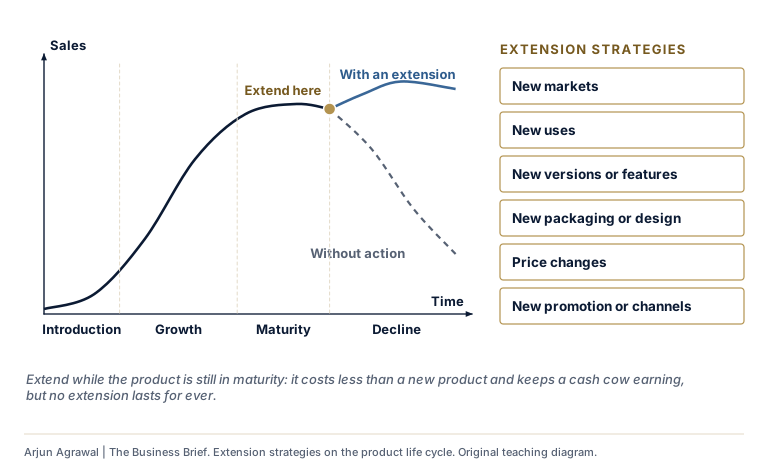
An extension strategy is an action that lengthens a product's life cycle by renewing its sales, usually in maturity, before decline sets in. The life cycle diagram shows the idea as a second curve rising out of maturity.
Extension strategies are attractive because the product already exists, customers already know it, and its development has been paid for. Extending a successful product is usually cheaper and less risky than launching a new one, and it keeps a profitable product earning the cash that funds new ones. The danger is spending money to delay the inevitable: if the product is genuinely outdated, the extra sales may not cover the cost, and the money could have done more for a replacement.
The guide sets extension strategies at AO3, so an answer should judge which strategy fits the product and its customers, and whether extending is better than replacing the product or withdrawing it. Timing matters too: an extension works best while the product is still in maturity, not after its customers have drifted away.
- New markets
Selling the product to new segments or in new countries, which is market development in the Ansoff matrix. The product already exists, but the business needs research and may have to adapt the mix for its new customers.
- New uses
Finding and promoting new ways to use the product, so that existing customers buy more and new customers start.
- New versions or features
Updating the product, or adding features, sizes or flavours, so that it feels new. It costs more than most other strategies but can renew interest strongly.
- New packaging or design
A fresh look or more convenient packs, such as smaller or larger sizes, refills or multipacks. It is relatively cheap, but a purely cosmetic change may not convince customers for long.
- Price changes
Cutting the price, or offering better value, to attract customers who are sensitive to price. It is quick to do, but it cuts margins and can cheapen the brand.
- New promotion or channels
A new campaign aimed at a different segment, or selling through new channels such as online marketplaces or different retailers.
Advantages
- Cheaper and less risky than developing a new product, because the product and its brand already exist.
- Keeps a profitable product, often a cash cow, earning the cash that funds new products.
- Keeps the loyal customers who still want the product, and protects the brand.
Limitations
- Only delays decline: no extension strategy works for ever.
- Uses money and managers' time that could go to new products.
- Can fail if the product is outdated or the change is only cosmetic.
- Repeated relaunches and price cuts can damage a premium brand's image.
Section 05: Product: the product portfolio
A business's product portfolio is the full set of products it sells. The products in a portfolio are usually at different stages of their life cycles, and that is the point: mature products earn the cash that pays for new ones, and new products are ready to take over when older ones decline. A portfolio with every product at the same stage is risky, whether they are all new and using up cash, or all mature with nothing ready to replace them.
The Boston Consulting Group (BCG) matrix, a toolkit tool, analyses a portfolio on two measures: the growth rate of each product's market, and the product's market share relative to that of its largest rival (4.1). Its four boxes follow the life cycle closely. Question marks are often new products in the introduction stage, and stars are usually in growth, both in fast-growing markets; cash cows are mature products in slow-growing markets; dogs are often in decline.
Each box calls for a different marketing mix, which completes the link between the life cycle, the portfolio and the mix. The business uses the cash from its cash cows to back its stars and its most promising question marks.
- Stars
A high share of a fast-growing market. They earn a lot but need heavy promotion and investment in capacity to keep their lead, so they may produce little spare cash. The mix stresses strong promotion, wide distribution and new versions to stay ahead.
- Question marks
A low share of a fast-growing market. They need cash to build share, and their future is uncertain. Those the business backs get heavy promotion, wider distribution and perhaps a low price to win customers; the rest are withdrawn.
- Cash cows
A high share of a slow-growing, mature market. They generate more cash than they need. The mix holds the position at low cost, with reminder promotion, prices that keep loyal customers, and extension strategies to keep them earning.
- Dogs
A low share of a slow-growing market. They usually earn little, so promotion and investment are cut to a minimum, and they are often withdrawn or sold, unless they still make a contribution, complete a range or keep customers buying other products.
Text description
A two by two grid of a product portfolio, with market growth rate on the vertical axis and relative market share on the horizontal axis, high share on the left. Stars have a high share of a fast-growing market; build them by investing to keep the lead. Question marks have a low share of a fast-growing market; invest heavily or withdraw. Cash cows have a high share of a slow-growing market; hold or harvest them, as their cash funds the rest. Dogs have a low share of a slow-growing market; divest unless they serve a purpose. An arrow shows cash flowing from the cash cows to the question marks.
Advantages
- Shows whether the portfolio is balanced, with enough cash cows to fund the products of the future.
- Guides how a limited marketing budget should be shared between products.
- Simple to construct from market share and market growth data.
Limitations
- It uses only two measures, and a high market share does not guarantee profit.
- Defining the market is a judgement, and a different definition can move a product into another box.
- It is a snapshot, not a forecast: it does not say what will happen next.
- The labels can mislead, because a dog may still be profitable or support the sales of other products.
Section 06: Product: branding
A brand is a name, symbol, design or other feature that identifies a business's products and sets them apart from rivals', together with everything customers associate with it. The guide names four aspects of branding, shown in the diagram as steps that build on each other: awareness, development, loyalty and value.
Branding matters because a strong brand works for the business in several ways at once. It makes the product easy to recognize on a crowded shelf or screen. It reassures customers about quality, which matters most when they cannot judge a product before buying it. It builds loyalty, which makes sales steadier and promotion cheaper per sale. It lets the business charge more than for an unbranded equivalent, and it makes new products easier to launch under a name customers already trust.
The other side is cost and fragility. A brand takes years of consistent marketing to build and can be damaged in days by a faulty product, poor service or an ethical scandal, which is one reason the guide's conceptual understandings link ethical marketing with a stronger brand image.
- Brand awareness
How far customers in the target market recognize the brand, can recall it and know what it offers. It is the first step, because customers rarely buy a brand they have never heard of. It is built through promotion, distribution and word of mouth, and measured by asking customers which brands they know.
- Brand development
Building the brand's identity, values and reputation over time, through consistent design and messages and by keeping the brand's promises. It can include brand extension, putting a trusted name on new products, which works only if the new product fits what the brand stands for.
- Brand loyalty
Customers' tendency to keep buying the brand rather than switching, even when rivals are cheaper or easier to find. Loyal customers bring repeat sales and recommendations, and they are less sensitive to price.
- Brand value
What the brand is worth to its owner, from the extra sales and higher prices it brings compared with an unbranded product. A brand a business builds itself does not appear on its balance sheet, but when one business buys another, part of the price it pays can be recorded as an intangible asset (3.4).
Text description
A staircase of four steps. Brand awareness: customers recognize and recall the brand. Brand development: its identity, values and reputation are built up. Brand loyalty: customers keep choosing it over rivals. Brand value: it is worth more than an unbranded product. A strong brand lets a business charge more, launch new products more easily and keep customers when rivals cut prices.
Advantages
- Customers recognize and find the product quickly.
- A known brand reduces the risk customers feel, especially with services and expensive products.
- Loyal customers accept higher prices, which raises margins.
- New products carry the brand's reputation from their first day.
Limitations
- Building awareness and loyalty takes years and large promotion budgets.
- One scandal or product failure can damage the brand and every product that carries it.
- Stretching a brand over too many products can confuse customers and weaken it.
- When incomes fall, many customers switch to cheaper own-label and unbranded products.
Section 07: Price: cost-plus, penetration, loss leader, predatory and premium pricing
Price is the only P that brings in revenue; the others cost money. Price also sends a message: a low price can suggest good value or poor quality, and a high price can suggest high quality or poor value. The guide asks you to judge how appropriate each pricing method is (AO3), which depends on the business's costs and objectives, the product's position, how sensitive customers are to price, and what competitors charge.
The five methods below are for SL and HL. They differ in what drives the price: cost (cost-plus pricing), the aim of winning customers or market share (penetration pricing and the loss leader), the aim of removing rivals (predatory pricing), or the image the business wants (premium pricing). A business may use different methods for different products, or for one product at different stages of its life cycle.
You may meet price skimming in textbooks: launching a new product at a high price and lowering it in stages. It is not on the 2024 guide's list of pricing methods. Premium pricing is the closest method the guide names, and it differs because the high price is kept to signal lasting quality, not cut once the keenest buyers have paid it.
- Cost-plus (mark-up) pricing
Adds a mark-up, a percentage or a fixed amount, to the cost of each unit. It is simple, makes sure each sale covers its cost and is easy to justify, which suits retailers with many products and businesses quoting for one-off jobs. It ignores demand and rivals' prices, so the price may be too high to sell or lower than customers would happily pay, and it needs an accurate unit cost, which changes with output.
- Penetration pricing
A low price when a product enters a market, to win customers and market share quickly, usually raised later. It suits mass markets where customers are sensitive to price and high volumes bring economies of scale. Profit is thin at first, customers may resist later rises, and rivals may cut their own prices in reply.
- Loss leader
Selling a product below cost to attract customers who will also buy other, profitable products. It suits retailers with a wide range, and products that need profitable extras, such as cheap printers and expensive ink. It loses money unless customers buy enough else, it can cheapen the brand, and some countries restrict selling below cost.
- Predatory pricing
Setting prices so low, often below cost, that rivals cannot compete and leave the market, so that prices can rise once they have gone. It needs large financial reserves, is illegal in many countries because it destroys competition, and is widely seen as unethical. Its aim, removing rivals, is what separates it from penetration pricing.
- Premium pricing
Setting a price deliberately higher than rivals' to signal quality, exclusivity or status. It suits strong brands with a clear USP, luxury goods and niche markets, and it brings high margins per unit. Sales volumes are lower, and quality, service and promotion must justify the price, or customers will stop paying it.
Cost-plus price
Price = unit cost + (unit cost × mark-up % ÷ 100)
The unit cost should include a share of indirect costs as well as the direct costs. The guide's formula list has no pricing formulas, so this is the standard working.
HL Section 08, Price at HL: dynamic, competitive and contribution pricing, and PED, is HL only and is hidden while you are viewing SL content. Switch to HL at the top of the page to see it.
Section 08: Price at HL: dynamic, competitive and contribution pricing, and PED
HL onlyHL students judge three more pricing methods, and use price elasticity of demand (PED) as evidence for pricing decisions.
PED measures how much the quantity demanded responds to a change in price. It is usually negative, because a higher price means fewer sales, so it is often quoted without the minus sign. Demand is price elastic when the value, ignoring the sign, is greater than 1: quantity changes by a larger percentage than price, so a price cut raises total revenue and a price rise lowers it. Demand is price inelastic when the value is less than 1: quantity changes by a smaller percentage than price, so a price rise raises total revenue. At exactly 1, revenue stays about the same.
Demand tends to be inelastic for necessities, habits and products with few close substitutes, including strong brands with loyal customers. It tends to be elastic where there are many close substitutes, where the product takes a large share of customers' income, and over longer periods, as customers find alternatives. This is why a strong brand and differentiation (4.2) matter for pricing: they make demand less elastic.
Revenue is not profit. A price cut that raises revenue also means making and selling more units, so whether profit rises depends on costs.
- Dynamic pricing
Changing prices frequently, often automatically, as demand, the time, stock levels or rivals' prices change, so that prices are higher at busy times and lower at quiet ones. It suits businesses whose capacity is fixed and cannot be stored, such as seats, rooms and rides, and that have software to track demand. Customers can see it as unfair, especially when prices jump during an emergency, and it needs good data and systems.
- Competitive pricing
Setting prices mainly by reference to rivals' prices for similar products, at, just below or just above them. It suits markets where products are similar and customers compare prices easily, so no business can stray far from the going rate. It is simple and reduces the risk of a price war, but it ignores the business's own costs, so the price may not be profitable, and it leaves the business following the market leader.
- Contribution pricing
Setting a price above the variable cost per unit, so that each sale contributes towards fixed costs and then profit. It suits a business with spare capacity, several products that share fixed costs, or a special order at a lower price than usual. A hotel with empty rooms and a variable cost of $30 a guest-night can accept a tour group at $50 a night, because each room then contributes $20 to fixed costs it must pay anyway. In the long run, total contribution must cover all fixed costs, and low prices for some customers can upset those paying more.
- Price elasticity of demand
Not a pricing method but evidence for choosing one. Elastic demand makes price cuts and low-price methods such as penetration pricing more effective, while inelastic demand allows premium pricing and price rises. Estimates come from past sales and market research, and they change as rivals, incomes and tastes change.
Contribution per unit
Contribution per unit = price − variable cost per unit
Any price above the variable cost per unit gives a positive contribution, which goes first towards fixed costs and then to profit. The Finance Desk judges a special order on contribution.
Price elasticity of demand (PED)
PED = percentage change in quantity demanded ÷ percentage change in price
The guide's formula list does not include PED, so this is the standard form, as in the glossary entry. Each percentage change is (new value − old value) ÷ old value × 100. Read the result without its minus sign, so that above 1 is elastic and below 1 is inelastic.
Section 09: Promotion: above, below and through the line
Promotion is how a business communicates with its customers: to inform them that a product exists, to persuade them to choose it, and to remind them to keep buying it. The guide groups promotion by a line between mass media and targeted methods, as the diagram shows.
The categories describe the audience a method reaches. A method is above the line when it reaches a broad, mass audience that the business cannot select, below the line when it is aimed at chosen customers or segments, and through the line when a campaign deliberately combines both. Digital media blur the boundary, since an online advert can be shown to everyone or only to a narrow segment, so classify a method by how it is used in the case.
The right promotional mix depends on the target market, the product and its stage in the life cycle, the budget and what rivals do. Mass-market launches lean on above the line methods to build awareness fast; niche businesses and small budgets lean on below the line methods.
- Above the line
Paid promotion through mass media, such as television, radio, cinema, newspapers, magazines and billboards. It builds awareness quickly across a whole market and suits mass-market products and big launches. It is expensive, hard to aim at one segment, and its effect on sales is difficult to measure.
- Below the line
Promotion aimed directly at chosen customers without mass media, such as sales promotions (discounts, free samples, loyalty rewards), direct mail and email, public relations, sponsorship, personal selling and in-store displays. It is usually cheaper per customer and easier to target and measure, which suits niche markets and small businesses. It reaches fewer people, and frequent discounts can cut margins and cheapen a brand.
- Through the line
One integrated campaign that uses both, with one consistent message, so that mass media build awareness and targeted methods turn it into sales. It gets the most from each method, with social media often bridging the two, but it needs careful coordination and a larger budget.
Text description
A horizontal line divides promotion. Above the line: paid mass media reaching a broad audience, such as television, radio, cinema, newspapers and magazines, and billboards. Below the line: promotion aimed directly at chosen customers without mass media, such as sales promotions, direct mail and email, public relations, sponsorship and personal selling. Through the line: one integrated campaign using both, with social media often bridging them.
Section 11: Place: distribution channels
Place is about getting the product to customers where and when they want it. A distribution channel is the route a product takes from the producer to the final customer, including any intermediaries: agents, wholesalers and retailers. The diagram shows the main types, from selling direct to chains of intermediaries.
Each intermediary takes a share of the final price and some control over how the product is sold, but it adds something in return: reach, storage, breaking bulk into smaller quantities, local knowledge or selling skill. The choice is a trade-off between control and margin, which favour short channels, and reach and convenience, which favour longer ones. Many businesses use several channels at once, such as their own website alongside retailers.
The guide asks for the importance of different types of channel (AO3). The channel can decide whether a product reaches its target market at all, it shapes the product's image, and it affects costs and so the price. A luxury brand sold in discount stores loses its premium; a snack sold only online misses the shoppers who buy on impulse. The right channel depends on:
- the product: perishable, technical, customized or expensive products suit short channels;
- the customers: many customers spread over a wide area need intermediaries to reach them;
- the image: premium brands choose a few carefully selected outlets;
- cost and control: each intermediary's margin, set against the cost of doing its job yourself;
- what customers expect and rivals offer, such as next-day delivery.
- Direct
Producer to consumer, through the business's own website, app, shops or sales staff. It gives full control of the mix, the customer data and the margin, but the producer does all the work of storing, selling and delivering. E-commerce has made this possible for many small producers.
- One intermediary
Producer to retailer to consumer. Retailers give visibility, convenience, advice and after-sales service close to customers, and large retailers buy in bulk. They take a margin and can have strong bargaining power over producers.
- Two intermediaries
Producer to wholesaler to retailer to consumer. The wholesaler buys in bulk and supplies many small retailers, saving the producer from dealing with each one. It suits everyday goods sold through many small shops, though the extra stage raises the final price or cuts the producer's margin.
- Through an agent
An agent arranges sales for a commission without owning the goods, often in a distant or foreign market where it has local knowledge and contacts. It is cheaper than setting up there, but the producer depends on the agent's effort and honesty.
Text description
Four distribution channels from producer to consumer. Direct: producer to consumer. One intermediary: producer to retailer to consumer. Two intermediaries: producer to wholesaler to retailer to consumer. Through an agent: producer to agent to wholesaler to retailer to consumer. Each intermediary adds cost but brings reach, storage, selling or local knowledge, and online sales can make even large producers direct sellers.
Section 12: People, processes and physical evidence
Services differ from goods in ways that make three more Ps necessary. A service is intangible, so customers cannot see or test it before they buy. It is usually produced and consumed at the same time, often with the customer present, so the people delivering it are part of the product. It is variable: the same haircut or hotel stay can be excellent one day and poor the next. And it cannot be stored: a hotel room left empty tonight is revenue lost for good.
People, processes and physical evidence are how a service business manages these problems, and they are often what customers really compare. Two hotels with similar rooms and prices compete on their staff, on how easy they are to book and check in to, and on how the place looks and feels. The guide sets all three at AO3, so judge their importance for the particular service in the case.
- People
The employees who deal with customers, and the relationships they build with them. Their skills, product knowledge, attitude and appearance shape the customer's experience, so recruitment, training and motivation (unit 2) become marketing decisions. A good relationship wins repeat custom and recommendations; one rude employee can lose a customer for good.
- How relationships vary between cultures
What customers expect from staff differs between cultures, including how formal or friendly staff should be, whether service should feel personal or simply efficient, how directly problems are raised, how much small talk is welcome, and whether tipping is expected. A business operating in several countries may adapt how its staff behave while keeping the standards that define its brand.
- Processes
The procedures through which a service is delivered, from finding and booking it to paying, receiving it and any follow-up. Fast, reliable and convenient processes raise satisfaction and can become a USP; delays and errors drive customers away.
- Changes in processes
Online booking, apps, self-service, contactless payment, automated reminders and chatbots cut costs and waiting times, and many customers prefer them. They can also lose the personal contact some customers value, exclude people less comfortable with technology, and cause new problems when systems fail.
- Physical evidence
The tangible things that show what an intangible service is like, such as the premises and their cleanliness, decor, uniforms, the website, brochures, tickets, receipts and packaging. Good physical evidence reassures customers before they buy, justifies the price and supports the brand's position; a shabby waiting room or a confusing website can lose a sale before the service begins.
- Hofstede's cultural dimensions (toolkit) HL
An HL toolkit tool for comparing national cultures, for example on power distance and individualism. It can help explain why customers in one country expect formality and deference from staff while customers in another expect a relaxed, personal manner. It describes national averages, not individual customers.
HL This section has HL-only points, hidden while you are viewing SL content.
Section 13: Choosing an appropriate marketing mix
No marketing mix is right in general. The guide asks you to judge which mix is appropriate for a particular product or business (AO3), and the diagram puts the target customer at the centre for that reason: every P should be chosen for the customers the business has targeted and the position it wants (4.2).
A useful way to judge a mix, and a method rather than a list from the guide, is to apply four tests:
- It fits the target market and the position. A premium position needs a high-quality product, a premium price, selective distribution and promotion that builds image; a mass-market position needs low costs, low prices, wide distribution and broad promotion.
- The Ps are consistent. Each P must support the others. A luxury price with discount-store distribution, or a budget brand with costly personal service, confuses customers and wastes money.
- It fits the product's stage and type. The mix changes over the life cycle, and services depend on people, processes and physical evidence far more than goods do.
- It fits the business's resources and objectives. A small business cannot fund national television, and a business aiming for market share prices differently from one aiming for early profit.
The mix also has to work in its setting: what rivals do, the law, ethics and sustainability, and how customers' tastes and technology are changing. A mix that is appropriate today may need to change next year.
- A mass-market consumer good
A standardized product, a low or penetration price, above the line and social media promotion, and wide distribution through wholesalers and retailers.
- A luxury or niche good
A distinctive product and a strong brand, a premium price, selective promotion such as public relations, sponsorship and influencers, and a few carefully chosen outlets or direct sales.
- A product sold to other businesses
A technical or customized product, prices set by cost-plus or negotiated with each customer, personal selling and trade events, and direct distribution or specialist agents.
- A service
All seven Ps, with people, processes and physical evidence often deciding whether customers come back.
Text description
Seven elements around the target customer. The four Ps of any product: product, its features, quality, branding, the portfolio and the life cycle; price, including cost-plus, penetration, premium, loss leader and predatory pricing; promotion, above, below and through the line and on social media; and place, the distribution channels and outlets. Three more for services: people, the staff and customer relationships, which vary across cultures; processes, how the service is delivered; and physical evidence, what customers see and touch, such as premises, packaging and receipts.
Section 14: In practice: industries and stakeholders
The same ideas look different from one industry to the next, and land differently on each group with a stake in the business.
Across industries
- Packaged food and drink
Products are sold through supermarkets and wholesalers to a mass market, so branding, wide distribution and above the line promotion carry most of the load. Retailers' own-label products compete on price on the same shelves, which is why mature brands lean on extension strategies and loyalty rather than price cuts.
- Luxury goods
Premium pricing, a few carefully chosen outlets and promotion through public relations, sponsorship and selected influencers protect an image of exclusivity. Discounting or wide distribution would raise sales briefly and damage the brand value that justifies the price.
- Hotels and hospitality
A stay cannot be tested before it is bought, so people, processes and physical evidence, from the welcome at the desk to the look of the lobby and the booking website, do much of the marketing. At HL, dynamic pricing is common, because an empty room tonight cannot be sold tomorrow.
- Industrial products sold to other businesses
Buyers are few, expert and buying in large quantities, so personal selling, trade events and technical support matter more than advertising. Prices are often set by cost-plus pricing or negotiated with each customer, and distribution is direct or through specialist agents.
- Apps and digital services
Distribution is direct through app stores and websites, promotion relies heavily on social media and recommendations, and many apps use a low or free starting price to win users quickly. The process, how easy the app is to start, use and pay for, is often what decides whether customers stay.
- Healthcare
Patients judge a clinic or a pharmacy by its people and its physical evidence, since they cannot judge the treatment itself, and trust matters more than price. Promotion is limited by law and by professional ethics, so reputation and recommendations do most of the work.
For each stakeholder
- Customers
Gain from products and services that fit their needs and from honest promotion, but can lose from prices that feel unfair, such as surge prices at busy times, or from predatory pricing that removes rivals and then lets prices rise. Social media gives them a public voice in the mix.
- Employees
Are the people P in any service, so their training, pay and morale shape what customers experience. A mix that promises personal service puts pressure on frontline staff, and cultural expectations of how staff should behave vary from one market to another.
- Retailers and other intermediaries
Take a share of the price in return for reach, and resist when a producer starts selling direct online at a lower price. Large retailers can also become competitors, launching own-label versions of the products they stock.
- Competitors
React to every move in the mix, matching price cuts, copying successful features and fighting for shelf space and attention. Penetration or predatory pricing can start a price war that damages every business in the market, and predatory pricing is illegal in many countries.
- Owners and shareholders
Branding and promotion take years to pay back, while price cuts and promotions can lift sales quickly at the cost of margins. Owners have to balance spending on today's best sellers against investment in the products that will replace them.
- Regulators and the community
Advertising standards, laws on pricing and rules on marketing to children limit the mix. Communities also judge packaging waste and the environmental claims made in promotion, which can strengthen a brand or damage it.
Section 15: Evaluation and limits
What to weigh before reaching a judgement.
- The Ps work as a mix, not a list. A change to one, such as a price cut, changes how customers read the others, so an answer that shows these links is stronger than one that treats each P on its own.
- The product life cycle and the BCG matrix simplify. They help to organize thinking about investment, cash and priorities, but they describe patterns rather than predict them, and the business's own decisions change the curve.
- Pricing is never just arithmetic. Cost-plus pricing gives a starting point, but the appropriate price depends on demand, rivals, the brand's position and the business's objectives. At HL, price elasticity of demand adds evidence, but estimates rest on past behaviour and change over time.
- Branding and promotion take time to pay back and are hard to measure. Social media make measurement easier and costs lower, but they give customers a public voice, so they reward businesses whose products and service can stand scrutiny.
- For services, people, processes and physical evidence are often what customers actually compare, and they depend on human resource and operations decisions as much as on marketing.
- Ethics and sustainability are part of the mix. Predatory pricing, hidden advertising and misleading claims can bring sales in the short run but damage the brand and may break the law; the guide's conceptual understandings link ethical and sustainable marketing with a stronger brand and business success.
- In an examination answer, recommend a mix for the business in the case, given its target market, position, resources and stage of the life cycle. Justify each P with evidence from the case and show how the Ps support each other.
Section 16: Make the decision
Use the ideas on a business choice: weigh the options, decide, and say what would change your mind.
Decision brief · a fictional business
Cut, extend or harvest?
Brightfield sells about 1.6 million cans of its sparkling tea a year at $1.25, about $2 million of sales. Each can costs $0.50 to make and deliver, so each contributes $0.75, and the tea contributes $1.2 million a year towards fixed costs and profit. It spends $300,000 a year promoting it. A supermarket's own-label sparkling tea now sells at about $1.00.
How to weigh the options
Start with the life cycle. Sales have stopped growing and a cheaper rival has arrived, which are the signs of maturity, the stage at which extension strategies are usually considered and at which a product earns the most cash. The tea is now closer to a cash cow than a star, so the question is how to keep its cash coming for as long as possible.
The price cut is the weakest fit. It needs a quarter more volume just to stand still, leaves Brightfield still dearer than the own-label tea, and may cheapen a brand built on quality. HL students can put a number on it: a 12% cut that needs a 25% rise in volume only works if demand has a price elasticity of about −2.1, which is unlikely for a product with loyal buyers. The extension works with the tea's strengths, its brand and its loyal drinkers, and on these forecasts returns $540,000 for $250,000. But the forecast is a hope, the new flavours may take sales from the original rather than from rivals, and an extension only delays decline. Harvesting pays for one year, but by the second year the tea loses more contribution than the promotion saved, so it makes sense only if the iced coffee earns more from the $200,000 than the tea gives up.
The judgement also involves place. The supermarket is both one of the tea's biggest retailers and now its competitor, so Brightfield needs a reason for that retailer to keep the tea on its shelves, which is easier with new flavours than with a price war. A defensible recommendation is the extension, with its results checked within a year, while the iced coffee is backed from the lemonade's cash rather than the tea's; harvesting becomes the better choice if the extension's trial fails. Say what evidence would change the choice: early sales of the new flavours, how much the own-label tea is taking, and the iced coffee's growth.
Section 17: Exam-style practice
Original questions written by the platform in the style of the papers, with what a strong response does. They are not IB questions and the guidance is not an official markscheme.
-
Hearthstone Bakery, a fictional chain of bakeries, sets its prices by cost-plus pricing. Its sourdough loaf costs $2.40 to make and sell, including a share of indirect costs.
Calculate (i) the price of the loaf with a mark-up of 75%, and (ii) the mark-up that would give a price of $4.50.
What a strong response does
A strong response writes the standard working, since the guide's formula list has no pricing formula, and shows each step.
- (i) Price = unit cost + (unit cost × mark-up % ÷ 100) = 2.40 + (2.40 × 75 ÷ 100) = 2.40 + 1.80 = $4.20.
- (ii) Mark-up = (price − unit cost) ÷ unit cost × 100 = (4.50 − 2.40) ÷ 2.40 × 100 = 2.10 ÷ 2.40 × 100 = 87.5%.
A strong answer adds that cost-plus pricing guarantees a margin on each loaf but ignores what customers will pay and what rivals charge.
-
Brightfield has just launched a canned iced coffee. Explain how the iced coffee's profit and cash flow are likely to change as it moves through its life cycle.
What a strong response does
A strong response follows the product through the stages and keeps profit and cash flow apart.
- Development and introduction: spending on recipes, equipment, stock and launch promotion comes before sales, so the product makes a loss and its cash flow is negative.
- Growth: as sales rise, profit turns positive, but cash flow can stay weak for a while, because Brightfield is still paying for capacity, stock and promotion and some retailers pay on credit.
- Maturity: with sales at their peak and the heavy investment already made, profit and cash flow are usually at their highest, and the iced coffee could fund later products.
- Decline: both fall, unless an extension strategy renews sales. A strong answer links this to the portfolio: as a question mark, the iced coffee needs cash from Brightfield's cash cows until it can earn its own.
-
Distinguish between above the line and below the line promotion, using examples for Hearthstone Bakery.
What a strong response does
A strong response explains the difference in audience and method, with an example of each for the bakery.
- Above the line uses paid mass media to reach a broad audience the business cannot select, such as a local radio advert or a billboard announcing a new branch. It builds awareness quickly but is costly and hard to measure.
- Below the line is aimed directly at chosen customers without mass media, such as a loyalty card, free tasting samples in store or an email offer to existing customers. It is cheaper per customer and easier to measure, but reaches fewer people.
- A strong answer notes the difference that matters for a local bakery: most of its customers live nearby, so targeted below the line methods may reach them more cheaply than mass media.
-
Spinwise, the fictional laundry service in these notes, collects and returns washing within a day, takes bookings only through its app and relies on its drivers. Explain the importance of people and processes in marketing Spinwise's service.
What a strong response does
A strong response explains why each P matters for this service in particular.
- People: the drivers are the only staff most customers ever meet, so their punctuality and politeness are the service in the customer's eyes; one careless driver can lose a customer and, through reviews, others too. Recruitment, training and motivation become marketing decisions.
- Processes: the app booking, the collection window, the one-day turnaround and the way lost items are handled are what customers are paying for. A reliable, simple process can be a USP; a missed collection breaks the promise the whole mix rests on.
- A strong answer adds why both matter more for a service than for a good: customers cannot inspect a laundry service before buying it, so they judge it by the people and the process.
-
Hearthstone Bakery plans a subscription service that delivers fresh bread and pastries to homes before 7 a.m. each day, ordered through an app. Recommend an appropriate marketing mix for the new service.
What a strong response does
A strong response recommends each P for this service and its likely customers, shows how the Ps support each other and justifies the whole mix.
- Product and target market: a weekly or monthly subscription of fresh bread and pastries, aimed at busy households who value convenience and quality, with the option to skip days.
- Price: a subscription price set from cost-plus pricing for a floor, with a premium for convenience, since the service saves a trip to the shop; a first month at a reduced price could win trial customers, at the cost of margin.
- Promotion: below the line methods suit a local service, such as free samples in the shops, flyers with each in-store purchase and targeted social media adverts to nearby households; reviews and recommendations will matter most.
- Place: direct delivery from the nearest bakery, which keeps control and freshness, but limits the service to the areas the vans can reach before 7 a.m.
- People, processes and physical evidence: reliable drivers and a simple app for ordering, pausing and paying; insulated, branded bags and the bakery's name on the vans as evidence of quality.
- Judgement: for example, a premium-convenience mix built on reliability, since one late or missing delivery would undo the value of the service, with the reduced first month used only to build trial. A strong answer notes the risks, such as delivery costs early in the morning and rivals copying the idea, and says what research would test the demand first.
-
Hearthstone raises the price of its sourdough loaf from $4.20 to $4.62, and weekly sales fall from 5,000 loaves to 4,600. Calculate the price elasticity of demand (PED) and the change in weekly revenue, and state whether demand is price elastic or price inelastic.
What a strong response does
A strong response writes the standard formula, since PED is not on the guide's formula list, and shows each percentage change.
- Percentage change in price = (4.62 − 4.20) ÷ 4.20 × 100 = +10%.
- Percentage change in quantity demanded = (4,600 − 5,000) ÷ 5,000 × 100 = −8%.
- PED = −8% ÷ 10% = −0.8. Ignoring the sign, 0.8 is less than 1, so demand is price inelastic.
- Weekly revenue rises from 5,000 × $4.20 = $21,000 to 4,600 × $4.62 = $21,252, an increase of $252.
A strong answer adds that the rise in revenue fits inelastic demand, and that profit rises by more than revenue, because 400 fewer loaves also means 400 fewer loaves to bake.
HL Question 6 is HL only and hidden while you are viewing SL content. Switch to HL at the top of the page to see it.
Section 18: Revision summary
The subtopic on one page: what to remember.
- The marketing mix is the seven Ps, product, price, promotion and place, plus people, processes and physical evidence for services. Every P should fit the target market, the position and the other Ps.
- The product life cycle runs from development and introduction through growth and maturity to decline. Cash flow is negative at first, profit turns positive in growth, and cash flow is usually strongest in maturity.
- The product portfolio, analysed with the BCG matrix's stars, question marks, cash cows and dogs, links the life cycle to investment, because the cash cows fund the products of the future.
- Extension strategies, such as new markets, uses, versions, packaging, prices, promotion or channels, renew sales in maturity, but they only delay decline.
- Branding builds awareness, development, loyalty and value. A strong brand supports higher prices and new products, but it takes years to build and can be lost quickly.
- Cost-plus, penetration, loss leader, predatory and premium pricing are each appropriate in some conditions, depending on costs, objectives, the product's position, rivals and how sensitive customers are to price.
- (HL only) Dynamic, competitive and contribution pricing add three more methods, and PED = percentage change in quantity demanded ÷ percentage change in price shows whether demand is elastic (above 1, ignoring the sign) or inelastic (below 1).
- Promotion is above the line (mass media), below the line (aimed at chosen customers) or through the line (both together). Social media marketing is cheap and precise but public and demanding.
- Place trades control and margin, in short channels, against reach, in longer ones. For services, people, processes and physical evidence often decide whether customers come back.
Section 19: The mindmap
Product (the life cycle, extension strategies, the portfolio and branding), price (five methods for all, three more and price elasticity of demand at HL), promotion above, below and through the line and on social media, place, the three service Ps, and how to choose an appropriate mix.
Drag to move the map, or use the arrow keys. Click a branch to fold it away. Whole map shows all of it; zoom with the buttons, or with Ctrl and the scroll wheel.
- Core ideas
- Types and forms
- Evaluation
- Advantage
- Limitation
- HL HL only
The map as an outline
Product
Core ideas
- Definition Product life cycle: launch to decline
- Introduction: slow sales Launch and promotion costs usually mean a loss.
- Growth: sales and profit rise
- Maturity: sales peak Most profit and cash; rivals crowd in and the market saturates.
- Decline: sales and profit fall
- Cash flow: negative at launch, best in maturity Heavy investment comes first; profit and cash follow in growth and maturity if the product succeeds.
- Extension strategies Renew sales in maturity and delay decline.
- Example New uses, markets, packaging Also new versions, price changes and fresh promotion.
- Portfolio: the whole range Balance products at different stages of the life cycle.
- BCG: stars, cash cows, question marks, dogs Cash cows fund stars and question marks; dogs may be withdrawn.
- Branding: awareness, development, loyalty, value A strong brand brings recognition, trust, loyalty and the power to charge more.
Price
Types and forms
- Cost-plus: a mark-up added to unit cost Simple and covers cost, but ignores demand and rivals' prices.
- Penetration: low price to win share Thin early margins, and raising the price later is hard.
- Loss leader: below cost to draw buyers Works only if customers also buy other, profitable items.
- Predatory: undercut to drive out rivals Illegal in many countries and widely seen as unethical.
- Premium: a high price signals quality Needs a strong brand or USP to justify it.
- Dynamic: varies with demand HL Fills capacity and raises revenue, but can look unfair.
- Competitive: follows rivals HL Suits similar products, but ignores the firm's own costs.
- Contribution: priced above variable cost HL Each sale contributes towards fixed costs and profit; useful with spare capacity.
- Formula Price elasticity of demand HL PED = % change in quantity demanded ÷ % change in price
- Elastic (above 1): cut price to raise revenue HL
- Inelastic (below 1): raise price to raise revenue HL
Promotion
Types and forms
- Above the line: mass media Television, radio, print, cinema and billboards; wide reach, high cost, hard to target.
- Below the line: targeted
- Example Sales promotion, PR, direct mail, selling Also sponsorship and in-store displays; cheaper per customer and easier to measure.
- Through the line: both, integrated One message carried across mass and targeted media.
- Social media marketing
- Advantage Cheap, targeted, two-way, measurable
- Limitation Criticism spreads fast; needs constant work
- Influencers reach trusting followers
Place
Types and forms
- Definition Distribution channel: maker to customer
- Direct: online or own shops A zero-level channel; more control and margin, but the producer does all the work.
- One-level: via a retailer
- Two-level: adds a wholesaler
- Agents for distant or foreign markets
- Choose by product, market, cost, control Short channels give control and margin; long ones give reach.
People
Core ideas
- Definition Staff are part of a service
- Training, attitude, relationships Good relationships between employees and customers win repeat business.
- Expectations vary between national cultures Formality, speed, directness and personal attention all differ.
- Hofstede's dimensions (toolkit) HL An HL tool for comparing national cultures.
Processes
Core ideas
- Definition How a service is delivered
- Speed and reliability drive satisfaction
- Changes: apps, self-service, automation Lower costs and waiting times, but less personal contact.
Physical evidence
Core ideas
- Definition Tangible cues to an intangible service
- Example Premises, uniforms, website, receipts, brochures
- Advantage Reassures buyers, supports the price
Choosing the right mix
Evaluation
- The Ps must fit each other
- Fit the target market and the position
- Mix changes with PLC stage Informative promotion at launch, wider distribution in growth, competitive prices in maturity.
- Services need all seven Ps Goods rely most on the first four.
- Limitation Limited by budget, rivals and ethics
Open the mindmap on its own page, with its terms and connections.
Section 20: More diagrams
Original diagrams from the platform's library, each with a text description and an SVG download.
Point to a stage or a strategy, or tab to it, to read what it means; select it to open its subtopic. On a touch screen, the first tap explains and the second opens.
Every part, explained
- Introduction Sales start slowly while customers learn about the product. Promotion is heavy and cash flow is negative: the product has not yet paid for its development. 4.5 The seven Ps of the marketing mix
- Growth Sales rise fast as the product catches on and rivals arrive. Cash flow turns positive. 4.5 The seven Ps of the marketing mix
- Maturity Sales level off as the market saturates. Profit and cash flow are usually at their highest: the time to plan an extension, before decline sets in. 4.5 The seven Ps of the marketing mix
- Decline Without action, sales fall as tastes change or better products appear. The business must choose to extend, replace or withdraw the product. 4.5 The seven Ps of the marketing mix
- New markets Sell the product to new segments or in new countries: market development in the Ansoff matrix. 4.5 The seven Ps of the marketing mix
- New uses Find and promote new ways to use the product, so existing customers buy more and new ones start. 4.5 The seven Ps of the marketing mix
- New versions or features Update the product or add features, sizes or flavours so it feels new: costly, but it can renew interest strongly. 4.5 The seven Ps of the marketing mix
- New packaging or design A fresh look or more convenient packs: cheap, but a purely cosmetic change may not convince customers for long. 4.5 The seven Ps of the marketing mix
- Price changes Cut the price or offer better value to win buyers who are sensitive to price: quick, but it cuts margins and can cheapen the brand. 4.5 The seven Ps of the marketing mix
- New promotion or channels A new campaign for a different segment, or selling through new channels such as online marketplaces. 4.5 The seven Ps of the marketing mix
Text description
Sales over time through introduction, growth, maturity and decline. Late in maturity the curve splits: a dashed line shows sales falling into decline without action, and a solid line shows sales renewed by an extension strategy. Six extension strategies are listed beside the turning point: new markets, new uses, new versions or features, new packaging or design, price changes, and new promotion or channels. Extensions work best while the product is still in maturity, cost less than a new product and keep a profitable product earning the cash that funds new ones, but no extension lasts for ever.
Section 21: Key terms
Defined in the platform's own words. Each opens its full entry.
- Above the line promotion
- Promotion through paid mass media that reach a large, broad audience, such as television, radio, cinema, newspapers, magazines and billboards.
- Below the line promotion
- Promotion aimed directly at a chosen segment or at individual customers without using mass media, such as sales promotions, direct mail and email, public relations, sponsorship, personal selling and in-store displays.
- Boston Consulting Group (BCG) matrix
- A tool for analysing a business's range of products by placing each on a grid according to its market share and the growth rate of its market, which sorts them into stars, cash cows, question marks and dogs.
- Brand
- A name, symbol, design or other feature that identifies a business's products and sets them apart from rivals', together with the ideas customers associate with it.
- Brand awareness
- How far customers in the target market recognize a brand, can recall it and know what it offers.
- Brand development
- Building and strengthening a brand over time by shaping its identity, values and reputation, and sometimes by extending it to new products or markets.
- Brand image
- The overall impression customers have of a brand, built up from its products, promotion, prices, service and reputation.
- Brand loyalty
- Customers' tendency to keep buying the same brand rather than switching to rivals, even when alternatives are cheaper or easier to find.
- Brand value
- What a brand is worth to its owner, from the extra sales and higher prices it brings compared with an unbranded product, sometimes estimated as a sum of money.
- Competitive pricing HL
- Setting prices mainly by reference to competitors' prices for similar products, whether at, slightly below or slightly above them.
- Contribution pricing HL
- Setting a price above the variable cost per unit, so that each sale makes a contribution towards fixed costs and then profit.
- Cost-plus pricing
- Setting a price by adding a mark-up, a percentage or fixed amount, to the cost of making or buying each unit.
- Direct marketing
- Sending promotional messages straight to individual customers or potential customers, for example by post, email, text message or phone.
- Distribution channel
- The route a product takes from the producer to the final customer, including any intermediaries such as agents, wholesalers or retailers.
- Dynamic pricing HL
- Changing prices frequently, often automatically, in response to demand, the time, the stock available or competitors' prices.
- E-commerce
- Buying and selling goods and services over the internet, through a business's own website or app or through online marketplaces.
- Ethical marketing
- Marketing that is honest, fair and responsible towards customers, society and the environment, for example by making truthful claims and not exploiting vulnerable groups.
- Extension strategy
- An action taken to lengthen a product's life cycle by renewing its sales in maturity and delaying its decline.
- Influencer marketing
- Paying or partnering with people who have a large or loyal online following, so that they show or recommend a product to their followers.
- Intermediary
- A business that stands between the producer and the final customer in a distribution channel, such as an agent, a wholesaler or a retailer.
- Loss leader
- A product sold below its cost to attract customers, in the hope that they will also buy other, profitable products.
- Marketing mix
- The combination of decisions a business makes to market a product. The seven Ps are product, price, promotion, place, people, processes and physical evidence.
- Penetration pricing
- Setting a low price when a product enters a market, to attract customers quickly and win market share, usually intending to raise the price later.
- People (marketing mix)
- The employees who deal with customers when a service is delivered, and the relationships they build with those customers, as an element of the marketing mix.
- Personal selling
- Promotion in which a salesperson deals with a customer one to one, in person, by phone or by video call, to explain a product and win a sale.
- Physical evidence
- The tangible things customers can see or touch that show what a service is like and how good it is, such as the premises, decor, staff uniforms, website, brochures, receipts and packaging.
- Predatory pricing
- Deliberately setting prices so low, often below cost, that rivals cannot compete and leave the market, so that the business can raise its prices once they have gone.
- Premium pricing
- Setting a price deliberately higher than competitors' prices to signal quality, exclusivity or status.
- Price elasticity of demand (PED) HL
- A measure of how much the quantity demanded of a product responds to a change in its price.
- Price skimming
- Launching a new or innovative product at a high price to earn high profits from customers keen to have it first, then lowering the price in stages to reach more buyers.
- Processes (marketing mix)
- The procedures and systems through which a service reaches customers, from booking and payment to the service itself and any follow-up, as an element of the marketing mix.
- Product life cycle
- A model of the stages a product's sales pass through over time, usually shown as development, introduction, growth, maturity and decline.
- Product portfolio
- The full set of products a business sells, which may be at different stages of the product life cycle and in markets growing at different rates.
- Promotional mix
- The combination of methods a business uses to communicate with customers, such as advertising, sales promotion, public relations, personal selling, direct marketing, sponsorship and social media.
- Public relations (PR)
- Activities that build and protect an organization's reputation and win favourable publicity, such as press releases, events, sponsorship, community projects and dealing with the media in a crisis.
- Retailer
- An intermediary that sells goods to final consumers, in shops, online or both, usually in small quantities.
- Sales promotion
- A short-term incentive to persuade customers to buy now, such as a discount, a buy-one-get-one-free offer, a free sample, a competition or a loyalty reward.
- Social media marketing
- Using social media platforms to promote a business and its products, through its own posts, paid adverts aimed at chosen audiences, influencers and conversations with customers.
- Through the line promotion
- An integrated campaign that combines above the line and below the line methods, so that mass-media messages and targeted activity support each other.
- Wholesaler
- An intermediary that buys large quantities from producers and sells smaller quantities to retailers or other businesses.
Section 22: Tools and practice
8 tools on the platform for 4.5, by room, with exercises, worked calculations and practice questions.
Strategy Studio
- BCG portfolio matrix IB toolkit
Entrepreneurship and Innovation Lab
- Business plan outline builder IB toolkit
- Revenue model planner IB and enrichment
- Unit economics calculator Enrichment
Section 23: Check your recall
Answer from memory, then reveal and rate yourself. Your ratings stay on this device.
Answer each question from memory, out loud or on paper, before you reveal the answer. Your ratings also schedule these questions in your flashcards.
-
Name the seven Ps of the marketing mix, and say which three matter especially for services.
Product, price, promotion, place, people, processes and physical evidence. People, processes and physical evidence matter most when marketing a service.
How well did you recall it? -
How do profit and cash flow usually change over the product life cycle?
Both are negative in development and introduction, because investment and launch costs come before sales. Profit and then cash flow turn positive during growth, are usually highest in maturity, when sales peak and the heavy investment has been made, and fall in decline.
How well did you recall it? -
Give three extension strategies and one limitation of extending a product's life.
For example new markets, new uses, new versions or features, new packaging, price changes, and new promotion or channels. A limitation is that they only delay decline, and they use money that could fund new products.
How well did you recall it? -
Name the four boxes of the BCG matrix and link each to the product life cycle.
Question marks (low share of a fast-growing market) are often new products in introduction; stars (high share of a fast-growing market) are usually in growth; cash cows (high share of a slow-growing market) are mature; dogs (low share of a slow-growing market) are often in decline. Cash from the cash cows funds the stars and the most promising question marks.
How well did you recall it? -
Name the four aspects of branding in the guide, and give two reasons why branding matters.
Awareness, development, loyalty and value. Branding matters because, for example, it builds recognition and trust, supports higher prices, steadies sales through loyalty, and makes new products easier to launch.
How well did you recall it? -
Distinguish between penetration pricing and predatory pricing.
Both use low prices. Penetration pricing aims to win customers and market share for a new product, and the price is usually raised later. Predatory pricing aims to drive rivals out of the market so that prices can then rise, and it is illegal in many countries.
How well did you recall it? -
A product costs $25 a unit. What is its cost-plus price with a 60% mark-up?
$25 + ($25 × 60 ÷ 100) = $25 + $15 = $40.
How well did you recall it? -
HL only: a 10% price rise cuts quantity demanded by 20%. What is the PED, and what happens to total revenue?
PED = −20% ÷ 10% = −2. Ignoring the sign, 2 is greater than 1, so demand is price elastic and total revenue falls, by about 12% (1.10 × 0.80 = 0.88).
How well did you recall it? -
HL only: when is contribution pricing appropriate, and what is its main risk?
When the business has spare capacity, several products that share fixed costs, or a special order, since any price above the variable cost per unit adds to profit in the short run. The risk is that total contribution may not cover fixed costs in the long run, and regular customers may resent the lower price.
How well did you recall it? -
Distinguish between above, below and through the line promotion.
Above the line uses paid mass media to reach a broad audience; below the line is aimed directly at chosen customers without mass media; through the line combines both in one integrated campaign.
How well did you recall it? -
Give two advantages and two limitations of social media marketing as a promotional strategy.
Advantages include its low cost, precise targeting with data on results, two-way communication, and sharing that spreads the message. Limitations include criticism that spreads fast, the need for constant fresh content, platforms that control reach, and concerns about privacy and other ethical issues.
How well did you recall it? -
Why might a producer use a longer distribution channel rather than selling direct?
Intermediaries bring reach, storage, breaking bulk, local knowledge and selling skill, so the product reaches more customers with less effort. The cost is a smaller margin and less control over how the product is sold.
How well did you recall it? -
Why do people, processes and physical evidence matter more for services than for goods?
A service is intangible, produced and consumed at the same time, and variable in quality, so customers judge it by the staff who deliver it, how smoothly it is delivered, and the tangible cues they can see, such as the premises, uniforms and website.
How well did you recall it? -
What four tests can you use to judge whether a marketing mix is appropriate?
It fits the target market and position; the Ps are consistent with each other; it fits the product's stage in the life cycle and whether it is a good or a service; and it fits the business's resources and objectives.
How well did you recall it?
Section 24: How it connects
Where 4.5 meets the rest of the course: worked connections with an exam-style question on each, then the further links the notes name.
-
With 3.5 Profitability and liquidity ratio analysis
Marketing decisions and financial performance
Every choice in the marketing mix reaches the statement of profit or loss. A price cut lowers revenue per unit, so unless sales rise strongly it lowers the gross profit margin; a premium price can raise the margin if customers accept the brand's value. Promotion is an expense, so a campaign lowers the profit margin in the year it is paid for, and the gain comes only if the extra sales cover its cost. Because ROCE is calculated from profit before interest and tax, the same decisions move it too. Ratio analysis is one way to judge a marketing decision after the event, and a reason to estimate its financial effect before it is made.
Exam-style question Source: Original practice question Command term: Discuss (AO3)
Discuss the likely effects of a decision to use penetration pricing on a business's gross profit margin and profit margin. [10 marks]
-
With 3.7 Cash flow
The product life cycle and cash flow
The guide asks for the relationship between the product life cycle, investment, profit and cash flow. In development and at launch, cash flows out on research, production and promotion while sales are low, so cash flow and profit are usually negative. In growth, sales rise and the product moves towards profit, though it may still need investment to keep up with demand. In maturity it usually generates the most cash, which can fund new products, and in decline its cash inflows fall unless an extension strategy revives sales. A business whose products are all at the same stage can face serious cash flow problems.
Exam-style question Source: Original practice question Command term: Explain (AO2)
Explain the relationship between the product life cycle and cash flow. [4 marks]
-
With 4.1 Introduction to marketing
Pricing to win market share
Market share, a business's sales as a percentage of the total sales in its market, is often the measure a pricing decision is judged by. Penetration pricing sets a low price to enter a market and build share quickly; premium pricing gives up some volume in exchange for a higher margin; and at HL, competitive pricing keeps prices close to rivals' to defend a position. Share bought with low prices can be costly to keep, and a price war may leave every business in the market with lower profit. Whether share is worth buying depends on the business's objectives and, at HL, on the importance of market share and market leadership.
Exam-style question Source: Original practice question Command term: Explain (AO2)
Explain how a business could use penetration pricing to increase its market share. [4 marks]
-
The marketing mix delivers the plan
Marketing planning decides whom the business serves and how it wants to be seen; the seven Ps are how it gets there. A niche market for a premium product calls for a mix that holds together: a high-quality product, a premium price, selective distribution and promotion aimed at the target segment. A mass market calls for something else. A mix whose parts contradict one another, such as a premium brand sold at discount prices through every channel, confuses customers and weakens the position the plan chose. For a service, people, processes and physical evidence carry the position as well.
Exam-style question Source: Original practice question Command term: Explain (AO2)
Explain how a business targeting a niche market might adapt its marketing mix. [4 marks]
-
With 4.6 International marketing
Adapt the mix abroad, or keep it the same HL
A business entering an international market must decide how far to adapt its marketing mix. A standard mix keeps costs down and the brand consistent, while adaptation responds to differences in tastes, incomes, culture, language and law: a product may need a new recipe or name, prices may reflect local incomes and taxes, and promotion may need new messages and channels. Services meet the cultural variation in employee and customer relationships that the guide mentions under People. Getting this choice wrong is one of the threats of operating internationally.
Exam-style question Source: Original practice question Command term: Discuss (AO3)
Discuss whether a business entering an international market should adapt its marketing mix. [10 marks]
-
Price changes and break-even
Price is one of the seven Ps and also one of the inputs to break-even analysis. A higher price raises the contribution per unit, so fewer units are needed to cover fixed costs and the break-even quantity falls; a lower price does the opposite. Break-even analysis shows that effect exactly, but it cannot say how customers will respond: if a price rise loses more sales than it saves in break-even units, the margin of safety shrinks. At HL, price elasticity of demand helps to judge that response.
Exam-style question Source: Original practice question Command term: Calculate (AO4)
A bakery has fixed costs of $6,300 a month and sells loaves at $3.00, with a variable cost of $1.20 a loaf. It raises its price to $3.30, and the variable cost does not change. Calculate the change in the bakery's break-even quantity. [4 marks]
The worked answer
Before, contribution per unit = $3.00 − $1.20 = $1.80, so break-even = $6,300 ÷ $1.80 = 3,500 loaves. After, contribution per unit = $3.30 − $1.20 = $2.10, so break-even = $6,300 ÷ $2.10 = 3,000 loaves. Break-even falls by 500 loaves a month.
-
With 5.8 Research and development
Research and development renews the product portfolio HL
Every product eventually declines, and extension strategies only delay it. Research and development produces the new goods and services that take its place and keep the product portfolio balanced. Incremental innovation improves existing products and can work as an extension strategy; disruptive innovation creates new markets and can make existing products obsolete, including the business's own. Research that finds customers' unmet needs, even ones they are not aware of, gives the marketing mix something new to offer, and patents and trademarks protect it for a time.
Exam-style question Source: Original practice question Command term: Explain (AO2)
Explain how research and development can help a business to manage its product portfolio. [4 marks]
Also linked in the notes
- 2.1 Introduction to human resource management Recruiting and training the people who deliver a service is a human resource decision.
- 3.3 Costs and revenues Costs set the floor for cost-plus pricing and, at HL, contribution pricing.
- 3.4 Final accounts A brand bought with another business can appear on the balance sheet as an intangible asset.
- 4.4 Market research Products, prices and promotions are tested on customers before launch, and research checks how well they worked afterwards.
- 5.1 Introduction to operations management For services, people, processes and physical evidence join the marketing mix, because the operation is part of what the customer buys.
- 5.9 Management information systems Loyalty programmes aim to build brand loyalty, and data on customers drives personalized promotion and dynamic pricing.
See 4.5 on the course connections map, with every link drawn across the five units.
Section 25: Connected learning
Everything else on the platform that teaches, applies or tests 4.5, each labelled by its standing.
- Revise
-
- The 4.5 mindmap Full and revision views, to print or download
- Revision sheet The subtopic on one printable page
- Flashcards The 4.5 cards, to rate as you go
- Practise
-
- 13 questions on 4.5 in the question bank From the practice sets, the notes and the case files, filtered to this subtopic
- Cases
-
- Atelier Barro Fictional Case Vault
- Quintanilla Autopartes Fictional Case Vault
- Tausi Beverages Fictional Case Vault
- Decisions and simulations
-
- Kestle Cycles: the cash runs out first Fictional Boardroom simulation
- Hotel Mareluce: full rooms or a future Fictional Boardroom simulation
- Corvell Furniture: three years to restore the margin Fictional Boardroom simulation
- Frameworks
-
- The product life cycle IB syllabus
- The Boston Consulting Group matrix IB toolkit
- Tools
-
- 8 tools for 4.5 In Tools and practice on this page: Strategy Studio, Market Studio, Entrepreneurship and Innovation Lab
- Boardroom Briefings
-
- Hartwell & Rye weighs its first step into Japan Fictional Briefing 1
- Kittiwake Air's margins fall for a third year Fictional Briefing 3
- Scholarline's tutors meet a tutor that never sleeps Fictional Briefing 7
- Rowan & Rill's recycled range turns out to be partly recycled Fictional Briefing 10
- Business Intelligence
-
- Car finance lenders face a £9.1 billion bill from the FCA's compensation scheme, now partly suspended Real-world A real development, 30 March 2026, with its sources
- Google completes its purchase of Wiz, the deal it called its largest ever Real-world A real development, 11 March 2026, with its sources
- Novo Nordisk cuts the US list price of Wegovy by about half as a new pill widens its market Real-world A real development, 24 February 2026, with its sources
- Saks Global files for Chapter 11 and emerges five months later as Exemplar Luxury Group Real-world A real development, 14 January 2026, with its sources
- Docker makes its secure container images free, and keeps a paid enterprise tier Real-world A real development, 17 December 2025, with its sources
- Unilever demerges its ice cream business as The Magnum Ice Cream Company Real-world A real development, 6 December 2025, with its sources
- Kroger closes three automated warehouses built with Ocado and expects about $2.6 billion of charges Real-world A real development, 18 November 2025, with its sources
- Canal+ completes its takeover of MultiChoice and starts turning around the African pay-TV group Real-world A real development, 22 September 2025, with its sources
- Cracker Barrel restores its old logo weeks after a rebrand, pauses remodels and plans for fewer guests Real-world A real development, 19 August 2025, with its sources
- Microsoft retires Skype and moves its users to Teams Real-world A real development, 28 February 2025, with its sources
- Advanced Management
-
- Brand strategy and competitive positioning Enrichment Advanced marketing: beyond the IB course
- Pricing strategy Enrichment Advanced marketing: beyond the IB course
- Course connections
-
- 7 worked connections on the connections map With 3.5, 3.7, 4.1, 4.2, 4.6, 5.5, 5.8
Notes checked against: Business management guide, first assessment 2024 (published February 2022, updated May 2022), pp. 14, 30 to 32, 64 to 65 (The content statements and their assessment objectives, the unit's conceptual understandings and suggested tools, the toolkit, and the formula list, which has no pricing formula and no price elasticity of demand); Business management teacher support material, pp. 80 to 83, 85 to 88, 90 (Glossary definitions of the branding aspects, the pricing methods, price elasticity of demand, the product portfolio, the three lines of promotion and distribution channels, checked for consistency; paraphrased). Updated 2026-11-03. The IB guide is the authority on the course.
Arjun Agrawal | The Business Brief, https://the-business-brief-dun.vercel.app/topics/the-seven-ps-of-the-marketing-mix/. Original teaching material, not an IB publication. The organizations in the teaching cases are fictional unless a case says otherwise.
Section 10: Promotion: social media marketing
Social media marketing uses social media platforms to promote a business and its products. As a promotional strategy it combines several methods: the business's own posts and videos, paid adverts shown to chosen audiences, influencers who recommend the product to their followers, and conversations with customers in comments and messages.
It is a clear case of the guide's conceptual understanding that social, cultural and technological change alters the language and medium of marketing. Social media are cheap enough for a one-person business and precise enough for a multinational, but they also change the relationship with customers, who can now answer back in public.
The guide sets this statement at AO3, so judge social media marketing as a strategy for the business in the case: whether its target market spends time on the platforms, whether the product suits the medium, and whether the business can keep producing content worth watching.
Posts, videos and stories on the business's own accounts. They are cheap to produce, but how many people see them depends on each platform's rules.
Adverts shown to people chosen by age, location, interests or behaviour, with detailed data on who sees, clicks and buys.
Paying or partnering with people whose followers trust them. It reaches the right segment through a credible voice, but results are hard to predict, an influencer's behaviour can damage the brand, and sponsored posts should be clearly labelled as advertising so that followers are not misled.
Replying to comments, sharing customers' posts and handling complaints in public. It builds relationships and loyalty, but a complaint handled badly is seen by everyone.
Advantages
Limitations