Enrichment map · Strategy · Beyond the IB course
Strategy formulation
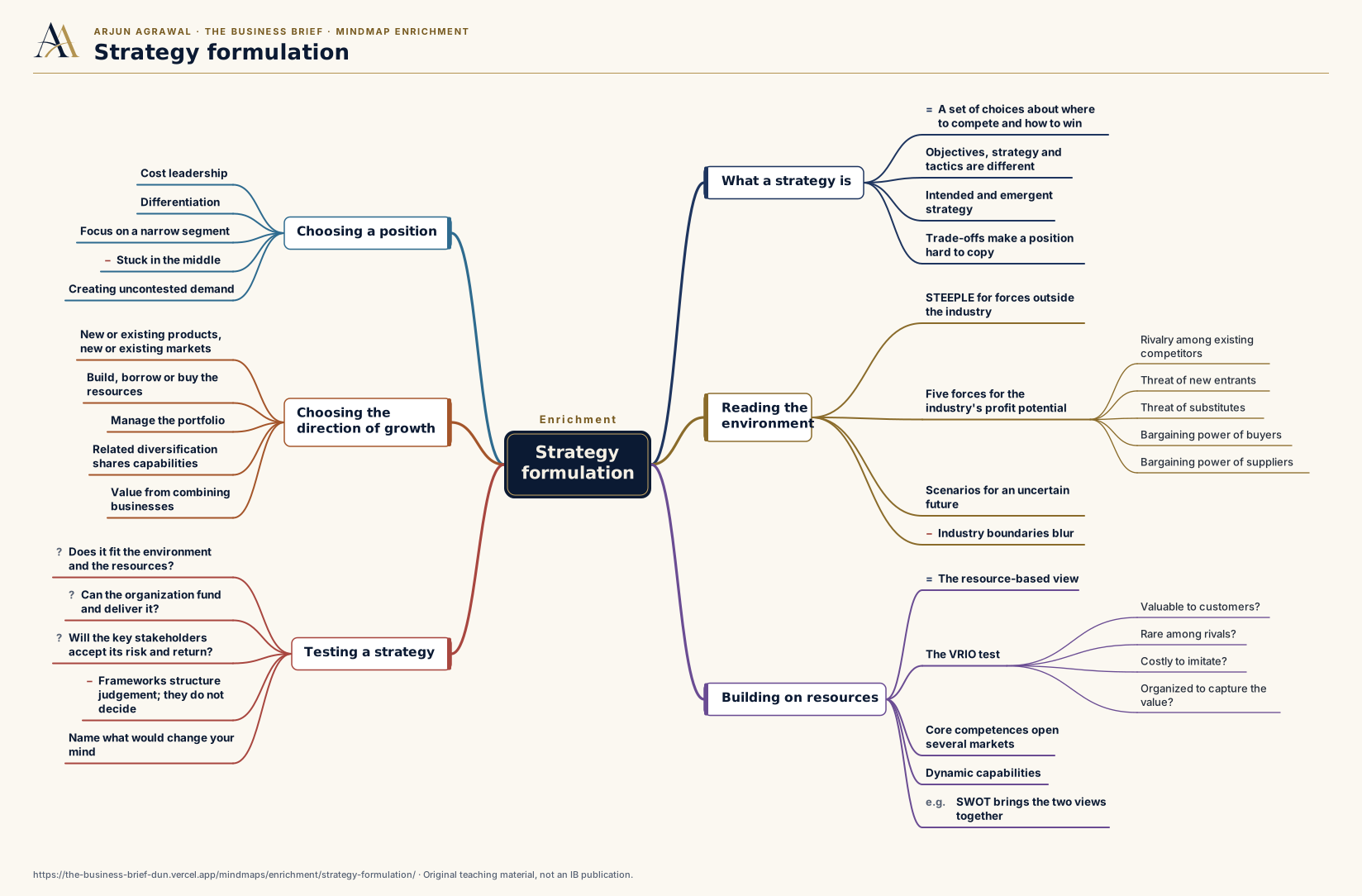
How an organization chooses where to compete and how to win, from reading its environment and its own resources to testing a strategy before committing to it.
Drag to move the map, or use the arrow keys. Click a branch to fold it away. Whole map shows all of it; zoom with the buttons, or with Ctrl and the scroll wheel.
- Core ideas
- Tools
- Theories and models
- Types and forms
- Applications
- Evaluation
- Advantage
- Limitation
The map as an outline
What a strategy is
Core ideas
- Definition A set of choices about where to compete and how to win The choices must fit together and rule options out; a list of goals is not a strategy.
- Objectives, strategy and tactics are different Objectives say what to achieve, strategy says how, and tactics are the short-term moves.
- Intended and emergent strategy Plans meet events, so the strategy that happens mixes the two (Mintzberg).
- Trade-offs make a position hard to copy Deciding what not to do is what protects a position from imitation.
Reading the environment
Tools
- STEEPLE for forces outside the industry
- Five forces for the industry's profit potential Porter's model of what shapes the returns open to firms in an industry.
- Rivalry among existing competitors
- Threat of new entrants
- Threat of substitutes
- Bargaining power of buyers
- Bargaining power of suppliers
- Scenarios for an uncertain future Several plausible futures, with the strategy tested against each one.
- Limitation Industry boundaries blur Rivals from other industries and new platforms are easy to miss.
Building on resources
Theories and models
- Definition The resource-based view Lasting advantage comes from resources and capabilities that rivals cannot easily copy.
- The VRIO test A resource gives lasting advantage only if it passes all four questions (Barney).
- Valuable to customers?
- Rare among rivals?
- Costly to imitate?
- Organized to capture the value?
- Core competences open several markets Collective know-how that can be carried across products (Prahalad and Hamel).
- Dynamic capabilities The ability to renew resources and skills as markets change.
- Example SWOT brings the two views together Strengths and weaknesses inside, opportunities and threats outside.
Choosing a position
Types and forms
- Cost leadership The lowest costs in the industry, at a quality customers accept.
- Differentiation Something buyers value enough to pay more for.
- Focus on a narrow segment Cost or differentiation in a niche the broad players serve poorly.
- Limitation Stuck in the middle Neither cheapest nor distinctive. Hybrids can work, but only with a clear logic.
- Creating uncontested demand Redraw the offer to add new value and cut cost at once (Kim and Mauborgne's blue ocean strategy).
Choosing the direction of growth
Applications
- New or existing products, new or existing markets Market penetration, product development, market development or diversification.
- Build, borrow or buy the resources Grow organically, through alliances and contracts, or by acquisition (Capron and Mitchell).
- Manage the portfolio Fund some businesses, harvest others, and leave some.
- Related diversification shares capabilities An unrelated move adds risk without the benefit of shared skills.
- Value from combining businesses Often promised in a merger, and often harder to capture than planned.
Testing a strategy
Evaluation
- Question Does it fit the environment and the resources? Suitability.
- Question Can the organization fund and deliver it? Feasibility: money, people, time and skills.
- Question Will the key stakeholders accept its risk and return? Acceptability.
- Limitation Frameworks structure judgement; they do not decide The same analysis can support different choices.
- Name what would change your mind Agree the signal that would trigger a rethink before committing.
Download the full map as an SVG file Works without JavaScript; the buttons above also save the view you have open.
Section 01: Where it starts from the IB course
For readers who know the IB course: the subtopics this map builds on. The map goes further than any of them.
- 1.3 Business objectives Objectives, SWOT and, at HL, Porter's generic strategies
- 1.5 Growth and evolution Growth, the Ansoff matrix and the external routes to grow
- 4.2 Marketing planning Differentiation and positioning
Section 02: Related enrichment maps
- Marketing strategy Winning a place in the customer's mind
- Corporate finance Putting a value on a strategic option
- Leading change Turning a chosen strategy into change
Section 03: Terms on the map
Where an idea on the map is the same as a term in the platform's glossary, the node links to it. The glossary defines each term as the IB course uses it.
How this map was written
The platform's own summary of established management ideas, written for the undergraduate and MBA pathways. It goes beyond the IB course and is aligned to no university course or textbook, because none was supplied. Frameworks are named with the people usually credited with them; their works were not opened for this map.
- Strategies for Diversification, H. Igor Ansoff (1957): The matrix of products and markets. Cited as a bibliographic reference; not opened for this map.
- Build, Borrow, or Buy: Solving the Growth Dilemma, Laurence Capron and Will Mitchell (2012): Build, borrow or buy. Cited as a bibliographic reference; not opened for this map.
Arjun Agrawal | The Business Brief, https://the-business-brief-dun.vercel.app/mindmaps/enrichment/strategy-formulation/. Original teaching material, not an IB publication. The organizations in the teaching cases are fictional unless a case says otherwise.