Enrichment map · Leadership · Beyond the IB course
Leading change
How leaders take an organization through change, from the kinds of change and the models that guide it to leading people, resistance and culture, and how a transformation is sequenced and made to last.
Drag to move the map, or use the arrow keys. Click a branch to fold it away. Whole map shows all of it; zoom with the buttons, or with Ctrl and the scroll wheel.
- Types and forms
- Theories and models
- Core ideas
- Applications
- Tools
- Evaluation
- Advantage
- Limitation
The map as an outline
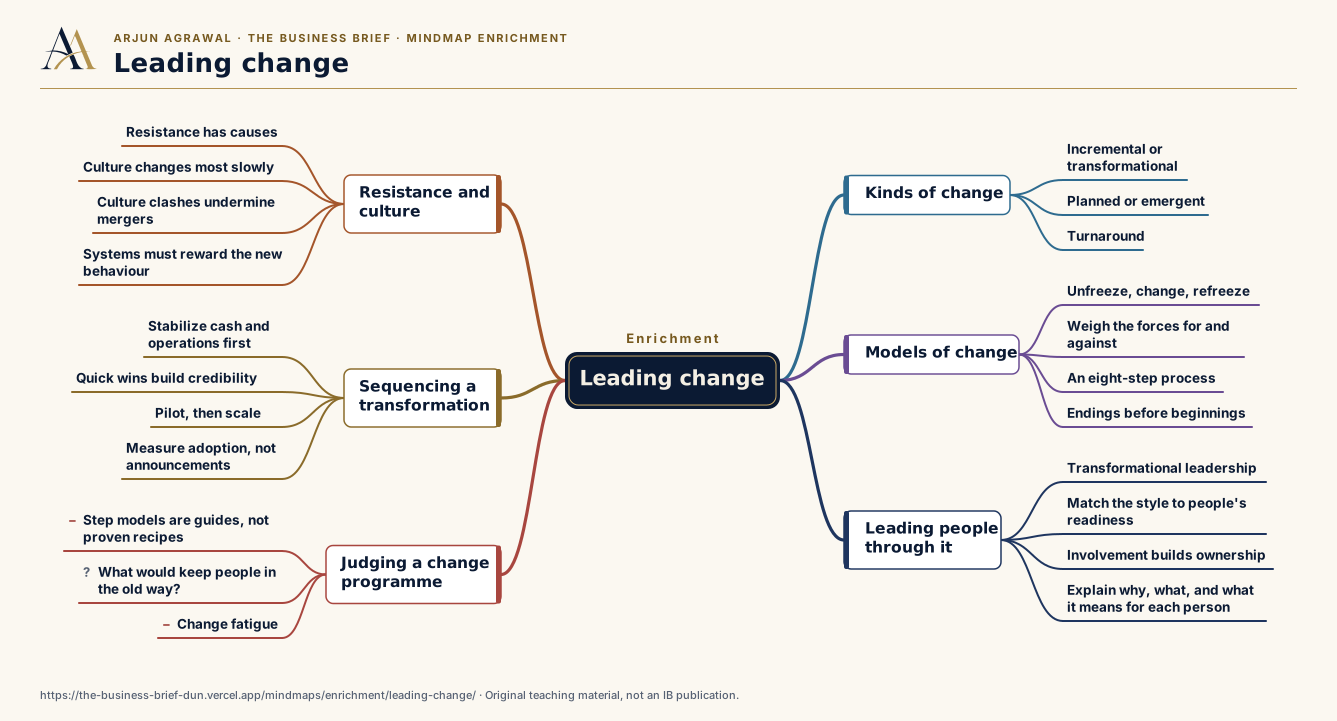
Kinds of change
Types and forms
- Incremental or transformational Adjusting the current way of working, or replacing it.
- Planned or emergent Designed at the top, or grown from local adaptation.
- Turnaround Rescue under pressure; stabilize first, then rebuild.
Models of change
Theories and models
- Unfreeze, change, refreeze Commonly credited to Lewin, though historians debate how far he set it out as a model.
- Weigh the forces for and against
- An eight-step process Urgency, a coalition, a vision, communication, removing obstacles, quick wins, consolidating, embedding (Kotter).
- Endings before beginnings People must let go of the old way before they commit to the new (Bridges).
Leading people through it
Core ideas
- Transformational leadership Building commitment to a shared vision, beyond trading reward for effort.
- Match the style to people's readiness
- Involvement builds ownership
- Explain why, what, and what it means for each person
Resistance and culture
Applications
- Resistance has causes Fear of losing status, security or competence; distrust; a weak case for change.
- Culture changes most slowly
- Culture clashes undermine mergers Integration plans that ignore culture often lose the value the deal promised.
- Systems must reward the new behaviour New values fail if pay and processes still reward the old ones.
Sequencing a transformation
Tools
- Stabilize cash and operations first In a crisis, buy time before redesigning anything.
- Quick wins build credibility Visible early results win over sceptics.
- Pilot, then scale Test a change where failure is cheap.
- Measure adoption, not announcements
Judging a change programme
Evaluation
- Limitation Step models are guides, not proven recipes Most of the evidence for them comes from case studies.
- Question What would keep people in the old way?
- Limitation Change fatigue Too many initiatives at once exhaust commitment.
Download the full map as an SVG file Works without JavaScript; the buttons above also save the view you have open.
Section 01: Where it starts from the IB course
For readers who know the IB course: the subtopics this map builds on. The map goes further than any of them.
- 2.1 Introduction to human resource management Resistance to change and change management
- 2.3 Leadership and management Leadership styles, including situational leadership
- 2.5 Organizational (corporate) culture HL: organizational culture and culture clash
- 5.7 Crisis management and contingency planning HL: crisis management and contingency planning
Section 02: Related enrichment maps
- Organizational behaviour Motivation, teams and power during change
- Strategy formulation The strategy the change serves
Section 03: Terms on the map
Where an idea on the map is the same as a term in the platform's glossary, the node links to it. The glossary defines each term as the IB course uses it.
How this map was written
The platform's own summary of established ideas about leading change, written for the MBA and undergraduate pathways. It goes beyond the IB course and is aligned to no university course or textbook, because none was supplied. Models are named with the people usually credited with them; their works were not opened for this map.
- Field Theory in Social Science, Kurt Lewin (1951): Force field analysis. Cited as a bibliographic reference; not opened for this map.
- Life cycle theory of leadership (the origin of the Situational Leadership model), Paul Hersey and Kenneth H. Blanchard (1969): Matching leadership to people's readiness. Cited as a bibliographic reference; not opened for this map.
Arjun Agrawal | The Business Brief, https://the-business-brief-dun.vercel.app/mindmaps/enrichment/leading-change/. Original teaching material, not an IB publication. The organizations in the teaching cases are fictional unless a case says otherwise.