Unit 2: Human resource management
2.1 Introduction to human resource management
Study mode could not start. The page reads as usual.
Study mode
On this page
Section 01: What the IB course asks
The content statements for 2.1, in the platform's words, with the depth of teaching the guide sets (guide, from p. 25).
- The role of human resource management AO2
- Internal and external factors that influence human resource planning, such as demographic change, labour mobility, immigration, flexi-time and the gig economy AO2
- Reasons for resistance to change in the workplace AO2
- Human resource strategies for reducing the impact of change and resistance to change AO3
AO1 knowledge and understanding · AO2 application and analysis · AO3 synthesis and evaluation · AO4 a range of skills. A question can use a command term at its statement's level or below. The whole course.
Section 02: Why it matters
Every plan a business makes, to grow, to automate, to open a new site or to cut costs, depends in the end on people: enough of them, with the right skills, in the right place, willing to work in new ways. Human resource management (HRM) is how an organization plans for, finds, develops, rewards and looks after those people, and how it manages them through change.
This subtopic sets out what HRM does, the internal and external factors that shape a workforce plan, such as demographic change, labour mobility, immigration, flexi-time and the gig economy, and why people so often resist change at work. Its most demanding statement asks you to evaluate the HR strategies that reduce the impact of change and the resistance to it (AO3), which means judging which strategy fits which situation, not listing them.
By the end you can
- Explain the role of human resource management and how it supports an organization's objectives.
- Explain how human resource planning matches the workforce to the organization's plans, and work through a simple workforce plan.
- Analyse the internal and external factors that influence human resource planning, including demographic change, labour mobility, immigration, flexi-time and the gig economy.
- Explain why employees resist change in the workplace.
- Evaluate human resource strategies for reducing the impact of change and resistance to change.
- Apply force field analysis to a proposed change (HL only).
Section 03: The role of human resource management
Human resource management (HRM) is the management of the people an organization employs so that they help it achieve its objectives. People are usually a business's largest cost and the source of most of its ideas, quality and service, so decisions about them shape its costs, its productivity and its culture. The guide sets this statement at AO2: you should be able to explain what HRM does in a particular organization, not only list its tasks.
HRM follows employees through their working lives with the organization: planning how many people are needed and with which skills, recruiting and selecting them, introducing and training them, reviewing their performance, rewarding them and looking after their welfare, managing relations with them and their representatives, and handling their departure through retirement, resignation, dismissal or redundancy. In a small business the owner does all of this; in a large one an HR department sets policies and gives specialist advice, while line managers do much of the day-to-day work of managing people.
HRM is also strategic. A plan to expand abroad, to automate or to move to a new site is partly a plan about people, and it fails if the right people are not there or will not work in new ways. The unit's conceptual understandings make the same point from several sides: people are at the centre of organizational change, creative staff can make the difference between success and failure, and fair, ethical HR systems tend to bring better performance. Technology is changing the work itself: HR information systems hold staff records, track absence and analyse why people leave, though using data to monitor employees raises ethical questions that HL students meet in 5.9.
- Human resource planning
Forecasting the workforce the organization will need and planning how to close the gap with the one it has. The next section explains it.
- Recruitment and selection
Attracting suitable applicants and choosing among them. The methods, and the choice between internal and external recruitment, are HL content in 2.4.
- Training and development
Induction for new staff, and on-the-job and off-the-job training to build skills for now and for the future (2.4).
- Reward and welfare
Pay, benefits, health and safety, and support such as counselling, flexible working and help with stress.
- Employee relations
Communicating and consulting with employees and their representatives, and handling grievances, discipline and disputes. At HL, conflict and its resolution are studied in 2.7.
- Managing departures
Retirement, resignation, dismissal for misconduct or poor performance, and redundancy, when a job is no longer needed. How departures are handled affects the morale of those who stay.
Section 04: Human resource planning: matching people to plans
Human resource planning, also called workforce planning, is forecasting how many employees, with which skills, an organization will need, comparing this with the workforce it will have, and planning how to close the gap. It starts from the organization's objectives, because a plan to grow, automate, relocate or cut costs changes the workforce it needs.
A plan usually works through five steps.
- Forecast the demand for labour: how many people, with which skills, where and when, given the business's plans and its expected sales.
- Audit the supply: the people already employed, their skills, ages and contracts, and how many are likely to leave or retire.
- Find the gap: a shortage of people or skills, a surplus, or often both at once, with too many people in one role and too few in another.
- Plan the action: recruit, train or retrain, redeploy staff to other roles, promote, use flexible or agency labour, or reduce numbers through natural wastage, voluntary redundancy or, as a last resort, compulsory redundancy.
- Monitor and review: compare what happens with the plan, and change it as the business's plans and the labour market change.
The forecast is the weak point. Demand for labour depends on sales forecasts and on how technology changes the work, while supply depends on how many people choose to leave, which is hard to predict. A good plan states its assumptions and is reviewed often, and the further ahead it looks, the less reliable it becomes.
- Shortage
The organization will need more people, or more of a particular skill, than it will have. It closes the gap by recruiting, training, promoting or using flexible labour.
- Surplus
The organization will have more people in some roles than it needs. It closes the gap by redeploying, retraining, natural wastage or redundancy.
- Natural wastage
The fall in staff numbers as people leave of their own accord, through resignation or retirement, and are not replaced. It avoids redundancies but is slow, and the organization cannot choose who leaves. At HL, the rate of leaving is measured as labour turnover (2.4).
- Redeployment
Moving employees to other roles in the organization, often with retraining, instead of making them redundant.
Section 05: Internal factors in human resource planning
Some influences on a workforce plan come from inside the organization, so its managers can control or at least shape them. The most important is the organization's own direction: its objectives and strategy decide what work there will be. A business that plans to grow needs more people; one that automates needs fewer people with different skills; one that moves to a new site may lose staff who cannot follow it.
The diagram shows these internal factors beside the external ones in the next section. Flexi-time sits on the border between the two. The guide names it among the factors without saying which kind it is: a business decides whether to offer flexi-time, which makes it internal, but it is often responding to what employees and rival employers expect, which is an external pressure. In an answer, say which way the pressure runs in the case.
- Objectives and strategy
Growth, new products, new markets, a merger, relocation or a drive to cut costs each change how many people are needed, with which skills and where.
- Finance available
The budget for pay, recruitment and training limits what the plan can do. A business short of cash may freeze recruitment even when it is short of staff.
- Technology and automation
New machines and software change the number of people needed and the skills they need, often creating a surplus in one role and a shortage in another.
- Working patterns, including flexi-time
How the business organizes working time, such as shifts, part-time roles, remote working and flexi-time, in which employees choose when to start and finish around agreed core hours. These choices change how many people are needed to cover the hours, and whom the business can attract.
- The current workforce
Its skills, its age profile, how many people leave and how often they are absent. An ageing workforce means retirements to plan for; high turnover means constant recruitment.
- Structure and culture
Delayering removes management posts, a flatter structure needs managers with wider spans of control (2.2), and the culture shapes whom the business hires and how readily people accept change.
Text description
Human resource planning, deciding how many people the business needs, with which skills and when, is shaped by internal and external factors. Internal: plans for growth or change, flexi-time and other working patterns, labour turnover and absence, the budget for pay and training, and the skills of the current workforce. External: demographic change, labour mobility, immigration, the gig economy, and laws, technology and the economy. The guide names demographic change, labour mobility, immigration, flexi-time and the gig economy.
Section 06: External factors in human resource planning
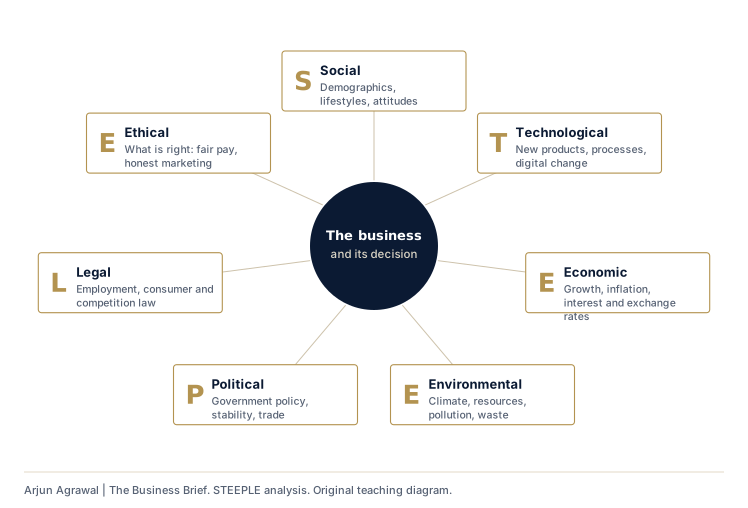
Other influences come from outside the organization. It cannot control them, only forecast them and plan around them, and they can change quickly. Four of the guide's five examples are external: demographic change, changes in labour mobility, immigration and the gig economy. Employment law, the state of the economy and technology in the wider world matter too. A STEEPLE analysis, one of the toolkit tools the guide suggests for this unit, is a systematic way to scan them.
The external factors work mainly through the supply of labour: how many people with the right skills are available, where, and at what wage. A business in a region with an ageing population, little immigration and high employment will struggle to recruit, and will need to raise pay, train its own people, automate or move work elsewhere. One in a region with a young, growing population and high unemployment will find recruitment easier and cheaper.
- Demographic change
Changes in the size and make-up of the population, such as an ageing population, falling birth rates or more women in paid work. An ageing population means more retirements and fewer young people entering work, so businesses may need to retain and retrain older staff, offer flexible hours or recruit from further afield. It also changes demand, for example raising the need for care workers.
- Labour mobility
How easily workers move between occupations (occupational mobility) or between places (geographical mobility). High mobility makes vacancies easier to fill but also makes it easier for staff to leave for rivals. Housing costs, family ties and the need to retrain limit mobility; remote working has raised it for some jobs.
- Immigration
People moving into a country to live and work. It adds to the supply of labour and can fill skills shortages and seasonal peaks, but depends on government rules that can change, and brings costs such as work permits, language support and checking qualifications.
- The gig economy
A labour market in which many people work task by task, often through digital platforms, usually as self-employed contractors rather than employees. It gives businesses a pool of labour they can use when they need it, as the section on flexible work explains.
- Employment law
Minimum wages, limits on working hours, rules on contracts, discrimination, redundancy and consultation. A new law can change labour costs or the way a business may use flexible workers.
- The economy and the labour market
When unemployment is low, recruitment is harder, pay rises and more staff leave for other jobs; in a downturn, the reverse. Rivals' pay and conditions set what a business must offer.
- Technology and social attitudes
New tools make remote and flexible working possible and change which skills are scarce, while rising expectations of work-life balance change what employees ask for.
Section 07: Flexi-time, flexible work and the gig economy
Two of the guide's examples, flexi-time and the gig economy, are both forms of flexibility, but they serve different purposes. Flexi-time gives employees some control over when they work, within a permanent job. Gig work gives the business flexibility over how much labour it buys, task by task, usually without employing the worker at all. Between the two lie many other arrangements, and most organizations use several.
Flexibility helps an organization match its labour to demand, cut costs and recruit people who cannot work fixed full-time hours. Its costs are less visible: coordinating people who are rarely in the same place, weaker loyalty from workers who are not employees, and the training and quality control that a constantly changing workforce needs. Flexibility for the business can mean insecurity for the worker, which is why the gig economy raises ethical and legal questions as well as economic ones. In several countries, courts and governments have examined whether people who work through platforms are really self-employed or should have employees' rights.
- Flexi-time
Employees choose when to start and finish, within limits, provided they work during agreed core hours and complete their total hours. It can raise motivation and cut absence and lateness. It suits office and knowledge work better than jobs tied to a production line or fixed opening hours.
- Part-time work and job sharing
Jobs with fewer than full-time hours, or one full-time job split between two people. They widen the pool of applicants, for example to parents, carers and older workers, but need careful handovers.
- Remote and hybrid working
Working from home or elsewhere for some or all of the week. It saves office costs and lets a business recruit from a wider area, but makes supervision, training and teamwork harder.
- Temporary and agency work
Workers hired for a fixed period or supplied by an agency, to cover peaks, absences or projects. Quick to arrange and end, but usually dearer per hour and less committed.
- Gig work
Short tasks found and paid through digital platforms, by workers who are usually self-employed. It turns a fixed labour cost into a variable one, but the business has less control over quality, and the workers usually have no guaranteed hours, sick pay, holiday pay or pension.
Advantages
- Labour can be matched to demand, so the business pays for work only when it is needed.
- A wider pool of applicants, including people who cannot work fixed full-time hours.
- Flexi-time and remote work can raise motivation and retention, and save office space.
- Gig and agency labour can be scaled up quickly for a peak or a new service.
Limitations
- Harder coordination, supervision and communication when people work at different times and places.
- Gig and agency workers may be less loyal and less trained, which can affect quality and safety.
- Insecure work raises ethical concerns and the risk of disputes or new laws on employment status.
- Constant changes of staff add to induction and training costs.
Section 08: Why people resist change at work
Resistance to change is employees' reluctance to accept, or active opposition to, a change in how they work, such as new technology, a restructuring, new working hours or a move to another site. It is a normal human response, not a sign of a bad workforce, and it is often a sign that people expect to lose something they value.
Resistance takes two forms. Some is open: complaints, petitions, grievances, refusals and, where employees are organized, industrial action (HL students study this in 2.7). Much is hidden: more absence, less effort, slow adoption of new methods, mistakes, and the quiet departure of people who can find work elsewhere, often the most skilled. Hidden resistance is harder to see and can do more damage, because managers think the change has been accepted.
Resistance is not always irrational. Employees often know the work better than the managers planning the change, and their objections may reveal real flaws: a system that does not suit the task, a timetable that is too fast, or training that is too short. Treating every objection as obstruction throws that knowledge away.
- Fear of the unknown
People do not know what the change will mean for them, and uncertainty is uncomfortable, especially when information arrives through rumour.
- Job security and pay
Automation, restructuring or relocation can threaten jobs, hours, overtime or bonuses, the most powerful reasons of all.
- Status, skills and power
A change can make hard-won skills worthless, remove a supervisor's authority or break up a respected team.
- Habit and comfort
Familiar routines are easy; new ones take effort and bring the risk of looking incompetent while learning.
- Poor communication and no consultation
People told late, told little or not asked at all assume the worst and feel the change is being done to them rather than with them.
- Low trust in management
Where past changes went badly, or promises were broken, employees doubt the reasons they are given now.
- Disagreement with the change
Employees may believe, sometimes correctly, that the change is a mistake.
- Change fatigue
Too many changes in a short time exhaust people, so even a sensible change meets resistance.
- Enrichment: Kotter and Schlesinger
In a widely taught 1979 article, John Kotter and Leonard Schlesinger grouped the reasons into four: self-interest (people expect to lose out), misunderstanding and a lack of trust, different assessments of whether the change makes sense, and a low tolerance for change. This framework is not named in the guide.
Section 09: HR strategies for reducing the impact of change and resistance to it
The guide asks for strategies that reduce two things: the impact of change on employees, and their resistance to it. The two are linked. People resist less when the change hurts them less, and when they understand it, have shaped it and can see how they will cope with it.
No strategy suits every situation. The right choice depends on why people are resisting, how urgent the change is, how much the organization needs employees' ideas and commitment, how much trust already exists, and what it can afford. Most successful changes combine several strategies, starting with communication and involvement and adding training, support and negotiated guarantees where jobs or skills are at stake. Coercion, forcing the change through with threats, is fast, but it buys compliance rather than commitment, damages trust for the next change, and can turn hidden resistance into open conflict.
Timing matters too. Strategies that build understanding, such as early communication and consultation, must come before the decision is fixed, or they are seen as a sham. Strategies that reduce the impact, such as retraining, redeployment and support for anyone made redundant, run alongside the change and after it.
- Communicate early and honestly
Explain why the change is needed, what will happen, when, and what it means for each group, before rumours fill the gap. Cheap and essential, but it does not remove a real threat to jobs.
- Consult and involve
Ask employees how the change should work and let them shape its details, through meetings, working groups or representatives. People resist less what they have helped to design, and their knowledge improves the plan. It takes time, and it fails if the decision has already been made.
- Train and support
Training in new skills, coaching, and counselling for those who are anxious. It reduces fear of incompetence and builds confidence, but costs money and takes people away from their work.
- Retrain and redeploy
Move people whose jobs are going into new roles, with the training they need. It reduces the impact of change on jobs and keeps experienced staff, but there may not be enough suitable roles.
- Negotiate incentives and guarantees
Offer something in return, such as a bonus for new skills, a guarantee of no compulsory redundancies, or protected pay for a period. Effective where people stand to lose, but it can be expensive and may encourage resistance next time.
- Introduce change in stages or pilot it
Try the change in one team first, learn from it, and use the pilot team as champions. It lowers the risk of a failed change but slows it down.
- Support people who leave
Voluntary redundancy before compulsory redundancy, fair redundancy pay, and help to find new work. It reduces the harm to those affected and shows those who stay that they will be treated fairly.
- Coercion, as a last resort
Imposing the change and threatening those who resist. Quick when time is short, but it damages trust, morale and future cooperation, and drives the best people to leave.
- Enrichment: Kotter and Schlesinger's approaches
The same 1979 article set out six approaches, from education and communication, participation and involvement, and facilitation and support, through negotiation and agreement and manipulation and co-optation, to explicit and implicit coercion, and argued that the choice should match the reason for resistance and the urgency of the change. The first four match the strategies above; manipulation raises obvious ethical problems.
Advantages
- Communication, involvement and training are relatively cheap and build the trust that later changes need.
- Retraining and redeployment keep experienced people and their knowledge of the business.
- Strategies matched to the cause of resistance deal with it, rather than suppressing it.
Limitations
- Consultation and phased change take time, which a business in a crisis may not have.
- Guarantees and incentives cost money and can raise expectations for future changes.
- No strategy removes resistance when the change genuinely makes people worse off; it can only reduce and compensate.
HL Section 10, Force field analysis (HL toolkit), is HL only and is hidden while you are viewing SL content. Switch to HL at the top of the page to see it.
Section 10: Force field analysis (HL toolkit)
HL onlyForce field analysis is an HL toolkit tool for planning a change, developed from the work of the psychologist Kurt Lewin. It sets out the driving forces that push for a change and the restraining forces that hold it back, so that managers can see whether the change is likely to succeed and what they could do to help it.
The method has four steps. Describe the proposed change. List the driving and restraining forces. Give each force a score for its strength, commonly from 1 (weak) to 5 (strong), and add up each side. Then decide what to do: go ahead, strengthen the driving forces, weaken the restraining forces, or drop the change. Lewin's insight was that weakening a restraining force is often more effective than adding a driving one, because pushing harder tends to provoke more resistance, while removing a reason for resistance lets the change move on its own.
The scores are judgements, not measurements, so the tool is most useful when the people involved discuss them together, which is itself a form of consultation. The diagram shows an example for a design agency considering a four-day working week.
Text description
A fictional design agency considers a proposed change: move to a four-day working week. Driving forces push for it: better staff retention, scored 4; easier recruitment, scored 3; fewer sick days, scored 2, a total of 9. Restraining forces push against it: clients expect five-day cover, scored 4; rota and scheduling costs, scored 2; managers’ doubts, scored 2, a total of 8. Arrow lengths match the scores. The scores are judgements; the driving forces narrowly win, so the plan would weaken the strongest restraint before going ahead.
Advantages
- Makes the forces against a change visible, so they can be planned for rather than discovered too late.
- Points to the restraining forces worth weakening, which links directly to HR strategies for reducing resistance.
- Simple to draw and discuss, and building it with staff involves them in the change.
Limitations
- The scores are subjective, and different people would score the same forces differently.
- Totals can hide one force that is decisive on its own, such as a legal requirement or a key client's refusal.
- It shows the balance at one moment, while forces change as the change proceeds.
Section 11: In practice: industries and stakeholders
The same ideas look different from one industry to the next, and land differently on each group with a stake in the business.
Across industries
- Healthcare
Ageing populations raise the demand for care while older nurses and doctors retire, so health systems plan years ahead and often recruit from abroad, which makes them sensitive to immigration rules. New digital records and rotas meet resistance from staff who are already stretched, so involving clinicians in their design matters.
- Hospitality and tourism
Demand is seasonal and staff turnover is high, so hotels and restaurants rely on part-time, temporary, agency and gig workers and on mobile young workers, including from abroad. The HR plan is less about headcount than about recruiting and training quickly, every season.
- Manufacturing
Automation creates surpluses in manual roles and shortages of technicians at the same time, so retraining and redeployment are central. Long-serving, often unionized workforces and the threat to jobs make resistance to change likely and consultation important.
- Technology
Skills are scarce and mobile, so firms compete hard for talent, recruit across borders and use remote work and freelancers widely. Change is constant, which makes change fatigue a real risk and a culture that accepts change an asset.
- Retail
Large part-time workforces work flexible shifts matched to footfall, and self-service and online ordering keep changing the work. Plans must cover seasonal peaks, such as the end-of-year holidays, with temporary staff.
- A social enterprise
Limited funds and a mission-driven workforce, often including volunteers, mean pay cannot be the main tool. Purpose and involvement in decisions matter more, and change that seems to drift from the mission can meet strong resistance from committed staff.
For each stakeholder
- Employees
Want security, fair pay, development and some control over their working time. Change that threatens jobs or skills affects them most directly, and flexibility that suits the business can mean insecurity for them.
- Managers
Line managers carry out most HR decisions and must lead their teams through change while keeping output up. They are often caught between directors' plans and employees' concerns.
- Owners and shareholders
Want labour costs controlled and productivity raised, which can favour automation, flexible labour and fast change. Their interest conflicts with employees' interest in security, though both lose if a badly managed change drives away key staff.
- Employee representatives and trade unions
Negotiate on pay, conditions and how change is introduced, and may resist redundancies. Involving them early can make change smoother; ignoring them can turn resistance into conflict (HL, 2.7).
- Government
Sets employment and immigration law, the minimum wage and often funds retraining. It wants high employment and fair treatment of workers, which can limit how far businesses rely on insecure work.
- Customers
Feel the effects of HR decisions through service quality. A poorly managed change, high staff turnover or untrained temporary staff can lower quality, while a well-planned workforce improves it.
Section 12: Evaluation and limits
What to weigh before reaching a judgement.
- A workforce plan is only as good as its forecasts. Demand for labour depends on sales and technology, and supply on people's choices to stay or leave, so plans need stated assumptions and frequent review, and they become less reliable the further ahead they look.
- Flexibility is not free. Flexi-time, part-time roles and remote work can serve both sides, but gig and agency work shifts risk from the business to the worker. The savings must be weighed against weaker loyalty, lower quality and the ethical and legal questions insecure work raises.
- Resistance carries information. Employees often understand the work better than the planners, so some resistance signals a flawed change. Listening can improve the plan as well as reduce opposition.
- The best strategy depends on the cause and the situation. Communication answers misunderstanding, training answers fear of incompetence, guarantees answer threats to jobs, and coercion is a last resort when time is short. Matching the strategy to the cause is what turns a list into an evaluation.
- Speed and commitment pull against each other. Consultation and phased change build commitment but take time; imposed change is fast but costly in trust, morale and the departure of the best people, costs that appear later and are easy to underestimate.
- Context changes what works. Laws on consultation and redundancy, the strength of unions and national attitudes to authority differ between countries; at HL, Hofstede's cultural dimensions help to explain why. In an answer, apply each strategy to the business in the case rather than describing it in general.
Section 13: Make the decision
Use the ideas on a business choice: weigh the options, decide, and say what would change your mind.
Decision brief · a fictional business
Staffing the claims team at Ashdown Insurance
Ashdown Insurance, a fictional insurer, is introducing software that sorts and checks routine claims automatically. Its claims team of 120 handlers will need to shrink by 30%, to 84, within two years, and it needs 8 new data specialists to run and monitor the system. About 14 handlers leave each year of their own accord. Each handler costs about $38,000 a year. The team is experienced and loyal, but rumours about the software have started, and a competitor has been recruiting Ashdown's best handlers.
How to weigh the options
Start with the trade-off between speed and commitment. Option A reaches the smaller team within six months, so the salary savings of about $1.37 million a year (36 × $38,000) begin almost at once, but it costs $432,000 in redundancy pay and confirms the rumours in the worst way. Survivors may lose trust, the competitor will find it easier to recruit Ashdown's best handlers, and the business loses experience just when the new software is most likely to make mistakes.
Option B costs far less in redundancy pay and keeps people who know the claims, and the retrained specialists understand the work the software is doing. But its savings build up slowly over two years, it depends on about 14 handlers leaving each year, which may not happen if jobs elsewhere become scarce, and Ashdown cannot choose who leaves: the best handlers are the most likely to go. A recruitment freeze also stretches the team while it learns the new system.
Option C tests whether the software works before the workforce is reshaped around it, and gives the change a group of employees who can vouch for it. It delays the savings and does not, on its own, answer the question of the 36 roles.
A strong judgement may combine options, for example a pilot (C) followed by gradual reduction (B), with voluntary redundancy if wastage runs slow. Say what would change it: evidence on how reliable the software is, how fast handlers are really leaving, and whether the competitor's recruiting is targeting the people Ashdown can least afford to lose.
Section 14: Exam-style practice
Original questions written by the platform in the style of the papers, with what a strong response does. They are not IB questions and the guidance is not an official markscheme.
-
Define the term human resource planning.
What a strong response does
A strong response gives a precise definition: forecasting how many employees, with which skills, an organization will need, comparing this with the workforce it will have, and planning how to close any gap, for example by recruiting, training, redeploying or reducing staff.
- A full answer includes both the forecast of need and the plan to close the gap.
- "Planning how many workers to recruit" is only partly right, because planning also covers skills, timing and reducing staff.
-
Seabright Hotels, a fictional hotel group, employs 180 permanent staff. Next year it will open a new hotel that needs 60 more permanent staff. It expects 25 staff to resign and 5 to retire during the year. In the 12-week summer peak it also needs 40 extra staff across its hotels.
Using the data, explain the size of the workforce gap Seabright must close next year, and one way it could close it.
What a strong response does
A strong response works out the gap from the data, then explains a suitable way to close it.
- Demand: 180 + 60 = 240 permanent staff needed.
- Supply: 180 − 25 − 5 = 150 still employed by the end of the year without action.
- Gap: 240 − 150 = 90 permanent staff, plus 40 temporary staff for the 12-week peak.
- One way to close it, explained in context: for example, recruit the 90 permanent staff partly from the local labour market and partly from abroad where the law allows, starting early because new hotel staff need training before opening; and cover the 40 peak roles with temporary or agency workers, or with gig workers booked through an app, because the need lasts only 12 weeks and permanent contracts would leave Seabright paying for staff it does not need for the rest of the year.
A response that treats the 40 seasonal roles as permanent misses the point of the data.
-
Distinguish between flexi-time and gig work as ways of meeting a business's need for labour.
What a strong response does
A strong response makes clear differences, rather than describing each in turn.
- Who the flexibility serves: flexi-time gives employees control over when they work, within agreed core hours; gig work gives the business control over how much labour it buys, task by task.
- Employment status: flexi-time workers are usually permanent employees with employees' rights; gig workers are usually self-employed contractors without guaranteed hours, sick pay or holiday pay.
- Effect on costs and planning: flexi-time does not change the size of the workforce, while gig work turns part of labour cost from fixed to variable and lets the business scale up and down quickly.
- Application to an example business strengthens the answer.
-
Fenwick Engineering, a fictional firm with 85 design engineers, is replacing its drawing software with a system that automates routine drafting, and expects to need 15 fewer drafting roles within a year. Engineers heard about the change through rumours, and many have used the old software for over a decade. Explain two reasons why Fenwick's engineers might resist the change.
What a strong response does
A strong response gives two distinct reasons, each explained and linked to the case. For example:
- Job security: 15 drafting roles will go, so engineers fear redundancy, and without information each assumes the worst for themselves.
- Loss of skills and habit: engineers with a decade on the old software lose the expertise that gave them status, and fear looking incompetent while learning the new system.
- Poor communication: hearing about the change through rumours breeds distrust and suggests the decision was made without them.
Two reasons, each with an explanation and application, reach the top of the range; a list of four reasons without explanation does not.
-
Evaluate two human resource strategies that Fenwick Engineering could use to reduce resistance to the change.
What a strong response does
A strong response chooses two strategies that fit the causes of resistance in the case, weighs the strengths and limitations of each, and reaches a supported judgement. For example:
- Communication and consultation: explaining why the software is needed and inviting engineers to shape how it is introduced answers the rumours and the sense of exclusion, and their expertise could improve the rollout. It is cheap, but it cannot remove the fear of redundancy on its own, and it fails if the decision on the 15 roles is already fixed and presented as open.
- Retraining with a guarantee on compulsory redundancies: training engineers in the new system answers the fear of incompetence, and reducing the 15 roles through natural wastage, redeployment and voluntary redundancy answers the threat to jobs. It costs money and time, the business cannot choose who leaves, and some engineers may never adapt.
- Judgement: for example, that the two work best together, because the causes of resistance are both misunderstanding and a real threat to jobs: communication first, before the plan is fixed, then training and a no-compulsory-redundancy commitment. The judgement depends on how quickly Fenwick needs the savings and how many engineers leave of their own accord.
- Limits: the case does not say how fast staff usually leave, or whether the software has been tested.
The teacher support material advises that when evaluating two options, a response gives at least one argument for and one against each, applied to the case, and a conclusion that does more than repeat them (pp. 56 and 60).
-
(HL) Fenwick's managers score the forces for and against the change from 1 (weak) to 5 (strong). Driving forces: lower costs (4), faster delivery to clients (3), clients asking for the new file format (3). Restraining forces: fear of job losses (5), loss of familiar skills (3), cost of training (2).
Apply force field analysis to the change, and explain which force managers should address first.
What a strong response does
A strong response totals both sides, interprets the balance and chooses a force to act on, with a reason.
- Totals: driving 4 + 3 + 3 = 10; restraining 5 + 3 + 2 = 10. The forces are balanced, so the change is likely to stall or meet strong resistance if pushed through as it stands.
- Which force first: the strongest restraint, fear of job losses (5). Weakening it, for example with a commitment to reduce the 15 roles through natural wastage, redeployment and voluntary redundancy rather than compulsory redundancy, could bring it down to about 2, making the restraining total 7 against 10.
- Why weaken rather than push: adding pressure for the change, such as stressing the cost savings, may increase the fear of job losses; removing the reason for resistance lets the change proceed.
- A top response notes that the scores are judgements and could be tested by consulting the engineers.
HL Question 6 is HL only and hidden while you are viewing SL content. Switch to HL at the top of the page to see it.
Section 15: Revision summary
The subtopic on one page: what to remember.
- Human resource management is managing people so they help the organization meet its objectives: planning, recruiting, training, rewarding, looking after them and managing their departure. Line managers do much of it.
- Human resource planning forecasts the demand for labour, audits the supply, finds the gap and plans to close it: recruit, train, redeploy, use flexible labour, or reduce through natural wastage or redundancy.
- Internal factors include objectives and strategy, finance, technology and automation, working patterns such as flexi-time, the current workforce, and structure and culture.
- External factors include demographic change, labour mobility, immigration and the gig economy, plus employment law, the economy, technology and social attitudes. They work mainly through the supply of labour.
- Flexi-time gives employees flexibility within a job; gig work gives the business flexibility over how much labour it buys, at the cost of security for the worker.
- People resist change through fear of the unknown, threats to jobs, pay, status or skills, habit, poor communication, low trust, disagreement and change fatigue. Resistance can be open or hidden, and is not always wrong.
- HR strategies reduce both the impact of change and resistance to it, through communication, consultation, training, retraining and redeployment, negotiated guarantees, piloting, support for those who leave and, as a last resort, coercion.
- The right strategy depends on the cause of resistance, the urgency, the trust that exists and the cost; most changes need several.
- At HL, force field analysis weighs driving against restraining forces; weakening a restraint often works better than pushing harder.
Section 16: The mindmap
What human resource management does, the internal and external factors that shape workforce planning, why people resist change at work and how HR strategies can reduce that resistance.
Drag to move the map, or use the arrow keys. Click a branch to fold it away. Whole map shows all of it; zoom with the buttons, or with Ctrl and the scroll wheel.
- Core ideas
- Applications
- Connections
- Advantage
- Limitation
- HL HL only
The map as an outline
The role of HRM
Core ideas
- Definition HRM: managing people to meet objectives People are planned for, recruited, developed, rewarded and supported like any other key resource.
- Plan the workforce: numbers, skills, timing Forecast the staff needed, compare with the staff in post, then recruit, train, redeploy or reduce.
- Recruit and select new staff
- Train, appraise and develop people The types of training are in 2.4; the types of appraisal are HL content in 2.4.
- Reward staff and look after their welfare Pay and benefits, health and safety, and relations with employees and their unions.
- Manage exits: retirement, dismissal, redundancy Redundancy means the job is no longer needed; dismissal follows misconduct or poor performance.
Internal factors in HR planning
Core ideas
- Objectives and growth plans Expansion needs more or different staff; cutting back needs fewer.
- The budget for labour costs
- Working patterns: flexi-time, remote work The business sets its own patterns, though the demand for flexibility also comes from outside.
- New technology and automation Changes how many people are needed and which skills they must have.
- Staff leaving, retiring or being promoted Each creates a gap to fill; at HL the rate of leaving is measured as labour turnover.
- Structure and culture A flatter structure needs fewer managers; the culture shapes whom the business hires.
External factors in HR planning
Core ideas
- Demographic change
- Example Ageing population: more retirements Fewer young people join the workforce as more older staff retire.
- Labour mobility
- Occupational: ease of changing job or skills
- Geographical: ease of moving to the work
- Immigration Adds workers and scarce skills, subject to visa and work-permit rules.
- The gig economy Short-term, task-based work, often through apps; flexible for firms but insecure for workers.
- Employment law and the economy Minimum wages, employment rights, the level of unemployment and rivals' pay offers.
Why people resist change
Core ideas
- Definition Reluctance or opposition to new ways of working
- Fear of the unknown
- Threat to jobs, pay or status
- Comfort with familiar routines
- Poor communication, no consultation
- Low trust in management
Reducing resistance to change
Applications
- Definition Manage the people side of change
- Communicate early: why, what and when
- Consult and involve staff People resist less the changes they have helped to shape.
- Train and support, including retraining Also counselling, redeployment and help for anyone who is made redundant.
- Negotiate incentives or guarantees For example, a bonus for adopting the change or a promise of no compulsory redundancies.
- Introduce in stages, or pilot first
- Limitation Coercion: quick, but breeds resentment
- Force field analysis (toolkit) HL Weighs the forces driving a change against those restraining it, to plan how to manage it.
Connections
Connections
- 2.4: recruitment, training and rewards
- 2.2: flexible work reshapes structures
- 2.7: change as a source of conflict HL
- 1.3: the HR plan follows the objectives
Open the mindmap on its own page, with its terms and connections.
Section 17: More diagrams
Original diagrams from the platform's library, each with a text description and an SVG download.
Text description
Seven external factors around a business and its decision. Social: demographics, lifestyles and attitudes. Technological: new products, processes and digital change. Economic: growth, inflation, interest and exchange rates. Environmental: climate, resources, pollution and waste. Political: government policy, stability and trade. Legal: employment, consumer and competition law. Ethical: what is right, such as fair pay and honest marketing.
Section 18: Key terms
Defined in the platform's own words. Each opens its full entry.
- Change management
- Planning and leading a change so that people accept it and its harmful effects on them are kept small, mainly through communication, involvement, training and support.
- Demographic change
- A change in the size or make-up of a population, such as its age structure, birth rate, life expectancy or the number of people moving in and out, which alters the supply of workers and the demand for products.
- Flexi-time
- An arrangement in which employees choose when to start and finish work, within limits, provided they are present during agreed core hours and work the total hours required.
- Flexible working
- Working arrangements that vary when, where or how much people work, such as flexi-time, part-time work, job sharing, compressed hours, remote or hybrid working and temporary contracts.
- Gig economy
- A labour market in which many people do short-term, task-by-task work, often found and paid through digital platforms, usually as self-employed contractors rather than as employees.
- Human resource management
- Managing the people an organization employs so that they help it reach its objectives: planning the workforce, recruiting and training staff, rewarding and looking after them, and managing their departure.
- Human resource planning
- Forecasting how many employees, with which skills, an organization will need, comparing this with the workforce it has, and planning how to close the gap by recruiting, training, redeploying or reducing staff.
- Immigration
- People moving into a country to live and work, which adds to its supply of labour and can bring skills that are in short supply.
- Labour mobility
- How easily workers can move between jobs, either into a different occupation (occupational mobility) or to a different place (geographical mobility).
- Natural wastage
- The fall in the number of employees as people leave of their own accord, through resignation or retirement, and are not replaced.
- Recruitment
- The process of filling a vacancy, from deciding what the job needs and attracting suitable applicants to choosing the best of them (selection) and making an offer.
- Redundancy
- Dismissal because an employee's job is no longer needed, for example after falling demand, automation, relocation or restructuring, rather than because of anything the employee has done.
- Resistance to change
- Employees' reluctance to accept, or active opposition to, a change in how they work, such as new technology, a restructuring or a move to a new site.
Section 19: Tools and practice
6 tools on the platform for 2.1, by room, with exercises, worked calculations and practice questions.
Strategy Studio
- Force field builder IB toolkitHL
- STEEPLE builder IB toolkit
- Strategic fit check Enrichment
Section 20: Check your recall
Answer from memory, then reveal and rate yourself. Your ratings stay on this device.
Answer each question from memory, out loud or on paper, before you reveal the answer. Your ratings also schedule these questions in your flashcards.
-
What is human resource management?
Managing the people an organization employs so that they help it achieve its objectives, through planning the workforce, recruitment, training, rewards, welfare, employee relations and managing departures.
How well did you recall it? -
What are the five steps of human resource planning?
Forecast the demand for labour, audit the current supply, find the gap, plan the action to close it, and monitor and review the plan.
How well did you recall it? -
A shop needs 30 staff next year. It has 26 now and expects 4 to leave. How many must it recruit or find?
30 − (26 − 4) = 8 staff.
How well did you recall it? -
Name three internal factors that influence human resource planning.
For example, objectives and strategy, the finance available, technology and automation, working patterns such as flexi-time, the skills and age profile of the current workforce, and structure and culture.
How well did you recall it? -
How does an ageing population affect human resource planning?
More staff retire and fewer young people enter work, so recruitment is harder; businesses may retain and retrain older workers, offer flexible hours, recruit from further afield or automate.
How well did you recall it? -
Distinguish between occupational and geographical mobility of labour.
Occupational mobility is how easily workers can move into a different kind of job; geographical mobility is how easily they can move to work in a different place.
How well did you recall it? -
What is the gig economy, and what does it offer a business?
A labour market of short-term, task-by-task work, often through digital platforms, usually by self-employed workers. It lets a business buy labour only when it needs it, turning a fixed cost into a variable one.
How well did you recall it? -
What is natural wastage?
The fall in staff numbers as people resign or retire and are not replaced. It avoids redundancies but is slow, and the business cannot choose who leaves.
How well did you recall it? -
Give four reasons why employees resist change.
For example, fear of the unknown, threats to job security or pay, loss of status or skills, habit, poor communication or no consultation, low trust in management, disagreement with the change, and change fatigue.
How well did you recall it? -
Why can hidden resistance be more damaging than open resistance?
Managers may not see it. Absence, low effort and the quiet departure of skilled staff continue while managers believe the change has been accepted.
How well did you recall it? -
Why should consultation happen before a decision is fixed?
If employees are consulted after the decision has been made, the consultation is seen as a sham and increases distrust instead of reducing resistance.
How well did you recall it? -
(HL) In force field analysis, why is weakening a restraining force often better than adding a driving force?
Pushing harder for a change tends to provoke more resistance, while removing a reason for resistance lets the change move forward without extra pressure.
How well did you recall it?
Section 21: How it connects
Where 2.1 meets the rest of the course: worked connections with an exam-style question on each, then the further links the notes name.
-
With 2.6 Communication
Communication and resistance to change
Employees resist change for reasons such as fear of losing their jobs, uncertainty about the future and a sense that the change is being done to them. Most strategies for reducing resistance depend on communication: explaining early and honestly why the change is needed, listening to concerns through two-way, formal channels, and involving staff in how it is carried out. Where formal communication is slow or missing, informal channels fill the gap with rumours that harden resistance. The method should suit the message: a meeting allows questions, while an email alone can feel like an announcement already made.
Exam-style question Source: Original practice question Command term: Explain (AO2)
Explain how communication can reduce employees' resistance to change. [4 marks]
-
With 5.4 Location
Labour and the choice of location
The availability, skills and cost of labour are among the main reasons for a specific location, and they tie location to human resource planning. A business may locate where skilled workers are plentiful or wages are lower, and changes in labour mobility and immigration, which the guide lists among the factors in workforce planning, change how many workers a region can supply. Reorganizing production through offshoring or reshoring changes the workforce plan in turn: redundancies in one place, recruitment and training in another, and the resistance to change that may follow.
Exam-style question Source: Original practice question Command term: Explain (AO2)
Explain how the availability of labour can influence where a business locates its production. [4 marks]
Also linked in the notes
- 1.3 Business objectives The workforce plan starts from the organization's objectives, and ethical objectives shape how it treats people affected by change.
- 1.4 Stakeholders Employees who are not consulted resist change, and the strategies for reducing resistance are largely about managing this stakeholder group.
- 2.2 Organizational structure Restructuring and delayering are changes that meet resistance, and flexible work reshapes structures; at HL, Handy's Shamrock Organization describes a flexible labour force.
- 2.3 Leadership and management The leadership style used to introduce change, from autocratic to democratic, shapes how much resistance it meets.
- 2.4 Motivation and demotivation Recruitment, training and rewards carry out the workforce plan, and change imposed without consultation is a common cause of demotivation.
- 2.5 Organizational (corporate) culture Culture shapes how people respond to change, and the HR strategies for reducing resistance to change are the tools for reducing a clash.
- 2.7 Industrial/employee relations At HL, change imposed without consultation, especially redundancy, is a common source of conflict between employees and employers.
- 4.3 Sales forecasting Human resource planning depends on forecast sales, which set how many staff are needed and when.
- 4.5 The seven Ps of the marketing mix Recruiting and training the people who deliver a service is a human resource decision.
- 5.2 Operations methods A change of method changes jobs, skills and working practices, which can meet the resistance to change that human resource strategies aim to reduce.
See 2.1 on the course connections map, with every link drawn across the five units.
Section 22: Connected learning
Everything else on the platform that teaches, applies or tests 2.1, each labelled by its standing.
- Revise
-
- The 2.1 mindmap Full and revision views, to print or download
- Revision sheet The subtopic on one printable page
- Flashcards The 2.1 cards, to rate as you go
- Practise
-
- 9 questions on 2.1 in the question bank From the practice sets, the notes and the case files, filtered to this subtopic
- Cases
-
- Halden Distribution Fictional Case Vault
- Quintanilla Autopartes Fictional Case Vault
- Silvertree Clinics Fictional Case Vault
- Decisions and simulations
-
- Kilbrack Bakery: machines, people and the price of bread Fictional Boardroom simulation
- Corvell Furniture: three years to restore the margin Fictional Boardroom simulation
- Frameworks
-
- Force field analysis IB toolkitHL
- STEEPLE analysis IB toolkit
- Kotter's eight steps Enrichment
- Lewin's change model Enrichment
- PESTLE against STEEPLE Enrichment
- The McKinsey 7S model Enrichment
- Tools
-
- 6 tools for 2.1 In Tools and practice on this page: Strategy Studio, People and Culture
- Boardroom Briefings
-
- Tasman Loaf Company weighs robots for its packing hall Fictional Briefing 4
- Mãozinha's founders choose between more cities and a profit Fictional Briefing 6
- Business Intelligence
-
- Microsoft's research on AI agents at work: workers move faster than their organizations Real-world A real development, 5 May 2026, with its sources
- Nestlé replaces its chief executive and its chair, then plans to cut about 16,000 jobs Real-world A real development, 16 October 2025, with its sources
- Canal+ completes its takeover of MultiChoice and starts turning around the African pay-TV group Real-world A real development, 22 September 2025, with its sources
- Advanced Management
-
- Strategy execution, change and crisis Enrichment Advanced strategy: beyond the IB course
- Motivation, incentives and talent Enrichment Leadership and organizational behaviour: beyond the IB course
- Change, organizational politics and conflict Enrichment Leadership and organizational behaviour: beyond the IB course
- Course connections
-
- 2 worked connections on the connections map With 2.6, 5.4
Notes checked against: Business management guide, first assessment 2024 (published February 2022, updated May 2022), pp. 13 to 14, 25, 27 (The four content statements and their assessment objectives, the unit's conceptual understandings and suggested tools (p. 25); the unit's inquiry statements (p. 27); the toolkit, with force field analysis as an HL tool taught at AO2 and AO4 (pp. 13 to 14)); Business management teacher support material, pp. 56, 60 (The advice on evaluating two options in an extended response, read; nothing reproduced). Updated 2026-11-03. The IB guide is the authority on the course.
Arjun Agrawal | The Business Brief, https://the-business-brief-dun.vercel.app/topics/introduction-to-human-resource-management/. Original teaching material, not an IB publication. The organizations in the teaching cases are fictional unless a case says otherwise.