Unit 2: Human resource management
2.4 Motivation and demotivation
Study mode could not start. The page reads as usual.
Study mode
On this page
Section 01: What the IB course asks
The content statements for 2.4, in the platform's words, with the depth of teaching the guide sets (guide, from p. 26).
- Motivation theories of Taylor, Maslow and Herzberg (motivation-hygiene theory) AO3
- McClelland's acquired needs theory, Deci and Ryan's self-determination theory, and equity and expectancy theory AO3 HL
- Labour turnover AO2, AO4 HL
- Types of appraisal: formative, summative, 360-degree feedback and self-appraisal AO2 HL
- Methods of recruitment AO2 HL
- Internal and external recruitment AO3 HL
- Financial rewards: salary, wages (time and piece rates), commission, performance-related pay, profit-related pay, employee share ownership schemes and fringe payments AO2
- Non-financial rewards: job enrichment, job rotation, job enlargement, empowerment, purpose and teamwork AO2
- Types of training: induction, on the job and off the job AO2
AO1 knowledge and understanding · AO2 application and analysis · AO3 synthesis and evaluation · AO4 a range of skills. A question can use a command term at its statement's level or below. The whole course.
Section 02: Why it matters
A business can buy machines and buildings, but it cannot buy effort. Two employees on the same pay, doing the same job, can differ enormously in how hard and how carefully they work and in how long they stay. Motivation is what makes the difference, and demotivation, its loss, shows up as absence, mistakes, complaints and resignations.
This subtopic gives you the main theories of what drives people at work, starting with Taylor, Maslow and Herzberg, and the practical tools a business can use: financial rewards, non-financial rewards and training. At HL you add four further theories, the measurement of labour turnover, appraisal and recruitment. Examination questions rarely ask you to recite a theory. They ask you to use one to explain what is happening in a case, and to judge how well it fits.
By the end you can
- Evaluate the motivation theories of Taylor, Maslow and Herzberg, and apply them to a workplace.
- Explain the financial and non-financial rewards in the guide, and when each is likely to motivate.
- Distinguish between induction, on-the-job and off-the-job training.
- Evaluate McClelland's acquired needs theory, Deci and Ryan's self-determination theory, and equity and expectancy theory (HL only).
- Explain the types of appraisal and the methods of recruitment, and evaluate internal against external recruitment (HL only).
- Calculate labour turnover and comment on what the figure shows (HL only).
Section 03: Motivation and demotivation
Motivation is the drive that makes a person put effort into reaching a goal. At work it shows in how hard, how carefully and how long someone works, and in whether they do more than the minimum. It is not the same as job satisfaction: a contented employee is not necessarily a hard-working one.
Motivation matters because labour is one of the largest costs of most businesses, and its people are the source of most of its quality, service and ideas. A motivated workforce raises productivity and quality and makes change easier to carry through. A demotivated one costs money in ways that rarely appear under a single heading.
Demotivation is the loss of that drive. It is seldom announced, but it shows in the evidence:
- More absence and lateness.
- Falling output and quality, and more complaints from customers.
- Fewer ideas, less cooperation, and more grievances and disputes.
- More employees leaving, which raises the costs of recruitment and training.
Common causes are pay that feels unfair, poor management, dull or repetitive work, a lack of recognition, job insecurity, poor working conditions and changes imposed without consultation. The theories that follow try to explain both sides: what drives people, and what switches the drive off.
- Intrinsic motivation
Comes from the work itself, because it is interesting, challenging or meaningful. It tends to last, and it supports creativity and quality.
- Extrinsic motivation
Comes from outside the work, from rewards such as pay, bonuses, praise and promotion, or from the wish to avoid a penalty. It can change behaviour quickly, but its effect may fade once the reward is received or taken for granted.
- Both at once
Most people respond to a mix of the two. Financial rewards work mainly on extrinsic motivation, while most non-financial rewards aim at intrinsic motivation. The theories disagree about which matters more.
Section 04: Taylor: scientific management
Frederick Winslow Taylor (1856 to 1915), an American engineer, set out his ideas in The Principles of Scientific Management (1911). He believed that most work was done inefficiently, by habit and rule of thumb, and that managers could find the one best way to do any job by studying it scientifically.
His method had five parts, the first four of which appear in the diagram:
- Observe the task and time each part of it, the practice that became known as time-and-motion study.
- Find the most efficient method, and the output a trained worker should reach with it.
- Select workers suited to the job and train them in the method.
- Pay by output through a piece rate, so that more work earns more money. Taylor's own scheme paid a higher rate per piece to workers who reached the standard.
- Separate planning from doing: managers design and control the work, and workers carry it out.
Behind the method lies a view of people. Taylor assumed that workers are motivated mainly by money and that, left to themselves, they deliberately work slowly, a habit he called soldiering. Tie pay to output, he argued, and they will work hard, so he saw financial reward, not the work itself, as the motivator. He also argued that higher output would benefit both sides, with higher wages for workers and lower costs for employers.
Text description
Five steps in a line: study the task through time and motion study, find the one best way to do it, select and train workers for it, pay them by output through piece rates, and so raise productivity. The limits: it treats money as the main motivator and work as simple repeated tasks, so work can become dull and controlled, quality may suffer under piece rates, and staff ideas are not used. Its methods live on in digital Taylorism.
Advantages
- It raised productivity sharply in factories, and its ideas underpin mass production.
- Standard methods make output, costs and quality predictable.
- Clear targets with pay linked to output suit simple tasks whose output can be counted.
- Workers can be trained quickly for simple, specialized tasks.
Limitations
- It treats people as motivated only by money and ignores their social and psychological needs.
- Repetitive, closely controlled work is dull and deskilling, which can cause absence, resignations and conflict.
- Piece rates can push speed at the expense of quality and safety.
- Workers' ideas are wasted, because they are never asked how the job could be done better.
- It is hard to apply to service, creative or knowledge work, where output cannot simply be counted.
Section 05: Maslow: the hierarchy of needs
Abraham Maslow (1908 to 1970), an American psychologist, argued in 1943 that people have five levels of need, arranged in a hierarchy. A person is driven mainly by the lowest need that is not yet met. Once it is broadly satisfied, the next level up becomes the motivator, and a need that is satisfied no longer motivates. The top level, self-actualization, is never fully met, so it can go on motivating.
For managers, the message is that employees are motivated by different things, depending on which needs their job and their life already meet. Pay and security matter most when they are in doubt. Once they are secure, belonging, recognition, responsibility and challenge matter more, so a business that offers only money will reach a limit.
- Physiological needs
Food, water, warmth and shelter. At work, pay that is enough to live on, rest breaks, drinking water and a warm, dry place to work.
- Safety needs
Security and freedom from danger. At work, a secure contract, safe working conditions, sick pay and a pension.
- Social needs
Love, friendship and belonging. At work, teamwork, friendly colleagues and a sense of being part of the group.
- Esteem needs
Self-respect and the respect of others. At work, recognition, praise, status, responsibility and promotion.
- Self-actualization
Reaching one's full potential. At work, challenging and creative work and the chance to grow, which looks different for every person.
Text description
A pyramid of five levels of need, from the base up, with workplace examples. Physiological: pay enough for food, shelter and warmth. Safety: job security, safe conditions and a pension. Social: belonging, teamwork and friendly colleagues. Esteem: recognition, status and responsibility. Self-actualization: challenging work, growth and reaching potential. Each need motivates once the one below it is broadly met.
Advantages
- It is simple and intuitive, and reminds managers that people want more from work than money.
- It explains why the same reward motivates one employee and not another.
- It suggests a range of non-financial rewards for employees whose basic needs are already met.
Limitations
- People do not always move up the levels in order. Some put esteem or creative work before security, and needs at several levels can act at once.
- Needs are hard to observe or measure, so a manager cannot easily tell which level an employee has reached.
- Later research has found little support for a fixed order. Maslow himself said the order is not rigid, and the familiar pyramid, used in the diagram above, was drawn by later writers rather than by Maslow.
- The order reflects an individualistic, Western view. In cultures that value the group, social needs or security may rank above personal esteem.
- Self-actualization is vague, which makes it hard to act on.
Section 06: Herzberg: motivation-hygiene theory
Frederick Herzberg (1923 to 2000), an American psychologist, interviewed around 200 engineers and accountants in Pittsburgh in the 1950s. He asked them to describe times when they had felt exceptionally good, and exceptionally bad, about their jobs, and found that the causes of the good times were different from the causes of the bad. He published the results, with two colleagues, in The Motivation to Work (1959).
His conclusion is that satisfaction and dissatisfaction are not two ends of one scale but two separate scales, which is why the theory is also called two-factor theory:
- Hygiene factors surround the job. When they are poor they cause dissatisfaction; putting them right removes the dissatisfaction but does not motivate.
- Motivators lie in the job itself. They create satisfaction, and they are what lead people to work harder and better.
The opposite of dissatisfaction is therefore not satisfaction but simply no dissatisfaction. A business must get the hygiene factors right first, to stop the complaints, absence and resignations they cause, and then motivate through the content of the work. Herzberg's practical answer was job enrichment: giving people complete, challenging tasks and responsibility for the result.
- Hygiene factors
Pay, working conditions, company policy and administration, supervision, relationships at work and job security. Poor hygiene factors cause dissatisfaction; good ones prevent it.
- Motivators
Achievement, recognition, the work itself, responsibility, advancement and personal growth. These create satisfaction and effort.
- Pay as a hygiene factor
Herzberg classed pay as a hygiene factor. A pay rise can end complaints about pay, but its effect on effort soon fades, while pay that feels unfair quickly causes dissatisfaction.
Text description
Two separate scales. Hygiene factors, such as pay, working conditions, company policy and administration, supervision, relationships at work and job security, prevent dissatisfaction when they are right, moving a worker from dissatisfied to not dissatisfied. Motivators, such as achievement, recognition, the work itself, responsibility, advancement and personal growth, create satisfaction and effort, moving a worker from not satisfied to satisfied. Improving hygiene factors removes dissatisfaction but does not motivate; motivation comes from the job itself.
Advantages
- It explains why pay rises and better conditions often stop complaints without raising effort.
- It points managers towards job design, recognition and responsibility, which may cost little.
- It underpins job enrichment and empowerment, which are widely used.
Limitations
- The sample was small and narrow, professional men in one American city in the 1950s; manual and low-paid workers may respond differently.
- The method invites bias, because people tend to credit themselves for good times and blame their surroundings for bad times, which could itself produce two factors.
- Pay clearly does motivate some people, especially when it is linked to performance or when income is low.
- Satisfaction is not the same as productivity, and a satisfied worker does not necessarily work harder.
- Not everyone wants more responsibility, and enrichment without training and support can cause stress.
HL Section 07, Needs theories: McClelland, and Deci and Ryan, is HL only and is hidden while you are viewing SL content. Switch to HL at the top of the page to see it.
Section 07: Needs theories: McClelland, and Deci and Ryan
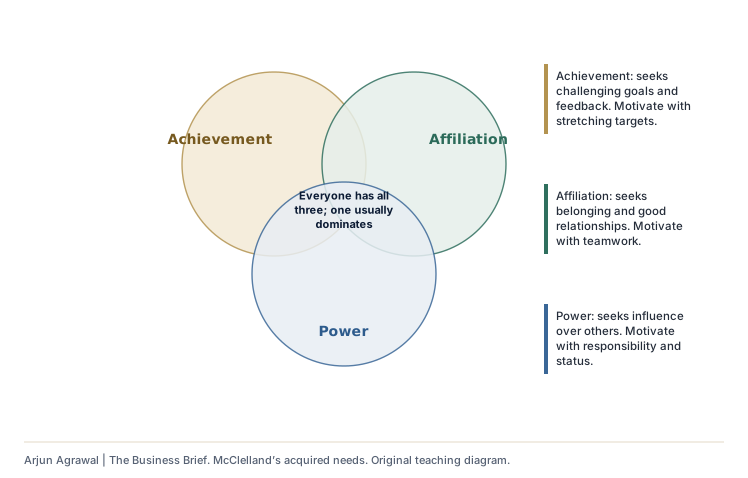
HL onlyMcClelland's acquired needs theory. David McClelland (1917 to 1998), an American psychologist, argued that three needs drive behaviour at work: the needs for achievement, affiliation and power. People acquire them through their experiences, upbringing and culture, rather than being born with them. Everyone has all three in some degree, but one is usually dominant, and it shapes what motivates that person. Unlike Maslow, McClelland did not arrange the needs in a hierarchy: which need dominates depends on the person, not on which needs are already met.
For managers, the theory is a tool for matching people to work. Find each employee's dominant need, then give them the tasks, roles and rewards that feed it.
Deci and Ryan's self-determination theory. Edward Deci and Richard Ryan, American psychologists, developed the theory from the 1970s onwards. It holds that everyone shares three basic psychological needs, for autonomy, competence and relatedness, and that work which meets them builds intrinsic motivation: people work because the task is interesting or worthwhile, not because they are pushed.
The theory separates autonomous motivation, acting by choice because one values the work, from controlled motivation, acting under pressure, for a reward or to avoid a penalty. Autonomous motivation brings more lasting effort, better work and greater well-being. Rewards and close monitoring that feel controlling can crowd out intrinsic motivation, which is a direct challenge to Taylor.
- Need for achievement
In McClelland's theory, the drive to succeed at challenging but realistic goals, with personal responsibility for the result and frequent feedback. Motivate with stretching targets and regular feedback. Strong achievers can make poor managers, because they would rather do the work themselves than delegate it.
- Need for affiliation
In McClelland's theory, the wish to be liked, to belong and to keep relationships warm. Motivate with teamwork and cooperative roles. People driven by affiliation may avoid conflict and find tough decisions about colleagues hard.
- Need for power
In McClelland's theory, the wish to influence and lead others and to make an impact. Motivate with responsibility, status and leadership roles. McClelland found that a need for power directed at the organization's goals, rather than personal gain, often marks effective managers.
- Autonomy
In Deci and Ryan's theory, the need to act by choice, with a say in how, when or in what order work is done and an understanding of why it matters. It does not mean working alone. Empowerment and flexible working support it.
- Competence
In Deci and Ryan's theory, the need to feel capable and to master challenges. Training, useful feedback and tasks that stretch people without overwhelming them support it.
- Relatedness
In Deci and Ryan's theory, the need to feel connected to other people and valued by them. Supportive managers, teamwork and a sense of belonging support it.
Text description
Three basic psychological needs feed self-determined, or intrinsic, motivation: doing the work because it is interesting or meaningful. Autonomy: some control over how and when the work is done. Competence: feeling able, and getting better, at the work. Relatedness: feeling connected to and valued by others. Rewards and pressure can crowd out intrinsic motivation if they take away the sense of choice.
Advantages
- McClelland's theory recognizes that people differ, so roles and rewards can be matched to the person, and it helps in choosing managers and in spotting likely entrepreneurs.
- Because McClelland's needs are learned, training and experience can strengthen them.
- Self-determination theory is supported by a large body of research across many countries and kinds of work.
- Self-determination theory explains why empowerment, training and teamwork can motivate more lastingly than pay alone.
Limitations
- A person's dominant need is hard to identify. McClelland measured it by interpreting the stories people told about pictures, a subjective method.
- Needs can change with a person's role and circumstances, so labelling someone an achiever or a power-seeker can mislead.
- Self-determination theory gives less guidance for routine, low-skilled work, where autonomy is hard to offer.
- Meeting Deci and Ryan's three needs does not replace fair pay and security, which people still need before anything else motivates.
HL Section 08, Equity theory and expectancy theory, is HL only and is hidden while you are viewing SL content. Switch to HL at the top of the page to see it.
Section 08: Equity theory and expectancy theory
HL onlyThese two theories are less about what people need than about how they think about rewards. Motivation depends on what employees believe about fairness and about the link between effort and reward, which is why the same scheme can motivate one person and leave another cold.
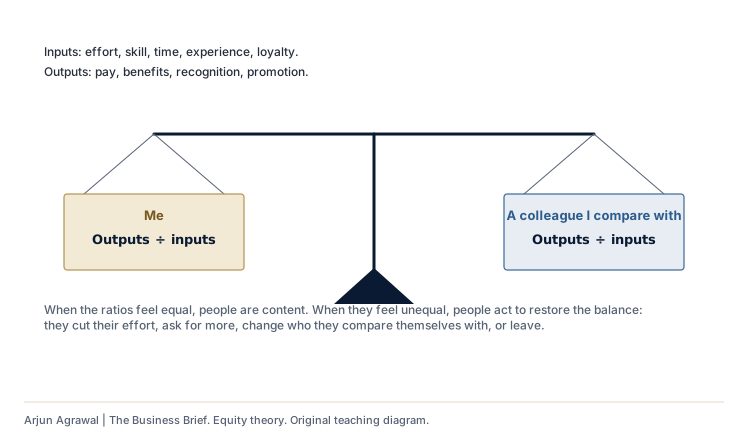
Equity theory. J. Stacy Adams, a psychologist who studied behaviour at work, argued in the 1960s that employees compare what they get from a job (outcomes, or outputs, such as pay, benefits, recognition and promotion) with what they put into it (inputs such as effort, skill, experience, time and loyalty). They then compare this ratio with the same ratio for other people: colleagues, people in similar jobs elsewhere, or themselves in the past. When the ratios seem equal, people feel fairly treated. When they feel under-rewarded, they act to restore the balance: they cut their effort, ask for more, change whom they compare themselves with, or leave. Feeling over-rewarded can bring guilt, though people adjust to it more easily. What matters is perceived fairness, not actual fairness.
Expectancy theory. Victor Vroom, a Canadian-born psychologist who worked in the United States, set out the theory in Work and Motivation (1964). Effort depends on three beliefs, each judged by the employee:
- Expectancy: will my effort lead to the performance required?
- Instrumentality: will that performance actually be rewarded?
- Valence: do I value the reward?
Because the three combine by multiplication, motivation is weak if any one of them is close to zero. Managers can strengthen each: realistic targets, training and resources raise expectancy; a clear and trusted reward system raises instrumentality; rewards that suit the individual raise valence.
Text description
A chain from effort to performance to reward to a valued goal. Expectancy: will my effort lead to the performance? Instrumentality: will the performance bring the reward? Valence: do I value the reward? Motivation equals expectancy times instrumentality times valence, each judged by the worker, so if any one is close to zero, so is motivation.
Expectancy theory
Motivational force = expectancy × instrumentality × valence
The three terms are beliefs held by the employee, not figures a manager can measure, and the guide sets no calculation for them. The multiplication makes the key point that if any one is close to zero, so is motivation.
Advantages
- Equity theory explains why relative pay matters as much as the amount, and why a pay rise can demotivate if a colleague received more.
- Equity theory supports open, consistent decisions on pay and promotion.
- Expectancy theory gives managers a test for any incentive scheme. Is the target reachable, is the reward certain, and is it wanted?
- Expectancy theory recognizes that people value different rewards, so one scheme rarely suits everyone.
Limitations
- In equity theory, people choose different comparison groups and value their inputs differently, so fairness is hard to predict or manage.
- Equity theory says little about how to correct a perception of unfairness that is mistaken.
- Expectancy theory assumes that people weigh their chances rationally before acting, but much behaviour is habitual or emotional.
- The beliefs are hard to measure, so both theories explain behaviour after the event more easily than they predict it.
Section 09: Financial rewards
Financial rewards are payments in money, or with a clear money value. They meet the needs at the base of Maslow's hierarchy, work mainly through extrinsic motivation and are, in Taylor's view, the main motivator. Herzberg adds a warning: pay is a hygiene factor, so pay that feels unfair demotivates quickly, while a rise motivates only for a while.
The method of payment matters as much as the amount. A good scheme rewards something the employee can influence, is seen as fair, is simple to understand and does not reward the wrong behaviour. Most businesses combine methods: a salary or wage for security, something linked to performance, and fringe payments to attract and keep staff.
- Salary
A fixed annual amount, usually paid monthly, that does not change with the exact hours worked or the output. It gives a secure, predictable income and suits managerial, professional and office jobs where output is hard to measure, but it gives no direct reward for extra effort.
- Wages: time rates
Pay for each hour or other period worked, usually paid weekly. It is simple to run and suits work where output is hard to count, and extra hours are often paid as overtime at a higher rate. It rewards time spent, not effort or results.
- Wages: piece rates
A fixed amount for each unit produced, so that pay rises with output, as Taylor recommended. It rewards effort directly, but can lead workers to rush at the expense of quality and safety, and it suits only work where output can be counted and depends on the individual. Many schemes guarantee a minimum.
- Commission
A percentage of the value of the sales an employee makes, usually on top of a basic salary. It motivates sales staff and links pay costs to revenue, but it can encourage pushy selling, mis-selling and rivalry between colleagues, and income falls when sales fall for reasons the employee cannot control.
- Performance-related pay (PRP)
A bonus or a larger pay rise for meeting or beating agreed targets, usually an individual's and sometimes a team's, judged at a review of performance. It rewards the best performers and links pay to the organization's goals, but performance in many jobs is hard to measure fairly, targets can narrow people's focus, and those who miss out may think the system unfair.
- Profit-related pay
A bonus paid out of the organization's profit, so that pay rises and falls with how well the business does. It gives everyone an interest in its success and can encourage cooperation and cost saving, but one person's effort makes little visible difference to total profit, and in a bad year the bonus disappears however hard people worked.
- Employee share ownership schemes
Shares in the company given to employees, or sold to them at a discount, often on condition that they keep them for a period. As part-owners, employees gain from dividends and a rising share price, which can build loyalty and long-term thinking. The link to individual effort is weak, employees' savings become tied to their employer, and only companies with shares can offer them.
- Fringe payments
Rewards in addition to pay, such as a company car, health insurance, pension contributions, staff discounts or subsidized meals; also called fringe benefits or perks. They help to recruit and keep staff and can be valued more than a pay rise of the same cost, but they are soon taken for granted.
Text description
Two columns of the rewards in the guide. Financial: salary, a fixed annual amount; wages, paid by time rates or piece rates; commission, a share of the value of sales; performance-related pay for meeting targets; profit-related pay, a share of profit; employee share ownership schemes; and fringe payments, benefits in kind. Non-financial: job enrichment, more challenging and responsible work; job rotation between tasks; job enlargement, more tasks at the same level; empowerment, authority to decide; purpose, meaningful work; and teamwork.
Section 10: Non-financial rewards
Non-financial rewards motivate without money changing hands. Most of them change the job itself or the way people work together, so they act mainly on intrinsic motivation, on the higher levels of Maslow's hierarchy and on Herzberg's motivators. The diagram in the section above lists them beside the financial rewards.
They often cost little in money, and their effect can last longer than a one-off payment because the work itself becomes more rewarding. But they need management time, training and trust, they do not suit everyone, and they will not motivate people who feel underpaid or insecure. In Herzberg's terms, the hygiene factors must be right first.
- Job enrichment
Redesigning a job to give more responsibility, more challenging tasks and a complete piece of work, so that people use more of their abilities. It comes from Herzberg and acts on his motivators. It needs training and support, not everyone wants more responsibility, and staff may expect their pay to rise with it.
- Job rotation
Moving employees between different tasks or jobs at a similar level at regular intervals. It reduces boredom, builds a multi-skilled workforce that can cover absences and helps people understand the wider process. If every task is simple, it only swaps one dull task for another, and output dips while people learn.
- Job enlargement
Adding more tasks of a similar level to a job, which gives more variety but no more responsibility. It can make work less monotonous, but employees may see it as more work for the same pay, especially when it follows delayering or job cuts.
- Empowerment
Giving employees the authority, resources and confidence to make decisions about their own work without asking a manager first. It can speed up service, draw on staff knowledge and raise commitment. It needs training, trust and a culture that accepts some mistakes, and it goes further than delegation, which passes down particular tasks.
- Purpose: the opportunity to make a difference
The sense that one's work makes a positive difference to customers, colleagues, society or the environment. Businesses build it through a clear mission, by showing staff the effect of their work, and through ethical and sustainable practices. Claims of purpose that do not match how the business behaves breed cynicism.
- Teamwork
Organizing work so that employees cooperate in groups with shared responsibility for a goal. It meets social needs, spreads skills and ideas, and can raise quality and commitment. Teams can also bring conflict, pressure to conform and members who rely on others' effort, and they need good leadership.
Advantages
- They can motivate for longer than a one-off payment, because they change the work itself.
- They often cost little in money, so they suit businesses that cannot afford to raise pay.
- They build skills and flexibility, which benefit the business as well as the employee.
Limitations
- They need management time, training and trust, and done badly they feel like extra work.
- They do not motivate people whose pay or security is inadequate.
- Not everyone wants more responsibility or variety; some people prefer predictable work.
- Their results are hard to measure, so their value is easy to doubt.
HL Section 11, Recruitment, is HL only and is hidden while you are viewing SL content. Switch to HL at the top of the page to see it.
Section 11: Recruitment
HL onlyRecruitment is the process of filling a vacancy: working out what the job needs, attracting suitable applicants, choosing among them and making an offer. It links to motivation in two ways. A good appointment brings in people whose needs and abilities the job can meet, and promotion from inside is itself a reward, a step up Maslow's hierarchy and one of Herzberg's motivators.
A typical process has seven stages:
- Confirm the vacancy. Check against the workforce plan whether the post needs filling at all, or whether the work could be reorganized.
- Write a job description, setting out the job's title, purpose, duties and responsibilities, its conditions and whom the holder reports to.
- Write a person specification, setting out the qualifications, skills, experience and qualities needed, often divided into essential and desirable.
- Advertise the post, inside the organization, outside it, or both.
- Shortlist by comparing applications or CVs with the person specification.
- Select with one or more methods: interviews (one-to-one, by a panel or by video), aptitude, skills and personality tests, work samples or trial days, assessment centres with group tasks and presentations, and references from previous employers.
- Appoint the chosen candidate and plan their induction.
Ways of reaching applicants from outside include job websites and social media, the organization's own careers page, newspapers and specialist journals, recruitment agencies and government job centres, headhunters who approach people already working elsewhere, job fairs and visits to universities, and referrals from current staff. The criteria at every stage should relate to the job itself, so that the process is fair and lawful and does not exclude good candidates.
Neither internal nor external recruitment is better in general. Internal recruitment suits a business that values continuity, has people ready for promotion and wants to reward loyalty; external recruitment suits one that needs skills it lacks, fresh ideas or a change of culture. Many organizations advertise inside and outside at once and let the candidates compete.
- Internal recruitment
Filling the post with someone who already works for the organization, by promotion, transfer or redeployment.
For: it is quicker and cheaper; the candidate's abilities and record are known, so the risk is lower; little induction is needed; and the chance of promotion motivates other staff.
Against: the pool of applicants is small; no new ideas or experience come in; colleagues who are passed over may resent it; and the promotion leaves another vacancy to fill.
- External recruitment
Filling the post with someone from outside the organization, through the methods above.
For: a wider choice of applicants; new skills, ideas and experience, including skills no one inside has; and an outsider's view when the business needs to change.
Against: it costs more and takes longer; a full induction is needed; the risk of a poor fit is greater, because the candidate is known only from the selection process; and internal candidates may be demotivated.
Section 12: Types of training
Training develops the skills, knowledge and attitudes that employees need now and in the future. It raises productivity and quality, cuts mistakes and accidents, prepares staff for change and promotion, and can motivate: it meets esteem needs, opens the way to Herzberg's advancement and growth, and shows people that the business values them.
Training costs money and time, and trained staff may be poached by rivals. The cost of not training is usually higher, though: mistakes, accidents, poor service and staff who leave because they see no future.
The line between on-the-job and off-the-job training is not always sharp. The IB teacher support material defines the two by place: on-the-job training happens at the workplace during working hours, and can include classroom-style sessions there, while off-the-job training happens away from the workplace, usually run by an outside provider. Some textbooks instead count any session that takes employees away from their normal work as off the job, even in the company's own training room. In an answer, say what the training involves, not only its label.
- Induction
Training that introduces new employees to the organization, its people, procedures, facilities, culture and health and safety rules, and to their own job. It helps new starters become productive sooner, feel welcome and avoid early mistakes, and it reduces the number who leave in their first months. Too much information at once is soon forgotten.
- On-the-job training
Training while doing the job in the normal workplace, for example by watching and copying an experienced colleague, coaching, mentoring or job rotation. It is usually cheap and directly relevant, and the trainee keeps producing. But its quality depends on the trainer, who may pass on bad habits, it can slow experienced staff down, and it may not develop wider or theoretical knowledge.
- Off-the-job training
Training away from the employee's normal work, such as courses, college programmes, conferences, workshops, online learning or simulations. It can give specialist knowledge, qualifications and new ideas without the distractions of the workplace. It costs more, the employee produces nothing while training, what is learned may not transfer easily to the job, and newly qualified staff may become more attractive to rivals.
HL Section 13, Appraisal, is HL only and is hidden while you are viewing SL content. Switch to HL at the top of the page to see it.
Section 13: Appraisal
HL onlyAppraisal is a structured review of how well an employee is performing against agreed objectives. Businesses use it to give feedback, recognize good work, identify training needs, set new targets and gather evidence for decisions on pay and promotion, including performance-related pay.
Appraisal can motivate. It offers recognition and a plan for advancement, two of Herzberg's motivators, meets esteem needs in Maslow's hierarchy and, through useful feedback, builds the sense of competence that Deci and Ryan describe. Done badly, it demotivates. A rushed annual meeting, a one-sided judgement or a review tied too tightly to pay makes employees defensive, so they hide problems rather than solve them. The guide names four types, and most organizations combine several.
- Formative appraisal
Ongoing, often informal feedback during a period of work, to help the employee improve rather than to judge final results, like a coach's advice during a season. Problems are put right early and confidence grows, but it takes managers' time and may not produce the formal records needed for decisions on pay.
- Summative appraisal
A formal review at the end of a period, often a year, that judges and records performance against targets, usually to decide pay, promotion or further action, and to set targets for the next period. It gives a clear record and links performance to rewards, but it can feel threatening, and feedback that comes once a year arrives too late to help during that year.
- 360-degree feedback
Feedback on an employee gathered from people all around them at work, such as their manager, colleagues, the people they manage and sometimes customers, often alongside their own view. It gives a fuller and more balanced picture than one manager's opinion and is often used to develop managers. It takes time and money to collect, and it works only where feedback is honest, anonymous where needed and given in a culture of trust.
- Self-appraisal
The employee assesses their own performance against their objectives, usually before discussing it with their manager, and it can form part of either formative or summative appraisal. It encourages reflection and ownership of development and suits a culture of empowerment, but people may rate themselves too generously or too harshly, so it is normally combined with another type.
Text description
An employee at the centre receives feedback from five sources: their manager, peers, direct reports, customers and themselves, which together make 360-degree feedback. Alongside, the four types of appraisal in the guide. Formative: ongoing feedback during the period to help the employee improve. Summative: a judgement at the end of the period, often linked to pay or promotion. 360-degree feedback: views gathered from everyone the employee works with. Self-appraisal: the employee assesses their own performance.
Advantages
- It recognizes good work and plans each person's development, which can motivate.
- It identifies training needs and future leaders.
- It links each employee's targets to the organization's objectives.
Limitations
- It takes managers' and employees' time, often at busy points in the year.
- It depends on the appraiser's skill and fairness, and bias or favouritism undermines it.
- Tying it closely to pay can make employees defensive and hide problems.
HL Section 14, Labour turnover, is HL only and is hidden while you are viewing SL content. Switch to HL at the top of the page to see it.
Section 14: Labour turnover
HL onlyLabour turnover measures the share of a workforce that leaves an organization during a period, usually a year. It is one of the clearest signs of whether people are motivated to stay, and managers read it alongside absence rates and what leavers say in exit interviews.
The guide's list of formulae does not include labour turnover, so the form below is the standard one, used throughout this platform. Divide by the average number of employees over the period, not by the number at the start or the end.
- Causes of high turnover
Pay below rivals' or seen as unfair, poor management, little training or chance of promotion, dull work, a poor induction, and plenty of jobs available elsewhere. In some industries, such as seasonal tourism, high turnover is part of the work.
- Costs of high turnover
The costs of recruitment, selection and induction; lost skills and knowledge; lower output and more mistakes while new staff learn; extra pressure and lower morale for those who stay; and poorer service to customers.
- Benefits of some turnover
New employees bring fresh ideas and skills, and leavers let a business reshape its workforce without redundancies. Very low turnover can mean a stale workforce and rising pay costs as everyone moves up the pay scale.
- Judging the figure
Compare it with the business's own past, with rivals and the industry average, and between departments, shifts or sites. A rate that is normal in fast food would be alarming in a law firm. Look also at who is leaving, since losing the best performers matters more than the rate.
Labour turnover
Labour turnover = (number of employees leaving ÷ average number of employees) × 100
The result is a percentage for the period. When only the numbers at the start and the end are known, the average is usually taken as (employees at the start + employees at the end) ÷ 2.
Advantages
- It is simple to calculate and to compare over time and between parts of the business.
- It gives early warning of demotivation, poor management or uncompetitive pay.
Limitations
- It shows how many people leave, not why; exit interviews and staff surveys are needed for that.
- It treats every leaver alike, whether they retired, were dismissed or were the best performer.
- In a small team, one or two leavers change the rate sharply.
Section 15: In practice: industries and stakeholders
The same ideas look different from one industry to the next, and land differently on each group with a stake in the business.
Across industries
- Warehousing and manufacturing
Output is easy to count, so piece rates, targets and close monitoring in Taylor's tradition are common, and handheld scanners now time every task. They raise output on simple work but can cost more in errors, injuries and resignations, which is why some firms add job rotation and teamwork to keep people engaged.
- Health and social care
Purpose is a powerful motivator because staff see the difference they make, but pay, shift patterns and staffing levels are hygiene factors that cause burnout and resignations when they are poor. Training and appraisal matter for patients' safety as well as for motivation, and at HL labour turnover, as at Wenlow Care, is a key sign of how well staff are managed.
- Hospitality and retail
Many jobs are part-time, low-paid and seasonal, so turnover is high, and fringe payments such as staff discounts and meals help to recruit and keep people. Empowering staff to put problems right themselves, as Quillon Hotels did with its housekeeping teams, can improve service without raising pay.
- Technology and creative work
Autonomy, mastery of difficult problems and the chance to build something new drive many employees, so these firms rely on flexible working, project teams and employee share ownership more than on piece rates. Research on intrinsic motivation suggests that bonuses do less for complex, creative work, so the work itself has to carry much of the motivation.
- Financial services and sales
Commission and performance-related pay dominate because sales are easy to measure, but rewards tied narrowly to sales have encouraged pushy selling and mis-selling. At HL, expectancy and equity theory explain why a scheme fails when its targets look unreachable or colleagues seem better rewarded for the same work.
- Charities and social enterprises
Many staff accept lower pay because they believe in the mission, and volunteers work for none, so purpose and teamwork carry much of the motivation. The risk is that goodwill is taken for granted, because pay that falls too far behind still causes dissatisfaction, as Herzberg would predict.
For each stakeholder
- Employees
They gain from fair pay, interesting work, training and recognition, and lose from monitoring and targets that treat them as machines. Their interests conflict with the owners' when rewards are cut to save money, and with each other's when individual bonuses and rankings set colleagues against each other.
- Managers
They choose and run the rewards, appraisals and training that motivate, which takes time and skill, and poor management is as often the cause of demotivation as its cure. Pressure for this quarter's output can push them towards Taylor's methods even when the work needs more autonomy.
- Owners and shareholders
Pay is one of the largest costs, so owners want rewards that raise productivity by more than they cost. Profit-related pay and share schemes tie employees' rewards to the owners' own, while high labour turnover, at HL, shows the price of getting motivation wrong.
- Customers
Motivated staff give better service and make fewer mistakes, so customers gain from good management without seeing it. Rewards tied narrowly to sales or speed can work against them, as when commission encourages mis-selling or a target for short calls cuts a customer off before the problem is solved.
- Trade unions
They bargain over pay and conditions, Herzberg's hygiene factors, and resist piece rates, close monitoring and changes imposed without consultation. At HL, these conflicts between employees and employers are the subject of industrial relations (2.7).
- Job applicants
At HL, the way a business recruits decides who it attracts and whether they stay, since a realistic job description, fair selection and a good induction reduce early resignations. Internal candidates and outsiders compete for the same promotions, so the choice between internal and external recruitment can motivate one group and disappoint the other.
Section 16: Evaluation and limits
What to weigh before reaching a judgement.
- No theory is a law. Each was built from particular evidence in a particular time and place, Taylor's from American factories around 1900 and Herzberg's from about 200 engineers and accountants in the 1950s, while Maslow's rested more on argument than on measurement. Use a theory as a lens on the case, and say where it fits and where it does not.
- Culture changes what motivates. The best-known theories come from the United States, a strongly individualistic culture. Where loyalty to the group, security or respect for seniority matter more, Maslow's order and the appeal of individual bonuses may not hold; at HL, Hofstede's cultural dimensions help to explain why.
- Money matters, but not in the same way for everyone. Taylor treats pay as the motivator and Herzberg as a hygiene factor, and both are partly right. Studies of piece rates show that they can raise output on simple tasks that can be counted, while research on intrinsic motivation suggests that bonuses do less for complex or creative work. People on low or insecure incomes are more likely to respond to money.
- The theories overlap more than they compete. Maslow's lower needs resemble Herzberg's hygiene factors, and his higher needs resemble Herzberg's motivators. At HL, Deci and Ryan's relatedness echoes Maslow's social needs and McClelland's need for affiliation. Showing the links, and the differences, is a mark of understanding.
- What people believe matters as much as what they receive. A generous reward fails if the target seems impossible, the reward seems unlikely to be paid or a colleague seems to get more for less; at HL, expectancy and equity theory explain why. Judge any reward scheme by how employees will see it, not only by what it costs.
- Motivation is only one cause of performance. Output also depends on training, equipment, the way the work is organized and leadership, and people leave for reasons such as better pay elsewhere, family or a strong local job market. Before blaming motivation, check the other causes in the case.
- In an examination answer, choose the one or two theories that best explain the evidence in the case and apply them to it, rather than describing every theory in full. Then judge which rewards the business should use, given its costs, its workforce and its culture.
- At HL, Paper 3 opens by asking you to describe the human need in its stimulus about a social enterprise (guide, p. 42), and the teacher support material suggests linking that need to a theory such as motivation (p. 65). Maslow's levels give you precise words for it.
Section 17: Make the decision
Use the ideas on a business choice: weigh the options, decide, and say what would change your mind.
Decision brief · a fictional business
More benches, without losing quality
Ostler Benches, a fictional maker of garden benches, employs 20 assemblers on a time rate of $16 an hour for an eight-hour day. Each assembler completes about four benches a day, so the team makes 80 benches a day and labour costs $32 a bench. About 2% of benches come back from customers with faults, and putting each one right costs $60.
Orders are rising, and the owner, Beth Ostler, wants more output without losing the quality her brand is known for. A staff survey shows that the assemblers think their pay is fair but find the work repetitive, because each person does one stage of the job all day.
How to weigh the options
Work out what each option does to cost and quality, then ask which explanation of the problem the evidence supports.
- Now: 20 × $16 × 8 = $2,560 a day for 80 benches, $32 a bench in labour, plus 1.6 faulty benches a day at $60, which is $96 a day or $1.20 a bench: $33.20 a bench in all.
- Piece rates: if output reaches 100 benches a day, labour falls to $30 a bench and each assembler earns $150 a day instead of $128, about 17% more. But at 5% faults, five benches a day come back at $60 each, $300 a day or $3 a bench, so the total is $33 a bench, barely less than now, and the brand's name for quality is at risk. Taylor would expect the money to raise effort; Herzberg would point out that the work stays as dull as before.
- Team bonus: at 90 benches a day the bonus is $120, or $6 for each assembler, and labour costs ($2,560 + $120) ÷ 90 = $29.78 a bench, while the quality condition protects the brand. But $6 a day is a small reward, some members may rely on others' effort, and the target must look reachable for the bonus to motivate at all.
- Enrichment: it costs $8,000 once and leaves labour at $32 a bench unless output rises, but it acts on Herzberg's motivators (complete work, responsibility, and recognition through the signature) and on the repetitive work the survey found. If faults fell from 2% to 1%, repairs would cost $48 a day instead of $96, a saving that would pay for the course in about 167 working days.
A strong judgement starts from the survey. Pay is seen as fair, so in Herzberg's terms the hygiene factors are in place and the problem lies in the work itself, which points to enrichment, perhaps combined with the team bonus. Piece rates fit Taylor's view but buy output at the cost of quality. At HL, expectancy theory adds a test for any bonus: can the team reach the target, will the bonus really be paid, and is it worth having? The answer would change if the trial's fault rate proved unusual, if the assemblers said they wanted more money, or if output is held back by the equipment rather than by effort.
Section 18: Exam-style practice
Original questions written by the platform in the style of the papers, with what a strong response does. They are not IB questions and the guidance is not an official markscheme.
-
Define the term job enrichment.
What a strong response does
A strong response gives a precise definition: redesigning a job to give the employee more responsibility, more challenging tasks and a complete piece of work, so that they use more of their abilities.
- The key idea is more responsibility, not just more tasks, which would be job enlargement.
- It may note the link to Herzberg's motivators.
-
Fenn Ceramics, a fictional pottery, is considering paying its glazers a piece rate instead of a time rate. Under the time rate, a glazer earns $15 an hour for a 40-hour week. Under the piece rate, a glazer would earn $5 for each item glazed. One glazer currently glazes 140 items a week.
Calculate the glazer's weekly pay under each method, and the weekly output at which the two methods pay the same.
What a strong response does
- Time rate: $15 × 40 = $600 a week.
- Piece rate: $5 × 140 = $700 a week.
- Output at which they pay the same: $600 ÷ $5 = 120 items a week.
A strong response shows the working and may add what it means: any glazer who glazes more than 120 items a week earns more under the piece rate, which rewards speed, but the pottery should watch quality and safety, as critics of Taylor's approach warn.
-
Using Herzberg's motivation-hygiene theory, explain why Thornvale Energy's 8% pay rise stopped the complaints about pay but did not reduce absence or resignations.
What a strong response does
A strong response applies the two factors to the case.
- Pay is a hygiene factor: when advisers felt underpaid it caused dissatisfaction, so raising pay removed that dissatisfaction and the complaints stopped, but in Herzberg's theory removing dissatisfaction does not create motivation.
- The motivators are missing: scripted calls, timing and a weekly ranking leave advisers little achievement, responsibility or recognition, and no control over the work itself, so absence and resignations continue. The rival that lets staff solve problems in their own way offers exactly the motivators Thornvale lacks.
- A strong answer may add that the team leader's proposal, authority over refunds and training, would act on the motivators.
-
Evaluate Strandline Parcels' use of scientific management in its warehouse.
What a strong response does
A strong response weighs Taylor's approach as Strandline applies it, using the case, and reaches a supported judgement.
- For: output per hour rose by a tenth in three months; picking is simple, repeatable work whose output can be counted, which is where Taylor's methods work best; the scanners give clear targets and a bonus that links pay to effort.
- Against: picking errors rose, which costs money and customers; resignations rose, which brings recruitment and training costs; the pickers' ideas for a better layout went unheard; and constant timing and ranking ignore the social and esteem needs in Maslow's hierarchy and the motivators in Herzberg's theory.
- Weighing it: the gain in output must be set against the cost of errors and turnover, which the case does not quantify, so the method may be raising activity rather than results.
- Judgement: for example, scientific management suits the counting and routing of picks, but Strandline should combine it with teamwork, job rotation and a channel for the pickers' ideas, or the errors and resignations may cancel the gain. A strong answer says what is missing: the cost of errors and of replacing staff who leave.
When weighing one option, the teacher support material advises at least two arguments for and two against (pp. 56 and 60).
-
Thornvale Energy's contact centre employed 58 advisers at the start of last year and 62 at the end. During the year, 21 advisers left. A survey of similar contact centres in the region reports an average labour turnover of 26%.
Comment on the labour turnover at Thornvale's contact centre.
What a strong response does
A strong response calculates the rate correctly, then judges it in context.
- The rate: average number of employees = (58 + 62) ÷ 2 = 60, so labour turnover = (21 ÷ 60) × 100 = 35%. Dividing by the 62 employed at the end would give 33.9%, which understates it.
- Compared with others: 35% is nine percentage points above the regional average of 26%, so Thornvale is losing advisers faster than similar employers.
- What it means: the case says that experienced advisers are leaving for a rival with more freedom, so the cost is greater than the rate suggests, in recruitment, training and service. One year's figure, and a survey whose methods are not given, call for some caution, and exit interviews would confirm the reasons.
-
Using self-determination theory and expectancy theory, evaluate the finance director's proposal to pay a bonus to the Thornvale advisers with the shortest calls.
What a strong response does
A strong response applies both theories to the proposal, uses the case and reaches a supported judgement.
- Expectancy theory, for: advisers can shorten their calls, so expectancy is high; if the bonus is paid reliably, instrumentality is high; and if it is worth having, valence is high, so the scheme is likely to change behaviour.
- Expectancy theory, against: it will change the wrong behaviour. The bonus rewards speed, not solved problems, so calls may be cut short and customers' satisfaction, already falling, may fall further.
- Self-determination theory: a bonus for speed, on top of scripts, timing and rankings, adds controlled motivation and does nothing for autonomy, competence or relatedness, and rewards that feel controlling can crowd out intrinsic motivation. The team leader's proposal, authority over refunds of up to $100 and training for hard cases, supports autonomy and competence directly.
- Equity: advisers who take the hardest calls would lose out to colleagues with easy ones, which equity theory predicts will feel unfair.
- Judgement: for example, the bonus would probably shorten calls but worsen service and do little about resignations, while the evidence that experienced advisers leave for a rival offering more freedom supports the team leader's proposal. A strong answer notes the limits: the case gives no cost for either option or the risk of refund authority being misused.
When weighing one option, the teacher support material advises at least two arguments for and two against (pp. 56 and 60).
HL Questions 5 and 6 are HL only and hidden while you are viewing SL content. Switch to HL at the top of the page to see them.
Section 19: Revision summary
The subtopic on one page: what to remember.
- Motivation is the drive to put effort into a goal, and demotivation shows in absence, mistakes, complaints and resignations. Intrinsic motivation comes from the work itself, extrinsic motivation from rewards.
- Taylor: people work mainly for money, so find the one best way, train workers in it, pay by piece rate and separate planning from doing. It raises output on simple, countable work but ignores social and psychological needs.
- Maslow: physiological, safety, social, esteem and self-actualization needs, with the lowest unmet need driving behaviour, so the same reward motivates some people and not others. The order is not rigid.
- Herzberg: hygiene factors, pay among them, prevent dissatisfaction but do not motivate, while motivators in the job itself, such as achievement, recognition and responsibility, do; hence job enrichment.
- Financial rewards are salary, wages (time and piece rates), commission, performance-related pay, profit-related pay, employee share ownership schemes and fringe payments; the method of payment matters as much as the amount.
- Non-financial rewards are job enrichment, job rotation, job enlargement, empowerment, purpose and teamwork. They act on intrinsic motivation but need trust, training and fair pay first.
- Training is induction for new starters, on-the-job training in the workplace, or off-the-job training away from it.
- (HL) McClelland: acquired needs for achievement, affiliation and power. Deci and Ryan: autonomy, competence and relatedness build autonomous motivation. Equity theory: perceived fairness compared with others. Expectancy theory: expectancy × instrumentality × valence.
- (HL) Labour turnover = (number of employees leaving ÷ average number of employees) × 100, judged against the past, rivals and who is leaving. Appraisal is formative, summative, 360-degree or self-appraisal, and recruitment internal or external, each with its trade-offs.
Section 20: The mindmap
Why people work hard or stop trying, the motivation theories of Taylor, Maslow and Herzberg, financial and non-financial rewards and the types of training and, at HL, four further theories, labour turnover, appraisal and recruitment.
Drag to move the map, or use the arrow keys. Click a branch to fold it away. Whole map shows all of it; zoom with the buttons, or with Ctrl and the scroll wheel.
- Core ideas
- Theories and models
- Types and forms
- Calculations
- Advantage
- Limitation
- HL HL only
The map as an outline
Why motivation matters
Core ideas
- Definition Motivation: the drive to work towards a goal Motivated staff work harder, make fewer mistakes, take less time off and stay longer.
- Intrinsic: from the work itself Interest, challenge and meaning; tends to last.
- Extrinsic: from rewards or pressure Pay, bonuses, praise or the wish to avoid a penalty; can fade once received.
- Demotivation: less effort, more absence and quits Caused by unfair pay, poor management, dull work, no recognition or insecurity.
Taylor, Maslow and Herzberg
Theories and models
- Taylor: scientific management One best way to do each task, found by timing the work; managers plan, workers carry out.
- Maslow: hierarchy of needs A higher need motivates once lower ones are largely met; a need that is met no longer motivates.
- Physiological, safety, social, esteem, self-actualization
- Herzberg: motivation-hygiene theory
- Hygiene factors: prevent dissatisfaction Pay, conditions, job security, supervision and company policy.
- Motivators: create satisfaction Achievement, recognition, responsibility, the work itself and advancement.
Further theories HL
Theories and models
- McClelland: achievement, affiliation, power Acquired needs theory; the needs are learned and one usually dominates, so match tasks and rewards to it.
- Deci and Ryan: autonomy, competence, relatedness Self-determination theory; meeting these three basic psychological needs builds intrinsic motivation.
- Adams: equity, fair rewards compared with others Staff compare their inputs and outcomes with others'; those who feel under-rewarded cut effort, demand more or leave.
- Vroom: expectancy × instrumentality × valence Expectancy theory; if any of the three beliefs is near zero, motivation is weak.
Financial rewards
Types and forms
Non-financial rewards
Types and forms
Training, recruitment, appraisal
Types and forms
- Induction training: welcoming new starters
- On-the-job training: learning while working
- Off-the-job training: courses away from work
- Recruitment: methods, internal or external HL Methods include a job description and person specification, adverts, agencies, interviews and tests.
- Appraisal: formative, summative, 360-degree, self HL
Labour turnover HL
Calculations
- Formula Labour turnover rate Labour turnover = (number of employees leaving ÷ average number of employees) × 100 The share of the workforce that leaves in a period; compare it with past years and with rivals.
- Limitation High: hiring costs, lost skills, low morale Some turnover is healthy, since new staff bring fresh ideas and skills.
Open the mindmap on its own page, with its terms and connections.
Section 21: More diagrams
Original diagrams from the platform's library, each with a text description and an SVG download.
Text description
Three overlapping circles for three needs that people acquire through experience. Achievement: seeking challenging goals and feedback, motivated by stretching targets. Affiliation: seeking belonging and good relationships, motivated by teamwork. Power: seeking influence over others, motivated by responsibility and status. Everyone has all three, and one usually dominates.
Text description
A balance scale. On one side, a worker’s own ratio of outputs to inputs; on the other, the same ratio for a colleague they compare themselves with. Inputs are effort, skill, time, experience and loyalty; outputs are pay, benefits, recognition and promotion. When the ratios feel equal, people are content; when they feel unequal, people act to restore the balance by cutting their effort, asking for more, changing who they compare themselves with, or leaving.
Text description
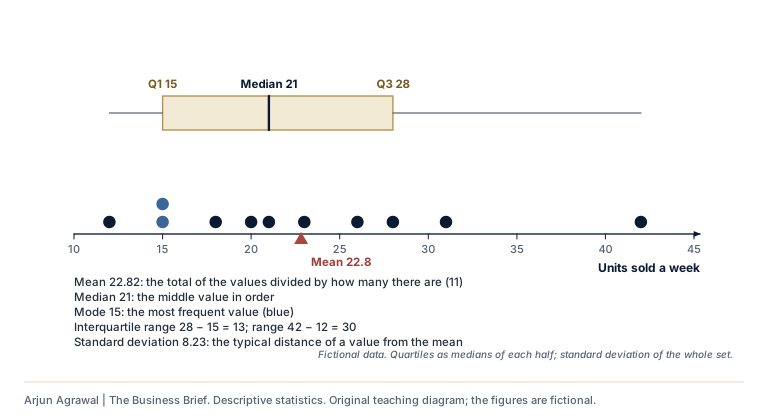
A dot plot of 11 weeks of fictional sales: 12, 15, 15, 18, 20, 21, 23, 26, 28, 31, 42 units. Above it, a box runs from the lower quartile, 15, to the upper quartile, 28, with the median, 21, marked inside. The mean is 22.82, pulled above the median by the one high week of 42. The mode is 15. The interquartile range is 13, the range is 30, and the standard deviation is 8.23. Quartiles here are the medians of the lower and upper halves; other methods give slightly different values.
Section 22: Key terms
Defined in the platform's own words. Each opens its full entry.
- 360-degree feedback HL
- Appraisal that gathers feedback on an employee from people all around them at work, such as their manager, colleagues, subordinates and sometimes customers, often alongside their own self-assessment.
- Appraisal HL
- A structured review of how well an employee is performing against agreed objectives, used to give feedback, identify training needs, set new targets and inform decisions on pay and promotion.
- Autonomy HL
- In self-determination theory, the need to feel in control of one's own actions and to act by choice rather than under pressure.
- Commission
- Pay calculated as a percentage of the value of the sales an employee makes, often on top of a basic salary.
- Competence HL
- In self-determination theory, the need to feel capable and effective in what one does and to master challenges.
- Demotivation
- A fall in an employee's drive to work well, shown in less effort, poorer quality, more absence and lateness, and a greater wish to leave.
- Employee share ownership scheme
- A scheme that gives employees shares in the company they work for, either free or at a reduced price, often on condition that they keep them for a period.
- Empowerment
- Giving employees the authority, resources and confidence to make decisions about their own work without having to ask a manager first.
- Equity theory HL
- J. S. Adams's theory that employees compare what they put into a job (inputs such as effort, skill and time) and what they get from it (outcomes such as pay, recognition and promotion) with the same balance for other people, and are motivated when they see the exchange as fair.
- Expectancy HL
- In Vroom's expectancy theory, a person's belief that putting in effort will lead to the required level of performance.
- Expectancy theory HL
- Victor Vroom's theory that motivation depends on three beliefs: that effort will lead to good performance (expectancy), that good performance will be rewarded (instrumentality) and that the reward is worth having (valence).
- External recruitment HL
- Filling a vacancy with someone from outside the organization, found through methods such as job advertisements, online job sites and social media, recruitment agencies, headhunting, job fairs and referrals.
- Extrinsic motivation
- Motivation that comes from outside the work, from rewards such as pay, bonuses, praise and promotion, or from the wish to avoid a penalty.
- Financial rewards
- Payments made to employees in money, or with a clear money value, including salary, wages, commission, performance-related pay, profit-related pay, employee share ownership schemes and fringe payments.
- Formative appraisal HL
- Ongoing appraisal during a period of work that gives regular feedback to help the employee improve, rather than to judge final results.
- Fringe payments
- Rewards given to employees in addition to their pay, such as a company car, health insurance, pension contributions, staff discounts, subsidized meals or gym membership.
- Herzberg's motivation-hygiene theory
- Frederick Herzberg's theory that the factors that cause job dissatisfaction (hygiene factors) are different from those that cause satisfaction and motivation (motivators), so removing dissatisfaction does not on its own motivate people.
- Hygiene factors
- In Herzberg's theory, the factors surrounding a job, such as pay, working conditions, job security, supervision, relationships at work and company policy, that cause dissatisfaction when they are poor but do not motivate when they are good.
- Induction
- Training that introduces new employees to the organization, its people, procedures, facilities, culture and health and safety rules, and to their own job.
- Instrumentality HL
- In Vroom's expectancy theory, a person's belief that good performance will actually be rewarded.
- Internal recruitment HL
- Filling a vacancy with someone who already works for the organization, by promotion, transfer or redeployment.
- Intrinsic motivation
- Motivation that comes from the work itself, because it is interesting, enjoyable, challenging or meaningful, rather than from a reward attached to it.
- Job description HL
- A document setting out a job's title, purpose, main duties and responsibilities, whom the job holder reports to and the working conditions.
- Job enlargement
- Adding more tasks of a similar level of difficulty to a job, so that it has more variety but no more responsibility.
- Job enrichment
- Redesigning a job to give the employee more responsibility, more challenging tasks and a complete piece of work, so that they use more of their abilities.
- Job rotation
- Moving employees between different tasks or jobs at a similar level at regular intervals.
- Labour turnover HL
- The share of a workforce that leaves in a period, calculated as the number of employees leaving divided by the average number employed, multiplied by 100.
- Maslow's hierarchy of needs
- Abraham Maslow's theory that people are motivated by five levels of need, rising from physiological needs through safety, social (love and belonging) and esteem needs to self-actualization, and that a higher need motivates only once the lower ones are largely met.
- McClelland's acquired needs theory HL
- David McClelland's theory that motivation is shaped by three needs, for achievement, affiliation and power, which people acquire through their experience of life, so that one of them is usually dominant in each person.
- Motivation
- The drive that makes a person put effort into reaching a goal. It may come from the work itself (intrinsic motivation) or from rewards and pressures outside it (extrinsic motivation).
- Motivators
- In Herzberg's theory, the factors in the content of a job, namely achievement, recognition, the work itself, responsibility, advancement and personal growth, that create satisfaction and motivation.
- Need for achievement HL
- In McClelland's theory, the drive to succeed at challenging tasks through one's own effort and to do things better than before.
- Need for affiliation HL
- In McClelland's theory, the desire to be liked and accepted by others and to have close, friendly relationships at work.
- Need for power HL
- In McClelland's theory, the desire to influence, direct or control other people and to make an impact.
- Non-financial rewards
- Ways of motivating employees that do not involve money, such as job enrichment, job rotation, job enlargement, empowerment, purpose (the opportunity to make a difference) and teamwork.
- Off-the-job training
- Training that takes place away from the employee's normal work, such as courses, college programmes, conferences, workshops or online learning.
- On-the-job training
- Training given while the employee does the job in the normal workplace, for example by watching and copying an experienced colleague, coaching, mentoring or job rotation.
- Performance-related pay
- Extra pay, such as a bonus or a higher pay rise, given to employees whose performance meets or beats agreed targets, usually judged at appraisal.
- Person specification HL
- A document setting out the qualifications, skills, experience and personal qualities needed in the person who will do a job, often divided into essential and desirable criteria.
- Piece rate
- A way of paying wages in which employees receive a fixed amount for each unit they produce, so that pay rises with output.
- Profit-related pay
- A bonus paid to employees out of the organization's profit, so that their pay rises and falls with how well the business does.
- Purpose at work
- The sense that one's work makes a positive difference to customers, colleagues, society or the environment, which can motivate in itself.
- Recruitment
- The process of filling a vacancy, from deciding what the job needs and attracting suitable applicants to choosing the best of them (selection) and making an offer.
- Relatedness HL
- In self-determination theory, the need to feel connected to other people, to care for them and to be cared for.
- Salary
- A fixed annual amount of pay, usually paid monthly, that does not change with the exact number of hours worked or the amount produced.
- Scientific management
- Frederick Taylor's theory that every job has one most efficient method, found by observing, timing and measuring the work. It assumes that workers are motivated mainly by money, so pay should be tied to output.
- Self-appraisal HL
- Appraisal in which employees assess their own performance against their objectives, usually before discussing it with their manager.
- Self-determination theory HL
- Edward Deci and Richard Ryan's theory that people have three basic psychological needs, for autonomy, competence and relatedness, and that meeting them builds intrinsic motivation and well-being.
- Summative appraisal HL
- A formal appraisal at the end of a period, such as a year, that judges and records an employee's performance against targets, often to decide pay, promotion or further action.
- Teamwork
- Organizing work so that employees cooperate in groups, sharing responsibility for a common goal.
- Valence HL
- In Vroom's expectancy theory, the value a person places on the reward that good performance will bring.
- Wages
- Pay calculated either by the hour or other period worked (a time rate) or by the amount produced (a piece rate), and usually paid weekly.
Section 23: Tools and practice
4 tools on the platform for 2.4, by room, with exercises, worked calculations and practice questions.
Worked calculations
Practice questions with mark schemes
- Two shifts, two turnover rates 4 marks
- Labour turnover on the night shift 2 marks
Section 24: Check your recall
Answer from memory, then reveal and rate yourself. Your ratings stay on this device.
Answer each question from memory, out loud or on paper, before you reveal the answer. Your ratings also schedule these questions in your flashcards.
-
What did Taylor assume motivates workers, and which method of payment did he recommend?
Money. He assumed workers want to earn as much as they can and will otherwise do as little as possible, so he recommended piece rates, which pay for each unit produced.
How well did you recall it? -
Name Maslow's five levels of need, starting from the bottom.
Physiological, safety, social (love and belonging), esteem and self-actualization.
How well did you recall it? -
According to Herzberg, why might a pay rise stop complaints without increasing effort?
Pay is a hygiene factor. Improving it removes dissatisfaction but does not motivate; motivation comes from motivators in the job itself, such as achievement, recognition and responsibility.
How well did you recall it? -
What is the difference between job enrichment and job enlargement?
Job enrichment adds responsibility and more challenging tasks. Job enlargement adds more tasks at the same level, so the job has more variety but no more responsibility.
How well did you recall it? -
What is the difference between commission and profit-related pay?
Commission is a percentage of the value of the sales an individual makes. Profit-related pay is a share of the whole organization's profit, so it depends on how well the business does, not on one person's results.
How well did you recall it? -
Distinguish between on-the-job and off-the-job training.
On-the-job training happens while doing the job in the normal workplace, for example working beside an experienced colleague. Off-the-job training happens away from normal work, for example on a course or at a college.
How well did you recall it? -
What is induction, and why does it matter?
Training that introduces new employees to the organization, its people, rules and procedures and their job. It helps them become productive sooner and makes them less likely to leave in their first months.
How well did you recall it? -
(HL) Name McClelland's three acquired needs and Deci and Ryan's three basic needs.
McClelland: achievement, affiliation and power. Deci and Ryan: autonomy, competence and relatedness.
How well did you recall it? -
(HL) Using expectancy theory, explain why a large bonus might fail to motivate.
Motivation depends on expectancy × instrumentality × valence. If staff think the target cannot be reached, doubt that the bonus will be paid, or do not value it, one of the three is close to zero, and so is motivation.
How well did you recall it? -
(HL) A firm employed 120 people at the start of the year and 140 at the end, and 26 left during the year. Calculate labour turnover.
Average number of employees = (120 + 140) ÷ 2 = 130. Labour turnover = (26 ÷ 130) × 100 = 20%.
How well did you recall it? -
(HL) Give one advantage and one disadvantage of internal recruitment.
Advantage: for example it is quicker and cheaper, the candidate is known, and promotion motivates other staff. Disadvantage: for example the pool is small, no new ideas come in, colleagues passed over may resent it, and it leaves another vacancy.
How well did you recall it? -
(HL) What is 360-degree feedback?
Appraisal that gathers feedback on an employee from people all around them at work, such as their manager, colleagues, the people they manage and sometimes customers, often with their own self-assessment.
How well did you recall it?
Section 25: How it connects
Where 2.4 meets the rest of the course: worked connections with an exam-style question on each, then the further links the notes name.
-
With 2.3 Leadership and management
Leadership style and motivation
The way people are led is one of the strongest influences on how motivated they are. Autocratic leadership, with close control and instructions from the top, echoes Taylor's view that workers respond mainly to pay and need supervising. Democratic leadership involves staff in decisions, which gives them the responsibility and recognition that Herzberg counted as motivators and Maslow placed among the higher needs. Laissez-faire leadership can motivate skilled, self-directed people and leave others without direction. Situational leadership accepts that the right style depends on the people and the task, so no single style motivates everyone.
Exam-style question Source: Original practice question Command term: Discuss (AO3)
Discuss whether a democratic leadership style is likely to motivate employees more than an autocratic style. [10 marks]
-
With 2.7 Industrial/employee relations
Pay, participation and disputes HL
Pay and working conditions are among the commonest sources of conflict in the workplace, and in Herzberg's terms they are hygiene factors: getting them wrong causes dissatisfaction, though getting them right does not on its own motivate. Employee participation and industrial democracy, such as works councils or employee representatives on a board, give staff a say in decisions, which can meet their need for responsibility and recognition and also gives a dispute a route to settlement before it becomes a strike. The same arrangements can slow decisions and raise expectations that managers cannot meet.
Exam-style question Source: Original practice question Command term: Examine (AO3)
Examine how employee participation can both motivate employees and reduce conflict in the workplace. [10 marks]
-
Rewards are costs
Every financial reward in 2.4 is also a cost in 3.3. A salary is a fixed cost, paid whatever the level of output; wages paid by piece rate and sales commission are variable costs, because they rise and fall with output or sales. The choice of reward therefore changes the cost structure: moving sales staff from salary to commission lowers fixed costs but raises the variable cost of every sale, which moves the break-even point and shares the risk of a poor month between the business and its staff, though it may also encourage pushy selling. Fringe payments and profit-related pay add costs that the business hopes better motivation will repay.
Exam-style question Source: Original practice question Command term: Explain (AO2)
Explain why sales commission is a variable cost while a salary is a fixed cost. [4 marks]
-
The production method and the worker
The operations method shapes the job, and so motivation. Job production gives workers varied, skilled work on a whole product, close to the sense of achievement and responsibility that Herzberg counted as motivators. Mass or flow production breaks the work into short, repeated tasks, the division of labour that Taylor favoured, which raises output but can make work monotonous. Businesses using flow production often add job rotation, job enlargement or teamwork to counter that effect.
Exam-style question Source: Original practice question Command term: Discuss (AO3)
Discuss the likely effects on employee motivation of a move from job production to mass production. [10 marks]
-
HR decisions and productivity HL
Labour productivity, output per worker or per labour hour, is where human resource decisions show up in operations. Training raises what each worker can produce; rewards and job design change how much effort people choose to give, which is the question the motivation theories try to answer, from Taylor's piece rates to Herzberg's motivators. High labour turnover works the other way: each leaver takes skills away, and recruiting and inducting a replacement costs time and money before the new worker reaches full productivity. The productivity measures belong to 5.6, so this connection is HL, but the link between motivation and output runs through the whole of Unit 2.
Exam-style question Source: Original practice question Command term: Explain (AO2)
Explain how two non-financial rewards could improve labour productivity in a business. [4 marks]
-
With 5.9 Management information systems
Digital Taylorism and motivation HL
Digital Taylorism applies Taylor's scientific management with software: tasks are broken down, timed and monitored, and each worker's output is measured continuously. Taylor's theory explains why managers expect it to raise productivity, since it treats pay and close supervision as the main levers. The other theories explain the risks: constant monitoring removes the autonomy that Deci and Ryan see as a basic need, and the lack of trust works against the higher needs in Maslow's hierarchy and against Herzberg's motivators. The guide asks for the use of data to manage and monitor employees to be weighed for exactly this reason.
Exam-style question Source: Original practice question Command term: Discuss (AO3)
Discuss the use of data to manage and monitor employees, with reference to motivation theory. [10 marks]
Also linked in the notes
- 2.1 Introduction to human resource management Recruitment and training carry out the workforce plan, and change imposed without consultation is a common cause of demotivation.
- 2.2 Organizational structure Delegation, empowerment and flatter structures give people the responsibility Herzberg's motivators need, while delayering can remove promotion steps.
- 2.5 Organizational (corporate) culture At HL, organizational culture shapes which rewards fit, and culture clashes are a common cause of demotivation.
- 2.6 Communication Recognition and feedback are motivators, and feeling unheard is a common cause of demotivation.
- 3.9 Budgets Budget targets and the responsibility of holding a budget can motivate, while imposed or unrealistic budgets demotivate.
- 5.3 Lean production and quality management At HL, lean production and total quality management rely on empowered, motivated teams.
See 2.4 on the course connections map, with every link drawn across the five units.
Section 26: Connected learning
Everything else on the platform that teaches, applies or tests 2.4, each labelled by its standing.
- Revise
-
- The 2.4 mindmap Full and revision views, to print or download
- Revision sheet The subtopic on one printable page
- Flashcards The 2.4 cards, to rate as you go
- Practise
-
- 15 questions on 2.4 in the question bank From the practice sets, the notes and the case files, filtered to this subtopic
- Cases
-
- Halden Distribution Fictional Case Vault
- Larkspur Software Fictional Case Vault
- Silvertree Clinics Fictional Case Vault
- Decisions and simulations
-
- Kestle Cycles: the cash runs out first Fictional Boardroom simulation
- Hotel Mareluce: full rooms or a future Fictional Boardroom simulation
- Corvell Furniture: three years to restore the margin Fictional Boardroom simulation
- Frameworks
-
- Equity theory IB syllabusHL
- Expectancy theory IB syllabusHL
- Herzberg's motivation-hygiene theory IB syllabus
- Maslow's hierarchy of needs IB syllabus
- McClelland's acquired needs theory IB syllabusHL
- Self-determination theory IB syllabusHL
- Taylor's scientific management IB syllabus
- Descriptive statistics IB toolkit
- Tools
-
- 4 tools for 2.4 In Tools and practice on this page: People and Culture
- Boardroom Briefings
-
- Tasman Loaf Company weighs robots for its packing hall Fictional Briefing 4
- Advanced Management
-
- Motivation, incentives and talent Enrichment Leadership and organizational behaviour: beyond the IB course
- Course connections
-
- 6 worked connections on the connections map With 2.3, 2.7, 3.3, 5.2, 5.6, 5.9
Notes checked against: Business management guide, first assessment 2024 (published February 2022, updated May 2022), pp. 26 to 27, 41 to 46, 64 to 65 (The nine content statements and their assessment objectives (pp. 26 to 27); the Paper 3 overview (p. 42); the list of formulae (pp. 64 to 65), which has no formula for labour turnover; the papers and the rule on command terms, pp. 41 to 46, for the exam-style practice); Business management teacher support material, pp. 56, 60, 65, 80 to 90 (The description of Paper 3 (p. 65) and the glossary of subject-specific terms, read to check definitions; nothing reproduced; the advice on answering papers 1 and 2, pp. 56 and 60). Updated 2026-11-03. The IB guide is the authority on the course.
Arjun Agrawal | The Business Brief, https://the-business-brief-dun.vercel.app/topics/motivation-and-demotivation/. Original teaching material, not an IB publication. The organizations in the teaching cases are fictional unless a case says otherwise.