Unit 4: Marketing
4.2 Marketing planning
Study mode could not start. The page reads as usual.
Study mode
On this page
Section 01: What the IB course asks
The content statements for 4.2, in the platform's words, with the depth of teaching the guide sets (guide, from p. 31).
- The role of marketing planning AO2
- Segmentation, targeting and positioning, including position maps AO2, AO4
- Niche markets versus mass markets AO2
- The importance of a unique selling point or proposition (USP) AO2
- How organizations differentiate themselves and their products from competitors AO3
AO1 knowledge and understanding · AO2 application and analysis · AO3 synthesis and evaluation · AO4 a range of skills. A question can use a command term at its statement's level or below. The whole course.
Section 02: Why it matters
No business can sell to everyone, and none can afford to try. Marketing planning is how a business decides where to aim: what marketing should achieve, which customers to serve, how it wants those customers to see it, and what it will do, spend and measure to get there.
This subtopic gives you the tools that sit underneath every marketing decision: segmenting a market and choosing a target, positioning a brand and drawing a position map, telling a niche market from a mass market, and finding the unique selling point and the differences that give customers a reason to choose one business over its rivals. In a case study, these tools explain why a business's marketing mix (4.5) looks the way it does, and whether it fits the customers the business wants.
By the end you can
- Explain the role of marketing planning and what a marketing plan contains.
- Apply segmentation, targeting and positioning to a business and its customers.
- Construct a position map from customer ratings, and read it for clusters, weak positions and possible gaps.
- Distinguish between niche markets and mass markets.
- Explain why a unique selling point (USP) matters to a business.
- Discuss how organizations differentiate themselves and their products from competitors.
Section 03: The role of marketing planning
Marketing planning is the process of deciding what marketing should achieve and how it will be done. Its result is a marketing plan, a document that sets out the marketing objectives, the analysis behind them, the customers the business will target, how it wants to be positioned, the marketing mix it will use, the budget, the timetable and how success will be measured.
The plan's role is to turn the business's overall objectives (1.3) into specific marketing actions. A business aiming to grow might set the objective of raising its market share (4.1) from 8% to 12% within two years; one aiming to protect its profit might aim to raise prices without losing its regular customers. Without a plan, marketing tends to become a series of unconnected campaigns whose results nobody can judge.
A plan rests on evidence, and it ties the business together. Market research (4.4) shows what customers want. Toolkit tools such as SWOT analysis and STEEPLE analysis show the business's position and the forces around it, and the Ansoff matrix helps it choose between selling more of its existing products in its existing markets and moving into new markets or new products. The plan is also a commitment the other functions must be able to keep: operations must be able to make what marketing intends to sell, finance must fund the campaign, and human resources must supply the people to deliver it.
- Marketing objectives
What marketing must achieve, such as a sales target, a market share, a level of brand awareness or a successful launch. Good objectives are specific and measurable, with a deadline, so that results can be judged.
- Where the business stands
An analysis of its customers, its competitors and the trends in its market, from market research and tools such as SWOT and STEEPLE analysis.
- Target market and positioning
The segments the business will serve, and how it wants those customers to see it compared with its rivals. The rest of this subtopic explains both.
- The marketing mix
The seven Ps (4.5) the business will use to reach its target market and support its position.
- Budget and timescale
How much will be spent, on what, and when each action will happen.
- Monitoring and review
How results will be measured against the objectives, for example through sales, market share or the number of new customers, and when the plan will be revised.
- Gantt chart (toolkit) HL
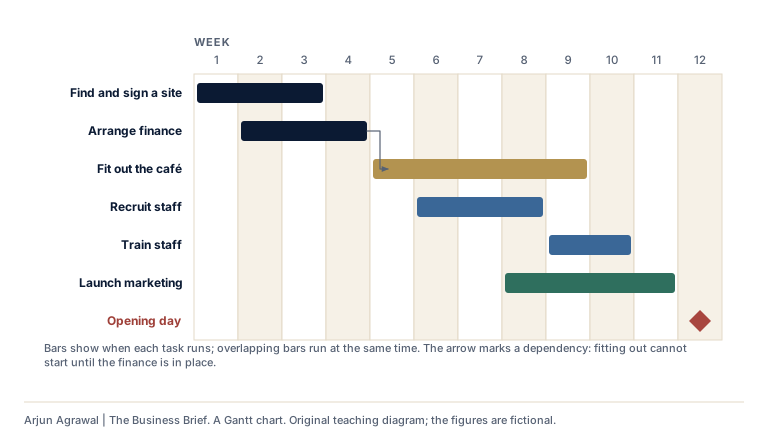
An HL toolkit tool for scheduling the plan. It shows each marketing activity against time, which activities overlap and which must wait for others, so managers can check whether the plan is on schedule.
HL This section has HL-only points, hidden while you are viewing SL content.
Advantages
- Makes the business study its market and its rivals before it spends money.
- Gives every function a shared target, so marketing, operations, finance and human resources pull in the same direction.
- Measurable objectives show whether a campaign worked, so managers can change course early.
- A clear plan helps persuade lenders and investors that a business's sales forecasts are realistic.
Limitations
- A plan is only as good as the research and forecasts behind it.
- Markets, rivals and technology change quickly, so a fixed plan can go out of date and needs regular review.
- Planning takes time and money that a small business may not have.
- A plan can create false confidence: following it is not the same as succeeding.
Section 04: Segmentation
Segmentation, targeting and positioning are three linked steps, shown in the diagram below. Segmentation comes first: dividing a market into groups of customers, called segments, who share characteristics or needs and respond to marketing in similar ways. A business that understands its segments can design products, prices and messages that fit each group, instead of one average offer that fits nobody particularly well.
There is no single correct way to segment a market. The four bases below are the most widely used, and businesses usually combine them: for example, young professionals (demographic) in city centres (geographic) who care about sustainability (psychographic) and buy coffee every working day (behavioural).
A segment is worth targeting only if it is measurable, so the business can estimate its size and spending; large enough to be profitable; reachable through promotion and distribution; and distinct, responding to marketing differently from other segments. Market research (4.4) supplies the data.
- Demographic
By measurable features of the population, such as age, gender, income, occupation, education, family size or stage of life. The data are easy to find, for example in government publications, but people with the same profile can want very different things.
- Geographic
By where customers live or work, such as country, region, city, urban or rural area, or climate. Useful when tastes, laws or costs differ from place to place, but it hides the differences between neighbours.
- Psychographic
By lifestyle, values, attitudes, interests and personality. It explains why two people of the same age and income buy differently, but the data are harder and more expensive to collect.
- Behavioural
By how customers buy and use the product, such as how often they buy, how loyal they are, the occasion and the benefit they look for. Past behaviour is a strong guide to future buying, and loyalty schemes and online data make it easier to observe.
Text description
Three steps. Segmentation: divide the market into groups with similar needs, by demographic factors such as age, income and family, geographic factors such as region and climate, psychographic factors such as lifestyle and values, or behavioural factors such as usage, loyalty and occasion. Targeting: choose the segments to serve, one niche, several each with its own mix, or the whole market through mass marketing. Positioning: decide how the brand should be seen against rivals, on a position map, built on a unique selling point and delivered through the marketing mix.
Advantages
- Products and messages fit customers' needs more closely, which raises sales and loyalty.
- Promotion is spent on likely buyers rather than everyone, so less of it is wasted.
- It can reveal segments that rivals serve badly, which may become opportunities.
Limitations
- Researching a market well enough to segment it costs time and money.
- Segments are averages: real customers do not fit neatly, and labels can harden into stereotypes.
- Serving several segments with different mixes raises costs and gives up some economies of scale.
- Collecting detailed personal data raises questions of privacy and ethics.
Section 05: Targeting: niche markets and mass markets
Targeting is choosing which segments to serve. The chosen group is the target market, often described as a customer profile: the typical buyer's age, income, lifestyle and buying habits. A clear target tells the business which marketing mix to build, and where not to spend.
There are three broad choices, shown in the diagram above: aim one offer at most of the market (mass marketing), aim a different mix at each of several segments, or concentrate on one small segment (niche marketing). The guide asks you to distinguish niche markets from mass markets, so the points below set the two side by side.
Neither is better in general. The right choice depends on the business's size and resources, the size and growth of each segment, the strength of rivals and what the business does best. Many businesses begin in a niche and grow towards the mass market, and some mass-market businesses launch separate brands for niches their main brand cannot reach.
- What each is
A niche market is a small, clearly defined segment of a larger market whose customers have specific needs. A mass market is a large market in which most customers buy a standardized product sold with one broad marketing mix.
- Product
Niche: specialized, often made in small quantities or tailored to the customer. Mass: standardized and made in large volumes.
- Price and margin
Niche: often a premium price and a high margin per unit, because customers value the specialism and have few alternatives. Mass: lower prices and thinner margins, made up for by high volumes and economies of scale.
- Promotion and place
Niche: targeted promotion, such as specialist media, direct marketing and social media, and selective distribution. Mass: mass media and wide distribution, which need large budgets.
- Competition
Niche: fewer direct rivals, though larger firms may move in once the niche proves profitable. Mass: intense competition, often on price.
- Risk
Niche: a small customer base, so a change in taste or one new rival can hit hard. Mass: heavy spending is at stake, and a product designed for everyone may fully satisfy no one, which leaves room for niche competitors.
Section 06: Positioning and position maps
Positioning is the last step: deciding how the business wants its target customers to see its product compared with rivals, and then making every element of the marketing mix support that view. A position might be the cheapest choice, the most luxurious, the most reliable or the most environmentally responsible. What counts is the position in customers' minds, which may differ from the one the business intends.
A position map, also called a perceptual map, shows positions visually. Each axis shows an attribute customers care about, such as price or perceived quality, and each brand is plotted where customers place it. To construct one:
- Choose two attributes that matter in the target market's buying decisions.
- Ask a sample of customers to rate each brand on both attributes, and average the ratings.
- Draw the axes, label both ends of each, and plot every brand.
- Read the map: look for clusters of rivals, brands in weak positions and empty spaces.
An empty space may be a gap in the market, a combination customers want that nobody offers. It may also be empty because few customers want that combination, or because nobody can supply it at a profit, so a gap is a question for more research, not an answer. Moving a brand to a new place on the map, repositioning, means changing customers' settled perceptions, which is slow and costly because every P has to change together.
You can build maps from a simulated survey, and judge whether a gap is worth filling, in the Market Studio, where you can also plot a market of your own.
- Choosing the axes
Pick attributes that customers actually use when they choose, and on which brands differ. Different pairs tell different stories, so the same market can be mapped in several ways.
- Clusters
Brands close together compete head to head for the same customers. Entering a crowded area needs a strong reason for customers to switch.
- Weak positions
A brand seen as high in price but low in quality, such as Saltmarsh on the map below, must raise its quality, or the way customers perceive it, or cut its price.
Text description
A position map of six fictional coffee brands, with price from low to high across and perceived quality from low to high up. Kettle Lane: price 8 out of 10, quality 8.4; Daybreak: price 3 out of 10, quality 3.2; Harbour Roast: price 6.4 out of 10, quality 6.8; Quickcup: price 1.6 out of 10, quality 1.8; Saltmarsh: price 7.6 out of 10, quality 3.4; Corner Brew: price 4 out of 10, quality 5.9. A circle marks a possible gap: good perceived quality at a modest price. Brands are placed by how customers see them; a gap may be an opportunity, or there may be no demand there.
Advantages
- Shows at a glance where a brand stands against its rivals, as customers see it.
- Helps to spot crowded areas to avoid and possible gaps to investigate.
- Checks whether customers see the brand as the business intends, and whether a repositioning has worked.
Limitations
- It shows one sample's perceptions, not facts about the products; another sample or other axes would give another map.
- Only two attributes appear at a time, though customers weigh many.
- A map drawn from managers' opinions rather than research may show only what managers hope.
- It is a snapshot: positions shift as rivals act and tastes change.
Section 07: The unique selling point (USP)
A unique selling point (or proposition), the USP, is a feature or benefit that makes a product different from its rivals and gives customers a reason to choose it. It answers the customer's question: why this one?
A USP matters because most customers have plenty of alternatives. A product with nothing distinctive has to compete on price, which squeezes profit margins. A clear USP helps a business stand out, gives its promotion something specific to say, supports a higher price, and builds loyalty, because customers cannot get the same thing elsewhere. It is often the centre of a brand's positioning.
A USP is valuable only if three things are true: customers care about it, it is genuinely different, and rivals cannot easily copy it. Most USPs are copied in the end, so businesses have to keep renewing them.
- The product
A feature, design, ingredient or level of quality that no rival offers.
- Price or value
Being the cheapest, or the best value, can be a USP if the business's costs are low enough to keep it up; otherwise rivals can simply match the price.
- Service
Speed, convenience, guarantees or after-sales care.
- How it is made or sourced
Hand-made, local, organic or ethically sourced production.
- The brand
A reputation or identity, built up over years, that customers value for itself.
Advantages
- Gives customers a clear reason to buy, which helps a new or small business win attention.
- Makes promotion sharper and easier to remember.
- Reduces direct price competition and can support a premium price.
- Builds loyalty and, over time, brand value.
Limitations
- Creating and protecting a USP costs money, for example in research, design or patents.
- Successful USPs attract imitators, so the advantage is often temporary.
- A difference that customers do not value is not a selling point.
- Claims must be true: an exaggerated USP damages trust and may break advertising law.
Section 08: How organizations differentiate themselves and their products
Differentiation means making a business or its products different from rivals in ways that customers value, so that customers are less likely to choose on price alone. A USP is usually the sharpest point of a wider differentiation strategy.
A business can differentiate through almost anything it offers, and the strongest differentiation combines several routes that reinforce each other. A difference is worth having only if customers value it more than it costs to provide, and if it lasts long enough to repay the investment.
The guide sets this statement at AO3, so an examination answer should go beyond listing routes: judge how far a particular route would work for the business in the case, at what cost, and for how long.
- Product features, quality and design
Better performance, durability, design or ingredients. Patents and design rights protect some differences for a time, but rivals catch up.
- Branding and image
A distinctive identity and reputation (4.5) that customers trust or admire.
- Customer service
Advice, speed, guarantees and after-sales care from well-trained staff. It is hard to copy, because it depends on people and culture.
- Distribution and convenience
Being easier to buy from, through more outlets, faster delivery, longer opening hours or a better app.
- Ethical and sustainable practices
Fair trade sourcing, lower emissions or recyclable packaging, which matter more and more to some segments. They must be genuine, because claims that cannot be backed up destroy trust.
- People, processes and physical evidence
For a service, the staff, the way the service is delivered and the look of the premises (4.5).
- Porter's generic strategies (toolkit) HL
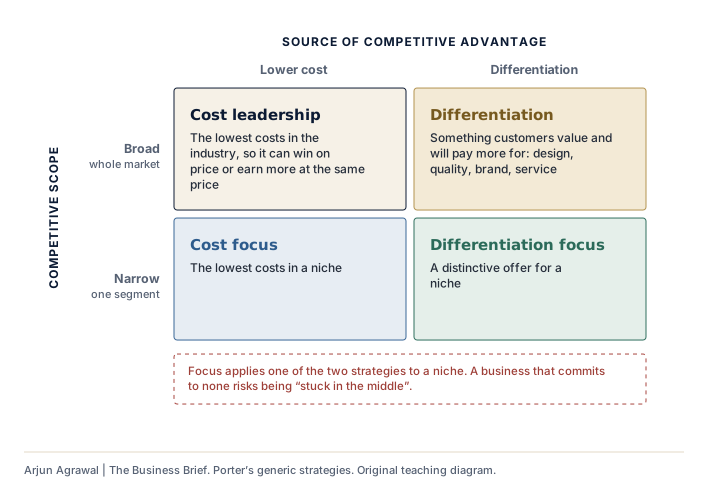
An HL toolkit tool. Porter treats differentiation as one route to competitive advantage, set against cost leadership, with a focus version of each for a narrow segment. A business that tries to be both the cheapest and the most distinctive risks being stuck in the middle, with neither advantage.
HL This section has HL-only points, hidden while you are viewing SL content.
Advantages
- Customers become less sensitive to price, so the business can charge more and protect its margins.
- Builds loyalty and repeat custom.
- Reduces head-to-head competition with rivals.
- Strengthens the brand, which helps when the business launches new products.
Limitations
- Differentiating costs money, in research, design, training or better materials, which raises prices or cuts margins.
- Rivals imitate successful differences, so they have to be renewed.
- Customers may not value, or even notice, the difference.
- Some customers will always buy the cheapest option, so differentiation narrows the market a business can win.
Section 09: In practice: industries and stakeholders
The same ideas look different from one industry to the next, and land differently on each group with a stake in the business.
Across industries
- Hotels
Travellers are segmented by the purpose of the trip and by budget, so business guests, families and couples on a short break are offered different rooms, prices and promotions. Budget chains serve a mass market with a standard room at a low price, while boutique hotels hold a niche through design, location and personal service.
- Car manufacturing
Car makers position their models on price, performance, status and, increasingly, environmental impact, and many run several brands so that each can hold its own position. A mass-market model competes on value and reliability; a luxury or specialist model relies on image and a few features that justify a much higher price.
- Banking
Banks segment customers by life stage and income, from students to families and retired people, and design accounts, loans and advice for each. Digital-only banks have differentiated themselves on app design, speed and low fees, while traditional banks stress branches and face-to-face advice.
- Fashion and clothing
Psychographic segmentation matters most here, because people of the same age and income dress very differently. Sustainable clothing brands target a niche that cares how clothes are made, and their USP is believed only if they can back their claims with evidence.
- Private healthcare
A private clinic may specialize in one niche, such as sports injuries, and differentiate on short waiting times and expert staff. Marketing health care raises ethical limits, since claims must be accurate and vulnerable patients must not be pressured.
- Social enterprises
A social enterprise often targets two groups at once, the customers who buy and the people its mission serves. Its social purpose can be its USP, but customers still compare quality and price, so the mission rarely sells a product that does not compete on its own merits.
For each stakeholder
- Customers
Benefit when products, prices and messages fit their needs, but customers outside the chosen segments may be ignored or priced out. Segmentation relies on data about them, which raises questions of privacy and consent.
- Employees
Deliver the position in practice, especially in services, where a business that differentiates on expert advice needs trained, motivated staff. Cutting staff costs to protect margins can undermine the very difference customers pay for, and repositioning means retraining.
- Owners and shareholders
Choose the balance of risk and reward. A niche offers higher margins from a small, loyal base but leaves the business exposed to a change in one group's tastes; a mass market offers scale but demands large budgets and brings fierce price competition.
- Competitors
Respond to every positioning move. A successful USP attracts imitators, a gap on the position map may be filled by a rival first, and a business that moves onto a rival's ground can provoke a price war.
- Suppliers
Differentiation through sourcing, such as local, organic or fair trade ingredients, depends on suppliers meeting higher standards, often at higher prices. A business that builds its USP on a supplier's product becomes dependent on that supplier.
- Regulators and the local community
Advertising law requires a USP's claims to be true, and the community expects businesses not to target children or vulnerable groups unfairly. Ethical positioning can win support, but claims that cannot be backed up damage trust in the whole business.
Section 10: Evaluation and limits
What to weigh before reaching a judgement.
- A marketing plan is a means, not an end. It improves decisions only when it rests on reliable research and is reviewed as the market changes; in a fast-moving market, a short plan revised often can be worth more than a detailed one that is never updated.
- Segmentation, targeting and positioning stand or fall together. A precise segment is useless if the business cannot reach it or serve it profitably, and a position on a map means little unless every element of the marketing mix supports it.
- A position map shows perceptions, not facts. It depends on which customers were asked and which two attributes were chosen, and a gap on it is a question to test, not proof of demand.
- Niche or mass is a strategic choice that depends on resources. A niche suits a small business with specialist strengths but leaves it exposed to changes in one small group; a mass market brings scale but demands large budgets and fierce price competition.
- A USP and differentiation are worth only what customers will pay for them, and only for as long as rivals cannot copy them. Most advantages fade, so the real question is how a business will keep renewing its difference.
- In an examination answer, apply the tools to the case's own customers and rivals. Name the segment, explain why it suits the business, and judge whether the proposed position or USP is believable and defensible. A generic list of segmentation bases or differentiation routes earns little.
Section 11: Make the decision
Use the ideas on a business choice: weigh the options, decide, and say what would change your mind.
Decision brief · a fictional business
How should Corner Brew answer the chain?
Corner Brew sells about 300 drinks a day at an average price of $4.00, and the beans, milk and cup for each cost about $1.20, so each drink contributes $2.80 and the day's drinks $840. About 200 of them are sold before 9 a.m., when the café is full, and about 60 in the afternoon. The new chain branch down the street charges less. The owner has about $10,000 to spend this year, not enough for every idea.
How to weigh the options
Start with segmentation, targeting and positioning, then look at the numbers.
Matching the chain moves Corner Brew onto the chain's ground: a mass-market position, competing on price with a rival whose scale gives it lower costs. The numbers make the problem plain, since 82 more drinks a day would have to come at the busiest time, when there is no room for them. It also blurs the position Corner Brew is aiming for, good quality at a modest price, and invites a price war it cannot win.
The afternoon students are a segment the café already serves badly and the chain may not want, and they fill tables that are empty anyway. The return is modest, $27 a day, and depends on students spending something while they stay for hours; the chain could also copy the offer.
The roastery builds on the one thing the chain cannot match, beans roasted on the premises every morning, and reaches the home brewers already identified in Corner Brew's own segments. It brings the most contribution per customer, but needs $9,000 before any bag is sold, and demand for the beans is untested.
A strong judgement rejects the price match unless the chain is taking the morning commuters in large numbers, which it would show first. The other two moves target different segments at different times of day and both support the same position, so they need not be rivals: a small trial, such as selling beans from the existing roaster for a month, would test the roastery before the $9,000 is spent, while the study-hours offer starts now; together they stay within the $10,000, which buying the roaster as well would not. What would change the decision: evidence that commuters are leaving for the chain, and how many bags the trial sells.
Section 12: Exam-style practice
Original questions written by the platform in the style of the papers, with what a strong response does. They are not IB questions and the guidance is not an official markscheme.
-
Define the term niche market.
What a strong response does
A strong response gives a precise definition: a small, clearly defined segment of a larger market whose customers have specific needs, served with a specialized product.
- Both elements are needed: a small, distinct segment, and needs that a specialized product meets.
- Saying only that it is "a small market" earns little.
-
Dev, a fictional fitness instructor, plans to open a gym in his town. A survey asked five gym users to rate the town's four gyms, each of them fictional, on price (1 = very low, 10 = very high) and on the range of facilities (1 = very narrow, 10 = very wide). Their ratings were:
- Forge Gym: price 3, 2, 3, 4, 2; facilities 4, 3, 5, 4, 4.
- Studio Nine: price 9, 8, 9, 10, 8; facilities 5, 4, 6, 5, 4.
- Harbourside Fitness: price 7, 8, 6, 7, 8; facilities 9, 8, 9, 10, 9.
- Millpond Leisure Centre: price 6, 7, 6, 5, 7; facilities 7, 8, 7, 8, 7.
Calculate each gym's average rating on each attribute and construct a position map of the four gyms.
What a strong response does
A strong response shows the averages, then draws and labels the map.
- Forge Gym: price 14 ÷ 5 = 2.8; facilities 20 ÷ 5 = 4.0.
- Studio Nine: price 44 ÷ 5 = 8.8; facilities 24 ÷ 5 = 4.8.
- Harbourside Fitness: price 36 ÷ 5 = 7.2; facilities 45 ÷ 5 = 9.0.
- Millpond Leisure Centre: price 31 ÷ 5 = 6.2; facilities 37 ÷ 5 = 7.4.
- The map: two axes crossing at the midpoint of the scale, 5.5, with both ends of each labelled, low price to high price and narrow facilities to wide facilities. Each gym is plotted at its two averages and named, and the map has a title saying what it shows and where the ratings came from.
Read this way, Forge sits alone at low price and narrow facilities, Studio Nine at high price and narrow facilities, and Harbourside and Millpond at high price and wide facilities. No gym is rated low in price and wide in facilities.
-
Using your position map from question 2, analyse the positioning options open to Dev's new gym.
What a strong response does
A strong response reads the map for clusters, weak positions and gaps, explains what each means for Dev, and notes what the map cannot show.
- A crowded area: Harbourside and Millpond both sit at high price and wide facilities, so a new gym there would compete head to head with two established rivals.
- A possible gap: no gym is seen as low in price and wide in facilities. It may be a real opportunity, but it may be empty for a reason, since a wide range of facilities is expensive to provide, so Dev would need to show he could offer it at a low price and still make a profit.
- A position that looks weak: Studio Nine charges a high price for narrow facilities. Either it is vulnerable, or customers value something the two axes leave out, such as expert coaching or small classes, which is a warning that the choice of axes shapes the story.
- The budget position: Forge holds low price and narrow facilities alone; Dev could challenge it on price, with all the risks of competing on cost.
- Limits: five users is a very small sample, the ratings are perceptions rather than facts, and only two attributes appear, so Dev should test any gap with more research before choosing.
-
Explain two bases on which Dev could segment the market for his gym.
What a strong response does
A strong response names two bases, explains each and applies it to gym users in Dev's town.
- Demographic: by age, income or stage of life. Students with little money, parents with young children and retired people want different hours, prices and facilities, so Dev could design memberships around one of them.
- Behavioural: by how customers use a gym and the benefit they seek, such as serious lifters who train daily, beginners who want guidance, or people who only use classes. Usage and benefit sought predict what members will pay for.
- Psychographic segmentation (lifestyle and values, such as health-conscious professionals) and geographic segmentation (where people live and work) are also valid.
-
Explain the importance of a unique selling point (USP) for Dev's new gym.
What a strong response does
A strong response explains why a USP matters for a new entrant in this market and what makes one valuable.
- A reason to switch: four gyms already serve the town, so a new gym without a clear difference must compete on price alone, which squeezes margins from the start.
- Sharper promotion and loyalty: a USP, such as round-the-clock access with a supervised children's area, gives promotion one clear message and gives members a reason to stay.
- It must pass three tests: customers must care about it, it must be genuinely different from what the four rivals offer, and they must not be able to copy it easily, otherwise the advantage lasts only until they do.
-
Dev is choosing between two plans. One is a budget gym for the mass market, like Forge Gym, which charges $25 a month and has 1,800 members. The other is a specialist strength-training gym for serious lifters, a niche that Studio Nine's experience suggests will pay more: it charges $90 a month and has 300 members. Dev has $150,000 of savings and loans to set up.
Evaluate whether Dev should aim his gym at a niche market rather than the mass market.
What a strong response does
A strong response compares the two targets in Dev's situation, uses the figures, weighs the risks and reaches a judgement.
- The scale of each: Forge's 1,800 members at $25 bring in $45,000 a month, Studio Nine's 300 at $90 bring in $27,000. A niche can be viable with a sixth of the members, but each member matters more.
- For the niche: a premium price and higher margin per member, fewer direct rivals, a clear USP and targeted promotion that suits a small budget; Dev's own expertise as an instructor fits a specialist gym.
- Against the niche: a small pool of serious lifters in one town, a business exposed if one rival targets the same group, and members who expect expert staff and specialist equipment, which cost money.
- For the mass market: a much larger pool of customers and less dependence on any group.
- Against the mass market: Forge already holds the budget position, so Dev would compete on price against an established rival with more members to spread its costs over; a budget gym needs high volumes, and $150,000 may not buy the equipment and space to reach them.
- Judgement: for example, that the niche suits Dev better because his budget is small, his skills are specialist and the budget segment is already served, provided research shows enough serious lifters in the town to fill a gym; or the reverse, if research finds that demand at peak times outstrips Forge's capacity. A strong answer says what evidence would decide it.
Section 13: Revision summary
The subtopic on one page: what to remember.
- Marketing planning turns the business's objectives into marketing objectives and a plan covering its analysis, target market, positioning, marketing mix, budget and timescale, and how results will be measured.
- Segmentation divides a market into groups of customers with shared needs, on demographic, geographic, psychographic and behavioural bases, usually in combination.
- A segment is worth targeting if it is measurable, large enough to be profitable, reachable and distinct.
- Targeting chooses the segments to serve. Mass marketing aims one standardized offer at most of the market; niche marketing serves a small, clearly defined segment with a specialized product, often at a premium price.
- Positioning is how a business wants its target customers to see it compared with rivals, and every element of the marketing mix has to support it.
- A position map plots brands on two attributes from customers' average ratings. Read it for clusters, weak positions and possible gaps, and treat a gap as a question to research, not proof of demand.
- A USP gives customers a reason to choose a product. It is valuable only if customers care about it, it is genuinely different and rivals cannot easily copy it.
- Differentiation through the product, the brand, service, convenience, ethics and, for services, people, processes and physical evidence reduces price competition, but it costs money and must be renewed as rivals imitate.
Section 14: The mindmap
How a marketing plan turns objectives into action; segmenting a market, choosing a target and positioning a product, with position maps; niche and mass markets; and how a USP and differentiation set a business apart.
Drag to move the map, or use the arrow keys. Click a branch to fold it away. Whole map shows all of it; zoom with the buttons, or with Ctrl and the scroll wheel.
- Core ideas
- Types and forms
- Applications
- Tools
- Evaluation
- Connections
- Advantage
- Limitation
- HL HL only
The map as an outline
The marketing plan
Core ideas
- Definition Objectives, target, mix, budget, timing What marketing will achieve, for whom, how, at what cost and by when.
- Objectives that are specific and measurable They follow from the business's objectives in 1.3.
- Uses research, SWOT, STEEPLE Toolkit tools give the plan its evidence.
- Advantage Coordinates marketing with other functions
- Limitation Needs regular review A plan dates quickly when the market or rivals change.
Segmentation
Types and forms
- Definition Splitting a market into groups that respond alike
- Demographic: age, income, gender, family
- Geographic: country, region, city, climate
- Psychographic: lifestyle, values, interests
- Behavioural: usage, loyalty, occasion, benefit
- Useful segments are big, reachable, distinct Each must be worth serving and respond differently to marketing.
Targeting
Applications
- Definition Choosing segments to aim at Often described as a customer profile of the typical buyer.
- Mass market: one mix for most buyers
- Advantage Volume and economies of scale
- Limitation Costly and fiercely contested
- Niche market: a small, specialized segment
- Advantage Fewer rivals, premium prices
- Limitation Small base; rivals may enter
Positioning and position maps
Tools
- Definition Positioning: where a brand sits in buyers' minds Every element of the mix must support the chosen position.
- Definition Position map: brands plotted on two attributes Choose attributes customers really use, such as price and quality.
- Advantage Reveals clusters and gaps
- A gap is a question Not an answer; some gaps are empty because nobody wants that combination.
- Limitation One sample's perceptions, not facts
- Repositioning: slow, costly Changing how buyers see a brand means changing every P.
USP and differentiation
Core ideas
- Definition USP: a reason to choose it
- Definition Differentiation: different in ways buyers value
- Routes: features, quality, design, brand, service Also distribution, and ethical or sustainable practices.
- Porter's generic strategies (toolkit) HL Differentiation is one of the routes to competitive advantage.
Weighing the choices
Evaluation
- A USP must matter and be hard to copy
- Advantage Buyers care less about price Differentiation and a USP build loyalty and weaken price competition.
- Limitation Costly; rivals imitate
- Niche or mass depends on resources And on the size of the market and the strength of rivals.
Connections
Connections
- 4.4: research finds segments and gaps
- 4.5: the mix delivers positioning
- 4.1: market share measures the result
Open the mindmap on its own page, with its terms and connections.
Section 15: More diagrams
Original diagrams from the platform's library, each with a text description and an SVG download.
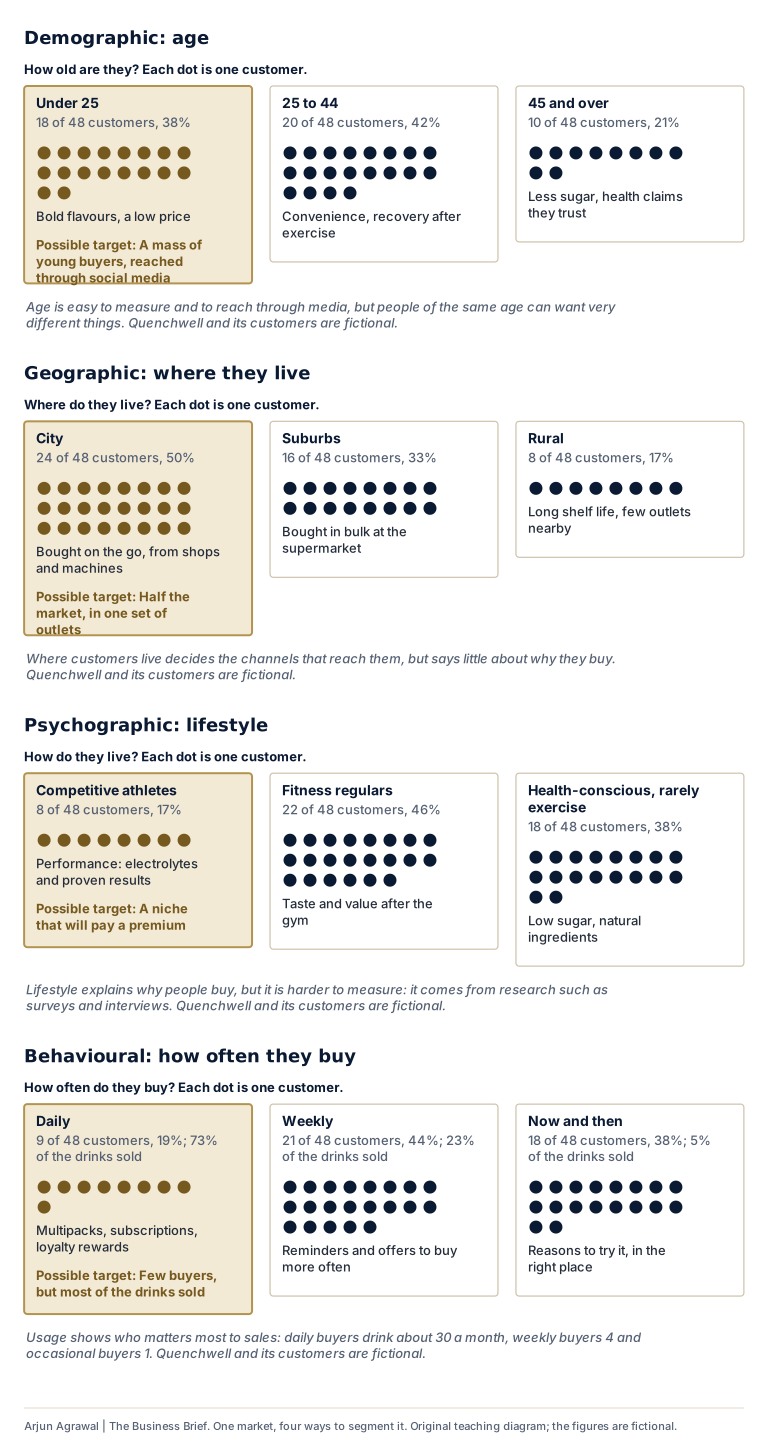
Choose a basis to regroup the same customers.
Demographic: age
Age is easy to measure and to reach through media, but people of the same age can want very different things.
Geographic: where they live
Where customers live decides the channels that reach them, but says little about why they buy.
Psychographic: lifestyle
Lifestyle explains why people buy, but it is harder to measure: it comes from research such as surveys and interviews.
Behavioural: how often they buy
Usage shows who matters most to sales: daily buyers drink about 30 a month, weekly buyers 4 and occasional buyers 1.
Text description
Quenchwell, a fictional maker of sports drinks, surveys 48 customers and segments them four ways. Demographic: age: under 25 18, 25 to 44 20, 45 and over 10. Geographic: where they live: city 24, suburbs 16, rural 8. Psychographic: lifestyle: competitive athletes 8, fitness regulars 22, health-conscious, rarely exercise 18. Behavioural: how often they buy: daily 9, weekly 21, now and then 18. The same customers fall into different groups depending on the basis, and each basis suggests a different target.
Text description
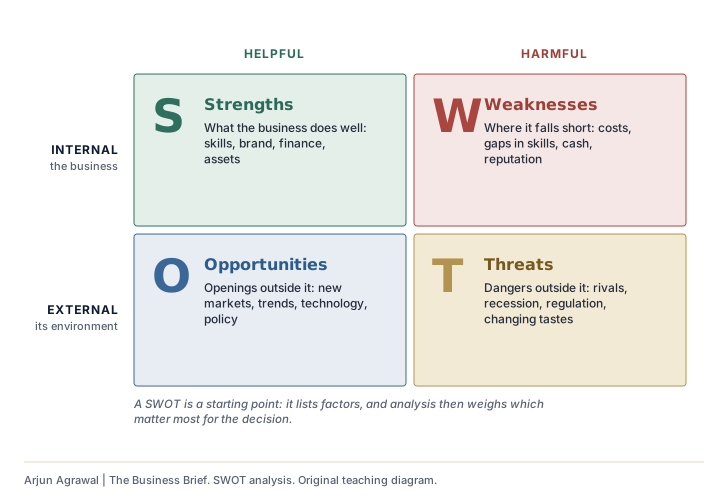
A two by two grid. Internal factors, about the business itself, are strengths, what it does well such as skills, brand, finance and assets, and weaknesses, where it falls short such as costs, gaps in skills, cash or reputation. External factors, about its environment, are opportunities, such as new markets, trends, technology and policy, and threats, such as rivals, recession, regulation and changing tastes. Strengths and opportunities are helpful; weaknesses and threats are harmful. A SWOT lists factors; analysis then weighs which matter most for the decision.
Text description
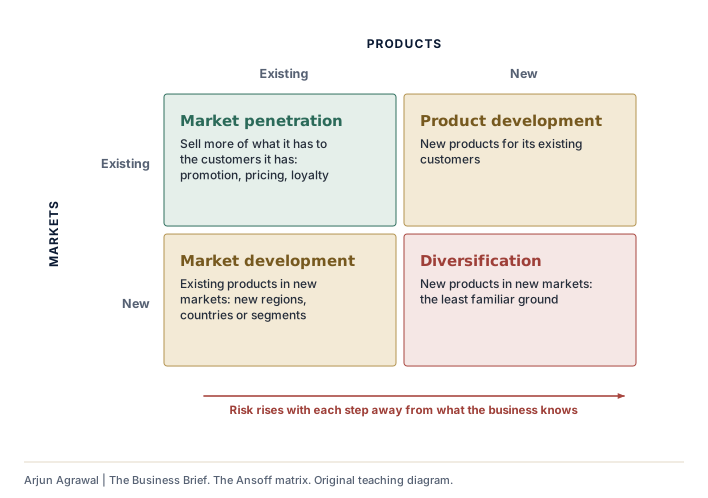
A two by two grid of products, existing or new, against markets, existing or new. Market penetration: selling more existing products to existing customers through promotion, pricing and loyalty. Product development: new products for existing customers. Market development: existing products in new markets such as new regions, countries or segments. Diversification: new products in new markets, the least familiar ground. Risk rises with each step away from what the business knows, so diversification is usually the riskiest.
Text description
A Gantt chart for opening a fictional café over 12 weeks. Find and sign a site: weeks 1 to 3. Arrange finance: weeks 2 to 4. Fit out the café: weeks 5 to 9. Recruit staff: weeks 6 to 8. Train staff: weeks 9 to 10. Launch marketing: weeks 8 to 11. Opening day is a milestone in week 12. Overlapping bars run at the same time, and an arrow shows that fitting out cannot start until the finance is in place.
Text description
A grid of the source of competitive advantage, lower cost or differentiation, against competitive scope, broad or narrow. Cost leadership: the lowest costs in the industry, to win on price or earn more at the same price. Differentiation: something customers value and will pay more for, such as design, quality, brand or service. In a narrow scope, focus applies one of these to a niche, as cost focus or differentiation focus. A business that commits to none risks being stuck in the middle.
Section 16: Key terms
Defined in the platform's own words. Each opens its full entry.
- Behavioural segmentation
- Grouping customers by how they buy and use a product, such as how often they buy, how loyal they are, the occasion of the purchase and the benefit they look for.
- Demographic segmentation
- Grouping customers by measurable characteristics of the population, such as age, gender, income, occupation, family size or education.
- Differentiation
- Making a business or its products different from rivals' in ways that customers value, so that customers are less likely to choose on price alone.
- Gap in the market
- A need, or a combination of features, that customers want but that no business currently provides well.
- Geographic segmentation
- Grouping customers by where they live or work, such as country, region, city, urban or rural area, or climate.
- Market segmentation
- Dividing a market into groups of customers, called segments, who share characteristics or needs and respond to marketing in similar ways.
- Marketing objectives
- The targets the marketing function sets to support the organization's overall objectives, such as raising market share, launching a product or increasing brand awareness.
- Marketing plan
- A document that sets out a business's marketing objectives and the strategy for reaching them, including the target market, the marketing mix, the budget, the timescale and how results will be measured.
- Mass market
- A large market in which a business sells a standardized product to most customers with one broad marketing mix, rather than different offers for different segments.
- Niche market
- A small, clearly defined segment of a larger market whose customers have specific needs, served with a specialized product.
- Position map
- A diagram with two axes, each showing an attribute customers care about, such as price and quality, on which brands are plotted according to how customers see them.
- Positioning
- The place a brand or product holds in customers' minds compared with its rivals, and the marketing decisions a business takes to win that place.
- Psychographic segmentation
- Grouping customers by their lifestyles, values, attitudes, interests and personalities.
- Target market
- The segment or segments of a market that a business chooses to aim its products and marketing at. Choosing them is called targeting.
- Unique selling point (USP)
- A feature or benefit that makes a product different from its competitors' products and gives customers a reason to choose it.
Section 17: Tools and practice
7 tools on the platform for 4.2, by room, with exercises, worked calculations and practice questions.
Strategy Studio
- Porter's generic strategies IB toolkitHL
Practice questions with mark schemes
Section 18: Check your recall
Answer from memory, then reveal and rate yourself. Your ratings stay on this device.
Answer each question from memory, out loud or on paper, before you reveal the answer. Your ratings also schedule these questions in your flashcards.
-
What is the role of marketing planning?
To turn the business's objectives into specific marketing objectives and actions, setting out who to target, how to position the product, which marketing mix to use, at what cost and by when, and how results will be measured.
How well did you recall it? -
Name four common bases for segmenting a market.
Demographic (such as age, income and family), geographic (such as region and climate), psychographic (lifestyle and values) and behavioural (usage, loyalty, occasion and the benefit sought).
How well did you recall it? -
What makes a market segment worth targeting?
It can be measured, it is large enough to be profitable, it can be reached through promotion and distribution, and it responds to marketing differently from other segments.
How well did you recall it? -
Distinguish between a niche market and a mass market.
A niche market is a small, clearly defined segment with specific needs, served with a specialized product, often at a premium price. A mass market is large and served with a standardized product and one broad marketing mix, relying on high volumes and economies of scale.
How well did you recall it? -
What does a position map show, and what is its main limitation?
Where customers place competing brands on two attributes, such as price and perceived quality. It shows one sample's perceptions on only two attributes, not facts, and a gap on it may be empty for a good reason.
How well did you recall it? -
What are the four steps in constructing a position map?
Choose two attributes that matter to customers; collect and average customers' ratings of each brand; draw and label the axes and plot the brands; then read the map for clusters, weak positions and gaps.
How well did you recall it? -
What three tests must a USP pass to be valuable?
Customers must care about it, it must be genuinely different, and rivals must not be able to copy it easily.
How well did you recall it? -
Give three ways an organization can differentiate itself from its competitors.
For example through product features, quality or design; branding; customer service; convenient distribution; ethical and sustainable practices; and, for a service, its people, processes and physical evidence.
How well did you recall it? -
Why is repositioning a brand slow and expensive?
It means changing customers' settled perceptions, which takes time, and every element of the marketing mix has to change consistently to support the new position.
How well did you recall it?
Section 19: How it connects
Where 4.2 meets the rest of the course: worked connections with an exam-style question on each, then the further links the notes name.
-
From business objectives to the marketing plan
Marketing planning starts from the business's objectives. A strategic objective, such as growth or entering a new market, becomes marketing objectives such as a target market share, and the plan then chooses the target market, the position and the marketing mix that should deliver them; tactical objectives set the shorter-term targets along the way. Ethical objectives shape the plan too, ruling out some markets or claims and favouring others. A plan that does not follow from the objectives may be well made and still pull the business in the wrong direction.
Exam-style question Source: Original practice question Command term: Explain (AO2)
Explain the relationship between a business's strategic objectives and its marketing plan. [4 marks]
-
With 4.4 Market research
Research behind the position map
Segmentation, targeting and positioning depend on market research. Research identifies groups of customers with similar needs, shows which segments are large or growing enough to target, and supplies the customer ratings that place brands on a position map. A map drawn from managers' opinions rather than customers' views can show a gap that customers do not see, or miss one they do. Quantitative research gives the scores; qualitative research, such as focus groups, explains why customers see the brands as they do.
Exam-style question Source: Original practice question Command term: Explain (AO2)
Explain how market research helps a business to construct a position map. [4 marks]
-
With 4.5 The seven Ps of the marketing mix
The marketing mix delivers the plan
Marketing planning decides whom the business serves and how it wants to be seen; the seven Ps are how it gets there. A niche market for a premium product calls for a mix that holds together: a high-quality product, a premium price, selective distribution and promotion aimed at the target segment. A mass market calls for something else. A mix whose parts contradict one another, such as a premium brand sold at discount prices through every channel, confuses customers and weakens the position the plan chose. For a service, people, processes and physical evidence carry the position as well.
Exam-style question Source: Original practice question Command term: Explain (AO2)
Explain how a business targeting a niche market might adapt its marketing mix. [4 marks]
Also linked in the notes
- 1.5 Growth and evolution Serving a profitable niche is one reason a business may choose to stay small.
- 4.1 Introduction to marketing Market orientation starts from customers' needs, and market share shows whether a plan worked.
- 4.6 International marketing At HL, segmenting and positioning are applied to foreign markets.
- 5.2 Operations methods Niche markets suit job production and mass customization; mass markets suit flow production.
See 4.2 on the course connections map, with every link drawn across the five units.
Section 20: Connected learning
Everything else on the platform that teaches, applies or tests 4.2, each labelled by its standing.
- Revise
-
- The 4.2 mindmap Full and revision views, to print or download
- Revision sheet The subtopic on one printable page
- Flashcards The 4.2 cards, to rate as you go
- Practise
-
- 8 questions on 4.2 in the question bank From the practice sets, the notes and the case files, filtered to this subtopic
- Decisions and simulations
-
- Hotel Mareluce: full rooms or a future Fictional Boardroom simulation
- Frameworks
-
- Gantt charts IB toolkitHL
- Porter's generic strategies IB toolkitHL
- SWOT analysis IB toolkit
- The Ansoff matrix IB toolkit
- Tools
-
- 7 tools for 4.2 In Tools and practice on this page: Strategy Studio, Market Studio, Entrepreneurship and Innovation Lab
- Boardroom Briefings
-
- Scholarline's tutors meet a tutor that never sleeps Fictional Briefing 7
- Business Intelligence
-
- Docker makes its secure container images free, and keeps a paid enterprise tier Real-world A real development, 17 December 2025, with its sources
- Google's own AI chips reach a seventh generation, then an eighth Real-world A real development, 6 November 2025, with its sources
- Cracker Barrel restores its old logo weeks after a rebrand, pauses remodels and plans for fewer guests Real-world A real development, 19 August 2025, with its sources
- Google Cloud sells sovereign clouds through local partners, from France to Japan Real-world A real development, 21 May 2025, with its sources
- Advanced Management
-
- Competitive advantage and industry analysis Enrichment Advanced strategy: beyond the IB course
- Brand strategy and competitive positioning Enrichment Advanced marketing: beyond the IB course
- Customer economics: segmentation, acquisition and lifetime value Enrichment Advanced marketing: beyond the IB course
- Startup strategy, business model validation and product-market fit Enrichment Entrepreneurship and innovation: beyond the IB course
- Course connections
-
- 3 worked connections on the connections map With 1.3, 4.4, 4.5
Notes checked against: Business management guide, first assessment 2024 (published February 2022, updated May 2022), pp. 14, 30 to 31 (The five content statements and their assessment objectives, the unit's conceptual understandings and suggested tools, and the toolkit); Business management teacher support material, pp. 86, 89 to 90 (Glossary definitions of niche market, mass market, segmentation and target market, checked for consistency; paraphrased). Updated 2026-11-03. The IB guide is the authority on the course.
Arjun Agrawal | The Business Brief, https://the-business-brief-dun.vercel.app/topics/marketing-planning/. Original teaching material, not an IB publication. The organizations in the teaching cases are fictional unless a case says otherwise.