Unit 5: Operations management
5.2 Operations methods
Study mode could not start. The page reads as usual.
Study mode
On this page
Section 01: What the IB course asks
The content statements for 5.2, in the platform's words, with the depth of teaching the guide sets (guide, from p. 33).
- Job, batch and mass (flow) production, and mass customization AO3
AO1 knowledge and understanding · AO2 application and analysis · AO3 synthesis and evaluation · AO4 a range of skills. A question can use a command term at its statement's level or below. The whole course.
Section 02: Why it matters
How a business makes its products decides much of what it can offer customers: how much choice, at what price, and how quickly. A tailor and a clothing factory both make shirts, but one makes each shirt for one person and the other makes a hundred thousand identical ones, and almost everything else about the two businesses follows from that difference.
The guide names four operations methods, job, batch and mass (flow) production and mass customization, and sets them at AO3 (p. 33). You need to know how each works, but above all to judge which suits a particular business, weighing unit costs against variety, investment against flexibility, and efficiency against the people who do the work.
By the end you can
- Describe job, batch and mass (flow) production and mass customization, with examples.
- Explain the trade-off between volume and variety, and why unit cost falls as volume rises.
- Analyse how the operations method changes the average cost of each unit, using the figures in a case.
- Evaluate the advantages and disadvantages of each method for a particular business.
- Recommend an operations method for a business, or a change of method, and justify it.
- Compare and contrast two methods for a particular business, including the volume at which each becomes the cheaper.
- Apply the four methods to services as well as to manufacturing.
Section 03: Choosing how to produce: volume and variety
An operations method is the way a business organizes production: how many units it makes at a time, how standard they are, and how work moves from one stage to the next. The guide names four methods: job, batch and mass (flow) production, and mass customization. It sets them at AO3, so you must be able to judge which suits a particular business, not just describe them.
The choice turns on two things: the volume a business needs to produce and the variety its customers want. Job production makes one item at a time, each different; batch production makes groups of identical items and then switches to another group; mass or flow production makes a standard product continuously in very large numbers. Along that line, volume rises, variety falls and the cost of each unit falls, because fixed costs are spread over more output and the work can be divided into simple, repeated tasks. Mass customization tries to break the trade-off, using flexible technology to make high volumes with features chosen by each customer, as the diagram shows.
The method also decides how labour-intensive or capital-intensive production is. Job production relies on skilled people with general-purpose tools; flow production relies on specialized machinery, often automated, with far less labour in each unit. So the choice of method is also a choice about costs, skills, investment and the kind of work people do.
- Volume
How many units a business needs to make in a period. High, steady volumes justify specialized equipment; low or unpredictable volumes do not.
- Variety
How much the product differs from one customer or order to the next. Variety needs flexible people and equipment.
- Standardization
Making every unit to the same specification. It allows specialized machines, simple tasks and consistent quality, but it limits choice.
- Labour-intensive production
Production that relies mainly on people, so labour is the largest share of its costs. Typical of job production and of many services.
- Capital-intensive production
Production that relies mainly on machinery and technology, so capital is the largest share of its costs. Typical of flow production.
Text description
Chart placing the four operations methods by volume of output and variety of products. Job production sits at low volume and high variety. Batch production sits in the middle. Mass or flow production sits at high volume and low variety. These three lie along the usual trade-off between volume and variety. Mass customization sits at high volume and high variety, breaking the trade-off with flexible technology.
Average (unit) cost
Average cost = total fixed costs ÷ output + variable cost per unit
The same as total costs ÷ output. As output rises, the fixed cost carried by each unit falls, which is why unit costs fall from job to batch to flow production. A standard form; the guide's formula list does not include it.
Section 04: Job production
In job production, each product is made individually, usually to a particular customer's specification. Examples range from a made-to-measure suit, a wedding cake and an architect's design to a bridge, a ship and a film. Every job is different, so the business needs skilled, flexible employees and general-purpose equipment, and it usually agrees the price of each job in advance.
Job production gives customers exactly what they want, and they will often pay a premium for it. The work is varied and creative, which can be highly motivating for skilled staff: in Herzberg's terms it is rich in achievement and responsibility (2.4). But the cost of each unit is high, because little can be standardized and few economies of scale are available; production is slow; and the business depends on skilled people who are scarce and take years to train. Demand can also be uneven, with weeks of overtime followed by idle ones.
Job production suits products that are unique by nature, low volumes, customers who value exclusivity or a perfect fit more than price, and small businesses whose skill is their advantage. It is the natural method for many start-ups, and for most construction and professional services.
Advantages
- Products match each customer's wishes exactly, which supports premium prices.
- Varied, skilled work can motivate employees.
- Flexible, because a job can be changed during production if the customer wishes.
- Little capital is needed to start, because the tools are general-purpose.
Limitations
- High cost per unit, with few economies of scale.
- Slow, so customers may wait a long time.
- Depends on scarce, skilled employees being available.
- Workload can be uneven, and each job must be priced separately.
Section 05: Batch production
In batch production, a group of identical items moves through each stage of production together, and when the batch is finished the equipment is reset for a different group. A bakery bakes a tray of white loaves, then a tray of rye; a paint maker mixes one colour, cleans the vats and mixes another; a clothing factory cuts and sews a run of one style in several sizes.
Batching gives a business some variety and some economies of scale at once. Within a batch, work can be divided into specialized stages, equipment can be designed for the task and materials can be bought in bulk, so each unit costs much less than in job production. Between batches, the business can still change the product to meet different orders or seasons.
Its costs come from the changes. While equipment is cleaned and reset, the changeover or set-up time, nothing is produced, so frequent changes waste capacity. Larger batches mean fewer changes but leave more stock waiting between stages and in the warehouse, tying up cash and space and risking waste if tastes change. The work is more repetitive than in job production, and a batch made wrongly is wrong in every unit. Batch production suits products with moderate, fairly predictable demand in a range of standard versions.
- Lean production (5.3) HL
At HL, lean production attacks the waste that batch production creates. Quicker changeovers make smaller batches worthwhile, so less stock waits between stages, and just-in-time delivery brings materials as they are needed rather than in large stocks.
HL This section has HL-only points, hidden while you are viewing SL content.
Advantages
- Lower unit costs than job production, through specialization and bulk buying.
- Some variety for customers, such as sizes, flavours or colours.
- Equipment can be used for several products, spreading its cost.
- Production can follow demand by changing which batches are made.
Limitations
- Idle time and cost at every changeover.
- Stock builds up between stages and in storage, tying up cash.
- More repetitive work, which can demotivate.
- A mistake affects the whole batch.
Section 06: Mass or flow production
In mass production, also called flow production, a standardized product is made continuously in very large numbers. Work flows along a line of specialized stages, each performed by a worker or, increasingly, a machine or robot, and units are started and finished all the time. Cars, smartphones, soft drinks and light bulbs are made this way.
Flow production delivers the lowest cost per unit of any method, provided that volume is high. Its heavy fixed costs, the line, the robots and the factory, are spread over enormous output, and each simple, repeated task is done quickly and consistently: the technical and purchasing economies of scale of 1.5. Quality is consistent, and output is predictable enough to plan stock and deliveries precisely.
The weaknesses are the mirror image. The investment is huge and specific to one product, so the line is inflexible, and a change of design can mean costly retooling. It needs high, steady demand: running a line at half its speed doubles the fixed cost carried by each unit. A breakdown at one stage stops the whole line. And the work, divided into short repeated tasks, is the kind Taylor designed and Herzberg criticized (2.4): dull, closely timed and demotivating, which shows in absence, errors and labour turnover unless the business automates the dullest tasks or rotates and enriches jobs.
Text description
Five steps in a line: study the task through time and motion study, find the one best way to do it, select and train workers for it, pay them by output through piece rates, and so raise productivity. The limits: it treats money as the main motivator and work as simple repeated tasks, so work can become dull and controlled, quality may suffer under piece rates, and staff ideas are not used. Its methods live on in digital Taylorism.
Advantages
- The lowest cost per unit at high volumes, through economies of scale.
- Consistent quality, because each task is standardized and often automated.
- Fast, predictable output that suits planning and mass distribution.
- Low prices can open up mass markets.
Limitations
- A very high initial investment, specific to one product.
- Inflexible, so changing the product is slow and costly.
- Needs high, steady demand, or the fixed cost carried by each unit soars.
- Repetitive work can demotivate, and a breakdown at one stage stops the whole line.
Section 07: Mass customization
Mass customization combines the low unit costs of mass production with products tailored to each customer. It usually works by making standard parts, or modules, in volume and adding the customer's choices as late as possible in the process, using flexible technology: computer-aided design, computer-controlled cutting and printing, 3D printing, and online configurators where customers choose and see their product before ordering. Trainers, bicycles, cars, furniture and computers are often sold this way, and personalized printed products are a simple case.
For the customer it offers choice, and a product made to order, at a price far below that of job production. For the business it can support a premium over standard products, build loyalty, give detailed data on what customers prefer, and reduce unsold stock, because many products are made only after they are ordered, and often paid for in advance.
It is not free. The technology, software and information systems are expensive, and the operation is complex to plan: every order differs, so errors are easier to make and harder to spot. Customers usually wait longer than for a product off the shelf, returned items are hard to resell, and too many options can confuse buyers. Mass customization suits products whose value to customers rises with personal choice and whose variations can be built from a manageable set of standard parts.
Advantages
- Personal products at a much lower cost than job production.
- Supports premium prices and builds loyalty.
- Made to order, so less unsold stock, and often paid for in advance.
- Gives rich data on customers' preferences.
Limitations
- Expensive technology and information systems.
- Complex to plan and run, with more scope for errors.
- Customers wait longer than for products in stock, and returns are hard to resell.
- Too many choices can confuse customers and slow sales.
Section 08: Volume decides: comparing methods by their costs
Each method has its own cost structure. Job production has low fixed costs but a high variable cost per unit, mostly skilled labour; flow production has very high fixed costs, the line and its machines, but a low variable cost per unit. Batch production and mass customization sit between them. Which method is cheapest therefore depends on volume, and the volume at which two methods cost the same can be found from their total costs (3.3).
At that crossover volume, fixed costs plus variable cost per unit × output come to the same total for both methods. Below it, the method with the lower fixed costs is cheaper; above it, the method with the lower variable cost per unit is cheaper. The calculation shows in numbers why rising volume pulls a business from job towards flow production, and the diagram shows the same idea as economies of scale: average cost falls as output grows, until diseconomies set in. As enrichment, Robert Hayes and Steven Wheelwright set out the matching of process to volume and variety as the product-process matrix (1979).
The comparison has limits, and they matter as much as the figures. It assumes fixed costs stay fixed and variable costs stay proportional across the whole range of output, when in practice fixed costs step up as capacity is added and bulk buying lowers variable costs. It compares costs only, while the methods also differ in what customers get: variety, speed, quality and the chance to choose. And it rests on a forecast of demand, which is exactly what makes a capital-intensive method risky. The Operations Floor's production methods exercise asks you to match a method to each of a series of businesses.
- Cost structure
The balance between a method's fixed and variable costs. Labour-intensive methods have high variable costs; capital-intensive methods have high fixed costs.
- Crossover volume
The output at which two methods have the same total cost. Below it the method with lower fixed costs is cheaper; above it the method with the lower variable cost per unit is cheaper.
- Economies of scale (1.5)
The fall in average cost per unit as the scale of output grows, which flow production exploits through specialized machinery, divided tasks and bulk buying.
- Capacity utilization (5.6) HL
At HL, the share of productive capacity in use. A flow line's low unit cost holds only while demand keeps it well used; at half its capacity, the fixed cost carried by each unit doubles.
HL This section has HL-only points, hidden while you are viewing SL content.
Text description
A U-shaped curve of average cost per unit against the scale of output. On the left, economies of scale: average cost falls as output grows, through technical, purchasing, financial, managerial, marketing and risk-bearing economies. The curve reaches its lowest average cost, then rises on the right, where diseconomies of scale such as poorer communication, coordination and motivation push average cost up. External economies and diseconomies, which come from the industry or area rather than the firm, shift the whole curve.
Crossover volume
Crossover volume = (fixed costs of method B − fixed costs of method A) ÷ (variable cost per unit of method A − variable cost per unit of method B)
A standard calculation from total cost = fixed costs + variable cost per unit × output; the guide's formula list does not include it. Method A has the lower fixed costs and method B the lower variable cost per unit. Above the crossover volume, method B has the lower total cost.
Advantages
- Shows the volume a business must reach before a capital-intensive method pays.
- Uses figures the business already has, its fixed and variable costs.
- Makes the risk of a fall in demand visible before the money is spent.
Limitations
- Assumes costs behave the same way across the whole range of output.
- Leaves out variety, quality, lead times and motivation.
- Rests on a forecast of demand that may not hold.
Section 09: Operations methods in services
The four methods are usually taught with factories, but services use the same logic. A job is a service designed for one client: an architect's design, a wedding, a legal case, an operation on one patient. In a batch service, customers move through the process together in groups: a coach tour, a cinema screening, a class, a flight. A flow service processes large numbers of customers through standardized steps: a fast-food counter, a car wash, an online payment. Digital services can practise mass customization at very low cost: a streaming service builds a different home screen for each viewer from the same catalogue, and an online shop recommends different products to each customer from the same stock.
Two features of services sharpen the trade-off between volume and variety. The customer is usually present, so the method shapes the experience as well as the cost: a flow process that is efficient can feel impersonal, and a job that is personal can keep customers waiting. And services cannot be stored, so capacity must match demand at the moment it arises, which favours flexible staff, appointments and booking systems over stock (5.1).
- Job services
Designed for one client at a time, priced individually and dependent on skilled professionals, such as an architect, a wedding planner or a surgeon.
- Batch services
Groups of customers served together at set times, such as tours, classes, screenings and flights, which spreads fixed costs across the group but fixes the timetable.
- Flow services
Many customers taken through the same standard steps, such as a fast-food counter or a drive-through, which keeps costs low and speed high but limits choice.
- Mass customization in services
A personal version for each customer assembled from standard parts or data, such as an online learning course that adapts to each learner.
Section 10: Choosing and changing the method
Choosing an operations method means matching it to the business and its market. The main factors are the size and stability of demand, since flow production needs high, steady volumes; the nature of the product, unique or standard; what customers value, whether price, choice, speed or exclusivity; the finance available for equipment; the skills of the workforce and the technology available; and the business's objectives and image, since a premium brand built on craft may lose its appeal if it is seen to mass-produce.
Methods are not exclusive. Many businesses combine them: a car maker mass-produces engines and bodies, batch-produces options and lets buyers choose the finish; a restaurant prepares sauces in batches and cooks each dish to order. Businesses also change method as they grow, often from job to batch to flow production, and sometimes back towards customization as technology makes variety cheaper.
Changing method is a major decision. It needs investment, which should be appraised (3.8); it changes jobs, skills and working practices, which can meet resistance (2.1); it changes costs and capacity, which must match demand; and it changes what the business offers, so marketing must agree. Each method also carries implications for sustainability: making to order, as in job production and mass customization, avoids unsold stock, while mass production is efficient per unit but can encourage overproduction and short product lives.
- Unit cost
Highest in job production, lower in batch and lowest in flow production. Mass customization sits between job and batch, depending on its technology.
- Variety and flexibility
Highest in job production, moderate in batch and lowest in flow production. Mass customization offers wide but bounded choice.
- Capital needed
Low for job production, moderate for batch, and very high for flow production and mass customization.
- Skills
Broad, high skills for job production; narrower ones for batch and flow production; technical and IT skills for mass customization.
- Stock
Little finished stock in job production and mass customization, which make to order; stock between stages in batch production; large planned stocks in flow production.
- Motivation
Job production offers varied, whole tasks; flow production offers repetitive ones, unless they are automated, rotated or enriched.
Section 11: In practice: industries and stakeholders
The same ideas look different from one industry to the next, and land differently on each group with a stake in the business.
Across industries
- Construction
Most building is job production, because every site, design and client differs. Builders increasingly make standard parts, such as wall panels, bathroom pods or whole modules, in factories in batches, bringing some of the cost and quality advantages of batch production to a job-production industry.
- Food and drink
Bakeries, breweries and sauce makers use batch production, with long cleaning changeovers between products for hygiene. Soft drinks and snacks run on flow lines at enormous volumes, and some brands offer personalized labels or mixes, a simple form of mass customization.
- Car manufacturing
The classic flow-production industry, now heavily automated. Buyers choose engines, colours and trim online, and each car is built to order on the same line, so modern car making combines flow production with mass customization.
- Clothing
Most clothing is batch-produced, a run of each style in each size, and fast fashion relies on quick, small batches that follow trends. Made-to-measure tailoring is job production, and body scanning with computer-controlled cutting is bringing it closer to mass customization.
- Healthcare
Each patient is in a sense a job, with treatment fitted to the individual. Yet hospitals organize routine operations into dedicated lists run in a standard sequence, gaining some of the efficiency of batch production without losing care for each patient.
- Printing and publishing
Long print runs of books and magazines are batches, cheap per copy but leaving stock that may not sell. Digital printing on demand makes a single copy when it is ordered, close to job production at a moderate cost, and personalized books and photo albums are a simple form of mass customization.
- Pharmaceuticals
Most medicines are made in batches, each one tested and recorded so that it can be traced and recalled if something goes wrong, with long, strictly checked cleaning between products. The batch record is part of what makes the product safe to sell.
For each stakeholder
- Customers
Weigh price against choice and waiting time. Flow production gives low prices and instant availability; job production gives exactly what they want, at a price and after a wait; mass customization offers a middle way.
- Employees
Job production uses and rewards their skills; flow production can deskill and bore them, and automation may replace them. A change of method means retraining, new working practices and sometimes job losses, which is why it can meet resistance.
- Owners and investors
Weigh the lower unit costs of volume against the capital and risk it needs. Flow production and mass customization need large investments that pay only if demand is high and steady, while job production needs little capital but limits growth.
- Suppliers
Flow and batch production give them large, regular orders; job production gives small, irregular ones; mass customization needs suppliers flexible enough to deliver many variants quickly.
- The environment and local community
Making to order avoids unsold stock and waste, while mass production uses resources efficiently per unit but can encourage overproduction. A large flow-production plant brings many jobs to an area, and many lost jobs if it closes.
- Managers
Must match the method to demand and keep it running well, by scheduling batches and changeovers, keeping a line busy or coordinating every variant of a customized order. A change of method changes what managers do, from supervising craft to planning capacity and data.
Section 12: Evaluation and limits
What to weigh before reaching a judgement.
- No method is best in general. The right method fits the volume and variety of demand, the product, what customers value, and the business's finance, skills and image; judge it for the business in the case, not in the abstract.
- The trade-off between volume and variety is real. Mass customization narrows it but does not abolish it, because the technology is costly, every order adds complexity, and customers still wait longer than for a product in stock.
- The unit cost advantage of flow production depends on high, steady demand. When demand falls or swings, idle capacity raises the fixed cost carried by each unit, and the inflexible line becomes a burden.
- Changing method is costly and disruptive. It needs investment, retraining and new working practices, can meet resistance from employees, and can change how customers see the brand, so the expected gains must be large enough to justify the risk.
- The human side matters. Job production can be deeply motivating and flow production dull, but automation can remove the dullest tasks, and job rotation and enrichment can improve the rest.
- In an examination, use the figures. Compare unit costs, capacity and payback where the case gives them, then weigh them against the qualitative factors, such as quality, flexibility, motivation and brand, before recommending a method.
- Cost comparisons favour volume, so use them with care. A crossover volume shows when a capital-intensive method becomes cheaper, but it assumes demand will stay above that volume and ignores what customers lose in variety and choice.
Section 13: Make the decision
Use the ideas on a business choice: weigh the options, decide, and say what would change your mind.
Decision brief · a fictional business
How should Ashgrove grow?
Ashgrove Guitars, a fictional business, builds about six custom guitars a week with nine luthiers, has a waiting list of 240 guitars, and earns $3,228 a week at an average price of $3,400. It is considering three ways forward, each of which uses its luthiers' 360 hours a week differently.
How to weigh the options
At first the figures look decisive: option A earns most and costs nothing. But the three rest on different assumptions, and the judgement lies in testing them.
Option A assumes that customers will pay $500 more and still wait. With 240 on the waiting list some will, but the cancellations show that patience has limits, and growth stops at six guitars a week, all of them depending on nine people. It protects the brand completely, and gives up the market the video created.
Option B earns $1,632 a week more than today, so its $60,000 would be repaid in about 37 weeks. But it changes what Ashgrove is: standard guitars sold through shops at $1,900, competing with factories that can make similar guitars far more cheaply. The luthiers' work becomes more repetitive, and a brand built on individual guitars may be diluted.
Option C earns $2,652 a week more, repaying its $240,000 in about 90 weeks, or 1.7 years, with more risk if orders fall short of 12 a week. It keeps the promise of a personal guitar at a lower price, uses every luthier hour and shows what customers choose; its risks are the technology, the complexity of orders that all differ, and whether customers accept a menu instead of a blank page.
A strong answer weighs these figures against the risks and against Ashgrove's objectives. It might recommend A in the short term and C if demand holds, or C because it grows the business without abandoning its identity, and it should name the evidence that would change its mind, such as how many waiting customers would accept a configured guitar.
Section 14: Exam-style practice
Original questions written by the platform in the style of the papers, with what a strong response does. They are not IB questions and the guidance is not an official markscheme.
-
Define the term mass customization.
What a strong response does
A precise definition: producing goods in volume at a low cost per unit while letting each customer choose some of the product's features, usually by combining standard parts with flexible technology.
A full answer contains both halves, the volume and low cost of mass production and the tailoring to each customer. "Making products to order" alone describes job production.
-
Distinguish between job production and batch production, with reference to Ashgrove Guitars.
What a strong response does
A strong answer makes the difference explicit and applies it:
- Job production makes each product individually to the customer's specification: each Ashgrove guitar is designed with its customer and built by one luthier over about 54 hours.
- Batch production makes groups of identical products, which move through each stage together before the equipment is reset: Ashgrove's proposed standard models would be cut, sprayed and finished in batches.
- The difference in consequence: job production gives maximum variety at a high unit cost ($2,862), while batching lowers the unit cost ($1,576) but limits customers to a few standard versions.
-
Ashgrove's workshop has fixed costs of $4,200 a week under job production, with a variable cost of $2,162 a guitar and an output of 6 guitars a week. Under batch production its fixed costs would be $6,000 a week, its variable cost $1,176 a guitar and its output 15 guitars a week.
Calculate the average cost of a guitar under each method.
What a strong response does
- Job production: $4,200 ÷ 6 + $2,162 = $700 + $2,162 = $2,862 a guitar.
- Batch production: $6,000 ÷ 15 + $1,176 = $400 + $1,176 = $1,576 a guitar.
Show the fixed cost per guitar and the addition for each. Batch production is cheaper per guitar for two reasons: higher fixed costs are spread over more than twice as many guitars, and each guitar needs far less labour.
-
Explain two reasons why flow production would not suit Ashgrove Guitars.
What a strong response does
Two reasons, each explained and applied:
- Volume: flow production is economic only at very high, steady volumes; Ashgrove sells tens of guitars a month, nowhere near enough to spread the fixed costs of a line, so its unit costs would be far higher than a factory's.
- Variety and brand: flow production makes one standard product, but Ashgrove's customers come for individual guitars, so it would destroy the variety and craft its premium price depends on.
Other valid reasons include the huge investment Ashgrove cannot finance, and the deskilling of luthiers whose craft is the business's main asset.
-
Analyse how a move from job production to batch production could affect Ashgrove's luthiers.
What a strong response does
A strong answer traces the effects through the case and links them to motivation theory:
- The work changes: each luthier would perform a few stages on many guitars instead of building whole guitars, so tasks become narrower and more repetitive.
- Motivation: in Herzberg's terms, achievement, responsibility and the work itself, the motivators of job production, would weaken; Taylor's approach would see higher output per hour as the gain.
- Skills and security: a craft that took years to learn would matter less, which may feel like a loss of status, although output of 15 guitars a week would secure jobs and could fund pay rises.
- A judgement: for example, the effects could be eased by rotating luthiers between stages and keeping some custom work, but some resistance to the change is likely.
-
Ashgrove is choosing between staying with job production at a higher price, batch production of three standard models, and mass customization with an online configurator.
Recommend which operations method Ashgrove should adopt as it grows.
What a strong response does
An extended response that uses the figures, weighs the qualitative factors and reaches a justified recommendation:
- The figures: weekly profit of $6,228 for job production at $3,900 (if orders hold), $4,860 for batch production with $60,000 repaid in about 37 weeks, and $5,880 for mass customization with $240,000 repaid in about 90 weeks.
- Job production at a higher price: no investment and the brand protected, but no growth, a risk that customers will not pay or wait, and dependence on nine people.
- Batch production: lower unit costs and more output, but standard guitars compete with factories, the brand may be diluted and the luthiers' work becomes repetitive.
- Mass customization: personal guitars at a lower price, full use of the luthiers' time and data on demand, but heavy investment, complexity and the risk that customers reject a menu.
- Judgement: for example, mass customization fits Ashgrove's identity and growth best if the configurator is trialled first; or a price rise now, with mass customization later. Say what evidence would change the recommendation.
An answer that only describes the methods, without the figures or a recommendation, does not do what the command term asks.
-
Suggest two ways Ashgrove Guitars could shorten its customers' wait without changing its operations method.
What a strong response does
A strong response puts forward two plausible measures, each with a reason that fits the case.
- Raise the price, which would slow new orders and lift profit while the waiting list falls, as long as enough customers still want an Ashgrove guitar.
- Train apprentices alongside the luthiers, adding hours of skilled work over time, although luthiers take years to train, so this works slowly.
- Other valid suggestions include subcontracting a stage such as lacquering, or offering a limited set of options that take fewer hours to build, while each guitar is still made to order.
Suggestions that change the method, such as moving to batch production, do not answer the question.
-
Spice Route Kitchens, a fictional food manufacturer, cooks curries in batches with fixed costs of $12,000 a week and a variable cost of $1.30 a pot. A flow line would have fixed costs of $40,000 a week and a variable cost of $0.60 a pot.
Determine the weekly output above which the flow line has the lower total cost.
What a strong response does
A strong response finds the one volume at which the two total costs are equal and shows how.
- Set the totals equal: $12,000 + $1.30Q = $40,000 + $0.60Q.
- Solve: $0.70Q = $28,000, so Q = 40,000 pots a week.
- Check: at 40,000 pots both methods cost $64,000 ($12,000 + $52,000 and $40,000 + $24,000).
Above 40,000 pots a week the line is cheaper. Full marks need the method and the answer with its unit; the check is good practice.
-
Compare and contrast batch production and mass customization for Larchmere Kitchens.
What a strong response does
A strong response sets out similarities and differences point by point, with both methods in every point and evidence from Larchmere throughout, and ends with a judgement on which differences matter most.
- Similarities: both make variety from standardized processes and parts, such as doors painted in a set range of colours; both cost far less per unit than making each kitchen as a one-off job; both need careful planning of what is made when.
- Differences in who sets the variety: in batch production the business chooses the versions, a run of each colour; in mass customization the customer chooses, online, from the standard parts.
- Differences in timing and stock: batches are made ahead of demand and held as stock; a customized kitchen is assembled after it is ordered, so less stock is held but each customer waits longer.
- Differences in investment and complexity: mass customization needs the online configurator and the systems to turn each order into a production plan, and every order differs, so errors are easier to make.
- Judgement: for example, that the biggest difference for Larchmere is who chooses, because its customers buy a kitchen for their own room, which is why it combines them, painting doors in batches while letting each customer configure the whole kitchen from standard parts.
An answer that describes each method in turn, without linking them point by point, does not compare and contrast.
Section 15: Revision summary
The subtopic on one page: what to remember.
- Job production makes one-off products to each customer's specification, with high variety, skilled labour and a high unit cost.
- Batch production makes groups of identical items and then changes over, giving some variety and some economies of scale, at the cost of idle changeovers and stock between stages.
- Mass or flow production makes a standard product continuously, with the lowest unit cost at high, steady volumes, but it is inflexible, capital-intensive and repetitive.
- Mass customization adds customers' choices to standard parts late in the process, using flexible technology, to give personal products at a moderate cost.
- Volume and variety trade off. Average cost = fixed costs ÷ output + variable cost per unit, so unit cost falls as volume rises.
- The choice depends on demand, the product, what customers value, finance, skills, technology and the business's image.
- Methods can be combined, and businesses change method as they grow; a change needs investment and can meet resistance.
- Judge a method with figures and with people, weighing unit cost against flexibility, motivation, brand and sustainability.
- Each method has its own cost structure. The crossover volume = difference in fixed costs ÷ difference in variable cost per unit; above it, the method with the lower variable cost per unit is cheaper.
- Services use the same four methods, from a job for one client to a flow of standardized steps, but the customer's presence and the fact that services cannot be stored sharpen the trade-off.
Section 16: The mindmap
The four operations methods in the guide, what each is good and bad at, and how a business chooses between them.
Drag to move the map, or use the arrow keys. Click a branch to fold it away. Whole map shows all of it; zoom with the buttons, or with Ctrl and the scroll wheel.
- Types and forms
- Evaluation
- Advantage
- Limitation
- HL HL only
The map as an outline
Job production
Types and forms
- Definition One-off product to a customer's design
- Skilled staff, general tools General-purpose equipment; usually labour-intensive.
- Advantage Exactly what the buyer wants Often commands a premium price, and the work can be motivating.
- Limitation High unit cost, slow, few economies of scale
- Example Made-to-measure suit, bridge, yacht
Batch production
Types and forms
- Definition Groups of identical items, then switch
- Advantage Some variety and some economies of scale
- Limitation Idle time at each changeover
- Limitation Stock waits between stages
- Example Bread, clothing, paint
Mass/flow production
Types and forms
- Definition Continuous output of a standard product
- Advantage Lowest unit cost at volume Fixed costs are spread over a very large output.
- Limitation Heavy investment, rigid line
- Limitation Repetitive work can demotivate Links to Taylor and motivation in 2.4.
- Example Soft drinks, cars, smartphones
Mass customization
Types and forms
- Definition Standard base, custom finish
- Technology keeps costs down Flexible machines, computer-aided design and online ordering make variety affordable.
- Advantage Higher prices, customer data
- Limitation Complex to plan and deliver
- Example Trainers designed online
Choosing a method
Evaluation
- Volume and pattern of demand Low volume suits job production; steady high volume suits flow.
- How standard the product is
- Finance for equipment Flow and mass customization need large investment.
- Labour or capital intensity
- Methods can be combined A car maker mass-produces parts and lets buyers choose the finish.
The trade-off
Evaluation
- Economies of scale Unit cost falls from job to batch to flow as volume rises.
- Less flexibility at volume Flow lines are the hardest to change.
- Mass customization: both It aims for low unit cost and flexibility together.
Open the mindmap on its own page, with its terms and connections.
Section 17: More diagrams
Original diagrams from the platform's library, each with a text description and an SVG download.
Choose two methods to compare; the facts that differ are marked.
Compare two operations methods
Choose two different ones to compare.
Job production
- Volume differs
- One, or a very few
- Variety differs
- Every item different
- Cost per unit differs
- High
- Labour differs
- Highly skilled, doing many tasks
- Flexibility differs
- Very high
- Example differs
- A wedding dress, a bridge, a website
Batch production
- Volume differs
- Medium
- Variety differs
- Some: each batch can differ
- Cost per unit differs
- Medium
- Labour differs
- Semi-skilled
- Flexibility differs
- Medium: machines are reset between batches
- Example differs
- Bread baked in batches of one type, then another
Mass or flow production
- Volume differs
- Very high
- Variety differs
- Little or none
- Cost per unit differs
- Low: economies of scale
- Labour differs
- Repetitive tasks, or automated
- Flexibility differs
- Low: a costly line built for one product
- Example differs
- Soft drinks, light bulbs, screws
Mass customization
- Volume differs
- High
- Variety differs
- High: each customer’s choice
- Cost per unit differs
- Low to medium
- Labour differs
- Skilled, working with flexible technology
- Flexibility differs
- High, within a set range of options
- Example differs
- Trainers or laptops built to a customer’s choices
Text description
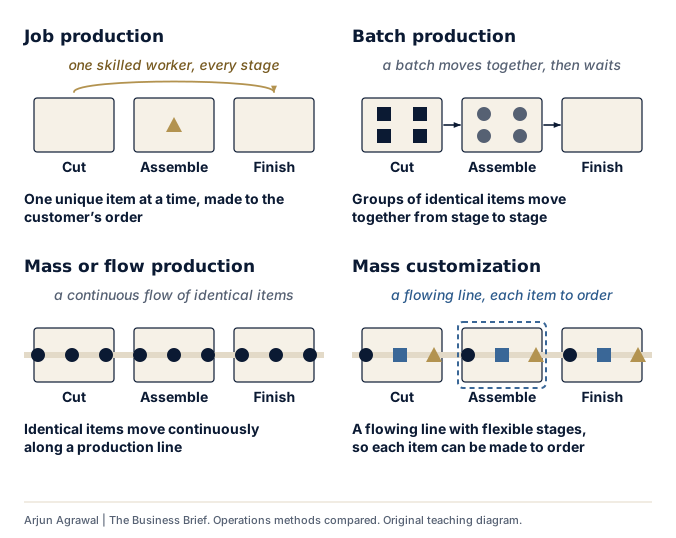
The four operations methods in the guide, each drawn as items moving through three stages, cut, assemble and finish. Job production: one unique item at a time, made to the customer’s order. Volume: one, or a very few; Variety: every item different; Cost per unit: high; Labour: highly skilled, doing many tasks; Flexibility: very high; Example: a wedding dress, a bridge, a website. Batch production: groups of identical items move together from stage to stage. Volume: medium; Variety: some: each batch can differ; Cost per unit: medium; Labour: semi-skilled; Flexibility: medium: machines are reset between batches; Example: bread baked in batches of one type, then another. Mass or flow production: identical items move continuously along a production line. Volume: very high; Variety: little or none; Cost per unit: low: economies of scale; Labour: repetitive tasks, or automated; Flexibility: low: a costly line built for one product; Example: soft drinks, light bulbs, screws. Mass customization: a flowing line with flexible stages, so each item can be made to order. Volume: high; Variety: high: each customer’s choice; Cost per unit: low to medium; Labour: skilled, working with flexible technology; Flexibility: high, within a set range of options; Example: trainers or laptops built to a customer’s choices.
Section 18: Key terms
Defined in the platform's own words. Each opens its full entry.
- Average cost
- Total cost divided by the number of units produced.
- Batch production
- Making products in groups of identical items and then switching the same equipment to a different group, so that a business can offer variety without making each item individually.
- Capital-intensive production
- Production that relies more on machinery, equipment and technology than on people, so that capital is the largest share of its costs.
- Changeover time
- The time taken to switch equipment or a production line from making one product or batch to making another, during which nothing is produced.
- Economies of scale
- The fall in average cost per unit that results from an increase in the scale of a business's operations.
- Job production
- A method of making one-off products, each to the specification of a particular customer, such as a made-to-measure suit or a new bridge.
- Labour-intensive production
- Production that relies more on people than on machinery, so that labour is the largest share of its costs.
- Mass customization
- Combining the low unit costs of mass production with features that each customer chooses, usually by mass-producing standard parts and adding the personal options late in the process.
- Mass production
- Continuous, high-volume production of a standardized product, in which work moves along a line of specialized stages, often automated.
Section 19: Tools and practice
1 tool on the platform for 5.2, by room, with exercises, worked calculations and practice questions.
Practice questions with mark schemes
Section 20: Check your recall
Answer from memory, then reveal and rate yourself. Your ratings stay on this device.
Answer each question from memory, out loud or on paper, before you reveal the answer. Your ratings also schedule these questions in your flashcards.
-
What is job production?
Making each product individually, usually to a particular customer's specification, such as a made-to-measure suit or a bridge.
How well did you recall it? -
Why does batch production involve idle time?
Equipment must be cleaned and reset between batches, and nothing is produced during the changeover.
How well did you recall it? -
Why is flow production the cheapest method per unit at high volume?
Its large fixed costs are spread over a very large output, and specialized, often automated, tasks are done quickly and consistently, giving economies of scale.
How well did you recall it? -
What is mass customization, and what makes it possible?
Making products in volume with features each customer chooses, made possible by flexible technology such as computer-aided design, computer-controlled machines and online configurators, usually adding the choices to standard parts late in the process.
How well did you recall it? -
Give two disadvantages of flow production for employees.
For example, repetitive, closely timed work that can demotivate; narrow skills that are easily replaced; and the risk that automation removes their jobs.
How well did you recall it? -
A line has fixed costs of $50,000 a week and a variable cost of $10 a unit. What is the average cost at 5,000 units and at 25,000 units a week?
$50,000 ÷ 5,000 + $10 = $20 a unit; $50,000 ÷ 25,000 + $10 = $12 a unit.
How well did you recall it? -
Which method suits a wedding cake, bread loaves, soft drinks and trainers designed online?
Job production, batch production, flow production and mass customization respectively.
How well did you recall it? -
Why can mass customization reduce unsold stock?
Many products are made only after the customer has ordered and often paid for them, so the business does not build stock that may not sell.
How well did you recall it? -
Distinguish between labour-intensive and capital-intensive production.
Labour-intensive production relies mainly on people, so labour is the largest cost; capital-intensive production relies mainly on machinery and technology, so capital is the largest cost.
How well did you recall it? -
Name four factors a business weighs when choosing an operations method.
For example, the volume and stability of demand, the nature of the product, what customers value, the finance available, the skills and technology available, and the business's objectives and image.
How well did you recall it? -
Why might a premium brand avoid flow production even if it could afford it?
Its customers pay for individuality and craft; standardized products would weaken the brand and the premium price it supports.
How well did you recall it? -
Method A has fixed costs of $5,000 and a variable cost of $8 a unit; method B has fixed costs of $14,000 and a variable cost of $5 a unit. At what output do they cost the same?
($14,000 − $5,000) ÷ ($8 − $5) = 3,000 units. Above 3,000 units, method B is cheaper.
How well did you recall it? -
Give an example of a batch service and a flow service.
For example, a coach tour or a cinema screening (batch), and a fast-food counter or a car wash (flow).
How well did you recall it? -
Why does a crossover volume calculation not settle the choice of method on its own?
It compares costs only and assumes demand stays above the crossover; the methods also differ in variety, quality, speed and the work people do.
How well did you recall it?
Section 21: How it connects
Where 5.2 meets the rest of the course: worked connections with an exam-style question on each, then the further links the notes name.
-
Scale and the operations method
As output grows, a business can move from job to batch to mass or flow production, and each step makes economies of scale possible. Specialized machinery and a continuous process are technical economies, and buying materials in bulk is a purchasing economy, so unit costs fall as volume rises. The move has costs too: flow production needs heavy investment and a large, steady demand, and it gives up the flexibility of job production. Mass customization tries to keep some of that flexibility at scale. Growth and the choice of operations method are therefore planned together.
Exam-style question Source: Original practice question Command term: Explain (AO2)
Explain how moving from batch production to mass production can create economies of scale. [4 marks]
-
With 2.4 Motivation and demotivation
The production method and the worker
The operations method shapes the job, and so motivation. Job production gives workers varied, skilled work on a whole product, close to the sense of achievement and responsibility that Herzberg counted as motivators. Mass or flow production breaks the work into short, repeated tasks, the division of labour that Taylor favoured, which raises output but can make work monotonous. Businesses using flow production often add job rotation, job enlargement or teamwork to counter that effect.
Exam-style question Source: Original practice question Command term: Discuss (AO3)
Discuss the likely effects on employee motivation of a move from job production to mass production. [10 marks]
Also linked in the notes
- 2.1 Introduction to human resource management A change of method changes jobs, skills and working practices, which can meet the resistance to change that human resource strategies aim to reduce.
- 3.3 Costs and revenues Fixed and variable costs explain why higher volumes cut unit costs, and why idle capacity raises them.
- 3.8 Investment appraisal The investment needed for a new line or a configurator should be appraised before it is made, as Ashgrove's payback periods show.
- 4.2 Marketing planning Niche markets suit job production and mass customization; mass markets suit flow production.
- 5.1 Introduction to operations management The method shapes every operations objective, from cost and quality to flexibility and dependability.
- 5.3 Lean production and quality management At HL, lean production, kaizen and just-in-time cut the changeover times and stock that batch production creates.
- 5.6 Production planning At HL, capacity utilization and productivity measure how fully and how efficiently a method's capacity is used.
See 5.2 on the course connections map, with every link drawn across the five units.
Section 22: Connected learning
Everything else on the platform that teaches, applies or tests 5.2, each labelled by its standing.
- Revise
-
- The 5.2 mindmap Full and revision views, to print or download
- Revision sheet The subtopic on one printable page
- Flashcards The 5.2 cards, to rate as you go
- Practise
-
- 10 questions on 5.2 in the question bank From the practice sets, the notes and the case files, filtered to this subtopic
- Decisions and simulations
-
- Kilbrack Bakery: machines, people and the price of bread Fictional Boardroom simulation
- Tools
-
- 1 tool for 5.2 In Tools and practice on this page: Operations Floor
- Boardroom Briefings
-
- Tasman Loaf Company weighs robots for its packing hall Fictional Briefing 4
- Advanced Management
-
- Operations strategy, process optimization and lean systems Enrichment Operations and supply chain strategy: beyond the IB course
- Course connections
-
- 2 worked connections on the connections map With 1.5, 2.4
Notes checked against: Business management guide, first assessment 2024 (published February 2022, updated May 2022), pp. 33, 41 to 43, 64 to 65 (The content statement and its assessment objective, with the unit's conceptual understandings (p. 33); the papers behind the practice questions (pp. 41 to 43); the formula list, which has no unit cost formula (pp. 64 to 65)); Business management teacher support material, pp. 7, 34 to 35, 47, 80, 85 to 86 (Glossary definitions of batch, job and mass (flow) production and mass customization, and the activities on production methods, read to check definitions and scope; nothing reproduced); Link manufacturing process and product life cycles (The product-process matrix, mentioned as enrichment; cited, not reproduced). Updated 2026-11-20. The IB guide is the authority on the course.
Arjun Agrawal | The Business Brief, https://the-business-brief-dun.vercel.app/topics/operations-methods/. Original teaching material, not an IB publication. The organizations in the teaching cases are fictional unless a case says otherwise.