Unit 5: Operations management
5.3 Lean production and quality management
HL This subtopic is HL only. You are viewing SL content, so treat this page as extension material; switch to HL to set it as part of your course.
Study mode could not start. The page reads as usual.
Study mode
On this page
Section 01: What the IB course asks
The content statements for 5.3, in the platform's words, with the depth of teaching the guide sets (guide, from p. 34).
- Features of lean production: less waste and greater efficiency AO1
- Methods of lean production: continuous improvement (kaizen) and just-in-time (JIT) AO2
- Features of cradle to cradle design and manufacturing AO2
- Features of quality control and quality assurance AO2
- Methods of managing quality: quality circles, benchmarking and total quality management (TQM) AO2
- The impact of lean production and TQM on an organization AO3
- The importance of national and international quality standards AO2
AO1 knowledge and understanding · AO2 application and analysis · AO3 synthesis and evaluation · AO4 a range of skills. A question can use a command term at its statement's level or below. The whole course.
Section 02: Why it matters
Two businesses can buy the same machines, hire people with the same skills and pay the same for materials, yet one delivers faster, wastes less and makes fewer faulty products. Much of the difference lies in how operations are organized. Lean production sets out to remove everything that adds cost without adding value, and quality management sets out to get things right first time rather than finding mistakes at the end.
This HL subtopic covers the features and methods of lean production, cradle to cradle design, quality control and quality assurance, three methods of managing quality and the importance of quality standards (AO1 and AO2), and asks you to evaluate what lean production and total quality management do to an organization (AO3).
By the end you can
- Describe the features of lean production: less waste and greater efficiency.
- Explain kaizen and just-in-time as methods of lean production, and the features of cradle to cradle design and manufacturing.
- Distinguish between quality control and quality assurance.
- Explain quality circles, benchmarking and total quality management, and the importance of national and international quality standards.
- Evaluate the impact of lean production and total quality management on an organization.
Section 03: Lean production: less waste, greater efficiency
Lean production is a way of organizing operations that removes anything which adds cost or time without adding value for the customer. The approach grew out of the Toyota Production System, developed in Japan in the decades after the Second World War, and the name was popularized by researchers at the Massachusetts Institute of Technology in The Machine That Changed the World (1990). The guide names two features, which are two sides of the same idea.
The first is less waste. In lean thinking, waste means far more than rubbish: it is any activity or resource the customer would not willingly pay for. A chair that waits three days between the sanding and finishing benches gains nothing from the wait, yet the business pays for the space, the cash tied up in it and the risk of damage. Lean practitioners usually list seven kinds of waste, below, and many add an eighth: the unused ideas and skills of employees.
The second is greater efficiency: more output from the same or fewer inputs, in less time. As waste is removed, products flow through the process faster, less stock is needed, fewer faults have to be fixed and the same people and machines produce more. Efficiency is not the same as effectiveness, which asks whether the right product is being made at all, and lean production aims at both by starting from what the customer values.
- Overproduction
Making more, or earlier, than customers need. Often called the worst waste, because it creates several others, from storage to stock that is never sold.
- Waiting
People, machines or products standing idle, for materials, information, a decision or the next stage of the process.
- Transport and motion
Moving products between distant workstations or buildings, and people walking, reaching or searching for tools and parts more than the job needs.
- Over-processing
Doing more than the customer requires, such as polishing a hidden surface or filling in a form nobody reads.
- Excess stock
Raw materials, work in progress and finished goods beyond what is needed now, which tie up cash and space and hide problems such as unreliable suppliers.
- Defects
Faulty products that must be inspected, repaired or scrapped, or that reach customers and come back as complaints and returns.
Section 04: Kaizen: continuous improvement
Kaizen, a Japanese word usually translated as change for the better, is the method of improving a process through a continuous stream of small changes, suggested and made by the people who do the work. Instead of waiting for an occasional large project, such as a new machine, every employee is expected to look for better ways of working every day.
The changes are small, cheap and quick to test: moving a tool closer to where it is used, changing the order of two tasks, adding a guide that makes a part impossible to fit the wrong way round. Each saves seconds or prevents an occasional fault, but over months and years hundreds of them add up to large gains in productivity and quality, and because staff design the changes, they understand and support them. Many businesses use a simple cycle: plan a change, do it on a small scale, check the results, and act by adopting it as the new standard or trying something else.
Kaizen works only in the right culture. Employees must be trained, trusted and listened to, managers must act on suggestions quickly, and people must not fear that an improvement will cost a colleague's job. It links closely to empowerment and teamwork in subtopic 2.4, to quality circles, and to incremental innovation in subtopic 5.8. Its weakness is the same as incremental innovation's: small steps may not be enough when a market or a technology changes suddenly.
- Small, frequent steps
Many low-cost changes rather than a few expensive projects, so risk is low and improvement never stops.
- Everyone involved
Ideas come from the people closest to the work, from the shop floor to the office, not only from managers or engineers.
- Standard work
Each improvement becomes the new standard way of doing the job, so gains are kept and become the starting point for the next improvement.
- Plan, do, check, act
A repeated cycle for testing changes on a small scale before adopting them, so decisions rest on evidence.
Text description
Performance over time under two approaches. Kaizen is a staircase of many small, regular improvements suggested by all workers, which together raise performance steadily. The alternative is a flat line followed by one large step, such as a new machine or method, with little change in between. Over the period shown, the small steps add up to more than the single jump.
Advantages
- Improvements are cheap, low-risk and add up over time.
- Staff own the changes, which supports motivation and acceptance of change.
- It uses the knowledge of the people who know the work best.
Limitations
- It needs a culture of trust and training that takes years to build.
- Gains can level off once the obvious improvements have been made.
- Small steps may not be enough when the market needs a radical change.
Section 05: Just-in-time production
Just-in-time (JIT) is the lean method of producing only what is needed, when it is needed and in the quantity needed. Materials and components arrive just before they are used, and products are made to meet actual orders rather than a forecast, so very little stock is held at any stage. Subtopic 5.6 compares JIT with just-in-case stock control and shows stock on a control chart; here the focus is on JIT as a way of running production.
JIT turns production from push into pull. In a push system each stage makes as much as it can and pushes it on to the next, whether or not it is needed, so stock piles up. In a pull system nothing is made until the next stage, or ultimately the customer, asks for it. A common way to signal demand is kanban, a card or empty container that travels back up the line to say that more of a part is needed. To make pull work, businesses make products in small batches, cut the time it takes to change a machine from one product to another, and keep workers multi-skilled so they can move to wherever the demand is.
Holding little stock removes the cushion that hides problems. With a pile of spare parts, a supplier's late delivery or a machine that keeps breaking can be ignored; under JIT it stops the line at once, so the cause has to be fixed. That is the strength of JIT and its risk. It depends on reliable suppliers, often working in close, long-term partnership with the business, on consistent quality and on stable demand, and it leaves the business exposed when a supply chain is disrupted.
- Pull production
Each stage makes only what the next stage has asked for, so work in progress stays low and nothing is made without a customer for it.
- Kanban
A simple visual signal, often a card or an empty bin, that tells the previous stage or a supplier to send more of a particular part.
- Small batches and quick changeovers
Making a few of each product at a time, which is affordable only if machines can be switched quickly from one product to the next.
- Supplier partnerships
Frequent, reliable deliveries of parts that are right first time, usually from a small number of trusted suppliers on long-term contracts.
- Right first time
With no spare stock to replace faulty parts, quality has to be built in, which is why JIT and total quality management usually go together.
Text description
Two charts of stock held over twelve weeks, on the same scale. Just in case: a large delivery every four weeks takes stock to 900 units, and it never falls below a buffer of 300, giving protection against late deliveries and surges in demand but tying up cash and space. Just in time: a small delivery every week brings 150 units that are used up by the end of the week, so little stock is held and less is wasted, but there is no cushion if a supplier is late.
Section 06: Cradle to cradle design and manufacturing
Most products follow a cradle to grave path: materials are extracted, made into a product, used, and thrown away. Cradle to cradle design rejects the idea of waste altogether. Products, and the way they are made, are designed from the start so that at the end of their use every material either returns safely to nature or is recovered as a raw material for new products of equal quality. The idea was set out by the architect William McDonough and the chemist Michael Braungart in Cradle to Cradle: Remaking the Way We Make Things (2002), and it is often summed up as waste equals food.
The design separates materials into two cycles. In the biological cycle, materials such as natural fibres, wood with natural finishes and compostable packaging are designed to break down safely and return nutrients to the soil. In the technical cycle, durable materials such as metals and some plastics are designed to be taken back, separated and remade without losing quality, rather than recycled into something worse. A product that mixes the two in a way that cannot be separated, such as a wooden chair glued to a plastic seat, fits neither cycle, so designers choose safe materials, avoid toxic substances, and make products easy to repair and take apart. Cradle to cradle thinking also favours renewable energy in manufacturing.
Cradle to cradle sits naturally beside the circular business models in the toolkit, such as resource recovery and product life extension, and the teacher support material presents the circular economy as a way of thinking about business that links to all four key concepts. It shares lean production's dislike of waste, but with a different meaning: lean waste is effort and time that add no value, while cradle to cradle waste is material that leaves the economy for good.
- Waste equals food
Every material is designed to become an input to something else at the end of its use, so nothing is simply thrown away.
- Biological cycle
Natural, non-toxic materials that can safely break down and return to the soil, such as untreated timber, natural oils and plant-based fibres.
- Technical cycle
Durable materials, such as metals, that are kept separate so they can be recovered and remade at the same quality again and again.
- Design for disassembly
Products held together with screws and clips rather than glues, so parts can be repaired, replaced or separated into their cycles.
- Take-back
The business collects used products, often in return for a discount on new ones, so the materials come back to it rather than going to landfill.
Text description
Two closed loops. In the biological cycle, products made from natural materials are used, then composted, becoming nutrients for new growth and new materials. In the technical cycle, products made from durable materials are used, taken back and remade at equal quality, so materials stay in use instead of becoming waste. In cradle to cradle design, every material is designed for one of the two cycles.
Advantages
- Lower spending on raw materials, and less exposure to their prices, once materials come back.
- Less waste sent to landfill and less pollution, which supports corporate social responsibility.
- A strong story for customers and a way to meet buyers' sustainability requirements.
- Durable, repairable products can support premium prices and repeat business through take-back.
Limitations
- Redesigning products and finding safe materials takes time and investment.
- It depends on getting used products back, which needs collection systems and willing customers.
- Some materials, such as certain mixed plastics or electronics, are hard to keep in a closed cycle.
- Claims of circularity can outrun reality, which risks accusations of misleading customers.
Section 07: Quality control and quality assurance
Quality means meeting customers' needs and expectations consistently, every time. A cheap product can be of good quality if it does what its buyers expect at that price; a luxury product that fails is of poor quality. Poor quality is expensive: faulty products have to be inspected, repaired or scrapped, and those that reach customers bring refunds, complaints and damage to the brand. The guide distinguishes two approaches to achieving it.
Quality control (QC) is about detection. Products are checked, usually at the end of production or of a stage, often by specialist inspectors testing a sample, and those that fail are repaired or rejected. Quality control stops many faulty items reaching customers, but it does not stop them being made, so the materials, time and energy spent on them are still wasted, and inspection itself adds cost. It can also suggest to workers that quality is the inspectors' job, not theirs.
Quality assurance (QA) is about prevention. Quality is built into every stage of the process through agreed standards and procedures, from the materials suppliers send to the way each task is done and checked by the person doing it. Responsibility for quality moves from inspectors to everyone involved. Because faults are prevented rather than found, waste and rework fall, and the business can show customers that its processes meet agreed standards, which is the basis of certification. Most businesses use both: assurance to prevent faults, and some final checks to catch what gets through.
- Features of quality control
Inspection and testing, often of samples; carried out by specialist inspectors; at the end of production or of a stage; finds faults after they happen; rejects or reworks faulty items.
- Features of quality assurance
Standards and procedures for every stage; checks by the people doing the work; suppliers held to agreed specifications; documented processes; aims to prevent faults; supports certification to quality standards.
- The cost of quality
Spending on prevention, such as training and better design, is usually far cheaper than the cost of failure, which grows the later a fault is found, and is greatest when a faulty product reaches the customer.
Text description
Two production lines, each running from inputs through two processes to finished goods. Under quality control, the only check is an inspection of the finished goods, which finds defects after they are made. Under quality assurance, there is a check at every stage, carried out by the people doing the work, so that defects are prevented rather than found.
Defect rate
Defect rate = units that fail to meet the quality standard ÷ units made × 100
The standard form used in the notes for 5.6; the guide's list of formulae does not include it.
Section 08: Managing quality: quality circles, benchmarking and total quality management
The guide names three methods of managing quality. They work at different levels: a quality circle is a small group tackling problems in its own area, benchmarking compares the business with the best performers elsewhere, and total quality management is a philosophy for the whole organization.
A quality circle is a small group of employees who do the same or similar work and meet regularly, often with a trained leader, to identify, analyse and solve problems of quality and efficiency in their area. The approach was developed in Japan in the 1960s. It draws on the knowledge of the people closest to the work and can motivate them through involvement, but it takes time away from production, and managers must act on its recommendations or staff quickly lose interest.
Benchmarking means measuring a process or a result against the best performer, in the business's own industry or in another, and adopting the better practices found. It turns a vague wish to improve into a specific target based on what someone else already achieves. Total quality management (TQM) goes furthest. It makes every employee, in every department, responsible for quality, with the aims of meeting customers' needs and getting things right first time. Departments treat each other as internal customers, problems are tackled at their source using data, and improvement never stops. TQM needs strong commitment from senior managers and training at every level, and it can take years to become part of the culture.
- Quality circle
A volunteer group of five to ten staff from one area, meeting at set times to find the causes of quality problems and recommend solutions. Supports kaizen and TQM, and gives staff a voice.
- Internal and competitive benchmarking
Internal benchmarking compares branches, sites or teams within the business; competitive benchmarking compares the business with its rivals, whose data can be hard to obtain.
- Functional benchmarking
Comparing one process, such as delivery or customer service, with the best performer at that process in any industry, who may happily share methods because it is not a rival.
- The benchmarking process
Choose what to improve, find a suitable benchmark, collect and compare the data, find the reasons for the gap, adopt and adapt better practices, then measure the results and repeat.
- Principles of TQM
A focus on customers, including internal customers; everyone involved and responsible; right first time; decisions based on data; continuous improvement; and visible commitment from the top.
Section 09: National and international quality standards
A quality standard is a published set of requirements, for a product, a service or the way an organization manages quality, set by a recognized standards body. A business that meets the requirements, usually after an independent audit, can be certified and display a mark or certificate that tells customers so.
National standards are set by a country's own standards body and are often required by its laws or its public-sector buyers; their marks are familiar to customers in that country. International standards apply across borders. The best known in quality management is the ISO 9000 family, from the International Organization for Standardization, under which a business's quality management system can be certified to ISO 9001. Certification shows that the business has documented processes, follows them consistently, measures results and keeps improving, and it is checked by regular audits after the first.
The guide asks for the importance of standards (AO2). They give customers confidence in a supplier they do not know, which matters most when buyers and sellers are far apart. They open doors, because many large businesses and governments buy only from certified suppliers, and an international standard is understood in every export market. They also help internally, by making processes clear and consistent. But certification costs money and staff time, it can bury a small business in paperwork, and it certifies that a process is followed consistently, not that the product is the best available. A business can be certified and still make a product customers do not want.
- National standards
Set by a country's standards body for products, safety or management systems. They suit businesses selling mainly at home, and are sometimes required by law or by public-sector buyers.
- International standards
Recognized across borders, such as ISO 9001 for quality management systems, so one certificate can satisfy customers in many countries.
- Certification and audit
The business documents its processes, an independent body audits them, and regular follow-up audits check that standards are kept, at a cost every year.
- Why they matter
Customer confidence, access to contracts and export markets, consistent processes, a marketing advantage, and evidence for regulators and insurers.
- Their limits
Cost and paperwork, a risk of box-ticking, and the fact that they certify the system rather than guaranteeing an excellent product.
Section 10: The impact of lean production and TQM on an organization
The guide asks you to evaluate the impact of lean production and TQM on an organization (AO3). They touch almost every part of a business, so a strong answer considers costs, quality, cash, customers, employees, suppliers and culture, and then judges the balance for the organization in the case.
When they work, the gains are large and lasting. Costs fall as waste, stock, rework and floor space shrink; cash tied up in stock is released; quality and reliability rise, which wins customers and supports higher prices; and faster, more flexible production lets the business respond to what customers actually order. Employees can gain too, through more varied work, training and a real say in how the job is done, which Herzberg and Deci and Ryan would expect to motivate.
The costs and risks are just as real. Both approaches need heavy investment in training and a change of culture that can take years, during which output may dip. Employees may experience lean not as empowerment but as constant pressure to do more with fewer people, and if improvements lead to job losses, kaizen suggestions dry up. JIT leaves little protection against a supplier's failure or a sudden rise in demand. And many businesses copy the techniques without the culture, introducing kanban cards or quality circles while managers keep the old habits, and then conclude that the methods do not work.
- What it depends on
Senior managers' long-term commitment; a workforce that trusts management and is trained; reliable suppliers; reasonably stable demand; and operations with enough repetition for small improvements to add up.
- Where it fits best
High-volume, repetitive operations such as batch and flow production, and service processes with many identical steps. One-off job production benefits less from standard work and pull systems, although its quality still matters.
- Lean and resilience
Removing buffers saves money in normal times but leaves less room for shocks, so many businesses now keep extra stock of critical parts or a second supplier while staying lean elsewhere.
Advantages
- Lower costs through less waste, stock, rework and space.
- Cash released from stock and work in progress.
- Higher quality and reliability, and a better reputation.
- Faster, more flexible response to customers' orders.
- More involved, skilled and potentially motivated employees.
Limitations
- Training and culture change are costly and slow, and output may dip at first.
- Work can intensify, raising stress, especially if jobs are cut.
- Little stock leaves the business exposed to supply disruptions.
- It depends on reliable suppliers and long-term management commitment.
- Copying techniques without changing the culture usually fails.
Section 11: In practice: industries and stakeholders
The same ideas look different from one industry to the next, and land differently on each group with a stake in the business.
Across industries
- Car manufacturing
The industry where lean production began. Assembly plants receive parts just in time, sometimes several times a day from suppliers located nearby, and workers can stop the line to fix a fault at its source. The same tight supply chains mean a shortage of one component can halt production across a whole region.
- Healthcare
Hospitals and clinics use lean thinking to cut waiting times and the walking and searching that take staff away from patients, and quality means safety above all. Quality assurance through checklists and standard procedures prevents errors, and accreditation to recognized standards reassures patients and those who pay for their care.
- Hospitality
Hotels and restaurants apply TQM by training every employee to solve a guest's problem on the spot and to record it so the cause can be fixed. Benchmarking against the best hotels, often through mystery guests and online reviews, sets the targets, and consistency across branches is a large part of what customers pay for.
- Technology and software
Software teams work in short cycles of small improvements, a form of kaizen, and quality assurance relies on automated testing at every stage rather than inspection at the end. Quality standards for information security matter because business customers often require certified suppliers.
- Food manufacturing
Quality assurance is a matter of safety and law, with procedures controlling every point where food could be contaminated and retailers requiring certified suppliers. JIT suits fresh products with short shelf lives, while cradle to cradle thinking appears in compostable packaging and the recovery of food waste.
- Social enterprise
Many social enterprises are built on cradle to cradle and circular ideas, such as refurbishing furniture or electronics and training disadvantaged people to do it. Kaizen and quality circles suit their participative cultures, but the cost of certification to quality standards can be hard to justify on small budgets, even when buyers ask for it.
For each stakeholder
- Employees
They can gain more varied work, training, responsibility and a voice through kaizen and quality circles. They may also face pressure to work harder and faster, more monitoring, and fear that efficiency will cost jobs, so their support depends on how the change is led and whether gains are shared.
- Customers
They gain better quality, faster and more reliable delivery and, if savings are passed on, lower prices. Certification to quality standards gives business customers confidence, and cradle to cradle products appeal to those who care about waste. They suffer if a lean supply chain fails and orders cannot be met.
- Owners and shareholders
Lower costs, released cash and a better reputation raise profit and the value of the business over time. But the upfront cost of training, reorganization and certification, and the dip in output during the change, fall on them first, so owners focused on short-term returns may resist.
- Suppliers
Lean customers want frequent, small, reliable deliveries of parts that are right first time, often under long-term contracts that give suppliers security. They also push the cost of holding stock back down the supply chain and may require suppliers to be certified, which can strain small firms.
- Managers
They must give up some control to teams, listen to suggestions and lead a long change in culture. Middle managers whose role was to supervise and inspect may feel threatened, which is one reason lean programmes stall.
- Community and environment
Less waste, less stock to store and cradle to cradle design reduce landfill and the use of raw materials. Local suppliers may gain from a preference for nearby deliveries, although efficiency gains can also mean fewer jobs in the area.
Section 12: Evaluation and limits
What to weigh before reaching a judgement.
- Lean production and TQM are cultures, not toolkits. A business that introduces kanban cards and quality circles while managers keep making every decision is likely to conclude, wrongly, that the methods do not work; long-term commitment from the top matters more than any technique.
- The benefits take time and the costs come first. Training, reorganization and a dip in output are certain and immediate, while lower costs and better quality build over months or years, so a business under short-term financial pressure may abandon the change before it pays.
- Removing waste can remove resilience. Little stock and few suppliers save money in normal times, but leave the business exposed when supply chains are disrupted, so a sensible lean business keeps buffers where the cost of running out is high.
- The effect on employees cuts both ways. Kaizen and quality circles can empower people and draw on their knowledge, but lean can also become constant pressure to do more with less; motivation theory suggests the outcome depends on whether staff gain autonomy and share in the gains.
- Quality standards certify that a process is followed consistently, not that a product is excellent or wanted. They can be essential for winning contracts and exporting, yet costly and bureaucratic for a small firm, so their value depends on who the customers are.
- Cradle to cradle design is an ambitious goal that few products fully reach. Its value depends on recovering used products and finding safe materials, and partial steps, such as designing for repair and take-back, are often where a business realistically starts.
Section 13: Make the decision
Use the ideas on a business choice: weigh the options, decide, and say what would change your mind.
Decision brief · a fictional business
How should Ashgrove change?
Ashgrove's owner must decide how to respond to the hotel group's requirements and the workshop's problems. Ashgrove has revenue of $3 million, profit of about $240,000 a year, and 60 employees, many of whom have worked there for decades. All figures are simulated.
The operations manager estimates that a full lean programme would release about $120,000 of cash from work in progress, save about $30,000 a year in faults and let the workshop make more chairs with fewer hours. The hotel group, 40% of revenue, will buy only from certified suppliers from next year and wants furniture designed for take-back.
How to weigh the options
The hotel contract sets a floor: without certification Ashgrove risks 40% of its revenue, so every sensible option includes it. The question is how much more to do, and how fast.
Transforming everything at once offers the largest gains soonest, but its $175,000 cost is about 73% of a year's profit, and the disruption falls on a workforce that has worked the same way for decades. Lean and TQM depend on culture, and culture rarely changes on an 18-month timetable; a failed rollout could leave staff cynical about the whole idea.
Meeting only the customer's demands is cheapest and safest in the short run, but certification does not fix the waiting, the stock or the defects. Ashgrove would still tie up cash in half-finished chairs, still deliver late, and still miss the efficiency gains that would let it compete for new contracts.
Piloting on the chair line keeps the hotel contract, tests the operations manager's estimates on a real product, and lets staff see the benefits before being asked to change everything. Its risk is that a pilot loses momentum, or that the owner treats it as a way of putting off the bigger decision.
A strong answer usually favours certification plus a pilot, with clear targets for the pilot, such as the defect rate and the value of work in progress, and a date for deciding on the rest. It should also address the take-back request, perhaps by redesigning one product first, and say what would change the decision: for example, the hotel group demanding the full redesign by next year, or the pilot showing that staff resist the change.
Section 14: Exam-style practice
Original questions written by the platform in the style of the papers, with what a strong response does. They are not IB questions and the guidance is not an official markscheme.
-
Describe two features of lean production.
What a strong response does
A strong answer describes the two features the guide names, each with a little development:
- Less waste: removing any activity or resource that adds cost or time without adding value for the customer, such as overproduction, waiting, unnecessary movement, excess stock and defects.
- Greater efficiency: producing more output from the same or fewer inputs, in less time, as products flow through the process with fewer delays and faults.
Naming a method such as kaizen or JIT instead of a feature would miss the question, although a method can be used to illustrate a feature.
-
Distinguish between quality control and quality assurance.
What a strong response does
- Quality control detects faults: products are inspected or tested, usually at the end of production or of a stage, often by specialist inspectors, and faulty items are rejected or reworked.
- Quality assurance prevents faults: quality is built into every stage through standards and procedures, with everyone, including suppliers, responsible for the quality of their own work.
- A strong answer makes the contrast explicit, such as detection after the event against prevention before it, or inspectors against everyone, and may add that assurance reduces waste because faulty items are not made in the first place.
-
Pembury Ceramics, a fictional pottery, introduced kaizen in its mug workshop. Before the change, the workshop made 1,200 mugs a day using 300 labour hours, and 60 mugs a day were defective. After the change, it made 1,350 mugs a day using 270 labour hours, and 27 mugs a day were defective. All figures are simulated.
Calculate the defect rate and the labour productivity (mugs per labour hour) before and after the change.
What a strong response does
- Defect rate before: 60 ÷ 1,200 × 100 = 5%.
- Defect rate after: 27 ÷ 1,350 × 100 = 2%.
- Labour productivity before: 1,200 ÷ 300 = 4 mugs per labour hour.
- Labour productivity after: 1,350 ÷ 270 = 5 mugs per labour hour, a rise of 25%.
These are the measures of subtopic 5.6. A full answer shows the working, gives the units, and uses the number of mugs made, not the number of good mugs, as the base for the defect rate.
-
Stridewell, a fictional maker of running shoes, wants to apply cradle to cradle design to its next range.
Explain two features of cradle to cradle design that Stridewell could adopt.
What a strong response does
A strong answer explains two distinct features and applies each to running shoes. For example:
- Separating the biological and technical cycles: an upper made of natural, compostable fibres and a sole made of a durable material that can be recovered and remade, so neither is lost to landfill.
- Design for disassembly: joining the upper and sole with stitching or clips rather than glue, so the shoe can be taken apart at the end of its life and each part sent to its cycle.
- Take-back: collecting worn shoes, perhaps for a discount on a new pair, so the materials return to Stridewell.
Safe, non-toxic materials and the use of renewable energy are also valid features. Each feature should be explained, not just named, and linked to Stridewell.
-
Evaluate the impact of lean production and total quality management on Ashgrove Furniture.
What a strong response does
A strong response uses the evidence from Ashgrove's first year, considers several stakeholders, and reaches a judgement.
- Positive impacts: labour productivity up 25% (0.20 to 0.25 chairs per labour hour); defect rate down from 6% to 2%, saving about $30,000 a year; $120,000 of cash released from work in progress; shorter lead times and more reliable deliveries, which help keep the hotel group's custom.
- Negative impacts: $90,000 of training and reorganization and about $18,000 of lost contribution during the changeover; the workshop stopped when the timber delivery was late, showing the risk of JIT; two experienced craftsmen retired rather than adapt, taking skills with them.
- People and culture: kaizen and quality circles gave staff a voice and produced 140 adopted ideas in six months, which suggests real engagement, but long-serving staff may experience the change as pressure, and support depends on whether gains are shared and jobs protected.
- Judgement: for example, that the impact is positive overall, because the one-off costs are smaller than the cash released plus a few years of savings, provided Ashgrove manages supplier risk with a fallback supplier and keeps staff involved. The best answers state what would change the judgement, such as further supply failures or rising staff turnover.
-
ReNest, a fictional social enterprise, collects unwanted furniture, trains long-term unemployed people to repair it, and sells it at low prices to families moving out of temporary housing. A local council has offered ReNest a large contract, on condition that it introduces formal quality procedures.
Explain two challenges ReNest may face in introducing total quality management.
What a strong response does
A strong response explains two distinct challenges, each developed and applied to ReNest. For example:
- Variable inputs and skills. Donated furniture arrives in every condition and the trainees are still learning, so achieving consistent, right-first-time quality is much harder than in a factory with standard materials and experienced staff.
- Cost and time. Training, documenting procedures and possibly certification cost money and management time that ReNest, with a small budget, would otherwise spend on its social mission.
- Balancing quality and mission. TQM's demand for consistency could push ReNest to take only the best donations or the most skilled trainees, which would conflict with its purpose of helping long-term unemployed people.
- Culture and staff turnover. Trainees move on once they find work, so building the shared, long-term commitment to quality that TQM needs is difficult.
Section 15: Revision summary
The subtopic on one page: what to remember.
- Lean production removes whatever adds cost or time without adding value for the customer. Its two features are less waste (overproduction, waiting, transport and motion, over-processing, excess stock, defects, and unused ideas) and greater efficiency.
- Kaizen is continuous improvement through many small changes by everyone, kept as standard work, often using plan, do, check, act. It needs a culture of trust.
- Just-in-time produces only what is needed, when it is needed, using pull production, kanban, small batches and reliable suppliers. It exposes problems but leaves little protection against disruption.
- Cradle to cradle design means every material returns safely to nature (biological cycle) or is remade at equal quality (technical cycle), through safe materials, design for disassembly and take-back.
- Quality control detects faults by inspection after they happen; quality assurance prevents them by building quality into every stage, with everyone responsible.
- Quality circles are staff groups solving problems in their own area; benchmarking adopts the practices of the best performers; TQM makes quality everyone's job across the whole organization.
- Quality standards, national or international such as ISO 9001, build customers' confidence and open contracts and export markets, but cost money, add paperwork and certify processes rather than excellence.
- The impact of lean production and TQM can be lower costs, released cash, better quality and more involved staff, but they need investment, time and culture change, can intensify work and reduce resilience, and fail when copied as techniques alone.
Section 16: The mindmap
How lean production cuts waste, how kaizen, just-in-time and cradle to cradle design work, and how businesses control, assure and manage quality.
Drag to move the map, or use the arrow keys. Click a branch to fold it away. Whole map shows all of it; zoom with the buttons, or with Ctrl and the scroll wheel.
- Core ideas
- Tools
- Types and forms
- Evaluation
- Advantage
- Limitation
- HL HL only
The map as an outline
Lean production HL
Core ideas
- Definition Cut whatever adds no value Value is judged from the customer's point of view.
- Feature: less waste
- Overproduction, excess stock
- Waiting and needless movement
- Defects and over-processing
- Feature: greater efficiency More output from fewer resources.
Lean methods HL
Tools
- Definition Kaizen: continuous improvement Many small changes suggested by the people who do the work.
- Definition Just-in-time (JIT) Materials arrive as needed; goods are made to order.
- Advantage Frees cash and space
- Limitation Needs reliable suppliers
Cradle to cradle HL
Core ideas
- Definition Every material reused or safely returned
- Designed for repair and disassembly
- Two material cycles Biological materials break down safely; technical materials are recovered and reused.
- Not make, use, throw away A route to a circular business model (toolkit).
Controlling quality HL
Types and forms
- Definition Quality control: inspect Finds and removes faulty items after they are made.
- Definition Quality assurance: prevent Builds quality into every stage, with everyone responsible.
- Defect rate shows the result Measured in 5.6.
Managing quality HL
Tools
- Quality circles Staff groups solve quality problems in their own area.
- Benchmarking Compare with the best performer and adopt better practice.
- Total quality management TQM makes everyone responsible for quality, right first time.
Quality standards HL
Core ideas
- Definition Set requirements, certified
- National: set by a country
- International: e.g. ISO 9000 Recognized across borders, which helps exporters.
- Why they matter
- Advantage Trust and access to contracts
- Limitation Costly; proves process only
Impact on the organization HL
Evaluation
- Advantage Lower costs and less waste
- Advantage Better quality and reputation
- Advantage Involved, motivated staff Kaizen and quality circles use employees' ideas.
- Limitation Training and culture costs
- Limitation JIT exposed to supply shocks
- Limitation Benefits can take years
Open the mindmap on its own page, with its terms and connections.
Section 17: More diagrams
Original diagrams from the platform's library, each with a text description and an SVG download.
Point to an approach or a method, or tab to it, to read what it means; select it to open its subtopic. On a touch screen, the first tap explains and the second opens.
Every part, explained
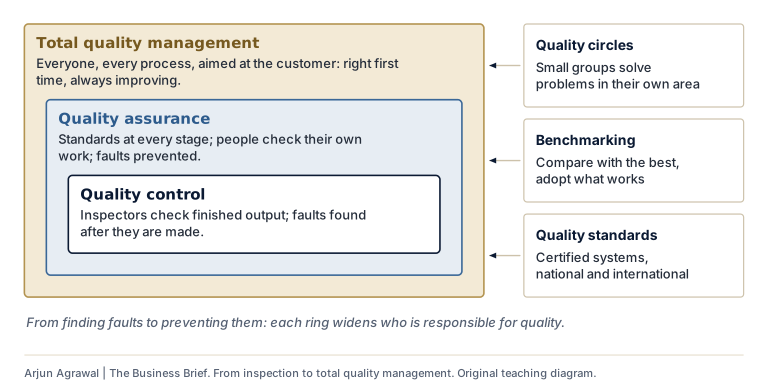
- Quality control Inspectors check finished output and reject or rework what fails: it finds faults after they are made, so the waste has already happened. 5.3 Lean production and quality management
- Quality assurance Standards and procedures for every stage, with checks by the people doing the work and suppliers held to agreed specifications: it prevents faults, and supports certification to quality standards. 5.3 Lean production and quality management
- Total quality management Every employee in every department is responsible for quality, aiming to meet customers’ needs and get things right first time, with improvement that never stops. It needs commitment from the top and years to become the culture. 5.3 Lean production and quality management
- Quality circles Small groups of employees who do similar work meet regularly to find and solve quality problems in their area: they use the knowledge closest to the work. 5.3 Lean production and quality management
- Benchmarking Measuring a process or result against the best performer, inside or outside the industry, and adopting the better practice: a vague wish to improve becomes a target. 5.3 Lean production and quality management
- National and international standards Certification that a business’s quality systems meet an agreed standard: some customers buy only from certified suppliers, and it reassures new ones. 5.3 Lean production and quality management
Text description
Three nested approaches to quality, each wider than the last. At the centre, quality control: inspectors check finished output and find faults after they are made. Around it, quality assurance: standards and procedures at every stage, checked by the people doing the work, which prevent faults and support certification. Around both, total quality management: every employee in every department responsible for quality, focused on the customer, getting things right first time and improving without end. Three methods support them: quality circles, small groups of workers solving quality problems in their area; benchmarking against the best performers; and national and international quality standards, which certify a business’s quality systems.
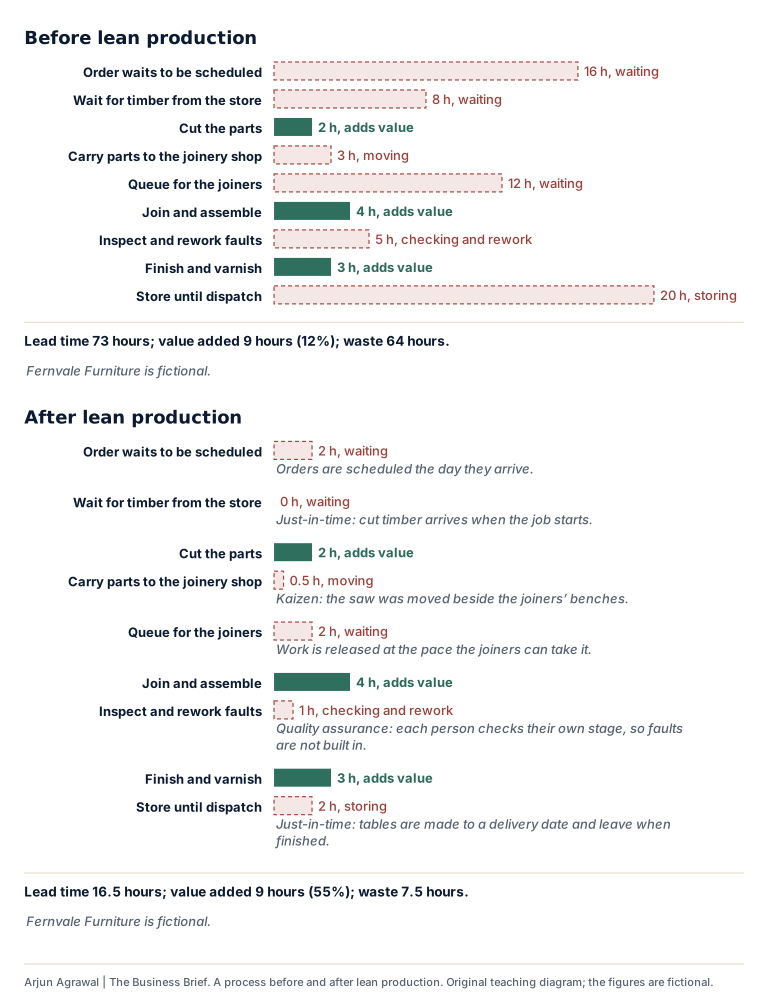
Switch between before and after to see which steps lean production shortens.
Before lean production
9 of 73 hours add value: the rest is waste.
After lean production
The same 9 hours of work, but the order now takes 16.5 hours instead of 73.
Text description
Fernvale Furniture, a fictional workshop, makes a table to order. Before lean production the order takes 73 hours, of which 9 add value (12%). After just-in-time deliveries, kaizen changes to the layout, quality assurance at each stage and making to a delivery date, it takes 16.5 hours, of which the same 9 add value (55%). Lean production cuts waste, the time that adds nothing a customer would pay for, not the work itself.
Text description
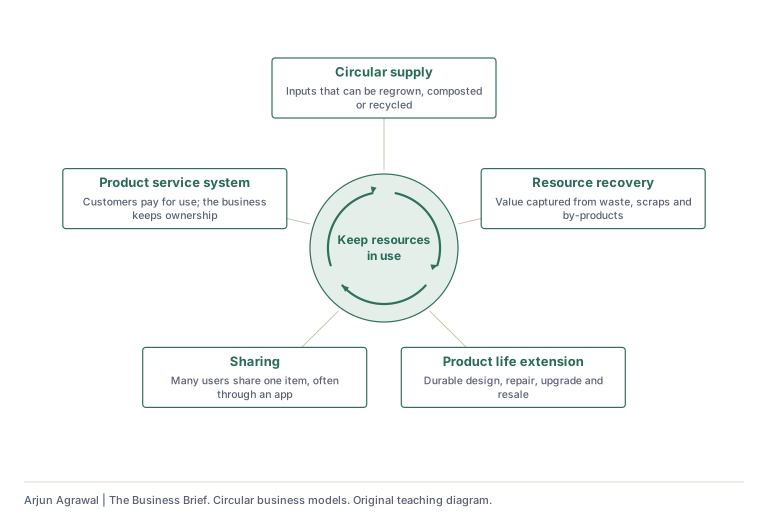
The five circular business models the guide names, around a loop that keeps resources in use. Circular supply: inputs that can be regrown, composted or recycled. Resource recovery: value captured from waste, scraps and by-products. Product life extension: durable design, repair, upgrade and resale. Sharing: many users share one item, often through an app. Product service system: customers pay for use while the business keeps ownership.
Section 18: Key terms
Defined in the platform's own words. Each opens its full entry.
- Benchmarking HL
- Measuring how well a business does something against the best performer, in its own industry or another, and adopting the better practices it finds.
- Cradle-to-cradle design HL
- Designing products and the way they are made so that, at the end of their use, every material can safely return to nature or be recovered as an input for new products, leaving no waste.
- Efficiency
- Producing a given output with as few resources as possible, or getting as much output as possible from the resources used.
- Just-in-time (JIT) HL
- A lean method of production and stock control in which materials arrive just as they are needed and goods are made to meet actual orders, so that little or no stock is held.
- Kaizen HL
- Continuous improvement: a lean method that relies on many small, low-cost changes suggested by the people who do the work, rather than on occasional large projects.
- Lean production HL
- A way of organizing operations that removes anything which does not add value for the customer, such as excess stock, waiting time, defects and unnecessary movement.
- Quality
- How well a good or service meets the needs and expectations of its customers, consistently, every time it is supplied.
- Quality assurance HL
- An approach that builds quality into every stage of a process, by setting standards and procedures that prevent faults rather than finding them at the end.
- Quality circle HL
- A volunteer group of staff from the same area of work who meet at set times to tackle the quality problems they see every day and to recommend improvements to managers.
- Quality control HL
- Checking products, usually at the end of a stage or of production, to find and remove items that do not meet the required standard.
- Quality standard HL
- A published set of requirements for a product, service or management process, set by a national or international body; a business that meets it can usually display a certificate or mark.
- Total quality management (TQM) HL
- A whole-organization approach in which every employee, in every department, takes responsibility for quality, with the aim of meeting customer needs and getting things right first time.
- Waste (in lean production) HL
- In lean thinking, any activity or use of resources that adds cost or time but adds nothing the customer values.
Section 19: Tools and practice
3 tools on the platform for 5.3, by room, with exercises, worked calculations and practice questions.
Practice questions with mark schemes
- Features of lean production 2 marks
Section 20: Check your recall
Answer from memory, then reveal and rate yourself. Your ratings stay on this device.
Answer each question from memory, out loud or on paper, before you reveal the answer. Your ratings also schedule these questions in your flashcards.
-
What are the two features of lean production named in the guide?
Less waste and greater efficiency.
How well did you recall it? -
Name five of the kinds of waste that lean production aims to remove.
For example, overproduction, waiting, unnecessary transport and motion, over-processing, excess stock and defects, and many add the unused ideas of employees.
How well did you recall it? -
What is kaizen, and why does it depend on the culture of the business?
Continuous improvement through many small changes suggested by the people who do the work. It needs employees who are trained, trusted and listened to, and who do not fear that improvements will cost jobs.
How well did you recall it? -
What is the difference between push and pull production?
In push production each stage makes as much as it can and passes it on, so stock builds up. In pull production nothing is made until the next stage, or the customer, asks for it.
How well did you recall it? -
What is a kanban?
A visual signal, such as a card or an empty container, that tells the previous stage or a supplier to send more of a particular part.
How well did you recall it? -
Explain the two cycles in cradle to cradle design.
In the biological cycle, natural materials break down safely and return to the soil. In the technical cycle, durable materials are recovered and remade at the same quality, again and again.
How well did you recall it? -
What is the main difference between quality control and quality assurance?
Quality control detects faults by inspection after products are made; quality assurance prevents faults by building quality into every stage of the process.
How well did you recall it? -
What is a quality circle?
A small group of employees doing similar work who meet regularly to identify, analyse and solve quality problems in their own area and recommend improvements.
How well did you recall it? -
What is functional benchmarking, and why might it be easier than comparing with rivals?
Comparing a process with the best performer at that process in any industry. Because that business is not a rival, it may be willing to share its data and methods.
How well did you recall it? -
Give three principles of total quality management.
For example, a focus on customers including internal customers, everyone responsible for quality, right first time, decisions based on data, continuous improvement and commitment from senior managers.
How well did you recall it? -
Why are international quality standards important to an exporter?
They are recognized across borders, so certification gives unfamiliar foreign customers confidence and meets the requirements of buyers who deal only with certified suppliers.
How well did you recall it? -
Of 900 units made, 27 fail to meet the standard. What is the defect rate?
27 ÷ 900 × 100 = 3%.
How well did you recall it?
Section 21: How it connects
Where 5.3 meets the rest of the course: worked connections with an exam-style question on each, then the further links the notes name.
-
With 2.5 Organizational (corporate) culture
Quality is a culture before it is a system HL
Total quality management and kaizen ask every employee to look for faults and suggest improvements every day. That works only in a culture where staff are trusted, where mistakes are reported rather than hidden, and where suggestions are acted on. In a culture of blame or rigid hierarchy, quality circles become meetings nobody wants, and lean production feels like pressure to do more with less. The impact of lean production and TQM on an organization therefore depends heavily on its culture, and introducing them is itself a change that can cause a clash.
Exam-style question Source: Original practice question Command term: Discuss (AO3)
Discuss the importance of organizational culture when a business introduces total quality management. [10 marks]
-
With 5.1 Introduction to operations management
Operations and quality management HL
Operations management turns inputs into goods and services, and quality is one of the main standards it is judged by, alongside cost, speed and flexibility. Quality control inspects output to find defects after they are made; quality assurance builds checks into every stage so that fewer defects are made in the first place. Total quality management goes further and makes quality every employee's responsibility, supported by quality circles and by benchmarking against the best performers. Lean production joins the two ideas, because every defect is wasted material, time and labour.
Exam-style question Source: Original practice question Command term: Distinguish (AO2)
Distinguish between quality control and quality assurance in a food manufacturer. [4 marks]
Also linked in the notes
- 1.1 What is a business? At HL, lean production and cradle to cradle design take the circular idea into operations.
- 1.3 Business objectives Cradle to cradle design and less waste support corporate social responsibility and the sustainability of the business.
- 2.4 Motivation and demotivation Kaizen, quality circles and TQM depend on empowerment and teamwork, and motivation theory explains when they motivate and when lean feels like pressure.
- 2.7 Industrial/employee relations At HL, quality circles and continuous improvement are forms of employee participation, and lean production depends on cooperative relations.
- 5.2 Operations methods Lean methods suit batch and flow production with many repeated steps, and mass customization relies on the quick changeovers JIT requires.
- 5.6 Production planning Just-in-time is set against just-in-case stock control and shown on stock control charts, and the defect rate measures what quality management sets out to cut.
- 5.8 Research and development Kaizen is incremental innovation applied to processes; neither on its own protects a business from a disruptive change.
See 5.3 on the course connections map, with every link drawn across the five units.
Section 22: Connected learning
Everything else on the platform that teaches, applies or tests 5.3, each labelled by its standing.
- Revise
-
- The 5.3 mindmap Full and revision views, to print or download
- Revision sheet The subtopic on one printable page
- Flashcards The 5.3 cards, to rate as you go
- Practise
-
- 7 questions on 5.3 in the question bank From the practice sets, the notes and the case files, filtered to this subtopic
- Decisions and simulations
-
- Kilbrack Bakery: machines, people and the price of bread Fictional Boardroom simulation
- Corvell Furniture: three years to restore the margin Fictional Boardroom simulation
- Frameworks
-
- Circular business models IB toolkit
- Tools
-
- 3 tools for 5.3 In Tools and practice on this page: Operations Floor
- Boardroom Briefings
-
- Tallowood Cafés is offered the roaster behind its coffee Fictional Briefing 8
- Rowan & Rill's recycled range turns out to be partly recycled Fictional Briefing 10
- Business Intelligence
-
- Two fires at Novelis's Oswego plant cost it $925 million and cut a year's profit by 98% Real-world A real development, 19 May 2026, with its sources
- Advanced Management
-
- Operations strategy, process optimization and lean systems Enrichment Operations and supply chain strategy: beyond the IB course
- Capacity planning, quality management and technology adoption Enrichment Operations and supply chain strategy: beyond the IB course
- Sustainable operations Enrichment Operations and supply chain strategy: beyond the IB course
- Course connections
-
- 2 worked connections on the connections map With 2.5, 5.1
Notes checked against: Business management guide, first assessment 2024 (published February 2022, updated May 2022), pp. 34, 13 to 14 (The seven content statements and their assessment objectives (p. 34); circular business models in the toolkit (pp. 13 to 14)); Business management teacher support material, pp. 48 to 51, 80 to 90 (The pages on the circular economy and circular business models, and the glossary's definitions of benchmarking, cradle-to-cradle design, just-in-time, kaizen, lean production, quality circles and TQM, read to check coverage and terminology; nothing reproduced. No coursebook chapter for 5.3 was supplied). Updated 2026-11-03. The IB guide is the authority on the course.
Arjun Agrawal | The Business Brief, https://the-business-brief-dun.vercel.app/topics/lean-production-and-quality-management/. Original teaching material, not an IB publication. The organizations in the teaching cases are fictional unless a case says otherwise.