Unit 1: Introduction to business management
1.3 Business objectives
Study mode could not start. The page reads as usual.
Study mode
On this page
Section 01: What the IB course asks
The content statements for 1.3, in the platform's words, with the depth of teaching the guide sets (guide, from p. 23).
- Vision statements and mission statements AO2
- Common business objectives, including growth, profit, protecting shareholder value and ethical objectives AO2
- Strategic and tactical objectives AO3
- Corporate social responsibility (CSR) AO3
AO1 knowledge and understanding · AO2 application and analysis · AO3 synthesis and evaluation · AO4 a range of skills. A question can use a command term at its statement's level or below. The whole course.
Section 02: Why it matters
A vision says where an organization hopes to be, a mission says what it is for, and objectives turn both into targets that people can plan for and be judged against. Without them, staff pull in different directions and nobody can tell whether the business is succeeding.
This subtopic follows that chain from the vision down to the tactical objectives of a single team. It covers the four common objectives that the guide names (growth, profit, protecting shareholder value and ethical objectives) and corporate social responsibility: the idea that a business answers for its effects on society and the environment, not only to its owners. Strategic and tactical objectives and CSR are set at AO3, so expect to weigh them, not just describe them.
By the end you can
- Distinguish between a vision statement and a mission statement, and explain how each guides a business.
- Explain the common objectives of growth, profit, protecting shareholder value and ethical objectives, and why they can conflict.
- Compare strategic and tactical objectives, and examine how they fit together.
- Evaluate corporate social responsibility from the point of view of a business and of its stakeholders.
- Apply SWOT analysis, and at HL Porter's generic strategies, to the choice of objectives and strategy.
Section 03: Vision and mission statements
A vision statement says where the organization wants to be in the long term, or what kind of world it wants to help create. It looks ahead and is meant to inspire. A mission statement sets out why the organization exists today: what it does, for whom and why, and often the values it works by. The vision answers "where are we going?"; the mission answers "why do we exist, and how do we behave?"
Both are usually short and broad. Senior managers usually write them, ideally with staff involved, because a statement that nobody believes changes nothing.
Because they are broad, neither can be checked directly; the measurable work is done by the objectives that sit beneath them.
Advantages
- Give a shared sense of direction, and a test for any decision: does it fit our purpose?
- Can motivate staff who share the purpose, and attract recruits who do.
- Tell customers, investors and other stakeholders what to expect.
- Provide the starting point for strategic objectives.
Limitations
- Often vague or generic, so they guide few real decisions.
- Cannot be measured directly, so progress towards them is hard to judge.
- Can become public relations, and a fine statement that behaviour contradicts damages trust.
- Need revising as the business changes, or they stop describing it.
Section 04: Common business objectives
An objective is a target that can be planned for and checked: it says what is to be achieved, usually in numbers, and by when. "Improve customer service" is too vague to be an objective; "answer every customer email within 24 hours by the end of March" is one.
A widely used checklist for writing objectives is SMART: specific, measurable, achievable, realistic and time-bound. Versions differ (some use agreed, attainable or relevant), and the guide does not name it, so treat it as a useful test rather than an IB requirement. And a target can pass every test and still be the wrong target.
The guide names four common objectives. Most businesses pursue several at once, and they can pull against each other.
- Growth
Getting bigger, whether in sales revenue, output, market share, outlets or staff. Size can lower costs per unit through economies of scale, give more power over suppliers and prices, and make the business harder to knock over, but growing costs money and often eats into profit at first.
- Profit
The surplus of revenue over costs. Some businesses aim for the largest profit possible (profit maximization); many are content with a satisfactory profit, because owners also care about keeping control, having a life outside work or staying on good terms with staff, customers and the community. Even organizations with other aims need some profit, or a surplus, to survive and invest.
- Protecting shareholder value
For companies, making the owners' investment worth more over time, through a rising share price and dependable dividends. Managers must weigh how much profit to pay out against how much to reinvest, and avoid gambles or scandals that would knock the share price.
- Ethical objectives
Targets based on what the business believes is morally right, not merely legal, such as sourcing only certified sustainable materials, refusing to advertise to young children or closing the pay gap between men and women. They can win trust and loyalty, but they usually cost money.
- Other common objectives
Survival, above all for a start-up or in a crisis; cash flow; market share; and, for public sector organizations and social enterprises, service to the community or social impact.
Section 05: Why objectives differ and change
Objectives depend on who sets them and on the situation they are in.
Different organizations aim at different things. A sole trader may want a steady income and independence; a publicly held company is under pressure to protect shareholder value; a public sector organization aims to provide a service and at least cover its costs; a social enterprise puts its social impact first.
Objectives also change over time.
- Stage of development. A start-up may aim simply to survive and break even; an established business may aim for growth or market share; a mature one may concentrate on profit and dividends.
- The economy. In a recession, survival and cash flow come before growth; in a boom, growth targets rise.
- Competition. A new rival may force a business to defend its market share at the expense of profit.
- Owners and managers. A new chief executive, a takeover or the retirement of a founder can bring new priorities.
- Stakeholders and society. Pressure from customers, staff, investors and governments has led many businesses to add ethical and environmental objectives.
Targets also shape behaviour, and not always for the better. If bonuses depend on a sales figure, some staff will push products that customers do not need; if they depend on cutting costs, some will skimp on safety. Setting objectives well means checking what behaviour they reward, and many organizations publish a code of ethics alongside them.
Section 06: SWOT analysis: where the business stands
Before setting strategic objectives, managers need an honest picture of where the business stands. SWOT analysis, one of the tools in the business management toolkit, organizes that picture into four boxes.
Strengths and weaknesses are internal: features of the business now, such as its skills, brand, finances, assets or costs. Opportunities and threats are external: changes in its environment that could help or harm it, such as new markets, new technology, rivals, regulation or a recession. A STEEPLE analysis of the external environment often feeds the second half.
A SWOT is a starting point, not a decision. Its value lies in what managers do next: build on strengths to take opportunities, fix or work around weaknesses, and prepare for threats. Those choices become strategic objectives and the strategy to reach them.
Text description
A two by two grid. Internal factors, about the business itself, are strengths, what it does well such as skills, brand, finance and assets, and weaknesses, where it falls short such as costs, gaps in skills, cash or reputation. External factors, about its environment, are opportunities, such as new markets, trends, technology and policy, and threats, such as rivals, recession, regulation and changing tastes. Strengths and opportunities are helpful; weaknesses and threats are harmful. A SWOT lists factors; analysis then weighs which matter most for the decision.
Advantages
- Simple, quick and easy to share, so managers start from the same picture.
- Links the internal position of the business to the changes around it.
- Leads naturally into strategic objectives and strategy.
Limitations
- It can only reflect what managers know, and it cannot list what nobody foresaw.
- People inside a business tend to overrate its strengths and play down its weaknesses.
- A list does not show which factors matter most; they still have to be weighed.
- A snapshot that dates quickly, so it needs regular review.
Section 07: Strategic and tactical objectives
Objectives work at different levels. Strategic objectives are long-term objectives for the organization as a whole, usually several years ahead, set by the board and senior managers. They commit large resources, are hard to reverse and carry high risk: entering a new country, launching a new product range, becoming carbon neutral. Some writers call them corporate objectives.
Tactical objectives are the shorter-term steps that deliver the strategy: targets for a department, team, product or region over months or a year or two, usually set by middle managers. They are more specific and quicker to change: open three shops this year, cut delivery times to two days, recruit twelve engineers by June.
Alongside the objectives sit the plans for reaching them. A strategy is the long-term plan for reaching strategic objectives; tactics are the short-term actions that carry it out. Keep the two ideas apart in answers: an objective is the destination (what), while strategy and tactics are the route (how).
- Time horizon
Strategic objectives look several years ahead; tactical objectives run for a few months, a year, or perhaps two.
- Scope
Strategic objectives cover the whole organization; tactical objectives cover a department, product, region or team.
- Who sets them
Strategic objectives are set by the board and senior managers; tactical objectives by middle managers, often with their teams.
- Resources and risk
Strategic objectives commit large, hard-to-reverse resources with uncertain results; tactical objectives involve smaller, more routine commitments that are easier to adjust.
Text description
A pyramid of four levels, narrow at the top. Vision statement: where the organization wants to be in the long term. Mission statement: its purpose, what it does, for whom and why. Strategic objectives: long-term goals for the whole organization, set by senior managers. Tactical objectives: short- to medium-term goals for parts of the business that deliver the strategy. Each level puts the one above it into practice. Many organizations also set objectives for growth, profit, shareholder value, ethics and corporate social responsibility.
Advantages
- Linking every tactical objective to a strategic one points everyone's work in the same direction.
- Breaking a long-term objective into short steps makes progress visible and keeps people motivated.
- Tactics can change quickly while the strategy holds steady.
Limitations
- Tactical success can undermine the strategy, as when a factory meets its monthly cost target by skipping maintenance and a breakdown later stops production.
- Long-term objectives can go out of date as the environment changes, and pursuing them rigidly wastes resources.
- Objectives imposed on staff who think them unachievable can demotivate, so involving the people who must deliver them helps.
HL Section 08, Porter's generic strategies, is HL only and is hidden while you are viewing SL content. Switch to HL at the top of the page to see it.
Section 08: Porter's generic strategies
HL onlyOnce a strategic objective is set, the business must decide how it will compete to reach it. The management writer Michael Porter argued that there are only a few broad ways to gain a competitive advantage, and that a business should choose one deliberately. His generic strategies are part of the HL toolkit, and the guide suggests using them in unit 1.
The choice rests on two questions. Will the business win through lower cost, or through differentiation, offering something customers value enough to pay more for? And will it target the whole market (a broad scope) or a niche (a narrow scope)?
- Cost leadership
Having the lowest costs in the industry, through scale, efficient processes, cheaper inputs or a stripped-back product. The business can then win on price, or charge the same as its rivals and earn a higher margin.
- Differentiation
Offering something customers see as distinctive and will pay more for, such as design, quality, brand, features or service. It pays only if the extra price exceeds the extra cost.
- Cost focus
Having the lowest costs in a niche, such as the cheapest beds for students in one city.
- Differentiation focus
Offering something distinctive to a niche, such as equipment designed for one sport at the highest level.
- Stuck in the middle
Porter warned that a business that fails to commit to one of these risks ending up neither the cheapest nor clearly different. Some writers disagree, pointing to businesses that manage to combine low cost with a difference customers value.
Text description
A grid of the source of competitive advantage, lower cost or differentiation, against competitive scope, broad or narrow. Cost leadership: the lowest costs in the industry, to win on price or earn more at the same price. Differentiation: something customers value and will pay more for, such as design, quality, brand or service. In a narrow scope, focus applies one of these to a niche, as cost focus or differentiation focus. A business that commits to none risks being stuck in the middle.
Advantages
- Forces a clear choice about how to compete, which then guides objectives and tactics.
- Simple to apply, and to explain to staff and investors.
Limitations
- Real businesses often blend low cost and differentiation, so the categories can oversimplify.
- Advantages wear out as rivals copy them, so a position has to be defended and renewed.
- A label is not a capability: a firm that calls itself a cost leader without the scale or methods to back it up is simply cheap.
Section 09: Corporate social responsibility (CSR)
Corporate social responsibility means a business accepting that it is accountable for how its activities affect people and the planet, and choosing to act for its stakeholders beyond the legal minimum. Obeying the law is what every business must do; CSR begins where the law stops.
In practice CSR reaches every stakeholder group.
- Employees: fair pay, safe conditions, training and a voice in decisions.
- Customers: honest marketing, safe products, and personal data handled with care.
- Suppliers: fair prices and terms, and checks on how workers are treated further down the supply chain.
- The community: local jobs and training, and keeping noise, traffic and pollution down.
- The environment: cutting emissions, waste and water use, and designing products to last.
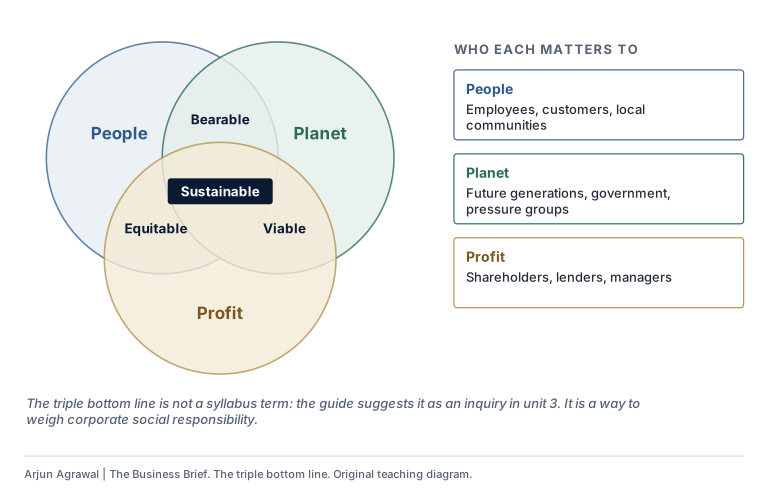
Many socially responsible businesses report on the triple bottom line, an idea introduced by the writer John Elkington: they measure their social impact (people) and their environmental impact (planet) alongside their financial results (profit). The guide uses the same three dimensions in its key concept of sustainability.
CSR is not the same as being a social enterprise. A conventional business that practises CSR still exists mainly to earn a return for its owners, and CSR shapes how it does so. For a social enterprise, the social purpose is the reason it exists.
Section 10: Weighing CSR
Views on CSR differ, and an answer at AO3 should show that.
- It is right in itself. A business uses society's resources and affects many people's lives, so it has duties beyond its owners, whether or not those duties pay.
- It is good business. Responsible behaviour builds reputation and loyalty, helps to recruit and keep staff, lowers the risk of scandals, fines and boycotts, attracts investors who weigh social and environmental risk, and prepares the business for tighter regulation. On this view CSR serves long-term shareholder value.
- It is not the business's job. A company's duty is to earn money for its owners while obeying the law; social goals belong to governments, and managers who spend the owners' money on causes are spending money that is not theirs.
Expectations also change. Practices once seen as generous, such as basic safety standards, are now the legal minimum in many countries, while issues such as emissions, labour conditions in supply chains and the use of customers' data have moved up the agenda. Expectations differ between cultures too, so a multinational may face different standards in each country where it operates.
Advantages
- A stronger reputation and brand, and more loyal customers.
- Easier recruitment, better motivation and lower staff turnover.
- Lower risk of scandals, fines, boycotts and campaigns by pressure groups.
- Access to investors and lenders who screen for social and environmental risk.
- Can spark creativity, such as products designed to be repaired or new uses for waste.
Limitations
- Costs money now, while many of the benefits are uncertain and long term.
- The benefits are hard to measure, which makes them hard to justify to shareholders.
- Claims that run ahead of actions, known as greenwashing, destroy the trust that CSR was meant to build.
- Stakeholders disagree about what is responsible, so a choice that pleases one group can anger another.
Section 11: In practice: industries and stakeholders
The same ideas look different from one industry to the next, and land differently on each group with a stake in the business.
Across industries
- Retail chains
Publicly held retailers are judged quarter by quarter on sales growth, margins and the share price, so protecting shareholder value dominates their objectives, and new stores are a common growth target. Their size makes their supply chains a focus of CSR, and campaigners and investors now ask about the pay and safety of the people who make the products, not only the prices on the shelves.
- Technology start-ups
Survival and growth come long before profit, because investors often accept years of losses in return for users and market share, and a bold vision helps to recruit staff who could earn more elsewhere. The risk is that growth targets crowd out everything else, including ethical objectives on customers' data and privacy.
- Public services
Hospitals, schools and emergency services set service objectives, such as waiting times, results or response times, within a budget, and any surplus goes back into the service. Their missions matter because many staff are driven by purpose, but targets set by government can distort behaviour when hitting the number becomes the point.
- Manufacturing and energy
Strategic objectives stretch over decades because plants and equipment last that long, and environmental objectives, such as cutting emissions, are driven more and more by regulation and investors as well as by choice. Tactical objectives are set plant by plant, on output, cost, safety and waste.
- Family businesses
Owners often value control, continuity and the family name above the largest possible profit or rapid growth, so many aim for a satisfactory profit and steady growth paid for from their own profits. Objectives can change sharply when a founder retires and the next generation, or a buyer from outside, takes over.
- Social enterprises and cooperatives
Social impact is the main objective and profit a means to it, so success is reported through the triple bottom line rather than through profit alone. Balancing the two is a constant tension, because members or funders may disagree about how much surplus to spend on the mission and how much to keep.
For each stakeholder
- Shareholders
They want a rising share price and dependable dividends, which is what protecting shareholder value means, so some resist growth or CSR spending that cuts this year's profit. Long-term investors may back the same spending if it protects the reputation and future earnings of the business, so shareholders do not always speak with one voice.
- Directors and senior managers
They set the vision, the mission and the strategic objectives and are judged against them, and their own pay is often tied to targets, which can tempt them to favour short-term results. Where ownership and control are separate, managers may also pursue growth for the status it brings rather than the returns the owners want.
- Employees
Tactical objectives become their daily targets, and targets tied to bonuses can push them towards behaviour the business would not want, such as overselling or skipping safety checks. Ethical objectives and genuine CSR can make work more meaningful and help recruitment, but staff notice quickly when the mission statement and reality part company.
- Customers
They gain from ethical objectives such as safer products and honest marketing, but they will not always pay more for them, so a business that raises prices to pay for CSR can lose customers to cheaper rivals. Greenwashing like Verdant Home's damages trust, and customers increasingly check claims against the evidence.
- Suppliers
Ethical objectives can bring fairer prices and steadier orders, as Tandem Coffee's switch to fair-trade coffee does for its growers, but cost-cutting objectives often land on suppliers first. Businesses that set CSR standards for their supply chains expect suppliers to meet them, which raises the suppliers' standards and their costs.
- Local communities and pressure groups
CSR programmes such as Inkwell Print's apprenticeships bring local benefits, and pressure groups hold businesses to the objectives they publish. They also push for ethical objectives that owners may resist, and their power grows when the media and customers take up their cause.
Section 12: Evaluation and limits
What to weigh before reaching a judgement.
- Mission and vision statements cannot be measured, but that does not make them worthless, which is the issue behind one of the guide's theory of knowledge questions for this unit. Their value lies in whether they shape real decisions; a statement that behaviour contradicts does more harm than having none.
- Objectives conflict, so the useful question is which comes first, and for how long. Growth and ethical objectives often cost profit in the short run and support it in the long run, while a business short of cash may rightly put survival first.
- Protecting shareholder value and serving other stakeholders clash less over the long term than they appear to, but in the short term they can clash sharply, for example over job cuts or dividends in a downturn. Whose interests come first is a matter of judgement and ethics, not calculation.
- Strategic and tactical objectives work only if they are aligned and revised. Rigid objectives in a changing environment waste resources, and targets that are too demanding can encourage unethical behaviour.
- CSR can be genuine, strategic or cosmetic, and the same activity can be any of the three. Judge it by evidence: what the business does, what it costs, whether it continues when times are hard, and whether it changes the core of the business or only its advertising.
- SWOT and, at HL, Porter's generic strategies help to structure the choice of objectives and strategy, but they do not make it. What comes out of them depends on the evidence and judgement that go in.
Section 13: Make the decision
Use the ideas on a business choice: weigh the options, decide, and say what would change your mind.
Decision brief · a fictional business
Keep the CSR programme in a bad year?
Inkwell Print, the fictional printing company with 70 staff, spends about $35,000 a year on its CSR programme: $14,000 on volunteering days (two paid days a year for each employee, 140 days in all), $12,000 on apprenticeships (the cost above what the apprentices' work brings in) and $9,000 on the extra cost of vegetable-based inks and recycled paper. Last year that was 4% of a profit of $875,000.
This year its largest customer has gone out of business, and profit is forecast to fall to $500,000. Two shareholders propose stopping the whole programme until profit recovers. In surveys, about a fifth of Inkwell's customers, mostly schools and charities, say its recycled paper is one reason they use the firm.
How to weigh the options
Treat the decision as a test of whether Inkwell's CSR is genuine, strategic or cosmetic, and weigh it against its other objectives.
- Keep it all: $35,000 is now 7% of the forecast profit, up from 4% last year, a bigger share of a smaller profit but nowhere near a threat to the firm. Keeping it shows staff, customers and the community that the commitment survives hard times, which is what makes CSR credible.
- Suspend it: it raises forecast profit by $35,000, or 7%, and protects dividends, which serves shareholder value in the short run. But dropping the recycled paper puts at risk the fifth of customers who chose Inkwell partly for it, just after the firm has lost its largest customer, and stopping apprenticeships may make skilled printers harder to find later. A programme that vanishes at the first downturn looks cosmetic.
- Trim it: it saves $7,000 while keeping the parts that matter most to customers, the recycled paper, and to the firm's future skills, the apprentices, and it cuts the part with the least direct effect on the business. Staff may still resent losing a volunteering day, so the reason needs explaining.
A strong judgement compares the saving with what is at risk. If even a few of the schools and charities would leave without the recycled paper, suspending everything could cost more than it saves, which strengthens the case for keeping or trimming; if the downturn threatened the firm's survival, every cost would be open to question. Say what the case does not give: the revenue from the customers who value the paper, and how long the downturn will last.
Section 14: Exam-style practice
Original questions written by the platform in the style of the papers, with what a strong response does. They are not IB questions and the guidance is not an official markscheme.
-
Define the term mission statement.
What a strong response does
A strong response gives a precise definition: a short statement of why an organization exists, setting out what it does, for whom and why, often with the values it works by.
- It is about the organization's purpose now, which distinguishes it from a vision statement, which describes where the organization wants to be in the future.
- A full answer goes beyond "what the business wants to do".
-
With reference to Ridgeway Outdoor, distinguish between a strategic objective and a tactical objective.
What a strong response does
A strong response makes two clear differences, each illustrated with Ridgeway's own objectives.
- Time and scope: a strategic objective is long term and covers the whole organization, such as Ridgeway's aim of earning 25% of its revenue from rentals and repairs within four years; a tactical objective is shorter term and covers one part of it, such as opening rental counters in two shops by May.
- Who sets it and what it commits: strategic objectives are set by the board and senior managers and commit large, hard-to-reverse resources; tactical objectives, such as marketing's target of 1,000 rental members by December, are set by middle managers and are easier to adjust.
- A strong answer shows the link: the tactical objectives are the steps that deliver the strategic one.
-
Dunmore Foods, a fictional food manufacturer, sent 2,500 tonnes of waste to landfill last year. Its strategic objective is to cut that figure by 40% within three years, and its tactical objective for this year is a cut of 15%.
Calculate the most waste Dunmore can send to landfill in three years' time, and the further cut in tonnes it will need after this year to meet its strategic objective.
What a strong response does
- Strategic target: 2,500 × (1 − 0.40) = 1,500 tonnes a year, a cut of 1,000 tonnes.
- After this year's tactical objective: 2,500 × (1 − 0.15) = 2,125 tonnes, a cut of 375 tonnes.
- Further cut needed: 2,125 − 1,500 = 625 tonnes over the next two years.
A strong response shows the working and notices what the figures mean: this year's tactical objective delivers only 37.5% of the total cut, and the remaining 625 tonnes is 29.4% of the waste Dunmore will still be sending at the end of this year, to be removed in the two years that follow.
-
Explain two ways in which Tandem Coffee's objectives for this year conflict.
What a strong response does
A strong response explains two distinct conflicts with the case's figures.
- Ethical against profit: buying only fair-trade coffee from April will cost $45,000 more this year, which pulls profit away from the target of $550,000, a 10% rise on last year's $500,000.
- Growth against profit: the two new cafés are expected to lose $20,000 between them before they find their customers, so opening them also cuts this year's profit.
- The combined effect: profit is likely to be $550,000 − $45,000 − $20,000 = $485,000, a 3% fall, so the profit objective cannot be met alongside the other two. A strong answer may add that growth and ethical sourcing could support profit in later years.
-
Evaluate the proposal by Ridgeway Outdoor's younger staff to replace its waterproof coating with a more expensive alternative that does not pollute rivers.
What a strong response does
A strong response weighs the proposal as a CSR decision, using the case, and reaches a supported judgement.
- For: it is an ethical objective that fits Ridgeway's mission of gear made by people who love the hills; customers who walk in the hills are likely to care about clean rivers, so it can strengthen the brand and set Ridgeway apart from a cheaper rival; it shows staff that their views count, which helps motivation and recruitment; and it prepares the firm for stricter rules on pollution.
- Against: it raises costs just as a large rival is undercutting Ridgeway's prices; it threatens the profit the finance director wants to protect and the dividend two family shareholders depend on; the alternative may not perform as well; and any claim about it must be accurate, or Ridgeway risks the kind of damage that greenwashing brought Verdant Home.
- Judgement: for example, the switch is justified because Ridgeway cannot win on price and its future lies in quality and trust, provided the extra cost per jacket is modest and customers are told honestly what has changed; a phased switch, starting with the best-selling jacket, would limit the risk. A strong answer says what is missing: the extra cost, how the alternative performs, and how much more customers will pay.
When weighing one option, the teacher support material advises at least two arguments for and two against (pp. 56 and 60).
-
Using Porter's generic strategies, analyse why Ridgeway Outdoor chose differentiation focus rather than cost leadership to compete with the foreign brand.
What a strong response does
A strong response uses the two questions behind Porter's strategies, compete on cost or on difference, across the market or in a niche, and applies them to the case.
- Cost leadership is closed: the foreign brand has the scale to produce more cheaply, Ridgeway has six shops, and rising fabric prices squeeze its costs further, so a price war is one it would lose.
- Differentiation fits its strengths: loyal customers, well-reviewed waterproof jackets and a skilled repair workshop give it something customers value and will pay more for, backed by rentals and free repairs for life.
- A focus fits its size: concentrating on serious hikers in cold, wet mountains lets it be the specialist in a segment where a broad brand is less expert.
- Risks: the niche may be too small to reach the revenue its strategic objective needs, the extra price must cover the extra cost, and rivals may copy the service; a strong answer notes that a firm which also tries to match prices risks being stuck in the middle.
HL Question 6 is HL only and hidden while you are viewing SL content. Switch to HL at the top of the page to see it.
Section 15: Revision summary
The subtopic on one page: what to remember.
- A vision statement says where an organization wants to be in the long term; a mission statement says why it exists now, for whom and with what values. Neither can be measured directly.
- Objectives are measurable targets with a deadline. SMART is a useful test of them, although the guide does not name it.
- The guide's four common objectives are growth, profit, protecting shareholder value and ethical objectives. They often conflict in the short run, so managers must decide which comes first.
- Objectives differ with the type of organization and change with its stage of growth, the economy, competition, its owners and what stakeholders expect.
- SWOT analysis sets internal strengths and weaknesses beside external opportunities and threats, as a starting point for strategic objectives.
- Strategic objectives are long-term targets for the whole organization, set by senior managers; tactical objectives are shorter-term targets for parts of it that deliver the strategy. Objectives are the what; strategy and tactics are the how.
- CSR means acting for stakeholders beyond the legal minimum, and the triple bottom line reports on people, planet and profit. Judge CSR by evidence, because it can be genuine, strategic or cosmetic.
- (HL) Porter's generic strategies are cost leadership, differentiation, cost focus and differentiation focus, chosen by asking whether to compete on cost or on difference, across the market or in a niche.
- The guide sets strategic and tactical objectives and CSR at AO3, so expect to evaluate them; vision and mission statements and the common objectives are set at AO2.
Section 16: The mindmap
How a vision and a mission become strategic and tactical objectives, the objectives businesses commonly set, and what corporate social responsibility asks of them.
Drag to move the map, or use the arrow keys. Click a branch to fold it away. Whole map shows all of it; zoom with the buttons, or with Ctrl and the scroll wheel.
- Core ideas
- Types and forms
- Evaluation
- Connections
- Advantage
- Limitation
- HL HL only
The map as an outline
Vision and mission
Core ideas
- Definition Vision: the future it hopes to create
- Definition Mission: its purpose, for whom, with what values
- Vision looks ahead; mission states the purpose now
- Advantage Unite staff and guide decisions
- Limitation Vague, hard to measure, can be mere PR
Strategic and tactical objectives
Types and forms
- Definition Objective: a specific, measurable target
- Best written as SMART objectives Specific, measurable, achievable, realistic and time-bound.
- Strategic: long-term, for the whole organization
- Tactical: shorter-term, supports the strategy
- Strategy: the long-term plan to get there
- Tactics: short-term actions within it
Common objectives
Types and forms
- Growth: more sales, outlets or market share
- Profit: maximize it, or make enough Many firms settle for a satisfactory profit (satisficing).
- Protecting shareholder value A rising share price and reliable dividends.
- Ethical: doing what is morally right
- Also survival, market share and cash flow
- Objectives change as conditions change New rivals, a recession, new owners or a new stage of growth.
Corporate social responsibility
Core ideas
- Definition CSR: responsibility for impact on society
- Goes beyond what the law requires
- Triple bottom line: profit, people, planet
- Rooted in business ethics
- Expectations of CSR keep changing Laws, stakeholder pressure and media scrutiny all move over time.
Evaluating objectives and CSR
Evaluation
- Advantage Objectives focus effort and measure success
- Limitation Imposed or rigid targets can backfire
- Advantage CSR builds reputation, loyalty and trust
- Limitation CSR raises costs; the payback is uncertain
- Limitation Claims without action destroy trust
- Question Whose interests come first? Shareholders, other stakeholders or society as a whole.
Connections
Connections
- Objectives differ by type of entity: 1.2
- Stakeholders shape and contest objectives: 1.4
- Circular business models put CSR into practice
- Growth as an objective: 1.5
Open the mindmap on its own page, with its terms and connections.
Section 17: More diagrams
Original diagrams from the platform's library, each with a text description and an SVG download.
Point to a circle or an overlap, or tab to it, to read what it means; select it to open its subtopic. On a touch screen, the first tap explains and the second opens.
Every part, explained
- People The social bottom line: how the business treats its employees, its customers and the communities it touches, from fair pay and safe work to honest marketing. 1.4 Stakeholders
- Planet The environmental bottom line: the resources it uses and the waste and emissions it leaves, and whether its products can be reused, repaired or recycled. 5.3 Lean production and quality management
- Profit The economic bottom line: whether the business earns enough to survive, reward its owners and invest. Without it, nothing else lasts. 1.3 Business objectives
- Bearable People and planet without profit: good for society and the environment, but it depends on someone paying for it, so it may not last. 1.3 Business objectives
- Equitable People and profit without the planet: fair to people and profitable, but storing up environmental costs for later. 1.3 Business objectives
- Viable Planet and profit without people: efficient and green, but at a cost to workers or communities that can turn stakeholders against it. 1.4 Stakeholders
- Sustainable All three at once: the aim of corporate social responsibility. Few decisions reach it fully; the diagram helps to see which bottom line a decision neglects. 1.3 Business objectives
Text description
Three overlapping circles for the triple bottom line, the idea that a business should be judged on people, planet and profit, not on profit alone. People is the social bottom line: employees, customers and communities. Planet is the environmental bottom line: resources, waste and emissions. Profit is the economic bottom line: whether the business earns enough to survive and invest. Where two circles overlap without the third: people and planet is bearable, people and profit is equitable, and planet and profit is viable. Where all three overlap the business is sustainable, the aim of corporate social responsibility. Around the circles, the stakeholders each bottom line matters most to: employees, customers and local communities for people; future generations, the government and pressure groups for the planet; shareholders and lenders for profit. The guide does not name the triple bottom line as a syllabus term; it suggests it as an inquiry in unit 3, and it is a way to weigh corporate social responsibility (1.3).
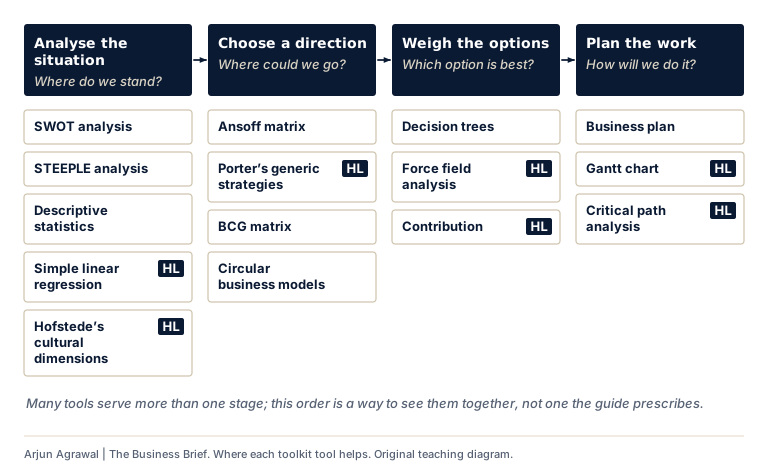
Point to a tool, or tab to it, to read the question it answers; select it to open the framework. On a touch screen, the first tap explains and the second opens.
Every part, explained
- SWOT analysis The question it answers: Where does the business stand before it decides, inside and out? SWOT analysis: the framework explained
- STEEPLE analysis The question it answers: What is changing outside the business that could affect this decision? STEEPLE analysis: the framework explained
- Descriptive statistics The question it answers: What does this data actually show, and how much does it vary? Descriptive statistics: the framework explained
- Simple linear regression (HL) The question it answers: How closely are these two things linked, and what might happen next? Simple linear regression: the framework explained
- Hofstede’s cultural dimensions (HL) The question it answers: How might this country’s culture change the way we manage, sell or negotiate here? Hofstede’s cultural dimensions: the framework explained
- Ansoff matrix The question it answers: Which route to growth suits this business, and how much risk does it carry? Ansoff matrix: the framework explained
- Porter’s generic strategies (HL) The question it answers: On what basis will we beat our competitors, and across how much of the market? Porter’s generic strategies: the framework explained
- BCG matrix The question it answers: Which of our products should we invest in, keep, rethink or let go? BCG matrix: the framework explained
- Circular business models The question it answers: How can the business earn more while using fewer new resources? Circular business models: the framework explained
- Decision trees The question it answers: Taking the risks into account, which option is likely to pay off best? Decision trees: the framework explained
- Force field analysis (HL) The question it answers: What is pushing for this change, what is holding it back, and which force should we work on? Force field analysis: the framework explained
- Contribution (HL) The question it answers: Does this decision add to profit once only the costs it changes are counted? Contribution: the framework explained
- Business plan The question it answers: Is this business idea viable, and can we convince others to back it? Business plan: the framework explained
- Gantt chart (HL) The question it answers: When does each task happen, and is the project on schedule? Gantt chart: the framework explained
- Critical path analysis (HL) The question it answers: How long will the project take, and which activities can we not afford to delay? Critical path analysis: the framework explained
Text description
The fifteen tools of the business management toolkit, placed at the stage of a strategic decision where each helps most. Analyse the situation (where do we stand): SWOT analysis; STEEPLE analysis; Descriptive statistics; Simple linear regression, HL only; Hofstede’s cultural dimensions, HL only. Choose a direction (where could we go): Ansoff matrix; Porter’s generic strategies, HL only; BCG matrix; Circular business models. Weigh the options (which option is best): Decision trees; Force field analysis, HL only; Contribution, HL only. Plan the work (how will we do it): Business plan; Gantt chart, HL only; Critical path analysis, HL only. Many tools serve more than one stage; the order is a way to see them together, not one the guide prescribes.
Section 18: Key terms
Defined in the platform's own words. Each opens its full entry.
- Business ethics
- The application of ideas of right and wrong to business decisions and conduct, including how a business treats people, the environment and the truth.
- Business growth
- An increase in the size of a business, measured for example by sales revenue, output, market share, number of employees, number of outlets or the value of the business.
- Business objective
- A specific result an organization commits to achieving, stated precisely enough to plan for and to check, usually by a set date.
- Circular business models
- Ways of organizing a business so that products and materials stay in use for as long as possible and waste is designed out, instead of following a take, make, use and throw away pattern.
- Corporate social responsibility (CSR)
- A business's acceptance that it is responsible for the effects of its activities on society and the environment, and its commitment to act in the interests of stakeholders beyond what the law requires.
- Ethical objectives
- Targets that commit an organization to doing what it believes is morally right, such as treating workers, suppliers and the environment fairly, even where the law does not require it.
- Mission statement
- A statement of an organization's core purpose: what it does, for whom, and the values that guide how it does it.
- Profit maximization
- The objective of making the largest possible profit, that is, the greatest possible gap between total revenue and total costs.
- Shareholder value
- The value a company creates for its owners, mainly through a rising share price and the dividends it pays.
- SMART objectives
- Objectives that are specific, measurable, achievable, realistic and time-bound, so that everyone knows exactly what is to be achieved and by when.
- Stakeholder concept
- The view that a business should take account of the interests of all its stakeholders when making decisions, not only those of its owners.
- Strategic objective
- A long-term objective for the organization as a whole, set by senior management, that shapes its overall direction.
- Strategy
- The broad, long-term approach an organization chooses to reach its objectives, setting out where it will compete and how it will use its resources.
- Tactical objective
- A short- to medium-term objective, usually for a department, team or period, that helps the organization reach a strategic objective.
- Tactics
- Short-term actions or plans used to carry out a strategy and meet tactical objectives.
- Triple bottom line
- A way of judging an organization's performance by three measures rather than by profit alone: its social impact (people), its environmental impact (planet) and its financial results (profit).
- Vision statement
- A short, aspirational statement of the long-term future an organization hopes to create or the position it hopes to reach.
Section 19: Tools and practice
4 tools on the platform for 1.3, by room, with exercises, worked calculations and practice questions.
Strategy Studio
- Porter's generic strategies IB toolkitHL
- Scenario planner Enrichment
- Strategic fit check Enrichment
- SWOT builder IB toolkit
Section 20: Check your recall
Answer from memory, then reveal and rate yourself. Your ratings stay on this device.
Answer each question from memory, out loud or on paper, before you reveal the answer. Your ratings also schedule these questions in your flashcards.
-
Distinguish between a vision statement and a mission statement.
A vision says where the organization wants to be in the long term; a mission says why it exists now: what it does, for whom and why, often with the values it works by.
How well did you recall it? -
Name the four common business objectives that the guide lists.
Growth, profit, protecting shareholder value and ethical objectives.
How well did you recall it? -
Why might a business aim for a satisfactory profit rather than the largest possible profit?
For example because its owners also care about control or a life outside work, because squeezing out the maximum would harm relations with staff, customers or the community, or because it is giving up profit now for growth later.
How well did you recall it? -
What does protecting shareholder value involve?
Making the owners' shares worth more over time, through a rising share price and dependable dividends, and avoiding decisions that would damage either.
How well did you recall it? -
What is the difference between an objective and a strategy?
An objective is the result the business is aiming for; a strategy is the long-term plan for getting there.
How well did you recall it? -
Give three differences between strategic and tactical objectives.
Strategic objectives are long term, cover the whole organization, are set by senior managers and commit large, hard-to-reverse resources. Tactical objectives are short to medium term, cover a department or team, are set by middle managers and are easier to change.
How well did you recall it? -
What is CSR, and how does it differ from obeying the law?
A business accepting that it is accountable for its effects on people and the environment, and acting for its stakeholders beyond what the law demands. The law sets the minimum; CSR goes further.
How well did you recall it? -
What are the three parts of the triple bottom line?
People (social impact), planet (environmental impact) and profit (financial results).
How well did you recall it? -
Give two reasons why the objectives of a business might change.
For example a recession, a new competitor, a new owner or chief executive, a new stage of growth, or changing expectations from stakeholders.
How well did you recall it? -
At HL, name Porter's generic strategies and the two questions that decide between them.
Cost leadership, differentiation, cost focus and differentiation focus. Will the business win on lower cost or on being different, and will it serve the whole market or one segment?
How well did you recall it?
Section 21: How it connects
Where 1.3 meets the rest of the course: worked connections with an exam-style question on each, then the further links the notes name.
-
With 1.2 Types of business entities
Who owns a business shapes what it aims for
What a business aims for depends partly on who owns it and why it exists. A sole trader or a privately held company can set its own objectives, from profit to independence; a publicly held company is under pressure from its shareholders to protect shareholder value; a cooperative, one of the guide's for-profit social enterprises, serves its members and a social purpose while still having to cover its costs; and a non-governmental organization pursues a cause rather than profit. Comparing the types of entity shows that profit is a common objective, not a universal one.
Exam-style question Source: Original practice question Command term: Explain (AO2)
Explain why the objectives of a cooperative are likely to differ from those of a publicly held company. [4 marks]
-
With 1.4 Stakeholders
Sustainability and stakeholder interests
Sustainability, one of the course's four key concepts, asks a business to meet present needs without compromising the ability of future generations to meet theirs, across people, the planet and profit. Stakeholders weigh these differently: a local community or a pressure group may press for lower emissions and fair treatment of workers, while some shareholders want the highest return in the short term. Corporate social responsibility and ethical objectives are how a business responds. Over time they can reduce conflict between stakeholders, by protecting the brand and helping to attract and keep staff, but they have costs, so in the short term they can sharpen it. Judging whether a sustainable choice serves stakeholders means asking which stakeholders, and over what period.
Exam-style question Source: Original practice question Command term: Evaluate (AO3)
Evaluate the view that adopting ethical objectives must conflict with the interests of a company's shareholders. [10 marks]
-
From business objectives to the marketing plan
Marketing planning starts from the business's objectives. A strategic objective, such as growth or entering a new market, becomes marketing objectives such as a target market share, and the plan then chooses the target market, the position and the marketing mix that should deliver them; tactical objectives set the shorter-term targets along the way. Ethical objectives shape the plan too, ruling out some markets or claims and favouring others. A plan that does not follow from the objectives may be well made and still pull the business in the wrong direction.
Exam-style question Source: Original practice question Command term: Explain (AO2)
Explain the relationship between a business's strategic objectives and its marketing plan. [4 marks]
Also linked in the notes
- 1.1 What is a business? Objectives say what the business is trying to achieve, and CSR and the triple bottom line take them beyond profit.
- 1.5 Growth and evolution Growth is a common objective; 1.5 covers why businesses grow and how they do it.
- 1.6 Multinational companies (MNCs) Ethical objectives and corporate social responsibility decide how an MNC behaves where a host's laws are weak or poorly enforced.
- 2.1 Introduction to human resource management The workforce plan starts from the organization's objectives, and ethical objectives shape how it treats people affected by change.
- 3.5 Profitability and liquidity ratio analysis Profitability ratios measure progress towards profit objectives.
- 3.8 Investment appraisal Objectives, ethics and corporate social responsibility shape the qualitative side of an investment decision.
- 3.9 Budgets Budgets turn strategic and tactical objectives into financial targets for each part of the organization.
- 4.1 Introduction to marketing Whether share matters depends on the business's objectives, such as growth, profit or ethical and social aims.
- 5.3 Lean production and quality management Cradle to cradle design and less waste support corporate social responsibility and the sustainability of the business.
See 1.3 on the course connections map, with every link drawn across the five units.
Section 22: Connected learning
Everything else on the platform that teaches, applies or tests 1.3, each labelled by its standing.
- Revise
-
- The 1.3 mindmap Full and revision views, to print or download
- Revision sheet The subtopic on one printable page
- Flashcards The 1.3 cards, to rate as you go
- Practise
-
- 9 questions on 1.3 in the question bank From the practice sets, the notes and the case files, filtered to this subtopic
- Cases
-
- Larkspur Software Fictional Case Vault
- Marigold Kitchens Fictional Case Vault
- Patchwork Digital Fictional Case Vault
- Decisions and simulations
-
- Kilbrack Bakery: machines, people and the price of bread Fictional Boardroom simulation
- Hotel Mareluce: full rooms or a future Fictional Boardroom simulation
- Corvell Furniture: three years to restore the margin Fictional Boardroom simulation
- Frameworks
-
- Porter's generic strategies IB toolkitHL
- SWOT analysis IB toolkit
- Porter's five forces Enrichment
- SMART objectives Enrichment
- The balanced scorecard Enrichment
- The business model canvas Enrichment
- Tools
-
- 4 tools for 1.3 In Tools and practice on this page: Strategy Studio
- Boardroom Briefings
-
- Mãozinha's founders choose between more cities and a profit Fictional Briefing 6
- Velmar Components weighs a buyback against a factory for electric cars Fictional Briefing 9
- Rowan & Rill's recycled range turns out to be partly recycled Fictional Briefing 10
- Business Intelligence
-
- Microsoft's 2030 climate goals meet the AI build-out Real-world A real development, 14 October 2026, with its sources
- The FCA closes its investigation into Drax's biomass statements without taking action Real-world A real development, 18 June 2026, with its sources
- Car finance lenders face a £9.1 billion bill from the FCA's compensation scheme, now partly suspended Real-world A real development, 30 March 2026, with its sources
- Diageo's Indian subsidiary agrees to sell Royal Challengers Bengaluru for INR 166.6 billion as Diageo cuts its debt Real-world A real development, 24 March 2026, with its sources
- Microsoft retires Skype and moves its users to Teams Real-world A real development, 28 February 2025, with its sources
- Advanced Management
-
- Competitive advantage and industry analysis Enrichment Advanced strategy: beyond the IB course
- Corporate strategy and restructuring Enrichment Advanced strategy: beyond the IB course
- Governance and accountability Enrichment Leadership and organizational behaviour: beyond the IB course
- Sustainable operations Enrichment Operations and supply chain strategy: beyond the IB course
- Course connections
-
- 3 worked connections on the connections map With 1.2, 1.4, 4.2
Notes checked against: Business management guide, first assessment 2024 (published February 2022, updated May 2022), pp. 13 to 14, 23 to 24, 41 to 46 (Content statements and depth, pp. 23 to 24; the sustainability concept and the toolkit, pp. 13 to 14; the unit's inquiry statements and theory of knowledge questions, p. 24; the papers and the rule on command terms, pp. 41 to 46, for the exam-style practice); Business Management for the IB Diploma, pp. 14 to 16, 29 to 31, 84 to 96 (Chapter 1.3 and the toolkit pages on SWOT and Porter, read to check coverage and conventions; nothing reproduced); Business management teacher support material, pp. 56, 60, 63, 82 (How CSR in a conventional business differs from a social enterprise, and the glossary entry for CSR; the advice on answering papers 1 and 2, including the use of HL tools in paper 2, pp. 56 and 60). Updated 2026-11-03. The IB guide is the authority on the course.
Arjun Agrawal | The Business Brief, https://the-business-brief-dun.vercel.app/topics/business-objectives/. Original teaching material, not an IB publication. The organizations in the teaching cases are fictional unless a case says otherwise.