Enrichment map · Governance · Beyond the IB course
Corporate governance
How companies are directed and controlled, from the agency problem and the board's duties to whose interests come first, executive pay, audit and disclosure, and the checks that keep power accountable.
Drag to move the map, or use the arrow keys. Click a branch to fold it away. Whole map shows all of it; zoom with the buttons, or with Ctrl and the scroll wheel.
- Core ideas
- Theories and models
- Applications
- Evaluation
- Advantage
- Limitation
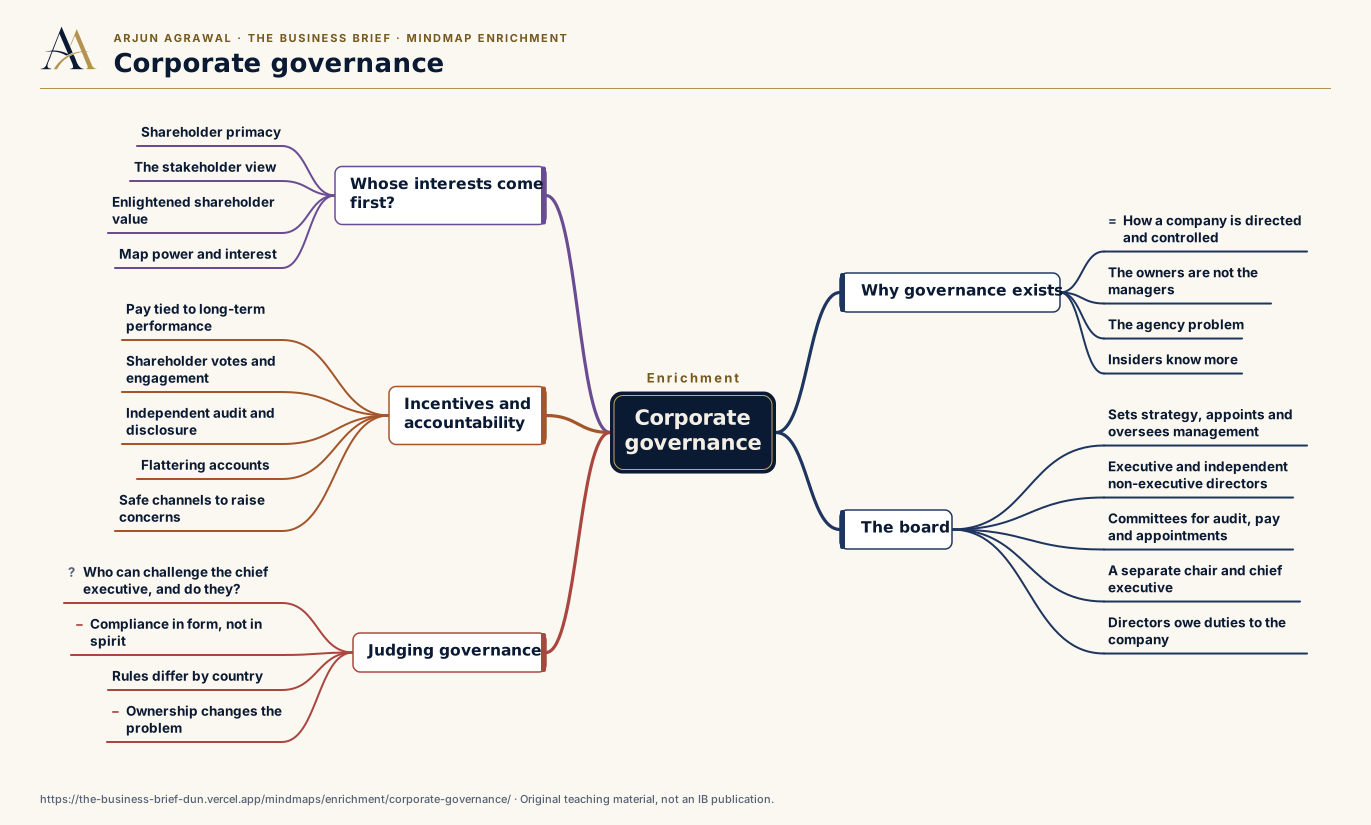
The map as an outline
Why governance exists
Core ideas
- Definition How a company is directed and controlled
- The owners are not the managers
- The agency problem Managers may serve their own interests; monitoring and incentives cost money (Jensen and Meckling).
- Insiders know more Managers know more than shareholders and lenders, who must rely on what they are told.
The board
Core ideas
- Sets strategy, appoints and oversees management
- Executive and independent non-executive directors Independent directors bring scrutiny without a stake in day-to-day decisions.
- Committees for audit, pay and appointments
- A separate chair and chief executive One runs the board, the other runs the company.
- Directors owe duties to the company Good faith, care and skill, and avoiding conflicts of interest; each country's law sets the detail.
Whose interests come first?
Theories and models
- Shareholder primacy Run the company for its owners' long-run value.
- The stakeholder view Balance employees, customers, suppliers, communities and owners.
- Enlightened shareholder value Long-run value for owners depends on treating stakeholders well.
- Map power and interest
Incentives and accountability
Applications
- Pay tied to long-term performance Badly designed targets invite short-termism and gaming.
- Shareholder votes and engagement Votes on directors and pay, and stewardship by large investors.
- Independent audit and disclosure Assurance that the accounts are fairly presented.
- Flattering accounts What audit and disclosure rules try to stop.
- Safe channels to raise concerns Whistleblowing routes let insiders report wrongdoing.
Judging governance
Evaluation
- Question Who can challenge the chief executive, and do they?
- Limitation Compliance in form, not in spirit Ticking the boxes of a code without changing behaviour.
- Rules differ by country Some countries rely on codes applied on a comply-or-explain basis, others mainly on law.
- Limitation Ownership changes the problem Family and state owners create different conflicts from those of dispersed shareholders.
Download the full map as an SVG file Works without JavaScript; the buttons above also save the view you have open.
Section 01: Where it starts from the IB course
For readers who know the IB course: the subtopics this map builds on. The map goes further than any of them.
- 1.2 Types of business entities Privately and publicly held companies
- 1.3 Business objectives Objectives and corporate social responsibility
- 1.4 Stakeholders Stakeholders, their conflicts and stakeholder mapping
- 3.4 Final accounts The final accounts that audit checks
Section 02: Related enrichment maps
- Corporate finance How profit is shared between payout and reinvestment
- Sustainable business strategy Boards and environmental and social risk
- Organizational behaviour Incentives and behaviour
Section 03: Terms on the map
Where an idea on the map is the same as a term in the platform's glossary, the node links to it. The glossary defines each term as the IB course uses it.
How this map was written
The platform's own summary of established ideas about corporate governance, written for the MBA and undergraduate pathways. It goes beyond the IB course and is aligned to no university course or textbook, because none was supplied. It states no country's law or code; each sets its own rules. Ideas are named with the people usually credited with them; their works were not opened for this map.
Arjun Agrawal | The Business Brief, https://the-business-brief-dun.vercel.app/mindmaps/enrichment/corporate-governance/. Original teaching material, not an IB publication. The organizations in the teaching cases are fictional unless a case says otherwise.