Unit 1: Introduction to business management
1.4 Stakeholders
Study mode could not start. The page reads as usual.
Study mode
On this page
Section 01: What the IB course asks
The content statements for 1.4, in the platform's words, with the depth of teaching the guide sets (guide, from p. 24).
- Internal and external stakeholders AO2
- Conflict between stakeholders AO2
AO1 knowledge and understanding · AO2 application and analysis · AO3 synthesis and evaluation · AO4 a range of skills. A question can use a command term at its statement's level or below. The whole course.
Section 02: Why it matters
Every decision a business takes lands on people: the staff who carry it out, the customers who pay for it, the neighbours who live next to it. These people are its stakeholders, and they are not passive. They can buy elsewhere, strike, lend on harder terms, campaign or pass new laws.
This subtopic gives you two things the examination asks for again and again: a way to name the groups a decision affects, inside and outside the business, and a way to analyse why their interests pull in different directions. Almost every Paper 1 and Paper 3 answer is stronger when it says which stakeholders gain, which lose, and how much each can push back.
By the end you can
- Define a stakeholder and distinguish it from a shareholder.
- Distinguish between internal and external stakeholders, with the objectives of each group.
- Explain why stakeholders' objectives conflict, and where they overlap.
- Analyse a decision for its effect on two or three stakeholder groups, using their power and interest.
- Apply stakeholder mapping to decide how a business should treat each group.
- Explain how the type of organization changes which stakeholders matter and how much power each holds.
- Analyse where stakeholders' objectives overlap as well as where they conflict, and trace a decision's effect on each group with figures.
Section 03: What a stakeholder is
A stakeholder is any individual, group or organization that is affected by a business's activities or can affect them. The relationship runs both ways: the business needs things from its stakeholders (work, money, custom, permission) and they want things from it in return.
Each group joins the relationship for its own reasons, so each has its own objectives. That is the root of everything else in this subtopic: a decision is never good or bad for "the business" alone, but better for some stakeholders and worse for others.
- Stakeholder
Anyone affected by, or able to affect, what the business does.
- Shareholder
An owner of part of a company, through its shares. Shareholders are one stakeholder group among many; the two words are not interchangeable, and confusing them costs marks.
- Stakeholder objectives
What a group wants from the business, such as fair pay, low prices, reliable orders, prompt repayment or a quiet neighbourhood.
Section 04: Internal and external stakeholders
Internal stakeholders are part of the organization: the people who work in it and the people who own it. External stakeholders are outside it but are affected by what it does, or can influence it.
Textbooks differ on where to put shareholders. Owners are usually counted as internal stakeholders, because they belong to the organization; some writers treat outside investors in a large public company as external. Say which view you take if it matters to your answer.
- Employees (internal)
Want fair pay, job security, safe conditions, training and respect. They can work harder, or leave, or take industrial action.
- Managers and directors (internal)
Want rewards, status and the success of the part of the business they run. They make many decisions, so their objectives shape those of everyone else.
- Owners and shareholders (internal)
Want profit, dividends and a rising share price, or, in a small firm, a living and independence. In a large company they can vote out the directors.
- Customers (external)
Want quality, value, choice and good service. Without them there is no revenue, which makes them among the most influential groups.
- Suppliers (external)
Want regular orders, fair prices and prompt payment. A supplier with few rivals has a great deal of power over its customer.
- Lenders (external)
Banks and other creditors want interest and repayment on time. They can refuse further credit or raise its price.
- Government (external)
Wants taxes paid, laws obeyed, jobs created and growth. It sets the rules everyone else plays by.
- Local community (external)
Wants jobs and local spending, but also little noise, traffic or pollution.
- Pressure groups (external)
Campaign on a cause, such as the environment or animal welfare, through publicity, boycotts and lobbying.
- Competitors (external)
Affected by the business's prices and products, and able to respond with their own.
Text description
Concentric circles around the business. The inner ring holds the internal stakeholders: employees, managers and directors, and owners and shareholders. The outer ring holds the external stakeholders: customers, suppliers, lenders, the government, the local community, pressure groups and competitors. Textbooks differ on shareholders, who are usually counted as internal. Stakeholders’ interests overlap and conflict, for example over wages, prices, profit and the environment.
Section 05: Stakeholders in different kinds of organization
Every organization has stakeholders, but which groups matter most, and how much power each holds, depends on the kind of organization it is (1.2).
In a sole trader or a small partnership, the owners usually run the business themselves, so the conflict between owners and managers hardly arises; the groups with most power over the owner are often the bank, a few large customers and key suppliers. In a privately held company, a small number of shareholders, often members of one family, own the business, and they may disagree among themselves about dividends, growth and who should run it next. In a publicly held company, thousands of shareholders own the business while professional directors and managers run it, the divorce of ownership and control, so managers' objectives can drift away from the owners', and large investors, analysts and the media watch them closely.
Social enterprises and non-governmental organizations add groups that a conventional business may not have: the beneficiaries they exist to serve, donors and grant-makers, and volunteers. In a cooperative, the members are its owners and also its customers, workers or suppliers, so two stakeholder roles sit in the same people. And in the public sector, the government owns the organization on citizens' behalf, so taxpayers, the people who use the service and elected politicians all have a stake, and decisions are judged on social as well as financial grounds.
- Sole traders and partnerships
The owners usually manage the business, so their objectives are its objectives; outsiders such as the bank, major customers and key suppliers often hold the most power over it.
- Publicly held companies
Shareholders own the company and directors run it, so the divorce of ownership and control can set managers' objectives, such as growth, status or their own pay, against the owners' returns.
- Cooperatives
Members own and control the business democratically, usually one member, one vote, and are also its customers, workers or suppliers, so conflicts that would lie between groups elsewhere arise among the members themselves.
- Social enterprises and NGOs
Beneficiaries, donors, funders and volunteers join the usual groups. The people the organization serves often have the most at stake and the least power, so its mission has to speak for them.
- Public sector organizations
Owned by the government on behalf of citizens. Taxpayers, service users and politicians all have claims, and the objectives include social ones, such as access for everyone, that a private business would not have to meet.
Text description
The private sector, owned by individuals or investors, and the public sector, owned and run by the government. For-profit businesses in the private sector run from sole traders, with one owner, and partnerships, with two or more owners, both with unlimited liability, to privately held companies, whose shares are sold privately, and publicly held companies, whose shares are traded on a stock exchange, both with limited liability. Social enterprises put a social purpose first. For-profit social enterprises are private sector companies, public sector companies and cooperatives; their surpluses are reinvested in the purpose or shared with members. Non-governmental organizations are non-profit social enterprises funded by donations and grants. Public sector companies are owned by the state and the guide lists them among the for-profit social enterprises.
Section 06: How stakeholders push back
Stakeholders do not just receive decisions; they respond to them. How strongly a group can respond depends on how much the business depends on it, how organized it is, and whether it has alternatives.
- Shareholders can sell their shares, or vote against the directors.
- Employees can leave, refuse overtime or, through a union, strike.
- Customers can buy from a rival or complain in public, often on social media.
- Suppliers can raise prices, demand payment on delivery or stop supplying.
- Lenders can refuse new loans or set higher interest rates.
- Government can tax, regulate, fine or license.
A group's power is not fixed. One large shareholder holding 60% of the shares can decide alone; a thousand holders of tiny stakes rarely act together. A supplier of a rare component is powerful; a supplier of something sold by many firms is not.
Section 07: Conflict between stakeholders
Stakeholders conflict because their objectives differ and the business has limited money, time and attention to share among them. A gain for one group is often a cost for another: higher wages may mean lower profit; lower prices may mean lower wages or squeezed suppliers.
Conflict is not inevitable, though. Over the long term many objectives overlap: a profitable, well-run business can pay better wages, reward its owners, keep its customers and pay its taxes. The analysis that earns marks shows both: where interests clash in the short run, and whether they meet in the long run.
- Owners against employees
Owners may want to cut costs to raise profit; employees want pay rises and job security.
- Customers against owners
Customers want low prices; owners want healthy profit margins.
- Business against community
Expansion brings jobs, but also traffic, noise and pressure on local services.
- Managers against owners
Where ownership and control are separate, managers may pursue growth, status or their own rewards rather than the owners' returns.
- Government against business
Environmental and employment rules protect society, but raise costs and prices.
Section 08: Where stakeholders' objectives meet
Conflict between stakeholders is real, but it is only half of the picture: a strong analysis of a conflict also asks where the groups' interests meet. Over a longer period many objectives overlap. Customers who are well served come back; employees who are treated fairly stay longer and work better; suppliers who are paid on time give priority in a shortage; a community that gains from a business supports it when it wants to expand. Serving these groups well can also serve the owners.
Two broad views describe how a business should weigh its stakeholders. The shareholder view holds that a company exists to make returns for its owners, and should meet other groups' needs as far as the law requires and as far as doing so pays. The stakeholder view, usually traced to R. Edward Freeman's Strategic Management: A Stakeholder Approach (1984), holds that every group with a stake has a legitimate claim, and that managers should balance those claims rather than simply rank the owners first. This second view is often called the stakeholder concept, and corporate social responsibility (1.3) is one way of putting it into practice.
In practice most businesses sit between the two, and the difference shows most clearly when serving one group costs another, as in Moorlink's decision about its bus route below. The overlap is strongest in the long run and where stakeholders can respond. It is weakest when one group's gain is another's immediate loss and the losing group has little power, which is exactly when ethics, the law and corporate social responsibility matter most.
- Shareholder view
The business serves its owners first, within the law, and serves other groups because, and as far as, doing so raises the owners' returns.
- Stakeholder view (the stakeholder concept)
The business takes account of the interests of all its stakeholders when it decides, treating their claims as legitimate in their own right, not only as means to profit.
- Shareholder value
The value a company creates for its owners, mainly through a rising share price and dividends; one of the common business objectives in 1.3.
- Triple bottom line
Judging performance by people, planet and profit rather than by profit alone, the way the guide describes sustainability, one of the course's four key concepts (p. 13).
Advantages
- Trust and loyalty from employees, customers and suppliers lower costs and support sales over time.
- Fewer surprises, because groups that are heard are less likely to campaign, strike or call in regulators.
- It matches the rising expectations of customers, employees and investors that businesses behave ethically.
Limitations
- Balancing many groups can blur objectives and slow decisions.
- The benefits are long-term and hard to measure, while the costs are immediate and certain.
- Talk of serving stakeholders can become a cover for managers pleasing themselves, because no single group can hold them to account.
- A business fighting to survive may not be able to afford to put long-term relationships first.
Section 09: Stakeholder mapping
Managers cannot satisfy every group equally, so they need a way to decide whose views to put first for a particular decision. Stakeholder mapping plots each group by its power over the business and its interest in the decision.
It is a widely used planning tool, though the guide does not name it, so treat it as a recommended way to structure your analysis rather than an IB requirement.
- Manage closely (high power, high interest)
The key players. Consult them early and involve them in the decision.
- Keep satisfied (high power, low interest)
Make sure the decision does not provoke them, for example a major lender.
- Keep informed (low power, high interest)
Explain the decision and listen, for example local residents.
- Monitor (low power, low interest)
Little effort is needed, but watch for changes.
- Salience (enrichment)
Ronald Mitchell, Bradley Agle and Donna Wood (1997) argued that managers attend to stakeholders according to three attributes, power, the legitimacy of their claim and its urgency, not power alone. It is beyond the guide, but it separates who can push back from whose claim is fair, and the platform's stakeholder salience tool applies it.
Text description
A two by two grid with power on the vertical axis and interest in the decision on the horizontal axis. High power and low interest: keep satisfied. High power and high interest, the key players: manage closely. Low power and low interest: monitor. Low power and high interest: keep informed. It is a widely used planning tool, not one the guide names, and a stakeholder’s position changes from one decision to the next.
Advantages
- Shows managers where to spend their time and attention.
- Helps to anticipate opposition before it becomes a problem.
- Makes the trade-offs in a decision visible to everyone involved.
Limitations
- Placing a group is a judgement, and different managers will place it differently.
- Power and interest change, sometimes quickly, so a map soon goes out of date.
- Groups can join forces: weak groups acting together, or with the media, can become powerful.
- It can be used to justify ignoring groups with little power, which raises ethical questions.
Section 10: How businesses manage the conflict
There is no single answer, but businesses tend to combine several approaches.
- Communicate and consult. Explaining a decision, and listening before it is made, often reduces opposition.
- Compromise. Phase a change in, share a gain, or offer something in return, such as retraining when jobs change.
- Prioritize. Use the power and interest of each group, and the business's own objectives, to decide whose interests come first this time.
- Take a wider view. Some organizations follow the stakeholder concept, treating all stakeholders as partners whose interests matter, often through corporate social responsibility. Others put shareholders first and meet other groups' needs only as far as the law and good business require.
Advantages
- Consulting early builds trust and can bring better ideas into the decision.
- A reputation for treating stakeholders fairly helps with recruitment, sales and finance.
Limitations
- Consultation takes time and money, and can slow decisions down.
- Some conflicts have no compromise: a factory either closes or it does not.
Section 11: Analysing a decision for its stakeholders
Examination questions on stakeholders almost always attach them to a decision: a move, a closure, a price change, a new product. A clear method keeps the analysis on the case rather than on stakeholders in general.
- Name the decision and what it changes.
- Choose the two or three groups most affected, inside and outside the business, and say what each wants.
- Trace the effect on each, with the case's evidence and, where there are figures, with numbers.
- Judge each group's likely response: how much power does it have, and how is it likely to use it?
- Look for conflict and for common ground, and for ways the business could reduce the conflict.
- Weigh which effects matter most for this business and its objectives.
Internal and external is the classification the guide uses, but not the only one. Some writers separate primary stakeholders, without whom the business could not operate, such as customers, employees and suppliers, from secondary ones, who are affected but are not essential to its daily operation, such as pressure groups and the media. The teacher support material's glossary also mentions a division into market stakeholders, who trade with the business, and non-market ones, who do not (p. 89). Use either only if it sharpens an answer: the guide does not require them.
The platform's stakeholder map takes you through steps 2 to 4 for a decision of your own, and Mendelow's matrix explains the grid behind it. Both are enrichment, since the guide does not name stakeholder mapping.
Section 12: In practice: industries and stakeholders
The same ideas look different from one industry to the next, and land differently on each group with a stake in the business.
Across industries
- Mining and energy
Local communities, landowners and environmental groups have an unusually strong interest, because a mine or a wind farm changes the land around it for decades, and governments hold the licences without which nothing can happen. Businesses in these industries often talk of needing a social licence to operate, the acceptance of the people nearby, which can be lost long before any law is broken.
- Healthcare
Patients, staff, the government that funds care and the taxpayers behind it all have a high interest, and their objectives collide over waiting times, budgets and pay. Clinical staff hold unusual power through their scarce skills and their professional bodies, so changes imposed without them rarely succeed.
- Clothing retail
Customers want low prices and constant new ranges, which pushes retailers to squeeze their suppliers, while the workers who make the clothes, often far away, have a high interest but little power of their own. Pressure groups and the media can act on those workers' behalf, which is how a group with little power can suddenly matter to a retailer's reputation.
- Technology platforms
Users, advertisers, the people who create content and regulators all have a stake, and a platform's revenue may come from one group while its value comes from another. Disputes over data, privacy and what may be posted show how users, each with almost no power alone, gain it through their numbers, publicity and regulators.
- Banking
Savers want their money safe, borrowers want credit on good terms, shareholders want returns and regulators want a stable financial system, so the bank's appetite for risk is the central conflict. Because a bank's failure harms people far beyond its owners, governments act as an especially powerful stakeholder.
- Social enterprises
The people a social enterprise serves are often not the people who pay, so beneficiaries, paying customers, funders, staff and volunteers all have to be weighed, and the beneficiaries may have the most interest and the least power. That is why the HL Paper 3, set on a social enterprise, asks students to make decisions for its stakeholders.
- Professional sport
A football club's supporters have an interest few customers share, often for life, and little formal power, while owners, players, broadcasters, sponsors, the league and the town all have a stake. Decisions about ticket prices, kick-off times set for television or a move to a new stadium regularly set supporters against owners and broadcasters, and organized supporters' groups can win the attention of the media and of politicians.
- Airports
Expanding an airport pits airlines, passengers, business groups and often the government, which want more capacity and jobs, against residents under the flight paths and environmental groups, which want less noise and fewer emissions. Because the effects last for decades and permission is needed, the conflict is settled through planning processes, consultation and compensation as much as through markets.
For each stakeholder
- Employees
Their interest in most decisions is high, but their power depends on how scarce their skills are and whether they act together, so a stakeholder map often leaves them to be kept informed rather than managed closely. Consultation gives them a voice before decisions are made, and their conflicts with owners over pay and jobs are among the commonest in business.
- Owners and shareholders
They hold formal power over the business and expect their objectives to come first, a view the stakeholder concept qualifies by treating other groups as partners too. In large companies they also conflict with the managers who run the business on their behalf.
- Managers
They decide how to weigh every other group and are judged on the result, so they feel the conflicts most directly. Their own job security, status and bonuses are a stake as well, and stakeholder mapping is a tool they apply, which is why its judgements are open to bias.
- Customers
Their power rises with the number of alternatives they have and the ease of complaining in public, and falls when one supplier dominates. Their wish for low prices conflicts with owners' margins and employees' pay, though a business that serves them well usually serves its owners well too.
- Suppliers
Their power depends on how replaceable they are, as Fernhill Furniture's suppliers of screws and of walnut veneer show. They conflict with the business over prices and payment terms, but a long relationship can turn a supplier into a partner whose interests overlap with the firm's.
- Local communities and pressure groups
They often have the least formal power and the most to lose from noise, traffic or pollution, which is why a stakeholder map can tempt managers to overlook them. Their power grows quickly when they organize, win the attention of the media or persuade the government to act.
- Lenders
Banks and other creditors want interest paid and loans repaid on time, so they favour decisions that protect cash flow and resist risky expansion; Fernhill's $400,000 loan would give its bank a strong voice in the move. Their power is greatest when the business needs new finance or has broken the terms of an existing loan.
- Government
Sets the laws that limit what every other group can do, collects taxes and often offers grants or contracts, so it can change the outcome of a conflict, as Moorlink's council could with a subsidy. Its objectives, such as jobs, services and a clean environment, can clash with owners' profit, though both gain from a successful local business.
Section 13: Evaluation and limits
What to weigh before reaching a judgement.
- The importance of each stakeholder depends on the decision and the business. Customers matter most to a retailer facing new rivals; lenders matter most to a firm running short of cash.
- Short-term conflict often hides long-term common interest. A pay rise that cuts this year's profit may raise productivity and loyalty for years.
- Power is not the same as legitimacy. A stakeholder map shows who can push back, not whose claim is fair, which is a question of ethics.
- Ownership matters. In a sole trader the owner and manager are the same person; in a large public company the separation of ownership and control adds a conflict between managers and shareholders.
- In an examination answer, choose the two or three stakeholders most affected, explain the effect on each with the case's evidence, and judge which effect matters most. A long list of groups with one line each earns less than a focused analysis.
- The same group is rarely of one mind. Day-shift and night-shift employees, or shareholders who want dividends now and those who want growth, can want opposite things, so analyse the part of a group the decision actually affects.
- The kind of organization changes the analysis. Owner and manager are one person in a sole trader; ownership and control are divided in a public company; members are owners and customers or suppliers at once in a cooperative; and in a social enterprise the people served may have the most at stake and the least power.
Section 14: Make the decision
Use the ideas on a business choice: weigh the options, decide, and say what would change your mind.
Decision brief · a fictional business
Keep the village bus running?
Moorlink Buses, a fictional privately owned bus company, runs a rural route that links six villages to the nearest market town. It is the only public transport the villages have, and about 120 regular passengers use it, many of them older people, students and workers without cars. The route costs $150,000 a year to run and takes $90,000 in fares, a loss of $60,000 a year, which the company's shareholders want stopped. Two drivers work on the route.
Each option settles the conflict between the stakeholders differently.
How to weigh the options
Map the stakeholders by power and interest before weighing the options, then judge which conflicts matter most.
- Who is affected: shareholders, with high power and an interest in profit, want the loss stopped; the 120 passengers have the highest interest but little power alone; the two drivers face a move or redundancy; the council has high power through its money and its say over local transport, and wants the villages connected; village shops and the town's market lose customers if the buses stop.
- Close: it serves the shareholders at once, but it cuts the villages off, invites a public campaign, and may be remembered by the council when Moorlink bids for other contracts. It is the option with the fewest winners.
- Raise fares: it cuts the loss by only $11,250, to $48,750, and it falls hardest on the poorest passengers. The 10% fall in passengers is a guess: a 20% fall would leave fare revenue at $90,000 and the loss exactly where it is now.
- Subsidy and a smaller bus: $150,000 − $20,000 = $130,000 of costs is matched by $90,000 + $40,000 = $130,000 of income, so the route breaks even and keeps running, which satisfies the passengers and the council. But it depends on public money that has other uses, on the smaller bus carrying everyone at busy times, and on the council's budget next year.
A strong judgement might favour the subsidy, because it is the only option that meets the objectives of the two most powerful groups, the shareholders and the council, while protecting the group with the most at stake, the passengers. It is also the most fragile, so Moorlink should agree in advance what happens if the subsidy ends. The answer would change if the council refused, if passengers would accept higher fares, or with Moorlink's own objectives: a company that values its reputation in the region may accept a small loss that one focused only on profit would not.
Section 15: Exam-style practice
Original questions written by the platform in the style of the papers, with what a strong response does. They are not IB questions and the guidance is not an official markscheme.
-
Define the term stakeholder.
What a strong response does
A strong response gives a precise definition: any individual, group or organization that is affected by a business's activities or can affect them.
- Both directions are needed: being affected by the business and being able to influence it.
- Defining a shareholder instead, or treating the two words as the same, is a common error.
-
Using examples from Fernhill Furniture, distinguish between internal and external stakeholders.
What a strong response does
A strong response states the difference clearly and gives a correct example of each from the case.
- Internal stakeholders belong to the organization: Fernhill's 38 employees and its owners, Ellen and Marcus Hale.
- External stakeholders are outside it but affected by it or able to influence it: for example its customers, the bank that would lend $400,000, the walnut veneer supplier, the town council, the neighbours or the wildlife group.
- A strong answer shows why the difference matters, for example that internal stakeholders work inside the decisions while external ones respond from outside, by buying, lending or campaigning.
-
Explain two conflicts between Fernhill Furniture's stakeholders that the move to the business park could cause.
What a strong response does
A strong response explains two distinct conflicts, naming the groups on each side and why their objectives clash.
- Owners against employees: the owners want room to double production and cut the ten-week wait, but employees who walk to work and have no car may find the new site hard or impossible to reach, so the owners' growth could cost some staff their jobs.
- Owners against the community: the move takes jobs and lunchtime trade away from the town, which the council and the cafés want to keep, while the wildlife group opposes the car park on the meadow.
- Other valid conflicts include neighbours, who welcome the end of the noise, against the cafés, who lose trade. Conflicts explained without the case's evidence earn little.
-
Moorlink Buses is considering closing its loss-making rural route. Analyse the likely response of two stakeholder groups to the closure.
What a strong response does
A strong response chooses two groups, explains how each would respond and why, and analyses how much their response could affect Moorlink.
- Passengers: the 120 regular passengers, many older people, students and workers without cars, would lose their only public transport, so their interest is very high. Alone they have little power, but by organizing a petition, contacting the local media and lobbying the council, they could damage Moorlink's reputation and draw in more powerful groups.
- The council: it wants the villages connected and controls money and local transport contracts, so it has high power. It might respond by offering a subsidy to keep the route, or remember the closure when Moorlink next bids for a contract.
- Other groups could be analysed instead, such as the shareholders, who would welcome the end of a $60,000 loss, or the two drivers. A strong answer notes how the groups interact: the passengers' campaign matters most if it moves the council.
-
Recommend whether Fernhill Furniture should move to the business park.
What a strong response does
This question draws on the reasons for growth (1.5) and on CSR (1.3) as well as on stakeholders, because 1.4 on its own is set at AO2. A strong response weighs the move for the main stakeholder groups, using the case, and reaches a justified recommendation.
- For: room to double production would cut the ten-week wait, which may be costing Fernhill orders; growth can bring economies of scale and higher profit for the owners; and the neighbours would gain from less noise and traffic.
- Against: some of the 38 staff, those who walk to work and have no car, might leave, taking their skills with them; the $400,000 loan adds risk if demand falls; the town loses jobs and trade, which strains the relationship with the council; and the car park on the meadow invites opposition from the wildlife group.
- Ways to reduce the conflict: a staff minibus or help with transport, consultation before the decision, or taking up the council's offer to find a larger site in the town, if one exists at a similar cost.
- Judgement: for example, Fernhill should move only if the council cannot find a suitable site closer by, and should fund transport for staff so that it keeps its skilled workforce; growth that loses the people who make the tables would defeat its purpose. A strong answer says what is missing, such as the cost of a site in the town and how many staff could not travel.
When weighing one option, the teacher support material advises at least two arguments for and two against (pp. 56 and 60).
-
Outline two objectives of Fernhill Furniture's local community.
What a strong response does
A strong response states two distinct objectives and gives the key feature of each from the case, in a sentence or two each.
- Jobs and local trade: the town council and the cafés want the business and its 38 staff to stay in the town, where the staff buy lunch and spend their wages.
- A quiet, safe neighbourhood: the neighbours want an end to the noise and lorries at the old workshop.
- Protecting the environment: the wildlife group wants the meadow beside the business park left as it is, without a car park.
Any two, each identified and briefly developed, earn the marks. The conflict between them is not asked for, so explaining it earns nothing extra.
-
Suggest two ways Fernhill Furniture could reduce the conflict with its employees over the move to the business park.
What a strong response does
A strong response puts forward two plausible measures, each with a reason that fits the case.
- Help with transport, such as a staff minibus from the town or a travel allowance, because several employees walk to work and do not own a car.
- Consult staff before deciding, for example on start times and the minibus route, because employees who have a say are less likely to resist the change or to leave.
- Other valid suggestions include phasing the move, or taking up the council's offer of a larger site in the town, which would avoid the conflict altogether if a suitable site exists.
A suggestion the case rules out, such as a large pay rise for a business about to borrow $400,000, earns less.
-
Rapido Eats, a fictional delivery app, plans to cut the fee it pays couriers from $4.00 to $3.40 a delivery and to raise its commission on restaurants from 25% to 28% of each order. A courier makes about 25 deliveries a day, and an average order is worth $30.
Comment on the effect of the changes on couriers and on restaurants.
What a strong response does
A strong response works out the effect on each group, then judges it.
- Couriers: 25 × $4.00 = $100 a day falls to 25 × $3.40 = $85, a cut of 15%.
- Restaurants: they keep $30 × 75% = $22.50 of an average order now and $30 × 72% = $21.60 after the change, 4% less.
- Judgement: the couriers bear by far the larger cut, and as individuals they have the least power to resist it, though by logging off together at busy times they could slow the whole service. Restaurants lose less on each order but have alternatives, such as raising their prices on the app or joining a rival.
- A top response notes what the figures leave out, such as how many couriers or restaurants would leave, which decides whether the app gains at all.
-
Brightwell Care, a fictional home-care company with 100 care workers, raised hourly pay at a cost of $48,000 a year. The number of workers leaving in a year fell from 30 to 18. Replacing a worker who leaves costs about $5,000.
Demonstrate how the interests of Brightwell Care's owners and employees can overlap.
What a strong response does
A strong response proves the point with the figures rather than asserting it.
- The cost to the owners: the pay rise costs $48,000 a year.
- The saving: leavers fell from 30 to 18, so 12 fewer replacements at about $5,000 each saved $60,000.
- The overlap: the owners gained $60,000 − $48,000 = $12,000 a year while the care workers gained higher pay, so one decision served both groups, and clients kept carers they knew.
- The condition: the overlap depends on leavers falling by at least 10 ($48,000 ÷ $5,000 = 9.6). Had they fallen by only 6, the owners would have been $18,000 a year worse off.
Section 16: Revision summary
The subtopic on one page: what to remember.
- A stakeholder is anyone affected by a business or able to affect it; a shareholder owns part of a company and is only one stakeholder group.
- Internal stakeholders, the employees, managers and owners, belong to the organization; external stakeholders, such as customers, suppliers, lenders, government, the local community, pressure groups and competitors, are outside it but affected by it or able to influence it.
- Each group has its own objectives, so a decision is better for some stakeholders and worse for others, never simply good or bad for the business.
- Stakeholders respond by leaving, buying elsewhere, striking, lending on harder terms, campaigning or regulating; their power depends on how much the business needs them, how organized they are and what alternatives they have.
- Conflict arises because objectives differ and resources are limited, but over the long term many objectives overlap, and strong answers show both.
- Stakeholder mapping plots power against interest to decide whom to manage closely, keep satisfied, keep informed or monitor. The guide does not name it, and power is not the same as a fair claim.
- Businesses manage conflict by consulting, compromising and prioritizing; the stakeholder concept treats every group as a partner, while other businesses put shareholders first within the law.
- The guide sets 1.4 at AO2, so analyse the two or three groups most affected with the case's evidence rather than listing every group; evaluation questions combine stakeholders with objectives and CSR (1.3) or growth (1.5).
- The kind of organization shapes its stakeholders. Owners manage sole traders; ownership and control divide in public companies; members are owners and customers, workers or suppliers in cooperatives; and beneficiaries, donors and volunteers join social enterprises and NGOs.
- Over the long run many objectives overlap. The shareholder view puts the owners first within the law; the stakeholder view, or stakeholder concept, treats every group's claim as legitimate and balances them.
- To analyse a decision, name it, choose the two or three groups most affected, trace the effect on each with the case's figures, judge their power to respond, look for conflict and common ground, and weigh what matters most.
Section 17: The mindmap
Who has a stake in a business, inside and outside it, why their interests clash, and how managers decide whose needs to put first.
Drag to move the map, or use the arrow keys. Click a branch to fold it away. Whole map shows all of it; zoom with the buttons, or with Ctrl and the scroll wheel.
- Core ideas
- Types and forms
- Applications
- Tools
- Connections
- Advantage
- Limitation
- HL HL only
The map as an outline
What a stakeholder is
Core ideas
- Definition Anyone affected by or able to affect the business
- Each group has its own objectives
- Shareholders are only one stakeholder group Stakeholder and shareholder are different words with different meanings.
Internal stakeholders
Types and forms
- Definition Part of the organization
- Employees: pay, security, conditions
- Managers and directors: rewards, success
- Owners and shareholders: profit, dividends
External stakeholders
Types and forms
- Definition Outside the organization
- Customers: quality, value, service
- Suppliers: steady orders, prompt payment
- Government: taxes, jobs, legal compliance
- Local community: jobs, little disruption
- Lenders: repayment with interest
- Pressure groups: change on their issue
Conflict between stakeholders
Applications
- Definition One group's gain can be another's cost
- Example Dividends for owners versus pay for staff
- Example Expansion brings jobs, but noise and traffic
- Example Lower prices for customers squeeze suppliers
- Example Managers' goals versus owners' interests
- A shared interest in the business surviving Common ground is the basis for a compromise.
Managing stakeholders
Tools
- Stakeholder mapping: power against interest
- High power, high interest: manage closely
- High power, low interest: keep satisfied
- Low power, high interest: keep informed
- Low power, low interest: monitor
- Consult, negotiate and compromise
- Stakeholder concept versus shareholder concept Serve every stakeholder, or put the owners' returns first?
- Power shifts with the issue and over time A map is a snapshot, not a permanent ranking.
Connections
Connections
- Objectives and CSR: 1.3
- Growth changes every group's position: 1.5
- Employee relations: 2.7 HL
Open the mindmap on its own page, with its terms and connections.
Section 18: More diagrams
Original diagrams from the platform's library, each with a text description and an SVG download.
Choose a decision to see who gains, who loses and where they conflict.
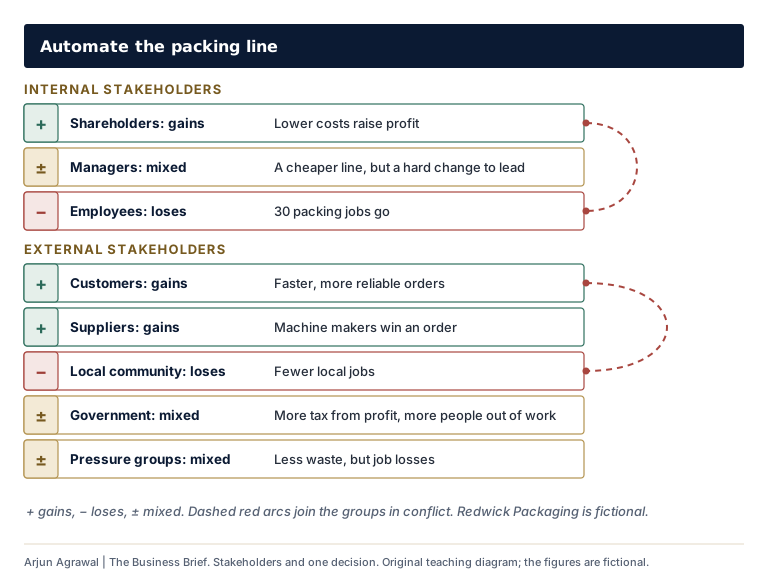
Automate the packing line
Owners and customers gain from lower costs; employees and the town lose jobs. The conflict is about who bears the cost of efficiency.
Move the factory to a cheaper region
The owners gain and the old town loses: a conflict between profit and the business’s place in its community.
Switch to recycled packaging
Most groups gain, but shareholders and customers pay more for now: a trade-off between short-term profit and corporate social responsibility.
Text description
Redwick Packaging, a fictional manufacturer, considers a decision: automate the packing line. Shareholders: gains, lower costs raise profit. Managers: mixed, a cheaper line, but a hard change to lead. Employees: loses, 30 packing jobs go. Customers: gains, faster, more reliable orders. Suppliers: gains, machine makers win an order. Local community: loses, fewer local jobs. Government: mixed, more tax from profit, more people out of work. Pressure groups: mixed, less waste, but job losses. Conflicts: shareholders against employees; customers against local community. Owners and customers gain from lower costs; employees and the town lose jobs. The conflict is about who bears the cost of efficiency.
Point to a circle or an overlap, or tab to it, to read what it means; select it to open its subtopic. On a touch screen, the first tap explains and the second opens.
Every part, explained
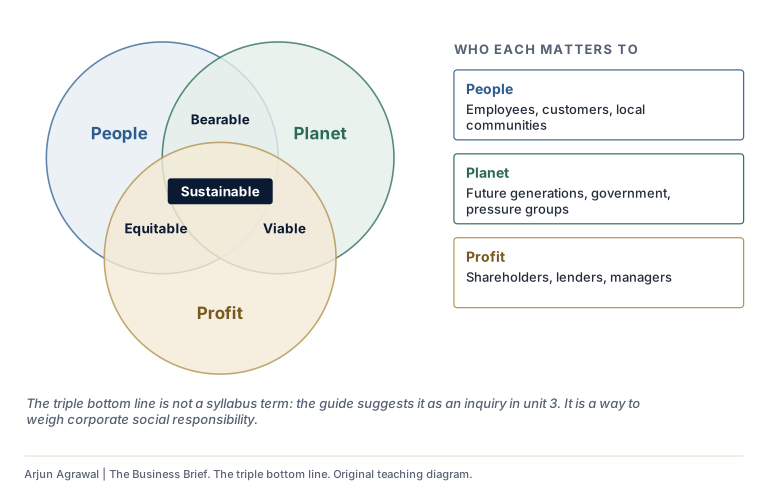
- People The social bottom line: how the business treats its employees, its customers and the communities it touches, from fair pay and safe work to honest marketing. 1.4 Stakeholders
- Planet The environmental bottom line: the resources it uses and the waste and emissions it leaves, and whether its products can be reused, repaired or recycled. 5.3 Lean production and quality management
- Profit The economic bottom line: whether the business earns enough to survive, reward its owners and invest. Without it, nothing else lasts. 1.3 Business objectives
- Bearable People and planet without profit: good for society and the environment, but it depends on someone paying for it, so it may not last. 1.3 Business objectives
- Equitable People and profit without the planet: fair to people and profitable, but storing up environmental costs for later. 1.3 Business objectives
- Viable Planet and profit without people: efficient and green, but at a cost to workers or communities that can turn stakeholders against it. 1.4 Stakeholders
- Sustainable All three at once: the aim of corporate social responsibility. Few decisions reach it fully; the diagram helps to see which bottom line a decision neglects. 1.3 Business objectives
Text description
Three overlapping circles for the triple bottom line, the idea that a business should be judged on people, planet and profit, not on profit alone. People is the social bottom line: employees, customers and communities. Planet is the environmental bottom line: resources, waste and emissions. Profit is the economic bottom line: whether the business earns enough to survive and invest. Where two circles overlap without the third: people and planet is bearable, people and profit is equitable, and planet and profit is viable. Where all three overlap the business is sustainable, the aim of corporate social responsibility. Around the circles, the stakeholders each bottom line matters most to: employees, customers and local communities for people; future generations, the government and pressure groups for the planet; shareholders and lenders for profit. The guide does not name the triple bottom line as a syllabus term; it suggests it as an inquiry in unit 3, and it is a way to weigh corporate social responsibility (1.3).
Section 19: Key terms
Defined in the platform's own words. Each opens its full entry.
- Cooperative
- A business owned and controlled by its members, who may be its customers, its workers or the producers who supply it; they share the benefits it creates and run it democratically, normally on the basis of one member, one vote.
- Corporate social responsibility (CSR)
- A business's acceptance that it is responsible for the effects of its activities on society and the environment, and its commitment to act in the interests of stakeholders beyond what the law requires.
- Divorce of ownership and control
- The situation in a large company where the shareholders own the business but professional directors and managers decide how it is run.
- External stakeholder
- A stakeholder outside the organization that is affected by its activities or can influence them, such as customers, suppliers, lenders, the government, the local community and pressure groups.
- Internal stakeholder
- A stakeholder that is part of the organization: its employees, its managers and directors, and its owners.
- Pressure group
- An organized group that tries to influence the decisions of businesses or governments on a particular issue, without seeking political office itself.
- Shareholder
- An owner of a company, holding one or more of the shares into which its ownership is divided.
- Shareholder value
- The value a company creates for its owners, mainly through a rising share price and the dividends it pays.
- Stakeholder
- Any individual or group with an interest in what an organization does, because its decisions have an impact on them or because they can influence those decisions.
- Stakeholder concept
- The view that a business should take account of the interests of all its stakeholders when making decisions, not only those of its owners.
- Stakeholder conflict
- A situation in which the interests or objectives of different stakeholder groups clash, so a decision that benefits one group harms or disappoints another.
- Stakeholder mapping
- A way of prioritizing stakeholders by plotting each group on a grid according to its power over the organization and its interest in a particular decision.
- Triple bottom line
- A way of judging an organization's performance by three measures rather than by profit alone: its social impact (people), its environmental impact (planet) and its financial results (profit).
Section 20: Tools and practice
3 tools on the platform for 1.4, by room, with exercises, worked calculations and practice questions.
Strategy Studio
- Stakeholder map Enrichment
- Stakeholder salience Enrichment
Section 21: Check your recall
Answer from memory, then reveal and rate yourself. Your ratings stay on this device.
Answer each question from memory, out loud or on paper, before you reveal the answer. Your ratings also schedule these questions in your flashcards.
-
What is the difference between a stakeholder and a shareholder?
A stakeholder is anyone affected by, or able to affect, a business. A shareholder owns part of a company through its shares, and is only one stakeholder group.
How well did you recall it? -
Name three internal and three external stakeholder groups.
Internal: employees, managers and directors, owners and shareholders. External: for example customers, suppliers, lenders, government, the local community, pressure groups and competitors.
How well did you recall it? -
Give two reasons why stakeholders' objectives conflict.
Their objectives differ (profit, pay, prices, a quiet neighbourhood), and the business has limited resources to share between them, so a gain for one group is often a cost for another.
How well did you recall it? -
What two things does stakeholder mapping compare, and which group must be managed closely?
Each group's power over the business and its interest in the decision. Groups with high power and high interest, the key players, must be managed closely.
How well did you recall it? -
Give one limitation of stakeholder mapping.
For example, placing a group is a judgement; power and interest change over time; weak groups can join together and become powerful.
How well did you recall it? -
How can a business reduce conflict between stakeholders?
For example by consulting and communicating early, compromising or phasing changes, and prioritizing groups by their power, interest and the business's objectives.
How well did you recall it? -
Why is the conflict between owners and managers usually absent in a sole trader?
The owner usually manages the business, so ownership and control are in the same hands; in a public company they are divided between shareholders and directors.
How well did you recall it? -
What is unusual about the stakeholders of a cooperative?
Its members are its owners and also its customers, workers or suppliers, so they hold two stakeholder roles at once, and they decide by voting, usually one member, one vote.
How well did you recall it? -
Distinguish between the shareholder view and the stakeholder view of a business.
The shareholder view puts the owners' returns first, meeting other groups' needs as far as the law requires and as far as it pays; the stakeholder view treats every group's claim as legitimate and balances them.
How well did you recall it? -
A pay rise costs $30,000 a year and replacing a worker who leaves costs $4,000. How many fewer workers must leave for the rise to pay for itself?
$30,000 ÷ $4,000 = 7.5, so at least 8 fewer leavers.
How well did you recall it?
Section 22: How it connects
Where 1.4 meets the rest of the course: worked connections with an exam-style question on each, then the further links the notes name.
-
Sustainability and stakeholder interests
Sustainability, one of the course's four key concepts, asks a business to meet present needs without compromising the ability of future generations to meet theirs, across people, the planet and profit. Stakeholders weigh these differently: a local community or a pressure group may press for lower emissions and fair treatment of workers, while some shareholders want the highest return in the short term. Corporate social responsibility and ethical objectives are how a business responds. Over time they can reduce conflict between stakeholders, by protecting the brand and helping to attract and keep staff, but they have costs, so in the short term they can sharpen it. Judging whether a sustainable choice serves stakeholders means asking which stakeholders, and over what period.
Exam-style question Source: Original practice question Command term: Evaluate (AO3)
Evaluate the view that adopting ethical objectives must conflict with the interests of a company's shareholders. [10 marks]
-
With 1.6 Multinational companies (MNCs)
Who gains when a multinational arrives
The impact of a multinational company on a host country is not one effect but several, and each stakeholder group feels a different one. Workers may gain jobs and training; local suppliers may win contracts or lose out to the company's own supply chain; local competitors may struggle against its economies of scale; the government gains tax revenue and investment but may have offered incentives to attract it; and nearby communities may bear environmental costs. Because the gains and losses fall on different groups, judging an MNC's impact means saying whose interests are being weighed, and over what period.
Exam-style question Source: Original practice question Command term: Discuss (AO3)
Discuss the impact on two stakeholder groups in a host country of a multinational company's decision to open a factory there. [10 marks]
-
With 2.7 Industrial/employee relations
Conflict at work is stakeholder conflict HL
Industrial relations are the clearest case of conflict between stakeholders. Employees want fair pay, security and good conditions; managers and shareholders want lower costs and higher profit; customers want the product or service to continue; and trade unions represent employees in the negotiation. Collective bargaining, work-to-rule and strike action, or threats of redundancy and changes of contract, are ways of using the power each side holds, and conciliation and arbitration bring in a third party when the two sides cannot agree. Mapping the stakeholders' power and interest helps to predict how a dispute will develop and what settlement might last.
Exam-style question Source: Original practice question Command term: Examine (AO3)
Examine how collective bargaining can help to resolve a conflict between the employees and the owners of a business. [10 marks]
-
With 3.4 Final accounts
Who reads the accounts, and why
Final accounts are prepared for stakeholders, and each group reads them for something different. Shareholders look for profit and the return on their investment; lenders such as banks check whether loans and interest can be repaid; suppliers want to know whether they will be paid; employees and their unions look at whether pay rises and jobs are affordable; and the government uses the accounts to assess tax. Because their interests differ, the same accounts can lead different stakeholders to different conclusions, which is why the purpose of accounts to different stakeholders is part of the course.
Exam-style question Source: Original practice question Command term: Explain (AO2)
Explain why the final accounts of a business are of interest to two different stakeholder groups. [4 marks]
Also linked in the notes
- 1.2 Types of business entities Ownership decides who the shareholders are and how much control they have.
- 1.5 Growth and evolution Growth, mergers and takeovers change the balance of power between stakeholders.
- 2.1 Introduction to human resource management Employees who are not consulted resist change, and the strategies for reducing resistance are largely about managing this stakeholder group.
- 2.6 Communication Consulting and informing stakeholders is a communication task, and the methods chosen shape how a decision is received.
- 3.5 Profitability and liquidity ratio analysis Each stakeholder reads the ratios that bear on its own decision.
- 5.4 Location Location decisions, and the choice to outsource or offshore, land on local communities, employees and suppliers at home and abroad.
- 5.7 Crisis management and contingency planning A crisis tests whose interests come first, and conflicts such as customers' safety against shareholders' profit come to the surface.
See 1.4 on the course connections map, with every link drawn across the five units.
Section 23: Connected learning
Everything else on the platform that teaches, applies or tests 1.4, each labelled by its standing.
- Revise
-
- The 1.4 mindmap Full and revision views, to print or download
- Revision sheet The subtopic on one printable page
- Flashcards The 1.4 cards, to rate as you go
- Practise
-
- 13 questions on 1.4 in the question bank From the practice sets, the notes and the case files, filtered to this subtopic
- Cases
-
- Bellbird Home and Garden Fictional Case Vault
- Larkspur Software Fictional Case Vault
- Marigold Kitchens Fictional Case Vault
- Patchwork Digital Fictional Case Vault
- Decisions and simulations
-
- Kestle Cycles: the cash runs out first Fictional Boardroom simulation
- Hotel Mareluce: full rooms or a future Fictional Boardroom simulation
- Corvell Furniture: three years to restore the margin Fictional Boardroom simulation
- Frameworks
-
- Mendelow's matrix Enrichment
- Tools
-
- 3 tools for 1.4 In Tools and practice on this page: Strategy Studio, People and Culture
- Boardroom Briefings
-
- Quarrystone Climbing is offered its closest rival Fictional Briefing 2
- Kittiwake Air's margins fall for a third year Fictional Briefing 3
- Velantra Cold Chain's systems go dark at three in the morning Fictional Briefing 5
- Velmar Components weighs a buyback against a factory for electric cars Fictional Briefing 9
- Rowan & Rill's recycled range turns out to be partly recycled Fictional Briefing 10
- Business Intelligence
-
- Microsoft's 2030 climate goals meet the AI build-out Real-world A real development, 14 October 2026, with its sources
- The FCA closes its investigation into Drax's biomass statements without taking action Real-world A real development, 18 June 2026, with its sources
- Engine inspections keep Wizz Air jets on the ground as its annual profit falls to €1.3 million Real-world A real development, 11 June 2026, with its sources
- Car finance lenders face a £9.1 billion bill from the FCA's compensation scheme, now partly suspended Real-world A real development, 30 March 2026, with its sources
- Novo Nordisk cuts the US list price of Wegovy by about half as a new pill widens its market Real-world A real development, 24 February 2026, with its sources
- Saks Global files for Chapter 11 and emerges five months later as Exemplar Luxury Group Real-world A real development, 14 January 2026, with its sources
- Nestlé replaces its chief executive and its chair, then plans to cut about 16,000 jobs Real-world A real development, 16 October 2025, with its sources
- Microsoft and OpenAI rewrite their partnership as OpenAI restructures Real-world A real development, October 2025, with its sources
- Oracle replaces one chief executive with two Real-world A real development, 22 September 2025, with its sources
- Cracker Barrel restores its old logo weeks after a rebrand, pauses remodels and plans for fewer guests Real-world A real development, 19 August 2025, with its sources
- Couche-Tard withdraws its offer for Seven & i, the owner of 7-Eleven, and the two companies dispute why Real-world A real development, 16 July 2025, with its sources
- Microsoft retires Skype and moves its users to Teams Real-world A real development, 28 February 2025, with its sources
- Advanced Management
-
- Change, organizational politics and conflict Enrichment Leadership and organizational behaviour: beyond the IB course
- Governance and accountability Enrichment Leadership and organizational behaviour: beyond the IB course
- Sustainable operations Enrichment Operations and supply chain strategy: beyond the IB course
- Course connections
-
- 4 worked connections on the connections map With 1.3, 1.6, 2.7, 3.4
Notes checked against: Business management guide, first assessment 2024 (published February 2022, updated May 2022), pp. 7, 13, 24, 41 to 46 (The two content statements and their assessment objectives; Paper 3's decisions for the stakeholders of a social enterprise, p. 7; the triple bottom line, p. 13; the papers and the rule on command terms, pp. 41 to 46, for the exam-style practice); Business Management for the IB Diploma, pp. 97 to 106 (Read to check coverage and conventions; nothing reproduced); Business management teacher support material, pp. 56, 60, 89 (The advice on answering papers 1 and 2, used to set the exam-style practice, and the glossary entry for stakeholders, which mentions other classifications (p. 89); nothing reproduced); Strategic Management: A Stakeholder Approach (The stakeholder view of the firm, as it is usually attributed; cited, not reproduced); Toward a Theory of Stakeholder Identification and Salience: Defining the Principle of Who and What Really Counts (The salience model of power, legitimacy and urgency, mentioned as enrichment). Updated 2026-11-20. The IB guide is the authority on the course.
Arjun Agrawal | The Business Brief, https://the-business-brief-dun.vercel.app/topics/stakeholders/. Original teaching material, not an IB publication. The organizations in the teaching cases are fictional unless a case says otherwise.