Unit 3: Finance and accounts
3.2 Sources of finance
Study mode could not start. The page reads as usual.
Study mode
On this page
Section 01: What the IB course asks
The content statements for 3.2, in the platform's words, with the depth of teaching the guide sets (guide, from p. 28).
- Internal sources of finance: personal funds (for sole traders), retained profit and the sale of assets AO2
- External sources of finance: share capital, loan capital, overdrafts, trade credit, crowdfunding, leasing, microfinance providers and business angels AO2
- Which short- or long-term source of finance suits a given situation AO3
AO1 knowledge and understanding · AO2 application and analysis · AO3 synthesis and evaluation · AO4 a range of skills. A question can use a command term at its statement's level or below. The whole course.
Section 02: Why it matters
Every business needs money that it does not yet have: to start up, to buy equipment, to carry stock, to survive a slow month or to grow. Where that money comes from matters almost as much as what it is spent on. Each source of finance has its own cost, its own risk and its own strings attached, from interest that must be paid whatever happens to owners who expect a say in how the business is run.
The guide names three internal sources and eight external ones, to be understood and applied (AO2), and then asks which short- or long-term source suits a given situation (AO3). That last statement is the heart of the subtopic. Answers that list advantages and disadvantages of every source score little; answers that match a source to the purpose, the amount, the time and the business in the case score well.
By the end you can
- Explain the internal sources of finance: personal funds for sole traders, retained profit and the sale of assets.
- Explain the external sources of finance: share capital, loan capital, overdrafts, trade credit, crowdfunding, leasing, microfinance providers and business angels.
- Distinguish between internal and external, short-term and long-term, and debt and equity finance.
- Analyse the cost, risk and control that come with each source, using simple figures where they help.
- Evaluate which short- or long-term sources suit a given situation, and recommend a choice.
Section 03: Why businesses need finance, and how sources are classified
Businesses need finance for four broad purposes: to start up, before any revenue arrives; for capital expenditure on assets that last, such as premises and equipment (3.1); for working capital, the cash tied up in stock and in customers who have not yet paid (3.7); and to grow, by opening sites, launching products or buying other businesses (1.5). The purpose, more than anything else, decides which source suits.
The guide sorts sources in two ways. Internal sources come from within the business: the owner's own money for a sole trader, profit kept in the business, and cash from selling assets. External sources come from outside: investors, banks, suppliers, leasing companies, crowds of backers, microfinance providers and business angels. Its AO3 statement adds a second division, by time. Short-term finance is needed for less than a year, usually for working capital; long-term finance is needed for more than a year, usually for capital expenditure and growth. Some writers add a medium term of one to five years; the guide does not.
A third division, not named in the guide but used throughout this unit, applies to most external sources. Debt must be repaid, usually with interest, whatever happens to the business; lenders gain no ownership. Equity is money invested in return for a share of ownership; it need not be repaid, but the investors share in the profits and in control. Reward and donation crowdfunding are neither: backers receive a product, or nothing at all. Most decisions about finance are, at bottom, a choice between the risk of debt and the dilution of equity.
- Internal sources
Money from within the business. No interest and no new owners, but limited in amount.
- External sources
Money from outside the business, from investors, lenders, suppliers or the public. Larger amounts, but with interest, fees or a loss of control.
- Short-term finance
Needed for less than a year, usually for working capital and cash flow gaps. Overdrafts and trade credit are the main short-term sources.
- Long-term finance
Needed for more than a year, usually for non-current assets, start-up and growth. Share capital, loan capital, retained profit and leasing are the main long-term sources.
- Debt and equity
Debt, such as loans and overdrafts, must be repaid with interest but leaves ownership unchanged. Equity, such as share capital and investment by business angels, gives investors a share of ownership instead.
Text description
Internal sources come from within the business: personal funds, the owner’s savings, for sole traders; retained profit; and the sale of assets. External sources come from outside. Usually short term: overdrafts, spending beyond the bank balance, and trade credit, paying suppliers later. Usually medium to long term: share capital, loan capital, leasing, crowdfunding, microfinance providers and business angels. Which source suits depends on the purpose and amount, the cost, how quickly it is needed, the risk and how much control the owners will give up.
Section 04: Internal sources of finance
Internal finance is usually the cheapest and quickest money a business can find, because there is no lender to persuade, no interest to pay and no new owner to satisfy. Its limit is size. A business can only use the savings, profit and spare assets it has, which are rarely enough for a large project, and are least available exactly when a young business needs money most.
The guide names personal funds as an internal source for sole traders, and the qualification matters. A sole trader and the business are the same legal person, so the owner's savings put into the business are its own money. For a company, which is a separate legal person, money from the owners arrives as share capital, which the guide counts as an external source (1.2).
Retained profit is the main internal source for established businesses: the profit left after tax and dividends, kept and reinvested. In a business with several products, it often moves from mature products to new ones; in the BCG matrix, a toolkit tool the guide suggests for this unit, the cash cows fund the question marks. The sale of assets raises a one-off sum from property, vehicles or equipment the business no longer needs. A variant, sale and leaseback, sells an asset the business does need, such as its premises, to an investor and leases it back, releasing cash while keeping the use of the asset.
- Personal funds (for sole traders)
The owner's own savings, put into the business. Available at once, with no interest or loss of control, and they show lenders that the owner is committed. But they are usually small, and with unlimited liability the owner risks personal wealth beyond what was invested.
- Retained profit
Profit kept in the business after tax and dividends. No interest, no repayment and no dilution of ownership. Only available to a profitable business, limited by the size of the profit, and every dollar retained is a dollar not paid to shareholders, which can cause conflict with those who want dividends.
- Sale of assets
Selling assets the business no longer needs, such as surplus land, old vehicles or unused equipment. Turns idle assets into cash, but it is a one-off source, assets may have to be sold below their value to sell quickly, and once sold they are gone.
- Sale and leaseback
Selling an asset the business still uses and leasing it back. Releases a large sum while keeping the asset in use, but the business then pays rent for years and loses any rise in the asset's value.
Advantages
- No interest, so it adds no fixed financial burden.
- No new owners, so control stays where it is.
- Usually quick, with no lender or investor to convince.
Limitations
- Limited in amount, and often too small for major investment.
- Least available to new or loss-making businesses, which most need finance.
- Has an opportunity cost, since retained profit could have been paid as dividends or kept as a cash buffer.
Section 06: Short-term external sources: overdrafts and trade credit
An overdraft is an arrangement with a bank that lets a business spend more than it has in its current account, up to an agreed limit. Interest is charged only on the amount overdrawn and only for the days it is overdrawn, so it is cheap for short, irregular gaps, such as a month when customers pay late or a season when stock must be bought before it sells. It is flexible and quick to arrange. But the interest rate is usually higher than on a loan, there may be fees, and the bank can reduce the limit or demand repayment at short notice, which makes an overdraft a dangerous way to pay for anything long-term.
Trade credit is the time suppliers allow a business to pay for goods and services it has already received, typically 30, 60 or 90 days. It is one of the most widely used sources of finance, because in effect it is a short-term loan without interest: a shop can sell stock before it has paid for it. Its hidden cost is the discount some suppliers offer for paying early, which a business using the full credit period gives up. Paying late damages relationships and credit ratings, and new businesses with no track record may be offered little or no credit at first.
Both are short-term sources for short-term needs. They finance working capital, not buildings or machines, and 3.7 shows how both are used, and misused, in managing cash flow.
- Overdraft, for
Flexible; interest only on the amount used, for the days it is used; quick to arrange; ideal for short or seasonal gaps.
- Overdraft, against
Higher interest than a loan; fees; the bank can withdraw it at short notice; unsuitable for long-term needs.
- Trade credit, for
Usually no interest; goods can be sold before they are paid for; widely available to established businesses.
- Trade credit, against
Early-payment discounts are lost; paying late harms supplier relationships and credit ratings; new businesses may not be offered it.
Overdraft interest for a number of days
Interest ≈ amount overdrawn × annual interest rate × (days ÷ 365)
A standard form for a simple estimate; the guide lists no formula. Banks calculate interest on the balance each day.
Section 07: Crowdfunding, business angels and microfinance providers
Three of the guide's sources exist largely for the businesses that banks and stock markets find too small, too new or too risky.
Crowdfunding raises money from a large number of people, each contributing a small sum, usually through an online platform. Backers may receive a reward (often the product itself, so the campaign is a form of pre-selling), shares in the business (equity crowdfunding), interest on a loan (peer-to-peer lending), or nothing at all, giving because they support the cause. A successful campaign proves that people want the product and builds a community of early customers; a failed one is public. Platforms charge fees, rewards cost money to make and deliver, ideas are exposed to copycats, and some platforms release the money only if the target is reached. The teacher support material asks whether crowdfunding is a sustainable source of finance (p. 11): it can launch a product, but few businesses can return to the crowd again and again.
Business angels are wealthy individuals who invest their own money in start-ups and small businesses, usually in return for shares. Many have run businesses themselves and offer advice, contacts and credibility as well as money, which can be worth as much as the cash. In return they take a share of ownership and often a say in decisions, and they usually expect to sell their stake, ideally at a large profit, within a few years. Microfinance providers lend small sums, and often offer savings and insurance, to people on low incomes who cannot borrow from banks because they have no collateral or credit history. Some lend to groups whose members guarantee one another. Microfinance has helped many people start small businesses, especially women in low-income communities, but the loans are small, the cost of administering them makes interest rates relatively high, and borrowers can be pushed into debt they cannot repay.
- Crowdfunding, for
Reaches finance that banks will not offer; tests demand before production; builds publicity and a loyal customer base; reward-based campaigns give away no ownership.
- Crowdfunding, against
Platform fees and the cost of rewards; failure is public; the idea is exposed to copycats; it takes a great deal of marketing effort; equity crowdfunding creates many small shareholders.
- Business angels, for
Finance for risky young businesses with no collateral; no interest or repayments; expertise, contacts and mentoring come with the money.
- Business angels, against
A share of ownership, profits and control is given away; angels may disagree with the founders; they usually expect to sell their stake within a few years; good angels are hard to find.
- Microfinance providers, for
Lend to people excluded from banks, often without collateral; support entrepreneurship and incomes in poor communities; often come with training and support.
- Microfinance providers, against
Only small sums; interest rates can be high relative to the amount; strict, frequent repayments; a risk of over-indebtedness if borrowers take several loans.
Section 08: Leasing
Leasing lets a business use an asset, such as a vehicle, a machine, a computer system or a building, in return for regular payments to the leasing company that owns it. The business never has to find the full price, so leasing turns one large capital outlay into a stream of payments spread over the asset's use, matching the cost to the years in which the asset earns its keep.
Leases vary. Some are short, and the asset goes back to the leasing company at the end, which suits equipment that goes out of date quickly; others cover most of the asset's working life and may let the business buy it at the end. Maintenance is often included, which makes costs predictable. The price of this convenience is usually a higher total cost than buying, because the leasing company must cover its own costs and make a profit, and the business owns nothing when the lease ends. Ending a lease early can be expensive.
Leasing is particularly useful for businesses that are short of cash or cannot borrow easily, for assets that need frequent upgrading, and as a way to keep cash and borrowing capacity free for other uses. How leases appear in published accounts depends on accounting rules that are beyond the course.
- For
No large outlay, so cash is preserved; payments are spread over the asset's use; maintenance and upgrades are often included; easier to obtain than a loan for some businesses.
- Against
Usually costs more than buying over the asset's life; no ownership and no resale value at the end; a contract that is costly to end early.
Section 09: Matching the source to the situation
The guide's AO3 statement asks which short- or long-term source suits a given situation. Start with the matching principle: finance a need with a source that lasts about as long as the need. Long-term needs, such as premises, machinery and growth, call for long-term sources, such as share capital, loan capital, retained profit or leasing. Short-term needs, such as stock, a seasonal gap or late-paying customers, call for short-term sources, such as an overdraft or trade credit. Paying for a five-year machine with an overdraft risks the bank calling in the money before the machine has earned it back; paying for a few weeks' stock with a five-year loan means paying interest on money that is not needed for most of the time.
Then weigh the other factors. Cost: interest, fees, dividends, lost discounts and the opportunity cost of using retained profit. Control: equity brings new owners and votes; debt does not. Risk: debt adds fixed payments that must be met in bad years as well as good. Amount: personal funds, microfinance and crowdfunding suit small sums; share issues and large loans suit large ones. Legal form: sole traders and partnerships cannot issue shares, and in general only publicly held companies can sell shares to the public. The business's position: a profitable business with assets to offer as collateral can borrow cheaply; a young one with none may have to give away equity to angels or the crowd. And the wider economy: when interest rates are high, debt is dearer.
Most real decisions combine sources, and the best answer is often a package: retained profit for part, a loan or a lease for the asset, and an overdraft for working capital. A strong answer explains why each part of the package fits, and what would make it change.
- A sole trader starting up
Personal funds first, perhaps with a small bank loan secured on the owner's property, trade credit once suppliers trust the business, or a microfinance loan where banks will not lend.
- A growing privately held company buying a factory
Retained profit and a long-term loan secured on the factory, or new shares sold to private investors if the owners will accept dilution.
- A seasonal retailer stocking up
An overdraft and trade credit, repaid from the season's sales.
- A risky technology start-up with no assets
Business angels or equity crowdfunding, because banks will not lend without collateral or a track record.
- A social entrepreneur in a low-income community
Microfinance, donation or reward crowdfunding, and personal funds.
- A profitable business with a cash crisis and valuable premises
An overdraft for the immediate gap, or sale and leaseback to release a larger sum without leaving the premises.
- The gearing ratio (HL) HL
HL students measure reliance on long-term borrowing with the guide's gearing ratio, non-current liabilities ÷ capital employed × 100, where capital employed is non-current liabilities plus equity (3.6). A business with $440,000 of long-term borrowing and $660,000 of equity has a gearing ratio of 440,000 ÷ 1,100,000 × 100 = 40%. The higher the ratio, the riskier more borrowing becomes.
HL This section has HL-only points, hidden while you are viewing SL content.
Advantages
- Matching sources to needs protects liquidity and avoids paying for finance that is not needed.
- Weighing cost, control and risk together exposes trade-offs that a comparison of interest rates alone would miss.
- A package of sources can combine the strengths of each, such as low-cost retained profit with a loan for the remainder.
Limitations
- The choice is constrained by what lenders and investors will offer, which a small or new business may find very limited.
- Future interest rates, sales and profits are uncertain, so a source that suits today may not suit next year.
- Qualitative factors, such as the founders' wish to keep control or a backer's expertise, are hard to weigh against figures.
Section 10: In practice: industries and stakeholders
The same ideas look different from one industry to the next, and land differently on each group with a stake in the business.
Across industries
- Technology start-ups
With few physical assets, little revenue and high risk, they rarely qualify for bank loans, so they rely on founders' money, business angels, equity crowdfunding and, at a larger scale, specialist investors. They give away equity early, so the founders' share shrinks with each round of funding.
- Retail
Seasonal peaks are financed with trade credit and overdrafts, repaid from sales. Many retailers lease their shops rather than buying them, and some raise cash by sale and leaseback of the stores they own.
- Manufacturing
Capital-intensive businesses use long-term loans secured on their plant and property, lease machinery, and reinvest retained profit. Their tangible assets make them attractive borrowers, but heavy borrowing makes them vulnerable when demand falls.
- Social enterprises and charities
Microfinance, donation and reward crowdfunding, grants and loans from investors who seek social impact matter more than share issues, which many social enterprises cannot or will not make. Trading income, the core of a social enterprise, is reinvested as retained surplus.
- Hospitality
Restaurants, bars and hotels often start with personal funds and bank loans secured on property, and lease kitchen equipment. Their earnings are seasonal and sensitive to the economy, so lenders can be cautious, and trade credit from food and drink suppliers is vital.
- Large publicly held companies
They can raise very large sums by issuing new shares to the public or by borrowing from many investors, but most of their investment is paid for from retained profit. Every new share issue is watched closely, because it dilutes existing shareholders.
For each stakeholder
- Owners and founders
Want finance that keeps control and does not put their personal wealth or their business at risk. These aims conflict, because the sources that keep control, loans, add risk, and the sources that share risk, equity, give away control.
- Existing shareholders
Lose a share of ownership and future dividends when new shares are issued, and may oppose retaining profit if they want dividends now.
- Banks and other lenders
Want to be repaid with interest, so they look for profit, cash flow and collateral, and may attach conditions to a loan. Their caution decides which businesses can borrow at all.
- Suppliers
Effectively lend to their customers when they give trade credit, so they carry the risk of not being paid. They watch a customer's liquidity and may shorten credit terms if it weakens.
- Employees
Gain security from a business that is financed soundly, but heavy borrowing makes jobs depend on meeting repayments, and an investor seeking a quick profit may push for cost cuts.
- Investors, angels and backers
Want a return that matches their risk, a say in decisions in proportion to their stake, and honest information. Crowd backers who were promised a product expect it to arrive.
Section 11: Evaluation and limits
What to weigh before reaching a judgement.
- There is no best source in general. The right choice depends on the purpose and how long the money is needed, the amount, the cost, the effect on control, the risk, the legal form and what lenders and investors will offer the business in the case.
- Cost is wider than interest. Equity costs dividends and a share of every future profit; retained profit has an opportunity cost; trade credit can cost the discount; crowdfunding costs fees and rewards; an angel's stake may cost the founders control of their own company.
- Debt and equity trade risk against control. Borrowing keeps ownership but adds payments that must be met in bad years; issuing shares spreads the risk but dilutes control. HL students measure the balance with the gearing ratio.
- The matching principle is a strong guide but not a rule. Many businesses keep a permanent overdraft, and young businesses use whatever finance they can get. Breaking the principle is a risk to be judged, not an automatic error.
- Access is unequal. Small and new businesses, and entrepreneurs in poor communities, often cannot borrow from banks, which is why crowdfunding, angels and microfinance matter, each with its own costs and risks. The teacher support material's question on whether crowdfunding is sustainable (p. 11) is a good test of that judgement.
- In an examination, match the source to the purpose and the time span, apply it to the business's legal form and position, and weigh at least one argument for and one against each option before recommending (pp. 56 and 60 of the teacher support material).
Section 12: Make the decision
Use the ideas on a business choice: weigh the options, decide, and say what would change your mind.
Decision brief · a fictional business
Financing Saltmarsh's second brewery
Saltmarsh Brewing must raise $500,000 for its second brewery and taproom: $350,000 for equipment and fit-out and $150,000 for working capital and launch. It made $95,000 profit after tax last year, has $120,000 of retained profit available, owes $60,000 on an old loan and owns its first site. The founders, who each own half the company, have three packages to choose from.
How to weigh the options
Start by matching each package to the two parts of the need. All three use retained profit, which fits the launch costs well, and only option C leans on an overdraft for part of a need that may last longer than a season.
Option A keeps control but adds the most risk. In the first year the business would pay $47,500 of the loan plus interest of $380,000 × 7% = $26,600, a total of $74,100, about 78% of last year's profit after tax, on top of the $60,000 it still owes. Over eight years the interest would total $119,700. If the taproom is slow to fill, the repayments still fall due, and the first site, pledged as security, is at risk: the very bet the founders want to avoid.
Option B carries no repayments, so it is the safest for cash flow, and the hotelier brings hospitality expertise the founders lack. But $350,000 for 35% values the company at $1 million, and the founders would each fall from 50% to 32.5%, giving up 35% of every future profit and, with a board seat, part of their control. They should ask what the angel expects in return and when he will want to sell.
Option C keeps ownership and puts no property at risk. The lease costs $69,600 a year, close to option A's first-year payment, and $487,200 over seven years, $137,200 more than the equipment's price, and the brewery owns nothing at the end. Using part of a $30,000 overdraft for launch costs stretches the matching principle.
A strong judgement weighs control, risk and cost against the founders' priorities and their confidence in the taproom. If they are confident of quick success, A is cheapest in the long run; if they want to protect the first site and their cash, B or C. A mixed package is worth considering, such as a smaller loan with leased equipment. Say what would change your mind: the angel's terms and exit plans, the bank's willingness to lend without the first site as security, or evidence of how quickly the taproom will make money.
Section 13: Exam-style practice
Original questions written by the platform in the style of the papers, with what a strong response does. They are not IB questions and the guidance is not an official markscheme.
-
Define the term trade credit.
What a strong response does
A strong response gives a precise definition: an arrangement in which a supplier allows a business to pay for goods or services some time after receiving them, for example 30 or 60 days later, usually without charging interest.
- The key features are the delay between receiving goods and paying for them, and that the supplier provides the finance.
- "Buying on credit" alone is too vague to earn full marks.
-
Saltmarsh Brewing, a fictional privately held company, has $120,000 of retained profit available (see the situation above). Explain two advantages for Saltmarsh of using retained profit to finance part of its expansion.
What a strong response does
A strong response gives two distinct advantages, each explained and applied to Saltmarsh. For example:
- No interest or repayments: unlike a bank loan, retained profit adds no fixed payments, which matters because Saltmarsh still owes $60,000 on an old loan and the taproom's early trading is uncertain.
- No loss of control: unlike the angel's offer, it brings no new shareholders, so Theo and Priya keep their 50% stakes and full control.
- Other valid points include speed and no need to offer the first site as security.
A strong answer may note a limit: $120,000 covers less than a quarter of the $500,000 needed, so retained profit can only be part of the package.
-
Larkspur Interiors, a fictional furniture retailer, has an overdraft at an interest rate of 12% a year. A supplier sends an invoice for $50,000, payable in 30 days, and offers a 2% discount if it is paid within 10 days.
Comment on whether Larkspur should take the discount by paying early from its overdraft.
What a strong response does
A strong response works out the figures, then judges them.
- The discount: 2% × $50,000 = $1,000, so paying early costs $49,000.
- The cost of paying early: borrowing $49,000 on the overdraft for 20 days costs about 49,000 × 12% × 20 ÷ 365 = $322.
- Net effect: taking the discount saves about $1,000 − $322 = $678.
- Judgement: Larkspur should take the discount, as long as the overdraft limit has room and the extra borrowing does not leave it short for other payments. Giving up the discount is in effect borrowing at about 37% a year, far dearer than the overdraft.
-
Distinguish between share capital and loan capital as sources of finance.
What a strong response does
A strong response makes the differences clear on more than one dimension.
- Ownership and control: share capital gives investors a share of ownership and votes, diluting existing owners; loan capital gives the lender no ownership, so control is unchanged.
- Repayment and cost: share capital is never repaid and dividends are not compulsory; loan capital must be repaid with interest on fixed dates whatever the business's results.
- Availability and security: only companies can issue shares; loans are available to any business that can satisfy the lender, who usually wants collateral.
-
Amara, a fictional dressmaker in a rural area of a low-income country, wants $300 to buy a second sewing machine and hire an apprentice. She has no property and no credit history. Explain two reasons why a microfinance provider may suit her better than a commercial bank.
What a strong response does
A strong response gives two reasons, each explained and applied to Amara. For example:
- No collateral or credit history needed: a bank would usually refuse a loan without security or a record of borrowing, while microfinance providers lend to people in Amara's position, sometimes through groups whose members guarantee one another.
- Loans of the right size: $300 is too small for most banks to arrange profitably, but it is the kind of loan microfinance exists to provide, often with training and support.
- A strong answer notes a limit, for example that interest may be high relative to the sum and repayments frequent, so Amara must be confident that the second machine will earn enough to repay the loan.
-
ClearCurrent, a fictional start-up, has designed a reusable water bottle with a built-in filter and needs $80,000 to begin production. Its founders are choosing between two options.
- A reward-based crowdfunding campaign that pre-sells bottles at $40 each. The platform and payment fees total 8% of the money raised, and each bottle costs $14 to make and post.
- A business angel who offers $80,000 for 25% of the company and a seat on its board.
Discuss which option ClearCurrent should choose.
What a strong response does
A strong response weighs both options, applies them to ClearCurrent and reaches a supported conclusion. One way to organize it:
- Crowdfunding, for: no loss of ownership or control; it tests demand before production and builds a base of customers and publicity, valuable for a new consumer product.
- Crowdfunding, against: each backer nets only $40 × 92% − $14 = $22.80, so raising $80,000 for production needs about 3,509 backers and $140,360 of pledges; a public failure would damage the brand; the design may be copied once it is shown.
- The angel, for: the $80,000 arrives in one sum with no repayments, and an experienced investor may bring manufacturing and retail contacts.
- The angel, against: the founders give up 25% of the company, valuing it at $320,000, share every future profit and accept a voice on the board; the angel will expect to sell the stake at a profit in a few years.
- Conclusion: for example, that crowdfunding suits ClearCurrent if the founders can reach a large audience and value control, because it proves demand at the same time; the angel suits them if speed and expertise matter more than ownership. A combination, such as a smaller campaign to prove demand followed by angel investment on better terms, is a strong original conclusion.
- Limits: the case gives no evidence of likely demand, the angel's experience or what the founders most value.
The teacher support material advises at least one argument for and one against each option when choosing between two, applied to the case, and a conclusion that does more than repeat them (pp. 56 and 60).
Section 14: Revision summary
The subtopic on one page: what to remember.
- Businesses need finance to start up, for capital expenditure, for working capital and to grow; the purpose largely decides the source.
- Internal sources are personal funds (for sole traders), retained profit and the sale of assets: cheap, quick and without new owners, but limited in size.
- External sources are share capital, loan capital, overdrafts, trade credit, crowdfunding, leasing, microfinance providers and business angels.
- Debt (loans, overdrafts) must be repaid with interest but keeps control; equity (shares, angels, equity crowdfunding) need not be repaid but dilutes ownership.
- Short-term sources, overdrafts and trade credit, finance working capital; long-term sources, share capital, loans, retained profit and leasing, finance assets and growth.
- The matching principle finances a need with a source that lasts about as long as the need; an overdraft for a machine or a long loan for stock is a mismatch.
- Choosing also weighs cost, control, risk, amount, legal form, the business's position and the economy; most real decisions combine several sources.
- Crowdfunding, business angels and microfinance reach businesses banks will not serve, each at a price in fees, ownership or interest.
- At HL, the gearing ratio measures reliance on long-term borrowing, and so the risk of borrowing more.
Section 15: The mindmap
Where a business can find money, from its own resources or from outsiders, and how to choose a source whose cost, risk, control and time span suit the need.
Drag to move the map, or use the arrow keys. Click a branch to fold it away. Whole map shows all of it; zoom with the buttons, or with Ctrl and the scroll wheel.
- Types and forms
- Core ideas
- Evaluation
- Advantage
- Limitation
- HL HL only
The map as an outline
Internal sources
Types and forms
- Definition Money from within the business No interest and no loss of control, but limited in size.
- Personal funds (sole traders) The owner's savings; full control, but small and at risk.
- Retained profit Profit kept after dividends; only once the business is profitable.
- Sale of assets One-off cash from assets the business no longer needs.
External: shares and borrowing
Types and forms
- Definition Money from outside the business
- Share capital Companies only; never repaid, but dilutes control and dividends are expected.
- Loan capital Fixed sum and term, repaid with interest; includes mortgages and debentures.
- Overdrafts Flexible and short-term; high interest, and the bank can withdraw it.
- Trade credit Buy now, pay suppliers in 30 to 90 days, usually without interest.
External: other providers
Types and forms
- Crowdfunding Many small sums raised online; tests demand, but uncertain and public.
- Reward, equity, loan or donation models
- Leasing Pay regularly to use an asset; no large outlay, but no ownership.
- Microfinance providers Small loans for people on low incomes who cannot borrow from banks.
- Business angels Wealthy individuals invest for a share of ownership.
- Often bring advice and contacts too
Short or long term?
Core ideas
- Definition Short-term: under a year
- Example Overdrafts, trade credit, debt factoring
- Pays for stock, wages and other running costs
- Definition Long-term: more than a year
- Example Shares, loans, retained profit, leasing
- Pays for non-current assets and growth
- Match the source to how long it is needed An asset bought with an overdraft must be paid for before it has earned its cost.
Choosing a source
Evaluation
- Purpose and how long the money is needed
- Amount needed
- Cost: interest, fees, dividends
- Control: new shares dilute ownership
- Risk: borrowing commits the business to repay HL students measure this with the gearing ratio (3.6).
- Legal form: sole traders cannot sell shares Types of business entities (1.2).
- Existing debts and the state of the accounts Lenders and investors look at the final accounts first.
Open the mindmap on its own page, with its terms and connections.
Section 16: More diagrams
Original diagrams from the platform's library, each with a text description and an SVG download.
Open or close each question to follow one path; each source opens its glossary entry.
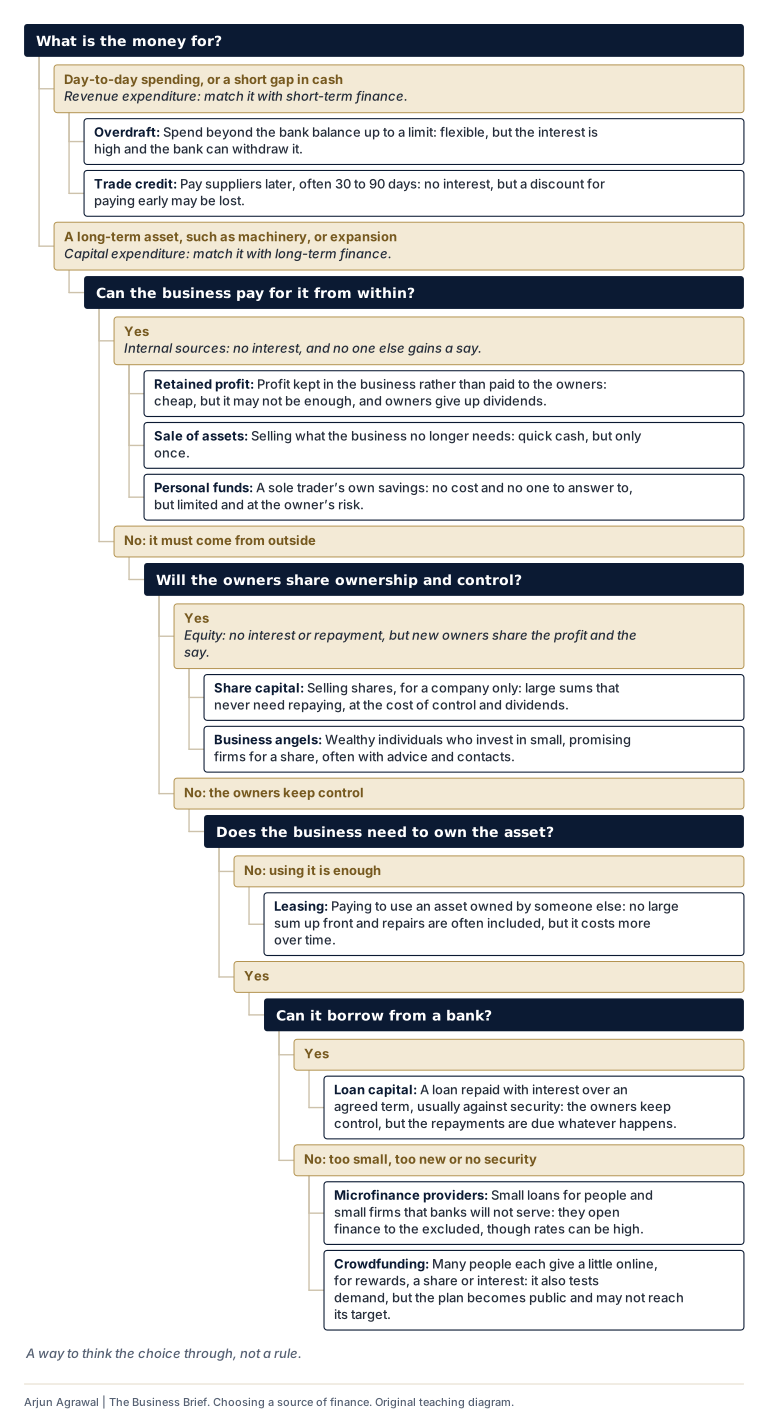
What is the money for?
Day-to-day spending, or a short gap in cash
Revenue expenditure: match it with short-term finance.
- OverdraftSpend beyond the bank balance up to a limit: flexible, but the interest is high and the bank can withdraw it.
- Trade creditPay suppliers later, often 30 to 90 days: no interest, but a discount for paying early may be lost.
A long-term asset, such as machinery, or expansion
Capital expenditure: match it with long-term finance.
Can the business pay for it from within?
Yes
Internal sources: no interest, and no one else gains a say.
- Retained profitProfit kept in the business rather than paid to the owners: cheap, but it may not be enough, and owners give up dividends.
- Sale of assetsSelling what the business no longer needs: quick cash, but only once.
- Personal fundsA sole trader’s own savings: no cost and no one to answer to, but limited and at the owner’s risk.
No: it must come from outside
Will the owners share ownership and control?
Yes
Equity: no interest or repayment, but new owners share the profit and the say.
- Share capitalSelling shares, for a company only: large sums that never need repaying, at the cost of control and dividends.
- Business angelsWealthy individuals who invest in small, promising firms for a share, often with advice and contacts.
No: the owners keep control
Does the business need to own the asset?
No: using it is enough
- LeasingPaying to use an asset owned by someone else: no large sum up front and repairs are often included, but it costs more over time.
Yes
Can it borrow from a bank?
Yes
- Loan capitalA loan repaid with interest over an agreed term, usually against security: the owners keep control, but the repayments are due whatever happens.
No: too small, too new or no security
- Microfinance providersSmall loans for people and small firms that banks will not serve: they open finance to the excluded, though rates can be high.
- CrowdfundingMany people each give a little online, for rewards, a share or interest: it also tests demand, but the plan becomes public and may not reach its target.
Text description
A decision tree for choosing a source of finance. Question: What is the money for? Answer: Day-to-day spending, or a short gap in cash. Revenue expenditure: match it with short-term finance. Overdraft: Spend beyond the bank balance up to a limit: flexible, but the interest is high and the bank can withdraw it. Trade credit: Pay suppliers later, often 30 to 90 days: no interest, but a discount for paying early may be lost. Answer: A long-term asset, such as machinery, or expansion. Capital expenditure: match it with long-term finance. Question: Can the business pay for it from within? Answer: Yes. Internal sources: no interest, and no one else gains a say. Retained profit: Profit kept in the business rather than paid to the owners: cheap, but it may not be enough, and owners give up dividends. Sale of assets: Selling what the business no longer needs: quick cash, but only once. Personal funds: A sole trader’s own savings: no cost and no one to answer to, but limited and at the owner’s risk. Answer: No: it must come from outside Question: Will the owners share ownership and control? Answer: Yes. Equity: no interest or repayment, but new owners share the profit and the say. Share capital: Selling shares, for a company only: large sums that never need repaying, at the cost of control and dividends. Business angels: Wealthy individuals who invest in small, promising firms for a share, often with advice and contacts. Answer: No: the owners keep control Question: Does the business need to own the asset? Answer: No: using it is enough Leasing: Paying to use an asset owned by someone else: no large sum up front and repairs are often included, but it costs more over time. Answer: Yes Question: Can it borrow from a bank? Answer: Yes Loan capital: A loan repaid with interest over an agreed term, usually against security: the owners keep control, but the repayments are due whatever happens. Answer: No: too small, too new or no security Microfinance providers: Small loans for people and small firms that banks will not serve: they open finance to the excluded, though rates can be high. Crowdfunding: Many people each give a little online, for rewards, a share or interest: it also tests demand, but the plan becomes public and may not reach its target. The tree is a way to think a decision through, not a rule: real decisions also weigh the cost, the risk, the amount and how quickly the money is needed.
Section 17: Key terms
Defined in the platform's own words. Each opens its full entry.
- Business angel
- A wealthy individual who invests their own money in a small or new business, usually in return for a share of the ownership.
- Collateral
- An asset that a borrower pledges to a lender, which the lender can take and sell if the loan is not repaid.
- Crowdfunding
- Raising money for a business or project from many people, each putting in a modest sum, usually through a website set up for the purpose.
- Dividend
- A share of a company's profit paid to its shareholders, usually as a fixed amount for each share they own.
- External sources of finance
- Money a business raises from people or organizations outside it, such as shareholders, banks, suppliers, leasing firms, crowdfunders, microfinance providers and business angels.
- Interest
- The price of borrowing money, paid by the borrower to the lender, usually stated as a percentage of the amount borrowed for each year.
- Internal sources of finance
- Money a business raises from within, from the owner's own savings (for a sole trader), from retained profit or from selling assets it no longer needs, rather than from outside lenders or investors.
- Leasing
- Paying regular amounts to use an asset, such as a vehicle, machine or building, that is owned by another firm, instead of buying it.
- Loan capital
- Money borrowed for a fixed period, usually from a bank, and repaid in instalments with interest; loans due after more than a year are non-current liabilities.
- Long-term finance
- Finance that is available to the business for more than a year, often for many years, used to pay for capital expenditure and growth.
- Microfinance provider
- An organization that offers small loans and other financial services to people on low incomes who cannot borrow from ordinary banks, often because they have no credit record or collateral.
- Overdraft
- An arrangement with a bank that lets a business take more money out of its current account than it has in it, up to an agreed limit.
- Personal funds
- The owner's own savings or other personal money put into the business, usually the first source of finance for a sole trader.
- Retained profit
- The part of a period's profit that is kept in the business to reinvest rather than paid out to shareholders; in the statement of profit or loss it is the profit for period minus dividends.
- Sale and leaseback
- Selling an asset the business still needs, usually property, to another firm and then leasing it back so that the business can go on using it.
- Sale of assets
- Raising money by selling things the business owns, usually ones it no longer needs, such as surplus land, old equipment or a closed branch.
- Share capital
- Money a company raises by selling shares, each share being a small part of the ownership of the company; it is shown under equity in the statement of financial position.
- Short-term finance
- Finance that is needed for, and usually repaid within, one year, used for day-to-day needs such as buying stock or paying wages before customers pay.
- Trade credit
- An arrangement in which a supplier lets a business receive goods or services now and pay for them later, often 30 to 90 days after delivery.
Section 18: Tools and practice
2 tools on the platform for 3.2, by room, with exercises, worked calculations and practice questions.
Entrepreneurship and Innovation Lab
- Business plan outline builder IB toolkit
- Start-up cost calculator IB and enrichment
Section 19: Check your recall
Answer from memory, then reveal and rate yourself. Your ratings stay on this device.
Answer each question from memory, out loud or on paper, before you reveal the answer. Your ratings also schedule these questions in your flashcards.
-
Name the three internal sources of finance in the guide.
Personal funds (for sole traders), retained profit and the sale of assets.
How well did you recall it? -
Why does the guide count personal funds as internal only for sole traders?
A sole trader and the business are the same legal person, so the owner's savings are the business's own money. A company is a separate legal person, so owners' money arrives as share capital, an external source.
How well did you recall it? -
What is retained profit, and what is its opportunity cost?
Profit kept in the business after tax and dividends. Its opportunity cost is the dividends shareholders could have received, or the cash buffer it could have provided.
How well did you recall it? -
Give one advantage and one disadvantage of share capital.
Advantage: it never has to be repaid and dividends are not compulsory. Disadvantage: it dilutes the ownership and control of existing owners.
How well did you recall it? -
What is collateral?
An asset, such as property, that a borrower pledges to a lender, who can take and sell it if the loan is not repaid.
How well did you recall it? -
Why is an overdraft unsuitable for buying a machine?
It is short-term finance with high interest that the bank can withdraw at short notice, while the machine earns its cost back over several years.
How well did you recall it? -
An overdraft of $10,000 lasts 73 days at 10% a year. Roughly how much interest is charged?
10,000 × 10% × 73 ÷ 365 = $200.
How well did you recall it? -
When does trade credit stop being free?
When the supplier offers a discount for early payment, because using the full credit period means giving up the discount.
How well did you recall it? -
Name four types of crowdfunding.
Reward-based, equity-based, lending-based and donation-based.
How well did you recall it? -
What does a business angel usually offer besides money, and what does it ask in return?
Advice, contacts and credibility; in return it takes a share of ownership and often a say in decisions, and usually expects to sell its stake within a few years.
How well did you recall it? -
Who do microfinance providers serve, and why?
People on low incomes who cannot borrow from banks because they lack collateral or a credit history, lending them small sums, often with training and support.
How well did you recall it? -
What is the matching principle?
Finance a need with a source that lasts about as long as the need, long-term sources for assets and growth and short-term sources for working capital.
How well did you recall it?
Section 20: How it connects
Where 3.2 meets the rest of the course: worked connections with an exam-style question on each, then the further links the notes name.
-
With 1.2 Types of business entities
Legal form and the finance a business can raise
The type of business entity limits the sources of finance open to it. A sole trader relies on personal funds, loans, overdrafts, trade credit and, in some countries, microfinance providers, and because the owner has unlimited liability, a lender looks at the owner's own assets. A company can raise share capital: a privately held company sells shares only to people its owners choose, while a publicly held company can offer shares to the public on a stock exchange, which opens far more finance but risks a loss of control to new shareholders. Changing legal form is often part of raising the finance for growth.
Exam-style question Source: Original practice question Command term: Explain (AO2)
Explain why a publicly held company can usually raise more share capital than a privately held company. [4 marks]
-
Business growth and sources of finance
How a business grows decides how much finance it needs and what kind. Internal growth, such as opening another branch or buying equipment, is often paid for with retained profit or loan capital over several years. External growth through an acquisition or a takeover needs a large sum at once, which a company may raise by issuing share capital, diluting the existing owners' control, or by borrowing, which adds interest and risk. A small business that wants to stay independent may grow more slowly so that its own profits can pay for growth. The choice of finance is part of the growth decision, not a step after it.
Exam-style question Source: Original practice question Command term: Discuss (AO3)
Discuss whether a privately held company should finance the acquisition of a competitor with loan capital or with share capital. [10 marks]
-
With 3.6 Efficiency ratio analysis
The choice of finance sets the gearing HL
The gearing ratio shows how much of a business's capital employed comes from long-term borrowing: non-current liabilities divided by capital employed, where capital employed is non-current liabilities plus equity. Every choice of long-term finance in 3.2 moves it. Loan capital raises gearing and adds interest that must be paid in bad years as well as good; share capital and retained profit lower it, at the cost of sharing control or holding back dividends. A highly geared business can find further loans harder and dearer to obtain.
Exam-style question Source: Original practice question Command term: Calculate (AO4)
A business has non-current liabilities of $2.4 million and equity of $5.6 million. Calculate its gearing ratio. [2 marks]
The worked answer
Capital employed = $2.4m + $5.6m = $8.0m. Gearing ratio = $2.4m ÷ $8.0m × 100 = 30%.
Also linked in the notes
- 1.1 What is a business? Where the finance for a start-up comes from, and why it is hard to raise.
- 3.1 Introduction to finance Capital expenditure is usually matched with long-term sources, and revenue expenditure with revenue and short-term sources.
- 3.4 Final accounts Share capital and retained earnings appear in equity, and loans and overdrafts among the liabilities, on the statement of financial position.
- 3.7 Cash flow Overdrafts, trade credit, leasing and sale and leaseback are among the strategies for dealing with cash flow problems.
- 3.8 Investment appraisal A worthwhile project still has to be financed, and the interest rate on a loan is a benchmark its return must beat.
See 3.2 on the course connections map, with every link drawn across the five units.
Section 21: Connected learning
Everything else on the platform that teaches, applies or tests 3.2, each labelled by its standing.
- Revise
-
- The 3.2 mindmap Full and revision views, to print or download
- Revision sheet The subtopic on one printable page
- Flashcards The 3.2 cards, to rate as you go
- Practise
-
- 10 questions on 3.2 in the question bank From the practice sets, the notes and the case files, filtered to this subtopic
- Cases
-
- Bellbird Home and Garden Fictional Case Vault
- Marigold Kitchens Fictional Case Vault
- Patchwork Digital Fictional Case Vault
- Quintanilla Autopartes Fictional Case Vault
- Decisions and simulations
-
- Kestle Cycles: the cash runs out first Fictional Boardroom simulation
- Corvell Furniture: three years to restore the margin Fictional Boardroom simulation
- Tools
-
- 2 tools for 3.2 In Tools and practice on this page: Entrepreneurship and Innovation Lab
- Boardroom Briefings
-
- Tasman Loaf Company weighs robots for its packing hall Fictional Briefing 4
- Mãozinha's founders choose between more cities and a profit Fictional Briefing 6
- Velmar Components weighs a buyback against a factory for electric cars Fictional Briefing 9
- Business Intelligence
-
- Anaconda buys three AI companies in a year of rapid expansion Real-world A real development, 4 August 2026, with its sources
- Oracle's record year leaves free cash flow at minus $23.7 billion Real-world A real development, 10 June 2026, with its sources
- Diageo's Indian subsidiary agrees to sell Royal Challengers Bengaluru for INR 166.6 billion as Diageo cuts its debt Real-world A real development, 24 March 2026, with its sources
- Saks Global files for Chapter 11 and emerges five months later as Exemplar Luxury Group Real-world A real development, 14 January 2026, with its sources
- Unilever demerges its ice cream business as The Magnum Ice Cream Company Real-world A real development, 6 December 2025, with its sources
- Microsoft and OpenAI rewrite their partnership as OpenAI restructures Real-world A real development, October 2025, with its sources
- Couche-Tard withdraws its offer for Seven & i, the owner of 7-Eleven, and the two companies dispute why Real-world A real development, 16 July 2025, with its sources
- Advanced Management
-
- Risk, return, the cost of capital and capital structure Enrichment Advanced financial management: beyond the IB course
- Funding strategy and venture capital Enrichment Entrepreneurship and innovation: beyond the IB course
- Course connections
-
- 3 worked connections on the connections map With 1.2, 1.5, 3.6
Notes checked against: Business management guide, first assessment 2024 (published February 2022, updated May 2022), pp. 28 to 29, 64 (The three content statements and their assessment objectives and the unit's suggested tools (p. 28); the gearing ratio as HL content in 3.6 (p. 29) and its formula (p. 64)); Business management teacher support material, pp. 11, 56, 60 (The inquiry question on whether crowdfunding is a sustainable source of finance (p. 11) and the advice on evaluating options (pp. 56 and 60), read; nothing reproduced). Updated 2026-11-03. The IB guide is the authority on the course.
Arjun Agrawal | The Business Brief, https://the-business-brief-dun.vercel.app/topics/sources-of-finance/. Original teaching material, not an IB publication. The organizations in the teaching cases are fictional unless a case says otherwise.