Enrichment map · Operations · Beyond the IB course
Operations strategy
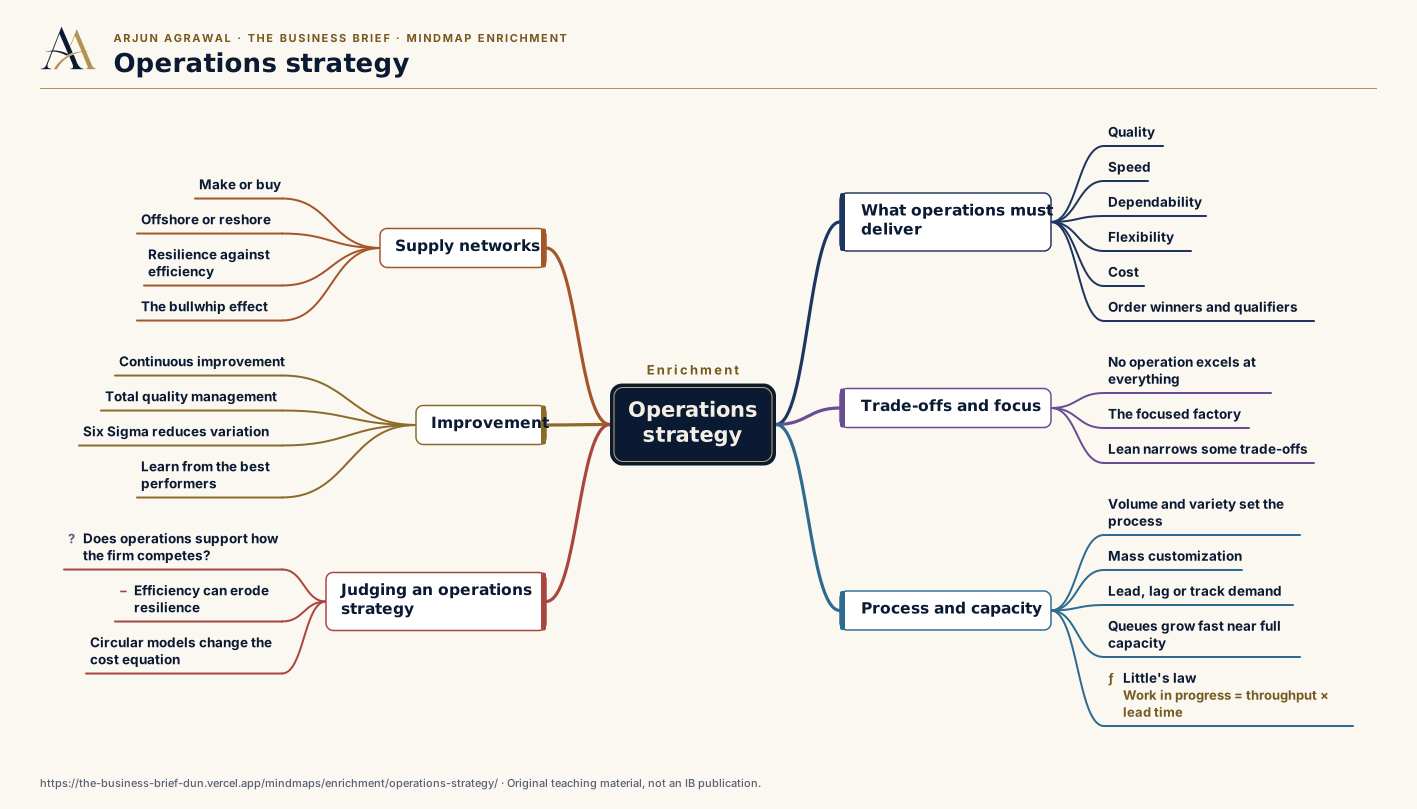
How operations help an organization compete, from the performance it must deliver and the trade-offs between objectives to process, capacity, supply networks and continuous improvement.
Drag to move the map, or use the arrow keys. Click a branch to fold it away. Whole map shows all of it; zoom with the buttons, or with Ctrl and the scroll wheel.
- Core ideas
- Theories and models
- Types and forms
- Applications
- Tools
- Evaluation
- Advantage
- Limitation
The map as an outline
What operations must deliver
Core ideas
Which objective matters most depends on how the firm competes.
- Quality
- Speed
- Dependability Delivering when promised.
- Flexibility Changing what is made, how much, or when.
- Cost
- Order winners and qualifiers Qualifiers get a firm considered; order winners make the customer choose it.
Trade-offs and focus
Theories and models
- No operation excels at everything Choosing a priority means accepting weakness elsewhere.
- The focused factory A plant with a narrow task beats one asked to do everything (Skinner).
- Lean narrows some trade-offs Removing waste can improve cost and quality together.
Process and capacity
Types and forms
- Volume and variety set the process From one-off jobs through batches to mass and continuous flow.
- Mass customization
- Lead, lag or track demand Leading risks idle capacity; lagging risks lost sales.
- Queues grow fast near full capacity When demand varies, waiting times rise steeply as utilization approaches 100%.
- Formula Little's law Work in progress = throughput × lead time At the same throughput, less work in progress means a shorter lead time.
Supply networks
Applications
- Make or buy
- Offshore or reshore Lower costs weighed against distance, risk and control.
- Resilience against efficiency Buffers and second suppliers cost money but absorb shocks.
- The bullwhip effect Small changes in customer demand grow into large swings further up the chain.
Improvement
Tools
- Continuous improvement
- Total quality management
- Six Sigma reduces variation Data-driven projects that cut defects.
- Learn from the best performers
Judging an operations strategy
Evaluation
- Question Does operations support how the firm competes?
- Limitation Efficiency can erode resilience
- Circular models change the cost equation
Download the full map as an SVG file Works without JavaScript; the buttons above also save the view you have open.
Section 01: Where it starts from the IB course
For readers who know the IB course: the subtopics this map builds on. The map goes further than any of them.
- 5.2 Operations methods Job, batch, mass and flow production, and mass customization
- 5.3 Lean production and quality management HL: lean production and quality management
- 5.4 Location Location, outsourcing, offshoring and reshoring
- 5.6 Production planning HL: supply chains, stock and capacity
Section 02: Related enrichment maps
- Strategy formulation The position operations must support
- Sustainable business strategy Circular models and supply chain responsibility
Section 03: Terms on the map
Where an idea on the map is the same as a term in the platform's glossary, the node links to it. The glossary defines each term as the IB course uses it.
How this map was written
The platform's own summary of established operations ideas, written for the undergraduate and MBA pathways. It goes beyond the IB course and is aligned to no university course or textbook, because none was supplied. Ideas are named with the people usually credited with them; their works were not opened for this map.
Arjun Agrawal | The Business Brief, https://the-business-brief-dun.vercel.app/mindmaps/enrichment/operations-strategy/. Original teaching material, not an IB publication. The organizations in the teaching cases are fictional unless a case says otherwise.