Unit 1: Introduction to business management
1.2 Types of business entities
Study mode could not start. The page reads as usual.
Study mode
On this page
Section 01: What the IB course asks
The content statements for 1.2, in the platform's words, with the depth of teaching the guide sets (guide, from p. 23).
- The difference between the private and the public sectors AO2
- The main features of sole traders, partnerships, privately held companies and publicly held companies AO3
- The main features of for-profit social enterprises: private sector companies, public sector companies and cooperatives AO3
- The main features of non-governmental organizations (NGOs), a non-profit social enterprise AO3
AO1 knowledge and understanding · AO2 application and analysis · AO3 synthesis and evaluation · AO4 a range of skills. A question can use a command term at its statement's level or below. The whole course.
Section 02: Why it matters
Before a business can trade, its founders must decide who will own it, who will carry the risk if it fails and what it is for. Those decisions fix its legal form, and the legal form shapes almost everything that follows: how much finance it can raise, how quickly it can decide, what it must publish and whose interests come first.
This subtopic maps the choices. It starts with the split between the private and public sectors, works through the four types of commercial organization from the sole trader to the publicly held company, and ends with social enterprises, which trade in order to serve a social purpose. The guide sets the features of every type at AO3, so you must be able to weigh each form and judge which suits a particular business at a particular stage.
By the end you can
- Distinguish between the private and public sectors, and explain why governments run some organizations themselves.
- Compare sole traders, partnerships, privately held companies and publicly held companies by ownership, liability, finance and control.
- Examine the features of the three for-profit social enterprises that the guide names: private sector companies, public sector companies and cooperatives.
- Discuss the strengths and weaknesses of non-governmental organizations (NGOs) as non-profit social enterprises.
- Recommend a legal form for a business at a given stage, weighing control, risk, finance and purpose.
Section 03: The private and public sectors
Every organization belongs to one of two sectors, depending on who owns it. The private sector is everything owned privately: by one person, a family, a group of partners, shareholders or members. The public sector is everything owned or controlled by the government, national or local.
The two sectors usually differ in what they are for. Most privately owned businesses exist to earn a profit for their owners, although social enterprises, charities and NGOs in the private sector put a purpose first. Public sector organizations aim mainly to provide a service. Some charge for what they provide and try to break even or earn a surplus, but any surplus goes back into the service or to the government rather than to private owners.
Governments usually run an activity themselves for one of three reasons: they see it as something everyone should have whatever their income, such as basic schooling or clean water; it is too important to the country to leave to the market, such as defence or air traffic control; or private firms would provide too little of it because it would not pay, such as street lighting. Where the line falls differs between countries and moves over time, through privatization, which sells or transfers public activities to private owners, and nationalization, which brings private businesses into public ownership.
- Private sector
Owned privately and funded mainly by sales, the owners' money and borrowing. Alongside profit-seeking businesses of every size, it includes cooperatives, charities and NGOs.
- Public sector
Owned or controlled by the government and funded mainly by taxation and borrowing, plus sales for the organizations that trade. It includes government departments, state schools and hospitals, the police and government-owned companies.
- Publicly held is not public sector
The shares of a publicly held company are traded on a stock exchange, but its owners are private shareholders, so it is in the private sector. Mixing the two up is one of the commonest errors in this subtopic.
Text description
The private sector, owned by individuals or investors, and the public sector, owned and run by the government. For-profit businesses in the private sector run from sole traders, with one owner, and partnerships, with two or more owners, both with unlimited liability, to privately held companies, whose shares are sold privately, and publicly held companies, whose shares are traded on a stock exchange, both with limited liability. Social enterprises put a social purpose first. For-profit social enterprises are private sector companies, public sector companies and cooperatives; their surpluses are reinvested in the purpose or shared with members. Non-governmental organizations are non-profit social enterprises funded by donations and grants. Public sector companies are owned by the state and the guide lists them among the for-profit social enterprises.
Section 04: Sole traders
A sole trader is a business owned by one person. The owner may employ staff, but takes every major decision, keeps all the profit and carries all the risk. It is the most common form of business in many countries, typical of tradespeople, small shops, freelancers and personal services.
In law the business has no identity of its own: the business and the owner are the same person. That is why the owner has unlimited liability. If the business cannot pay its debts, creditors can claim the owner's personal assets, such as savings, a car or a home. It is also why the business has no continuity: it ends when the owner stops, unless someone buys it.
Advantages
- Easy and cheap to start, with very little paperwork.
- The owner has full control and can decide quickly.
- The owner keeps all the profit after tax.
- Accounts usually stay private, apart from what goes to the tax authorities.
- Close contact with customers allows a personal service.
Limitations
- Unlimited liability puts the owner's personal assets at risk.
- Raising money is hard, because the owner relies on savings, profits and loans, and small firms often pay more to borrow.
- Long hours and little cover for illness or holidays, with every decision resting on one person.
- No continuity, because the business depends on one person.
- The owner may lack some skills, and growing is hard without partners or shareholders.
Section 05: Partnerships
In a partnership, two or more people own the business together: each puts in money, skills or both, they run it jointly and they share the profits. Law firms, accountants, architects and medical practices are often partnerships, because the partners can bring different specialisms and share clients and costs.
Like a sole trader, an ordinary partnership is not a separate legal entity, so the partners usually have unlimited liability, and each partner can be made to pay for debts that a fellow partner ran up on the firm's behalf. Some countries offer a limited liability partnership, which protects the partners' personal assets, but the rules differ from country to country.
Partners are strongly advised to sign a deed of partnership, a legal agreement that sets out how much capital each puts in, how profits are shared, who decides what, how disputes are settled and what happens when a partner leaves or dies. If they do not, the country's partnership law fills the gaps, and in many countries that means equal shares of profit even when one partner put in far more.
Advantages
- More capital than one owner can usually provide.
- Partners bring different skills, ideas and contacts, and can specialize.
- The workload is shared, and the business does not stop when one partner is ill or away.
- Still fairly simple to set up, and the accounts usually stay private.
Limitations
- Usually unlimited liability, including for business decisions that other partners make.
- Profits are split between the partners.
- Disagreements can slow decisions or break the business up.
- Finance is still limited compared with a company, and the partnership may have to be re-formed when a partner leaves.
Section 06: Companies and privately held companies
Incorporating a business creates a company: a new legal person, separate from the people who own it. The company, not its owners, holds the property, signs the contracts, borrows the money and can be taken to court, and it carries on when its owners change. It is owned by shareholders, each holding part of it, and run by directors whom the shareholders appoint. In a small company the shareholders and the directors are often the same people.
Because the company is a separate legal person, its debts are its own. Its shareholders have limited liability: if the company fails, they can lose the money they paid for their shares, but not their personal assets. Limited liability is what makes people willing to invest in businesses they do not run themselves.
A privately held company keeps its shares out of public hands. They are not sold to the general public and do not trade on any stock exchange, and the existing shareholders normally have a say over who may buy them. Many family businesses, and many young firms backed by a few investors, are privately held. Privately held does not mean small: some very large businesses choose to stay private.
Advantages
- Limited liability protects the personal assets of the shareholders.
- The company continues if an owner dies or leaves.
- Selling shares to people the owners choose raises more finance than a sole trader or partnership can.
- The owners keep control over who joins them.
- Company status can make lenders, suppliers and large customers take the business more seriously.
Limitations
- Costs more to set up and run, with registration, legal duties, annual filings and, above a certain size in most countries, an independent audit.
- Accounts must usually be filed publicly, where rivals can read them.
- Cannot raise money from the general public, so finance is still limited.
- Shares are hard to sell, because there is no public market for them.
- Lenders often ask the owners of small companies for personal guarantees, which weakens the protection of limited liability.
Section 07: Publicly held companies
A publicly held company is one whose shares anyone can buy: they are listed on a stock exchange and change hands there every trading day. A company usually goes public when it needs more finance than private investors can provide, and its first sale of shares to the public, often called a flotation or an initial public offering, can raise very large sums.
Going public brings obligations. The company must publish detailed accounts checked by independent auditors, obey the stock exchange's rules and announce promptly any news that could move its share price. Because anyone can buy its shares, ownership is spread across many shareholders, including pension funds and other investors who take no part in running the business. Professional directors and managers run it instead. This divorce of ownership and control means that the owners and the decision-makers are different people, and their objectives may differ.
Ordinary shares usually carry one vote each, so a shareholder or group with more than half the votes controls ordinary decisions. Publicly held companies are in the private sector: "public" describes who can buy the shares, not who owns the company.
Advantages
- Access to very large sums from the public, for growth and investment.
- Limited liability, and shares that are easy to buy and sell, which attracts investors.
- Size and a public profile can raise the status of the company and help it borrow more cheaply.
- Shares can be used to buy other companies or to reward staff.
Limitations
- Expensive to float and to stay listed, with legal, accounting and stock exchange costs.
- Detailed public disclosure, including information that rivals can use.
- The founders may lose control, and because anyone can buy shares, the company can be taken over.
- Investors may press for quick results, which can discourage long-term investment.
- Managers may pursue their own objectives rather than the shareholders' interests.
Section 08: For-profit social enterprises
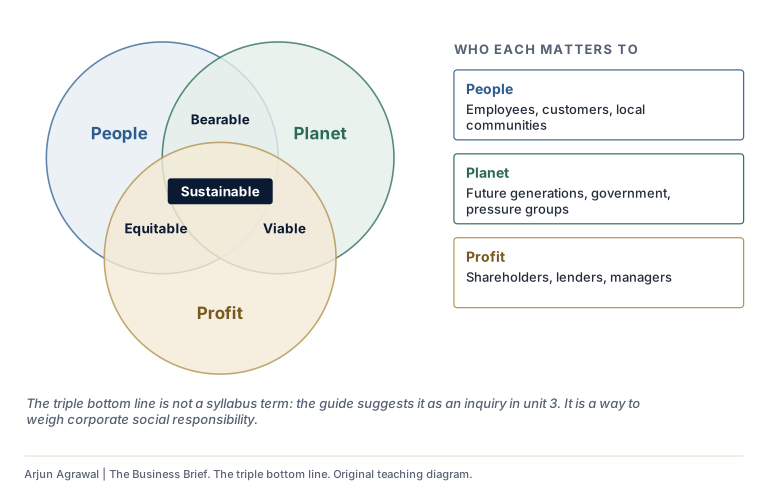
A social enterprise is a business with a mission. It sells goods or services and has to cover its costs like any other business, but it exists to tackle a social or environmental problem, and most of any surplus is spent on that problem rather than paid to owners. It differs from a charity in where its money comes from: most of it is earned by trading, not given. Success is measured in impact as well as money, often using the triple bottom line of people, planet and profit.
The guide divides social enterprises into for-profit and non-profit types. A for-profit social enterprise sets out to make a profit, since profit is what lets it stand on its own feet and do more good, but the profit serves the mission rather than the owners. The guide names three forms, at AO3, without defining them; the definitions below are the platform's, consistent with the IB's teacher support material on social enterprises.
Some textbooks teach private sector companies and public sector companies simply as ordinary types of company. These notes follow the guide, which lists both, with cooperatives, as for-profit social enterprises.
- Private sector companies
Privately owned companies that put a social or environmental purpose first. They trade for a profit, but most of it goes back into the mission. In law they are companies like any other, so their owners have limited liability. The name is easily confused with a privately held company: that label is about who may buy the shares, while this one is about what the company exists to do. In some countries the law offers company types whose rules lock profits or assets into the mission.
- Public sector companies
Companies owned wholly or mostly by the government that sell to customers like any business and aim to make a surplus, but exist to serve the public, for example by keeping a service affordable or reaching places a private firm would not. Their surplus is reinvested in the service or paid to the government.
- Cooperatives
Businesses owned and run by the people who use them or work in them: their workers (a worker cooperative), their customers (a consumer cooperative) or the producers who supply them, such as farmers who pack and sell their crops together (a producer cooperative). Decisions are democratic, normally one member, one vote, however much each has invested. Any surplus belongs to the members: it is paid back to them, usually in line with how much each traded with or worked for the cooperative, or ploughed back into the business.
Advantages
- Trading income gives independence from donors and grants, and profit pays for a wider impact.
- A clear purpose attracts customers, committed staff and support from the community.
- In a cooperative, democratic control and a shared surplus can motivate members and keep the benefits local.
- A public sector company can serve people that a purely profit-seeking firm would drop, while still covering its costs.
Limitations
- Balancing profit and purpose is hard, and pressure to earn more can pull an enterprise away from its mission.
- Raising finance is harder, because investors seeking high returns stay away, and a cooperative cannot sell shares to outsiders.
- Social impact is hard to measure, so success is harder to prove to customers and funders.
- One member, one vote can slow the decisions of a cooperative, and public sector companies can suffer political interference.
Section 09: Non-governmental organizations (NGOs)
In a non-profit social enterprise, nobody takes a share of the surplus: whatever is left after costs is spent on the purpose. Making a surplus is still a sensible aim, because it pays for more of the work. What sets it apart from a for-profit social enterprise is who benefits from a surplus, not whether there is one. The guide names one type to know, the NGO.
A non-governmental organization (NGO) is independent of government and exists to advance a cause: human rights, the environment, health, education or the fight against poverty, for example. Some are a handful of volunteers in one town; others employ thousands of staff across many countries. Many are registered charities.
- Independence
An NGO is neither part of government nor run for profit, and its credibility rests on that independence and on its record of honesty.
- Funding
Mainly donations, grants from foundations, businesses and sometimes governments, and membership fees, often with some trading income from services, publications or merchandise.
- Activities
Many deliver services directly, such as disaster relief, clinics or schools. Many also campaign and lobby, using research, publicity and petitions to change laws and the behaviour of businesses; in that role they act as pressure groups.
- Charities
In many countries a charity is a non-profit body registered as serving the public benefit, which brings tax relief in return for tight rules on how it spends its money. Many NGOs are charities. A charity that lives mostly on donations is not a social enterprise in the strict sense, because social enterprises earn most of their income by trading.
Advantages
- Can reach people and causes that governments and businesses neglect.
- Public trust and independence give them influence over businesses and governments.
- Donations, grants, volunteers and tax advantages keep their costs down.
- Often close to the communities they serve, so they can act quickly and with local knowledge.
Limitations
- Income can be unpredictable, rising and falling with the generosity of donors and the state of the economy.
- Relying on large donors or government grants can compromise their independence, or appear to.
- Impact is hard to measure, and large sums for long-term investment are hard to raise.
- Reputation is fragile, and a scandal over spending or conduct can collapse donations.
Section 10: Choosing and changing the legal form
No legal form is best in general. The right choice depends on the size and riskiness of the business, how much finance it needs, how much control its owners want to keep and what the organization is for.
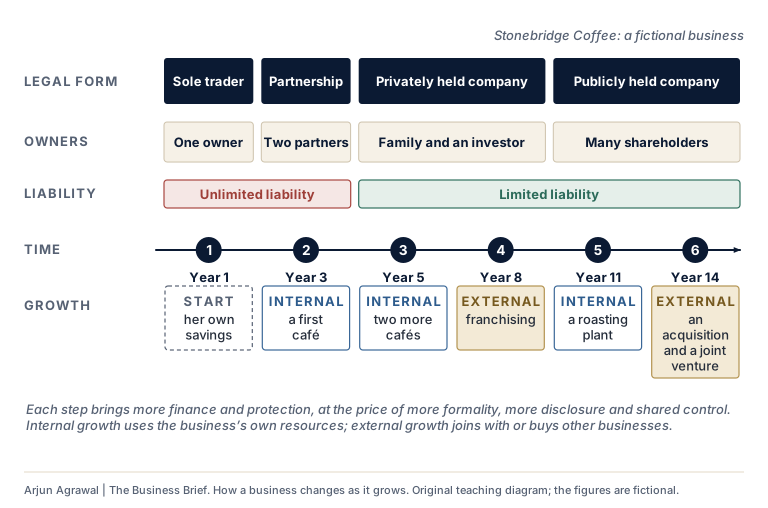
Many businesses change form as they grow. A sole trader takes on a partner; a partnership incorporates as a privately held company to gain limited liability; a privately held company floats on a stock exchange to fund expansion. Each step brings more finance and protection, at the price of more formality, more disclosure and shared control. Some businesses move the other way, as when a small group of investors buys all the shares of a publicly held company and takes it private again.
- Control
Every new owner brings money but takes a share of the decisions. Founders who value control stay small or stay private.
- Risk and liability
The riskier the business and the larger its debts, the more limited liability is worth.
- Finance
Sole traders and partnerships depend on the owners' money and on loans; companies can sell shares; only publicly held companies can sell them to the public.
- Cost and privacy
Incorporating, and still more floating, costs money and means publishing accounts that rivals can read.
- Continuity
A company carries on when owners leave or die; a sole trader's business does not.
- Purpose
If the main aim is social, a social enterprise, cooperative or NGO may fit better than a conventional company, and may attract customers, staff and grants that a profit-seeking firm would not.
Section 11: In practice: industries and stakeholders
The same ideas look different from one industry to the next, and land differently on each group with a stake in the business.
Across industries
- Professional services
Law firms, accountants, architects and medical practices have long been partnerships, because the partners' skills and reputations are the business and clients like dealing with the owners. Where the law allows, many have become limited liability partnerships or companies as firms and the claims against them have grown, since unlimited liability for a fellow partner's mistake is a heavy risk in a large firm.
- Technology start-ups
Founders usually incorporate from the start, because they need outside investors and limited liability long before they earn any revenue, and they often pay staff partly in shares. Each round of finance passes more of the shares, and so more of the control, to investors; the most successful may float, while many others are bought by larger firms.
- Farming
Family farms are often sole traders or partnerships, but many farmers also belong to producer cooperatives that store, pack and market their crops together. Pooling gives small producers bargaining power with large buyers and spreads the cost of equipment no single farm could justify, with the surplus shared in line with what each member supplies.
- Utilities and transport
Water, rail, ferries and postal services are run in some countries by government departments or public sector companies and in others by private firms under regulation. Where the line falls is a political choice that moves with privatization and nationalization, and a public sector company such as Harbourline must earn a surplus while keeping its service affordable.
- Retail
Retail spans every form, from the sole trader's corner shop to publicly held chains with thousands of stores, and consumer cooperatives owned by their shoppers. The form shapes the strategy, because a listed chain answers to shareholders who want growth, while a cooperative's members may prefer lower prices or a store that stays open in their town to a larger surplus.
- International development
NGOs deliver much of the disaster relief, basic education and health care in poor and remote areas, funded by donations, grants and some trading. Their independence from governments brings them access and trust, but income that rises and falls with the generosity of donors makes long-term planning hard, which is why many, like Lumen Eye Trust, try to earn more by trading.
For each stakeholder
- Founders and owners
The choice of form trades control against finance. Every partner or shareholder who brings money takes a share of the decisions and the profit, as the founders of Tallgrass Fitness found when their stake fell from 80% to 50%, while liability decides how much of the owners' own wealth is at risk.
- Lenders and suppliers
Unlimited liability lets the creditors of a sole trader or partnership claim the owners' personal assets, while limited liability leaves them only the company's assets, so lenders to small companies often ask for personal guarantees. Published company accounts help creditors judge the risk, which is one reason companies must disclose more than sole traders.
- Employees
In a worker cooperative such as Loom and Lathe the employees are owners with a vote; in a publicly held company they may be given shares but have little say; in a sole trader's business their jobs depend on one person's health and plans. A takeover bid for a publicly held company can bring new managers and job cuts, so employees and shareholders may be on opposite sides of the same offer.
- Shareholders
In a privately held company the shareholders are often the directors too, but in a publicly held company most of them take no part in running it, so the divorce of ownership and control can set their interest in dividends and the share price against the managers' plans. Their power lies in their votes and in the threat to sell, and selling exposes the company to a takeover.
- Customers and service users
Public sector organizations aim to serve everyone whatever their income, private firms compete on choice, price and service, and social enterprises put a purpose before profit, as Harbourline does with its fares for island residents. A consumer cooperative makes its customers the owners, so the usual conflict between low prices and high profits is settled by the members themselves.
- Government and taxpayers
Governments decide what stays in the public sector, regulate companies and charities, and give charities tax relief in return for strict rules on spending. Taxpayers fund public services and bear the loss when a public organization fails, which is why decisions to privatize or nationalize are argued over so fiercely.
Section 12: Evaluation and limits
What to weigh before reaching a judgement.
- Every legal form is a trade-off between control, risk, finance and disclosure. The useful question is never which form is best, but which suits this business, at this stage, given what its owners want; a recommendation that says what would change it is stronger than one that does not.
- Limited liability protects the owners of small companies less than it seems, because lenders often demand personal guarantees. In larger companies it shifts risk from shareholders to creditors, which is one reason companies must disclose more.
- Going public raises finance but changes the business. Founders lose control, investors press for short-term results, and the divorce of ownership and control can set managers against shareholders. Some very large businesses stay private for exactly these reasons.
- Neither sector is automatically better. Public provision can guarantee access to essential services; private provision can bring competition and efficiency. The result depends on the service, on regulation and on how each organization is run.
- Social enterprises live with a lasting tension between profit and purpose. Too little profit and they cannot survive or grow; too much attention to profit and they drift from the mission. And because social impact is harder to measure than profit, their success is harder to prove.
- The guide's grouping is a classification, not a fact of nature. It calls NGOs social enterprises, yet many NGOs live mainly on donations, which the IB's teacher support material associates with traditional charities rather than social enterprises. Real organizations sit on a spectrum from charity to business, so judge an organization by how it earns and spends its money, not by its label.
Section 13: Make the decision
Use the ideas on a business choice: weigh the options, decide, and say what would change your mind.
Decision brief · a fictional business
Who should own the village shop?
Ashcombe, a fictional village of 1,100 people, lost its only shop when the owner retired, and the nearest supermarket is a forty-minute bus ride away. Mira Patel, who managed a supermarket for ten years, wants to reopen the shop with a post office counter and a café corner. Refitting it and buying the first stock will cost $60,000. Once it is established, the shop should make a surplus of about $8,000 a year after its running costs, including a manager's salary for Mira, but before any loan repayments or dividends.
Mira must decide how the shop will be owned before she can raise the money.
How to weigh the options
Weigh each form against what the shop is for, not only against the money.
- Company with an investor: limited liability protects Mira's home, and the money is raised in one step. But her $20,000 buys only a third of the shares, so the investor controls ordinary decisions, and a 10% dividend on his $40,000 is $4,000 a year, half the expected surplus. If he later wants a higher return, he can outvote her on prices, opening hours or whether to keep the post office counter.
- Cooperative: 300 × $100 = $30,000 from the members and the $30,000 loan together meet the cost. After repayments of $3,500, $4,500 of the $8,000 surplus is left to reinvest or share. The villagers would own their shop, which gives them a reason to use it, but one member, one vote can make decisions slow, and Mira becomes an employee answering to a committee. The plan also needs 300 members in a village of 1,100 people, more than one resident in four.
- Sole trader: Mira keeps full control and the whole surplus, but repayments of $5,000 leave her $3,000 a year, and her house is at risk if the shop fails. Everything rests on one person: nobody covers her illness, and the shop ends when she stops.
A strong judgement starts from purpose. If the shop exists mainly to serve the village, the cooperative fits best, because the people it serves would own and control it, provided enough of them join. If Mira wants a business she runs and might one day sell, the sole trader keeps control but concentrates the risk on her, while the company spreads the risk but hands control to the investor. The answer would change with the number of villagers who sign up, an investor willing to take a smaller stake, or how much risk Mira and her family can carry.
Section 14: Exam-style practice
Original questions written by the platform in the style of the papers, with what a strong response does. They are not IB questions and the guidance is not an official markscheme.
-
Define the term limited liability.
What a strong response does
A strong response gives a precise definition: the owners of a business can lose no more than the money they invested in it, so their personal assets are protected if it cannot pay its debts.
- It follows from the company being a separate legal person, whose debts are its own.
- A full answer covers both the limit, the amount invested, and the protection of personal assets such as savings or a home.
-
With reference to Corran's public hospital and Bayview Clinic, distinguish between the private sector and the public sector.
What a strong response does
A strong response makes two clear differences, each applied to the two organizations.
- Ownership and purpose: the public hospital is owned by the government and exists to treat everyone, while Bayview Clinic is owned privately and runs as a business, choosing which treatments to offer.
- Funding: the hospital is paid for through taxes and is free at the point of use; Bayview charges fees and competes for patients on comfort and short waits.
- Other valid differences include accountability: the hospital answers to the government and so to voters, Bayview to its owners. The teacher support material notes that answers to AO2 questions that are not applied to the case are typically limited to half the marks (p. 56).
-
Lattice Studio's deed of partnership pays each partner 5% interest on the capital they put in, $30,000 from Maya and $10,000 from Tomasz, and splits the rest of the profit equally. This year the partnership made a profit of $86,000.
Calculate each partner's share of the profit.
What a strong response does
- Interest on capital: Maya 5% × $30,000 = $1,500; Tomasz 5% × $10,000 = $500; $2,000 in all.
- Profit left to share: $86,000 − $2,000 = $84,000, or $42,000 each.
- Shares: Maya $1,500 + $42,000 = $43,500; Tomasz $500 + $42,000 = $42,500.
A strong response shows the working and checks that the shares add up to the profit: $43,500 + $42,500 = $86,000. Without a deed, the law in many countries would split the profit equally, $43,000 each, whatever capital each partner put in.
-
Lumen Eye Trust's board wants to raise the share of its $400,000 income that comes from selling reading glasses from 10% to 25% within three years. Analyse the advantages and disadvantages for Lumen Eye Trust of earning more of its income by trading.
What a strong response does
A strong response explains both sides with the case's figures and the features of an NGO.
- The scale: if total income stays at $400,000, 25% is $100,000, so trading income must rise by $60,000, two and a half times today's $40,000.
- Advantages: less dependence on donations (60%) and grants (30%), which rise and fall with donors' generosity, so income becomes more predictable; greater independence, which matters while the trust is lobbying the government to add eye tests to school health checks; and a step towards being a social enterprise that earns its way.
- Disadvantages: selling needs stock, staff and retail skills; time spent selling may pull the trust away from its clinics and its campaign, a drift from the mission; it may compete with local opticians; and donors may give less if they believe the trust can pay its own way.
- The strongest answers note that the effect depends on the profit from selling glasses, not just the revenue, which the case does not give.
-
Recommend whether Joel Mensah should take his sister into partnership or accept the investor's offer of $30,000 for a third of a new privately held company.
What a strong response does
A strong response weighs each option with the case's figures, uses the features of the two forms and makes a justified recommendation.
- Partnership, for: his sister brings skills and shares the work and the risk; the business stays simple, cheap to set up and private.
- Partnership, against: $8,000 + $15,000 = $23,000 does not even cover the $25,000 oven, so they would still need a loan or a lease; both partners would usually have unlimited liability; and a family dispute could end the business and the relationship.
- Company, for: $8,000 + $30,000 = $38,000 pays for the oven and leaves $13,000 towards rent, stock and wages; limited liability protects Joel's personal assets; and with two-thirds of the shares Joel still controls ordinary decisions.
- Company, against: the investor takes a third of the profit and will want a say; a company costs more to set up and run, and its accounts must usually be filed publicly; and selling more shares later would weaken Joel's control further.
- Judgement: for example, the company is the stronger choice because it is the only option that pays for the oven with money to spare for running costs, while protecting Joel's personal assets and leaving him in control; the partnership suits Joel better if he values working with his sister and can lease the oven. A strong answer notes what is missing, such as how long the café contract lasts and what the investor would expect in return.
When asked to choose between two options, the teacher support material advises at least one argument for and one against each (pp. 56 and 60).
-
Discuss whether Tallgrass Fitness was right to become a publicly held company.
What a strong response does
A strong response gives balanced arguments, applied to the case's figures, and reaches a judgement.
- For: selling 6 million shares at $15 raised $90 million to fund 60 new gyms, probably more than loans or a few private investors would have provided; shareholders keep limited liability; shares that trade freely are easier to sell and can reward staff; and a listing raises the chain's profile.
- Against: the founders' stake fell from 8 million of 10 million shares (80%) to 8 million of 16 million (50%), so they can block a vote but no longer win one alone; the company must publish its results every six months; and a rival has already bought 15% of the shares, the first sign of a possible takeover.
- Wider issues: investors may press for quick results, while new gyms take years to fill; the divorce of ownership and control may set managers against shareholders.
- Judgement: for example, it was right if rapid growth was the founders' main objective and no other source could fund 60 gyms, but wrong if keeping control mattered more, since growing more slowly with loans, or staying private with a few large investors, would have kept it. The answer depends on information the case lacks, such as how the new gyms perform and what the rival intends.
When weighing one option, the teacher support material advises at least two arguments for and two against (pp. 56 and 60).
Section 15: Revision summary
The subtopic on one page: what to remember.
- The private sector is owned privately, by individuals, families, partners, shareholders or members; the public sector is owned or controlled by the government. A publicly held company is in the private sector.
- Sole traders have one owner, full control and all the profit, but unlimited liability, limited finance and no continuity.
- Partnerships share capital, skills, work and profit between two or more owners, usually with unlimited liability, including for each other's decisions; a deed of partnership sets the rules.
- Companies are separate legal persons, so shareholders have limited liability and the business continues when owners change. A privately held company controls who may buy its shares; a publicly held one sells them to anyone on a stock exchange.
- Going public raises large sums but brings disclosure, the risk of a takeover and the divorce of ownership and control.
- For-profit social enterprises, which the guide names as private sector companies, public sector companies and cooperatives, trade for a profit that serves a social purpose. A cooperative is owned and controlled by its members, one member, one vote.
- NGOs are non-profit social enterprises: independent of government, working for a cause and funded mainly by donations and grants, so their income can be unpredictable.
- Every form trades control, risk, finance, cost and privacy against each other, and many businesses change form as they grow; the right choice depends on the business, its stage and its purpose.
- The guide sets the features of every type at AO3, so expect to weigh a form for a particular business, not only to describe it.
Section 16: The mindmap
How organizations differ in who owns them, who carries the risk and what they are for, from sole traders to publicly held companies, and from for-profit social enterprises to NGOs.
Drag to move the map, or use the arrow keys. Click a branch to fold it away. Whole map shows all of it; zoom with the buttons, or with Ctrl and the scroll wheel.
- Core ideas
- Types and forms
- Evaluation
- Advantage
- Limitation
- HL HL only
The map as an outline
Private and public sectors
Core ideas
- Definition Private sector: owned by individuals and firms
- Definition Public sector: owned or run by government
- Profit or purpose versus public service Public sector bodies put access to essential services before profit.
- Privatization moves activity into private hands Nationalization moves it the other way.
Types of organizations
Types and forms
- Sole trader: one owner, full control
- Limitation Unlimited liability, limited finance
- Partnership: two or more owners
- Privately held company: shares sold privately
- Owners control who can buy shares
- Publicly held company: shares traded publicly
- Raises large sums, but must publish accounts
Ownership and liability
Core ideas
- Definition Unlimited liability: personal assets at risk
- Definition Limited liability: lose only what you invested
- A company is a legal person in its own right It owns assets, signs contracts and continues when its owners change.
- Shareholders own a company; directors run it
- Divorce of ownership and control In large companies, managers may pursue their own goals.
For-profit social enterprises
Types and forms
- Definition Social enterprise: trades for a social purpose Most income comes from trading; most surplus goes back into the mission.
- Private sector companies with a social mission
- Public sector companies: state-owned, trading
- Cooperatives: owned and run by members One member, one vote; any surplus is shared among the members or reinvested.
Non-profit social enterprise: NGOs
Types and forms
- Definition NGO: non-profit, independent of government
- Every surplus goes to the cause
- Funded by donations, grants and trading
- Campaigns, lobbies or delivers services Many NGOs act as pressure groups.
- Charities depend more on donations
Choosing a legal form
Evaluation
- Control versus access to finance Selling shares raises capital but spreads ownership and control.
- Risk carried by the owners Limited liability encourages investment; unlimited liability deters it.
- Privacy versus public disclosure
- Cost and paperwork of setting up
- Continuity when owners leave or die
- Mission versus returns to owners
- Question Which form suits this business now?
Open the mindmap on its own page, with its terms and connections.
Section 17: More diagrams
Original diagrams from the platform's library, each with a text description and an SVG download.
Point to a stage, or tab to it, to read what changed; select it to open its subtopic. On a touch screen, the first tap explains and the second opens.
Every part, explained
- Year 1: Sole trader. Start-up with her own savings Ana Silva roasts coffee and sells it from a market stall, using $6,000 of her own savings. She takes every decision and keeps all the profit, but has unlimited liability: if the business cannot pay its debts, her own savings and possessions can be claimed. 1.2 Types of business entities
- Year 3: Partnership. Internal growth: a first café A partner joins with $20,000 and the lease of a café. The partners share the profit and the decisions under a deed of partnership, and both still have unlimited liability. Opening the café is internal (organic) growth: the business grows from its own resources. 1.2 Types of business entities
- Year 5: Privately held company. Internal growth: two more cafés The partners form a company. It is a separate legal entity, so the owners have limited liability. They sell shares privately to family and a business angel, and add a bank loan and retained profit to open two more cafés: more internal growth. 1.5 Growth and evolution
- Year 8: Privately held company. External growth: franchising Other owners pay a fee and a share of their sales to open cafés under the Stonebridge brand. Franchising is external growth: the business spreads faster, using the franchisees’ capital, but has less control over each café. 1.5 Growth and evolution
- Year 11: Publicly held company. Internal growth: a roasting plant To pay for a large roasting plant, the company sells shares to the public on a stock exchange. It raises far more finance, but must publish its accounts, can be taken over, and is now owned by many shareholders and run by directors: ownership and control are divorced. 1.2 Types of business entities
- Year 14: Publicly held company. External growth: an acquisition and a joint venture It buys a coffee importer, which secures its supply of beans, and sets up a joint venture with a partner abroad to open cafés in a new country. Both are external growth: faster than building from scratch, but costly and harder to manage. 1.5 Growth and evolution
Text description
How a fictional business, Stonebridge Coffee, changes as it grows over fourteen years. Year 1: sole trader, owned by one owner, with unlimited liability; start-up with her own savings. Year 3: partnership, owned by two partners, with unlimited liability; internal growth: a first café. Year 5: privately held company, owned by family and an investor, with limited liability; internal growth: two more cafés. Year 8: privately held company, owned by family and an investor, with limited liability; external growth: franchising. Year 11: publicly held company, owned by many shareholders, with limited liability; internal growth: a roasting plant. Year 14: publicly held company, owned by many shareholders, with limited liability; external growth: an acquisition and a joint venture. Liability changes from unlimited to limited when the business becomes a company, the owners change from one person to many shareholders, and growth moves from internal steps to external methods such as franchising, an acquisition and a joint venture.
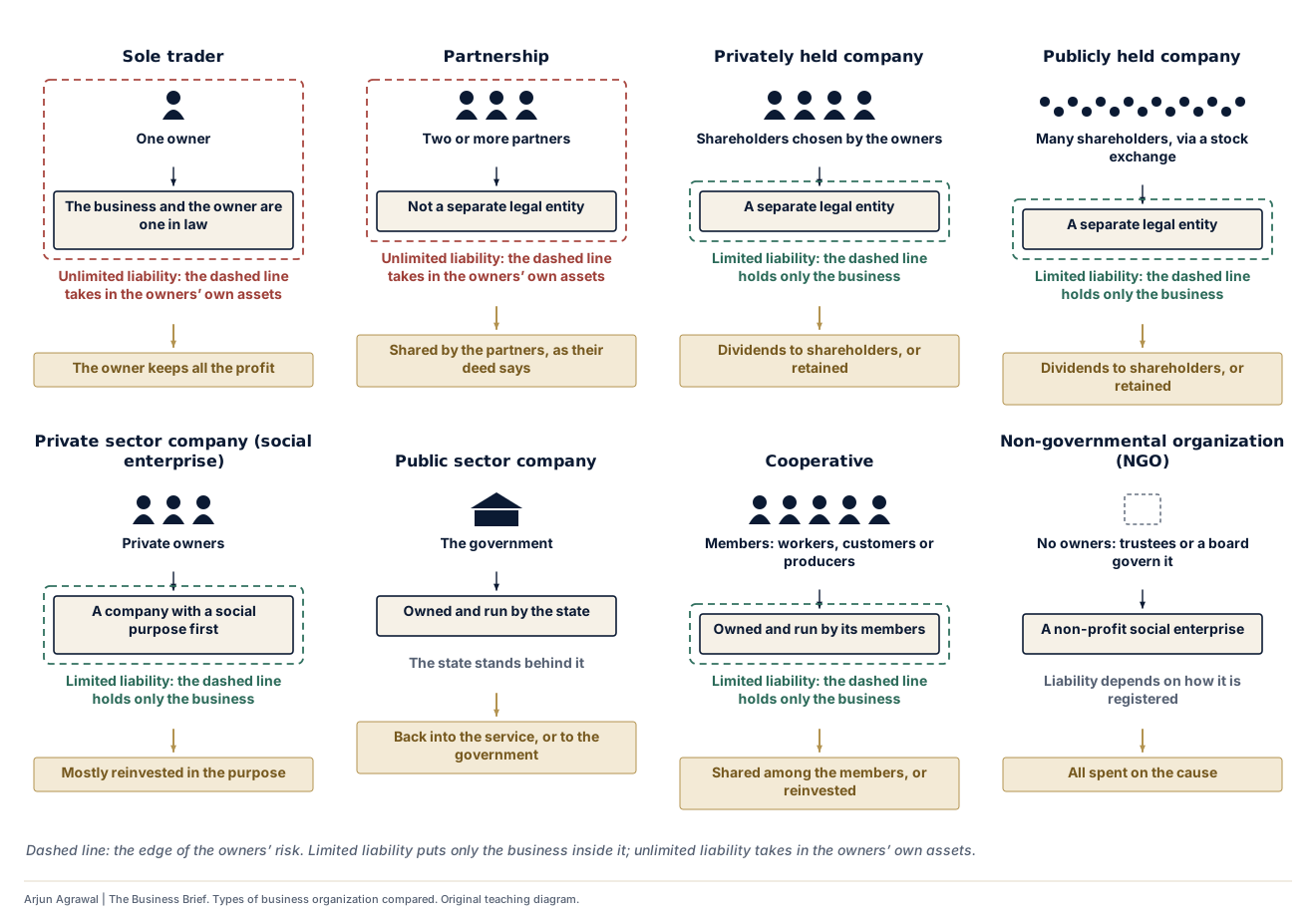
Choose two types to compare; the facts that differ are marked.
Compare two types of organization
Choose two different ones to compare.
Sole trader
- Owned by differs
- One person, who may employ staff
- Liability differs
- Unlimited: the owner’s personal assets are at risk
- Finance differs
- Personal funds, loans, overdrafts, trade credit
- Profit goes to differs
- The owner
- Control differs
- The owner decides everything
- Accounts differs
- Private, apart from tax returns
Partnership
- Owned by differs
- Two or more partners
- Liability differs
- Usually unlimited, even for a fellow partner’s debts
- Finance differs
- The partners’ capital, loans, overdrafts
- Profit goes to differs
- The partners, as the deed of partnership sets out
- Control differs
- Shared by the partners
- Accounts differs
- Usually private
Privately held company
- Owned by differs
- Shareholders; shares are not sold to the public
- Liability differs
- Limited: shareholders can lose only what they paid for their shares
- Finance differs
- Share capital from chosen investors, loans, retained profit
- Profit goes to differs
- Dividends to shareholders, or kept in the business
- Control differs
- Directors appointed by the shareholders, often the same people
- Accounts differs
- Usually filed publicly
Publicly held company
- Owned by differs
- Anyone who buys its shares on a stock exchange
- Liability differs
- Limited
- Finance differs
- Large sums from selling shares to the public, loans, retained profit
- Profit goes to differs
- Dividends to shareholders, or kept in the business
- Control differs
- Directors and managers: ownership and control are divorced
- Accounts differs
- Published in full and independently audited
Private sector company (social enterprise)
- Owned by differs
- Private owners
- Liability differs
- Limited, as in any company
- Finance differs
- Trading income, owners’ capital, loans, impact investors
- Profit goes to differs
- Mostly back into its social or environmental purpose
- Control differs
- Directors, guided by the mission
- Accounts differs
- As for any company
Public sector company
- Owned by differs
- The government
- Liability differs
- The state stands behind it
- Finance differs
- Trading income and government funds
- Profit goes to differs
- Back into the service, or to the government
- Control differs
- Managers answerable to the government
- Accounts differs
- Reported to the government and the public
Cooperative
- Owned by differs
- Its members: the people who work in it, buy from it or supply it
- Liability differs
- Usually limited
- Finance differs
- Members’ contributions, loans, retained surplus; no shares sold to outsiders
- Profit goes to differs
- The members, usually by how much each traded or worked, or back into the business
- Control differs
- Democratic: normally one member, one vote
- Accounts differs
- Reported to the members
Non-governmental organization (NGO)
- Owned by differs
- No one takes a share: trustees or a board govern it
- Liability differs
- Depends on how it is registered
- Finance differs
- Donations, grants, some trading income
- Profit goes to differs
- Its cause: no surplus is paid out
- Control differs
- Trustees or a board, independent of government
- Accounts differs
- Reported to donors and regulators, often published
Text description
The types of business organization the guide names, each drawn the same way: its owners above, the business, a dashed line marking the edge of the owners’ risk, and where its profit or surplus goes. Sole trader: owned by one person, who may employ staff; liability unlimited: the owner’s personal assets are at risk; finance personal funds, loans, overdrafts, trade credit; profit goes to the owner; control the owner decides everything; accounts private, apart from tax returns. Partnership: owned by two or more partners; liability usually unlimited, even for a fellow partner’s debts; finance the partners’ capital, loans, overdrafts; profit goes to the partners, as the deed of partnership sets out; control shared by the partners; accounts usually private. Privately held company: owned by shareholders; shares are not sold to the public; liability limited: shareholders can lose only what they paid for their shares; finance share capital from chosen investors, loans, retained profit; profit goes to dividends to shareholders, or kept in the business; control directors appointed by the shareholders, often the same people; accounts usually filed publicly. Publicly held company: owned by anyone who buys its shares on a stock exchange; liability limited; finance large sums from selling shares to the public, loans, retained profit; profit goes to dividends to shareholders, or kept in the business; control directors and managers: ownership and control are divorced; accounts published in full and independently audited. Private sector company (social enterprise): owned by private owners; liability limited, as in any company; finance trading income, owners’ capital, loans, impact investors; profit goes to mostly back into its social or environmental purpose; control directors, guided by the mission; accounts as for any company. Public sector company: owned by the government; liability the state stands behind it; finance trading income and government funds; profit goes to back into the service, or to the government; control managers answerable to the government; accounts reported to the government and the public. Cooperative: owned by its members: the people who work in it, buy from it or supply it; liability usually limited; finance members’ contributions, loans, retained surplus; no shares sold to outsiders; profit goes to the members, usually by how much each traded or worked, or back into the business; control democratic: normally one member, one vote; accounts reported to the members. Non-governmental organization (NGO): owned by no one takes a share: trustees or a board govern it; liability depends on how it is registered; finance donations, grants, some trading income; profit goes to its cause: no surplus is paid out; control trustees or a board, independent of government; accounts reported to donors and regulators, often published.
Point to a circle or an overlap, or tab to it, to read what it means; select it to open its subtopic. On a touch screen, the first tap explains and the second opens.
Every part, explained
- People The social bottom line: how the business treats its employees, its customers and the communities it touches, from fair pay and safe work to honest marketing. 1.4 Stakeholders
- Planet The environmental bottom line: the resources it uses and the waste and emissions it leaves, and whether its products can be reused, repaired or recycled. 5.3 Lean production and quality management
- Profit The economic bottom line: whether the business earns enough to survive, reward its owners and invest. Without it, nothing else lasts. 1.3 Business objectives
- Bearable People and planet without profit: good for society and the environment, but it depends on someone paying for it, so it may not last. 1.3 Business objectives
- Equitable People and profit without the planet: fair to people and profitable, but storing up environmental costs for later. 1.3 Business objectives
- Viable Planet and profit without people: efficient and green, but at a cost to workers or communities that can turn stakeholders against it. 1.4 Stakeholders
- Sustainable All three at once: the aim of corporate social responsibility. Few decisions reach it fully; the diagram helps to see which bottom line a decision neglects. 1.3 Business objectives
Text description
Three overlapping circles for the triple bottom line, the idea that a business should be judged on people, planet and profit, not on profit alone. People is the social bottom line: employees, customers and communities. Planet is the environmental bottom line: resources, waste and emissions. Profit is the economic bottom line: whether the business earns enough to survive and invest. Where two circles overlap without the third: people and planet is bearable, people and profit is equitable, and planet and profit is viable. Where all three overlap the business is sustainable, the aim of corporate social responsibility. Around the circles, the stakeholders each bottom line matters most to: employees, customers and local communities for people; future generations, the government and pressure groups for the planet; shareholders and lenders for profit. The guide does not name the triple bottom line as a syllabus term; it suggests it as an inquiry in unit 3, and it is a way to weigh corporate social responsibility (1.3).
Section 18: Key terms
Defined in the platform's own words. Each opens its full entry.
- Charity
- A non-profit organization set up for purposes that benefit the public, such as relieving poverty, advancing education or protecting animals, and funded mainly by donations, grants and fundraising.
- Company
- A business that has been incorporated, that is, registered as a legal person separate from its owners, so it can own property, make contracts, borrow, sue and be sued in its own name.
- Cooperative
- A business owned and controlled by its members, who may be its customers, its workers or the producers who supply it; they share the benefits it creates and run it democratically, normally on the basis of one member, one vote.
- Deed of partnership
- A legal agreement between partners that sets out how their partnership will run, including each partner's capital, share of profits, role and say in decisions, and what happens if a partner leaves or dies.
- Divorce of ownership and control
- The situation in a large company where the shareholders own the business but professional directors and managers decide how it is run.
- For-profit social enterprise
- A social enterprise that aims to make a profit from trading, but uses that profit mainly to serve its social or environmental purpose rather than to reward its owners.
- Limited liability
- A legal protection under which the owners of a company can lose only the money they put into it, and cannot be made to pay its debts out of their own pockets.
- Non-governmental organization (NGO)
- An organization that is set up and run independently of any government, works for a cause such as human rights, the environment, health or relief from poverty, and does not distribute profits to owners.
- Non-profit social enterprise
- A social enterprise that never distributes a surplus to owners or members: everything left over after costs is used for its social or environmental purpose.
- Partnership
- A business owned by two or more people who share its capital, decisions, workload and profits, usually with unlimited liability.
- Private sector
- All the organizations in an economy that are owned by individuals, families, investors or members rather than by the state.
- Private sector company
- In the guide's classification, a company owned by private individuals or organizations that operates as a for-profit social enterprise: it trades for a profit, but its main purpose is social or environmental and most of its profit goes back into that purpose.
- Privately held company
- A company whose shares are owned privately, often by a family, its founders or a small group of investors, and cannot be offered to the general public or traded on a stock exchange.
- Privatization
- Moving an organization or activity out of government ownership or control and into private hands, for example by selling a state-owned company to investors or contracting out a public service.
- Public sector
- Organizations that are owned, funded or run by central or local government, such as state schools, public hospitals, the armed forces and state-owned companies.
- Public sector company
- A company owned wholly or mainly by the government that sells goods or services commercially and aims to make a profit or surplus, while serving a public purpose.
- Publicly held company
- A company whose shares can be offered to the general public and are bought and sold on a stock exchange.
- Shareholder
- An owner of a company, holding one or more of the shares into which its ownership is divided.
- Social enterprise
- An organization that trades in order to pursue a social or environmental purpose, earning most of its income from selling goods or services and using most of any surplus to further that purpose.
- Social entrepreneur
- An entrepreneur whose main aim is to solve a social or environmental problem, using business methods and trading income rather than relying only on donations.
- Sole trader
- A business owned by one person, who takes all the decisions, keeps all the profit and has unlimited liability for its debts.
- Triple bottom line
- A way of judging an organization's performance by three measures rather than by profit alone: its social impact (people), its environmental impact (planet) and its financial results (profit).
- Unlimited liability
- A legal position in which the owners of a business are personally responsible for all its debts, so they may have to use their own savings or sell personal possessions to pay them.
Section 19: Tools and practice
1 tool on the platform for 1.2, by room, with exercises, worked calculations and practice questions.
Practice questions with mark schemes
Section 20: Check your recall
Answer from memory, then reveal and rate yourself. Your ratings stay on this device.
Answer each question from memory, out loud or on paper, before you reveal the answer. Your ratings also schedule these questions in your flashcards.
-
Distinguish between the private and the public sector.
The private sector is owned privately, by individuals, families, partners, shareholders or members; the public sector is owned or controlled by the government. Most private sector businesses aim for profit, while public sector organizations aim mainly to provide a service.
How well did you recall it? -
Why is a publicly held company in the private sector?
It is owned by private shareholders. "Publicly held" means that anyone can buy its shares on a stock exchange, not that the government owns it.
How well did you recall it? -
What is unlimited liability, and which forms of business usually have it?
The owners are personally responsible for all the debts of the business, so their own assets are at risk. Sole traders and most partnerships.
How well did you recall it? -
Give three things that a deed of partnership usually sets out.
For example the capital each partner puts in, how profits are shared, who decides what, how disputes are settled, and what happens when a partner leaves or dies.
How well did you recall it? -
Give two differences between a privately held and a publicly held company.
A publicly held company may offer shares to anyone, and they trade on a stock exchange; a privately held company may not, and its owners control who joins them. A publicly held company must also disclose more, and can be taken over.
How well did you recall it? -
Name the three for-profit social enterprises that the guide lists, and the non-profit one.
Private sector companies, public sector companies and cooperatives; and NGOs.
How well did you recall it? -
How does a cooperative differ from a company owned by investors?
It is owned and controlled by its members (its workers, customers or producers), normally with one vote each whatever they have invested, and its surplus is shared among them or reinvested instead of rewarding outside investors.
How well did you recall it? -
How are NGOs usually funded, and why can that be a weakness?
Mainly through donations, grants and membership fees, with some trading. Income can be unpredictable, and relying on large donors or on governments can threaten their independence.
How well did you recall it?
Section 21: How it connects
Where 1.2 meets the rest of the course: worked connections with an exam-style question on each, then the further links the notes name.
-
Who owns a business shapes what it aims for
What a business aims for depends partly on who owns it and why it exists. A sole trader or a privately held company can set its own objectives, from profit to independence; a publicly held company is under pressure from its shareholders to protect shareholder value; a cooperative, one of the guide's for-profit social enterprises, serves its members and a social purpose while still having to cover its costs; and a non-governmental organization pursues a cause rather than profit. Comparing the types of entity shows that profit is a common objective, not a universal one.
Exam-style question Source: Original practice question Command term: Explain (AO2)
Explain why the objectives of a cooperative are likely to differ from those of a publicly held company. [4 marks]
-
Legal form and the finance a business can raise
The type of business entity limits the sources of finance open to it. A sole trader relies on personal funds, loans, overdrafts, trade credit and, in some countries, microfinance providers, and because the owner has unlimited liability, a lender looks at the owner's own assets. A company can raise share capital: a privately held company sells shares only to people its owners choose, while a publicly held company can offer shares to the public on a stock exchange, which opens far more finance but risks a loss of control to new shareholders. Changing legal form is often part of raising the finance for growth.
Exam-style question Source: Original practice question Command term: Explain (AO2)
Explain why a publicly held company can usually raise more share capital than a privately held company. [4 marks]
Also linked in the notes
- 1.1 What is a business? A start-up has to choose its legal form before it can trade.
- 1.4 Stakeholders Ownership decides who the shareholders are and how much power they have.
- 1.5 Growth and evolution Growth, takeovers and flotation change the legal form of a business and who controls it.
See 1.2 on the course connections map, with every link drawn across the five units.
Section 22: Connected learning
Everything else on the platform that teaches, applies or tests 1.2, each labelled by its standing.
- Revise
-
- The 1.2 mindmap Full and revision views, to print or download
- Revision sheet The subtopic on one printable page
- Flashcards The 1.2 cards, to rate as you go
- Practise
-
- 13 questions on 1.2 in the question bank From the practice sets, the notes and the case files, filtered to this subtopic
- Cases
-
- Patchwork Digital Fictional Case Vault
- Tools
-
- 1 tool for 1.2 In Tools and practice on this page: Entrepreneurship and Innovation Lab
- Boardroom Briefings
-
- Velmar Components weighs a buyback against a factory for electric cars Fictional Briefing 9
- Business Intelligence
-
- Unilever demerges its ice cream business as The Magnum Ice Cream Company Real-world A real development, 6 December 2025, with its sources
- Microsoft and OpenAI rewrite their partnership as OpenAI restructures Real-world A real development, October 2025, with its sources
- Canal+ completes its takeover of MultiChoice and starts turning around the African pay-TV group Real-world A real development, 22 September 2025, with its sources
- Advanced Management
-
- Governance and accountability Enrichment Leadership and organizational behaviour: beyond the IB course
- Funding strategy and venture capital Enrichment Entrepreneurship and innovation: beyond the IB course
- Course connections
-
- 2 worked connections on the connections map With 1.3, 3.2
Notes checked against: Business management guide, first assessment 2024 (published February 2022, updated May 2022), pp. 23, 41 to 46 (The four content statements and their assessment objectives, including the grouping of social enterprises; the papers and the rule on command terms, pp. 41 to 46, for the exam-style practice); Business Management for the IB Diploma, pp. 71 to 83 (Read to check coverage and conventions; nothing reproduced. Its syllabus box says not-for-profit where the guide says for-profit, and AO2 where the guide says AO3; the guide is followed); Business management teacher support material, pp. 56, 60, 62 to 63, 82 to 89 (The social enterprise guidance and the glossary entries for the types of entity; the advice on answering papers 1 and 2, pp. 56 and 60). Updated 2026-11-03. The IB guide is the authority on the course.
Arjun Agrawal | The Business Brief, https://the-business-brief-dun.vercel.app/topics/types-of-business-entities/. Original teaching material, not an IB publication. The organizations in the teaching cases are fictional unless a case says otherwise.