Unit 2: Human resource management
2.6 Communication
Study mode could not start. The page reads as usual.
Study mode
On this page
Section 01: What the IB course asks
The content statements for 2.6, in the platform's words, with the depth of teaching the guide sets (guide, from p. 27).
- Formal and informal methods of communication for an organization in a given situation AO3
- Barriers to communication AO2
AO1 knowledge and understanding · AO2 application and analysis · AO3 synthesis and evaluation · AO4 a range of skills. A question can use a command term at its statement's level or below. The whole course.
Section 02: Why it matters
Every plan, instruction, warning and idea in an organization travels as a message, and every message can arrive late, garbled or not at all. When communication works, people know what to do and why, problems surface early and change is understood. When it fails, the costs show up as mistakes, rumours, wasted time, lost customers and staff who feel ignored.
The guide asks two things of this subtopic. You should be able to explain the barriers that stop messages getting through (AO2), and to judge which formal and informal methods of communication suit an organization in a given situation (AO3). That second statement is the demanding one: there is no best method in general, only methods that fit a particular message, audience and moment.
By the end you can
- Describe the communication process, from sender to receiver and back through feedback.
- Explain formal communication and the directions in which it flows, and informal communication, including the grapevine.
- Compare the main methods of communication, oral, written, visual and digital, and what each does well.
- Explain the barriers to communication and how they can be reduced.
- Evaluate which formal and informal methods suit an organization in a given situation, and recommend a choice.
- Suggest ways of reducing a particular barrier in a given organization, and explain how the success of communication can be judged.
- Explain how Hofstede's cultural dimensions help to explain communication across cultures (HL only).
Section 03: Communication and the communication process
Communication is the transfer of information, ideas or instructions from a sender to a receiver, so that the receiver understands them as the sender intended. Inside an organization it coordinates work, passes on decisions, carries problems and ideas upwards, and builds the relationships people need to cooperate. Outside, it reaches customers, suppliers, investors and the community. This subtopic is mainly about communication inside the organization.
Every act of communication follows the same process, shown in the diagram. A sender has an idea and turns it into a message, in words, figures or images. The message travels through a channel, such as a meeting, an email, a notice or an app, to a receiver, who interprets it and acts on it. Feedback, the receiver's reply, question or action, tells the sender whether the message was understood. Anything along the way that distorts or blocks the message is a barrier.
The process shows why communication fails so often: there are many places for it to go wrong. The sender may be unclear, the channel unsuitable, the receiver distracted or distrustful. Feedback is the safeguard. One-way communication, such as a notice or an announcement, is fast but gives the sender no way of knowing whether the message landed. Two-way communication, such as a conversation or a meeting with questions, is slower but lets misunderstandings be caught and corrected.
- Sender
The person or group with the message, who decides what to say, to whom and through which channel.
- Message
The content, in words, numbers, images or actions. A clear message suits its purpose and its receiver.
- Channel
The route or medium the message travels through, such as a meeting, a report, an email, a phone call or the intranet.
- Receiver
The person or group the message is for. What they understand depends on their knowledge, language, attitude and attention.
- Feedback
The receiver's response, which confirms understanding or reveals confusion. Without it, the sender is guessing.
Text description
A sender has an idea and encodes it as a message of words, figures or images, sent through a channel such as a meeting, email, notice or app, to a receiver who decodes and acts on it. Feedback flows back as the receiver confirms, questions or replies. Formal channels follow the structure; informal ones run across it. Barriers that distort or block the message include jargon, information overload, the wrong channel, too many levels in the hierarchy, language and cultural differences, noise and distance, distrust or lack of interest, and poor listening.
Section 04: Formal communication
Formal communication uses the official channels the organization sets up, usually following its structure and chain of command. It is how decisions, policies, instructions and results are passed on with the organization's authority behind them. Because it is planned and often recorded, it is accurate and can be checked later, which matters for anything with legal, safety or financial consequences.
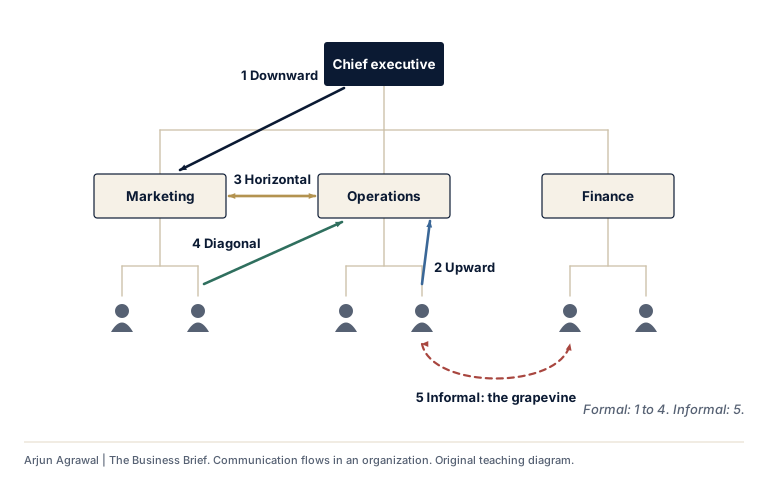
Formal communication flows in three directions. Downward communication passes decisions, instructions and policies from managers to the people they manage. Upward communication carries reports, results, problems, ideas and feedback from employees to managers. Horizontal (or lateral) communication coordinates work between people or departments at the same level, such as design and production. A healthy organization needs all three: one that only communicates downwards loses the early warnings and ideas that come from the people doing the work.
The structure shapes formal communication. In a tall structure, messages pass through many levels, which slows them down and gives each level a chance to filter or distort them (2.2). In a flatter structure messages travel faster, but managers with wide spans of control may be overloaded with them.
- Meetings and briefings
Team meetings, department briefings and all-staff meetings, often with an agenda and minutes. Two-way, but costly in time.
- Reports and memos
Written documents that record results, analysis or decisions, from a weekly sales report to a board paper.
- Official emails and letters
Fast written messages with a record, for instructions, confirmations and anything that must be kept, such as a contract change.
- Intranet, handbooks and notice boards
Places where policies, procedures and news are published for everyone to refer to.
- Appraisals and one-to-one reviews
Formal conversations between a manager and an employee about performance and development, which give feedback in both directions.
- Consultation committees
Formal meetings between managers and employee representatives to discuss changes before they are decided.
Text description
Two organization charts of fifteen people each. The tall, or vertical, structure has four levels of hierarchy with a span of control of two: one manager, two below, four below them and eight at the bottom, a long chain of command that gives close supervision and clear promotion steps but slows communication and decisions. The flat, or horizontal, structure has two levels: one manager with fourteen people reporting directly, a span of control of fourteen, which speeds communication and encourages delegation but stretches the manager and offers fewer promotion steps.
Advantages
- Accurate and consistent, because messages are planned and can be checked.
- Leaves a record, which matters for legal, safety and financial matters.
- Carries authority, so people know the message is official.
- Everyone receives the same message through the same channel.
Limitations
- Can be slow, especially in tall structures with long chains of command.
- Messages may be filtered or distorted as they pass through each level.
- Often one-way, so misunderstandings go unnoticed.
- Can feel impersonal and bureaucratic, and too much of it adds to information overload.
Section 05: Informal communication and the grapevine
Informal communication is the unofficial exchange of information between people outside the organization's formal channels: conversations over coffee, chats in a corridor, messages in staff chat groups, social media and talk after work. Its best-known form is the grapevine, the network through which news and rumours spread from person to person, often far faster than any official announcement.
Informal communication cannot be abolished, and managers should not want to abolish it. It builds the relationships that make cooperation easy, it carries problems and ideas across departmental boundaries without waiting for a meeting, and it tells managers what people really think. Much of the creativity in organizations comes from informal conversations between people in different teams.
Its danger is that it is unchecked. Rumours spread most when formal communication is slow, vague or silent: people fill the gap with guesses, usually pessimistic ones. The most effective defence against harmful rumours is not to suppress the grapevine but to communicate formally, early and honestly, and to listen to what the grapevine is saying. Some managers make a habit of walking around the workplace and talking to staff informally, which keeps them in touch with problems that formal reports may never mention.
- Speed
News on the grapevine can reach the whole organization within hours, ahead of the official version.
- Relationships and trust
Informal contact builds the goodwill that makes formal cooperation easier, especially between departments.
- Honest feedback
People say informally what they would not say in a meeting, so the grapevine can warn managers of problems early.
- Rumour and inaccuracy
Messages change as they pass from person to person, and rumours can cause anxiety, damage morale and lead good staff to leave.
- Exclusion
People outside the informal networks, such as remote, part-time or new staff, can miss information others have.
Advantages
- Fast, and flows across departments and levels without waiting for the formal channels.
- Builds relationships, trust and a sense of belonging.
- Gives managers an honest picture of morale and of problems.
- Supports creativity, as people in different teams share ideas.
Limitations
- Often inaccurate, and spreads rumours, especially when formal communication is poor.
- No record and no control over who hears what.
- Can undermine official messages and leak confidential information.
- Leaves out people who are not part of the informal networks.
Section 06: Methods of communication: oral, written, visual and digital
Formal and informal describe the route a message takes. The method, or medium, describes its form. The same formal message, such as a change to working hours, could be given in a meeting, in a letter, in an email, on a poster or in a short video, and each would land differently.
Methods differ in how much they can carry. Face-to-face conversation carries words, tone, facial expression and the chance to ask questions at once, so it suits messages that are complex, sensitive or open to misunderstanding. A written notice carries only words, but it is precise, permanent and can reach everyone at once, so it suits simple facts and anything that must be kept. Researchers Richard Daft and Robert Lengel described this as the richness of a medium in the 1980s, arguing that rich media suit ambiguous messages and lean media suit routine ones. Their framework is enrichment, not part of the guide, but the idea is useful when you judge a method.
- Oral, face to face
Conversations, meetings and presentations. Rich, personal and two-way, with tone and body language, but leaves no record unless notes are taken, and takes everyone's time at once.
- Oral, at a distance
Phone and video calls. Fast and two-way across distances, though video loses some of the cues of a meeting, and time zones limit when people can talk.
- Written
Letters, reports, memos, emails, handbooks and contracts. Precise and permanent, and can be studied and kept, but one-way, slower to produce, and easy to misread without tone.
- Visual
Charts, diagrams, infographics, signs and videos. Make data and procedures easy to grasp and can cross language barriers, but can oversimplify.
- Digital
Intranets, instant messaging, collaboration platforms and video conferencing. Fast and cheap, reaching dispersed teams, but they add to information overload, blur the line between work and home, and depend on the technology working.
- Non-verbal
Body language, tone, facial expression and actions. Part of every face-to-face message; when words and actions disagree, people tend to believe the actions.
Section 07: Choosing formal and informal methods for a given situation
The guide's AO3 statement asks which formal and informal methods suit an organization in a given situation. That is a judgement, so the answer is always "it depends", followed by what it depends on. A strong answer starts from the message and the audience, not from the method.
Ask six questions. What is the purpose: to inform, instruct, consult, persuade or reassure? How urgent is it? How sensitive or confidential is it, and how will people feel about it? How complex is it, and is it likely to be misunderstood? Does it need a record for legal, safety or financial reasons? And who is the audience: how many people, where, in what language, and with what access to technology? Cost, the organization's culture and its structure then narrow the choice.
Most important messages need more than one method: a rich, two-way method to explain and listen, a written method to record and confirm, and attention to the informal channels, which will carry the message on regardless. The order matters too. Bad news delivered in person first and confirmed in writing afterwards is received very differently from bad news that arrives by email or, worse, through the grapevine before anyone official has spoken.
- Announcing redundancies or other bad news
Face to face, by senior managers, to everyone affected at the same time, then confirmed in writing, with time for questions and support available. Never by email alone, and never after a leak if it can be avoided.
- A new safety rule
Formal and written, so there is a record, backed by a briefing or demonstration and visual signs at the point of use, and a check that each person has understood.
- A crisis, such as a product recall
Fast and frequent, through several channels at once, from a single trusted source so that messages do not conflict. HL students study communication in a crisis in 5.7.
- Consulting on a change
Two-way methods, such as meetings, workshops and surveys, before the decision is fixed, with informal conversations to bring out concerns people will not raise in public.
- Routine results and information
Lean, written or digital channels, such as a weekly dashboard or an intranet page, that people can consult when they need to.
- Coordinating teams across sites and time zones
Shared written channels that people can read at any time, combined with regular video calls at hours that suit everyone in turn.
- Building morale and belonging
Informal contact, such as social events, recognition in person and managers who walk around and talk, supported by formal recognition schemes.
Section 08: Barriers to communication
A barrier to communication is anything that stops a message being sent, received or understood as the sender intended. Barriers can arise at every stage of the process: in the sender, the message, the channel, the receiver or the feedback. The guide sets this statement at AO2, so you should be able to explain how a barrier affects a particular organization, not only name it.
Barriers matter because their costs are real even when they are hard to see: errors and rework, delays, duplicated effort, poor decisions made on poor information, low morale and staff who feel ignored. In a hospital or a factory, a misunderstood instruction can be a matter of safety.
Structure is one barrier that is easy to overlook. Suppose that each time a message is passed on, about 80% of its detail survives. A message from the board that passes down four further levels to the shop floor would arrive with about 0.8 × 0.8 × 0.8 × 0.8 = 0.41, or 41%, of its original detail; with only two levels to pass, about 64% would survive. The percentages are an illustration, but the point is real: every extra level of hierarchy is another chance for a message to be shortened, softened or misread.
- Jargon and technical language
Specialist terms that the receiver does not understand, such as engineering or finance terms used with non-specialists.
- Language differences
Receivers working in a second language, or a message in one language sent to a workforce that speaks several.
- Cultural differences
Different expectations about directness, hierarchy, formality and silence can lead to offence or misunderstanding. As enrichment beyond the guide, the anthropologist Edward T. Hall distinguished high-context cultures, where much is left unsaid and understood from the situation, from low-context cultures, where people expect everything to be stated explicitly.
- Information overload
So many messages that important ones are missed, skimmed or ignored, a growing problem with email and messaging apps.
- The wrong channel
A complex or sensitive message sent through a lean channel, such as bad news by email, or a simple fact buried in a long meeting.
- Too many levels in the hierarchy
Long chains of command slow messages and let them be filtered or distorted at each level.
- Distance, time zones and noise
Physical separation, working hours that do not overlap, and noisy or distracting workplaces.
- Technology failure
Unreliable networks, systems people have not been trained to use, or messages lost in filters and folders.
- Attitudes and emotions
Distrust of the sender, fear, anger, stress or lack of interest change how a message is heard, and people tend to hear what they expect.
- Poor listening and no feedback
Receivers who do not pay attention, and senders who never check understanding.
- Power distance (Hofstede, toolkit) HL
In Hofstede's cultural dimensions, an HL toolkit tool, power distance describes how far people accept that power is unequally distributed. Where it is high, employees may hesitate to question managers or report problems upwards, so upward communication is weak unless managers actively ask for it.
HL This section has HL-only points, hidden while you are viewing SL content.
Section 09: Reducing the barriers
Each barrier has a remedy, and the best remedies are matched to the barrier that is actually causing the problem. Clearer writing will not fix a message that arrives in the middle of the night; a better app will not fix a lack of trust.
Three principles run through them. Know the receiver: write and speak for the people who must understand, in their language and at their level. Match the method to the message: rich, two-way methods for complex or sensitive messages, lean and written ones for routine facts and records. Close the loop: ask for feedback, check understanding and act on what comes back, so that communication is a conversation rather than a broadcast. Communication is also a matter of trust built over time: people believe managers whose words have matched their actions before.
- Plain language
Short sentences, everyday words and jargon explained, with translation or visuals where people speak different languages.
- The right method and timing
Choose the method by the purpose, urgency, sensitivity and audience, and time messages so that every group receives them before outsiders do.
- Feedback and listening
Questions at the end of briefings, surveys, suggestion schemes and managers who walk around and listen.
- Fewer, clearer messages
Cut unnecessary emails, put the key point first, and use one trusted channel for official news, which reduces overload.
- Shorter chains of command
Delayering, or allowing direct communication across levels, so that messages pass through fewer hands.
- Training
Teach managers to brief, listen and give feedback, and teach staff to use the communication tools the organization relies on.
- Repetition through several channels
Important messages repeated in more than one form, for example in a meeting, in writing and on the intranet, so that one failed channel does not lose the message.
HL Section 10, Communicating across cultures (HL toolkit), is HL only and is hidden while you are viewing SL content. Switch to HL at the top of the page to see it.
Section 10: Communicating across cultures (HL toolkit)
HL onlyAt HL, the toolkit's Hofstede's cultural dimensions, which the guide suggests for unit 2 (p. 25), help to explain why the same message can be received differently in different countries. That matters for multinational companies, and for any organization with an international workforce, suppliers or customers. Three of the six dimensions bear most directly on communication inside an organization.
Power distance shapes how freely people communicate upwards: where it is high, employees expect instructions from above and may hesitate to question them or to report bad news; where it is low, staff expect to be consulted and to challenge their managers. Individualism and collectivism shape feedback: in more individualist cultures, direct feedback to one person is usual, while in more collectivist ones criticism in front of the group can cause a loss of face, so feedback is more often given privately or indirectly. Uncertainty avoidance shapes how much detail and formality people expect: where it is high, people prefer clear written rules, detailed instructions and formal channels; where it is low, they are more comfortable with informal, flexible arrangements.
The scores describe national averages, not individuals, and every organization also has a culture of its own (2.5), so the dimensions suggest questions to ask rather than answers. They are most useful in planning: who should deliver a message, in what form, and how feedback will be gathered.
- Power distance
How far people accept that power is shared unequally. Where it is high, upward communication is weak unless managers actively ask for it.
- Individualism and collectivism
Whether people look after themselves or their group first, which shapes whether feedback is given directly to one person or more carefully, to protect the group's harmony.
- Uncertainty avoidance
How uneasy people are with ambiguity, which shapes how much detail, formality and written confirmation they expect.
Text description
Six scales, each running between two poles. Power distance, low to high: how far people accept that power is shared unequally. Individualism versus collectivism: whether people look after themselves or their group first. Masculinity versus femininity: competition and achievement, or care and quality of life. Uncertainty avoidance, low to high: how uneasy people are with ambiguity and risk. Long-term orientation, short term to long term: tradition and quick results, or saving and persistence. Indulgence versus restraint: how freely people act on their wishes. Countries are scored on each dimension; the scores are national averages that describe tendencies, not individuals.
Section 11: Judging whether communication works
Because communication is two-way, the test of a method is not whether a message was sent but whether it was received, understood and acted on. Organizations can gather evidence of that in several ways, and a recommendation about methods is stronger when it says how its success would be judged.
- Surveys of staff, asking where they first heard important news and whether they understood it.
- Reach and response: how many people opened a message, attended a briefing or asked a question.
- Errors and rework traced back to misunderstood instructions.
- Speed: how long news takes to reach each site and level.
- The grapevine: which rumours are circulating, and how accurate they are.
- Outcomes that poor communication often feeds, such as absence, resignations and customers' complaints.
Numbers need interpreting. An email opened by 90% of staff says nothing about whether it was understood, and a fall in errors after a new briefing may have other causes. A comparison before and after a change, with the same questions asked of the same groups, is more convincing than a single survey, and the toolkit's descriptive statistics help to summarize the results.
- Percentage points and per cent
A share that falls from 62% to 34% has fallen by 28 percentage points, which is a fall of about 45% of its original size. Say which you mean.
Percentage change
Percentage change = (new value − old value) ÷ old value × 100
A standard form, not on the guide's formula list. For a share already measured in per cent, the simple difference is the change in percentage points.
Advantages
- Shows whether a change in communication has worked, rather than assuming it has.
- Reveals which sites, levels or groups the formal channels are missing.
- Gives managers evidence to act on and to report back to staff.
Limitations
- Surveys record what people say, and the people who answer may not be typical.
- Effects are hard to separate from other causes.
- Reach, such as messages opened and briefings attended, is easy to measure; understanding is not.
Section 12: In practice: industries and stakeholders
The same ideas look different from one industry to the next, and land differently on each group with a stake in the business.
Across industries
- Hospitals and healthcare
Communication is a matter of patient safety, so hospitals use structured, formal handovers between shifts, written records and checklists, and encourage staff to speak up about problems whatever their seniority. Jargon, fatigue, noise and steep hierarchies are recognized barriers.
- Manufacturing
Many staff work on the shop floor, in noise and in shifts, without computers, so short briefings at the start of a shift, visual signals and signs at workstations matter more than email. Several languages may be spoken on one site.
- Professional services
Law and accountancy firms depend on precise written communication with a record, and on confidentiality. Informal communication between colleagues spreads knowledge, but careless informal talk can leak client information.
- Retail chains
Head office must reach hundreds of stores and many part-time staff on different shifts, so it relies on store managers, short daily briefings, staff apps and the intranet. Messages that must reach the shop floor before customers do, such as price changes, test every channel.
- Technology and remote teams
Teams spread across cities and time zones rely on written, digital channels that people can read when they choose, with video calls for discussion. Overload and the loss of informal contact are the main risks, so firms deliberately create informal ways for people to meet.
- Multinational companies
Language, culture and time zones all act as barriers, and messages from head office can read very differently in each host country. At HL, Hofstede's dimensions help to explain why the same method of communication works in one country and fails in another.
- Aviation
Crews and air traffic controllers rely on standard phrases, the reading back of instructions and checklists, so that a message cannot be misheard over radio noise or between people with different first languages. Crew training also stresses that junior members must speak up about a concern, because a hierarchy in which juniors hesitate to question seniors is a recognized risk to safety.
- Charities and volunteer organizations
Volunteers give their time, often part-time and from home, so messages travel through group chats, newsletters and informal contact more than through a formal hierarchy. Keeping volunteers informed and heard matters because, unlike employees, they can simply stop coming, and donors expect clear, honest reports of how their money is used.
For each stakeholder
- Employees
Need timely, honest information about their work and their future, and a voice upwards. When formal communication fails they turn to the grapevine, and poor communication is a common cause of low morale and resistance to change.
- Managers
Depend on accurate information flowing up and across to make decisions, and must pass decisions down clearly. Middle managers can become bottlenecks, filtering messages in both directions, and suffer most from information overload.
- Owners and shareholders
Want clear, regular information about performance and strategy. Companies whose shares are traded publicly must report formally to investors, and what managers say in public affects the share price, so formal communication with shareholders is closely controlled.
- Customers
Experience the results of internal communication: a sales team that knows about a price change, or a delivery that arrives as promised because departments talked to each other. In a crisis, fast and honest external communication protects trust.
- Employee representatives
Expect formal consultation before major changes. Communication with them that is late or one-sided can turn concern into conflict, which HL students study in 2.7.
- Suppliers
Need accurate forecasts, specifications and changes in good time; a design change that is not communicated to a supplier causes waste and delay on both sides.
- The media and the public
Hear what the organization says in announcements, reports and responses to crises, and often what leaks from inside it. Internal communication that fails, such as staff learning of job cuts from the news, can quickly become a public story that damages the organization's reputation.
Section 13: Evaluation and limits
What to weigh before reaching a judgement.
- There is no best method in general. The right choice depends on the purpose, urgency, sensitivity and complexity of the message, the need for a record and the audience, and most important messages need a rich, two-way method together with a written one.
- Informal communication cannot be abolished, only managed. Strong, early and honest formal communication starves rumours of oxygen, while listening to the grapevine gives managers early warning of problems.
- More communication is not better communication. Digital tools make messages faster and cheaper, but also multiply them, and information overload is itself a barrier. Fewer, clearer messages through trusted channels often work better.
- Structure and culture shape communication. Tall structures slow and filter messages; flatter ones speed them up but may overload managers. Organizational culture decides whether people feel safe to speak up, and at HL, national culture and Hofstede's power distance help to explain why.
- Communication is two-way. A message is only effective if it is understood and acted on, so feedback and listening are as important as clear sending. Judging effectiveness needs evidence, such as surveys, errors, rumours and how fast news reaches each group.
- Communication raises ethical questions. Timing, honesty and the choice of words can inform people or manipulate them; the guide's theory of knowledge questions for this unit ask how language can be used to influence, persuade or manipulate employees (p. 28). Trust, once lost through spin or silence, is slow to rebuild.
- Judge communication by evidence, not by effort. Messages sent, meetings held and emails opened measure activity; surveys, errors, rumours and outcomes such as resignations show whether people understood and acted, best compared before and after a change.
Section 14: Make the decision
Use the ideas on a business choice: weigh the options, decide, and say what would change your mind.
Decision brief · a fictional business
Telling Kinloch's staff about the investment
Kinloch Bikes has agreed to sell a 60% stake to a larger bike company, which will keep the Kinloch brand and all three sites for at least two years. The deal will be signed on Thursday at 16:00 head-office time, when the sales office abroad will be closing. Rumours are already circulating on the staff chat group, two senior designers have asked about their jobs, and local journalists cover the company closely. Isla Kinloch must decide how to tell 160 staff on three sites.
How to weigh the options
Start with the nature of the message. It is sensitive, people fear for their jobs, and rumours already exist, so the method must be rich enough to reassure and to answer questions, fast enough to beat the grapevine, and consistent across sites.
Option A is consistent and quick, but a lean, one-way channel for news this personal invites people to read between the lines, and an email is easily forwarded to journalists. It answers the facts but not the fear. Option B is rich and two-way: staff hear the news from the founder, can ask questions at once and can judge her tone. It costs managers' time and needs careful timing so that no site hears it second-hand; the sales office will hear it last, which the video call and an early message from their manager must manage. Option C uses managers who know their teams, but briefing managers a day early risks a leak, each manager may tell the story differently, and the managers themselves may have the same worries as their staff.
A strong judgement weighs speed, richness, consistency and confidentiality, and may combine options: for example, B for the announcement, with A's written questions and answers sent the moment the briefings start so that every site has the same facts in writing, and managers briefed only an hour before. Say what would change your mind: a high risk of the news leaking before Thursday would favour speed over richness, and a deal that put jobs at risk would make face-to-face delivery essential, not merely better.
Section 15: Exam-style practice
Original questions written by the platform in the style of the papers, with what a strong response does. They are not IB questions and the guidance is not an official markscheme.
-
Define the term informal communication.
What a strong response does
A strong response gives a precise definition: the unofficial exchange of information between people outside the organization's formal channels, such as conversations, chat groups and the grapevine.
- The key contrast is with the official channels set by the structure.
- An example alone, such as "gossip", is not a definition.
-
Kinloch Bikes, a fictional manufacturer, has grown from 15 to 160 staff on three sites, one in another country six hours ahead (see the situation above). Explain two barriers to communication at Kinloch.
What a strong response does
A strong response identifies two distinct barriers and explains how each stops messages getting through at Kinloch. For example:
- Distance and time zones: the sales office is six hours ahead, so messages sent at the end of the day at head office arrive overnight, and the sales team learned of a price rise from a customer.
- Information overload: email traffic has tripled, so important messages are missed among routine ones.
- Other valid choices include the wrong channel (news by email to staff who rarely read it), jargon between designers and engineers, and attitudes shaped by takeover rumours.
Each barrier needs both an explanation of how it works and a link to Kinloch. The teacher support material notes that AO2 answers without application are typically limited to half the marks (p. 56).
-
Distinguish between formal and informal communication, using examples from Kinloch Bikes.
What a strong response does
A strong response makes the differences clear, with an example of each from the case.
- Route: formal communication uses official channels set by the structure, such as the monthly briefing or the weekly site reports; informal communication runs outside them, such as the staff chat group.
- Authority and accuracy: formal messages carry the organization's authority and are usually accurate and recorded; informal ones are unofficial, unchecked and can spread rumours, such as the takeover rumours.
- Speed and control: informal communication is often faster, which is why most Kinloch staff hear news first from colleagues, but managers cannot control it.
-
In a survey answered by 150 of Kinloch's 160 staff, 93 said they first heard important news from colleagues or the staff chat group, 39 from their line manager and 18 from an email.
Comment on what these results suggest about communication at Kinloch.
What a strong response does
A strong response turns the figures into percentages and then judges what they show.
- The figures: 93 ÷ 150 × 100 = 62% first hear news informally, 39 ÷ 150 × 100 = 26% from their line manager and 18 ÷ 150 × 100 = 12% from email.
- Judgement: formal communication is failing to reach staff first. Line managers, who should be the main channel for news, reach only about a quarter of staff first (26%), and email, the channel the business uses most, reaches only 12%.
- Implication: the grapevine is filling the gap, which explains the takeover rumours, and messages reaching staff informally may be inaccurate.
- A top response notes a limit: the survey shows where news is heard first, not whether the formal message is understood once it arrives.
-
(HL) Staff in Kinloch's overseas sales office come from a national culture that scores high on power distance in Hofstede's cultural dimensions. Explain how this might affect upward communication from the sales office to head office.
What a strong response does
A strong response explains the dimension and applies it.
- Power distance: the extent to which people accept that power is unequally distributed. Where it is high, employees tend to defer to managers and may avoid questioning or contradicting them.
- Effect: sales staff may not report problems, such as customers' complaints about the price rise, or challenge head office's decisions, so upward communication is weak and head office loses early warnings.
- Response: head office may need to ask for feedback explicitly, through anonymous surveys or one-to-one conversations, rather than waiting for it.
- A careful answer notes that a national score describes a tendency, not every individual.
-
Recommend how Kinloch Bikes should use formal and informal methods of communication between its three sites in future.
What a strong response does
A strong response recommends a set of methods matched to Kinloch's problems, supports it with evidence from the case and weighs alternatives. One way to organize it:
- Diagnose: the problems are horizontal (design and factory do not coordinate), cross-border (the sales office hears news late) and downward (62% hear news first through the grapevine).
- Formal methods, applied: a compulsory design-and-production meeting before any change reaches the factory; a monthly briefing at times that rotate between sites, recorded and summarized in writing; a rule that customer-facing staff hear of price changes before customers. Weigh each: they add meetings and cost time, but give accuracy and a record.
- Informal methods, applied: keep the chat group but use it to point to official news; create occasions for designers and engineers to meet informally; managers who talk to staff. Weigh the benefit of relationships and honest feedback against the risk of rumours.
- Alternatives considered: for example, relying on email alone (cheap, but already failing) or a full new intranet (useful, but technology will not fix trust or coordination on its own).
- Recommendation with conditions: for example, a small number of reliable formal channels, matched to each direction of communication, with informal contact deliberately encouraged; judged by whether the share hearing news first from the grapevine falls at the next survey.
A recommendation that names methods without linking them to Kinloch's specific problems, or ignores informal communication altogether, will score low.
-
Outline two advantages of two-way communication for Kinloch Bikes.
What a strong response does
A strong response states two distinct advantages and gives the key feature of each, applied to Kinloch, in a sentence or two.
- Misunderstandings are caught: feedback lets the sender check the message landed, which would have stopped the factory preparing for frame parts that did not exist.
- Problems and ideas travel upwards: designers and engineers can raise problems before parts fail to fit, rather than blaming each other afterwards.
- Other valid advantages include greater trust during the takeover rumours, because staff can ask questions and hear honest answers.
-
Suggest two ways Kinloch Bikes could reduce the barrier of jargon between its designers and its factory engineers.
What a strong response does
A strong response puts forward two plausible measures, each with a reason that fits the case.
- A shared glossary of part names, agreed by both teams, so that "next batch" and "revision B" mean the same thing on both sites.
- Drawings and samples instead of words alone, shown in the design-and-production meeting, because a visual message crosses the gap between the two teams' vocabularies.
- Other valid suggestions include short placements of designers on the factory floor, or a plain-language summary at the top of every design change.
A suggestion that does not address jargon, such as more email, earns little.
-
Compare and contrast an all-staff email and face-to-face briefings as ways for Kinloch Bikes to announce the investment to its staff.
What a strong response does
A strong response sets out similarities and differences point by point, with both methods in every point and evidence from Kinloch throughout, then judges which differences matter most for this message.
- Similarities: both are formal, downward communication from the founder; both can give every site the same facts; both can be followed by a written question-and-answer page.
- Richness and feedback: a briefing carries tone and lets staff ask questions at once, which matters for news that touches their jobs; an email is lean and one-way, and invites people to read between the lines.
- Speed and consistency: an email reaches everyone at the same moment with identical words; briefings at three sites, one six hours ahead, cannot all happen at once, so some staff hear the news later.
- Cost and confidentiality: an email is cheap but easily forwarded to the local journalists; briefings take managers' time but are harder to leak word for word.
- Judgement: for example, that richness matters most here, because staff fear for their jobs and rumours already exist, so briefings should lead, with the email and written questions and answers sent as they start.
Two separate descriptions, one of each method, do not compare and contrast.
-
Vellora Textiles, a fictional clothing maker, found that only 9% of staff at its factory had raised a problem with a manager in the last month, against 46% at its head office. The factory is in a country with much higher power distance.
Suggest two ways Vellora could improve upward communication at its factory.
What a strong response does
A strong response puts forward two measures that fit high power distance, each with a reason.
- Supervisors ask, rather than wait: a short meeting at the start of each shift in which supervisors ask each line what went wrong, because staff who will not volunteer bad news to a superior will often answer a direct question.
- Anonymous channels: a suggestion box or an anonymous survey, so that reporting a problem does not feel like challenging authority.
- Other valid suggestions include training supervisors to thank people who raise problems, or recognizing problems reported in team meetings.
Suggestions that assume staff will speak up freely, such as an open-door policy alone, ignore the case's evidence.
HL Questions 5 and 10 are HL only and hidden while you are viewing SL content. Switch to HL at the top of the page to see them.
Section 16: Revision summary
The subtopic on one page: what to remember.
- Communication passes a message from a sender, through a channel, to a receiver; feedback shows whether it was understood, and barriers can distort it at any stage.
- Formal communication uses official channels set by the structure and flows downward, upward and horizontally; it is accurate, recorded and authoritative, but can be slow, filtered and one-way.
- Informal communication, including the grapevine, is fast, builds relationships and reveals what people think, but spreads rumours, especially when formal communication is poor.
- Methods differ in richness. Face-to-face suits complex and sensitive messages; written methods suit facts and records; visual methods suit data and procedures; digital methods reach dispersed teams but add to overload.
- Choosing a method for a given situation depends on the purpose, urgency, sensitivity, complexity, the need for a record and the audience, then on cost, culture and structure.
- Important messages usually need a rich, two-way method together with a written one, delivered in the right order and before outsiders hear.
- Barriers include jargon, language and cultural differences, information overload, the wrong channel, too many levels in the hierarchy, distance and time zones, technology failure, attitudes and poor listening.
- Barriers are reduced by knowing the receiver, matching the method to the message and closing the loop with feedback; trust built over time makes every message more credible.
- At HL, high power distance can weaken upward communication, so managers must ask for feedback rather than wait for it.
- Judge communication by evidence of understanding and action, such as surveys before and after a change, errors and rumours, not by the number of messages sent; a share that falls from 62% to 34% has fallen by 28 percentage points.
- At HL, power distance, individualism and collectivism, and uncertainty avoidance help to explain how communication differs between cultures, as national tendencies rather than rules for individuals.
Section 17: The mindmap
How organizations communicate through formal and informal channels, how to choose the right method for a given situation, and the barriers that stop messages getting through.
Drag to move the map, or use the arrow keys. Click a branch to fold it away. Whole map shows all of it; zoom with the buttons, or with Ctrl and the scroll wheel.
- Types and forms
- Evaluation
- Core ideas
- Applications
- Connections
- Advantage
- Limitation
- HL HL only
The map as an outline
Formal communication
Types and forms
- Definition Official channels, following the chain of command
- Example Reports, memos, emails, meetings, intranet
- Flows down, up and across Instructions go down, reports and feedback go up, coordination goes across.
- Advantage Accurate, recorded, carries authority
- Limitation Slow, and filtered in tall structures
Informal communication
Types and forms
- Definition Unofficial messages outside formal channels
- Example Conversations, chat groups, the grapevine
- Advantage Fast; builds relationships and trust
- Advantage Shows managers what staff really think
- Limitation Spreads rumours and inaccurate news
Methods and media
Types and forms
- Written: letters, reports, email
- Oral: meetings, calls, presentations
- Visual: charts, diagrams, video
- Non-verbal: body language, tone
- Digital: intranet, messaging, video calls
Choosing a method for the situation
Evaluation
- Sensitive news: face to face For example, redundancies or a performance problem.
- Needs a record: written and formal For example, contracts, policies and warnings.
- Urgent: a call, message or meeting
- Complex: two-way, with time for questions
- Large or scattered audience: digital
- Weigh cost, speed, culture and the receiver
Barriers to communication
Core ideas
- Definition Anything that stops a message being understood
- Jargon and technical language
- Language and cultural differences
- Information overload
- Distance, time zones, technical failures
- Long chains of command distort messages
- Emotions, attitudes and lack of trust
Overcoming barriers
Applications
- Know the audience; use plain language
- Choose the method to suit the message
- Seek feedback to check understanding
- Shorten the chain of command
Connections
Connections
- 2.2: structure sets the formal channels
- 1.6: communicating across cultures
- 5.7: communication in a crisis HL
Open the mindmap on its own page, with its terms and connections.
Section 18: More diagrams
Original diagrams from the platform's library, each with a text description and an SVG download.
Point to a flow, or tab to it, to read what it carries; select it to open its subtopic. On a touch screen, the first tap explains and the second opens.
Every part, explained
- Downward communication Down the chain of command: instructions, targets and policies, through briefings, emails, memos and notices. It is formal, and every extra level it passes through is a chance for the message to be delayed or distorted. 2.6 Communication
- Upward communication From staff to managers: feedback, reports, suggestions and complaints, through meetings, appraisals, surveys and suggestion schemes. Without it managers decide without the knowledge of the people who do the work. 2.6 Communication
- Horizontal communication Between people at the same level in different departments, to coordinate: meetings, shared documents and project teams. Marketing and operations must agree what can be made and when. 2.6 Communication
- Diagonal communication Across departments and levels at once, such as a marketing assistant asking the operations manager directly. It is fast, but it bypasses the chain of command, so line managers can be left out. 2.2 Organizational structure
- Informal communication: the grapevine Conversation outside the formal structure: chats, social media groups and gossip. It is quick and builds relationships, but rumours spread on it and it cannot be controlled. Managers can listen to it, and keep formal channels open so it does not fill a silence. 2.6 Communication
Text description
An organization chart of a fictional business: a chief executive at the top, three department heads below (marketing, operations and finance) and two staff in each department. Five kinds of communication are marked. Downward: from the chief executive to a department head, carrying instructions, targets and policies. Upward: from a member of staff to their head, carrying feedback, reports and suggestions. Horizontal: between the heads of marketing and operations, to coordinate. Diagonal: from a marketing assistant directly to the head of operations, across departments and levels, which is fast but bypasses the chain of command. Informal: a dashed line between staff in operations and finance, the grapevine, quick but prone to rumour. The first four are formal methods, following or crossing the structure; the last is informal.
Section 19: Key terms
Defined in the platform's own words. Each opens its full entry.
- Barriers to communication
- Anything that stops a message being sent, received or understood as the sender intended.
- Chain of command
- The formal line of authority through which instructions pass down an organization and accountability passes up, from the top of the hierarchy to the bottom.
- Communication
- The transfer of information, ideas or instructions from a sender to a receiver through a channel, so that the receiver understands them as the sender intended.
- Formal communication
- Communication through the official channels set by an organization's structure, following the chain of command, such as reports, memos, official emails, meetings, notices and the staff intranet.
- Hofstede's cultural dimensions HL
- Geert Hofstede's framework for comparing national cultures on six dimensions: power distance, individualism versus collectivism, masculinity versus femininity, uncertainty avoidance, long-term versus short-term orientation, and indulgence versus restraint.
- Informal communication
- Unofficial communication between people outside the organization's formal channels, such as conversations, messaging groups and gossip, often called the grapevine.
- Information overload
- Receiving more information than a person can take in and act on, so that important messages are missed, decisions are delayed and stress rises.
- Jargon
- Specialist words, abbreviations or technical terms used within a profession or group that people outside it may not understand.
- Levels of hierarchy
- The number of layers of authority in an organization, from the most senior managers down to the employees with no one reporting to them.
- One-way communication
- Communication in which a message passes from sender to receiver with no chance for the receiver to reply or ask questions, such as a notice, a memo or an announcement.
- Two-way communication
- Communication in which the receiver can respond to the sender, through questions, discussion or feedback, so that understanding can be checked.
Section 20: Tools and practice
3 tools on the platform for 2.6, by room, with exercises, worked calculations and practice questions.
Strategy Studio
- Stakeholder map Enrichment Decide how to communicate with each stakeholder group, from managing it closely to keeping it informed, according to its power and interest.
People and Culture
- Change management planner Plan how to tell the people a change affects; the planner recommends education and communication where resistance comes from missing or wrong information.
- Organization chart creator Build a chart and count its levels and chains of command; every extra level is another step a formal message must pass through, one of the barriers to communication.
Practice questions with mark schemes
Section 21: Check your recall
Answer from memory, then reveal and rate yourself. Your ratings stay on this device.
Answer each question from memory, out loud or on paper, before you reveal the answer. Your ratings also schedule these questions in your flashcards.
-
What are the five parts of the communication process?
A sender, a message, a channel, a receiver and feedback.
How well did you recall it? -
Why is two-way communication usually more effective than one-way communication?
Feedback lets the sender check that the message was understood and correct any misunderstanding; one-way communication gives no such check.
How well did you recall it? -
In which three directions can formal communication flow?
Downward (instructions and decisions to staff), upward (reports, problems and ideas to managers) and horizontal (coordination between people or departments at the same level).
How well did you recall it? -
Give two advantages and two disadvantages of formal communication.
Advantages: accurate, recorded, carries authority, consistent. Disadvantages: can be slow, filtered through levels, often one-way, impersonal.
How well did you recall it? -
What is the grapevine?
The informal network through which news and rumours spread from person to person in an organization, often faster than official announcements.
How well did you recall it? -
When does the grapevine spread rumours most?
When formal communication is slow, vague or silent, so people fill the gap with guesses.
How well did you recall it? -
Why does face-to-face communication suit sensitive messages?
It is rich and two-way, carrying tone and body language, so the receiver can ask questions and the sender can see how the message is received and respond.
How well did you recall it? -
Name six questions to ask when choosing a method of communication.
What is the purpose, how urgent is it, how sensitive is it, how complex is it, does it need a record, and who is the audience?
How well did you recall it? -
How many possible one-to-one links are there between 6 people?
6 × 5 ÷ 2 = 15.
How well did you recall it? -
Give five barriers to communication.
For example, jargon, language differences, cultural differences, information overload, the wrong channel, too many levels in the hierarchy, distance and time zones, technology failure, distrust and poor listening.
How well did you recall it? -
Why do tall structures make communication harder?
Messages pass through more levels, which slows them down and gives each level a chance to filter or distort them.
How well did you recall it? -
(HL) How can high power distance act as a barrier to communication?
Employees may hesitate to question managers or report problems upwards, so upward communication is weak unless managers actively ask for feedback.
How well did you recall it? -
How should a business judge whether a new method of communication has worked?
With evidence of understanding and action, such as a survey asking the same questions before and after the change, errors traced to misunderstandings, rumours, and outcomes such as resignations, not just the number of messages sent or opened.
How well did you recall it? -
A share falls from 40% to 30%. By how many percentage points has it fallen, and by what percentage?
By 10 percentage points, which is a fall of 10 ÷ 40 × 100 = 25% of its original size.
How well did you recall it? -
(HL) How can individualism and collectivism affect the way feedback is given?
In more individualist cultures, direct feedback to one person is usual; in more collectivist ones, criticism in front of the group can cause a loss of face, so feedback is more often given privately or indirectly.
How well did you recall it?
Section 22: How it connects
Where 2.6 meets the rest of the course: worked connections with an exam-style question on each, then the further links the notes name.
-
With 2.1 Introduction to human resource management
Communication and resistance to change
Employees resist change for reasons such as fear of losing their jobs, uncertainty about the future and a sense that the change is being done to them. Most strategies for reducing resistance depend on communication: explaining early and honestly why the change is needed, listening to concerns through two-way, formal channels, and involving staff in how it is carried out. Where formal communication is slow or missing, informal channels fill the gap with rumours that harden resistance. The method should suit the message: a meeting allows questions, while an email alone can feel like an announcement already made.
Exam-style question Source: Original practice question Command term: Explain (AO2)
Explain how communication can reduce employees' resistance to change. [4 marks]
-
With 2.2 Organizational structure
The structure sets the channels
An organization chart is also a map of formal communication. In a tall structure with a long chain of command, messages pass through many levels, so they travel slowly and can be distorted or filtered on the way. A wide span of control gives a manager many people to keep informed, which can mean less contact with each. Delayering shortens the chain and can speed communication, though it may overload the managers who remain. A matrix structure adds a second line of reporting, which helps information cross departments but can send mixed messages.
Exam-style question Source: Original practice question Command term: Explain (AO2)
Explain how a tall organizational structure can create barriers to communication. [4 marks]
-
With 5.7 Crisis management and contingency planning
Communicating in a crisis HL
The guide names transparency, communication, speed and control as the factors in effective crisis management, and the first two are where 2.6 applies directly. In a crisis a business must reach customers, employees, regulators and the media quickly, through channels they trust, with information that is accurate and consistent. Barriers such as jargon, too many layers between the decision and the message, or different messages from different managers let rumour and social media set the story instead. A contingency plan that names a spokesperson and prepares the channels in advance lowers those barriers before they are tested.
Exam-style question Source: Original practice question Command term: Explain (AO2)
Explain how barriers to communication could make a crisis worse for a business. [4 marks]
Also linked in the notes
- 1.4 Stakeholders Consulting and informing stakeholders is a communication task, and the methods chosen shape how a decision is received.
- 1.6 Multinational companies (MNCs) Multinational companies communicate across languages, cultures and time zones, where barriers multiply.
- 2.3 Leadership and management Leadership style shapes communication, from one-way instruction under autocratic leadership to two-way consultation under democratic leadership.
- 2.4 Motivation and demotivation Recognition and feedback are motivators, and feeling unheard is a common cause of demotivation.
- 2.5 Organizational (corporate) culture At HL, organizational culture decides whether people feel safe to speak up, and cultural clashes after a merger often begin as failures of communication.
- 2.7 Industrial/employee relations At HL, early, two-way communication with employee representatives is part of preventing and resolving conflict at work.
- 4.4 Market research The surveys that judge whether communication works are a method of primary research, with the same questions of sampling and bias.
- 4.6 International marketing Communicating across languages, cultures and time zones is part of operating internationally, and Hofstede's dimensions inform both.
See 2.6 on the course connections map, with every link drawn across the five units.
Section 23: Connected learning
Everything else on the platform that teaches, applies or tests 2.6, each labelled by its standing.
- Revise
-
- The 2.6 mindmap Full and revision views, to print or download
- Revision sheet The subtopic on one printable page
- Flashcards The 2.6 cards, to rate as you go
- Practise
-
- 11 questions on 2.6 in the question bank From the practice sets, the notes and the case files, filtered to this subtopic
- Tools
-
- 3 tools for 2.6 In Tools and practice on this page: Strategy Studio, People and Culture
- Boardroom Briefings
-
- Velantra Cold Chain's systems go dark at three in the morning Fictional Briefing 5
- Rowan & Rill's recycled range turns out to be partly recycled Fictional Briefing 10
- Business Intelligence
-
- Couche-Tard withdraws its offer for Seven & i, the owner of 7-Eleven, and the two companies dispute why Real-world A real development, 16 July 2025, with its sources
- Course connections
-
- 3 worked connections on the connections map With 2.1, 2.2, 5.7
Notes checked against: Business management guide, first assessment 2024 (published February 2022, updated May 2022), pp. 14, 25, 27 to 28 (The two content statements and their assessment objectives and the unit's inquiry statements (p. 27); its conceptual understandings and suggested tools, including Hofstede's cultural dimensions at HL (p. 25); the toolkit's descriptive statistics and HL tools (p. 14); its theory of knowledge question on language and persuasion (p. 28)); Business management teacher support material, pp. 56 (The advice on applying AO2 answers to the case, read; nothing reproduced); Cultures and Organizations: Software of the Mind (third edition) (The six dimensions, of which three are applied to communication in the HL section; cited, not reproduced). Updated 2026-11-20. The IB guide is the authority on the course.
Arjun Agrawal | The Business Brief, https://the-business-brief-dun.vercel.app/topics/communication/. Original teaching material, not an IB publication. The organizations in the teaching cases are fictional unless a case says otherwise.