Enrichment map · Finance · Beyond the IB course
Corporate finance
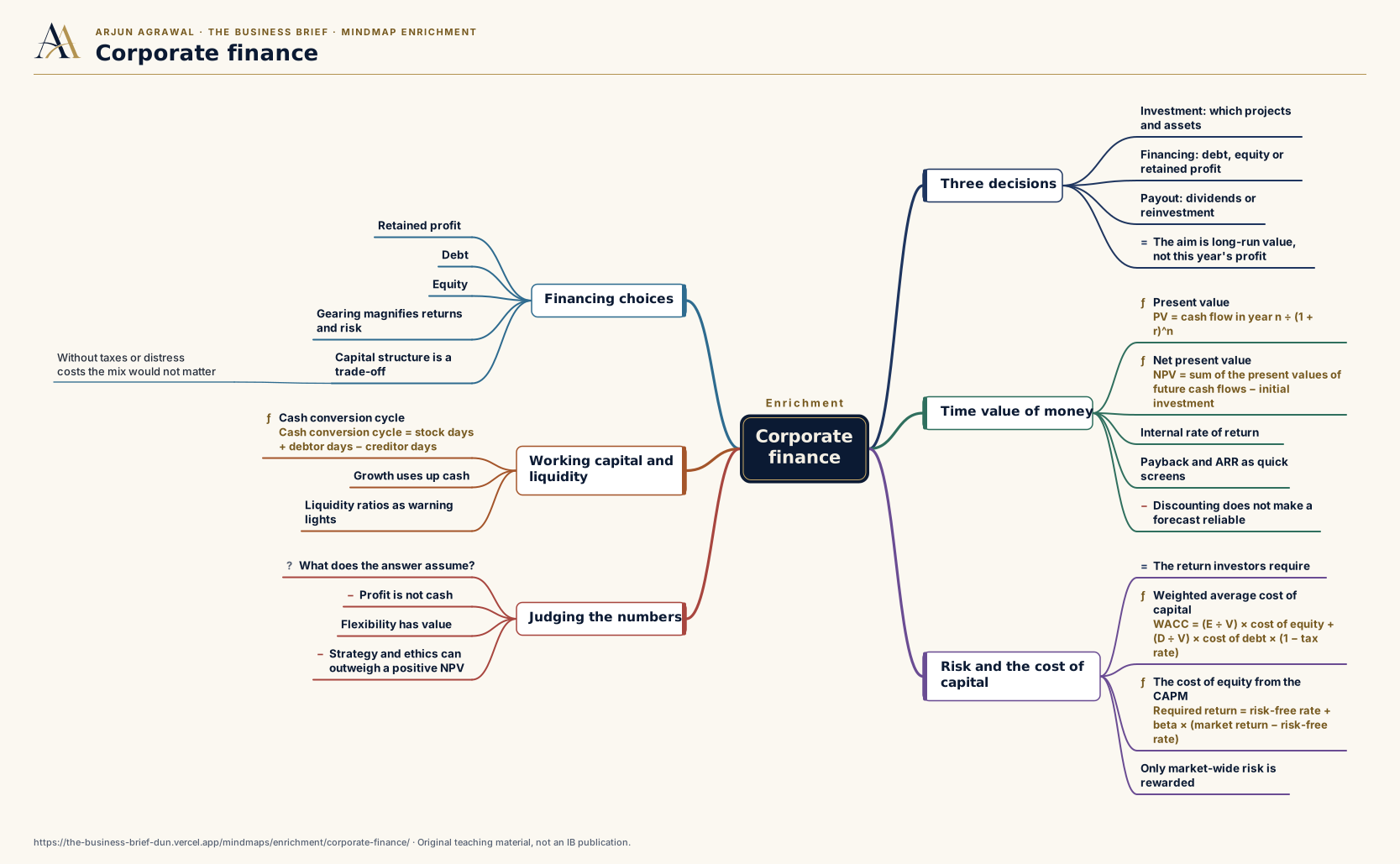
How a business decides which investments to make, how to pay for them and what to return to its owners, with the time value of money and risk at the centre of each decision.
Drag to move the map, or use the arrow keys. Click a branch to fold it away. Whole map shows all of it; zoom with the buttons, or with Ctrl and the scroll wheel.
- Core ideas
- Calculations
- Theories and models
- Types and forms
- Applications
- Evaluation
- Advantage
- Limitation
The map as an outline
Three decisions
Core ideas
- Investment: which projects and assets
- Financing: debt, equity or retained profit
- Payout: dividends or reinvestment
- Definition The aim is long-run value, not this year's profit Value depends on the size, timing and risk of future cash flows.
Time value of money
Calculations
- Formula Present value PV = cash flow in year n ÷ (1 + r)^n r is the discount rate. In the IB course the discount factors come from a table.
- Formula Net present value NPV = sum of the present values of future cash flows − initial investment The same idea as the IB's NPV (HL), with the rate set by the cost of capital.
- Internal rate of return The discount rate at which NPV is zero; a project passes if it beats the cost of capital.
- Payback and ARR as quick screens Payback ignores cash after the payback point; ARR ignores timing.
- Limitation Discounting does not make a forecast reliable Precise arithmetic on uncertain cash flows still gives an uncertain answer.
Risk and the cost of capital
Theories and models
- Definition The return investors require The cost of capital is the hurdle a project must clear; riskier projects face a higher one.
- Formula Weighted average cost of capital WACC = (E ÷ V) × cost of equity + (D ÷ V) × cost of debt × (1 − tax rate) E is equity, D is debt and V is E + D, each at market value.
- Formula The cost of equity from the CAPM Required return = risk-free rate + beta × (market return − risk-free rate) Beta measures how far a share tends to move with the market as a whole.
- Only market-wide risk is rewarded Investors can diversify away risks specific to one firm, so they are not paid to bear them.
Financing choices
Types and forms
- Retained profit No new owners or lenders, but it competes with dividends.
- Debt Interest is usually tax-deductible; repayments fall due whatever happens.
- Equity No fixed payments, but new owners share control and future profit.
- Gearing magnifies returns and risk The IB measures it against capital employed; many university texts use debt to equity.
- Capital structure is a trade-off Tax savings on debt against the costs of financial distress.
- Without taxes or distress costs the mix would not matter The starting point set out by Modigliani and Miller.
Working capital and liquidity
Applications
- Formula Cash conversion cycle Cash conversion cycle = stock days + debtor days − creditor days The days cash is tied up between paying suppliers and being paid by customers.
- Growth uses up cash More sales mean more stock and more debtors before more cash arrives.
- Liquidity ratios as warning lights
Judging the numbers
Evaluation
- Question What does the answer assume? Test growth, margins and the discount rate with sensitivity analysis.
- Limitation Profit is not cash Depreciation and credit sales separate the two.
- Flexibility has value Options to expand, delay or abandon later are worth something that NPV can miss.
- Limitation Strategy and ethics can outweigh a positive NPV
Download the full map as an SVG file Works without JavaScript; the buttons above also save the view you have open.
Section 01: Where it starts from the IB course
For readers who know the IB course: the subtopics this map builds on. The map goes further than any of them.
- 3.2 Sources of finance Internal and external sources of finance
- 3.5 Profitability and liquidity ratio analysis Profitability and liquidity ratios
- 3.6 Efficiency ratio analysis HL: the gearing ratio and efficiency ratios
- 3.7 Cash flow Cash flow and working capital
- 3.8 Investment appraisal Payback, ARR and, at HL, NPV
Section 02: Related enrichment maps
- Strategy formulation The options a valuation compares
- Corporate governance Who decides how profit is used
- Entrepreneurship and new ventures Financing before there are profits
Section 03: Terms on the map
Where an idea on the map is the same as a term in the platform's glossary, the node links to it. The glossary defines each term as the IB course uses it.
How this map was written
The platform's own summary of established finance ideas, written for the undergraduate and MBA pathways. It goes beyond the IB course and is aligned to no university course or textbook, because none was supplied. Formulas are given in standard forms. Ideas are named with the people usually credited with them; their works were not opened for this map.
- Business management guide, first assessment 2024 (published February 2022, updated May 2022), (2022) p. 64 to 66: The IB's own forms of gearing and NPV, and its discount table, for comparison. Supplied to the platform and read.
Arjun Agrawal | The Business Brief, https://the-business-brief-dun.vercel.app/mindmaps/enrichment/corporate-finance/. Original teaching material, not an IB publication. The organizations in the teaching cases are fictional unless a case says otherwise.