Enrichment map · Marketing · Beyond the IB course
Marketing strategy
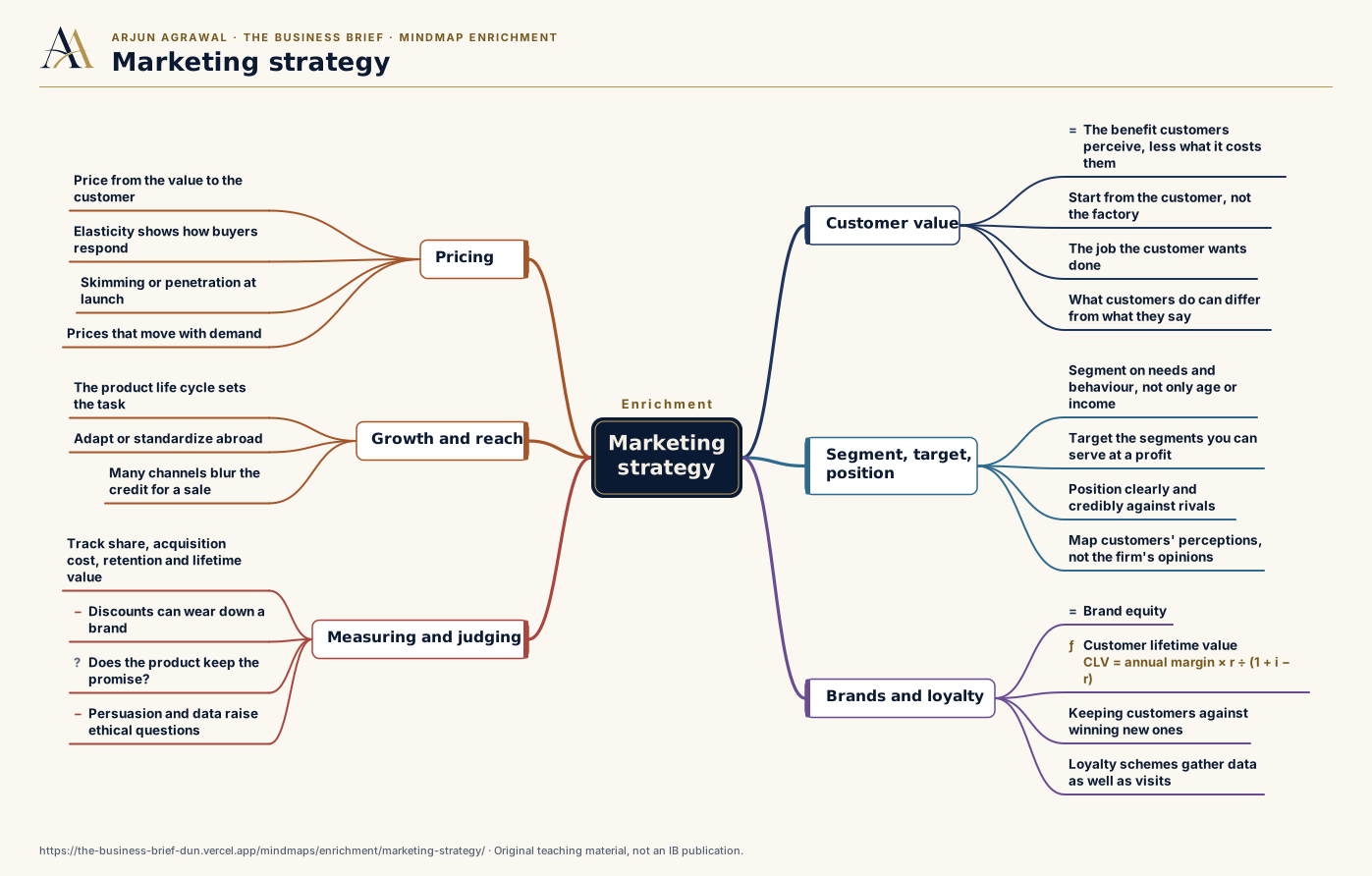
How an organization decides whom to serve, what value to promise and how to capture it, through customer insight, segmentation and positioning, brands and loyalty, pricing and measurement.
Drag to move the map, or use the arrow keys. Click a branch to fold it away. Whole map shows all of it; zoom with the buttons, or with Ctrl and the scroll wheel.
- Core ideas
- Types and forms
- Theories and models
- Applications
- Evaluation
- Advantage
- Limitation
The map as an outline
Customer value
Core ideas
- Definition The benefit customers perceive, less what it costs them The cost includes price, time, effort and risk.
- Start from the customer, not the factory
- The job the customer wants done Frame needs as the progress customers seek, not as product features.
- What customers do can differ from what they say Insight comes from behaviour as well as from surveys.
Segment, target, position
Types and forms
Brands and loyalty
Theories and models
- Definition Brand equity The value a brand adds: price premiums, loyalty and easier launches.
- Formula Customer lifetime value CLV = annual margin × r ÷ (1 + i − r) r is the yearly retention rate and i the discount rate; a simple form that assumes steady margins.
- Keeping customers against winning new ones Retention is often cheaper than acquisition, but that has to be measured, not assumed.
- Loyalty schemes gather data as well as visits
Pricing
Applications
- Price from the value to the customer Bounded by cost below and by rivals' offers.
- Elasticity shows how buyers respond
- Skimming or penetration at launch
- Prices that move with demand Efficient, but customers may judge them unfair.
Growth and reach
Applications
- The product life cycle sets the task
- Adapt or standardize abroad
- Many channels blur the credit for a sale With many touchpoints it is hard to say which campaign caused a purchase.
Measuring and judging
Evaluation
- Track share, acquisition cost, retention and lifetime value
- Limitation Discounts can wear down a brand Frequent promotions teach customers to wait for the next one.
- Question Does the product keep the promise? A position fails when the experience contradicts it.
- Limitation Persuasion and data raise ethical questions
Download the full map as an SVG file Works without JavaScript; the buttons above also save the view you have open.
Section 01: Where it starts from the IB course
For readers who know the IB course: the subtopics this map builds on. The map goes further than any of them.
- 4.1 Introduction to marketing Market orientation and the role of marketing
- 4.2 Marketing planning Segmentation, targeting and positioning
- 4.4 Market research Market research
- 4.5 The seven Ps of the marketing mix The product life cycle, branding and pricing
- 4.6 International marketing HL: marketing in other countries
Section 02: Related enrichment maps
- Strategy formulation Differentiation as a competitive position
- Sustainable business strategy Credible claims and greenwashing
Section 03: Terms on the map
Where an idea on the map is the same as a term in the platform's glossary, the node links to it. The glossary defines each term as the IB course uses it.
How this map was written
The platform's own summary of established marketing ideas, written for the undergraduate and MBA pathways. It goes beyond the IB course and is aligned to no university course or textbook, because none was supplied. The lifetime value formula is a standard simplified form.
Arjun Agrawal | The Business Brief, https://the-business-brief-dun.vercel.app/mindmaps/enrichment/marketing-strategy/. Original teaching material, not an IB publication. The organizations in the teaching cases are fictional unless a case says otherwise.