Enrichment map · People · Beyond the IB course
Organizational behaviour
How individuals, groups and the organization itself shape behaviour at work, from motivation and judgement to teams, power and culture, and what the evidence says a manager can change.
Drag to move the map, or use the arrow keys. Click a branch to fold it away. Whole map shows all of it; zoom with the buttons, or with Ctrl and the scroll wheel.
- Core ideas
- Theories and models
- Evaluation
- Advantage
- Limitation
The map as an outline
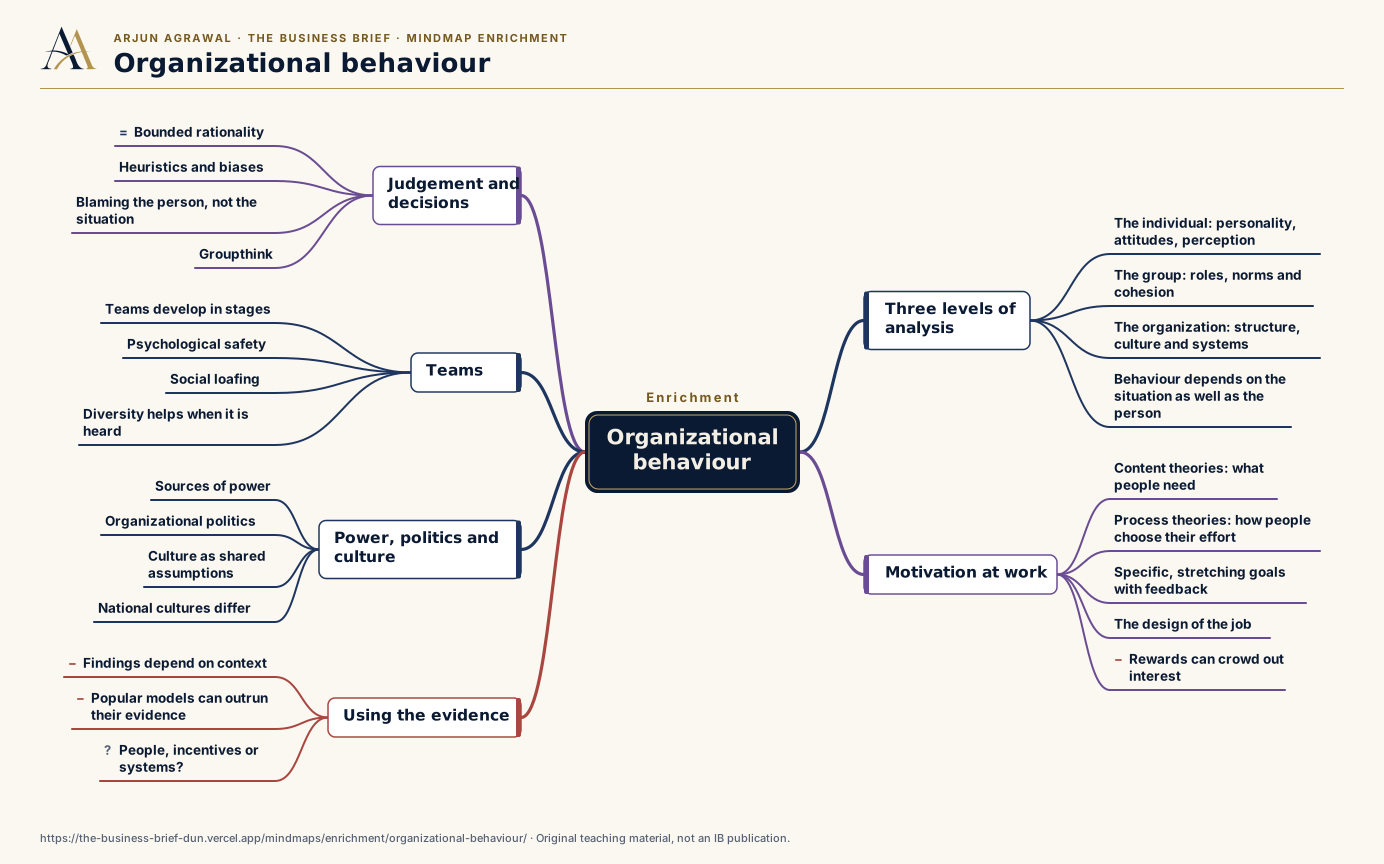
Three levels of analysis
Core ideas
- The individual: personality, attitudes, perception
- The group: roles, norms and cohesion
- The organization: structure, culture and systems
- Behaviour depends on the situation as well as the person Changing the system often works better than trying to change the people.
Motivation at work
Theories and models
- Content theories: what people need Maslow, Herzberg, McClelland, and self-determination theory.
- Process theories: how people choose their effort Expectancy theory and equity theory.
- Specific, stretching goals with feedback Goal-setting research (Locke and Latham) finds they raise performance when the goals are accepted.
- The design of the job Variety, a whole task, significance, autonomy and feedback (Hackman and Oldham).
- Limitation Rewards can crowd out interest Paying people for a task they enjoy can make it feel like work.
Judgement and decisions
Theories and models
- Definition Bounded rationality With limited time and information, people settle for good enough (Simon).
- Heuristics and biases Shortcuts such as anchoring and confirmation bias distort judgement (Kahneman and Tversky).
- Blaming the person, not the situation The fundamental attribution error.
- Groupthink Close groups suppress doubts; a devil's advocate and anonymous views help (Janis).
Teams
Core ideas
- Teams develop in stages Forming, storming, norming and performing (Tuckman).
- Psychological safety Teams learn faster when people can admit mistakes without fear (Edmondson).
- Social loafing Effort falls when no one can see each person's contribution.
- Diversity helps when it is heard Different views improve decisions only when the process lets them be voiced.
Power, politics and culture
Core ideas
- Sources of power Position, reward, coercion, expertise and personal appeal (French and Raven).
- Organizational politics Informal influence over scarce resources, harmful when it replaces open argument.
- Culture as shared assumptions Visible artefacts, stated values and taken-for-granted assumptions (Schein).
- National cultures differ
Using the evidence
Evaluation
- Limitation Findings depend on context A result from one country, sector or decade may not travel.
- Limitation Popular models can outrun their evidence Maslow's hierarchy is easy to teach but weakly supported by research.
- Question People, incentives or systems? Ask which of the three drives the behaviour before trying to change it.
Download the full map as an SVG file Works without JavaScript; the buttons above also save the view you have open.
Section 01: Where it starts from the IB course
For readers who know the IB course: the subtopics this map builds on. The map goes further than any of them.
- 2.3 Leadership and management Leadership styles and the situation
- 2.4 Motivation and demotivation Motivation theories and rewards
- 2.5 Organizational (corporate) culture HL: organizational culture
- 2.6 Communication Communication and its barriers
Section 02: Related enrichment maps
- Leading change Behaviour when the organization changes
- Corporate governance Incentives at the top
Section 03: Terms on the map
Where an idea on the map is the same as a term in the platform's glossary, the node links to it. The glossary defines each term as the IB course uses it.
How this map was written
The platform's own summary of established organizational behaviour, written for the undergraduate and MBA pathways. It goes beyond the IB course and is aligned to no university course or textbook, because none was supplied. Theories are named with the people usually credited with them; their works were not opened for this map.
Arjun Agrawal | The Business Brief, https://the-business-brief-dun.vercel.app/mindmaps/enrichment/organizational-behaviour/. Original teaching material, not an IB publication. The organizations in the teaching cases are fictional unless a case says otherwise.