Diagram · The business management toolkit · 1.3, 1.5
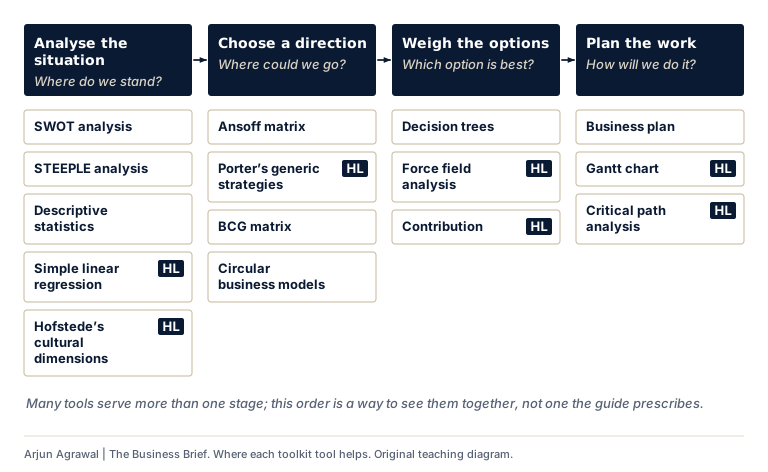
Where each toolkit tool helps
Point to a tool, or tab to it, to read the question it answers; select it to open the framework. On a touch screen, the first tap explains and the second opens.
Every part, explained
- SWOT analysis The question it answers: Where does the business stand before it decides, inside and out? SWOT analysis: the framework explained
- STEEPLE analysis The question it answers: What is changing outside the business that could affect this decision? STEEPLE analysis: the framework explained
- Descriptive statistics The question it answers: What does this data actually show, and how much does it vary? Descriptive statistics: the framework explained
- Simple linear regression (HL) The question it answers: How closely are these two things linked, and what might happen next? Simple linear regression: the framework explained
- Hofstede’s cultural dimensions (HL) The question it answers: How might this country’s culture change the way we manage, sell or negotiate here? Hofstede’s cultural dimensions: the framework explained
- Ansoff matrix The question it answers: Which route to growth suits this business, and how much risk does it carry? Ansoff matrix: the framework explained
- Porter’s generic strategies (HL) The question it answers: On what basis will we beat our competitors, and across how much of the market? Porter’s generic strategies: the framework explained
- BCG matrix The question it answers: Which of our products should we invest in, keep, rethink or let go? BCG matrix: the framework explained
- Circular business models The question it answers: How can the business earn more while using fewer new resources? Circular business models: the framework explained
- Decision trees The question it answers: Taking the risks into account, which option is likely to pay off best? Decision trees: the framework explained
- Force field analysis (HL) The question it answers: What is pushing for this change, what is holding it back, and which force should we work on? Force field analysis: the framework explained
- Contribution (HL) The question it answers: Does this decision add to profit once only the costs it changes are counted? Contribution: the framework explained
- Business plan The question it answers: Is this business idea viable, and can we convince others to back it? Business plan: the framework explained
- Gantt chart (HL) The question it answers: When does each task happen, and is the project on schedule? Gantt chart: the framework explained
- Critical path analysis (HL) The question it answers: How long will the project take, and which activities can we not afford to delay? Critical path analysis: the framework explained
Text description
The fifteen tools of the business management toolkit, placed at the stage of a strategic decision where each helps most. Analyse the situation (where do we stand): SWOT analysis; STEEPLE analysis; Descriptive statistics; Simple linear regression, HL only; Hofstede’s cultural dimensions, HL only. Choose a direction (where could we go): Ansoff matrix; Porter’s generic strategies, HL only; BCG matrix; Circular business models. Weigh the options (which option is best): Decision trees; Force field analysis, HL only; Contribution, HL only. Plan the work (how will we do it): Business plan; Gantt chart, HL only; Critical path analysis, HL only. Many tools serve more than one stage; the order is a way to see them together, not one the guide prescribes.
Section 01: Where it is used
- 1.3 Business objectives On the subtopic’s page, with its other diagrams
- 1.5 Growth and evolution On the subtopic’s page, with its other diagrams
Arjun Agrawal | The Business Brief, https://the-business-brief-dun.vercel.app/diagrams/toolkit-map/. Original teaching material, not an IB publication. The organizations in the teaching cases are fictional unless a case says otherwise.