Diagram · Unit 1 · 1.3, 1.2, 1.4
The triple bottom line
Point to a circle or an overlap, or tab to it, to read what it means; select it to open its subtopic. On a touch screen, the first tap explains and the second opens.
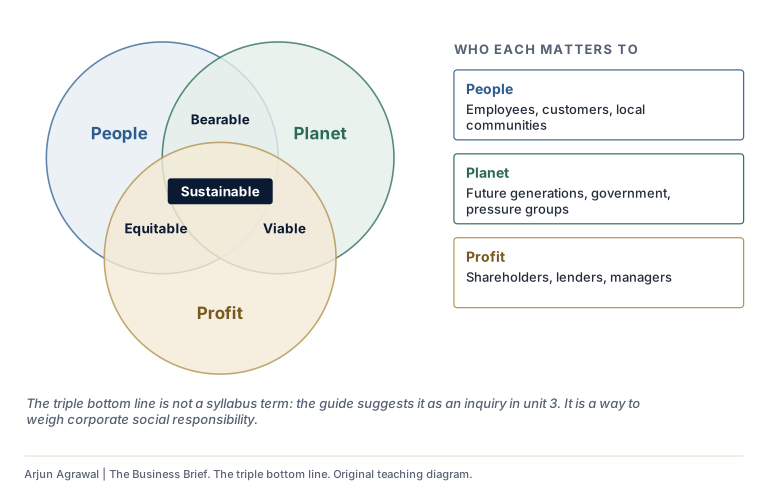
Every part, explained
- People The social bottom line: how the business treats its employees, its customers and the communities it touches, from fair pay and safe work to honest marketing. 1.4 Stakeholders
- Planet The environmental bottom line: the resources it uses and the waste and emissions it leaves, and whether its products can be reused, repaired or recycled. 5.3 Lean production and quality management
- Profit The economic bottom line: whether the business earns enough to survive, reward its owners and invest. Without it, nothing else lasts. 1.3 Business objectives
- Bearable People and planet without profit: good for society and the environment, but it depends on someone paying for it, so it may not last. 1.3 Business objectives
- Equitable People and profit without the planet: fair to people and profitable, but storing up environmental costs for later. 1.3 Business objectives
- Viable Planet and profit without people: efficient and green, but at a cost to workers or communities that can turn stakeholders against it. 1.4 Stakeholders
- Sustainable All three at once: the aim of corporate social responsibility. Few decisions reach it fully; the diagram helps to see which bottom line a decision neglects. 1.3 Business objectives
Text description
Three overlapping circles for the triple bottom line, the idea that a business should be judged on people, planet and profit, not on profit alone. People is the social bottom line: employees, customers and communities. Planet is the environmental bottom line: resources, waste and emissions. Profit is the economic bottom line: whether the business earns enough to survive and invest. Where two circles overlap without the third: people and planet is bearable, people and profit is equitable, and planet and profit is viable. Where all three overlap the business is sustainable, the aim of corporate social responsibility. Around the circles, the stakeholders each bottom line matters most to: employees, customers and local communities for people; future generations, the government and pressure groups for the planet; shareholders and lenders for profit. The guide does not name the triple bottom line as a syllabus term; it suggests it as an inquiry in unit 3, and it is a way to weigh corporate social responsibility (1.3).
Section 01: Where it is used
- 1.3 Business objectives On the subtopic’s page, with its other diagrams
- 1.2 Types of business entities On the subtopic’s page, with its other diagrams
- 1.4 Stakeholders On the subtopic’s page, with its other diagrams
Arjun Agrawal | The Business Brief, https://the-business-brief-dun.vercel.app/diagrams/triple-bottom-line/. Original teaching material, not an IB publication. The organizations in the teaching cases are fictional unless a case says otherwise.