Diagram · Unit 2 · 2.4

Taylor’s scientific management

SL and HL
Taylor’s scientific managementFive steps in a line: study the task through time and motion study, find the one best way to do it, select and train workers for it, pay them by output through piece rates, and so raise productivity. The limits: it treats money as the main motivator and work as simple repeated tasks, so work can become dull and controlled, quality may suffer under piece rates, and staff ideas are not used. Its methods live on in digital Taylorism.Study the task:time and motionFind the one bestwaySelect and trainworkers for itPay by output:piece ratesHigherproductivityScientific management (Frederick Taylor)LIMITSIt treats money as the main motivator and work as a set of simple, repeated tasks. Work can become dull andcontrolled, quality may suffer under piece rates, and staff ideas are not used. Its methods live on in digitalTaylorism, the close monitoring of work by data.
Taylor’s scientific managementFive steps in a line: study the task through time and motion study, find the one best way to do it, select and train workers for it, pay them by output through piece rates, and so raise productivity. The limits: it treats money as the main motivator and work as simple repeated tasks, so work can become dull and controlled, quality may suffer under piece rates, and staff ideas are not used. Its methods live on in digital Taylorism.1Study the task: time andmotion2Find the one best way3Select and train workers forit4Pay by output: piece rates5Higher productivityLimitsIt treats money as the mainmotivator and work as a set ofsimple, repeated tasks. Work canbecome dull and controlled, qualitymay suffer under piece rates, andstaff ideas are not used. Itsmethods live on in digitalTaylorism, the close monitoring ofwork by data.

Taylor’s scientific management The one best way, piece rates, and the limits of both.
Text description

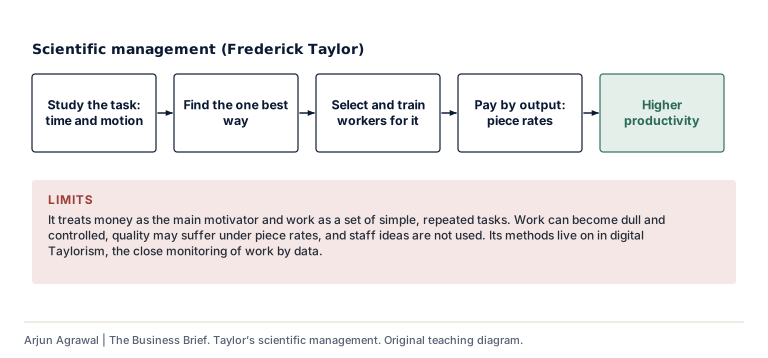
Five steps in a line: study the task through time and motion study, find the one best way to do it, select and train workers for it, pay them by output through piece rates, and so raise productivity. The limits: it treats money as the main motivator and work as simple repeated tasks, so work can become dull and controlled, quality may suffer under piece rates, and staff ideas are not used. Its methods live on in digital Taylorism.

Download SVG

Section 01: Where it is used