Home Diagrams One market, four ways to segment it Diagram · Unit 4 · 4.2
One market, four ways to segment it Choose a basis to regroup the same customers.
Segment the market by Demographic: age Geographic: where they live Psychographic: lifestyle Behavioural: how often they buy
Demographic: age
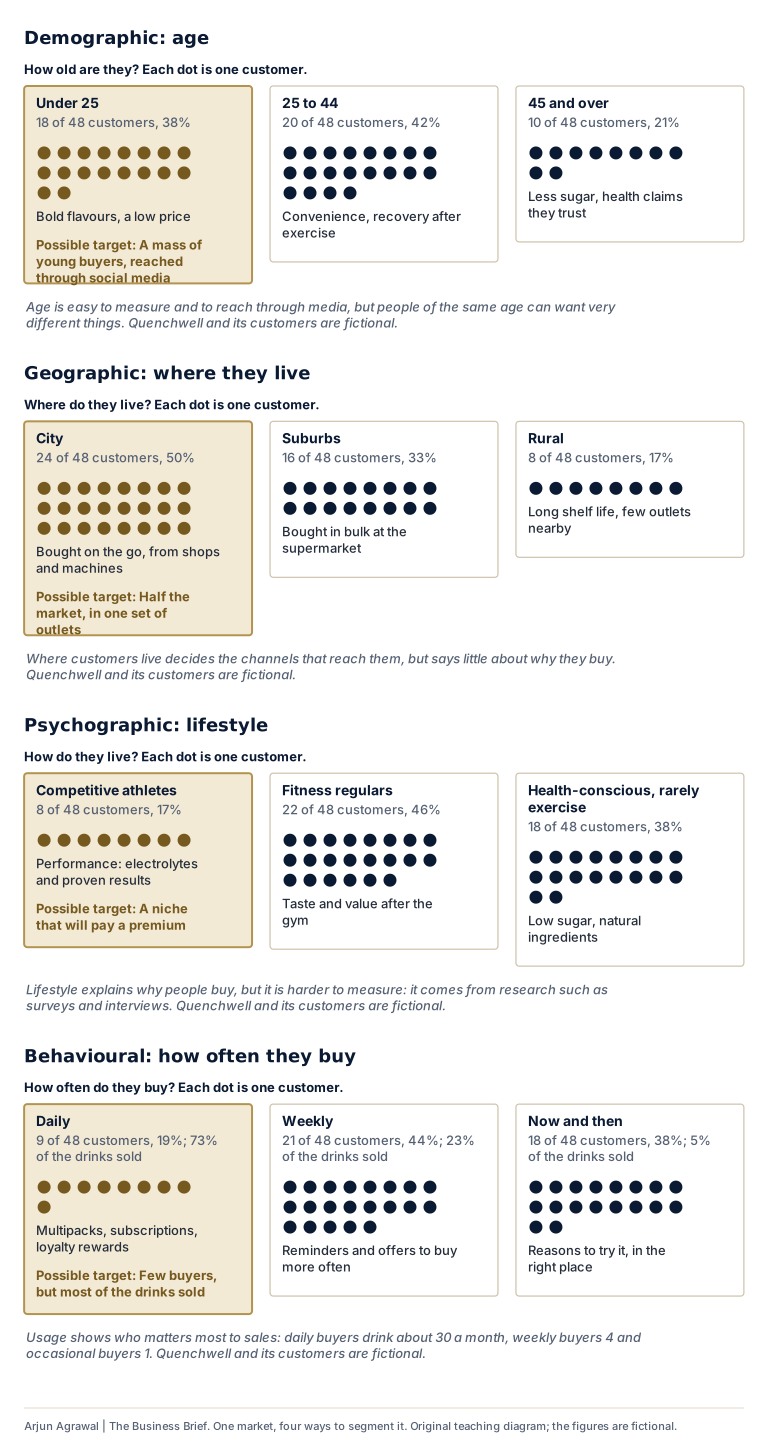
One market segmented by demographic: age. The same 48 fictional customers grouped into segments four ways: by age, by where they live, by lifestyle and by how often they buy, with one possible target segment marked for each. Quenchwell, a fictional maker of sports drinks, surveys 48 customers and groups them by demographic: age. Under 25: 18 customers, 38%, who want bold flavours, a low price; a possible target: a mass of young buyers, reached through social media. 25 to 44: 20 customers, 42%, who want convenience, recovery after exercise. 45 and over: 10 customers, 21%, who want less sugar, health claims they trust. Age is easy to measure and to reach through media, but people of the same age can want very different things. Under 25 18 of 48 customers, 38% Bold flavours, a low price Possible target: A mass of young buyers, reached through social media 25 to 44 20 of 48 customers, 42% Convenience, recovery after exercise 45 and over 10 of 48 customers, 21% Less sugar, health claims they trust How old are they? Each dot is one customer. Age is easy to measure and to reach through media, but people of the same age can want very different things. Quenchwell and its customers are fictional. One market segmented by demographic: age. The same 48 fictional customers grouped into segments four ways: by age, by where they live, by lifestyle and by how often they buy, with one possible target segment marked for each. Quenchwell, a fictional maker of sports drinks, surveys 48 customers and groups them by demographic: age. Under 25: 18 customers, 38%, who want bold flavours, a low price; a possible target: a mass of young buyers, reached through social media. 25 to 44: 20 customers, 42%, who want convenience, recovery after exercise. 45 and over: 10 customers, 21%, who want less sugar, health claims they trust. Age is easy to measure and to reach through media, but people of the same age can want very different things. How old are they? Each dot is one customer. Under 25: 18 (38%) Bold flavours, a low price Possible target: A mass of young buyers, reached through social media 25 to 44: 20 (42%) Convenience, recovery after exercise 45 and over: 10 (21%) Less sugar, health claims they trust Age is easy to measure and to reach through media, but people of the same age can want very different things.
Geographic: where they live
One market segmented by geographic: where they live. The same 48 fictional customers grouped into segments four ways: by age, by where they live, by lifestyle and by how often they buy, with one possible target segment marked for each. Quenchwell, a fictional maker of sports drinks, surveys 48 customers and groups them by geographic: where they live. City: 24 customers, 50%, who want bought on the go, from shops and machines; a possible target: half the market, in one set of outlets. Suburbs: 16 customers, 33%, who want bought in bulk at the supermarket. Rural: 8 customers, 17%, who want long shelf life, few outlets nearby. Where customers live decides the channels that reach them, but says little about why they buy. City 24 of 48 customers, 50% Bought on the go, from shops and machines Possible target: Half the market, in one set of outlets Suburbs 16 of 48 customers, 33% Bought in bulk at the supermarket Rural 8 of 48 customers, 17% Long shelf life, few outlets nearby Where do they live? Each dot is one customer. Where customers live decides the channels that reach them, but says little about why they buy. Quenchwell and its customers are fictional. One market segmented by geographic: where they live. The same 48 fictional customers grouped into segments four ways: by age, by where they live, by lifestyle and by how often they buy, with one possible target segment marked for each. Quenchwell, a fictional maker of sports drinks, surveys 48 customers and groups them by geographic: where they live. City: 24 customers, 50%, who want bought on the go, from shops and machines; a possible target: half the market, in one set of outlets. Suburbs: 16 customers, 33%, who want bought in bulk at the supermarket. Rural: 8 customers, 17%, who want long shelf life, few outlets nearby. Where customers live decides the channels that reach them, but says little about why they buy. Where do they live? Each dot is one customer. City: 24 (50%) Bought on the go, from shops and machines Possible target: Half the market, in one set of outlets Suburbs: 16 (33%) Bought in bulk at the supermarket Rural: 8 (17%) Long shelf life, few outlets nearby Where customers live decides the channels that reach them, but says little about why they buy.
Psychographic: lifestyle
One market segmented by psychographic: lifestyle. The same 48 fictional customers grouped into segments four ways: by age, by where they live, by lifestyle and by how often they buy, with one possible target segment marked for each. Quenchwell, a fictional maker of sports drinks, surveys 48 customers and groups them by psychographic: lifestyle. Competitive athletes: 8 customers, 17%, who want performance: electrolytes and proven results; a possible target: a niche that will pay a premium. Fitness regulars: 22 customers, 46%, who want taste and value after the gym. Health-conscious, rarely exercise: 18 customers, 38%, who want low sugar, natural ingredients. Lifestyle explains why people buy, but it is harder to measure: it comes from research such as surveys and interviews. Competitive athletes 8 of 48 customers, 17% Performance: electrolytes and proven results Possible target: A niche that will pay a premium Fitness regulars 22 of 48 customers, 46% Taste and value after the gym Health-conscious, rarely exercise 18 of 48 customers, 38% Low sugar, natural ingredients How do they live? Each dot is one customer. Lifestyle explains why people buy, but it is harder to measure: it comes from research such as surveys and interviews. Quenchwell and its customers are fictional. One market segmented by psychographic: lifestyle. The same 48 fictional customers grouped into segments four ways: by age, by where they live, by lifestyle and by how often they buy, with one possible target segment marked for each. Quenchwell, a fictional maker of sports drinks, surveys 48 customers and groups them by psychographic: lifestyle. Competitive athletes: 8 customers, 17%, who want performance: electrolytes and proven results; a possible target: a niche that will pay a premium. Fitness regulars: 22 customers, 46%, who want taste and value after the gym. Health-conscious, rarely exercise: 18 customers, 38%, who want low sugar, natural ingredients. Lifestyle explains why people buy, but it is harder to measure: it comes from research such as surveys and interviews. How do they live? Each dot is one customer. Competitive athletes: 8 (17%) Performance: electrolytes and proven results Possible target: A niche that will pay a premium Fitness regulars: 22 (46%) Taste and value after the gym Health-conscious, rarely exercise: 18 (38%) Low sugar, natural ingredients Lifestyle explains why people buy, but it is harder to measure: it comes from research such as surveys and interviews.
Behavioural: how often they buy
One market segmented by behavioural: how often they buy. The same 48 fictional customers grouped into segments four ways: by age, by where they live, by lifestyle and by how often they buy, with one possible target segment marked for each. Quenchwell, a fictional maker of sports drinks, surveys 48 customers and groups them by behavioural: how often they buy. Daily: 9 customers, 19%, buying 73% of the drinks, who want multipacks, subscriptions, loyalty rewards; a possible target: few buyers, but most of the drinks sold. Weekly: 21 customers, 44%, buying 23% of the drinks, who want reminders and offers to buy more often. Now and then: 18 customers, 38%, buying 5% of the drinks, who want reasons to try it, in the right place. Usage shows who matters most to sales: daily buyers drink about 30 a month, weekly buyers 4 and occasional buyers 1. Daily 9 of 48 customers, 19%; 73% of the drinks sold Multipacks, subscriptions, loyalty rewards Possible target: Few buyers, but most of the drinks sold Weekly 21 of 48 customers, 44%; 23% of the drinks sold Reminders and offers to buy more often Now and then 18 of 48 customers, 38%; 5% of the drinks sold Reasons to try it, in the right place How often do they buy? Each dot is one customer. Usage shows who matters most to sales: daily buyers drink about 30 a month, weekly buyers 4 and occasional buyers 1. Quenchwell and its customers are fictional. One market segmented by behavioural: how often they buy. The same 48 fictional customers grouped into segments four ways: by age, by where they live, by lifestyle and by how often they buy, with one possible target segment marked for each. Quenchwell, a fictional maker of sports drinks, surveys 48 customers and groups them by behavioural: how often they buy. Daily: 9 customers, 19%, buying 73% of the drinks, who want multipacks, subscriptions, loyalty rewards; a possible target: few buyers, but most of the drinks sold. Weekly: 21 customers, 44%, buying 23% of the drinks, who want reminders and offers to buy more often. Now and then: 18 customers, 38%, buying 5% of the drinks, who want reasons to try it, in the right place. Usage shows who matters most to sales: daily buyers drink about 30 a month, weekly buyers 4 and occasional buyers 1. How often do they buy? Each dot is one customer. Daily: 9 (19%), 73% of drinks Multipacks, subscriptions, loyalty rewards Possible target: Few buyers, but most of the drinks sold Weekly: 21 (44%), 23% of drinks Reminders and offers to buy more often Now and then: 18 (38%), 5% of drinks Reasons to try it, in the right place Usage shows who matters most to sales: daily buyers drink about 30 a month, weekly buyers 4 and occasional buyers 1.
One market, four ways to segment it The same 48 customers grouped by age, place, lifestyle and how often they buy: each basis suggests a different target. Text description Quenchwell, a fictional maker of sports drinks, surveys 48 customers and segments them four ways. Demographic: age: under 25 18, 25 to 44 20, 45 and over 10. Geographic: where they live: city 24, suburbs 16, rural 8. Psychographic: lifestyle: competitive athletes 8, fitness regulars 22, health-conscious, rarely exercise 18. Behavioural: how often they buy: daily 9, weekly 21, now and then 18. The same customers fall into different groups depending on the basis, and each basis suggests a different target.
Download SVG
Print
Arjun Agrawal | The Business Brief, https://the-business-brief-dun.vercel.app/diagrams/segmentation-map/. Original teaching material, not an IB publication.
The organizations in the teaching cases are fictional unless a case says otherwise.