Diagram · The business management toolkit · 2.5, 4.6

Hofstede’s cultural dimensions

HL only
Hofstede’s cultural dimensionsSix scales, each running between two poles. Power distance, low to high: how far people accept that power is shared unequally. Individualism versus collectivism: whether people look after themselves or their group first. Masculinity versus femininity: competition and achievement, or care and quality of life. Uncertainty avoidance, low to high: how uneasy people are with ambiguity and risk. Long-term orientation, short term to long term: tradition and quick results, or saving and persistence. Indulgence versus restraint: how freely people act on their wishes. Countries are scored on each dimension; the scores are national averages that describe tendencies, not individuals.Power distanceAcceptance of unequal powerLowHighIndividualismThe group first, or the selffirstCollectivismIndividualismMasculinityCare and quality of life, orachievementFemininityMasculinityUncertainty avoidanceUnease with ambiguity and riskLowHighLong-term orientationQuick results, or persistenceand savingShort termLong termIndulgenceHolding back, or acting freelyon wishesRestraintIndulgenceEach country is scoredon each dimension. Thescores are nationalaverages: theydescribe tendencies,not individuals, andthey change slowly.Businesses use them toadapt management,marketing andnegotiation acrosscultures.
Hofstede’s cultural dimensionsSix scales, each running between two poles. Power distance, low to high: how far people accept that power is shared unequally. Individualism versus collectivism: whether people look after themselves or their group first. Masculinity versus femininity: competition and achievement, or care and quality of life. Uncertainty avoidance, low to high: how uneasy people are with ambiguity and risk. Long-term orientation, short term to long term: tradition and quick results, or saving and persistence. Indulgence versus restraint: how freely people act on their wishes. Countries are scored on each dimension; the scores are national averages that describe tendencies, not individuals.Power distanceAcceptance of unequal powerLowHighIndividualismThe group first, or the self firstCollectivismIndividualismMasculinityCare and quality of life, orachievementFemininityMasculinityUncertainty avoidanceUnease with ambiguity and riskLowHighLong-term orientationQuick results, or persistence andsavingShort termLong termIndulgenceHolding back, or acting freely onwishesRestraintIndulgenceCountries are scored on each scale.The scores are national averages: theydescribe tendencies, not individuals.

Hofstede’s cultural dimensions HL Six scales for comparing national cultures.
Text description

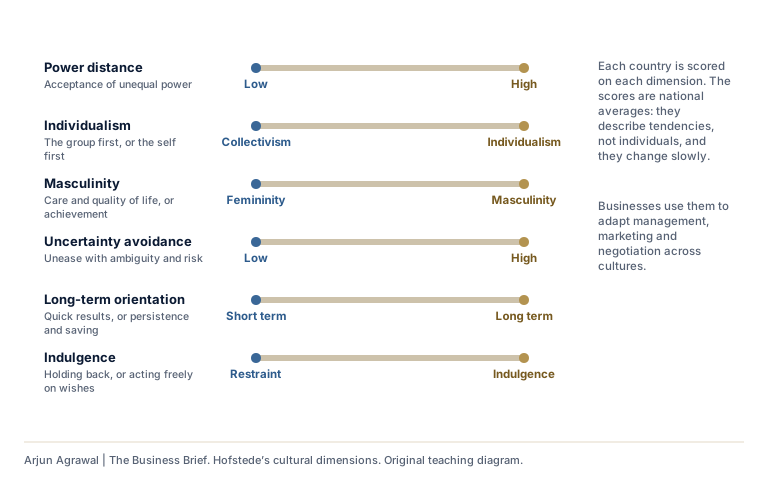
Six scales, each running between two poles. Power distance, low to high: how far people accept that power is shared unequally. Individualism versus collectivism: whether people look after themselves or their group first. Masculinity versus femininity: competition and achievement, or care and quality of life. Uncertainty avoidance, low to high: how uneasy people are with ambiguity and risk. Long-term orientation, short term to long term: tradition and quick results, or saving and persistence. Indulgence versus restraint: how freely people act on their wishes. Countries are scored on each dimension; the scores are national averages that describe tendencies, not individuals.

Download SVG

Section 01: Where it is used