Diagram · Unit 1 · 1.2, 1.5
How a business changes as it grows
Point to a stage, or tab to it, to read what changed; select it to open its subtopic. On a touch screen, the first tap explains and the second opens.
Every part, explained
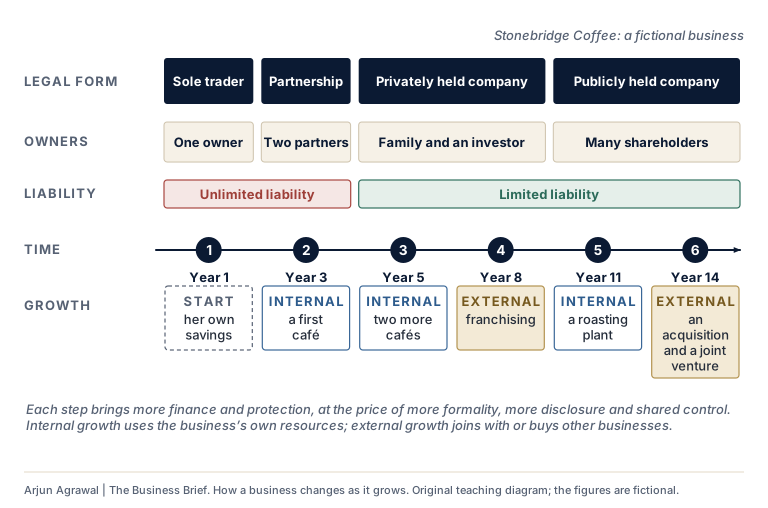
- Year 1: Sole trader. Start-up with her own savings Ana Silva roasts coffee and sells it from a market stall, using $6,000 of her own savings. She takes every decision and keeps all the profit, but has unlimited liability: if the business cannot pay its debts, her own savings and possessions can be claimed. 1.2 Types of business entities
- Year 3: Partnership. Internal growth: a first café A partner joins with $20,000 and the lease of a café. The partners share the profit and the decisions under a deed of partnership, and both still have unlimited liability. Opening the café is internal (organic) growth: the business grows from its own resources. 1.2 Types of business entities
- Year 5: Privately held company. Internal growth: two more cafés The partners form a company. It is a separate legal entity, so the owners have limited liability. They sell shares privately to family and a business angel, and add a bank loan and retained profit to open two more cafés: more internal growth. 1.5 Growth and evolution
- Year 8: Privately held company. External growth: franchising Other owners pay a fee and a share of their sales to open cafés under the Stonebridge brand. Franchising is external growth: the business spreads faster, using the franchisees’ capital, but has less control over each café. 1.5 Growth and evolution
- Year 11: Publicly held company. Internal growth: a roasting plant To pay for a large roasting plant, the company sells shares to the public on a stock exchange. It raises far more finance, but must publish its accounts, can be taken over, and is now owned by many shareholders and run by directors: ownership and control are divorced. 1.2 Types of business entities
- Year 14: Publicly held company. External growth: an acquisition and a joint venture It buys a coffee importer, which secures its supply of beans, and sets up a joint venture with a partner abroad to open cafés in a new country. Both are external growth: faster than building from scratch, but costly and harder to manage. 1.5 Growth and evolution
Text description
How a fictional business, Stonebridge Coffee, changes as it grows over fourteen years. Year 1: sole trader, owned by one owner, with unlimited liability; start-up with her own savings. Year 3: partnership, owned by two partners, with unlimited liability; internal growth: a first café. Year 5: privately held company, owned by family and an investor, with limited liability; internal growth: two more cafés. Year 8: privately held company, owned by family and an investor, with limited liability; external growth: franchising. Year 11: publicly held company, owned by many shareholders, with limited liability; internal growth: a roasting plant. Year 14: publicly held company, owned by many shareholders, with limited liability; external growth: an acquisition and a joint venture. Liability changes from unlimited to limited when the business becomes a company, the owners change from one person to many shareholders, and growth moves from internal steps to external methods such as franchising, an acquisition and a joint venture.
Section 01: Where it is used
- 1.2 Types of business entities On the subtopic’s page, with its other diagrams
- 1.5 Growth and evolution On the subtopic’s page, with its other diagrams
Arjun Agrawal | The Business Brief, https://the-business-brief-dun.vercel.app/diagrams/growth-timeline/. Original teaching material, not an IB publication. The organizations in the teaching cases are fictional unless a case says otherwise.