Diagram · Enrichment

Porter’s five forces

Beyond the IB course
Porter’s five forcesFive forces press on the profitability of an industry, with rivalry among existing competitors at the centre, shaped by the number and size of rivals, market growth, fixed costs and exit barriers. Around it: the threat of new entrants, which depends on barriers to entry such as scale, the capital needed, brand loyalty, regulation and access to channels; the bargaining power of suppliers, high when there are few suppliers, inputs with no substitute or high costs of switching; the bargaining power of buyers, high when buyers are few or large, products are standard and buyers are sensitive to price; and the threat of substitutes, other ways to meet the same need, judged by their price and performance. The stronger the forces, the less profit an average firm in the industry can expect to earn.Threat of new entrantsBarriers to entry: scale, capitalneeded, brand loyalty, regulation,access to channelsBargaining power ofsuppliersFew suppliers, inputs with nosubstitute, high costs ofswitching supplierBargaining power of buyersFew or large buyers, standardproducts, buyers who are sensitiveto priceThreat of substitutesOther ways to meet the same need,and how their price andperformance compareRivalry among existingcompetitorsNumber and size of rivals, marketgrowth, fixed costs, exit barriersThe stronger the forces, the less profit an average firm in the industry can expect to earn.
Porter’s five forcesFive forces press on the profitability of an industry, with rivalry among existing competitors at the centre, shaped by the number and size of rivals, market growth, fixed costs and exit barriers. Around it: the threat of new entrants, which depends on barriers to entry such as scale, the capital needed, brand loyalty, regulation and access to channels; the bargaining power of suppliers, high when there are few suppliers, inputs with no substitute or high costs of switching; the bargaining power of buyers, high when buyers are few or large, products are standard and buyers are sensitive to price; and the threat of substitutes, other ways to meet the same need, judged by their price and performance. The stronger the forces, the less profit an average firm in the industry can expect to earn.Rivalry among existingcompetitorsNumber and size of rivals, marketgrowth, fixed costs, exit barrierspressed on byThreat of new entrantsBarriers to entry: scale,capital needed, brand loyalty,regulation, access to channelsBargaining power of suppliersFew suppliers, inputs with nosubstitute, high costs ofswitching supplierBargaining power of buyersFew or large buyers, standardproducts, buyers who aresensitive to priceThreat of substitutesOther ways to meet the sameneed, and how their price andperformance compareThe stronger the forces, the lessprofit an average firm in the industrycan expect to earn.

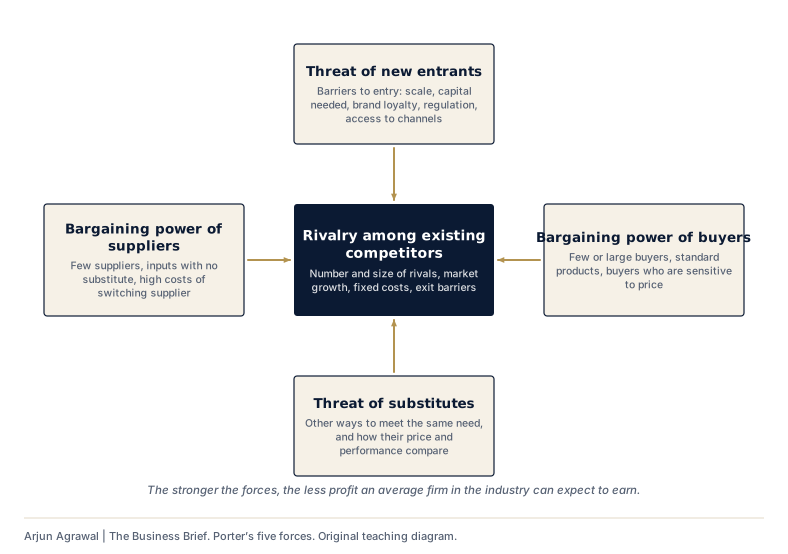
Porter’s five forces The five forces that shape how profitable an industry can be.
Text description

Five forces press on the profitability of an industry, with rivalry among existing competitors at the centre, shaped by the number and size of rivals, market growth, fixed costs and exit barriers. Around it: the threat of new entrants, which depends on barriers to entry such as scale, the capital needed, brand loyalty, regulation and access to channels; the bargaining power of suppliers, high when there are few suppliers, inputs with no substitute or high costs of switching; the bargaining power of buyers, high when buyers are few or large, products are standard and buyers are sensitive to price; and the threat of substitutes, other ways to meet the same need, judged by their price and performance. The stronger the forces, the less profit an average firm in the industry can expect to earn.

Download SVG

Section 01: Where it is used