Diagram · Enrichment

The value chain

Beyond the IB course
The value chainA business drawn as a chain of activities that together create value. Five primary activities run in order along the bottom: inbound logistics, receiving, storing and handling inputs; operations, turning inputs into the product or service; outbound logistics, storing and delivering to customers; marketing and sales, making customers aware and able to buy; and service, support after the sale such as installing, repairing and advising. Four support activities run across all of them above: firm infrastructure (management, planning, finance, legal and quality systems), human resource management, technology development (research, design, process improvement and IT) and procurement, buying the inputs every activity uses. At the end of the chain is the margin: what customers pay, less the cost of all the activities. An advantage comes from doing some activities more cheaply than rivals, or better in ways customers will pay for, and from how well they link.SUPPORT ACTIVITIESFirm infrastructureManagement, planning, finance, legal and quality systemsHuman resource managementRecruiting, training, rewarding and keeping peopleTechnology developmentResearch, design, process improvement and ITProcurementBuying the inputs that every activity usesPRIMARY ACTIVITIESInboundlogisticsReceiving, storingand handlinginputsOperationsTurning inputsinto the productor serviceOutboundlogisticsStoring anddelivering tocustomersMarketing andsalesMaking customersaware, and able tobuyServiceSupport after thesale: installing,repairing,advisingMarginwhat customerspay, less thecost of all theactivitiesEvery activity can add value or cost. An advantage comes from doing some of them more cheaply than rivals, or better inways customers will pay for, and from how well they link.
The value chainA business drawn as a chain of activities that together create value. Five primary activities run in order along the bottom: inbound logistics, receiving, storing and handling inputs; operations, turning inputs into the product or service; outbound logistics, storing and delivering to customers; marketing and sales, making customers aware and able to buy; and service, support after the sale such as installing, repairing and advising. Four support activities run across all of them above: firm infrastructure (management, planning, finance, legal and quality systems), human resource management, technology development (research, design, process improvement and IT) and procurement, buying the inputs every activity uses. At the end of the chain is the margin: what customers pay, less the cost of all the activities. An advantage comes from doing some activities more cheaply than rivals, or better in ways customers will pay for, and from how well they link.Support activities, across all theothersFirm infrastructureManagement, planning, finance,legal and quality systemsHuman resource managementRecruiting, training, rewarding andkeeping peopleTechnology developmentResearch, design, processimprovement and ITProcurementBuying the inputs that everyactivity usesPrimary activities, in order1Inbound logisticsReceiving, storing and handlinginputs2OperationsTurning inputs into the productor service3Outbound logisticsStoring and delivering tocustomers4Marketing and salesMaking customers aware, andable to buy5ServiceSupport after the sale:installing, repairing, advisingMarginWhat customers pay, less the costof all the activitiesAn advantage comes from doing someactivities more cheaply than rivals,or better in ways customers will payfor, and from how well they link.

The value chain Primary and support activities, and the margin they create.
Text description

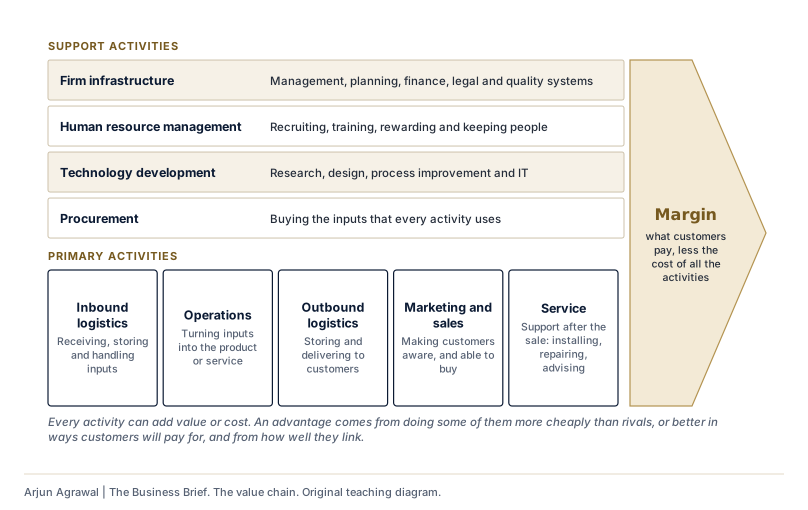
A business drawn as a chain of activities that together create value. Five primary activities run in order along the bottom: inbound logistics, receiving, storing and handling inputs; operations, turning inputs into the product or service; outbound logistics, storing and delivering to customers; marketing and sales, making customers aware and able to buy; and service, support after the sale such as installing, repairing and advising. Four support activities run across all of them above: firm infrastructure (management, planning, finance, legal and quality systems), human resource management, technology development (research, design, process improvement and IT) and procurement, buying the inputs every activity uses. At the end of the chain is the margin: what customers pay, less the cost of all the activities. An advantage comes from doing some activities more cheaply than rivals, or better in ways customers will pay for, and from how well they link.

Download SVG

Section 01: Where it is used