Diagram ยท Enrichment

The balanced scorecard

Beyond the IB course
The balanced scorecardFour perspectives around the vision and strategy, each with its own objectives and measures. Financial: how the business should appear to its owners, measured for example by return on capital employed and revenue growth. Customer: how customers should see it, measured by the repeat purchase rate and a satisfaction score. Internal processes: which processes it must excel at, measured by order lead time and the defect rate. Learning and growth: how its people and systems must develop, measured by training hours per employee and staff retention. Read upwards for cause and effect: people and systems improve processes, which win customers, which deliver the financial results.FinancialTo succeed financially, how should weappear to our owners?EXAMPLE MEASURESReturn on capital employed; revenue growthCustomerTo achieve our vision, how shouldcustomers see us?EXAMPLE MEASURESRepeat purchase rate; customersatisfaction scoreInternal processesTo satisfy customers, whichprocesses must we excel at?EXAMPLE MEASURESOrder lead time; defect rateLearning and growthTo keep improving, how must our people andsystems develop?EXAMPLE MEASURESTraining hours per employee; staffretentionVision and strategyRead upwards for cause and effect: people and systems improve processes, which win customers, which deliver the financial results.
The balanced scorecardFour perspectives around the vision and strategy, each with its own objectives and measures. Financial: how the business should appear to its owners, measured for example by return on capital employed and revenue growth. Customer: how customers should see it, measured by the repeat purchase rate and a satisfaction score. Internal processes: which processes it must excel at, measured by order lead time and the defect rate. Learning and growth: how its people and systems must develop, measured by training hours per employee and staff retention. Read upwards for cause and effect: people and systems improve processes, which win customers, which deliver the financial results.Vision and strategyEach perspective sets objectivesand measures for itFinancialTo succeed financially, how shouldwe appear to our owners? Measures:Return on capital employed; revenuegrowth.CustomerTo achieve our vision, how shouldcustomers see us? Measures: Repeatpurchase rate; customersatisfaction score.Internal processesTo satisfy customers, whichprocesses must we excel at?Measures: Order lead time; defectrate.Learning and growthTo keep improving, how must ourpeople and systems develop?Measures: Training hours peremployee; staff retention.Read upwards for cause and effect:people and systems improve processes,which win customers, which deliver thefinancial results.

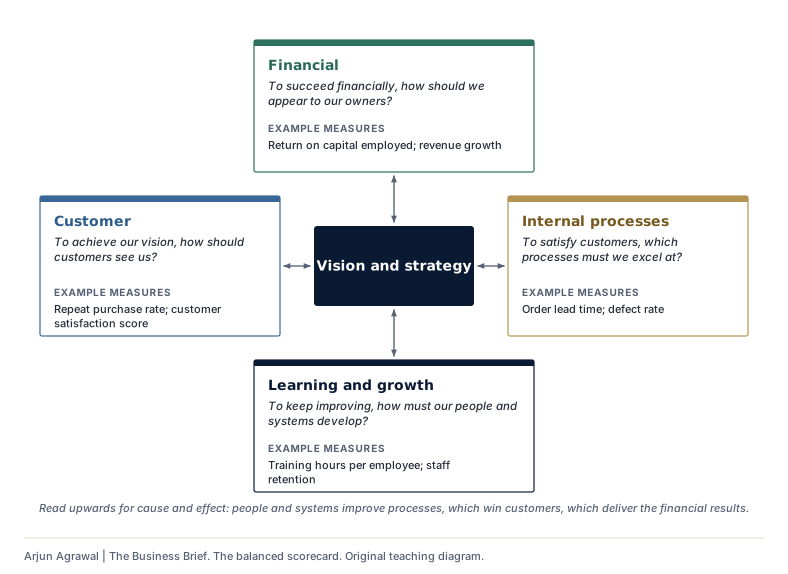
The balanced scorecard Four perspectives on performance, linked to the strategy.
Text description

Four perspectives around the vision and strategy, each with its own objectives and measures. Financial: how the business should appear to its owners, measured for example by return on capital employed and revenue growth. Customer: how customers should see it, measured by the repeat purchase rate and a satisfaction score. Internal processes: which processes it must excel at, measured by order lead time and the defect rate. Learning and growth: how its people and systems must develop, measured by training hours per employee and staff retention. Read upwards for cause and effect: people and systems improve processes, which win customers, which deliver the financial results.

Download SVG

Section 01: Where it is used