Diagram ยท Enrichment

The business model canvas

Beyond the IB course
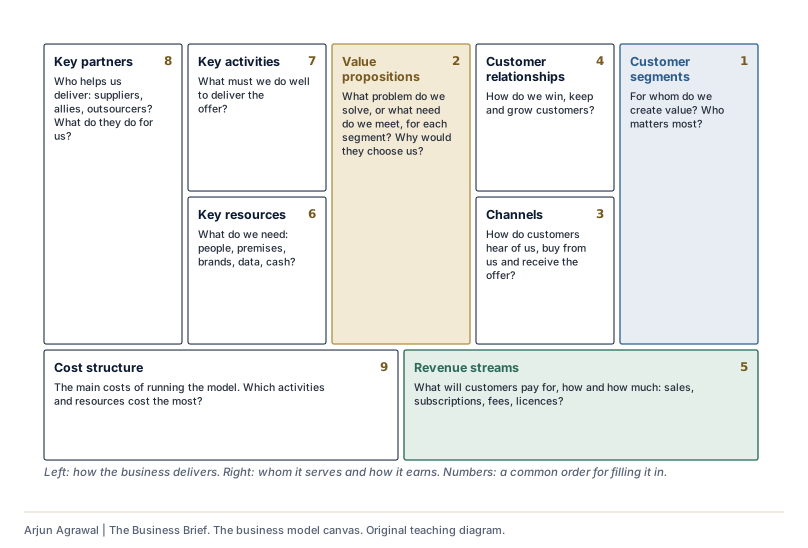
The business model canvasNine blocks on one page that describe how a business creates, delivers and captures value. In the middle, the value propositions: the problem it solves or the need it meets for each segment, and why customers would choose it. To the right, who it serves: customer relationships (how it wins, keeps and grows customers), channels (how customers hear of it, buy from it and receive the offer) and customer segments (for whom it creates value). To the left, how it delivers: key partners such as suppliers, allies and outsourcers, key activities it must do well, and key resources such as people, premises, brands, data and cash. Along the bottom, the cost structure, the main costs of running the model, and the revenue streams, what customers pay for, how and how much. Small numbers give a common order for filling it in: customer segments, value propositions, channels, customer relationships, revenue streams, key resources, key activities, key partners and the cost structure.Key partners8Who helps usdeliver: suppliers,allies, outsourcers?What do they do forus?Key activities7What must we do wellto deliver theoffer?Key resources6What do we need:people, premises,brands, data, cash?Valuepropositions2What problem do wesolve, or what needdo we meet, for eachsegment? Why wouldthey choose us?Customerrelationships4How do we win, keepand grow customers?Channels3How do customershear of us, buy fromus and receive theoffer?Customersegments1For whom do wecreate value? Whomatters most?Cost structure9The main costs of running the model. Which activitiesand resources cost the most?Revenue streams5What will customers pay for, how and how much: sales,subscriptions, fees, licences?Left: how the business delivers. Right: whom it serves and how it earns. Numbers: a common order for filling it in.
The business model canvasNine blocks on one page that describe how a business creates, delivers and captures value. In the middle, the value propositions: the problem it solves or the need it meets for each segment, and why customers would choose it. To the right, who it serves: customer relationships (how it wins, keeps and grows customers), channels (how customers hear of it, buy from it and receive the offer) and customer segments (for whom it creates value). To the left, how it delivers: key partners such as suppliers, allies and outsourcers, key activities it must do well, and key resources such as people, premises, brands, data and cash. Along the bottom, the cost structure, the main costs of running the model, and the revenue streams, what customers pay for, how and how much. Small numbers give a common order for filling it in: customer segments, value propositions, channels, customer relationships, revenue streams, key resources, key activities, key partners and the cost structure.Whom it serves, and how it earns1Customer segmentsFor whom do we create value?Who matters most?2Value propositionsWhat problem do we solve, orwhat need do we meet, for eachsegment? Why would they chooseus?3ChannelsHow do customers hear of us,buy from us and receive theoffer?4Customer relationshipsHow do we win, keep and growcustomers?5Revenue streamsWhat will customers pay for,how and how much: sales,subscriptions, fees, licences?How it delivers, and what it costs6Key resourcesWhat do we need: people,premises, brands, data, cash?7Key activitiesWhat must we do well to deliverthe offer?8Key partnersWho helps us deliver:suppliers, allies, outsourcers?What do they do for us?9Cost structureThe main costs of running themodel. Which activities andresources cost the most?Numbers: a common order for filling itin.

The business model canvas Nine blocks that describe how a business creates, delivers and captures value.
Text description

Nine blocks on one page that describe how a business creates, delivers and captures value. In the middle, the value propositions: the problem it solves or the need it meets for each segment, and why customers would choose it. To the right, who it serves: customer relationships (how it wins, keeps and grows customers), channels (how customers hear of it, buy from it and receive the offer) and customer segments (for whom it creates value). To the left, how it delivers: key partners such as suppliers, allies and outsourcers, key activities it must do well, and key resources such as people, premises, brands, data and cash. Along the bottom, the cost structure, the main costs of running the model, and the revenue streams, what customers pay for, how and how much. Small numbers give a common order for filling it in: customer segments, value propositions, channels, customer relationships, revenue streams, key resources, key activities, key partners and the cost structure.

Download SVG

Section 01: Where it is used