Diagram · Unit 2 · 2.6

The communication process

SL and HL
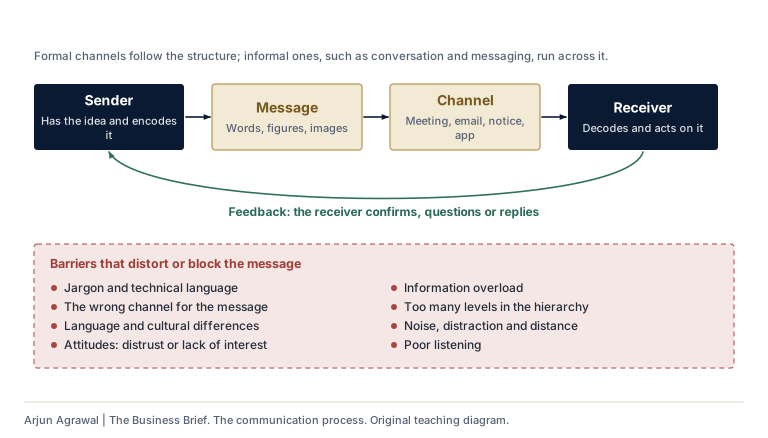
The communication process and its barriersA sender has an idea and encodes it as a message of words, figures or images, sent through a channel such as a meeting, email, notice or app, to a receiver who decodes and acts on it. Feedback flows back as the receiver confirms, questions or replies. Formal channels follow the structure; informal ones run across it. Barriers that distort or block the message include jargon, information overload, the wrong channel, too many levels in the hierarchy, language and cultural differences, noise and distance, distrust or lack of interest, and poor listening.SenderHas the idea and encodesitMessageWords, figures, imagesChannelMeeting, email, notice,appReceiverDecodes and acts on itFeedback: the receiver confirms, questions or repliesFormal channels follow the structure; informal ones, such as conversation and messaging, run across it.Barriers that distort or block the messageJargon and technical languageInformation overloadThe wrong channel for the messageToo many levels in the hierarchyLanguage and cultural differencesNoise, distraction and distanceAttitudes: distrust or lack of interestPoor listening

The communication process Sender, message, channel, receiver, feedback, and the barriers in between.
Text description

A sender has an idea and encodes it as a message of words, figures or images, sent through a channel such as a meeting, email, notice or app, to a receiver who decodes and acts on it. Feedback flows back as the receiver confirms, questions or replies. Formal channels follow the structure; informal ones run across it. Barriers that distort or block the message include jargon, information overload, the wrong channel, too many levels in the hierarchy, language and cultural differences, noise and distance, distrust or lack of interest, and poor listening.

Download SVG

Section 01: Where it is used