Diagram · The business management toolkit · 1.1

The anatomy of a business plan

SL and HL
The anatomy of a business planA business plan drawn as a document with eight sections: 1, an executive summary of the business, the opportunity and what is asked for, on one page; 2, the business, its aims, objectives, legal form and owners; 3, the market, its customers, size and competitors and the research behind them; 4, the marketing plan, product, price, promotion and place for the target market; 5, operations, premises, suppliers, production and location; 6, people, managers, staff, skills and structure; 7, finance, the costs, how they will be funded, forecasts of sales and cash flow, and break-even; 8, risks and the contingency plans. Beside it, its readers: the owners, who want a route and targets; lenders, who want evidence the loan can be repaid; investors, who want growth and a return; and staff and partners, who want to know where the business is going.Business plan01Executive summaryThe business, the opportunity and what is asked for, on one page02The businessIts aims, objectives, legal form and owners03The marketCustomers, size, competitors and the research behind them04Marketing planProduct, price, promotion and place for the target market05OperationsPremises, suppliers, production and location06PeopleManagers, staff, skills and structure07FinanceCosts, funding, sales and cash flow forecasts, break-even08RisksWhat could go wrong, and the contingency plansWHO READS IT, AND WHYThe ownersA route to follow and targets to checkprogress againstLendersEvidence the loan can be repaid: cashflow, profit, securityInvestorsGrowth, the return on their money, andthe people behind itStaff and partnersWhere the business is going, and theirpart in it
The anatomy of a business planA business plan drawn as a document with eight sections: 1, an executive summary of the business, the opportunity and what is asked for, on one page; 2, the business, its aims, objectives, legal form and owners; 3, the market, its customers, size and competitors and the research behind them; 4, the marketing plan, product, price, promotion and place for the target market; 5, operations, premises, suppliers, production and location; 6, people, managers, staff, skills and structure; 7, finance, the costs, how they will be funded, forecasts of sales and cash flow, and break-even; 8, risks and the contingency plans. Beside it, its readers: the owners, who want a route and targets; lenders, who want evidence the loan can be repaid; investors, who want growth and a return; and staff and partners, who want to know where the business is going.Its sections1Executive summaryThe business, the opportunityand what is asked for, on onepage2The businessIts aims, objectives, legalform and owners3The marketCustomers, size, competitorsand the research behind them4Marketing planProduct, price, promotion andplace for the target market5OperationsPremises, suppliers, productionand location6PeopleManagers, staff, skills andstructure7FinanceCosts, funding, sales and cashflow forecasts, break-even8RisksWhat could go wrong, and thecontingency plansWho reads it, and whyThe ownersA route to follow and targets tocheck progress againstLendersEvidence the loan can be repaid:cash flow, profit, securityInvestorsGrowth, the return on their money,and the people behind itStaff and partnersWhere the business is going, andtheir part in it

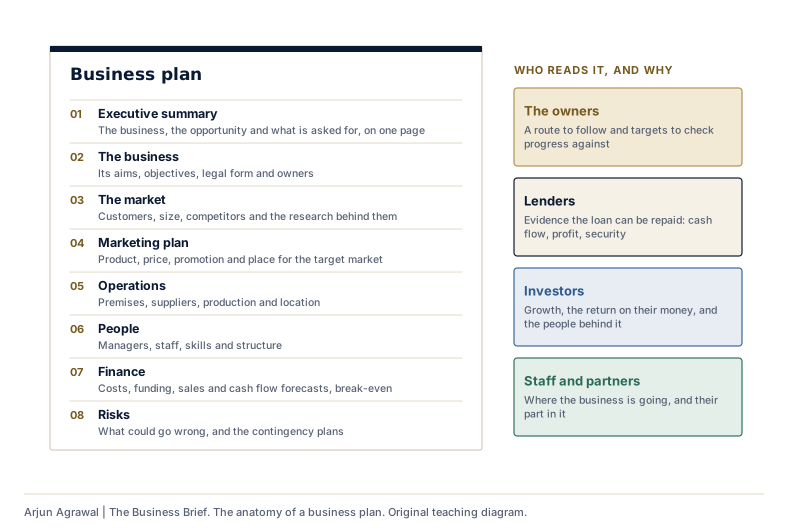
The anatomy of a business plan Its usual sections, and what each reader looks for.
Text description

A business plan drawn as a document with eight sections: 1, an executive summary of the business, the opportunity and what is asked for, on one page; 2, the business, its aims, objectives, legal form and owners; 3, the market, its customers, size and competitors and the research behind them; 4, the marketing plan, product, price, promotion and place for the target market; 5, operations, premises, suppliers, production and location; 6, people, managers, staff, skills and structure; 7, finance, the costs, how they will be funded, forecasts of sales and cash flow, and break-even; 8, risks and the contingency plans. Beside it, its readers: the owners, who want a route and targets; lenders, who want evidence the loan can be repaid; investors, who want growth and a return; and staff and partners, who want to know where the business is going.
Download SVG

Section 01: Where it is used