Diagram · Unit 4 · 4.6
International markets: opportunities and threats
Text description
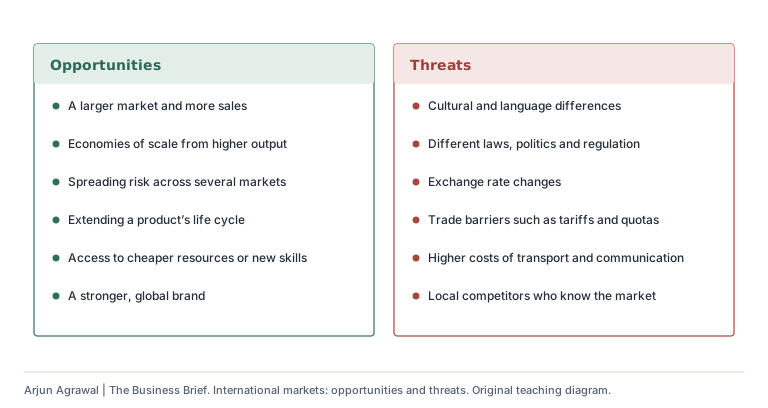
Two columns. Opportunities of entering and operating in international markets: a larger market and more sales, economies of scale, spreading risk across markets, extending a product’s life cycle, access to cheaper resources or new skills, and a stronger global brand. Threats: cultural and language differences, different laws, politics and regulation, exchange rate changes, trade barriers such as tariffs and quotas, higher costs of transport and communication, and local competitors who know the market.
Section 01: Where it is used
- 4.6 International marketing: The opportunities of entering and operating internationally In the notes, where it is taught
- 4.6 International marketing On the subtopic’s page, in its notes
Arjun Agrawal | The Business Brief, https://the-business-brief-dun.vercel.app/diagrams/international-marketing/. Original teaching material, not an IB publication. The organizations in the teaching cases are fictional unless a case says otherwise.